







Abstract
When fathers live away from their children, taking an active paternal role may become challenging and can add to paternal psychological distress. In a large (N = 3,980) diverse cohort, we found that nonresident fathers are more likely to be psychologically distressed than resident fathers (27.4% vs. 15.2%) and more likely to report wanting a change in the level of involvement they have in their child’s life (76.6% vs. 58.1%). Nonresident fathers were more likely to suffer economic hardship, unemployment, poor health, and have a depression and anxiety history (ps < .001). However, the factors associated with increased psychological distress were largely the same across resident and nonresident fathers. The biggest stressors were managing work alongside family responsibilities and commitments, arguments with the partner, prior history of depression, and economic hardship or deprivation. Fathers’ actual levels of involvement and desired levels of involvement with their child did not predict their psychological distress.
Meeting the expectations and demands of fatherhood can be challenging, and while it can entail a plethora of great rewards and highs, so too can it bring lows. The traditional breadwinner role of fathers is today combined with greater expectations of involvement in the day-to-day upbringing of their children (McLaughlin & Muldoon, 2014), creating new and potentially stressful challenges for some fathers. These challenges and stressors of fatherhood may increase one’s likelihood of experiencing psychological distress.
While the mental health of mothers has seen much investigation, paternal mental health remains a relatively underresearched domain (Underwood, Waldie, D’Souza, Peterson, & Morton, 2017; Underwood, Waldie, Peterson, et al., 2017; Waldie et al., 2015). Indeed, fathers are “a relatively recent addition to the developmental literature” (Burman, 1994, p. 94). While fathers are increasingly involved in childrearing and their impact on children’s development is increasingly acknowledged (Clarke-Stewart, 1982), their voice continues to be less heard. This is in part because, in most cases, mothers continue to be the primary caregiver and therefore the most convenient source of research information about the developing child and the family unit. The current study seeks to contribute to a growing literature that aims to better understand fathers and in particular fathers’ psychological distress. To do this, we have adopted an ecological framework that considers not only individual demographic factors but also family, work, and social support factors that may affect fathers. Importantly, we also consider fathers outside the traditional family unit, by including resident and nonresident fathers.
Research is increasingly highlighting the impact of poor paternal mental health on the well-being of their children. Such research (e.g., Kvalevaag et al., 2013; Ramchandani et al., 2008; Ramchandani & Psychogiou, 2009; Ramchandani, Stein, Evans, O’Connor, & ALSPAC Study Team, 2005) has demonstrated that paternal mental health problems are associated with emotional and behavioral problems in their children in later life, even when controlling for maternal mental health. These studies highlight the importance of going beyond maternal factors and considering the broader family unit (including nontraditional family units) in order to create a fuller picture of the factors that have the potential to influence child development.
Our focus on resident and nonresident partners is important because large percentages of families around the developed world are those comprising a single parent with children. While single-parent families as a percentage of total families in New Zealand has remained fairly constant over the past decade, single-parent families constitute almost one fifth of all families (Statistics New Zealand, 2014). An Organisation for Economic Co-operation and Development (2011) report, meanwhile, has shown that New Zealand has among the highest rates of single-parent households in the Organisation for Economic Co-operation and Development, and that globally, there is a large and increasing number of children growing up in single-parent families. As such, examining the dynamics of such households and the health of parents who live away from their children is an increasingly important task (Statistics New Zealand, 2014). As women are the main child caregivers in the vast majority of these households, the high frequency of men living away from their children (whether it be due to the parental relationship breakdown or for work) may introduce novel challenges for parents and have potential impacts on their children.
While research on nonresident parents is lacking, several studies support the hypothesis that living away from one’s children increases the likelihood of men experiencing psychological distress. For example, a longitudinal study of the occurrence and correlates of psychological distress among approximately 3,000 Australian fathers of children aged 0 to 5 years (Giallo et al., 2012) found that nonresident fathers were potentially more likely to experience psychological distress compared with fathers who resided with their children (13.8% nonresident vs. 9.8% resident). However, a small sample of nonresident fathers (n = 90 at Wave 2 when the children were 2-3 years old, 255 at Wave 3 when the children were 4-5 years old), low response rates, and wide confidence intervals (CIs) in the nonresident group meant that statistical significance of this could not be reliably determined.
Another longitudinal study of 2,716 fathers of newborns in the United States investigated major depression among fathers according to their relationship status with the mother of their child (Huang & Warner, 2005). Results suggested that fathers who were not in a romantic relationship with the mother of their child (n = 146), and fathers who are romantically involved but not living with the mother (n = 612), were more likely to experience a major depressive episode compared with fathers married or cohabitating with the mother of their child. The increased risk of depression among those fathers not romantically involved with the mother held when socioeconomic status and other background variables were was controlled for. Not being romantically involved with the mother of their child may introduce additional impediments to being a father, for example, reducing the amount of time a father can spend with their child, and so contribute to psychological distress.
In New Zealand, cross-sectional data on 498 fathers showed that those who did not live with their child all of the time (n = 54) reported more mental health problems (Jaffee, Caspi, Moffitt, Taylor, & Dickson, 2001) than those who live with their child all of the time. These fathers reported a higher number of symptoms of anxiety and experienced more time disabled by mental health problems. However, problems such as these could have preceded their nonresident fatherhood, and may have contributed to their living away from their children. Indeed, these fathers also reported more behavioral problems, and were worse off economically, problems that could plausibly reduce the likelihood of them living with their children in the first place.
Finally, a cross-sectional study in the United States compared 155 divorced fathers with 812 married fathers in their experience of psychological distress and parental role strain (Umberson & Williams, 1993). Divorced fathers had higher rates of psychological distress and lower parental role satisfaction, with the lower satisfaction mediating the relationship between divorce and psychological distress.
It is highly plausible that a father’s divorce or separation from the mother of their child and subsequent living away from their child may introduce additional strain in being a parent, which may, in turn, increase the likelihood of experiencing high levels of psychological distress. Similarly, a father’s involvement in their child’s life may decrease the likelihood of them experiencing psychological distress. Support for this idea comes from a study of 2,139 fathers in cities across the United States, which found that father–child activities were negatively associated with paternal depression (Bronte-Tinkew, Moore, Matthews, & Carrano, 2007). While decreased father–child involvement could result from a father being psychologically distressed, it may also be that not being involved in their child’s life also contributes to lower satisfaction and self-efficacy in being a parent. Subsequently, an uninvolved father may be more likely to experience psychological distress.
The lack of research into differences between resident and nonresident fathers warrants further investigation. Associations between nonresidence and psychological distress in fathers could be confounded by common risk factors for psychological distress and father’s nonresidence. It may be that unique risk factors for psychological distress exist for nonresident fathers, or simply that they experience the same risk factors as resident fathers but to a greater degree. A father’s nonresidence could constitute a risk factor in and of itself for psychological distress if it operates independently of characteristics that may have contributed to a father’s nonresidence in the first place. Low parental self-efficacy and satisfaction, for example, have been shown to increase the risks of experiencing psychological distress (Seymour, Dunning, Cooklin, & Giallo, 2014; Umberson & Williams, 1993), and nonresidence could exert a direct impact on parental self-efficacy.
Other factors, however, may both increase the risks of experiencing psychological distress and lead to a father living away from their child. For example, poor relationship quality with the mother of the child has been found to be a risk factor for psychological distress, which could lead fathers to living apart from their child as well as increasing their risks of psychological distress.
In addition to a father’s residing or not with their child, several other factors may influence the risk of a father experiencing psychological distress. For example, unemployment or undesirable work conditions (Bronte-Tinkew et al., 2007; Cooklin et al., 2015; Giallo et al., 2013), dissatisfaction in relationships (Bronte-Tinkew et al., 2007; Giallo et al., 2013; Giallo, D’Esposito, Cooklin, Christensen, & Nicholson, 2014), low parental self-efficacy (Giallo et al., 2013; Seymour et al., 2014) and satisfaction (Umberson & Williams, 1993), financial strain (Krynen, Osborne, Duck, Houkamau, & Sibley, 2013; Lorant et al., 2007; Marko, Linder, Tullar, Reynold, & Estes, 2015), history of mental or physical health issues (Marko et al., 2015; Ramchandani et al., 2008; Shih & Simon, 2008), lower education levels (Oakley Browne, Wells, Scott, & McGee, 2010; Ramchandani et al., 2008), and having other children in the household (Marko et al., 2015) have all been shown to predict psychological distress.
Knowledge of the risk factors of psychological distress for resident and nonresident fathers is vitally important to facilitate the identification and assistance of fathers who are experiencing psychological distress, both to their benefit and to that of their children. Several studies have shown that paternal mental health problems have deleterious impacts not only on the father but can also harm the father–child relationship and increase the risks of poor outcomes for children (Bronte-Tinkew et al., 2007; Giallo, Cooklin, Wade, D’Esposito, & Nicholson, 2014; Wilson & Durbin, 2010).
The aim of the present study is to examine differences between resident and nonresident fathers in their likelihood of experiencing psychological distress, and to identify the risk factors for both. It is expected that nonresident participants will be more likely to report psychological distress than resident participants, and that psychological distress in participants will be associated with the risk factors mentioned above. Additionally, it is expected that nonresident participants will be more likely to report lower parental self-efficacy due to potentially reduced opportunities to grow their parenting confidence), and this may also be associated with a greater likelihood of reporting psychological distress. Identifying common risk factors for psychological distress could help facilitate the identification and support of fathers who are most likely to experience psychological distress and, in doing so, may improve both their lives and the lives of their children.
Method
This study uses data collected within the Who Are Today’s Dads? project, which is an adjunct project to the Growing Up in New Zealand longitudinal birth cohort study. The child cohort consists of approximately 7,000 children recruited during their mothers’ pregnancy with a due date between April 2009 and March 2010. The child cohort is broadly generalizable to all New Zealand births, specifically with respect to ethnicity and socioeconomic status (Morton et al., 2013; Morton et al., 2015). When the cohort children were 6 years old the Who Are Today’s Dads? project was started. This data collection wave used an online survey to collect questionnaire data from the fathers of the Growing Up in New Zealand child cohort.
Recruitment
During the antenatal data collection wave for Growing Up in New Zealand, 4,401 partners of the cohort children’s mothers consented and completed a face-to-face interview (their characteristics are described elsewhere; Pryor, Morton, Bandara, Robinson, & Grant, 2015). When the children were 4 years old, their mothers (n = 6,639) were asked to supply updated contact details of the child’s father or another person who has a father-like role in the child’s life for the purpose of inviting these individuals to take part in Who Are Today’s Dads. Mothers were also asked if their current partner was the same partner from the antenatal period. With the addition of new partners and father figures, contact details of 5,716 “fathers” were obtained. In this article, we refer to these participants as “fathers” while recognizing that not all participants were male or the biological fathers of the children.
Participants
A total of 5,716 father participants were invited by e-mail to take part in the Who Are Today’s Dads? project. In total, from August 2015 to March 2016, 4,121 participants completed the electronic questionnaire and were included in analyses (response rate 72.1%). Although data were predominantly collected via an Internet-based questionnaire, data from 250 (6.1%) participants were obtained via a computer-assisted telephone interview (n = 66 did not have an e-mail address and n = 184 requested assistance in completing the questionnaire).
Of the 4,121 participants, 140 (3.3%) were excluded from further analyses due to not completing the Kessler-6 items (the psychological distress scale that is the main outcome of this study). This resulted in a final sample of 3,980 participants.
Demographic characteristics of the participants are presented in Table 1. The majority of participants were aged between 30 and 49 years (86.3%), had one or two children in addition to their Growing Up in New Zealand study child (69.2%), and were born in New Zealand (68.9%). With respect to ethnicity, 63.6% identified as European, 8.7% as Māori, 9.4% as Pacific Peoples, and 7.5% as Other. A total of 289 fathers (7.3%) were identified as nonresident. The majority of fathers (over 90%) were the biological father of the child, and over 70% were the same partner from the antenatal period. Most of the fathers also grew up with their own biological father.
Demographic Characteristics of All Resident and Nonresident Participants (%).
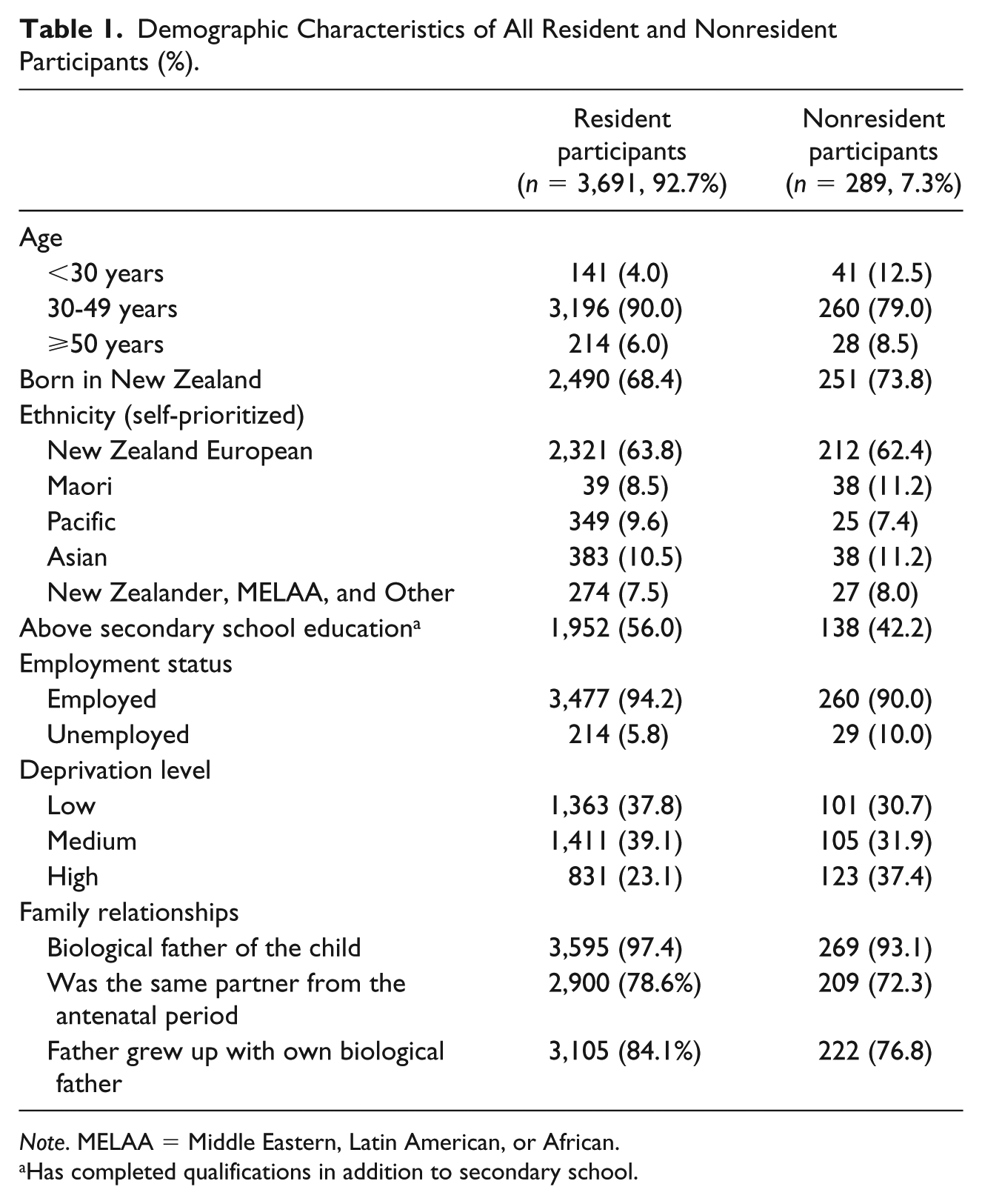
Note. MELAA = Middle Eastern, Latin American, or African.
Has completed qualifications in addition to secondary school.
Measures
The measures used in this study consisted of a number of short scales and single-item questions. Unless otherwise stated below, the single-item questions were designed for the Growing Up in New Zealand study or were taken from the New Zealand Census Questionnaires.
Father Demographics
Participants were asked to select their main ethnic group to which they identify. This was categorized into the following categories: European; Māori; Pacific Peoples; Asian; and Middle Eastern, Latin American or African, New Zealander and Other. They were also asked to state their age, which was categorized as follows: <30 years, 30-49 years, and ⩾50 years old; their employment status (employed/not unemployed); and if they grew up with a father figure in their own lives (yes/no).
Several paternal socioeconomic status variables were also used, consisting of father’s highest level of education (categorized into “secondary school or lower” or “higher than secondary school.”
The New Zealand Deprivation (NZDep 2006) Index (Salmond, Crampton, King, & Waldegrave, 2006) combines nine socioeconomic variables from the 2006 census capturing eight dimensions of deprivation at the small area level. The original deprivation scores (measured in deciles) were collapsed into three groups: Low (Deciles 1-3), Medium (Deciles 4-7), and high (Deciles 8-10).
Economic hardship was measured using a 6-item scale (yes/no), for example, “In the last 12 months have you personally put up with feeling cold to save heating costs.” The items were categorized into four quartiles of increasing levels of hardship according to the sum score. The items were taken from the New Zealand Index of Deprivation (Salmond et al., 2006).
Self-reported paternal health was measured on a 5-point Likert-type scale, 1 (excellent) to 5 (poor) and categorized into “excellent to good” and “fair to poor.” Self-reported lifetime prevalence of depression and anxiety and/or panic attacks were measured by asking participants if they had ever been diagnosed with and/or treated for depression or anxiety and/or panic attacks by a doctor (yes/no).
Resident and Nonresident Fathers
Fathers were also categorized into “resident participants” (living with the cohort child all the time, 7 days a week or almost all the time or almost every day) and “nonresident participants” (living half and half or less than half of the week with the cohort child) regardless of the reason why.
Kessler-6
Psychological distress was measured using the Kessler-6, a six item screening tool which has been validated worldwide and is suggested as a useful tool for population studies to screen for psychological distress due to its accuracy and brevity (Kessler et al., 2003; Kessler et al., 2010). Items include “In the past four weeks, how often have you felt nervous.” Responses to the six items were coded 1 (never or almost never) to 5 (always or almost always), resulting in sum scores ranging from 6 to 30. Previous research has used total scores of 14 to 18 to indicate symptomatic or moderate distress, and scores of 19 and above to indicate clinical or severe distress (Giallo et al., 2012; Krynen et al., 2013). In the current study, we used scores of 14 and above to indicate moderate to severe psychological distress. Cronbach’s α for the Kessler-6 in our sample was .84.
Work–Life Balance
The work–family conflict subscale from the Combining Work and Family scale was used. This scale has been used in multiple waves of the Growing Up in Australia: Longitudinal Study of Australian Children to assess “spillover” between work and family in both directions (i.e., from work to home and from home to work), for example, “Work leaves me with too little time or energy to be the kind of parent I want to be.” The scale consists of three item measured on a 5-point Likert-type scale: 1 (strongly disagree) to 5 (strongly agree). A sum score was calculated and formed quartiles of ascending work–family conflict.
Parental Involvement With Their Child and Parenting Efficacy
A total of 14 items designed for use in the GUiNZ study asked how often participants participated in their child’s day-to-day care, in learning, and in school activities (including, going on school trips, serving on school committees, coaching teams, etc.). Responses were made on a Likert-type scale: 1 (never or almost never) to 5 (always or almost always). Sum scores were calculated and formed quartiles of increasing involvement.
Participants were also asked how much involvement they ideally would like to have with their child, measured on a5-point Likert-type scale: 1 (a lot more involved) to 5 (a lot less involved). Responses to this item formed a dichotomous variable on whether change was desired in their level of involvement.
Participants’ overall perception of their own parental self-efficacy was measured on a 5-point Likert-type scale: 1 (a very good parent) to 5 (not very good at being a parent). Scores were then categorized into “a better than average to very good parent” and “an average or below average parent.”
Relationship Measures
We asked a single-item question about the father’s relationship status (partner/single). Participants in a relationship with the mother were also asked three questions about the climate of conflict in their relationship, for example, “How often do you and your partner argue?” Responses were measured on a 5-point Likert-type scale ranging from 1 (never or almost never) to 5 (always or almost always). The items were taken from the Verbal Conflict scale, which was developed for the New Zealand Resilience in Step Families Study (Pryor, 2004). Sum scores formed quartiles of increasing conflict in the relationship.
External Support
This scale was adapted from the widely used family support scale (Dunst, Jenkins, & Trivette, 1984). We extracted five items assessing how often various external agents (e.g., support agencies, parenting classes, or online support groups) acted as sources of support for participants. The degree of external support was measured using a 5-point Likert-type scale ranging from 1 (never or almost never) to (always or almost always). A sum score was calculated, which then formed quartiles of descending external support access.
Data Analysis
Univariate chi-square analyses were initially conducted to identify statistically significant predictors of psychological distress in resident and nonresident participants. Factors that were found to be significant at an alpha level of .05 were simultaneously entered into separate binary logistic regressions with listwise deletions for the resident and nonresident participants.
Results
Differences Between Resident and Nonresident Participants
We found several significant differences between resident and nonresident participants. First, univariate analysis revealed that nonresident participants were significantly more likely to report psychological distress (27.4% vs. 15.2%, χ2[1] = 33.43, p < .001) and more likely to report medium and high levels of economic hardship (31.1% vs. 19.9%, χ2[1] = 20.80, p < .001). Nonresident participants were more likely to be unemployed than resident participants (10.3% vs. 5.6%, χ2[1] = 14.80, p < .001), have no partner (41.2% vs. <1%, χ2[1] = 1292.08, p < .001) and less likely to have a higher than secondary school qualification (42.2% vs. 56.0%, χ2[1] = 22.91, p < .001). Additionally, nonresident participants were more likely to report their health as being fair to poor (15% vs. 10.7%, χ2[1] = 5.83, p = .016), have a current disability (6.6% vs. 4.2%, χ2[1] = 4.00, p = .046), a history of depression (21.1% vs. 10.9%, χ2[1] = 30.23, p < .001), a history of anxiety and/or panic attacks (14.7% vs. 7.5%, χ2[1] = 20.89, p < .001), view themselves more often as average or below average parents (23.3% vs. 17.4%, χ2[1] = 7.47, p = .006), and importantly, they also more often wanted a change in the level of involvement they had in their child’s life (76.6% vs. 58.1%, χ2[1] = 43.38, p < .001). Interestingly, level of involvement with the child was not statistically different between resident and nonresident participants. However, when examining the total involvement score, resident participants compared with nonresident participants were slightly more likely to report greater involvement in the day-to-day care of their child, t(3,716) = 4.5, p ⩽ .001), but the overall effect size was small (Cohen’s d = .25).
Psychological Distress Among Resident Participants
Table 2 shows the results of a univariate logistic regression analysis of psychological distress among resident participants. The table includes only variables which were statistically significantly associated with raised levels of psychological distress in univariate analyses.
Results of Univariate Logistic Regression Analysis Predicting Psychological Distress in Resident Participants (N = 3,691).
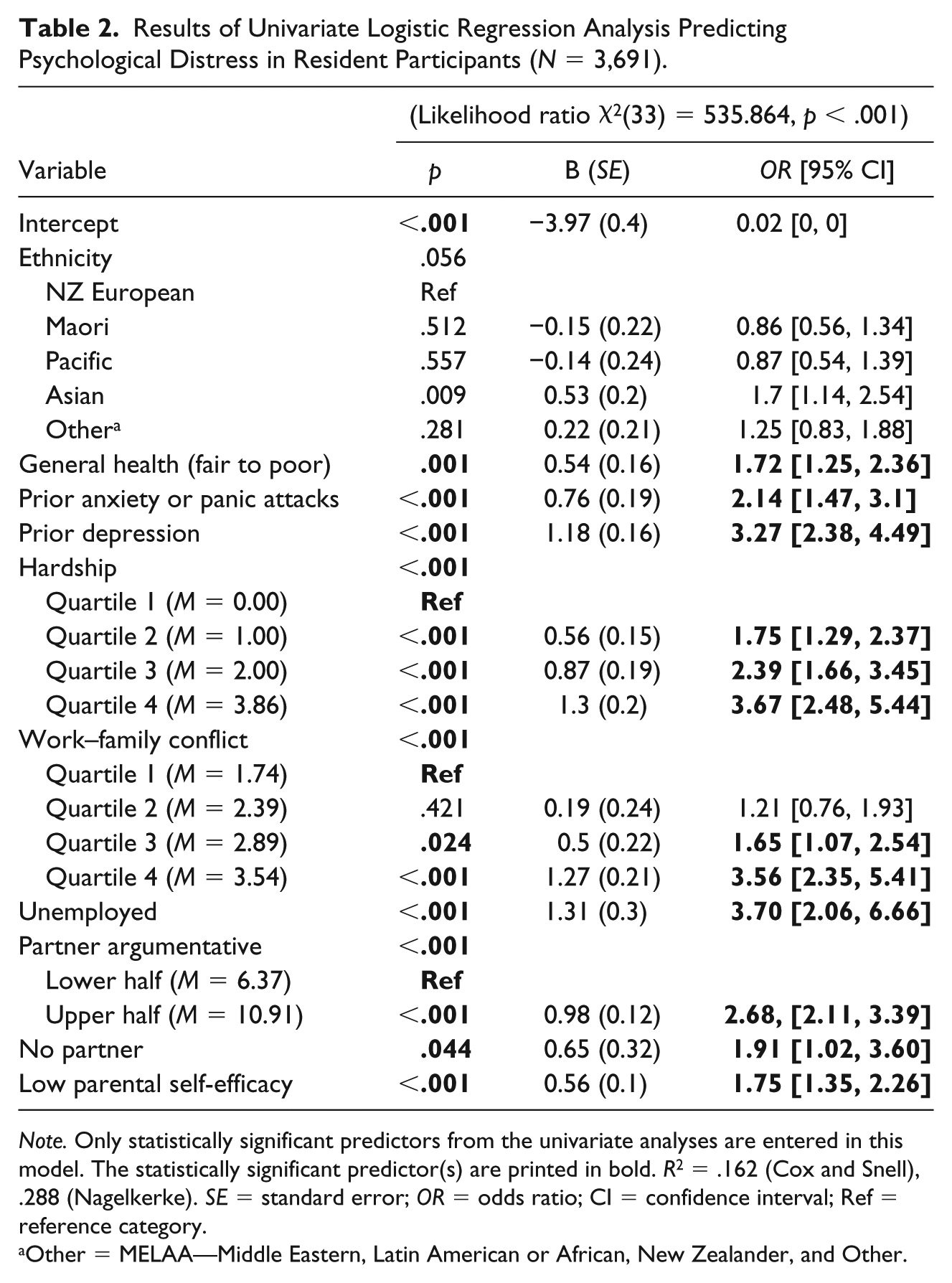
Note. Only statistically significant predictors from the univariate analyses are entered in this model. The statistically significant predictor(s) are printed in bold. R2 = .162 (Cox and Snell), .288 (Nagelkerke). SE = standard error; OR = odds ratio; CI = confidence interval; Ref = reference category.
Other = MELAA—Middle Eastern, Latin American or African, New Zealander, and Other.
Seven variables remained statistically significant in our univariate logistic regression model. First, resident participants who reported high levels of conflict between their work and family life were more likely to report psychological distress compared with those reporting low levels of work–family conflict (odds ratio [OR] = 3.56, 95% CI [2.35, 5.41]). Also, resident participants who were unemployed had increased odds of experiencing psychological distress compared with those who were employed and reported low levels of work-family conflict (OR = 3.70, 95% CI [2.06, 6.66]). Furthermore, having frequent arguments in their romantic relationship (OR = 2.68, 95% CI [2.11, 3.39]) and not having a partner (OR = 1.91, 95% CI [1.02, 3.60]) were significantly associated with having psychological distress in resident participants. We also found that self-reported fair to poor health (OR = 1.72, 95% CI [1.25, 2.36]), a lifetime prevalence of depression (OR = 3.27, 95% CI [2.38, 4.49]), or anxiety and/or panic attacks (OR = 2.14, 95% CI [1.47, 3.10]), and low paternal parental self-efficacy (OR = 1.75, 95% CI [1.35, 2.26]) were significantly associated with psychological distress among resident participants. Finally, compared with those resident participants who experienced no economic hardship, experiencing a low, medium, or high level of economic hardship was associated with increased odds of experiencing psychological distress (Table 2).
Psychological Distress Among Nonresident Participants
Table 3 shows the results of a second univariate logistic regression model predicting psychological distress among nonresident participants. We used the same approach as described in the previous paragraph.
Results of Univariate Logistic Regression Analysis Predicting Psychological Distress in Nonresident Participants.
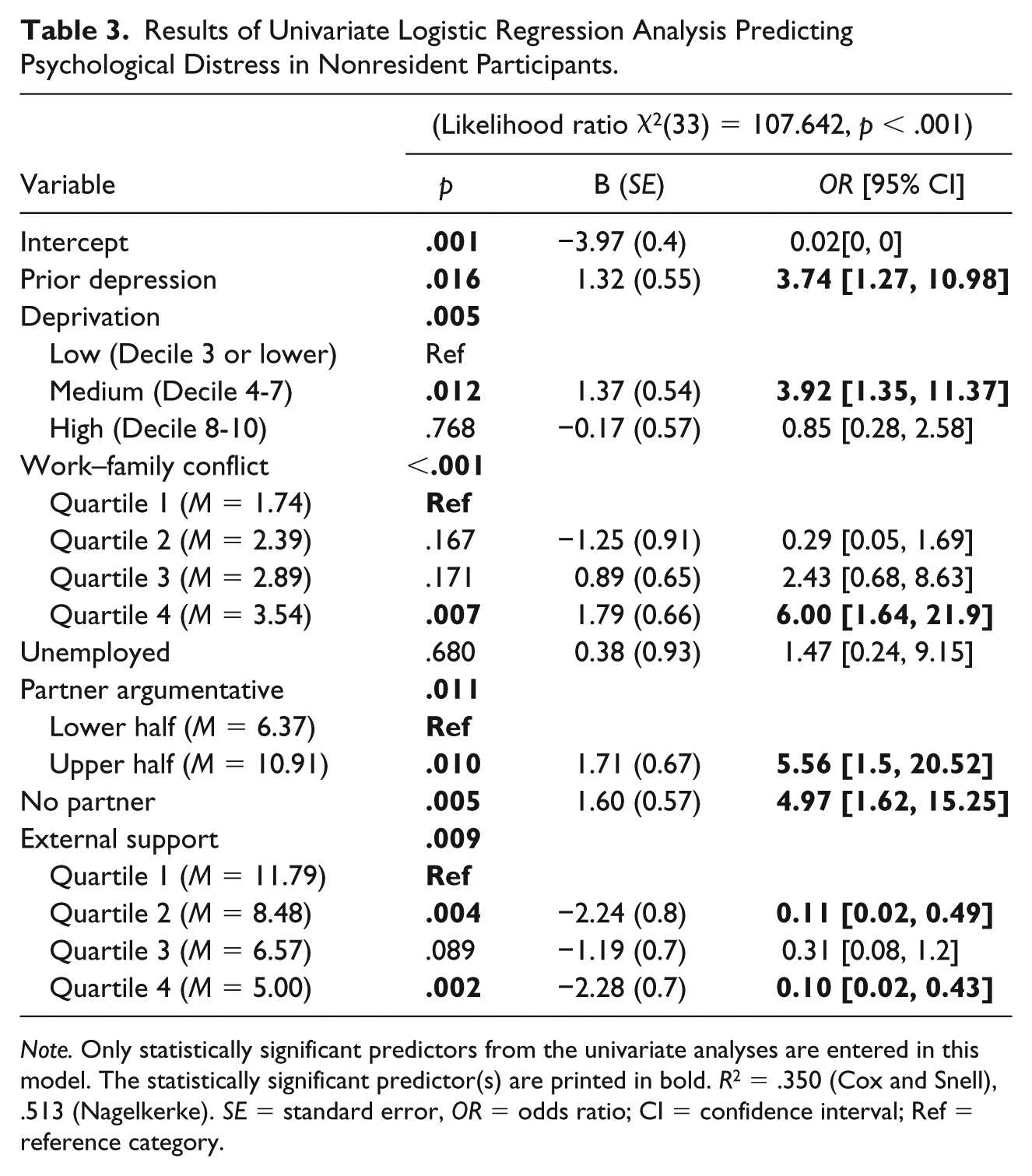
Note. Only statistically significant predictors from the univariate analyses are entered in this model. The statistically significant predictor(s) are printed in bold. R2 = .350 (Cox and Snell), .513 (Nagelkerke). SE = standard error, OR = odds ratio; CI = confidence interval; Ref = reference category.
Five variables were statistically significant associated with raised levels of psychological distress among nonresident participants. As we found among resident participants, nonresident participants who reported high levels of conflicts between their work and family life were more likely to report psychological distress compared with those reporting low levels of work–family conflict (OR = 6.00, 95% CI [1.64, 21.90]). Yet being unemployed was not significantly associated with psychological distress among nonresident participants. With regard to relationship status, we also found no association between being single and psychological distress. In keeping with the resident participants, we did however find a significant association between a having frequent arguments in a relationship and psychological distress (OR = 5.56, 95% CI [1.50, 20.52]) and having a lifetime prevalence of depression (OR = 3.74, 95% CI [1.27, 10.98]) also increased the odds of psychological distress among nonresident participants. Whereas for resident participants we found an association between psychological distress and hardship, for nonresident participants we found an association with medium-level deprivation (OR = 3.92, 95% CI [1.35, 11.37]). Somewhat surprisingly, we found that nonresident participants who reported low parental support from external sources were less likely to have psychological distress than those reporting the highest levels of external support, which we did not find among resident participants (OR = 0.10, 95% CI [0.02, 0.43]). No significant associations were found between psychological distress among nonresident participants and a lifetime prevalence of anxiety and/or panic attacks, parental self-efficacy, or self-reported health.
Discussion
This study examined a range of risk factors associated with psychological distress in a large sample of New Zealand fathers of 6-year-old children. We aimed to examine differences in the factors that are associated with psychological distress between fathers who live with their child all the time and nonresident fathers. Given the lack of research on mental health of nonresident fathers, our study is a valuable contribution to the current literature.
Summary of Main Findings
In keeping with earlier findings, nonresident participants were significantly more likely to experience psychological distress than resident participants (Giallo et al., 2012; Huang & Warner, 2005; Umberson & Williams, 1993). Nonresident participants were also more likely to report higher levels of economic hardship, to be unemployed, have no partner, to report their health as being fair to poor, to have a disability, and a history of depression, anxiety and panic attacks, and they reported lower parenting confidence. The nonresident participants were also more likely to report wanting to spend more time with their child, but their levels of involvement (low, medium-low, medium-high, high) did not differ significantly between the two groups.
While there were demographic differences between the resident and nonresident participants, there were relatively few differences in the predictors of psychological distress between the two groups. Overall, we found that participants (irrespective of them living with their 6-year-old child all the time or not) who reported work–family life conflict, hardship, or deprivation, a lifetime prevalence of depression, and frequent arguments in their romantic relationship were more at risk for psychological distress. Neither actual levels of involvement nor desired levels of involvement in the child’s life was associated with psychological distress in either group. One notable difference between the resident and nonresident groups was that in the nonresident participants a significant association was found between high external parenting support and psychological distress. Key findings are discussed in more detail below.
Balance Between Work and Family Life
High levels of conflict between a participants’ work and family life seem strongly associated with psychological distress across both resident and nonresident participants, which is in line with previous studies (Cooklin et al., 2015; Giallo et al., 2013). Compared with previous notions of fatherhood, the modern father ideal is one of evolving complexity, encompassing relatively new pressures and desires to be more involved in the lives of their children, while largely maintaining the traditional working ideal (Humberd, Ladge, & Harrington, 2015). Even though ideas of fatherhood have changed over the past 20 years, with men rating the importance of providing financially and family involvement similarly important (Harrington, Humberd, & Van Deusen, 2016), research has shown that fathers typically experience more family to work conflict and mothers vice versa, depending on the salience placed on their different roles (Hatter, Vinter, & Williams, 2002). This might explain why levels of child involvement for fathers was not associated with psychological distress, when work family conflict was.
While explicitly fathers might state they place relatively equal weighting on financial and family involvement, work practices and policies continue to reflect societal expectations that mothers are the primary carers. For example, in New Zealand, if the mother takes 12 months of maternity leave, the father is only entitled to between 1 and 2 weeks of unpaid parental leave on the birth of their child (the father must also have been employed for specified time period to be eligible; Parental Leave, 2016). In the United States, meanwhile, it has been estimated that only 15% of companies offer any paternity leave (Ladge, Humberd, Watkins, & Harrington, 2015).
As well as these barriers, social norms may also work against fathers’ involvement in child care. Research shows men who request family leave may suffer stigma as a result of their request (Rudman & Mescher, 2013). Participants in an experiment rated family leave requesters as poorer workers and weaker than they did for men who did not request family leave, and were subsequently less likely to recommend rewards for leave requesters. The dual and often competing pressures to be the ideal worker and an involved father may reduce satisfaction in both work and family domains subsequently increasing psychological distress.
Hardship and Deprivation
In line with our hypothesis, hardship was significantly associated with psychological distress among resident participants. As Krynen et al. (2013) point out, this could be down to one of two reasons. First, higher levels of hardship may lead to increased difficulty in everyday life and subsequently to psychological distress. People who are psychologically distressed may also fall into hardship and poverty as a result of their distress, and thereby face increased difficulty in finding and maintaining employment. Either way, the association between hardship and psychological distress found here supports prior research showing an association between income and subjective well-being (Diener et al., 1993). Although we did not find such an association in nonresident participants, we did find an association between deprivation and psychological distress in this group, which may act as a proxy for hardship. However, compared with a low level of deprivation, we only found an association for a medium level of deprivation and psychological distress not for a high level of deprivation. It is uncertain why this has occurred, and it warrants further investigation.
External Parenting Support
When looking at the factors that were associated with psychological distress separately for nonresident participants, our most noteworthy finding is that higher levels of external support in parenting was associated with an increased risk of psychological distress among nonresident fathers. This association was not found among resident fathers. External sources of support included parenting classes or support programs and support groups on the internet. This association may be mediated by other factors, such as unemployment, relationship status, or prior mental health problems; as nonresident fathers were more likely to be unemployed, without a partner, and reporting prior mental health problems. That is, it may be that these more disadvantaged fathers utilize external support sources more frequently and that their subsequent high external support scores merely reflect their greater disadvantage. Furthermore, it could be that fathers who experience psychological distress access more external support sources as a result of that distress. Future research should examine in more detail the types of support accessed by nonresident and more disadvantaged fathers, and the factors that motivate the use of such support.
Child Involvement
Contrary to our hypothesis, neither actual levels of involvement nor desired levels of involvement in the child’s life was associated with psychological distress. It may be that other factors—such as a conflict between work and family life—impede involvement and increase risks of psychological distress, rather than a lack of involvement itself causing psychological distress. More research is required to further untangle these potential mediated associations.
Strengths and Limitations
To the best of our knowledge, no previous study has examined differences in self-reported psychological distress in nonresident fathers compared with resident fathers in New Zealand families. In addition, this is one of the first studies that examines a wide range of factors potentially associated with psychological distress in a large and diverse sample of New Zealand fathers. With the inclusion of almost 4,000 fathers from a wide range of social and cultural backgrounds, this study was able to identify various factors relating to different domains of life that are associated with increased risks of psychological distress among both resident and nonresident fathers. As fathers living apart from their children grows more common (Statistics New Zealand, 2014), it is important to examine the lives and well-being of these fathers who do not live with their children. This study, therefore, has resulted in novel and relevant findings with strong ecological validity.
This study also has a number of limitations. First, due to a small proportion of nonresident participants, the sample size for this group was relatively small and confidence intervals for the estimates of odd ratios were particularly wide. It is likely, however, that as the children within the Growing Up in New Zealand cohort grow older, more parents will separate from each other and the number of fathers living away from their children will grow. It is important that this group of fathers, as an underresearched group, are the focus of future research. Second, our findings are limited in that our study uses a cross-sectional design. It is therefore important to follow these fathers and examine the factors that mitigate or increase the risk of psychological stress over time. Third, we have not explored how the factors in this study interact to affect psychological distress in fathers, or possible mediators of any effects. We have also not explored the potential bidirectional impact of some of our factors such as the impact of work life balance on psychological distress and vice versa.
While many of these limitations are similar to others studies, our study has added to the literature by exploring the relevance of wider number of life factors that have previously been either examined in isolation, or excluded from research. We have also replicated previous findings that may have been seen as tenuous in a large and diverse cohort, and we demonstrated such patterns in a new local context (New Zealand), which is likely to have different expectations and cultural norms and parental leave policies than other Western countries.
Concluding Comments
The development and life course of children are determined by an array of individual and contextual influences. Fathers are an important and often neglected part of child well-being and development research despite research showing that poor parental mental health can negatively affect children’s cognitive development and later educational attainment (Flouri & Buchanan, 2004; Meuwissen & Carlson, 2015). This study contributes to this literature by illustrating factors that may increase paternal psychological distress and the differences that exist between resident and nonresident fathers.
Our findings demonstrate that nonresident fathers are more likely to experience hardship, unemployment, suffer poor health, and have a history of depression and anxiety or panic attacks, and were more likely to report psychological distress than resident fathers. However, while nonresident participants were at greater risk of experiencing psychological distress, the predictors of this distress were largely the same across resident and nonresident participants. This suggests that fathers’ residential status, with respect to the child, is not a key driver of the psychological distress in fathers. As such, any attempts to reduce the psychological distress in fathers could be targeted at common sources of father distress, such as work–family conflict, which was the strongest predictor of distress in both resident and nonresident fathers. Importantly, consideration also needs to be given to the broader contextual factors associated with psychological distress, such as economic hardship and deprivation, a history of poor mental health, and work environment factors. This will help build a more complete picture of resident and nonresident fathers’ psychological distress.
Footnotes
Acknowledgements
The study has been designed and conducted by the Growing Up in New Zealand study team, led by the University of Auckland. The authors acknowledge the contributions of the original study investigators: Susan M. B. Morton, Polly E. Atatoa Carr, Cameron C. Grant, Arier C. Lee, Dinusha K. Bandara, Jatender Mohal, Jennifer M. Kinloch, Johanna M. Schmidt, Mary R. Hedges, Vivienne C. Ivory, Te Kani R. Kingi, Renee Liang, Lana M. Perese, Elizabeth Peterson, Jan E. Pryor, Elaine Reese, Elizabeth M. Robinson, Karen E. Waldie, and Clare R. Wall.
Authors’ Note
The views reported in this article are those of the authors and do not necessarily represent the views of the Growing Up in New Zealand Investigators.
Declaration of Conflicting Interests
The author(s) declared no potential conflicts of interest with respect to the research, authorship, and/or publication of this article.
Funding
The author(s) disclosed receipt of the following financial support for the research, authorship, and/or publication of this article: “Growing Up in New Zealand” has been funded by the New Zealand Ministries of Social Development, Health, Education, Justice and Pacific Island Affairs; the former Ministry of Science Innovation and the former Department of Labour (now both part of the Ministry of Business, Innovation and Employment); the former Ministry of Women’s Affairs (now the Ministry for Women); the Department of Corrections; the Families Commission (now known as the Social Policy Evaluation and Research Unit); Te Puni Kokiri; New Zealand Police; Sport New Zealand; the Housing New Zealand Corporation; and the former Mental Health Commission, The University of Auckland; and Auckland UniServices Limited. Other support for the study has been provided by the NZ Health Research Council, Statistics New Zealand, the Office of the Children’s Commissioner, and the Office of Ethnic Affairs.
