







Abstract
It is almost a consensus that the stronger family decision-making power a woman has, the happier she will be. While using the China Family Panel Studies, this study reveals a long-overlooked fact that women’s control over more family decision-making power does not necessarily improve their happiness. The results of the ordinary least squares and ordinal logit model confirm this finding, and the propensity score matching method corroborates the conclusion. Heterogeneity analysis shows that among those women with less education and lower social status, the negative happiness effect of women’s family decision-making power is particularly significant. Women’s traditional attitudes and self-esteem are two important factors which hinder women’s family decision-making power from enhancing their happiness.
Keywords
With economic development and progress, the voice of Chinese women has been rising day by day. More and more women not only hold important positions in many jobs, but the gender wage gap in many occupations is gradually narrowing. The improvement of economic condition has brought about the improvement of women’s family status (WEF, 2018). There tends to be equal power relations in the family, and some families are even adapted to a new model of ‘wife’s dominance over husband in family affairs’ (Wu, Ye, & He, 2014). The improvement of women’s family status can enhance women’s own well-beings and their next generation’s, including less domestic violence, female infant mortality and more investment on girls (Beegle, Frankenberg, & Thomas, 2001; Brown & Park, 2002; Panda & Agarwal, 2005). In addition, it may also affect family production decisions, such as the distribution of labour in household chores and agricultural production. Hence, to a large extent, people believe that the higher women’s family status is, the more their well-being will be increased, and the happier they will naturally be. In summary, socio-economic transformation has improved women’s family status, and thus, it might greatly enhance their happiness. The abovementioned force promotes the all-round development of women and is defined as ‘economic development force’.
Meanwhile, there is another competing social force that inhibits women’s development, which even further widens the gender gap. That is the deep-rooted traditional norms, such as ‘men being the masters of the family’, emphasizing the ‘main backbone’ role of men in the family and society, while women play the assistant role of housekeeping and educating children (Wang, Li, & Feng, 2019). Corresponding with ‘economic development force’, it is defined as ‘traditional norm force’. It has long-term constraints on women’s daily behaviours and role orientation within the family, which makes them understand a certain behaviour in an inherent way. Under its influence, women’s happiness may decrease when family members fail to play the assigned gender roles required by social norms (Turner & Salemink, 2015). In summary, traditional norms inhibit women’s development and empowerment. Once they transcend the invisible boundaries of traditional norms to hold family decision-making power, their happiness may be negatively affected.
Therefore, there are currently two competing forces that play important roles between women’s family decision-making power and their happiness. As for which one is stronger, there is no relevant research available. In view of this, this study employs the China Family Panel Studies (CFPS) to investigate whether women’s control over family decision-making power will improve their happiness. The study found that the fact that women holding family decision-making power are happier does not hold true. Overall, women’s control over more family decision-making power cannot effectively improve their happiness. Heterogeneity analysis showed that among those women with less education and lower social status, the negative happiness effect of women’s decision-making power is particularly significant. Further research found that those women hold strong traditional attitudes, so they might be personally unwilling to be decision-makers in the family. Moreover, they have a low degree of self-esteem, consistently adhering to mainstream gender role attitudes, repelling and alienating those who are off track. This conclusion reveals that women’s family status has been substantially improved, but the traditional family value of ‘men managing external affairs, women internal’ is still deeply ingrained in some people. If this barrier is not removed, women’s happiness is not really enhanced even when they have the power to make decisions about family affairs.
The following structure is arranged as follows: the second part presents literature review and research hypothesis, the third part displays data, variable selection and descriptive statistics, econometric analysis and its interpretation are given in the fourth part, the fifth part does a causal inference based on matching, and the last part discusses the findings and draws conclusions.
Literature Review and Research Hypothesis
Literature Review
There are many factors affecting an individual’s happiness. It not only depends on macro-level factors such as social development and progress (Hagerty & Veenhoven, 2003), but also personal characteristics, such as gender (Chui & Wong, 2016). When examining individual’s happiness from the family level, existing studies have shown that there is a happiness spillover effect within the family, that is, the characteristics and behaviours of other family members will affect individual’s happiness (Camfield, Choudhury, & Devine, 2009; Gray, Chamratrithirong, Pattaravanich, & Prasartkul, 2013). So, the family is an important source of individual’s happiness, among which the relative power relations between husband and wife is the most concerned by economists (Chiappori, Fortin, & Lacroix, 2002; Lelkes, 2005). The consensus reached by existing studies is that the improvement of women’s family status is conducive to improving the well-being of women themselves, subsequently, enhancing their happiness (Luke & Munshi, 2011; Panda & Agarwal, 2005). But there is an important flaw in the logic of the existing literature. They ignore the important even decisive roles on the relationship between intrahousehold power structure and family members’ happiness of social settings and constraints. Accounting for this, we propose three hypotheses as follows.
Research Hypothesis
‘Economic development force’ makes Chinese people now practice more individualized family behaviours than before, such as lifetime singlehood and premarital cohabitation. However, the trajectory of family changes in China has not followed those in Western countries. The trends and patterns of the Chinese family are changing only slowly, and the continuing role of traditional Confucian culture is still dominant (Yu & Xie, 2021). In Chinese traditional culture, different roles are set for adult men and women. Women spend their time and energy on housework more in line with social expectations. This kind of social division of labour has developed into a relatively rigid set of gendered institutions, emphasizing the retention, continuation and solidification of traditional gender role divisions and fertility models in the family. Thus, it forms an invisible barrier to the development and empowerment of women (Elam & Terjesen, 2010; Elson, 1999). Under the current social background, women’s economic and social status has been improved as never before, but overall, most women still find it difficult to get rid of the traditional social norms of ‘men being the masters of the family’. When women transcend traditional gender roles and have the powers originally entrusted to adult men, the happiness of most women may not be improved. Based on this, the first hypothesis is proposed.
Those women with strong traditional views tend to show behaviours consistent with social norms accepted by the community. Their sense of happiness comes more from family stability, harmonious relationship between husband and wife, successful spouse’s career (Turner & Salemink, 2015; Valutanu, 2012). If they can play the role of ‘good assistant’ and avoid worrying about major family affair decisions, their happiness will be greatly improved. For those women, it is relatively rare to take the initiative to hold family decision-making power. Even if they try taking the initiative, they have to be concerned about public opinion and moral pressures imposed by the community to prevent women from trying to become decision-makers in family affairs (Mabsout & van Staveren, 2010). This will negatively affect their happiness. Moreover, in case of women’s dominance in family affairs, it reveals that their husbands have failed to fulfil their due obligations. For women with conservative ideas, if their spouses break away from the gender roles assigned by traditional norms, their happiness also will be lost. Based on this, the second hypothesis is proposed.
A large proportion of women prefer to change their own destiny through marriage, rather than rely on education, career and other channels to hold their destiny in their own hands (Qian & Qian, 2015). This is mainly related to women’s low sense of self-esteem, and serious inferiority mentality makes them afraid to challenge the inherent social norms. The lack of self-confidence makes women look down on themselves from the bottom of their hearts, consistently adhere to mainstream gender concepts, and reject, alienate, and even attack those who are off track. This kind of women’s psychology has an important influence on their status and personal development (Filippin & Paccagnella, 2012). Because of low degree of self-esteem, those women are consistent with community-accepted behavioural norms, so they rarely plan to hold family decision-making power. When they cross the boundaries of social norms, the self-esteem effect will negatively affect their happiness. Based on this, the third hypothesis is proposed.
Data, Variable Selection, and Descriptive Statistics
Data
Accounting for the availability of core variables, we use the nationally representative sample data from the CFPS for the following analysis. The CFPS is a comprehensive survey designed to complement the Panel Study of Income Dynamics (PSID) used in the USA. Data collection and release is conducted in collaboration with Peking University’s Institute of Social Science Survey and the Survey Research Centre at the University of Michigan. While collecting individual-, family- and community-level longitudinal data with a focus on both the economic and non-economic well-being of the Chinese people, the CFPS tries to provide the highest-quality survey micro-data support for academic research and public policy analysis. The survey closely tracks social, economic, demographic, educational and health changes in contemporary China (Xie & Hu, 2014; Xie & Lu, 2015).
The 2012 CFPS is drawn from 25 provinces (or provincial-level cities, autonomous regions) in China, where 95% of the Chinese total population reside. The sample is obtained through a three-stage cluster sampling with unequal probabilities: administrative counties (or districts), administrative villages (or neighbourhood communities) and households. There are about 13,213 households and 34,940 adults (aged 16 years or more) within these families interviewed in the 2012 survey. The average cross-sectional response rate is around 79%. The 2012 CFPS is attractive for our case because the survey collected information on respondents’ happiness, family decision-making power and related social demographic information, especially, self-esteem related statements. Considering that the focus of the article is on women’s family decision-making effect, so we constrain the analytical sample to married women. After deleting missing values and conflicting observations, we obtain 6,500 observations for analysis. According to our calculation, the mean value and standard deviation of analytical sample are no different from original sample.
Variable Selection
The explained variable, women’s happiness (Happiness), is measured by the question of ‘How happy do you feel about yourself?’. The respondent chooses from five options: ‘very unhappy’, ‘relatively unhappy’, ‘can’t say happy or unhappy’, ‘relatively happy’ and ‘very happy’. We assign the value of 1, 2, 3, 4 and 5 to each option, respectively.
The core explanatory variable, the decision-making power of women in the family (Power), is measured by the question of ‘Who is the decision-maker on important family affairs?’. The respondent chooses from three options: ‘husband’, ‘co-negotiation’ and ‘wife’. In order to better reflect the influence of women’s family decision-making power on their happiness, we merge the two options of ‘husband’ and ‘co-negotiation’ into ‘others’. So, Power becomes a 0-1 dummy variable, and it is easier to explain its coefficient. To reduce the dependence on a single explanatory variable, we also use women’s control over household financial affairs (Finance) as an alternative. It is evaluated through the question of ‘Who is the financial decision-maker in the family?’. The respondent also chooses from three options: ‘husband’, ‘co-negotiation’ and ‘wife’. Like the above, we merge the first two options to construct a 0-1 dummy variable. Considering that a small number of couples disagree on the above two questions, we delete ten conflicting observations.
There are two important influencing factors: women’s attitudes towards traditional norms (Attitudes) and self-esteem (Esteem). In view of the availability of data, attitudes towards traditional norms are measured by the questions of ‘Do you agree that men are career oriented, women family oriented?’ and ‘Do you agree that for women marrying well is better than doing well?’. For each question, the respondent has four options: ‘quite disagree’, ‘disagree’, ‘agree’ and ‘quite agree’. Accordingly, we assign the value of 1, 2, 3 and 4 to the above options. Then, the scores from the above two questions are added together to construct an ordinal variable of traditional attitudes with a value ranging from 2 (the most open) to 8 (the most conservative). The higher the score is, the more conservative the respondent is.
Statements in the CFPS and RSES.
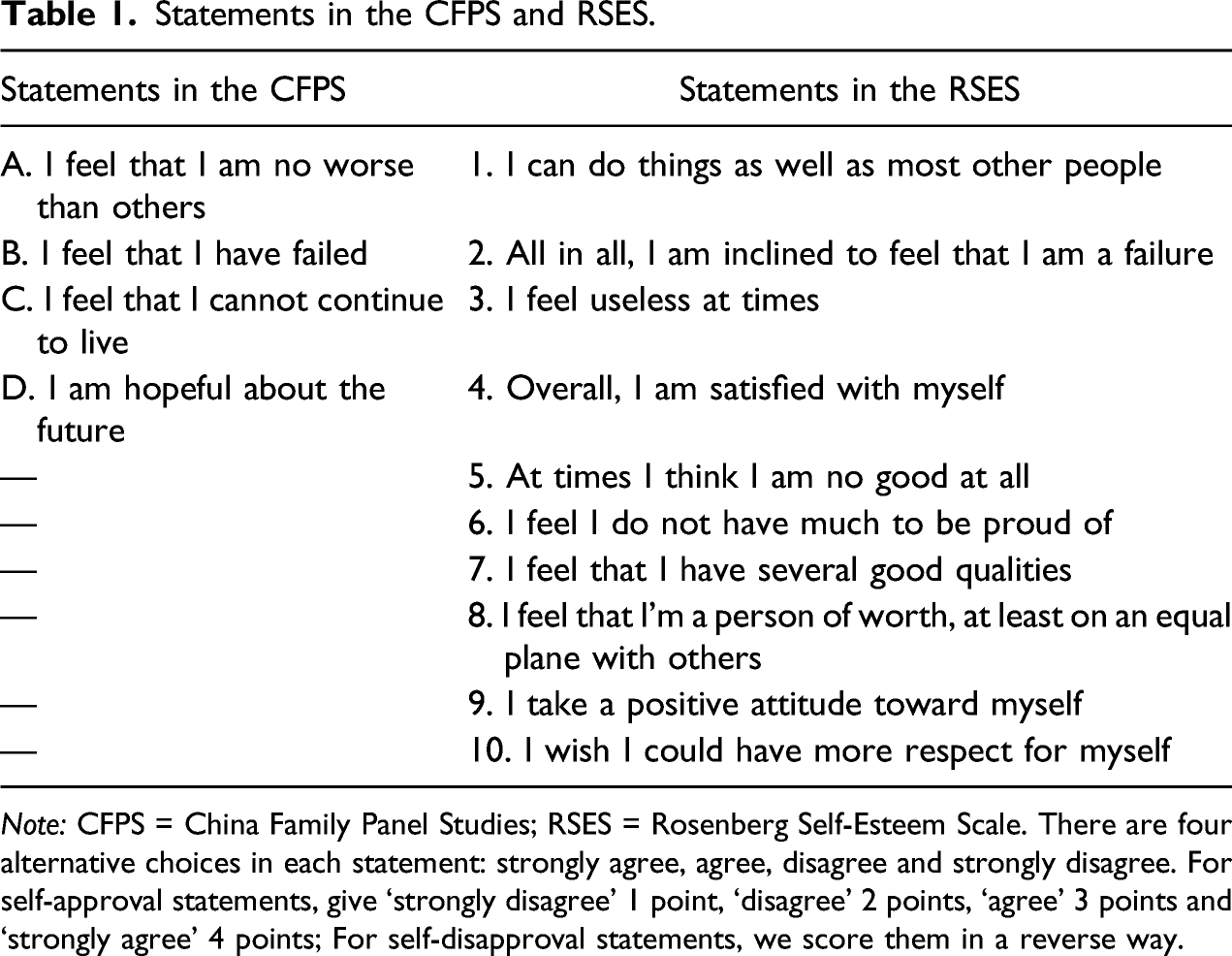
Note: CFPS = China Family Panel Studies; RSES = Rosenberg Self-Esteem Scale. There are four alternative choices in each statement: strongly agree, agree, disagree and strongly disagree. For self-approval statements, give ‘strongly disagree’ 1 point, ‘disagree’ 2 points, ‘agree’ 3 points and ‘strongly agree’ 4 points; For self-disapproval statements, we score them in a reverse way.
Variables and Their Definitions.
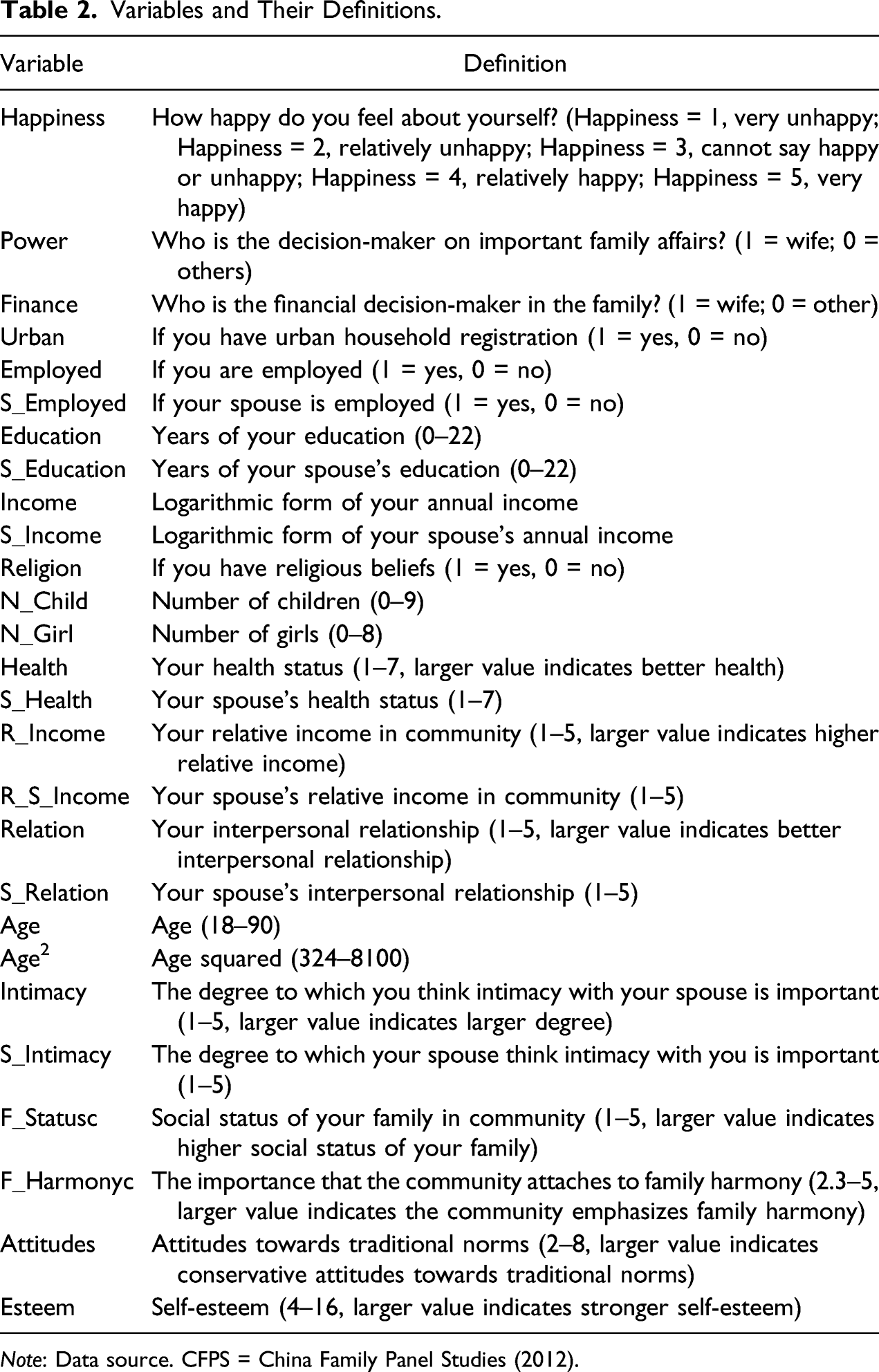
Note: Data source. CFPS = China Family Panel Studies (2012).
Descriptive Statistics
Descriptive Statistics by Women’s Family Decision-Making Status.
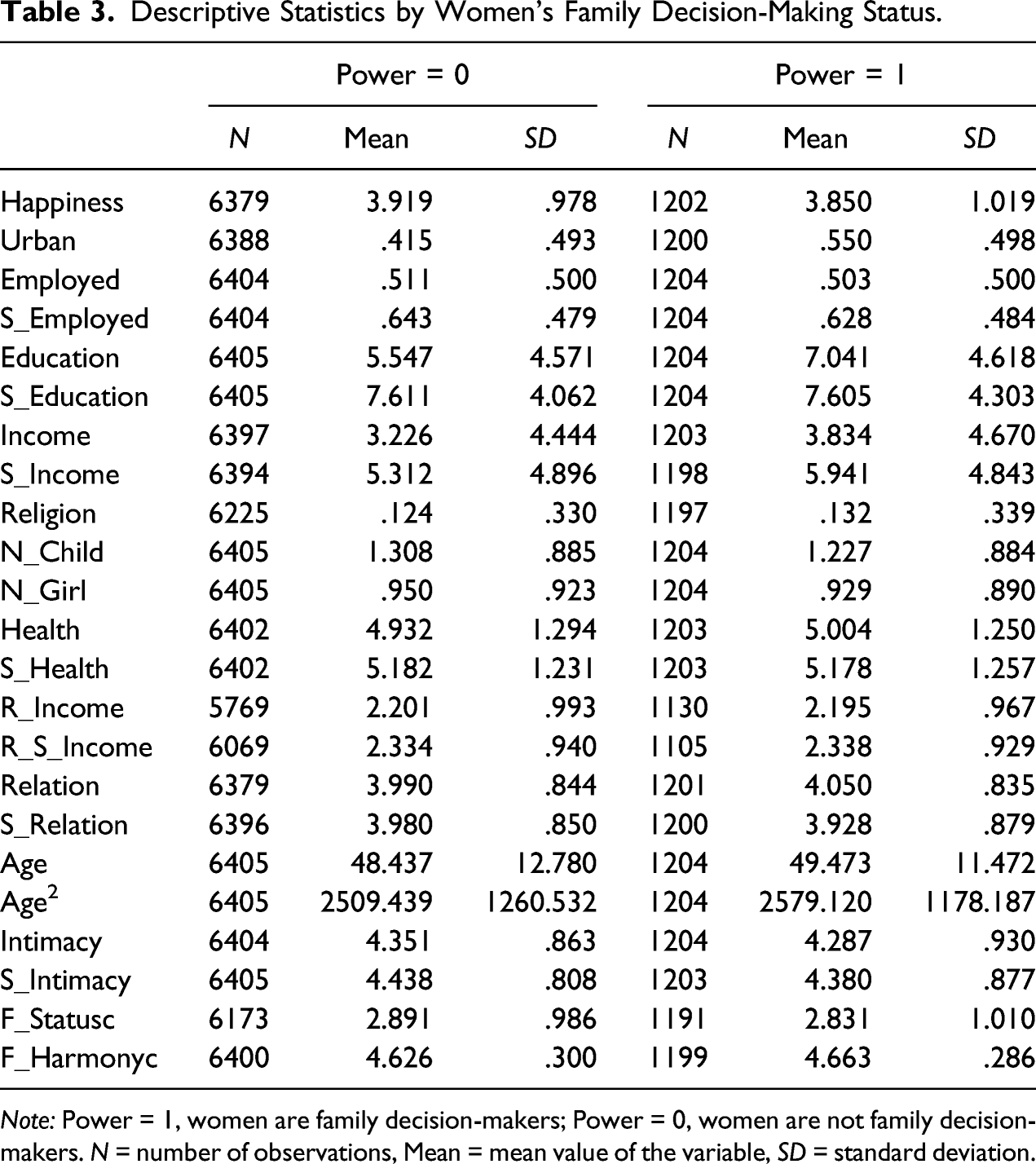
Note: Power = 1, women are family decision-makers; Power = 0, women are not family decision-makers. N = number of observations, Mean = mean value of the variable, SD = standard deviation.
Econometric Analysis and Interpretation
Econometric Model
The following econometric model is established to test the relationship between women’s family decision-making power and their happiness
Benchmark Regression Results
Family Decision-Making Power and Women’s Happiness.
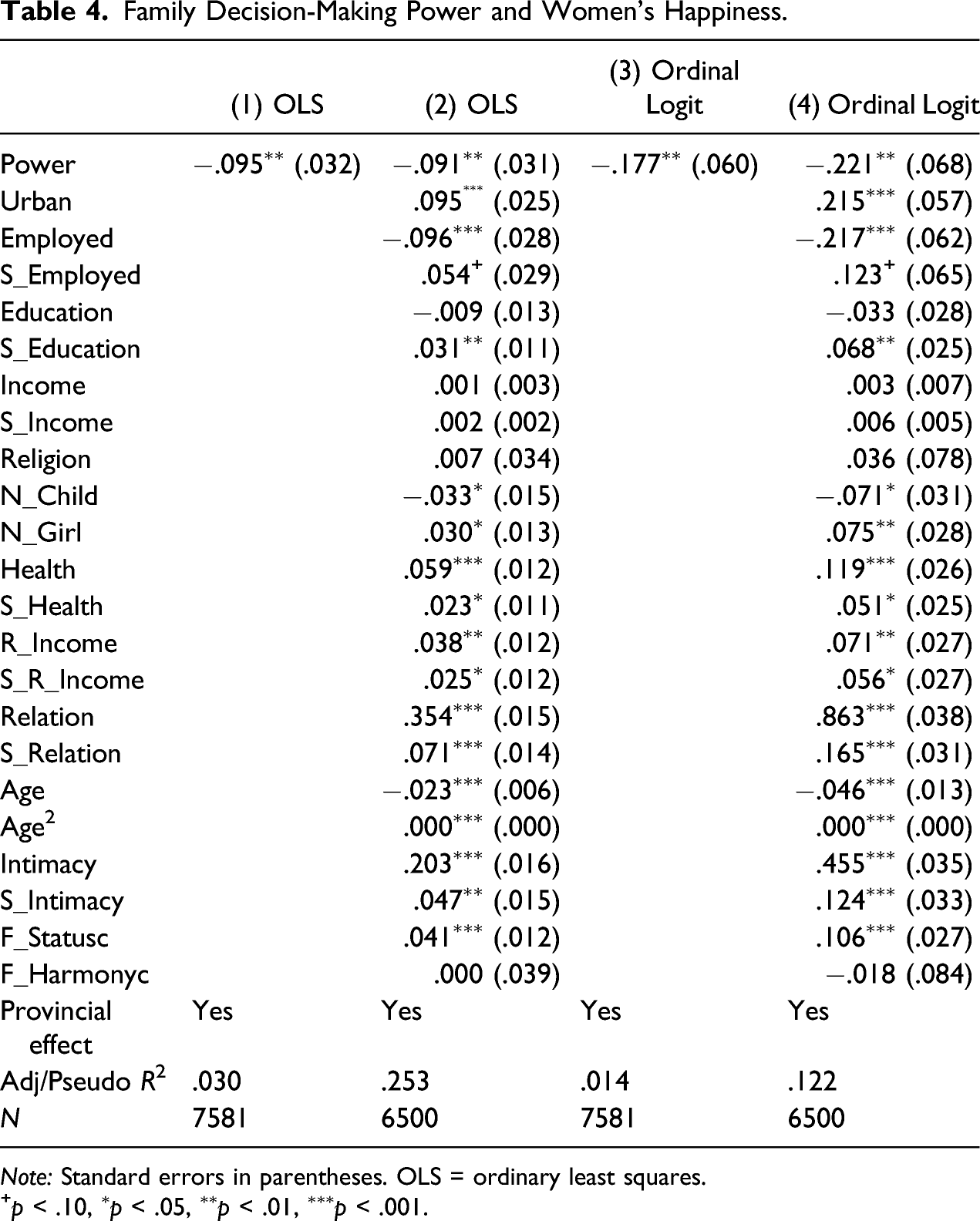
Note: Standard errors in parentheses. OLS = ordinary least squares.
+ p < .10, ∗p < .05, ∗∗p < .01, ∗∗∗p < .001.
Family Financial Decision-Making Power and Women’s Happiness.
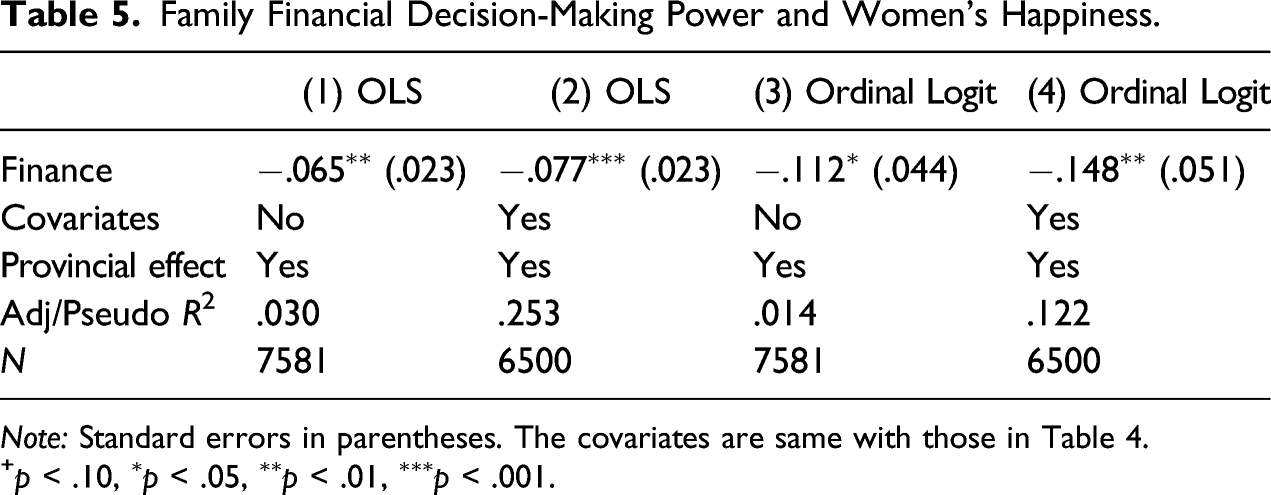
Note: Standard errors in parentheses. The covariates are same with those in Table 4.
+p < .10, ∗p < .05, ∗∗p < .01, ∗∗∗p < .001.
Additionally, the effect of control variables on women’s happiness is consistent with existing research (Appleton & Song, 2008; Clark, Flèche, Layard, Powdthavee, & Ward, 2018), ensuring the rationality of the selection of control variables. For example, women living in cities have a higher sense of happiness. The effect of age on women’s happiness is U-shaped, meaning that happiness declines first and then increases gradually along with age. Compared with absolute income, the relative income significantly improves women’s happiness. This validates the ‘relative income hypothesis’ in happiness economics. At family level, husband’s employment, education, health, relative income and interpersonal relationship also enhance women’s happiness. At community-level, the higher the social status of family is, the stronger women’s happiness will be (Wang & Vanderweele, 2011).
Heterogeneity Analysis
Sub-Sample Regression by Educational Level and Social Status.
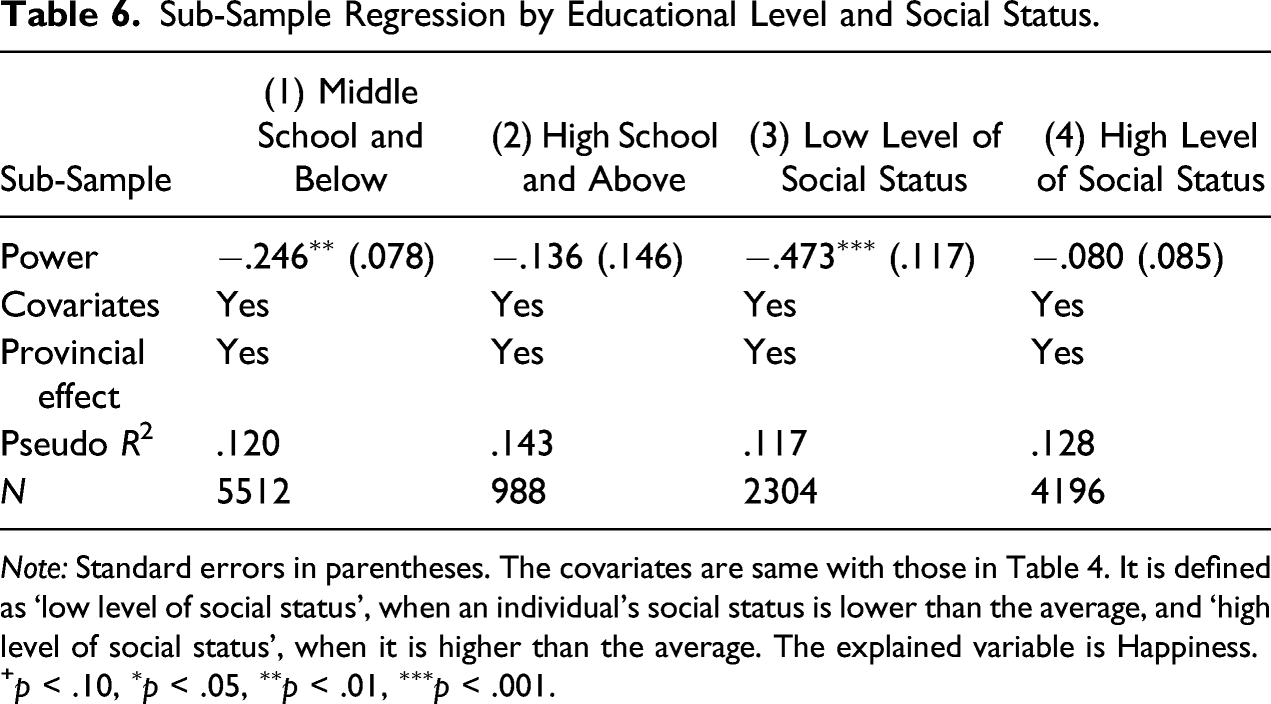
Note: Standard errors in parentheses. The covariates are same with those in Table 4. It is defined as ‘low level of social status’, when an individual’s social status is lower than the average, and ‘high level of social status’, when it is higher than the average. The explained variable is Happiness.
+p < .10, ∗p < .05, ∗∗p < .01, ∗∗∗p < .001.
How do the above results happen? It might be closely related to the following two factors: women’s traditional attitudes and self-esteem. According to Clark, Yi, and Huang (2019), although happiness has increased generally in China, it is significantly higher for those with more education and higher socio-economic status (SES). It means that there is still a gap in happiness among different groups, which originates from the transformation of the economy and society. Social transformation has brought about the unfair distribution of economic resources, marked by a sharp increase in income and social status inequality. The transformation of the Chinese economy is narrowly targeted at the better-educated, higher-SES segments of the population (Easterlin, Morgan, Switek, & Wang, 2012). The transformation makes those women with more education and higher SES financially independent from their spouses, and realizes their personal value through participation in economic, social and political life. Besides, it also brings them modern concepts of gender equality in the field of family affair and strengthens their self-esteem and confidence.
Contrastly, less targeted are the less-educated, lower-SES segments of the population. These women are still dependent on their spouses financially despite social transformation, and their focus is more on household chores. Surrounded by deep-rooted traditions, they subconsciously tend to accept the traditional gender attitudes of ‘men being the masters of the family, and women being the assistants to men’. In addition to conservative concepts, these women with less education and lower social status also do not recognize their own value and advantages because they are pressed to the bottom hierarchy of the society. They follow the existing social norms, and lack sufficient confidence to challenge the gendered institutions that put women at a disadvantageous position. So, these women are less likely to cross the constraints of social norms, instead, they are staunch supporters and practitioners of traditional household division of labour. This will make them accept that their husbands should hold major family decision-making power in many cases. If not, their happiness might be reduced to some extent. The following section will empirically verify whether the statements are supported in our analytical sample.
Potential Influencing Factors
We use two steps to verify the above statements. First, we examine whether women with less education and lower social status will have stronger traditional attitudes and lower self-esteem. Second, we examine whether traditional attitudes and low self-esteem leads to negative happiness effect of women’s decision-making power in the family. Once obtaining two positive answers, we could conclude that women with less education and lower social status tend to hold stronger traditional attitudes and lower self-esteem, which consequently brings negative happiness to their family decision-making power.
The Relationship Between Education, Social Status and Women’s Traditional Attitudes and Self-Esteem.
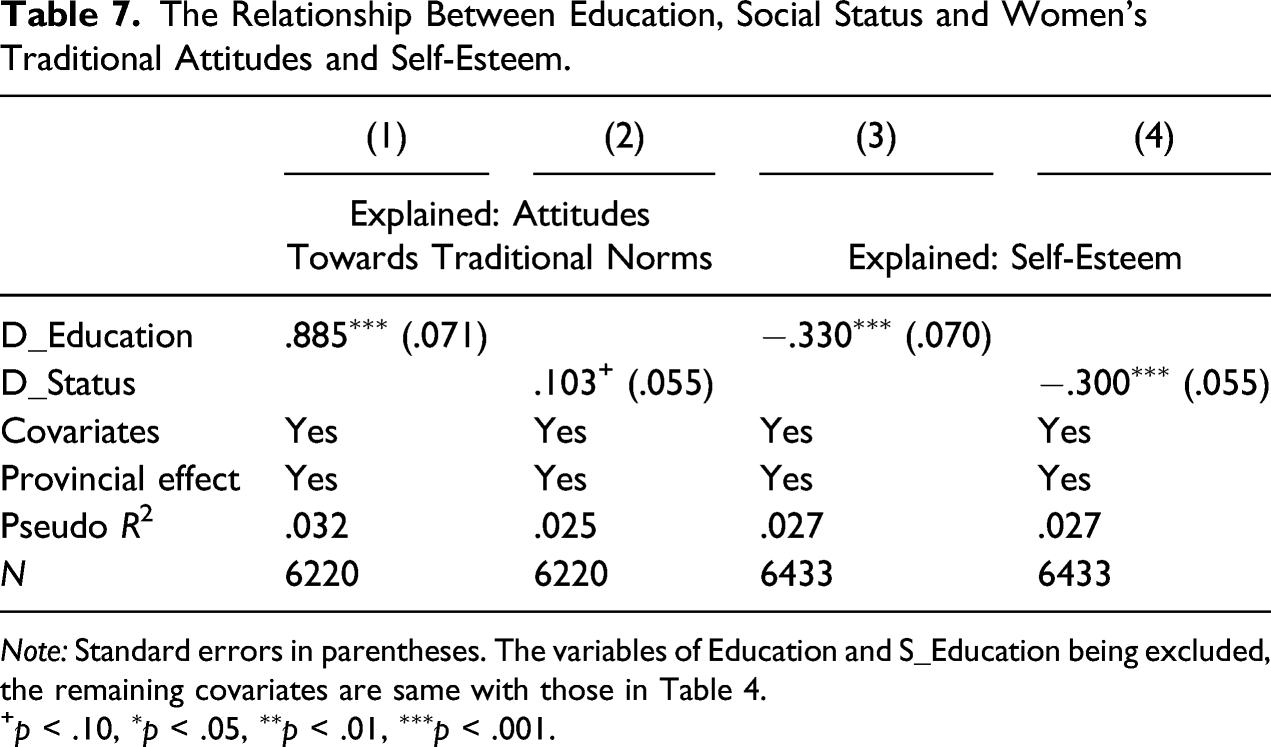
Note: Standard errors in parentheses. The variables of Education and S_Education being excluded, the remaining covariates are same with those in Table 4.
+p < .10, ∗p < .05, ∗∗p < .01, ∗∗∗p < .001.
Sub-Sample Regression by Traditional Attitudes and Self-Esteem.
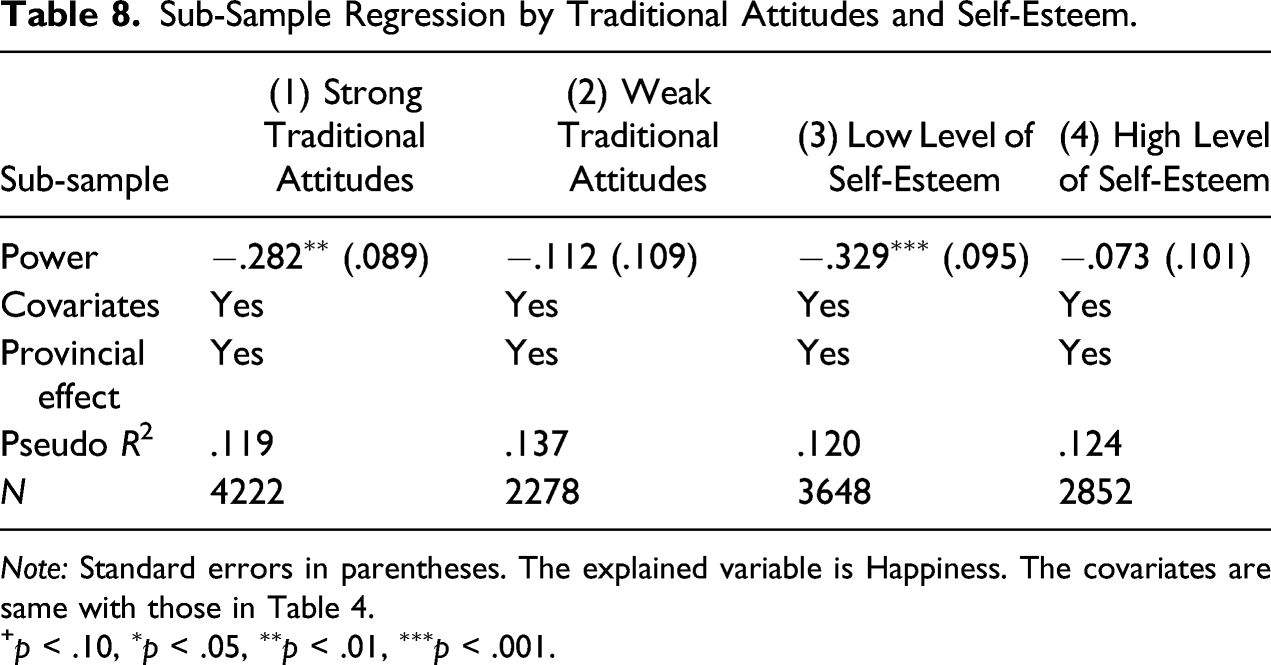
Note: Standard errors in parentheses. The explained variable is Happiness. The covariates are same with those in Table 4.
+p < .10, ∗p < .05, ∗∗p < .01, ∗∗∗p < .001.
Robustness Check
Robustness Check.
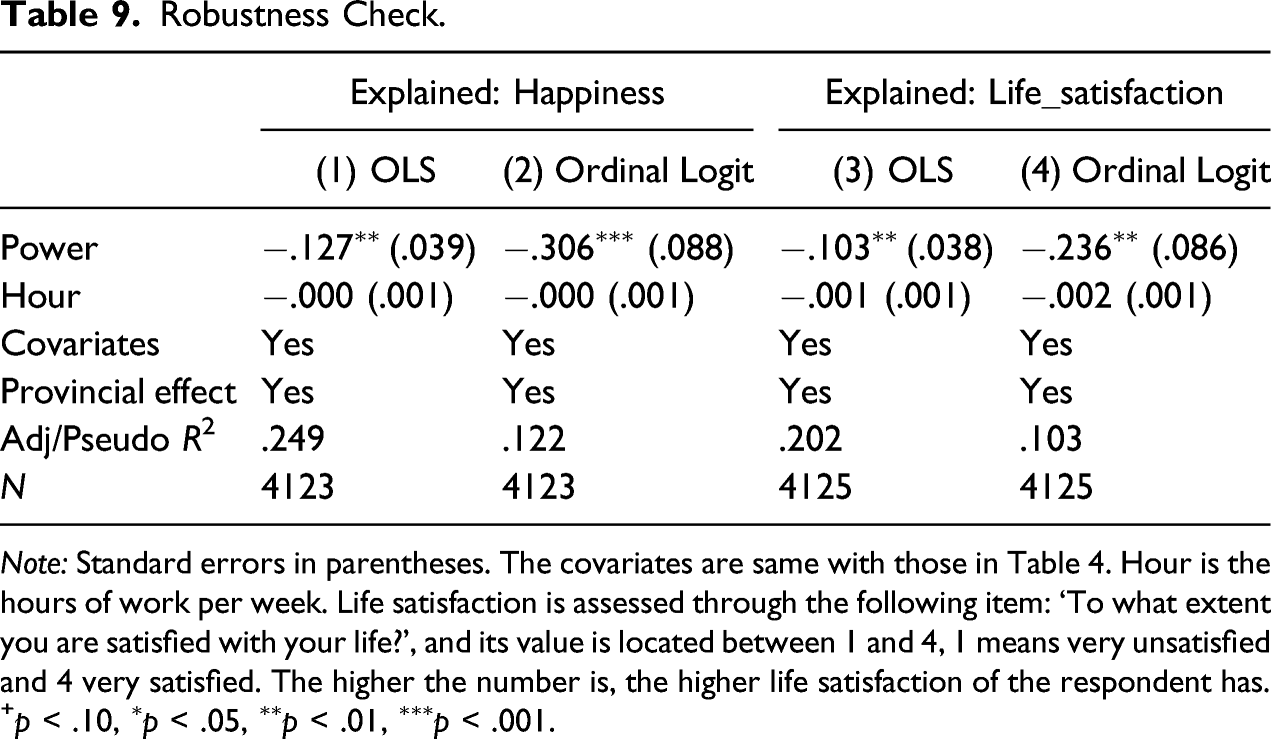
Note: Standard errors in parentheses. The covariates are same with those in Table 4. Hour is the hours of work per week. Life satisfaction is assessed through the following item: ‘To what extent you are satisfied with your life?’, and its value is located between 1 and 4, 1 means very unsatisfied and 4 very satisfied. The higher the number is, the higher life satisfaction of the respondent has.
+p < .10, ∗p < .05, ∗∗p < .01, ∗∗∗p < .001.
Causal Inference Based on Matching
Propensity Score Matching
The above section shows that family decision-making power has reduced the happiness of some women, but this result may be affected by the non-randomness of family decision-making power. The differences in happiness of women with or without family decision-making power may be determined by the characteristics that determine the decision-making power of women, rather than by the behaviour of women owning family decision-making power itself. There are many differences between women with family decision-making power and women without, which may lead to estimation bias caused by self-selection effect. For example, women with certain demographic characteristics have a higher probability of holding family decision-making power, but a lower probability of obtaining a sense of happiness. It will confound the negative happiness effect brought by the behaviour of women having family decision-making power.
To correct self-selection bias, we employ propensity score matching method (PSM) proposed by Rosenbaum and Rubin (1983) to find control group with similar characteristics for treatment group, and obtain the treatment effect of women’s family decision-making power. Under the framework of PSM, we first need to obtain a propensity score (PS), which is the probability of an individual assigned to the treatment group. In the study, it is the probability of a woman holding family decision-making power. Caliendo and Kopeinig (2008) pointed out that confounding variables that are highly correlated with treatment and outcome variables should be selected as matching covariates. We select the following matching covariates to predict the probability of women having family decision-making power: household registration (Urban), age (Age), age gap between husband and wife (Age_diff), annual income (Income), annual income gap (Income_diff), years of education (Education), gap in years of education (Education_diff), interpersonal relationship (Relation) and traditional attitudes in community (Attitudesc). Then, based on the calculated PS, a counterfactual control group is constructed using various matching methods to measure similarity. In order to ensure the robustness of the treatment effect, this study employs three following matching methods: one to one nearest neighbour matching (NNM), radius matching (RM) and kernel matching (KM).
Estimation Results of PSM
Treatment Effect of Women Having Family Decision-Making Power.
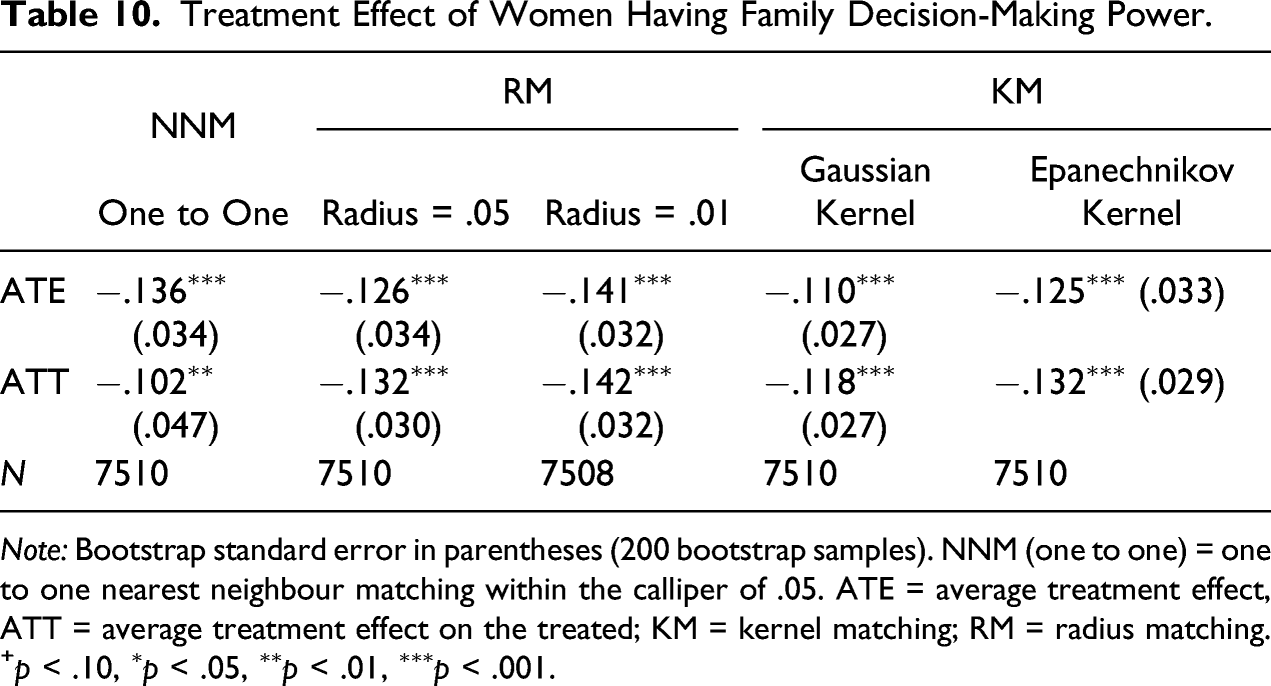
Note: Bootstrap standard error in parentheses (200 bootstrap samples). NNM (one to one) = one to one nearest neighbour matching within the calliper of .05. ATE = average treatment effect, ATT = average treatment effect on the treated; KM = kernel matching; RM = radius matching.
+p < .10, ∗p < .05, ∗∗p < .01, ∗∗∗p < .001.
Test of Balance of Matched Sample across Covariates.
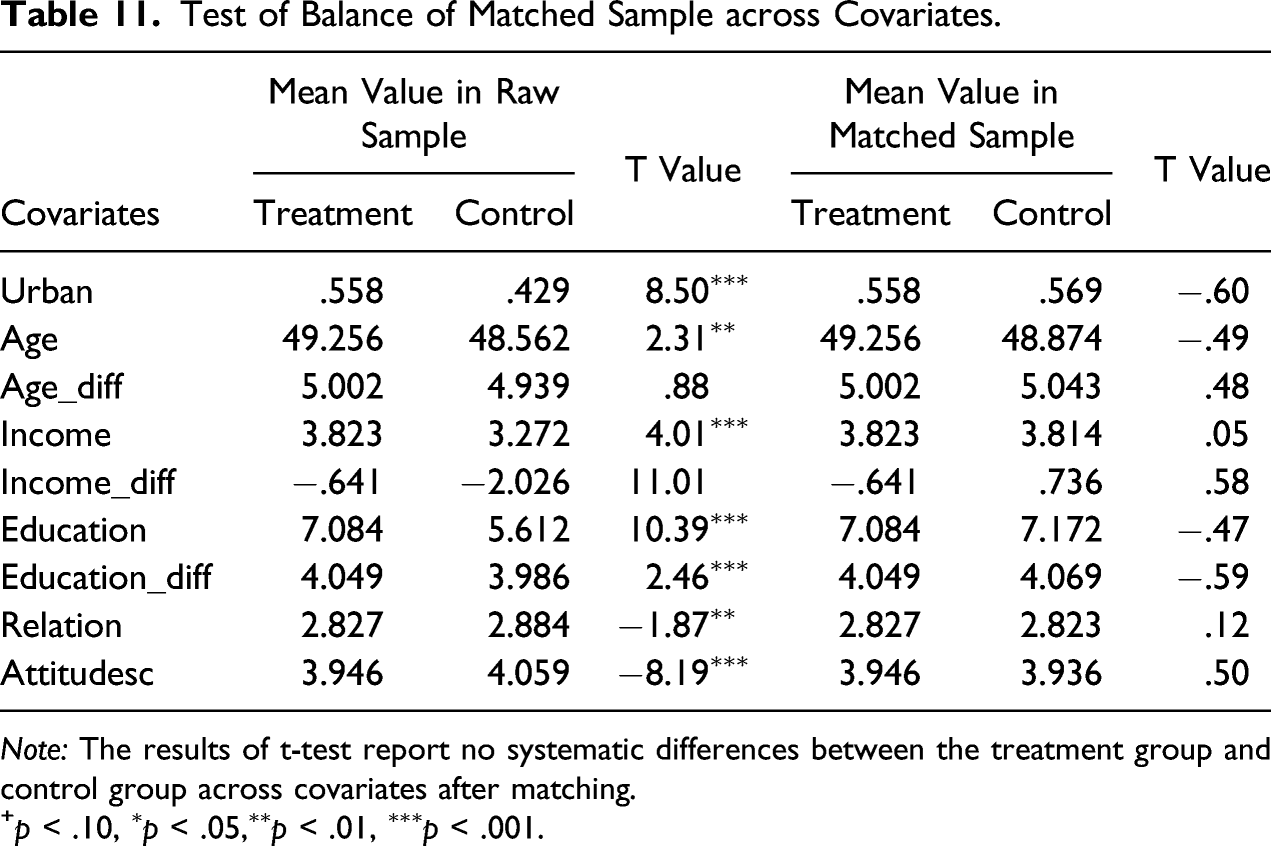
Note: The results of t-test report no systematic differences between the treatment group and control group across covariates after matching.
+p < .10, ∗p < .05,∗∗p < .01, ∗∗∗p < .001.
Test of Balance About Matching Equality.
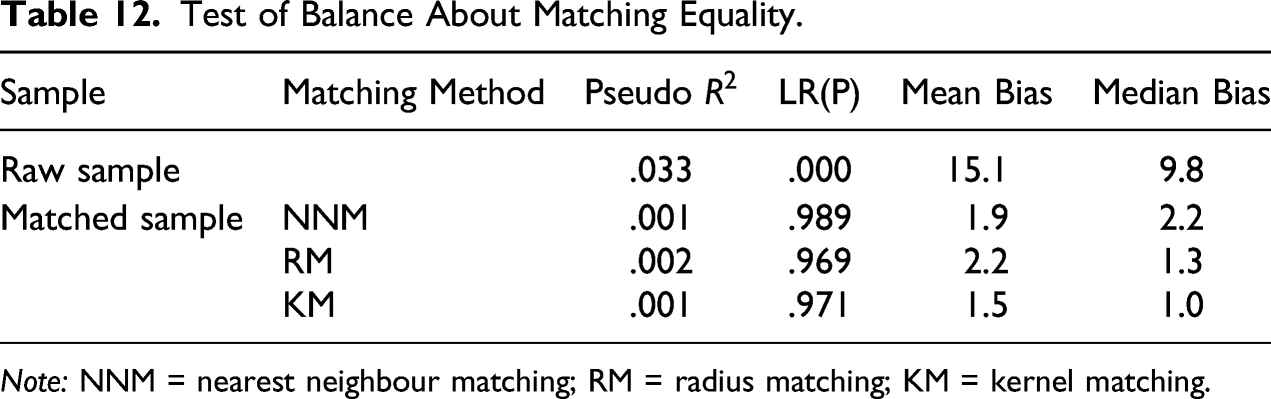
Note: NNM = nearest neighbour matching; RM = radius matching; KM = kernel matching.
Discussion and Conclusion
Discussion
With modernization in China, the family status of Chinese women has been unprecedentedly high. They are catching up with and even surpassing men in many fields, especially in higher education (Wang et al., 2019). In some places of China, there exists the phenomenon of ‘household husbands’. Men oversee the household chores and women earn money to feed the family, consequently, women have become independent decision-makers in family affairs. The reached consensus is that such improvement of women’s family status does favour women’s welfare, consequently improves their SWBs. However, our research shows that, overall, women’s control over family decision-making power negatively affects their happiness. It is particularly significant among those with less education and lower SES. Therefore, the counter-intuitive findings have important academic and policy significance. First, when studying women’s happiness academically, it is necessary to consider the social and cultural environments around. The backgrounds at the community-level will directly affect both family power relations and members’ happiness. Hence, the improvement of women’s decision-making power may not necessarily improve their happiness. Only when women’s own traditional attitudes and self-esteem are considered, can the direction of the happiness effect of women’s decision-making power be finally confirmed.
Second, in Confucian culture, ‘men managing the outside and women the inside’ is a common social norm in many places of China. Although in recent decades, with economic development and increasing self-awareness, this phenomenon has been greatly changed, cultural norms rooted in society have not undergone substantial changes. Previous research shows that happiness and life satisfaction have been rising in general, but it is significantly higher for better-educated and higher-SES segments of population. This originates from an unequal distribution of economic resources during social transformation. Consequently, it makes those women with less education and lower SES have to depend on their spouses for a better life. So, they at the bottom of the society not only abide by the traditional norms again but also cannot accept those crossing this norm. Meanwhile, they gradually lose recognition of their own value and advantages, and thus again adhere to the traditional gendered division of labour. Once this social norm is changed or broken, they will show inadaptability even oppose this social evolution, consequently reducing their happiness. In this regard, the findings can guide government policies to remove social and cultural barriers in front of disadvantageous women, and nurture their self-esteem and self-confidence to challenge stereotyped minds and institutions. Meanwhile, the government should design outcome-oriented policies to keep economic resources more equally distributed during social transformation.
Recently, women’s position in the labour market relative to men’s has deteriorated significantly in China. The two-child policy further reinforces the unequal positions of women in job-seeking and promotion. Ongoing tense family-work conflicts make media and society reemphasize the traditional gender-based division of labour among Chinese men and women (Attané, 2012). For example, some official media label ‘career-oriented women’ as ‘irresponsible to household needs’. This has pressed women to form a family-oriented value system, where household needs are the top priority. Besides, various public prejudices against ‘leftover women’ have exacerbated the panic and anxiety of single women. Thereby, they have to consider marriage and childbirth much earlier. Even for some educated women, the traditional dual responsibilities of family and work have split among them, but they have not been able to fundamentally get rid of the dependence on adult men. Under this social context, many Chinese women still have strong incentives to marry up to achieve a better living standard through marriage. Hence, the backbone role of the husband and the assistant role of the wife remain firmly in place in the families nowadays (Qian & Qian, 2014). We expect the trend will last for a period of time not until women overcome both visible and invisible pressures imposed by social norms.
The study found some important facts on family power relations and women’s happiness in contemporary China. Nevertheless, we would note there remain some limitations in the study. Firstly, compared to previous studies on individual’s happiness, the study not only controls the individual’s own demographic variables but also considers the spouse’s demographic variables. However, there may still be omitted-variable bias. For example, the lack of variables related to women’s personality traits, especially ‘the Big Five’ in the CFPS may overestimate the happiness effect of women being the masters of the family. Previous studies have shown that personality traits explain about 50% of individual’s happiness differences. Compared with demographic variables, life events and environmental factors, personality traits are more correlated with happiness (Lyubomirsky, Sheldon, & Schkade, 2005). The ongoing data collection related to personality traits might provide a basis for further estimation of the happiness effect of women’s family decision-making power.
Secondly, the data used is from 2012 which is 9 years ago, and there has been considerable economic growth in the past decade. So, the results are contingent on an earlier point in time, and the suitability in the current socio-economic climate is concerning. As for this, although the latest CFPS 2018 is released, only the 2012 survey data collected the most comprehensive indicator of family decision-maker in important family affairs (and financial affairs) and individual’s happiness. Additionally, the latest research shows that with economic and social modernization, there have been huge changes in people’s ideas, attitudes and family behaviours, for example, delayed marriage and rising singlehood and premarital cohabitation, but unlike that in Western countries, the trends and patterns of the Chinese family are changing only slowly. Overall, the traditional norms still play a dominant role in shaping family behaviours (Yu & Xie, 2021). Given this finding, we expect that the conclusions from the study still hold up in the current socio-economic settings.
Conclusion
The article uses the CFPS to study the relationship between women’s family decision-making power and their happiness. Overall, based on our analysis, the article mainly draws the following three conclusions. First, after controlling for related variables, we find that women’s family decision-making power reduces their happiness, given the stronger traditional norm force around. Second, heterogeneity analysis shows that for women with less education and lower social status, the negative happiness effect of family decision-making power is particularly significant due to unequal distribution of economic resources. Third, traditional attitudes and self-esteem are two possible factors causing a negative happiness effect above. Those women constrained by their traditional attitudes lack sufficient self-confidence to challenge inherent social norms. So, they tend to accept the tradition of ‘men being the masters of the family’ and gradually internalize it a part of themselves. Therefore, whenever we study women’s well-being, we should situate it in a specific social context.
Footnotes
Declaration of Conflicting Interests
The author(s) declared no potential conflicts of interest with respect to the research, authorship, and/or publication of this article.
Funding
The author(s) received no financial support for the research, authorship, and/or publication of this article.
Informed Consent
Informed consent was obtained from all individual participants included in the study.
