







Abstract
This study explored the association of quality of life (QOL) during the pandemic with family climate and family integrity. Participants were 1085 parents from Turkey. According to the findings, the participants’ QOL, which demonstrated their judgments regarding their physical health, mental well-being, social relations, and general happiness, was greatly influenced by the COVID-19 pandemic. Women were seen to have lower perceptions in relatedness in the family and cognitive cohesion than male participants. While there was a positive, but low, association between the variables, there were positive and high correlations between cognitive cohesion and relatedness in the family. When the mediation analyses were evaluated, it was concluded that QOL predicted the sense of family coherence alone, while intergenerational authority influenced other variables. The results highlighted the importance of family climate–based prevention and intervention targeting the promotion of family coherence.
COVID-19, which began to permeate throughout the world as a frightening new disease at the start of 2020, has become a global crisis through its spread and contagious effects every day. It has a major negative impact on the health, economy, society, and security of communities (Lloyd-Sherlock et al., 2020; Pierce et al., 2020; Rajkumar, 2020; UN Women, 2020; World Health Organization, 2020). National governments have begun to struggle against the destruction of the health sector, with sudden changes in the psychological, social, economic, and political fields, by choosing life above economies and further expansion. This pandemic, which exhibits serious symptoms, such as a respiratory tract disease, shows different courses according to age groups. While it shows a mild disease course in the younger population, it may cause serious symptoms and an increased risk of mortality, especially among older people and those with prior health problems (Bialek et al., 2020; Ludvigsson, 2020). As a result of the course of this disease and mortality rates, many countries have set strict rules in order to counter the outbreak. In addition to these strict practices, individuals are expected to implement their own social distancing measures that have a wide impact on family and working life (Mohler et al., 2020; Newbold et al., 2020; Pratt & Frost, 2020).
As stated above, countries are experiencing both the lockdown and the individual social isolation process to control the pandemic (Newbold et al., 2020). Within this context, individuals encounter reflections of the pandemic with examples, such as accessing schools through distance education, suspending direct contact with elderly relatives, decreasing economic production, and so on. Studies emphasize that this situation leads to the risk of an individual’s sense of confusion, uncertainty, and fear; these factors can also increase the individual’s risk of experiencing psychological problems (Conway et al., 2020; Erçetin et al., 2020; Mckibbin & Fernando, 2020; Wang et al., 2020).
One social institution shaped by our unstable living conditions during the pandemic is undoubtedly the family (Luttik et al., 2020). The family, which is emphasized as important in the formation of social relationships and personality (Winefield & Harvey, 1996), contributes to socialization processes with its distinctive features, such as strengthening networks; spending quality time; sharing love; developing self-confidence and appreciation; and teaching values, rituals, and traditions. In addition, the family traditionally includes roles such as attachment, caring, parenting, and social support, which depict duties and commitment to each other on family members. In providing these, the family climate and family coherence are important concepts for the well-being of family members (Björnberg & Nicholson, 2007; Steijn et al., 2015). However, like the COVID-19 pandemic, the stress that emerges as a result of changes in or outside the family affects its functioning positively or negatively, but it brings about a harmonization process (Lindström & Eriksson, 2011).
The sense of the family’s coherence can be mentioned in the completion of a well-established family relationship. The sense of family coherence refers to the family’s efforts to cope with stress, and the cognitive perceptions, and intra-family communication patterns of the family members in the face of challenging events (Çeçen, 2012; Eriksson & Lindström, 2005). In addition, Sagy and Dotan (2001) define family coherence as the family’s cognitive perceptions of the world and the effort to deal with the disruptive effects of unwanted life events. In previous studies, it has been emphasized that as family members' ability to cope with negative life experiences or cohesion skills increases, they become stronger and increase the individual’s sense of coherence (Çeçen, 2007, 2012).
One of the main factors that can affect family coherence is the family climate. The family climate consists of certain dimensions, such as intra-family relationality, intergenerational authority, and cognitive cohesion (Gönül et al., 2018). For example, the cognitive cohesion involving similar views, common interests, attitudes, and beliefs and close sharing in the family contributes positively to family decision-making processes, family functionality, and harmony (Gönül et al., 2018). With these dimensions, a positive family climate is thought to be a driving force that supports the socialization process of the family and society with its positive features, such as trust, self-confidence, assertiveness, positive emotional attachment, and autonomy (Cantero-García & Alonso-Tapia, 2017). In addition, in the light of previous research, it can be said that this is positively associated with the family relationality, life satisfaction and psychological well-being, social integrity, and harmony, including social interaction, open communication, positive family relationships and members' cohesion, coping skills, and decision-making styles used in difficult situations (Delhey & Dragolov, 2016; Hamama & Arazi, 2012). Considering the effects of the pandemic on an individual’s life, it is possible that the unusual conditions due to the pandemic may change family authority structures and their integration in common values, attitudes, and judgments. However, new studies are needed to determine this situation.
Family coherence can be expected to be a determinant of an individual’s quality of life during the pandemic period. Chwaszcz et al., (2021) state that economic, social, psychological, and health shortages in an individual’s life in the pandemic may seriously affect quality of life. Similarly, as emphasized above, the pandemic has brought about the restructuring of daily life, especially at the family level, and all family members have experienced the stressful impact of quarantine and/or social distancing on their quality of life. The changing quality of family life can damage important functions, such as domestic trust, which is the one indicator of cognitive coherence (Gönül et al., 2018). In addition, given that the integrity of family members with their values, perspectives, attitudes, and beliefs is an indication that their cognitive cohesion is fulfilled (Gönül et al., 2018), an individual’s cognitive cohesion may be positively affected by their quality of life and their family’s coherence levels. In other words, it can serve as a mediating effect on these two variables. In addition to these things, the family climate, which consists of dimensions, such as intergenerational authority and cognitive coherence (Çeçen, 2007; Erçetin et al., 2020; Gönül et al., 2018) can be expected to be predictive of family integrity and an individuals' quality of life. According to Bronfenbrenner’s ecological system theory (1992), family is an important factor that influences an individual’s life. Similarly, the theory asserts that an individual’s behavior can also affect his/her family and other social environment (Bronfenbrenner, 1992; Shelton, 2018). Given this mutual interaction between the individual and the family, the sense of family coherence may have been influenced by family climate and the individual’s life satisfaction. In addition, three dimensions of family climate (intergenerational authority, relatedness in the family, and cognitive cohesion) may mediate the relationship between the individuals' quality of life and family coherence. These three dimensions are also important in providing an open communication environment within the family, having the right to free expression, communicating, having roles, reacting emotionally, and showing necessary attention (Gönül et al., 2018; Prime et al., 2020). However, since such a pandemic has been experienced worldwide for the first time, it is not known how or to what extent which factors affect family coherence during the pandemic process. Considering that the pandemic process may take even longer (World Health Organization, 2020), determining the relationships between these variables can guide prevention and intervention studies.
In conclusion, it is thought that emotions, such as uncertainty, pressure, and stress caused by restrictions in the social area for the protection of public health due to the pandemic affect the psychosocial well-being of individuals and families (Chatterjee et al., 2020; Luttik et al., 2020). As a result of the increase and decrease of time spent by the core or extended families, the interactions can be differentiated and this change may affect the family’s structure and function. Creating a psychological and social-emotional well-being in the family as a social institution is beneficial and important, not only for the individual, but also for society (Prime et al., 2020). Prime et al. (2020) state that adversity due to the pandemic may be interrupted at multiple junctures, through research in the areas of child and family well-being and mental health, to limit its reach when threats to the family occur. Similarly, Pratt & Frost, (2020) state that we need to know immediately and measurably how people are affected by the COVID-19 pandemic. Given that there will also be long-term mental and physical health consequences of the pandemic (Luttik et al., 2020), it is important to determine the effect of the pandemic on people’s quality of life and to determine the extent to which the pandemic predicts family cohesion and family climate within the scope of individuals' quality of life.
The Aim of the Study and Hypothesis Development
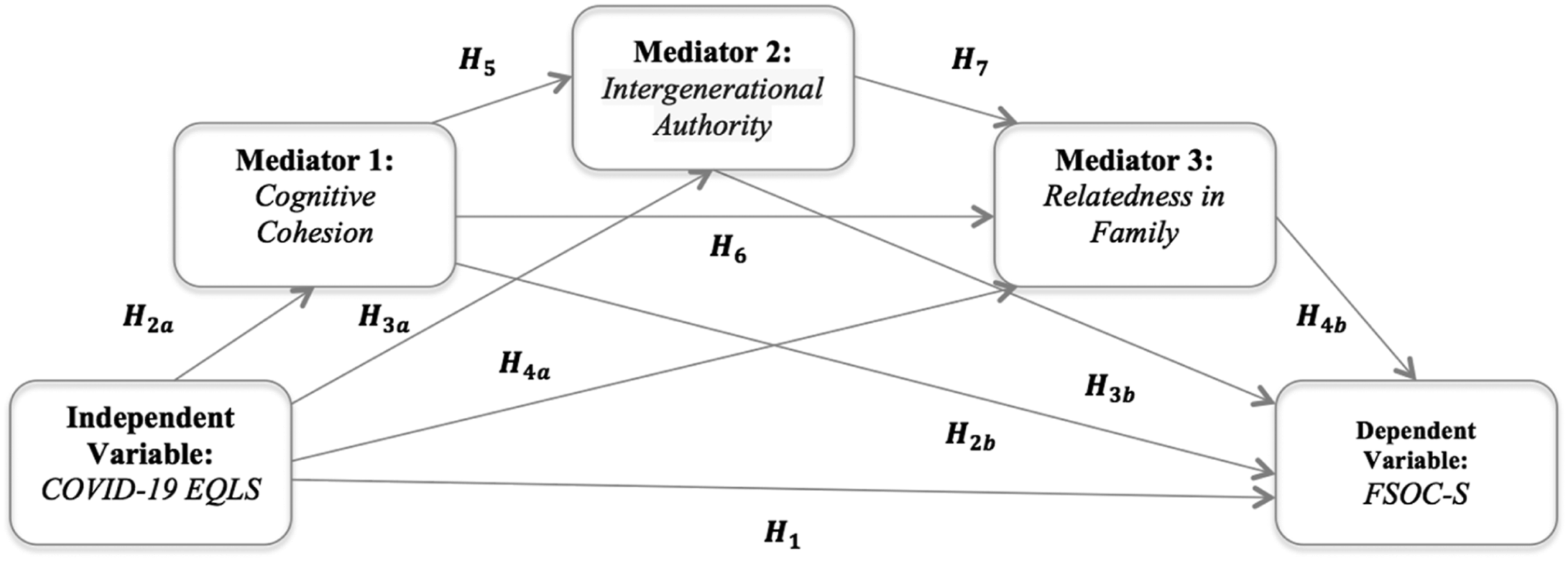
In the present study, we aim to determine the association of quality of life (QOL) during the pandemic with family climate and family integrity. A second aim is to determine whether the influences of the cognitive cohesion, intergenerational authority, and relatedness in the family are stronger than the direct influence of the quality of life on the family’s sense of coherence during the outbreak of COVID-19. For this purpose, we reviewed the relevant literature and formulated the following hypotheses in this study (see Figure 1): Hypothesized model.
Methods
Participants and Study Setting
According to the report of the Turkey Statistical Institute (TÜİK, 2019), there are 64,072,097 people in the population of Turkey over the age of 19. The sample size was determined as 1085 with a 3% margin of error using the simple random sampling method. After ethics committee approval (Ankara Hacı Bayram Veli University Ethics Committee -2020/134), online surveys were sent to participants from 15th May until 15th of June. A number of the participants who were living without children or adolescents (n = 88), with less than two family members (n = 0) and who were unwilling to participate in the study (n = 25) were excluded (see Figure 2). The final sample size was selected as 955. In addition, this study used STROBE reporting guidelines to strengthen the reporting, the transparency of results, and the quality of observational studies (von Elm et al., 2014). Definition of participation process by flowchart. Note. TUİK = Turkey Statistical Institute.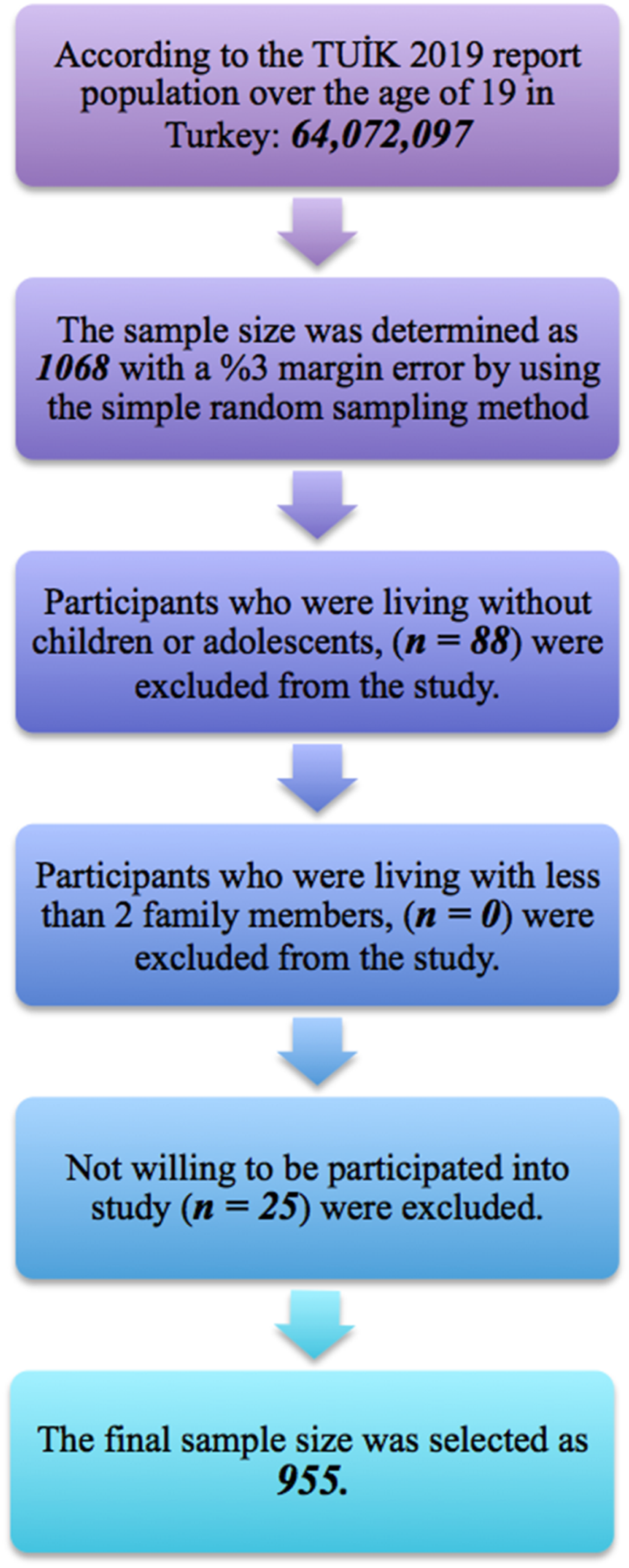
In the study, author/s initially communicated with the teachers working in schools. The teachers announced the study during their online meetings with students' parents and provided the researcher’s contact information to those willing to participate in the study. Before sending the Google online survey to the participants who contacted the researchers by email and cellular devices, the students' parents were informed about the scope of this study, both verbally and in online written form, and asked them to consent to participate in the study. After obtaining consent from the participants regarding their participation in the study, the link of the Google online survey was sent to the parents via email and cellular message.
In addition to the above, in this descriptive cross-sectional study, the participants were aged between 25 and 65. Among the participants, the marital status is described as 11.1% single (n = 106) , 86.2% married (n = 823), and 2.7% divorced (n = 26). The level of education of the participants were as follows: 15.4% primary school (n = 147), 11.6% secondary school (n = 111), 13.9% high school (n = 133), 43.8% associate or undergraduate degree (n = 418), and 15.4% master’s degree or PhD (n = 146)
Measures
The COVID-19 Pandemic’s Effect on Quality of Life Scale (COVID-19 EQLS)
The COVID-19 EQLS is a newly developed scale by Erçetin et al., (2020). The validity and reliability of the scale were also performed (Erçetin et al., 2020). The scale has four sub-dimensions: the psychological (13 items), social (4 items), professional (4 items), and familial effects (8 items). The total number of items are 29. The scale measured the levels of being affected by COVID-19 with a four-point scale. The levels are (1) I am affected at a very low degree, (2) I am affected at a low degree, (3) I am affected, and (4) I am affected at a very high degree. The COVID-19 EQLS scale’s scores classification is defined as [1–1.76]: no or low effect; [1.77–2.48]: moderate effect; and [2.49–4]: high effect. When all of the validity and reliability results are evaluated together, the COVID-19 EQLS is a suitable measurement tool that can be used psychometrically (Erçetin et al., 2020; Potas et al., 2021). In this context, the internal consistency estimates for each subscale are as follows: α = .93 for psychological effect; α = .79 for social effect; α = .86 for professional effect; and α = .94 for familial effect. Furthermore, the Cronbach alpha was found as .89 for the entire scale (Erçetin et al., 2020). In this research, COVID-19 EQLS’ Cronbach alpha is .81. Example items from the COVID-19 EQLS are “I do not communicate with others due to the epidemic,” “The pandemic reduced my excitement to work,” and “The pandemic has disrupted my social life.”
For convergent and discriminant validity of COVID-19 EQLS, the participants were also asked to complete the WHO Well-Being Index (WHO 5-item), EUROHIS—Developing common instruments for health surveys (EUROHIS-QOL 8-item), Beck Anxiety Inventory (BAI 21-item), and Beck Hopelessness Scale (BHS 20-item) (Beck, 1988; Beck et al., 1988; Buratta et al., 2003; Heun et al., 2001). The coefficients of correlation were considered as follows: small validity
Short Form of the Family Sense of Coherence Scale (FSOC-S)
The FSOC-S was originally developed as 26 items by Antonovsky & Sourani (1988), and then a 12-item short form of the scale was created by Sagy (1998). The scale was adapted to Turkish by Çeçen (2007). The scale measures the sense of family coherence of adolescents and adults (Antonovsky & Sourani, 1988; Sagy, 1998). The scale is a 7-point Likert type self-assessment scale. High scores obtained from the scale indicate that the individual’s family has a high sense of integrity. Çeçen (2007) determined that the scale was suitable for a three-dimensional structure on a sample specified as a result of factor analysis (n = 437). It was observed that the first factor “comprehensibility” consisted of four items (4, 8, 9, and 10), the second factor “manageability” consisted of five items (1, 2, 3, 5, and 6), and the third factor “meaningfulness” consisted of three items (7, 11, and 12). The FSOC-S’ scores classification is evaluated as no or a low sense of family coherence (12–35.99), a moderate sense of family coherence (36–59.99), and a high sense of family coherence (60–70) (Çeçen, 2007). In reliability studies, the internal consistency coefficient of the scale (n = 437) was α = .80 and the test–retest (n = 55) reliability was α = .85. In this research, the Cronbach alpha was calculated as α = .74. Furthermore, example items from the FSOC-S are “How much do you have the feeling that you can influence what is happening in your family?” “To what extent do you have the feeling of not knowing exactly what will happen in your family?” and “Do you feel that you have been treated unfairly by your family?”
The Family Climate Scale (FCS)
The scale, originally developed by Björnberg and Nicholson (2007) as a six-factor scale, was adopted to Turkish by Gönül et al. (2018). Results supported a three-factor with 34 items in the Turkish sample. It was determined that the first factor “relatedness in the family” (21 items) explained 43% of the variance, the second factor “intergenerational authority” (7 items) explained 10.12%, and the third factor “cognitive cohesion” (6 items) explained 5.14%. In terms of reliability, the internal consistency coefficient (α) was found as α = .91 for the all items of the scale, α = .95 for the relatedness in the family, α = .87 for the intergenerational authority, and .87 for the cognitive cohesion. In this research, the internal consistency coefficient was .85 for the relatedness in the family, .78 for intergenerational authority, and .73 for cognitive cohesion.
Items are rated on a 5-point scale, with responses ranging from 1 to 5 (strongly disagree = 1 and strongly agree = 5). The scores for each subscale are calculated separately. The higher values indicate that the area evaluated by the person is highly cared and/or experienced in the family, while the lower values indicate that the evaluated area is not very important and/or experienced in the family. Furthermore, example items from the FCS are “The emotional bonds between us are very strong,” “We are generally happy to be together,” and “When we stay apart for a while, we miss each other.”
Statistical Analysis
Mean, Standard Deviation, and Correlations Among Variables.
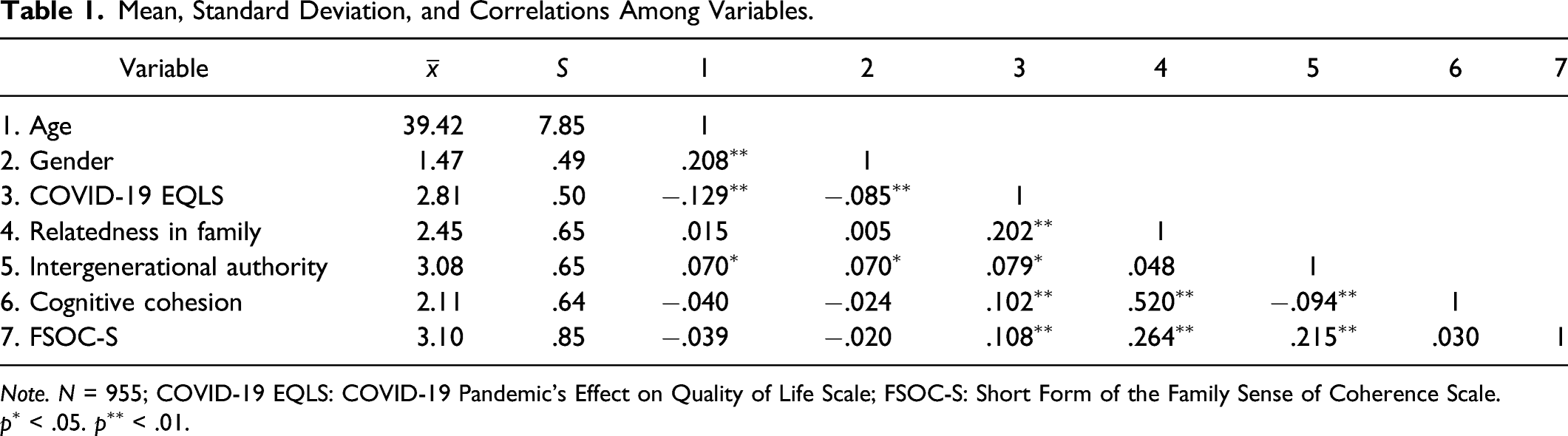
Note. N = 955; COVID-19 EQLS: COVID-19 Pandemic’s Effect on Quality of Life Scale; FSOC-S: Short Form of the Family Sense of Coherence Scale.
Results of Mediation Analysis and Triple Mediation Analysis.
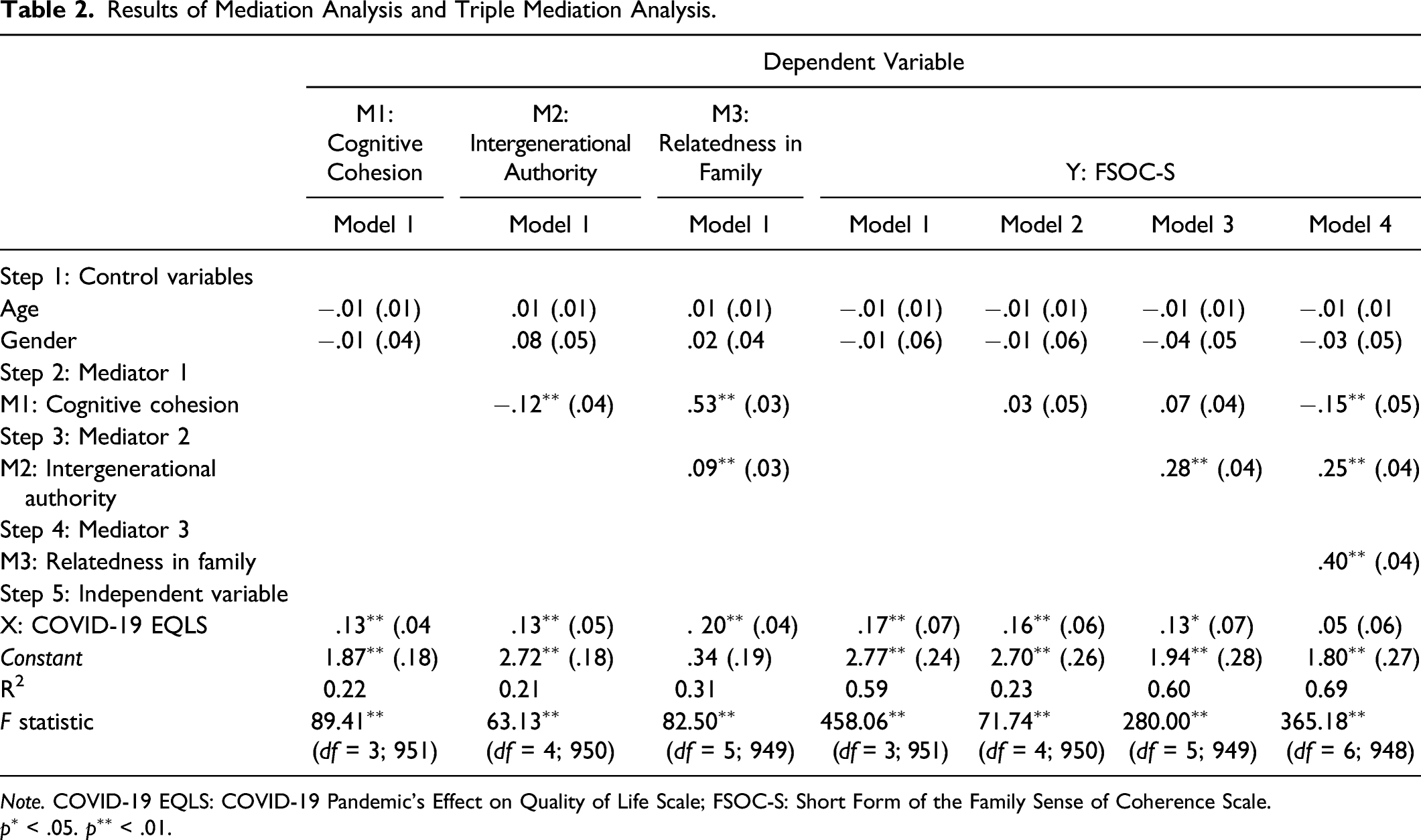
Note. COVID-19 EQLS: COVID-19 Pandemic’s Effect on Quality of Life Scale; FSOC-S: Short Form of the Family Sense of Coherence Scale.
Results
In this study, 47.1% (n = 450) of the participants were male. The participants' mean age and the SD was 39.42
The first mediator (M1) was tested using simple mediation analysis. COVID-19 EQLS (X) influenced FSOC-S (Y). The model 1 (
COVID-19 EQLS (X) influenced cognitive cohesion (M1). The model 1 (F = 89.41, df = 3; 951,
The two mediators (M1–M2) were tested using dual mediation analysis. COVID-19 EQLS (X) and cognitive cohesion (M1) influenced intergenerational authority (M2). Model 1 (F = 63.13, df = 4; 950, p < .01), and the coefficient of COVID-19 EQLS, and cognitive cohesion (β = −.12, p < .01) were statistically significant. Therefore, the
The three mediators (M1-M2-M3) were tested using triple mediation analysis. COVID-19 EQLS (X), cognitive cohesion (M1) and intergenerational authority (M2) influenced relatedness in the family (M3). Model 1 (
Cognitive cohesion (M1) influenced intergenerational authority (M2). The model (F = 6.47, df = 3; 951,
In the results of the mediation, dual mediation’s two conditions were not met, and the triple mediation analysis shows that two conditions were met, and then full mediation is supported. The total indirect effect of the confidence interval of the bootstrapping excluded zero. This means that the total indirect effect was statistically different from zero. If each indirect effect was examined: The indirect effect of (COVID-19 EQLS → Cognitive cohesion → FSOC-S, COVID-19 EQLS → Intergenerational authority → FSOC-S, COVID-19 EQLS → Cognitive cohesion → Intergenerational authority → FSOC-S, COVID-19 EQLS → Cognitive cohesion → Relatedness in the family → FSOC-S, COVID-19 EQLS → Intergenerational authority → Relatedness in the family → FSOC-S and COVID-19 EQLS → Cognitive cohesion → Intergenerational authority → Relatedness in the family → FSOC-S) confidence interval of the bootstrapping exclude zero.
Discussion
In this study, we aim to examine the effects of the pandemic on people’s quality of life, family climate, and family integrity. According to the findings, the participants’ quality of life, which demonstrates the participants’ judgments regarding their physical health, mental well-being, social relationships, and general happiness in regard to their lives (Kratz et al., 2017) is highly affected by the COVID-19 pandemic. In addition to this, in this study, it was found that the pandemic’s effect on an individual’s quality of life influences the sense of family coherence and the family climate which consists of cognitive cohesion, intergenerational authority, and relatedness in the family during the COVID-19 outbreak. Moreover, the family climate mediates the relationship between the individual’s quality of life and family coherence. However, while cognitive cohesion influences intergenerational authority and relatedness in the family, intergenerational authority does not influence relatedness in the family. Similarly, intergenerational authority and cognitive cohesion do not mediate the relationship between an individual’s quality of life and family coherence.
When the literature is examined, similar to this study, it can be seen that the quality of life of individuals is adversely affected by both disease-related symptoms and differentiated living conditions, especially in studies conducted during the COVID-19 pandemic period (Pelicioni & Lord, 2020; Spinelli et al., 2020). The finding that women have lower perceptions in relatedness in the family and cognitive cohesion than men in this study is again compatible with the literature. Although there has been no research on women’s sense of family climate during the pandemic period, important international organizations, such as the UN Women (2020); World Health Organization (2020), warn that women may be affected by gender inequality. When evaluated in terms of gender, these two dimensions of family climate may create more disadvantages for women, especially due to culturally shaped gender roles, such as caring family members, increasing domestic workload, and decreasing economic freedom during the pandemic period. We can say that family relatedness, which expresses the integrity of perceptions, solutions, and problems provided as social support by family members to each other in challenging situations does not work for women in the COVID-19 period. A similar situation exists for the findings of women’s cognitive coherence, which expresses common values, attitudes, and ways of thinking. According to the results of Yin & Zeng (2020) with clinical nurses, relatedness defined as an interpersonal relationship demand is associated with an increased need for face-to-face communication with families during the pandemic period (Yin & Zeng, 2020). In addition, in a study by van Der Vegt & Kleinberg, 2020 regarding gender difference in the COVID-19 period, it is emphasized that the anxieties and worries of women were mostly associated with family members and loved ones, while men mostly focused on the economic effects of the pandemic (van Der Vegt & Kleinberg, 2020). In brief, these findings can be interpreted as an indicator that women do not feel mentally or emotionally integrated with family members in solving problems, communicating, or adapting during the pandemic. On the other hand, this situation is not valid for intergenerational authority. Given that intergenerational authority has a slightly high score for all participants, it can be seen that both women and men in the family agree on the increase in the authority of the elderly. However, considering the other findings of the study on intergenerational authority, it can be seen that the authority of the elderly does not increase family coherence and relatedness in the family, and it does not mediate the relationship between an individual’s quality of life and family coherence.
As it is known, intergenerational authority has determined the degree of freedom or restriction in family work relations from generation to generation (Björnberg & Nicholson, 2007). Considering the health consequences of the pandemic and pandemic restrictions, particularly affecting the elderly, it can be thought that the pandemic causes the elderly to need more authority over the younger generation at home. However, since this situation did not increase family coherence according to the findings, an increase in intergenerational authority can cause problems, such as domestic conflict and violence. In fact, Duncan et al. (2020) emphasize that elderly parents in the home may also experience domestic violence in addition to an increased risk of mortality from COVID-19 (Duncan et al., 2020). However, in order to reach a definite opinion on this issue, causal studies are needed.
This study finds that the effect of the COVID-19 pandemic on quality of life influences the sense of family coherence and family climate. Although there has been no research on a subject similar to this study in the literature, similar findings were obtained regarding quality of life in pre-pandemic studies (Kimhi et al., 2010; Krok, 2016; Lucia & Breslau, 2006; Ngai & Ngu, 2011; Wiesmann et al., 2014). Accordingly, quality of life is an important factor in family coherence, and as the pandemic’s effect on quality of life increases, family coherence and family climate decrease. Given that family climate mediated the relationship between the individual’s quality of life and family coherence, it can be thought that families whose quality of life is affected negatively during the pandemic are at risk in terms of familial problems; for example, conflict or violence. However, if the family climate level is good, it could reduce the effect of quality of life on family coherence. Although there has been no research on a similar subject as this study, the literature provides support for evidence that family climate (Phillips, 2012) and a sense of family coherence (Juang & Alvarez, 2010; Moen et al., 2016) are significantly related with mental health and well-being.
Another finding of this study is that while the COVID-19 pandemic’s effect on quality of life also influences cognitive coherence, cognitive coherence is not influencing it. This is also relevant in the
Another important finding of the study is that the predictive effect of the COVID-19 pandemic on quality of life, intergenerational authority and cognitive cohesion influences relatedness in the family. In other words, the predictive effect of the pandemic on quality of life alters the relatedness within the family by enabling individual members to have the right to free expression, to communicate, have roles, to react emotionally, and to show the necessary attention. The authority experience of different generations, and common feelings, and understandings affect the relatedness within the family. Similarly, relatedness in the family, intergenerational authority, and cognitive cohesion dimensions representing family climate differentiate the sense of family coherence that controls the family’s structure and functioning. Similar with this finding, Neubauer et al. (2020) found that a positive climate with the relatedness in the family, intergenerational authority and cognitive cohesion improves family coherence and the expectation of individuals by increasing their motivation, autonomy, competence, and relatedness as well as their overall quality of life (Neubauer et al., 2020). Additionally, investigating the variables of quality of life and mental health during the SARS outbreak in 2003, Lau et al. (2006) report that social and family support increased during that period by providing more time for support and care for family members (Lau et al., 2006). When all of the results are evaluated together, it can be seen that the predictive effect of quality of life on family coherence is not only direct, but also indirect by affecting the family climate. Lastly, when the relationship between the three dimensions that make up family climate is evaluated, it is found that cognitive cohesion influences intergenerational authority
This study has several limitations. Given the limited data available and the time sensitivity of the pandemic outbreak, it is limited to the chosen method and sampling techniques. Therefore, it can be said that the participants, who were selected by an online sampling method, may not reflect a true universal model. In addition, the reported psychological health, isolation, and pandemic effect is based on the participants' own statements, and this may not be consistent with an assessment by mental health professionals. Despite these limitations, during the pandemic period, much valuable information has been obtained. To the best of our knowledge, this is the first study to report the quality of life and family functionality during the COVID-19 pandemic. In the light of this information, psychological support may be offered to individuals and families and a content of psychological support can be created. For example, the impact of the pandemic on a family’s quality of life can be reduced by strengthening the family climate. In addition to these, authorities could consider setting up mental health teams to deal with psychosocial issues and provide psychological support to individuals and families through community-based programs and strategies. Regular screening of families could be conducted to evaluate quality of life and any familial problems therein.
Footnotes
Acknowledgments
All authors contributed to the study conception and design. Material preparation, data collection, and analysis were performed by Şefika Şule Erçetin, Nihan Potas, and Şuay Nilhan Açıkalın. The first draft of the manuscript was written by Nilay Neyişci and Nilüfer Koçtürk, and all authors contributed and commented on previous versions of the manuscript. All authors read and approved the final manuscript.
Declaration of Conflicting Interests
The author(s) declared no potential conflicts of interest with respect to the research, authorship, and/or publication of this article.
Funding
The author(s) received no financial support for the research, authorship, and/or publication of this article.
Compliance with Ethical Standards
All procedures followed were in accordance with ethical standards of responsible communities on human experimentation (institutional and national) and with the Helsinki Declaration of 1975, as revised in 2000.
