







Abstract
Some criminologists have focused on understanding the role of childhood experiences on an individual’s likelihood of offending during adulthood. Although research has consistently linked these two phenomena, little is known about the extent to which childhood victimization influences later criminal behavior. The current study analyzed self-reported data to examine the abused–abuser relationship in the context of intimate relationships. Specifically, the study examined the direct effects of victimization across three types of offending, and whether or not individual characteristics in such a relationship were significant mediators. Using a multivariate OLS regression, a significant relationship was observed between childhood victimization and adulthood offending. Likewise, results revealed that individual characteristics significantly mediated this relationship. Policy implications of these observations are discussed.
Introduction
The relationship between victimization and offending has been an oft-studied topic within criminology (see Gottfredson, 1981; Jennings, Piquero, & Reingle, 2012; Lauritsen & Laub, 2007; Lauritsen, Sampson, & Laub, 1991). While some studies have focused on the victim–offender overlap by assessing factors that account for an offender’s propensity to become a victim (Broidy, Day, Crandall, Klar, & Jost, 2006; Jennings et al., 2012; Maldonado-Molina, Piquero, Jennings, Bird, & Canino, 2009), others have concentrated on explaining the etiology of offending by looking at an individual’s victimization history. There is some research showing that victims can become offenders later in life, drawing on social learning theory (modeling of behavior) and general strain theory (using the strain of being victimized and then coping with aggression) (Cohen et al., 2002; Ogloff, Cutajar, Mann, & Mullen, 2012). A recent meta-analysis by Jespersen et al. (2009) revealed a significant connection between experiencing past sexual abuse and engaging in sexual offending behavior. This and similar studies lend credence to the abused–abuser hypothesis.
The abused–abuser hypothesis has been mainly tested in sexual assault situations, with the vast majority of other offenses excluded. Accordingly, the current study empirically examines the influence of childhood victimization on adulthood offending in the context of intimate partner violence (IPV). A focus on the lasting adverse consequences of childhood victimization is important for a variety of reasons, but mainly because of the devastating effects of victimization—especially sexual assault—on children (Afifi & Macmillan, 2011; World Health Organization, 2005). For example, according to the World Health Organization, children who are exposed to IPV have an increased likelihood of engaging in violent behavior as children and later as adults as compared to those who have not been exposed to IPV. Similarly, Afifi and Macmillan (2011) identified numerous adverse consequences of victimization such as poor performance in school, aggression, and criminal conduct. These consequences set the stage for problematic outcomes throughout adolescence and into adulthood. In the past, the issue of the abused becoming abusers has been approached from different methodological perspectives, including longitudinally (Salter et al., 2003), cross-sectionally (Aebi, Landolt, Mueller-Pfeiffer, Schnyder, Maiser, & Mohler-Kuo, 2015; Schraufnagel, Davis, George, & Norris, 2010), and through systematic reviews and meta-analyses (Jennings et al., 2012; Stith, Rosen, Middleton, Busch, Lundeberg, & Carlton, 2000).
The present study utilizes a cross-sectional methodological approach to assess the effects of childhood exposure to violence or abuse on the likelihood of engaging in offending as young adults. Specifically, the study achieves the following objectives. First, it examines the direct effect of childhood victimization on adult offending behavior. Second, it examines the mediation effects of demographic characteristics and other variables in the relationship between victimization and offending. This exploration is done across three major types of intimate relationship violence. By focusing on violence in intimate relationship (IRV), this study contributes to the fields of victimology and criminology in several meaningful ways. For instance, earlier research on the abused–abuser hypothesis has mainly focused on understanding whether sexual assault victimization can lead to sexual offending. Although this work has been useful, it provides limited knowledge of the relationship between offending and victimization. There are other types of victimization that individuals may experience during childhood, and one cannot rely on the current literature to know whether non-sexual victimizations will lead to violence/offending behavior later in life. The current study addresses this limitation by focusing on three main types of IRV: sexual assault, physical assault, and emotional/psychological abuse. Furthermore, this study expands on existing efforts by drawing attention to the important role of other variables in mediating the victimization–offending connection. Findings from this endeavor may serve as a springboard for developing practical policies to address a great threat to society—IRV.
Theoretical Foundation: Social Learning and the Abused–Abuser Relationship
Several developmental, psychological, and criminological theories have been developed to explain the abused–abuser hypothesis. These theories include attachment theory, which suggests that there is a positive correlation between childhood insecure attachment and negative behavioral outcomes such as aggression, violent, and criminal offending (Chakhssi, Ruiter, & Bernstein, 2013; Ford, Chapman, Connor, & Cruise, 2012; Grady, Levenson, & Bolder, 2017; Miner, Romine, Robinson, Berg, & Knight, 2014; Park, 2016; Shillkret & Shillkret, 2011); control theory, which uses power and control as precursors of violence, where more powerful individuals are able to use force or threats to secure obedience from less powerful individuals, mostly children and women (Bostock, Auster, Bradshaw, Brewster, Chapin, & Williams, 2002; Goode, 1971; Loseke, 2005); and social learning theory, which proposes that violence and aggression are learned behaviors (Fite et al., 2008; Malley-Morrison & Hines, 2004). All these theories are convincing and have been empirically tested and examined. However, this study focuses on social learning theory as its theoretical framework because of the generalizability of the theory’s propositions. In fact, social learning theory posits that violence and aggression are learned through imitation, role modeling, and observation can apply to all contexts and crime types (see McCloskey & Lichter, 2003), and it is this potential that makes the theory appealing for the current study.
Social learning theory argues that behavior is learned, and that people model their behavior based on what they observe from others (Bandura, 1973, 1977; Burgess & Akers, 1966). Children imitate behaviors they observe their family members and caregivers engaging in or are exposed to themselves; thus, there is the possibility for learning and modeling both vicariously and directly. According to this theory, violence and aggression are learned through role modeling provided by these individuals either directly or indirectly (Malley-Morrison & Hines, 2004). Malley-Morrison & Hines, 2004 believed that people become violent toward others, especially family members, because they learn violent conduct through operant conditioning and observation. They suggest that children who grow up in violent familial or non-familial environments where people respond to stress and frustration with anger, aggression, and violence have an increased risk of engaging in similar behavior as adults (Malley-Morrison & Hines, 2004). Proponents of this theory believe that family members or caregivers not only expose children to violence and its associated techniques but also train children to accept or approve the use of violence as a normal practice (Fite et al., 2008; Gelles, 1972; Hare et al., 2009).
The general propositions of this theory can be summarized as follows: first, individuals (children) will commit their first violent acts as a result of a constellation of factors, such as internalizing social definitions that approve the acts and perceptions of reward and punishment, especially how their own offenses are rewarded or punished (Akers, 1998). Second, people will continue to offend due to their desire to overcome issues associated with their own victimization experiences, such as trauma, stress, anxiety, emotional disturbances, and addiction (Veneziano, Veneziano, & LeGrand, 2000).
Several empirical studies provide support for the abused–abuser hypothesis, arguing that experience of violence/victimization as a child is related to general patterns of aggressive/violent behavior, both as a child and as an adult (Aebi et al., 2015; Burton, 2003; Burton, Miller, & Shill, 2002; DeLisi, Kosloski, Vaughn, Caudill, & Trulson, 2014; Glasser, Kolvin, Campbell, Glasser, Leitch, & Farrelly, 2001; Jespersen, Lalumiere, & Seto, 2009; Nunes, Hermann, Malcom, & Lavoie, 2013; Ogloff et al., 2012; Simons, Wurtele, & Durham, 2008; Veneziano et al., 2000; White & Widom, 2003). For example, Jespersen et al. (2009) reviewed several studies that compared sex offenders to non-sex offenders and found a significantly higher rate of past sexual abuse among sex offenders than among non-sex offenders. Similarly, Glasser et al. (2001) adopted a retrospective approach to identify whether victims of child sexual abuse would become offenders of such behavior. The authors reviewed clinical case notes involving 843 individuals and reported that male victims of child sexual abuse had a higher risk of becoming child sexual offenders later in their life. Ehrensaft, Cohen, Brown, Smailes, Chen, and Johnson (2003) conducted a prospective study involving a randomly selected sample of children and their mothers to test the effects of exposure to domestic violence between parents; the authors found that observing violence between parents predicted perpetration of partner violence in later life.
Two recent studies also provide empirical support for the relationship between victimization and offending within the context of sexual abuse/assault. Aebi et al. (2015) analyzed self-reported data from a nationally representative sample of more than 6600 ninth-graders in Switzerland, which offered credence to the argument that children exposed to violence are more likely to exhibit violent behavior themselves. Specifically, the authors observed that victims of contact sexual abuse and non-contact sexual abuse were significantly more likely to report coercive sexual behaviors. This observation was true for both male and female students. Moreover, DeLisi et al. (2014) examined a large dataset containing information on more than 2500 adjudicated juvenile male offenders incarcerated in a major southern state facility to identify potential effects of childhood sexual abuse on sexual offending and other forms of crime. Consistent with other studies, the authors observed a strong effect of victimization on sexual offending and a marginal effect on other forms of crime such as homicide and property crimes.
The above studies help to explain the etiology of offending by providing support for the abused–abuser hypothesis. Still, there may be ample opportunity for other correlates of offending to mediate the relationship between victimization and offending. Many scholars believe that certain factors serve as mediators of the victim-to-offender cycle, and such factors play a significant role in determining whether an abused person will proceed to become an abuser (Glasser et al., 2001; Lambie, Seymour, Lee, & Adam, 2002; Lisak, Hopper, & Song, 1996). Glasser et al. (2001) observed the effect of the victim’s relationship with the perpetrator on a victim’s propensity to become an abuser. Similarly, Lambie et al. (2002) revealed that arousal related to abuse, masturbating and fantasizing about the abuse, and comfort or pleasure obtained from the abuse could largely affect a victim’s likelihood of victimizing others.
Additionally, some researchers have noted that not every person who is victimized becomes a victimizer, arguing for what is called the resilience thesis (Lambie & Johnston, 2016; Leach, Stewart, & Smallbone, 2016; Salter et al., 2003; Thomas & Fremouv, 2009; Widom & Ames, 1994). Researchers have variously found insignificant percentages of offenders with prior histories of abuse/victimization. For example, Salter et al. (2003) found that about 12% of the sample they studied became sexual abusers, with the majority refraining from offending. Similarly, Leach et al. (2016) conducted a prospective longitudinal birth cohort study of more than 38,200 males with a history of maltreatment and found that only about 3% of the sexually abused boys became sexual offenders.
The relationship between the abused and the abuser is more complex than most of the existing research suggests. It is not a straightforward relationship and given the fact that extant research examining the cycle of violence has extensively focused on sexual offending, there is room for further examination of this relationship across different crime contexts/forms. Based on the key propositions of the social learning perspective, the current study examines the abused–abuser connection across three major forms of IRV by assessing (1) direct effects of victimization on offending and (2) mediation effects of individual characteristics and exposure to sexual harassment in abused–abuser relationship. The following hypotheses are tested: 1. Individuals that were exposed to sexual violence or abuse as children will have greater likelihood of engaging in criminal behavior as an adult. With this hypothesis, it is expected that a. exposure to sexual assault/abuse will increase one’s propensity to engage in sexual assault offending in intimate relationship. b. Exposure to sexual assault/abuse will increase one’s propensity to engage in physical assault offending in intimate relationship. c. Exposure to sexual assault/abuse will increase one’s propensity to engage in emotional abuse offending in intimate relationship. 2. Individuals that were exposed to physical violence or abuse as children will have greater likelihood of engaging in criminal behavior as an adult. With this hypothesis, it is expected that a. exposure to physical assault/abuse will increase one’s propensity to engage in sexual assault offending in intimate relationship. b. Exposure to physical assault/abuse will increase one’s propensity to engage in physical assault offending in intimate relationship. c. Exposure to physical assault/abuse will increase one’s propensity to engage in emotional abuse offending in intimate relationship. 3. Individuals that were exposed to emotional abuse as children will have greater likelihood of engaging in criminal behavior as an adult. With this hypothesis, it is expected that a. exposure to emotional abuse will increase one’s propensity to engage in sexual assault offending in intimate relationship. b. Exposure to emotional abuse will increase one’s propensity to engage in physical assault offending in intimate relationship. c. Exposure to emotional abuse will increase one’s propensity to engage in emotional abuse offending in intimate relationship. 4. We hypothesized that individual characteristics and later experiences of violence/abuse will mediate the relationship between victimization and offending.
Method
Participants and Procedures
Descriptive characteristics of respondents in the study (n = 537)1.
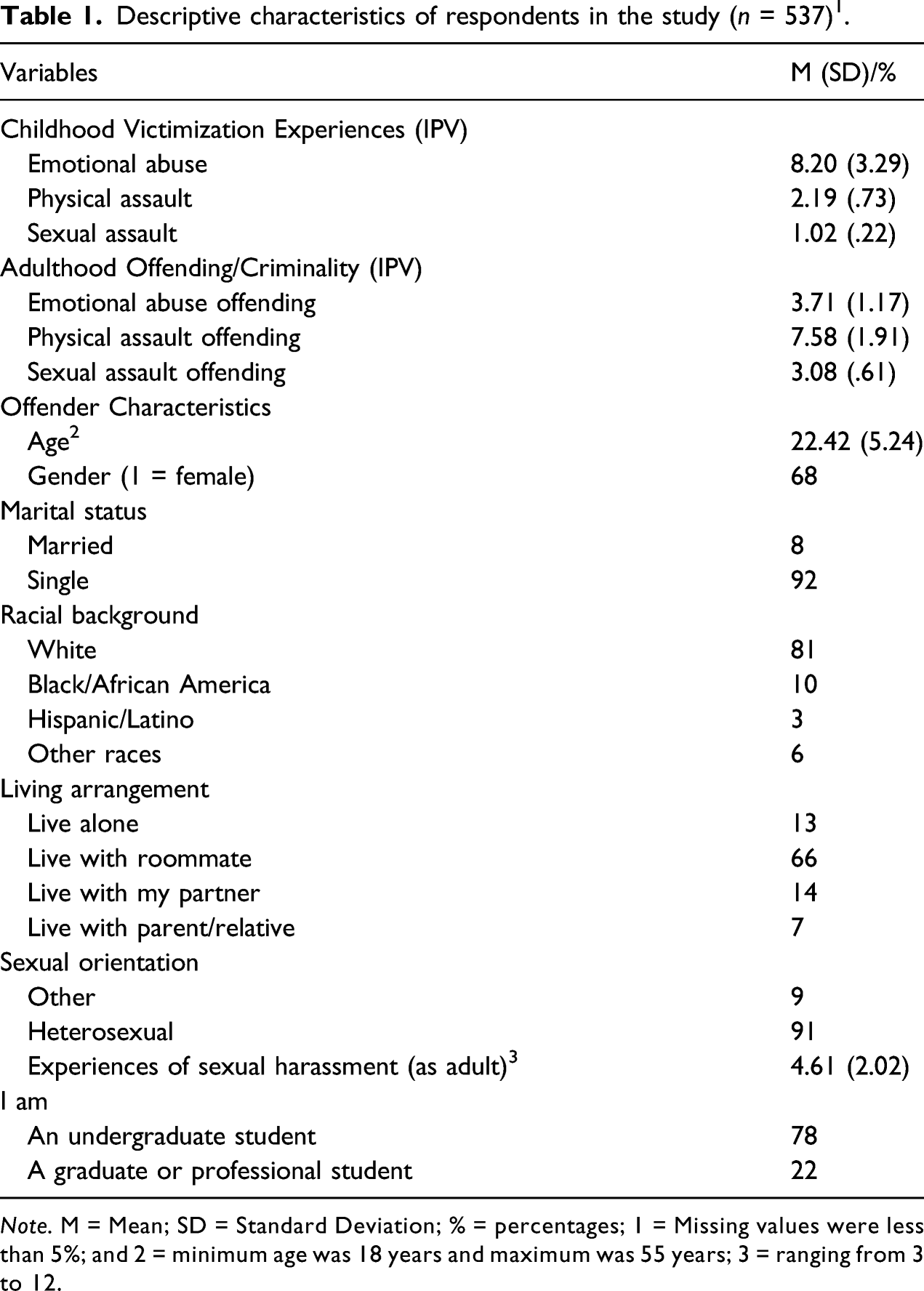
Note. M = Mean; SD = Standard Deviation; % = percentages; 1 = Missing values were less than 5%; and 2 = minimum age was 18 years and maximum was 55 years; 3 = ranging from 3 to 12.
Measures
Outcome variables
Intimate partner offending was the main outcome variable in the study. This was assessed using 13 items adapted with modification from the National Intimate Partner and Sexual Violence Survey (2010) and the National Violence Against Women Survey (2000), which was sponsored by the National Institute of Justice. The items had the same lead-in question asking respondents to indicate how frequently they had committed certain offenses against their partners. Factor analysis provided support for three different forms of IPV offending.
Sexual offending was measured with three items: “Sexual touching against your partner’s will”; “Attempted sexual penetration (vaginal, anal, or oral intercourse) against your partner’s will”; and “Sexual penetration (vaginal, anal, or oral intercourse) against your partner’s will.” The factor loadings of these items ranged from 0.74 to 0.96, with an alpha value of 0.74, indicating good internal consistency for the scale.
Physical assault offending was assessed using seven items: “You put your partner down in front of family and/or friends”; “You pushed, grabbed, or shoved your partner”; “You slapped your partner”; “You kicked or bit your partner”; “You beat your partner up”; “You hit your partner or tried to hit your partner with something”; and “You choked your partner.” The items were summed to form a scale (factor loadings ranged from 0.67 to 0.84) with an alpha value of 0.86.
Three items were used to measure emotional abuse: “You insulted or swore at your partner”; “You threatened to hit or throw something at your partner”; and “You threatened your partner with a gun or a knife.” The emotional abuse scale (factor loadings ranged from 0.68 to 0.87) had an alpha of 0.44. All the items were assessed on a four-point scale with 1 = never, 2 = once or twice, 3 = 3 to 10 times, and 4 = more than 10 times.
Independent variables
The effects of three types of childhood victimization experiences were examined as predictors of the outcome variables. Items used to measure these forms of victimization asked respondents to report on their experiences before the age of 16 years. Sexual assault victimization was measured with a single item, asking respondents to indicate the number of times parents/caregivers forced them to have sex (vaginal, anal, or oral intercourse) against their will. Two items were combined to form the physical assault victimization scale: “Parent/caregiver choked you” and “Parent/caregiver beat you up.” Emotional abuse victimization was measured using six items: “You saw your parent/caregiver push, grab, or shove your other parent/other caregiver”; “You saw your parent/caregiver put your other parent/other caregiver down in front of family and/or friends”; “You saw your parent/caregiver insult or swear at your other parent/other caregiver”; “You saw your parent/caregiver beat up your other parent/other caregiver”; “You saw your parent/caregiver choke your other parent/other caregiver”; and “Parent/caregiver threatened you with a gun or a knife.” As indicated by a factor analysis, these items measured the same underlying construct (factor loadings ranged from 0.65 to 0.89) and were combined to form an additive scale with an alpha of 0.81, suggesting good internal consistency.
Mediating variables
Several individual characteristics were included in the models as mediators. Age was measured as a continuous variable asking respondents to indicate their age (in years) at the time of survey administration. Gender was dichotomously measured as 0 = male and 1 = female. Also, marital status was measured as 0 = married and 1 = single. Race was a categorical variable with 1 = white, 2 = Black, 3 = Hispanic, and 4 = other races. The “white” category was used as the reference category. Equally, respondents’ living arrangement was categorically assessed as 1 = live alone, 2 = live with roommate, 3 = live with my partner, and 4 = with parents. Living alone was the reference category. Respondents’ sexual orientation was assessed as 0 = other and 1 = heterosexual. Finally, the effect of one’s adulthood experiences was also assessed. Experiences of sexual harassment as an adult was measured using three items that delved into whether respondents had experienced sexual harassment from their following students: For the past 12 months, how often did you experience (1) unwelcome remarks of a sexual nature from student(s); (2) unwelcome touching from student(s); and (3) repeated pressure for dates or sexual activity from student(s). These items were assessed as 1 = never, 2 = once or twice, 3 = 3 to 10 times, and 4 = more than 10 times. These items loaded on the same factor, with factor loadings ranging from .84 to .90 and 75% total variance explained. Subsequently, their responses were summed up to form sexual harassment scale, with an alpha value of .83, suggesting good internal reliability.
Plan of Analysis
To test the study’s hypotheses, several analyses were conducted. First, univariate and multivariate analyses were conducted to examine the distribution of responses and to estimate the effects of the predicting variables. Specifically, given that the three dependent variables were continuous measures, a series of ordinary least squares regression models were estimated to determine the relative impact of the independent variables on the dependent variables while controlling for other variables. Further, collinearity analysis was conducted to find out whether there was collinearity in our data that would raise concerns about multicollinearity. As indicated by the results of this analysis, none of the VIF values was greater than 10 and the tolerance values were all above .02 (none was below or closer to 0.01).
Results
Effects of Childhood Exposure to Violence on Adult Offending
The Influence of Victimization on Sexual Assault Offending (n = 341).
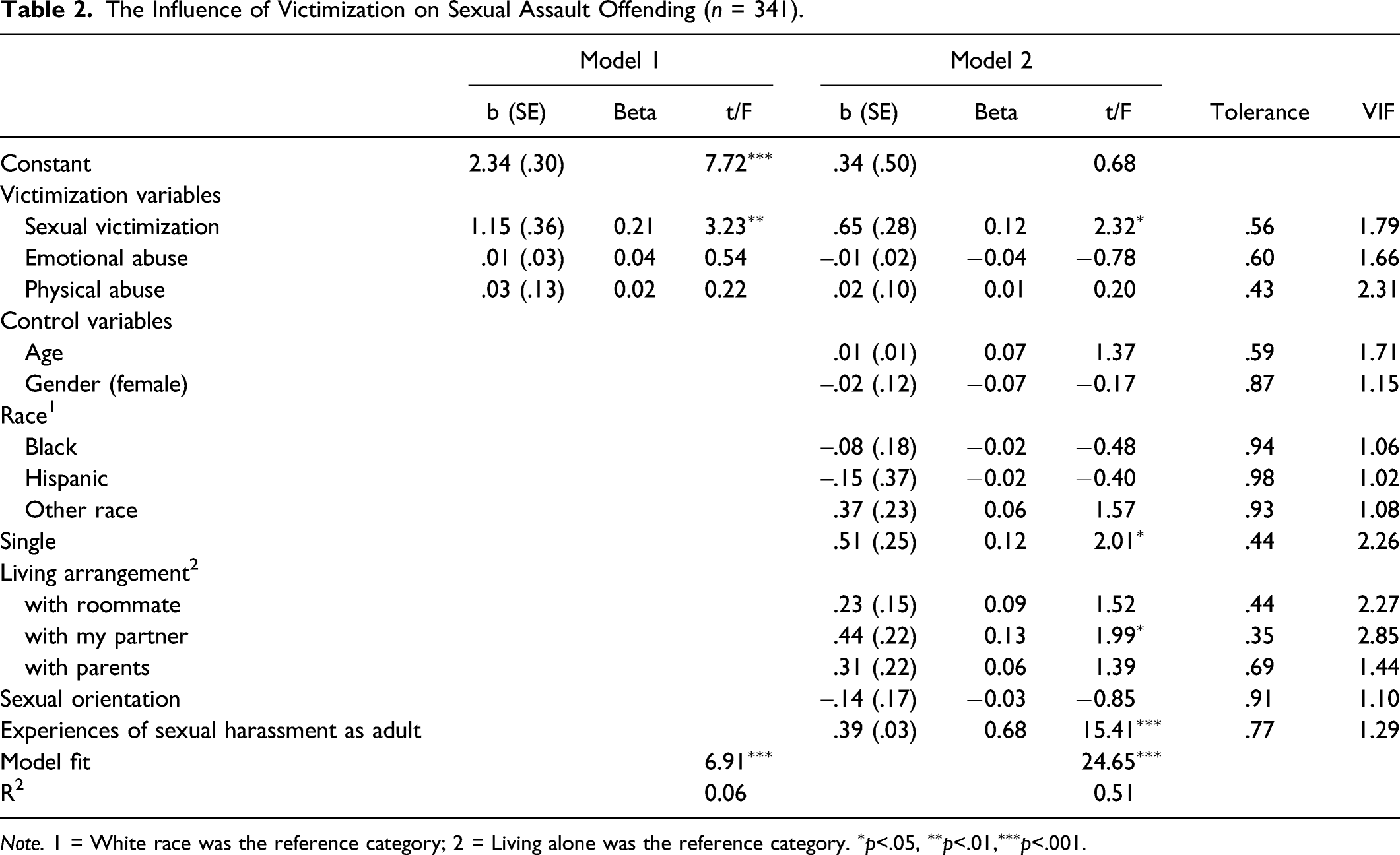
Note. 1 = White race was the reference category; 2 = Living alone was the reference category. ∗p<.05, ∗∗p<.01,∗∗∗p<.001.
The Influence of Victimization on Physical Assault Offending (n = 335).
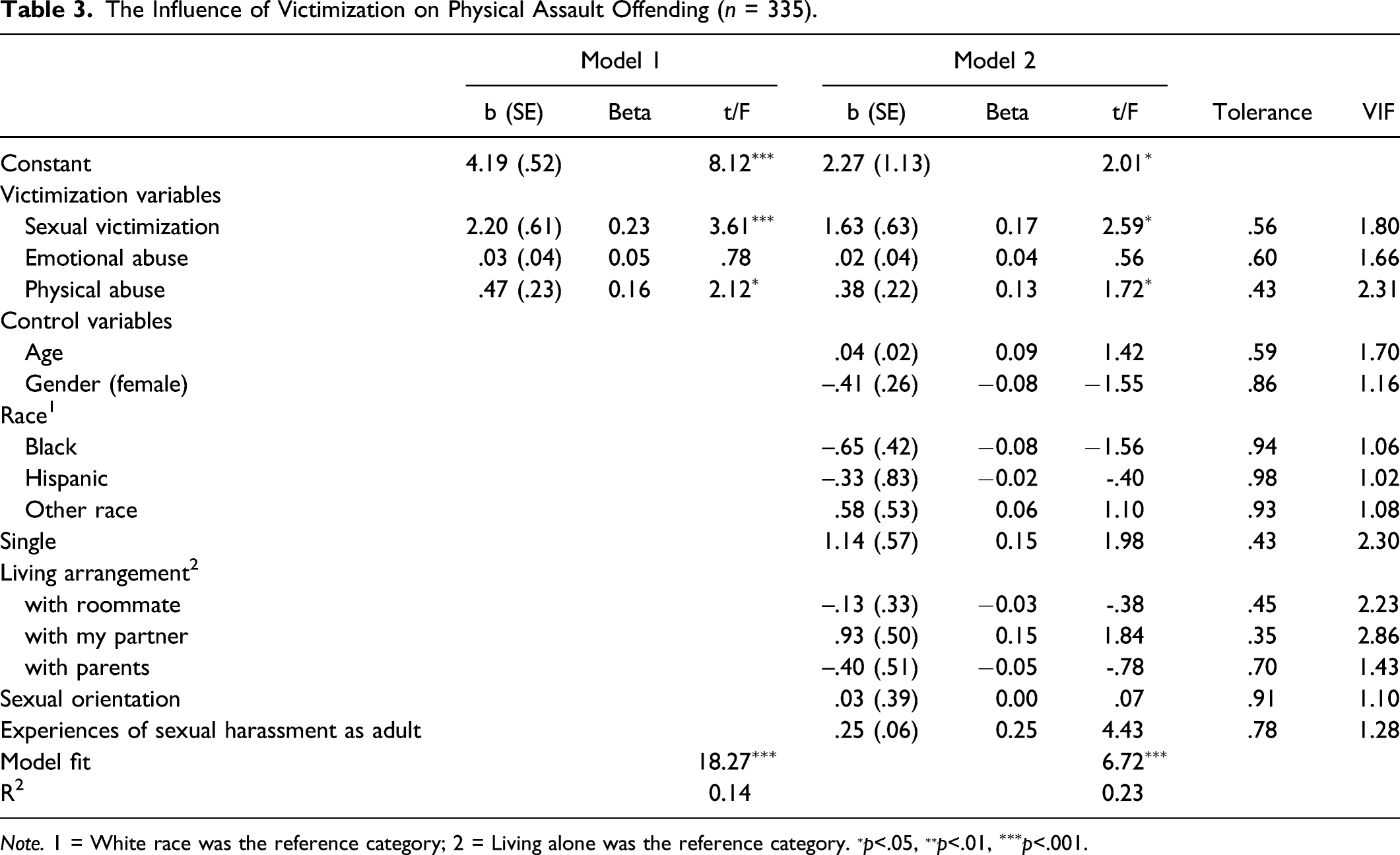
Note. 1 = White race was the reference category; 2 = Living alone was the reference category. ∗p<.05, ∗∗p<.01, ∗∗∗p<.001.
The Influence of Victimization on Emotional Abuse Offending (n = 336).
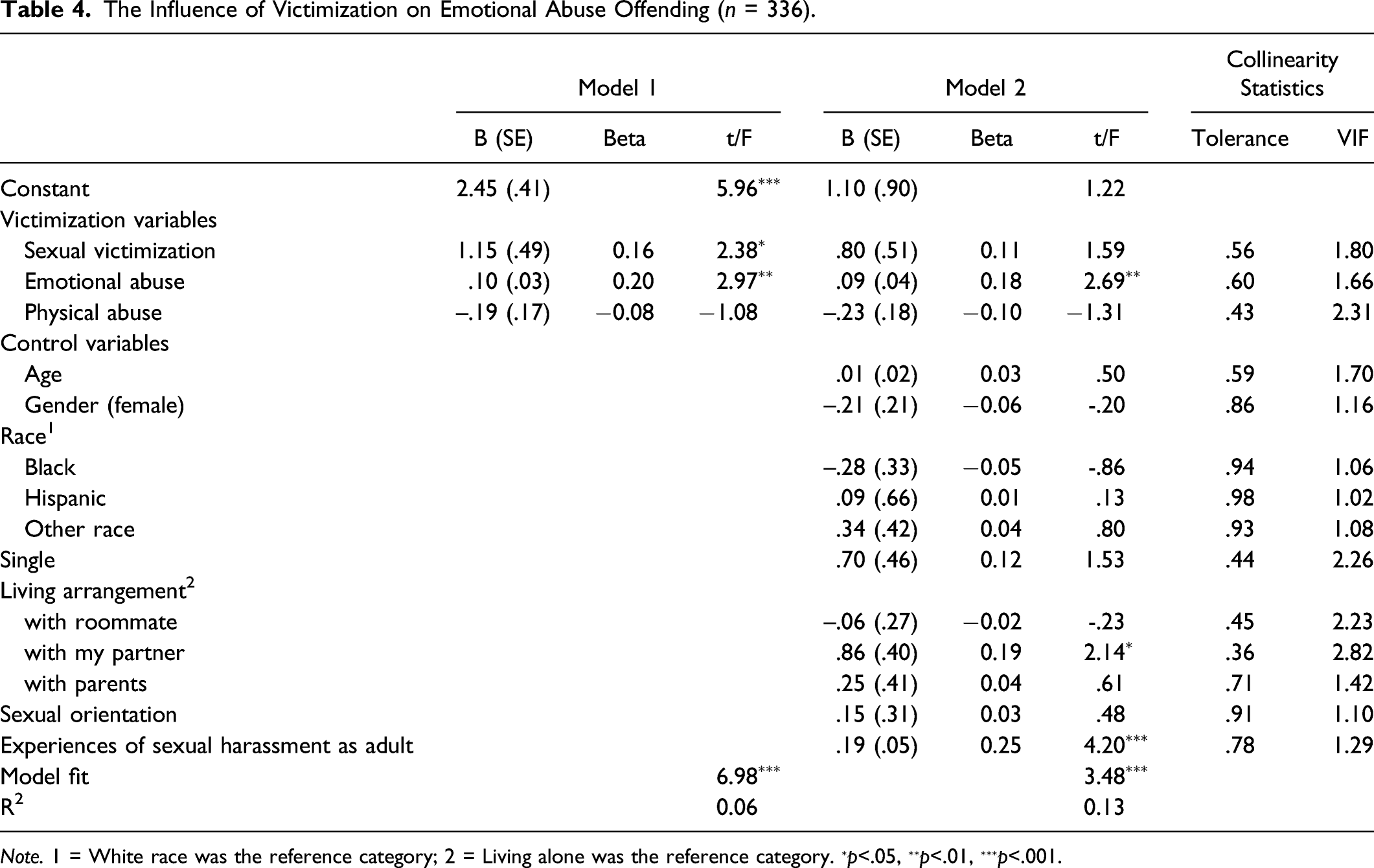
Note. 1 = White race was the reference category; 2 = Living alone was the reference category. ∗p<.05, ∗∗p<.01, ∗∗∗p<.001.
Discussion
The abused–abuser hypothesis has mainly focused on delineating the relationship between sexual victimization and sexual offending (Aebi et al., 2015; Glasser et al., 2001; Thomas & Fremouw, 2009), except for a few studies that included other forms of crime such as homicide and property crimes (DeLisi et al., 2014). These studies consistently suggest that victims of crime, especially sexual assault, have a greater likelihood of becoming offenders themselves. The present study extends existing knowledge on the abused–abuser thesis by examining the relationship between childhood victimization and adult offending across the three major types of violence in intimate relationship: sexual assault, physical assault, and emotional/psychological abuse. The goals of this study were (a) to examine the direct effects of childhood victimization on adult offending behavior and (b) to examine the mediation effects of demographic characteristics and other variables in the relationship between victimization and offending.
Results from the current analysis revealed two significant patterns. First, the study observed a direct effect of childhood victimization on adult offending, offering credence to existing findings and supporting the argument that children who are victimized during adolescence or pre-adolescence are most likely to become offenders in their adult life. The observation made in this study was true for all three types of violence. For instance, children who were sexually assaulted were found to have committed offenses such as sexual assault, physical assault, and emotional abuse against their partners as adults. Likewise, those who were either physically or emotionally abused engaged in similar offenses against their spouses or partners. These observations suggest a vicious cycle of violence that can be explained by revisiting the social learning argument about aggression and violence (see Malley-Morrison & Hines, 2004; Veneziano et al., 2000).
Social learning theorists have explained why people engage in criminal acts by arguing that criminal behavior is a learned behavior and that people become criminals through an elaborate learning process. Due to its generalizability, this theory is well suited to explain why people who have experienced childhood victimization may commit violence against their partners in intimate relationship. These people may have learned the languages and definitions of offending through their own victimization and become accustomed to such behavior, to the point that they may consider criminal offending a normal and socially accepted behavior. This may especially happen when their abusers were not punished for the crime. Another explanation could be the internal struggle that victims may undergo to overcome the negative consequences of their victimization. Research suggests that victims may cope by committing violence against others to unleash their frustration and to find internal peace (Veneziano et al., 2000). Victimizing romantic or intimate partners may therefore be viewed as a strategic option to put the past behind and move forward.
The second significant observation made in this study was regarding the mediating role that individual characteristics and experiences of sexual harassment as adult play in the relationship between victimization and offending. These variables partially and fully mediated the effects of victimization on offending. Specifically, when the variables were introduced into the models, the standardized coefficients of the victimization variables were reduced but remained significant, with the exception of sexual victimization which became insignificant in the emotional abuse offending model. One can therefore conclude that while individual characteristics have full mediation effects in the relationship between sexual victimization and emotional offending, they have partial mediation effects in the relationship between sexual and physical victimizations and sexual and physical assault offending. These observations are important especially given the role that individual characteristics play in criminal behavior. For instance, age has been recognized for decades as affecting whether an offender will desist or continue to offend throughout the life-course, the variable has not been examined to determine what role it plays in a victim’s propensity to become a perpetrator. Criminologists believe that the amount of crime an individual commit decreases after the age of 17 years, and as the person grows older, he/she may eventually stop offending. This argument is espoused by those who support the desistance perspective of criminal behavior (Cornelius, Lynch, & Gore, 2017; Hirschi & Gottfredson, 1983; Steffensmeier & Streifel, 1991; Sweeten, Piquero, & Steinberg, 2013; Ulmer & Steffensmeier, 2014; Wyse, Harding, & Morenoff, 2014). If this assertion is true, then it makes sense to suggest that age will decrease the amount of violence that a previously victimized person will commit against his/her partner or spouse.
There are two limitations to keep in mind as readers interpret the results of this study. First, the study used a cross-sectional approach in analyzing the issues discussed in this article. The disadvantage of this approach is that one cannot claim a causal relationship between childhood victimization and adult offending. To make such a claim, future research should rather use a longitudinal approach where data are collected over several time points. The second limitation has to do with the use of self-report data. Not only were the data analyzed collected at one-time point, but the study required respondents to report on their own victimization before the age of 16 years as well as their own offending behavior. Although using self-reporting is not bad, the data may be biased due to memory recall issues and inflated or deflated responses.
Despite the above limitations, the observations and findings of the current study have some policy implications. The observation that childhood victimization influences an individual’s likelihood to commit violence in intimate relationship such as sexual assault, physical assault, and emotional or psychological abuse highlights the need for early intervention to stop these incidents from escalating into serious criminal behavior in adult life. It is acknowledged that some previously victimized children do not grow up to become offenders (Lambie & Johnston, 2016; Thomas & Fremouw, 2009). However, it is important that a risk assessment strategy is put in place to identify at-risk children who have the potential of engaging in criminal activities. The adoption of modern risk assessment tools will also provide practitioners with information that will inform a child’s level and type of service needs. Given children who have a history of victimization are also more likely to experience psychological and emotional problems, it is imperative that trauma experts train service providers in the area of trauma-informed care. Attention to the unique needs of this population will not only increase responsivity to treatment but will ultimately reduce future criminal behavior.
In conclusion, the current study used college data to examine the direct and indirect effects of childhood experiences with violence on victims’ likelihood of becoming offenders. Despite its limitations, the findings obtained are significant and offer a meaningful contribution to the field of criminology; they highlight the need for effective early intervention mechanisms to identify at-risk children and help them effectively cope with the aftermath of victimization. This will eventually ensure that these children will grow up to become noncriminal adults and valuable members of the society.
Footnotes
Declaration of Conflicting Interests
The author(s) declared no potential conflicts of interest with respect to the research, authorship, and/or publication of this article.
Funding
The author(s) received no financial support for the research, authorship, and/or publication of this article.