







Abstract
This study explores whether cultural norms and economic performance shape the differences in the patterns of intergenerational exchanges, and analyzes whether structural, normative, or emotional dimensions of intergenerational solidarity predict the derived typology of intergenerational exchange in Taiwan before and after economic stagnation. Data derives from nationally representative samples of adult children with at least one parent alive in 2006 and 2016. Latent class analysis (LCA), measurement invariance with LCA, and multinomial logistic regression analysis are applied to analyze data. The results demonstrate how filial norms and economic stagnation influence the intergenerational exchange patterns. The study identifies five classes of intergenerational exchanges. There was a higher proportion of the high-exchange membership in the period of salary growth, while there was a higher proportion of the memberships of emotion-oriented exchanges during the wage stagnation period. Results reveal that geographic distance exerts a stronger and more consistent association with various exchange patterns.
Keywords
Introduction
Cultural norms and economic performance shape different patterns of intergenerational exchanges (Attias-Donfut, Ogg, & Wolff, 2005; Guo, Chi, & Silverstein, 2009; Park, Phua, McNally, & Sun, 2005). Filial piety—a norm regulating adult children’s behavior in a socially acceptable way in which they should provide not only monetary and instrumental support to their older parents but also respect and care—partially accounts for the difference in the direction of intergenerational transfer between East Asian and Western countries. Material and instrumental support predominantly flows upward in societies that share similar filial values (Hu, 2017; Park, et al., 2005), whereas financial transfer mainly from parents to adult children is apparently observed in Western counterparts (Hogan, Eggebeen, & Clogg, 1993). A cross-national study has shown that the extent of financial transfer between generations varies according to the economic development of each country (Attias-Donfut et al., 2005). Personal income is found to be positively related to monetary support (Lee, Parish, & Willis, 1994; Logan & Bian, 2003; Taniguchi & Kaufman, 2017). However, adult children’s intergenerational exchanges in response to normative expectations in different contexts of economic development remain unknown.
It is of note that the nature of kin support is reciprocal in the short or the long term (Hogan et al., 1993; Taniguchi & Kaufman, 2017). Understanding the bi-direction of flow (i.e., received and given) and three types of support (i.e., monetary, instrumental, and emotional) provides a comprehensive picture of intergenerational exchange. Most research that simply explores the patterns of intergenerational exchanges in a given time does not observe adult children’s intergenerational exchanges in response to normative expectations in two distinct economic stages. Lin (2012) compared Taiwanese data from 2001 and 2006, but this study simply reflects the differences in patterns of intergenerational exchanges in the period of wage growth and cannot observe the impacts of diverse economic conditions. The study examines how adult children exchange assistance with their own parents to fulfill filial obligations in different economic contexts, which would deepen the understanding of relevance of filial norms and economic environments in the field of intergenerational exchange patterns.
Drawn on the multi-dimension of the intergenerational solidarity model that posits six dimensions better capture the latent forms of solidarity and these dimensions to some extent are correlated (Silverstein & Bengtson, 1997; Yi & Lin, 2009), this study extends intergenerational solidarity research by analyzing the associations between different dimensions—namely, the relationship of geographic proximity, filial attitudes, and emotional closeness—with functional exchange between generations in different time points.
This study aimed to understand the roles of cultural norms and economic environments in shaping the differences in intergenerational exchange patterns between 2006 and 2016. The measurement invariance with latent class analysis (LCA) was tested to assess whether different memberships had the same meanings across two samples. A multinomial logistic regression model was used to examine whether geographic proximity, feeling of emotion, and filial attitudes predicted different exchange patterns before and after economic stagnation.
Filial Piety and Economic Performance in Taiwan
Taiwan provides an interesting profile for examining pertinent issues about the patterns and predictors of intergenerational exchanges in a context of stronger filial norms and economic stagnation. Like China, Japan, and Korea, filial piety is a value that emphasizes the obligation of adult children to take care of their aging parents, especially sons, and is inherited through socialization. Research has revealed that filial belief among Taiwanese appears stronger than other Chinese societies (Yeh, Yi, Tsao, & Wan, 2013). The co-residence of adult children with at least one parent alive in Taiwan is highest (about 47%) as compared with other Asian countries (Lin & Yi, 2013). Meanwhile, Taiwan has had stagnant economic growth and wage growth since 2007. Economic performance apparently declined after the Global Financial Crisis Struck (Clark, Tan, & Ho, 2018). The negative relationship between real wage and national income found in Taiwan represents the apparent wage stagnation (Haepp & Hsin, 2016; Lin, Chang, & Lu, 2017). Although wages peaked between 2001 and 2007 across different sectors, labors’ wages subsequently began to fall (Haepp & Hsin, 2016). Poor economic performance along with moderate inflation poses a challenge for Taiwanese adults to fulfill the culturally prescribed duty of providing financial support to their parents.
Previous research indicated that financial, instrumental, and emotional support exchanges are beneficial for the mental health of givers and receivers (Morelli, Lee, Arnn, & Zaki, 2015; Tsai, Motamed, & Rougemont, 2013). Therefore, research exploring the cultural, economic, and other determinants of support exchange patterns to increase people’s mental health is needed.
Literature Review
The Trade-Off Decision between Filial Norms and Insufficient Resources
A large body of research shows that Asian adults tend to adopt a trade-off to balance filial obligation and limited resources. The filial behavior of taking care of older parents in Chinese culture is usually indicated by co-residence (Lin & Yi, 2013). As co-residence with parents increases the likelihood of instrumental support (i.e., household chores) given to parents and received from parents, those who do not reside with parents are more likely to provide more financial resources (Yi & Lin, 2009), as a compensation for the lack of nonmonetary provision to parents. A trade of money for decreased provision of time-based assistance is even more prominent among Taiwanese sons because wealthy sons send more money to avoid living with parents (Lee et al., 1994). Likewise, in China, parents with non-resident children received more financial support and less instrumental support (Guo, Aranda, & Silverstein, 2009; Logan & Bian, 2003), although there is no difference in emotional support between parents with and without migrant children (Guo et al., 2009). Most studies disclosed the strategy of providing more monetary resources to compensate parents for insufficient instrumental assistance, especially when adults do not co-reside with parents. Following this line, adult children are expected to increase exchange in instrumental or emotional support with parents as compensation for decreased material assistance after 2007. Different patterns of intergenerational exchanges to some extent reflect a trade-off between cultural norms and available resources.
Intergenerational Support Exchange Patterns in East Asian Families
Research has shown four types of intergenerational relations that were constructed from financial and instrumental support (Hogan et al., 1993; Lin, 2012; Lin & Huang, 2017). This included reciprocal and high-exchange (the ideal type of filial piety), upward giving from children to parents (the obligatory type), downward giving from parents to children (the dependent type), and low-exchange (the detached type). The latter two types of support exchange that occupy dominant proportions among Americans (about 70%) contrast sharply with those among Taiwanese respondents (about 30%). Earlier results from Taiwan showed the majority of families prefer the ideal types rather than the other types (Lin, 2012) because cultural expectations for filial obligations have the dominant effect on intergenerational relationship in Asian countries (Guo et al., 2012; Park et al., 2005; Yi & Chang, 2019). The upstream support pattern is the reflection of filial piety rooted in Confucian ethics (Yeh et al., 2013). As such, the phenomena of the low-level exchange in parent–adult children relationships in America (Hogan et al., 1993) and downward support from parents to adult children in Europe (Attias-Donfut et al., 2005) will be viewed as deviating from the traditionally cultural norms.
Once researchers take financial, instrumental, and emotional support into account, exchanges between generations form a more complicated pattern, reflecting not only the trait of emotional support distinct from the other types of support (Morelli et al., 2015) but also a compromise achieved to respond to social environments. Emotional support and contact indicators added to the model yield five patterns of intergenerational relationships (Yi & Lin, 2009). Among these, the obligation type is high in material and instrumental provision to parents, but low in intergenerational emotion. A new pattern is composed of high provision in three types to parents but low in face-to-face contact. Similarly, the five–class exchange model is identified as taking into consideration three types of support and individual parents and parents-in-law (Kim, Zarit, Fingerman, & Han, 2015).
In terms of the differences in intergenerational exchanges patterns, given that material resources available to adults decrease in Taiwan after 2007, it is more probable that Taiwanese adult children decrease the proportion of the high-exchange pattern because high-exchange is comprised of high financial support exchange. The proportions of the dependent and low-exchange types might be slightly different during the survey period because these exchange patterns are not acceptable for most Taiwanese who obey culturally prescribed norms (Yi & Chang, 2019).
Three Aspects From a Solidarity Model Accounting for Intergenerational Exchanges
With regard to predictors of intergenerational exchange, theoretical arguments that guided earlier studies on functional exchange (the flow of all types of assistance between generations) in adulthood basically included individual resources and parental needs (Hogan et al., 1993; Lee et al., 1994). Subsequent research followed the intergenerational relationship model, composed of multiple dimensions of structural, normative, emotional, associational, consensual, and functional solidarity, mainly examining whether the other dimensions accounted for functional exchange, especially the former three significant factors (Park et al., 2005; Taniguchi & Kaufman, 2017; Yi & Lin, 2009). Geographic proximity, a structural solidarity indicator, can enhance or constrain support exchange between family members and is usually measured by co-residence or distance to the parental home.
Research shows that distance to parents causes difficulty in providing nonmonetary support, such as instrumental and emotional support, to parents (Lei, 2013; Taniguchi & Kaufman, 2017). Geographic proximity is of predictive different patterns of intergenerational exchanges across Western and Eastern societies (Hogan et al., 1993; Hunteler & Mulder, 2020; Lin, 2012) but spatial proximity does not predict emotional support given to parents (Hunteler & Mulder, 2020). Most Western studies indicate the prominence of geographic proximity and emotional closeness (Hogan et al., 1993; Schwarz, Trommsdorff, Albert, & Mayer, 2005) but do not take into account the role attitudes toward filial piety play in affecting intergenerational transfer due to the lack of cultural norms. A study indicated that the non-significant association between the filial obligation norm and support provided to parents in the Latin American population may be attributable to the fact that attitudes of filial obligation lose influence in more individualized societies (Lorca & Ponce, 2015).
Filial piety attitudes, a normative indicator, denote children’s attitudes toward a filial obligation that they owe their parents. Adult children with stronger perceptions of filial piety are more likely to provide monetary and emotional support, rather than instrumental support to parents (Lei, 2013; Taniguchi & Kaufman, 2017). Research has found that filial attitudes are positively associated with ideal and obligatory types as well as dependent types of intergenerational exchanges (Lin, 2012). However, attitude toward filial piety is not a one-dimensional construct. In principle, there are two types of filial piety: reciprocal and authoritarian. A reciprocal filial attitude denotes equal treatment of all people and is closely related to modernity and an authoritarian filial attitude linked to traditionalism, emphasizing suppressing one’s own wishes for compliance with parents’ wishes (Yeh & Bedford, 2003). There is a lack of research examining the functions of two types of filial attitudes in functional exchange. This study, which considers both distance to parents and two types of filial piety attitudes, can advance the understanding of whether the normative dimension is more crucial in predicting patterns of functional exchanges than the structural dimension.
Little attention is paid to relationship closeness in Asia which is distinct from Western research. Emotional closeness is not viewed as a primary concern in East Asian societies and expressing positive emotion is not valued (Campos & Kim, 2017), which could explain why the effect of emotional closeness is understudied in the cultural context. A study surveying Chinese migrant families reveals that from the parents’ perspectives, older parents getting along with their children is positively linked to financial support from parent to child, but not from child to parent (Liu, Guo, Mao, & Chi, 2018). In contrast with parents’ reports, adult children’s emotional closeness appears to be the more important motivation in determining family transfer. As the middle-aged women have the closer relationship with mother, they give more emotional support, instead of financial and instrumental support, to parents in Germany (Schwarz et al., 2005). In American families, family closeness with parents predicts the pattern of high-exchange but not the patterns of upward and downward transfer (Hogan et al., 1993). Emotional closeness may be related to specific support exchange, especially the high-exchange pattern.
The present study expands upon previous studies in several ways: first, by observing the differences in the patterns of intergenerational exchanges to understand the impacts of filial norms and economic stagnation; second, by considering the bi-direction of flow and three types of support to examine the complex patterns of intergenerational exchange; and third, by exploring whether structural, normative, and emotional dimensions of intergenerational solidarity predict the derived typology of intergenerational exchange (functional dimension) across different time points. It is hypothesized that as compared with 2006, the high-exchange membership decreases and nonmonetary exchange membership increases (Hypothesis 1). It is anticipated that there is little difference in the dependent and low-exchange membership between two points in time (Hypothesis 2). This study also hypothesizes that geographic distance and filial piety attitudes have consistent relationships with various intergenerational exchange patterns (Hypothesis 3).
Method
Sample
Data were taken from the Taiwan Social Change Survey (TSCS) in 2006 and 2016, a nationally representative sample of general population in terms of gender and age. The TSCS, which adopted multi-stage stratified method to collect data on relevant family issues from sample aged 18 and older. The sampling and informed consent procedures were conducted by the Academia Sinica of Taiwan.
The TSCS surveyed 2102 and 2024 adults in the two periods of time, with response rates of 51% and 56% in 2006 and 2016, respectively. Independent samples were analyzed from two time points. This study considered respondents with at least one parent alive at the time of survey, which provided samples of 1461 and 1397 respondents. After excluding missing values, groups of 1385 and 1297 respondents were under analysis. χ2 tests and ANOVA revealed no differences in gender, education, marital status, monthly income, individual health and parental health, age, number of children, or number of siblings between the complete sample and the incomplete sample with missing values.
Measures
Intergenerational exchange. Both directions of exchanges and three types of support including financial, instrumental, and emotional support were measured. Respondents were asked how frequently they gave money, provided household assistance, and shared emotional experiences with their parents as well as how frequently they received each type of support from their parents. A 5-point scale ranging from 1 (not at all) to 5 (very often) was used. To apply LCA, the original scales of intergenerational exchanges were divided into two types: high (combining three response options, “very often,” “often,” and “sometimes”) and low (combining two response options, “rarely” and “not at all”) (Kim et al., 2015; Lin, 2012; Yi & Lin, 2009).
Distance to parents. Geographic distance from the parents’ home assessed how far away participants live from their parents. Initially, respondents were asked whether they lived together with their parents. Those who did not co-reside with parents were then asked how far away they live from their parents. Three categories are provided: 0 (co-residence), 1 (within 30 minutes based on driving distance), and 2 (more than 30 minutes based on driving distance) (Lorca & Ponce, 2015; Yi & Lin, 2009).
Filial piety attitudes. A filial piety scale consisting of six items—the dual filial piety scale developed by Yeh and Bedford (2003)—was used to measure respondents’ attitudes toward filial piety. Respondents were asked how important these items were to them, including expressing gratitude, showing kindness, making their parents’ life more comfortable, giving up individual plans, giving birth to at least one son, and doing something to glorify the family. Each item was rated on a five-point scale that ranged from 1 (not important) to 5 (very important) in 2016. Filial piety was measured using a seven-point scale in 2006. This study converted all items to z scores and then items were summed to form standardized attitude scores. Two factors with eigenvalues larger than 1 were extracted, which accounted for 58.46% and 47.56% of the item variance in 2006 and 2016, respectively. The former three items were labeled as reciprocal filial piety, while the latter three items were viewed as authoritarian filial piety (Yeh & Bedford, 2003). The reliability of the subscale ranged from 0.55 to 0.62 in 2006 and from 0.59 to 0.61 in 2016.
Emotional closeness. Intergenerational emotion, consisting of two items, measured how well respondents got along with father or mother. Answer options ranged from 1 (not very well) to 5 (very well). Considering the proportion of those with two surviving parents was less than three-fourths, getting along well with their father or mother was viewed as emotional closeness (very well, so well, well) and other options (neither well nor poorly, poorly) were viewed as non-emotional closeness (Lorca & Ponce, 2015).
Covariates. As mentioned above, three sets of covariates including individual resources (respondents’ monthly income and health status), parental needs (parental health), and demographic characteristics were selected due to their associations with patterns of intergenerational exchanges well-documented in the literature.
Individual resources. Personal monthly income was divided into two categories: below NT$50,000 and above NT$50,000. The average monthly salary in Taiwan in 2016 was near NT$50,000. Self-rated health status was dichotomized as 1 for poor health (very poor, poor, and fair) and 0 for good health (good, excellent).
Parental needs. Parents’ health problems assessed how respondents perceived their father’s health or your mother’s and were rated in the same way as respondents’ self-rated health. Parental health problem was coded 1 if the health status of respondents’ father or mother was rated as poor and other responses were coded 0.
Demographic characteristics. Gender, education, marital status, age (from 18 to 77 years), the number of children, and the number of siblings. Male, those with a bachelor’s degree, and those married were coded as 1. Age was measured as chronological years and the numbers of children and siblings alive were assessed.
Data Analysis
LCA, a person-centered approach for capturing heterogeneity within and between groups from a set of categorical indicators, was applied to analyze the typological structure underlying intergenerational exchange at two time points. In LCA, multiple dimensions of a supportive behavior can be incorporated into a latent group. There are two parameters calculated in LCA: latent class probabilities and conditional probabilities. The former that sums to 1 means the distribution of classes of the latent variable, the latter is somewhat analogous to factor loading in factor analysis, indicating the degree of association between each latent class and each observed dummy variable (McCutcheon, 1987). High conditional probabilities represent that latent class members are more likely to approve a particular item. These parameters are obtained by using Mplus 5.1. The Latent Gold 4.5 program was used to assess measurement invariance with LCA across the two independent samples (Kankaraš, Moors, & Vermunt, 2010) due to lack of the function of the analysis of measurement invariance in Mplus.
After the latent class solution was identified, multinomial logistic regression analyses were conducted to examine whether geographic distance, two types of filial attitudes and emotional closeness predicted the derived class of intergenerational exchange in the two independent samples after controlling for other covariates. Low-exchange type is viewed as the reference group based on the studies (Hogan et al., 1993; Lin, 2012).
Results
Overview of Variables Used in the Study.
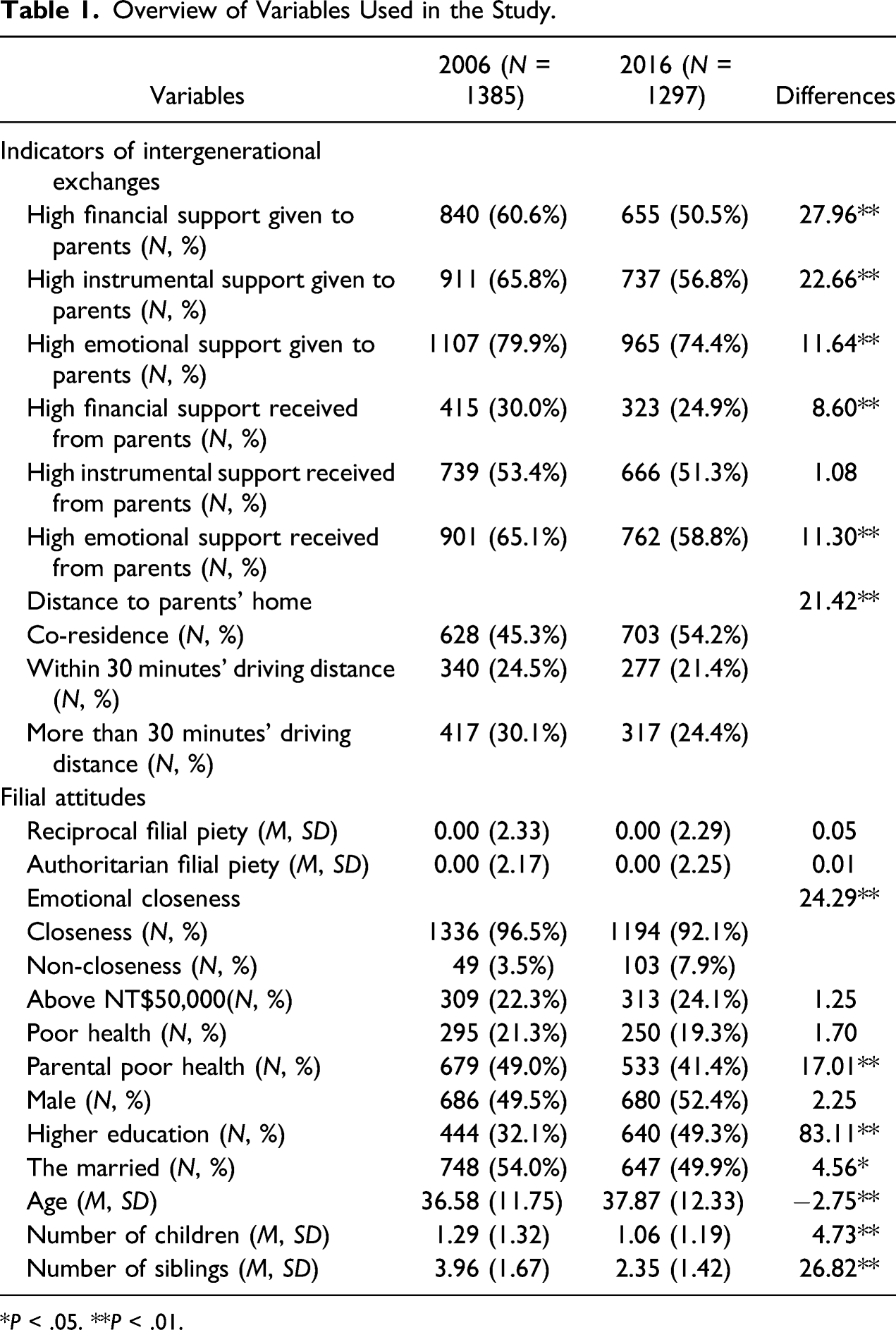
*P < .05. **P < .01.
Typologies of Intergenerational Exchanges
A series of LCAs revealed that of the goodness-of-fit information of seven latent class models, the five latent class model had a better fit than the other models. The decrease in adjusted Bayesian Informal Criterion (BIC) (9915.16 in 2006 and 9316.14 in 2016) and increase in Entropy (.73 in 2006 and .80 in 2016), up to five classes, indicated the superiority of the five-class model. Adding more classes to the model did not improve the model fit.
Conditional probabilities for five patterns of intergenerational exchanges in 2006 and 2016.
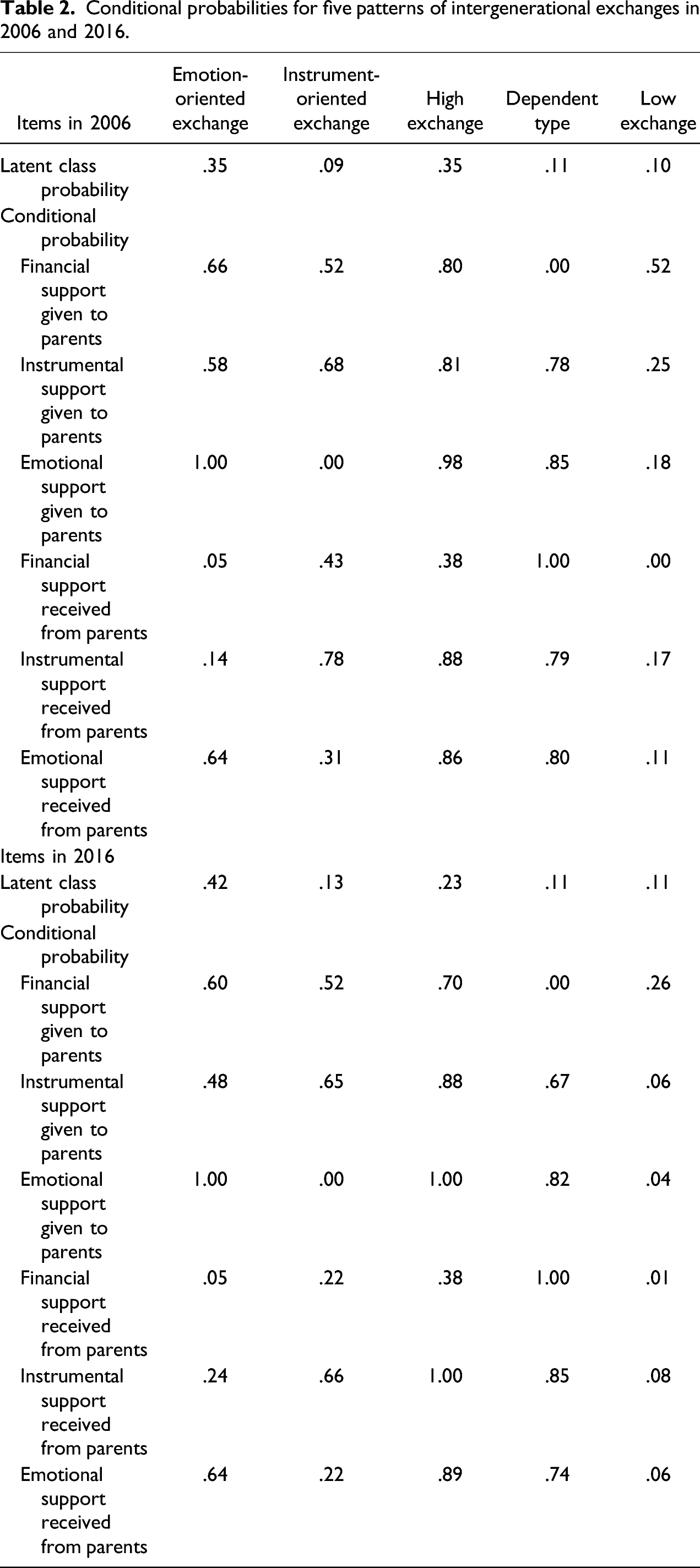
The first type, emotion-oriented exchange, denoted emotional support given to parents and received from parents frequently and other types of support exchange at a relatively low-level. Adult children in the instrument-oriented exchange type were likely to give instrumental support to parents but had the lowest likelihood of sharing emotion with them (.65 and .00, respectively in 2016). The high-exchange pattern, the ideal type, was represented by reciprocal and frequent exchange of various supports between generations. The fourth pattern, the dependent type, signified the downward transfer in types of support from parents to adult children, such as financial and instrumental assistance. The low-exchange pattern had the lower likelihood of intergenerational exchange in terms of financial, instrumental, and emotional support.
When testing measurement invariance with LCA via the Latent Gold 4.5 program, the heterogeneous model which had all measurement model parameters to be different across samples exhibited a poorer fit (BIC based on log-likelihood value = 19493.16, df = 58, entropy = .70). Partial homogeneity with the different conditional probabilities but equal slope parameters across groups improved the model fit (BIC = 19321.09, df = 82, entropy = .71). The complete homogeneity model with latent class probabilities and conditional probabilities set identically across groups (BIC = 19315.80, df = 92, entropy = .70) did not fit the data better than structural homogeneity. The structurally equivalent model that simulated conditional probabilities to be equal across samples was superior to other models (BIC = 19307.39, df = 88, entropy = .71), signifying that the relationships between observed items and latent variables were same across groups. As structural homogeneity was identified, the five-class memberships had the same meanings in the two samples and made it possible to compare membership probabilities across groups.
Predictors of Intergenerational Exchange Typologies
Results of multinomial logistic regression analysis of predictors of the five intergenerational exchange patterns in 2006.
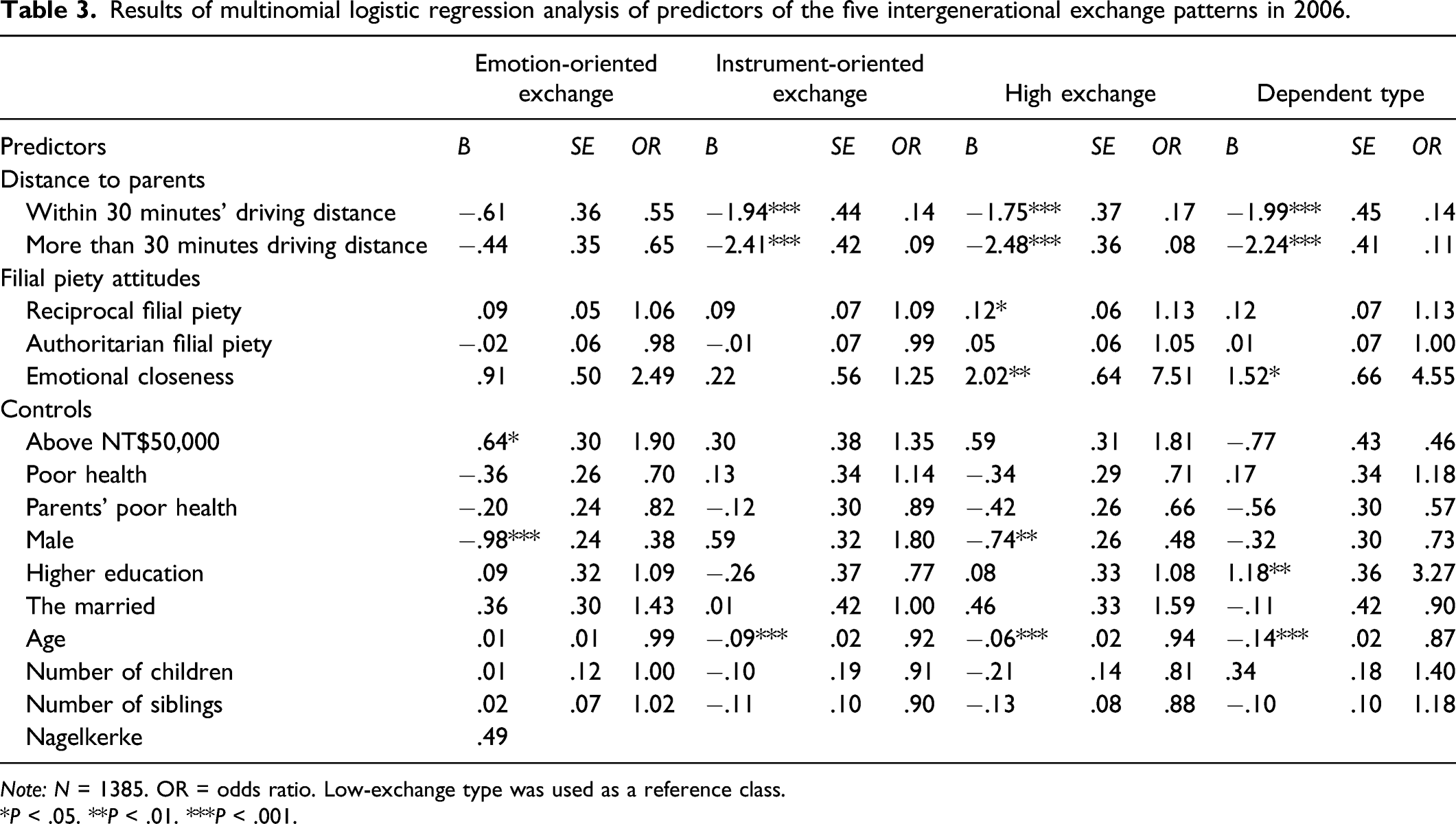
Note: N = 1385. OR = odds ratio. Low-exchange type was used as a reference class.
*P < .05. **P < .01. ***P < .001.
Results of multinomial logistic regression analysis of predictors of the five intergenerational exchange patterns in 2016.
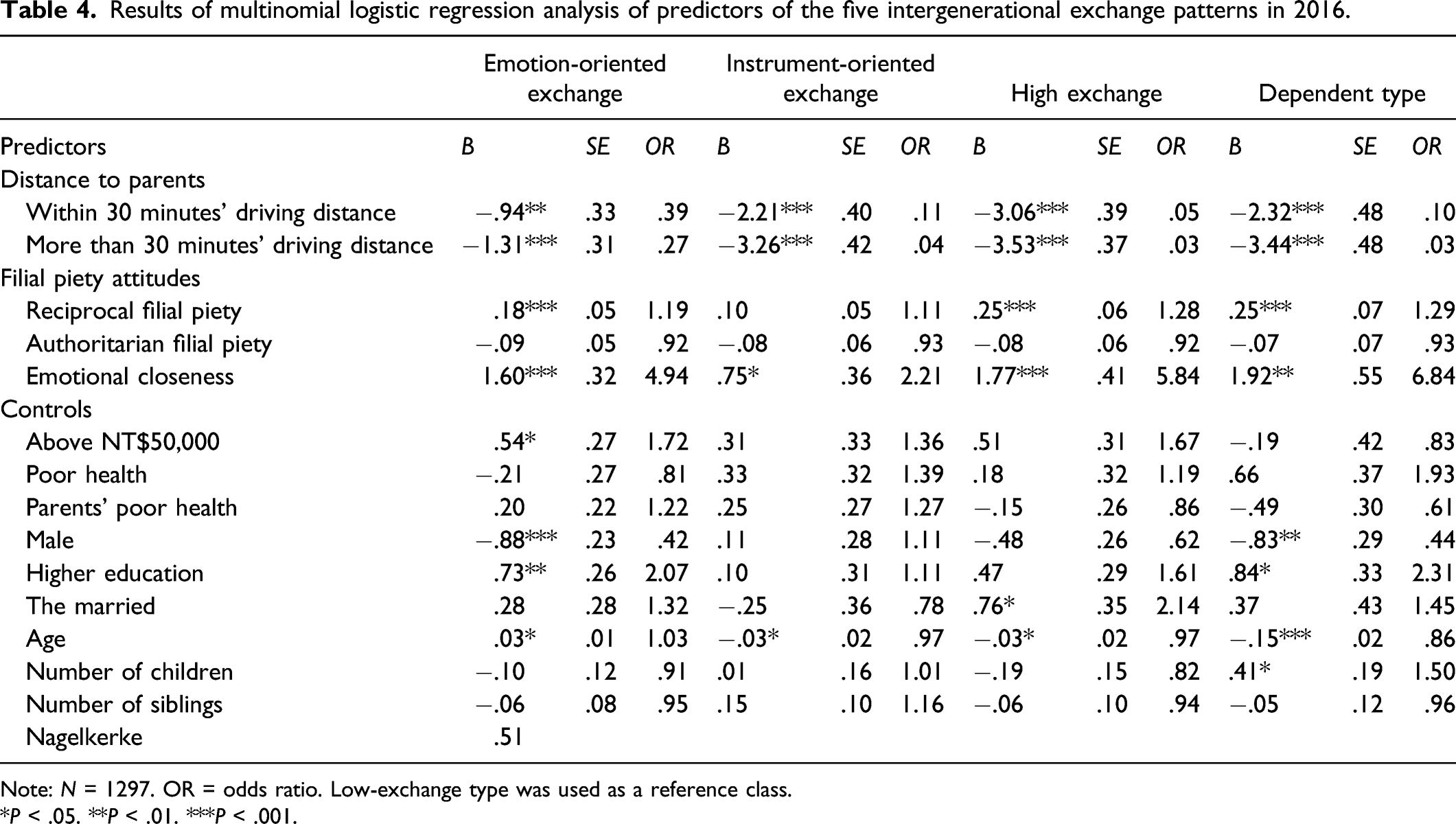
Note: N = 1297. OR = odds ratio. Low-exchange type was used as a reference class.
*P < .05. **P < .01. ***P < .001.
Positive attitudes toward reciprocal filial piety, instead of authoritarian filial piety, predicted a high-exchange pattern in 2006 and three patterns of intergenerational exchanges, including the emotion-oriented, high-exchange, and dependent patterns in 2016. Reciprocal filial piety appeared more important in explaining the variations in intergenerational exchange than authoritarian filial piety. Also, those with high emotional closeness were more likely to belong to the high-exchange and dependent class in 2006 and 2016 as compared with the low-exchange pattern. The study additionally tests the robustness of results when merging two databases, creating a variable for year and examining its interaction with main predictors. Similar to Tables 3 and 4, the results support a more consistent relationship of geographic distance with the instrument-oriented, high-exchange, and dependent patterns than filial attitudes and emotional closeness (data not shown). Of the interactive terms, the significant effects of interaction between geographic proximity and year on emotion-based and high-exchange types represent that the negative relationships of geographic distance with these dependent variables increase during 10 years (data not shown).
Discussion
This study aims to explore the intergenerational exchange patterns depending on macro factors such as filial norms and economic conditions and examines whether geographic proximity, emotional closeness, and filial attitudes are predictors of different exchange patterns before and after economic stagnation. High-exchange pattern consisted of high monetary and nonmonetary support between generations was a dominant pattern in the circumstance of the rapid economic growth in Asian societies (Guo et al., 2012; Lin, 2012). No significant difference in personal monthly income is found between 2006 and 2016. The limited GDP growth and wage growth in Taiwan since 2007 (Clark et al., 2018; Lin et al., 2017; Haepp & Hsin, 2016), which significant decreased the financial capacity of caring for aging parents in terms of financial, instrumental and emotional support given to parents in 2016 observed in the present study.
The results from LCA identified the five patterns of intergenerational exchange in 2006 and 2016. The proportion of respondents who belonged to the high-exchange pattern in 2006 was almost identical to that in previous research in Taiwan in 2001 (36%) (Lin, 2012). In comparison with instrument-oriented support, such as household chores and childcare, sharing emotions between adult children and parents is not time-consuming and thus may be preferred by individuals. There were few proportions of support exchange that were not in line with filial norms between the two time points. The dependent pattern (11%), similar to Western-style downstream support, showed financial transfer from parents to children. The other pattern, low-exchange, which did not fit the cultural norms was not recognized by most Taiwanese families. Filial norms that are still at work contributes a low proportion of the dependent and low-exchange patterns, which adds evidence to the established Asian literature (Guo et al., 2012; Lin, 2012; Park et al., 2005).
The Differences in Intergenerational Exchange Patterns Before and After Economic Stagnation
A local study uncovered that the proportion of high-exchange class increased from 36 to 53% in the period of salary growth (Lin, 2012). This study contributed to the prior work by showing that the lower proportion of the membership of high exchange observed during the period of wage stagnation. As anticipated, economic stagnation reduced the proportion of the high-exchange pattern. Taken together, the high-exchange pattern was more likely to be influenced by economic fluctuation than the other patterns. Results showed that an increase in the proportions of the emotion-oriented and instrument-oriented exchanges as compensation for the decrease in financial support. More emotional and instrumental assistance given to parents was viewed as alternative and acceptable in the face of insufficient financial resources. Emotion-oriented and instrument-oriented exchange signified the fulfillment of filial expectations and reduction in eldercare spending. The proportions of the dependent and low-exchange patterns appeared almost unchanged before and after economic stagnation, reflecting the cultural norms’ stronger influence than economic factors on the Taiwanese exchange patterns, especially the two exchange patterns. The results support the first and second research hypotheses and emphasize the importance of cultural norms and economic conditions as argued by scholars (Attias-Donfut et al. 2005; Guo et al., 2009; Park et al., 2005).
Given that emotional support, but not instrumental support, was related to mental health such as perceived stress, anxiety, and happiness (Morelli et al., 2015) and that financial support exchange increases psychological health (Lee et al., 2014), Taiwanese adult children and their parents may suffer from mental illness since 2007 due to the decrease in overall proportion of financial and emotional exchange (high-exchange and emotion-oriented exchange (from 70% in 2006 to 65% in 2016). An upward trend in common mental disorders was found to be significant in Taiwanese adults between 1990 and 2010 (Fu, Lee, Gunnell, Lee, & Cheng, 2013).
The two obligatory patterns characterized as compromise between filial norms and insufficient material resources may shed light on the implications of intergenerational exchange patterns in the East Asian societies that share filial norms. As East Asian economies suffer from the spread of the coronavirus, the emotion-oriented pattern, but not the high-exchange pattern, may gradually become prevalent.
Predictors of Intergenerational Exchange Patterns
Prior research has not considered the relationship of structural, normative, and emotional factors of intergenerational solidarity with functional exchange. The presented results add evidence to intergenerational solidarity and the relevant literature. There were close relationships between different dimensions of intergenerational solidarity, especially between the structural and functional dimension. Consistent with previous research (Hogan et al., 1993; Kim et al., 2015; Lin, 2012; Yi & Lin, 2009), longer distance to parents’ home decreased the opportunities of interaction and thus increased the likelihood of being members of the low-exchange pattern. The results that geographic distance from the parents’ home reduced the likelihood of emotion-oriented exchange in 2016 differed from the non-significant relationship between geographic distance and emotional exchange in the study (Hunteler & Mulder, 2020). The difference may be attributed to respondents’ age. In the recent study (Hunteler & Mulder, 2020), a majority of respondents who aged 20–30 years may rely on communication technology such as telephone or the internet to provide emotional support. A study with sample mean age more than 40 years found that adult children who co-reside with their parents tended to have emotional exchange with their parents (Moor & Komter, 2012). This reflected that adult children’ preferred mode of face-to-face communication might increase with age, which made the relationship between geographic distance and emotional exchange manifest in an older group.
Different attitudes toward filial piety were not of equal importance to predict the support exchange pattern. Reciprocal filial attitudes, rather than authoritarian filial attitudes, were associated with the high-exchange pattern. This finding echoed the argument that filial individuals tend not to be involved in instrumental support (Lei, 2013; Taniguchi & Kaufman, 2017). This is different from the research expectations that two types of filial attitudes predict various supportive behaviors; thus, the third hypothesis is partially supported by the results.
In contrast with the prior literature indicating emotional closeness is only associated with high-exchange (Hogan et al., 1993; Schwarz et al., 2005), emotional closeness was found to have consistent associations with intergenerational exchange across different patterns in 2016. The difference could be explained by cultural difference. In Confucian culture, which emphasizes harmony and cohesiveness among individuals, the parent–child relationship in Asia may have a stronger influence on intergenerational exchange than in Western countries. Cultural influence on determinants of support exchange was discussed by Lorca and Ponce (2015). Aging might account for the close association of emotional closeness with various intergenerational exchange patterns in 2016 but not in 2006. Research found that the support that older parents gave to their children declined with age (Kalmijm, 2019). As respondents in 2016 were older than their counterparts in 2006, it signifies the respondents’ older parents with less support ability in 2016. Emotional closeness may become more crucial to receive various supports from older parents and therefore showed consistent associations across different exchange patterns in 2016. Furthermore, as compared with the main predictors of interest, results suggest that exchange patterns were less dependent on individual resources and parents’ needs.
Limitations
The findings are subject to several limitations. First, the results about the specific patterns of intergenerational exchange in Taiwan are difficult to translate to Western countries. Second, the standardized scores that measure the relative levels of attitudes at each time point might not completely reflect the relationship between filial piety attitudes and intergenerational exchange patterns. Moreover, this study can only rely on the report of adult children. Bringing together information from both sides (i.e., adult children and parents) not only provides a comprehensive picture for intergenerational exchange but also helps clarify the validity of the results after adding the parent-report measures to the model although parents are more likely to report intergenerational relations in more favorable way than their adult children do (Giarrusso, Feng, & Bengston, 2004). Finally, despite the use of cross-sectional data of two time points, the results cannot be made into causal inferences.
Practice Implications
Despite these limitations, the findings suggest that emotion-oriented exchange pattern would become more popular than the ideal exchange pattern in East Asian countries during the weak economic development. As previous research indicated the advantage of emotional support exchange (Morelli et al., 2015), family practitioners should encourage and stimulate Asians to share emotions between generations as an alternative approach for decreased financial support. Researchers should take into consideration the importance of filial norms and economic development in shaping intergenerational exchange patterns in East Asian societies. The analysis of structural, normative, and emotional correlates of intergenerational exchange patterns provides useful information with regard to those that are more likely to belong to vulnerable members. Information can help practitioners effectively identify the specific groups in need, that is, the low exchangers such as adult children who live farther way from their parents.
Conclusion
This study contributes by demonstrating how the patterns of intergenerational exchange are shaped by the larger cultural and economic context in which families are embedded. Taiwanese adult children respond to filial piety expectations and economic stagnation by the decrease in being members of the high-exchange pattern and the increase in being members of emotion- and instrument-oriented exchange patterns. Culturally prescribed norms prevent an increase in the dependent and low-exchange types. The results highlight the different associations between the three dimensions and functional exchange, but it is essential to consider other theoretical dimensions in studying intergenerational exchange.
Supplemental Material
sj-pdf-1-jfi-10.1177_0192513X211041991 – Supplemental Material for Patterns and Predictors of Taiwanese Adult Children’s Intergenerational Exchanges Before and After Economic Stagnation
Supplemental Material, sj-pdf-1-jfi-10.1177_0192513X211041991 for Patterns and Predictors of Taiwanese Adult Children’s Intergenerational Exchanges Before and After Economic Stagnation by Fang-Hua Jhang in Journal of Family Issues
Footnotes
Declaration of conflicting interests
The author(s) declared no potential conflicts of interest with respect to the research, authorship, and/or publication of this article.
Funding
The author(s) received no financial support for the research, authorship, and/or publication of this article.

Supplemental Material
Supplemental material for this article is available online.
References
Supplementary Material
Please find the following supplemental material available below.
For Open Access articles published under a Creative Commons License, all supplemental material carries the same license as the article it is associated with.
For non-Open Access articles published, all supplemental material carries a non-exclusive license, and permission requests for re-use of supplemental material or any part of supplemental material shall be sent directly to the copyright owner as specified in the copyright notice associated with the article.
