







Abstract
Objective: Current understanding of the linkage between maternal education and parenting practices has largely been informed using a narrow definition of educational attainment—the highest level of education an individual has completed. However, the proximal processes that shape parenting, including informal learning experiences, are also important to understand. Less is known about the informal learning experiences that shape parenting decisions and practices. To this end, we conducted a qualitative inquiry about the informal learning experiences of mothers of children ages 3–4 years with the specific goal of understanding how maternal informal learning experiences shape parenting decisions and practices. Design: We conducted interviews with 53 mothers from across the United States who had previously participated in a randomized controlled trial (RCT) of an intervention targeting infant care practices. We recruited a purposive sample of mothers chosen to maximize diversity across educational attainment and adherence to infant care practices targeted in the RCT. Using a grounded theory approach, data were analyzed using an iterative process for organizing codes and themes that mothers identified as informal learning experiences. Results: We identified seven themes representing distinct types of maternal informal learning experiences that impact parenting practices, including: (1) experiential learning during childhood; (2) experiential learning during adulthood; (3) interpersonal interactions including via social media; (4) experiences with non-interactive media sources; (5) informal trainings; (6) beliefs; and (7) current circumstances. Conclusions: Multiple informal learning experiences inform the parenting decisions and practices of mothers with varying levels of formal educational attainment.
Early childhood represents one of the most critical periods in human development, as experiences during this time have lifelong implications for individual health, learning and development, and well-being. Young children depend entirely on adults, including parents, to provide nurturing care and enact health-promoting practices essential for them to survive and thrive (World Health Organization, United Nations Children’s Fund, & World Bank Group, 2018). As such, there is great interest in better understanding how specific parenting cognitions (e.g., knowledge, beliefs, goals, and attitudes) prompt parenting practices associated with children’s positive developmental outcomes (e.g., Bornstein & Cote, 2006; Bornstein, Putnick, & Suwalsky, 2018). Although an abundance of research demonstrates strong linkages between maternal education and parenting knowledge (e.g., Rowe, Denmark, Harden, & Stapleton, 2016) and practices (e.g., Domina & Roksa, 2012; Prickett & Augustine, 2016), current understandings of these linkages have largely been informed by relatively narrow definitions of educational attainment, which refers to the highest level of formal education an individual has completed (U.S. Census Bureau, 2016). Yet clearly, learning also occurs throughout the life course across multiple settings and contexts and through a combination of intentional and incidental means; less is known about these informal learning experiences (Marsick & Watkins, 2001) that shape maternal parenting cognitions and how these informal learning experiences prompt parenting practices. To inform this understanding, we conducted a qualitative inquiry about the informal learning experiences of mothers of children ages 3–4 years to better understand how maternal informal learning experiences relate to parenting practices. Understanding the informal learning experiences that shape parenting practices is a critical step to specifying malleable factors that could serve as prevention and intervention targets to support child health and development.
Informal Learning Experiences
Learning is an ongoing and lifelong process that can occur in various forms and contexts (Marsick & Vlope, 1999). There is growing recognition that informal learning represents a key component of learning that occurs throughout daily life, informed by past and current experiences, internal and external events, and through action and reflection (Lin & Lee, 2014). However, historically, there has been a lack of consensus concerning a shared definition of informal learning experiences (Rogoff, Callanan, Gutiérrez, & Erickson, 2016). Formal learning experiences are characterized as structured, linear, prescribed, and occurring in classroom contexts, while informal learning experiences tend to be predominantly unstructured, iterative, and experiential in nature (Marsick & Watkins, 2001). Moreover, informal learning tends to be nondidactic and oftentimes embedded in meaningful activities, built on the learner’s initiative, interest, or choice, and lacking formal assessment of the learning that occurs, as well as learning that is predominantly unstructured, experiential, and noninstitutional (Marsick & Vlope, 1999; Rogoff et al., 2016). Informal learning theories tend to emphasize the interconnectedness between learning and the social system (e.g., Lin & Lee, 2014; Marsick & Vlope, 1999), such as behavior learned by directly imitating another’s actions or by indirectly modeling one’s own behavior on another’s behavior (Bandura, 1995). Of particular relevance to the present study, informal learning experiences encompass information and skills in a multitude of domains, including parenting practices (Rogoff et al., 2016). Prior work investigating the determinants of parenting (e.g., Simons, Whitbeck, Conger, & Melby, 1990) points to the need to consider how factors, both internal and external to the parent–child relationship, influence parental behavior. In the present research, we draw on the bioecological model of development (Bronfenbrenner & Morris, 2006) to better understand the proximal processes and contexts related to informal learning experiences that parents report as being influential to their parenting decisions and practices.
How Informal Learning Experiences Relate to Parenting Practices
Parenting has been conceptualized in terms of the cognitions (e.g., knowledge, beliefs, goals, and attitudes) and practices that shape child development and well-being (Bornstein et al., 2018). Competent parenting relies on the acquisition and development of a combination of intellectual, physical, and socioemotional knowledge and skills (Bronfenbrenner & Morris, 2006). Several prior studies illustrate how the acquisition and development of such knowledge and skills occur throughout the life course across multiple settings and contexts and through a combination of intentional and incidental means.
As one example, on average, mothers of 9-month-old infants participating in the Early Childhood Longitudinal Study--Birth Cohort (ECLS-B; a nationally-representative sample of infants born in the United States in 2001) reported consulting their own mothers or spouses for parenting information and advice more often than pediatricians or nurses (Rowe et al., 2016). Within this cohort, Black mothers and mothers with fewer years of educational attainment were more likely than White or Latina mothers or mothers with higher educational attainment to report consulting extended family members (grandparents and aunts/uncles) for parenting advice and information. By comparison, White mothers and mothers with higher educational attainment were more likely than Black and Latina mothers or mothers with lower educational attainment to report turning to professionals (e.g., doctors) and immediate family members (e.g., spouses and parents) for parenting advice (Rowe et al., 2016). Further, Bornstein and colleagues’ (2010) summary of the Civitas Initiative national survey from 2000 revealed that mothers of children under age 3 years reported turning to family members (particularly their spouse and mother), friends, and neighbors as primary sources of parenting information. In comparison to these more familiar and proximal sources of information, the same survey revealed that parents reported relying less often on non-interactive media sources such as books, magazines, and the news. Parents also reported supplementing advice from members of their social networks (the family members, friends, colleagues, and others with whom one interacts regularly) with written materials, education programs, and professional advice, as well as non-interactive media sources such as CDs, TV, and the Internet.
In addition, in our previous work investigating mechanisms for maternal education disparities in enacting health-promoting infant care practices, we found a number of potent mediators that impacted the decisions to place infants in the back position for sleep and to breastfeed. Both positive attitudes and positive social norms were significant mediators of the association between education and both placing infants on the back for sleep and breastfeeding (Moon et al., 2020). Attitudes and social norms are likely to evolve, at least in part, through informal learning, thereby demonstrating the impact of informal learning experiences on important health behaviors.
Despite evidence of direct and indirect linkages between parenting cognitions, parenting practices, and child outcomes (e.g., Benasich & Brooks-Gunn, 1996; Bornstein et al., 2018; Bornstein & Cote, 2006), relatively little is known about the informal learning experiences—defined in the current study as learning experiences that occur outside the context of a formal degree, educational certification, certificate, or licensure program—that influence specific parenting practices for mothers of preschool-age children. Indeed, a sizeable proportion of the extant research corpus pertains to parenting practices for infants; additionally, this research does not adequately reflect more contemporary informal learning experiences (e.g., podcasts and social media) that may be influential to parenting. Given the rise in the availability and use of social media and other electronic media platforms during the last two decades, it would be worthwhile to identify more contemporary informal learning experiences that shape parenting decisions for mothers of preschool-age children.
Critically, many features that distinguish informal from formal learning experiences signal greater potential for informal learning experiences to serve as prevention and intervention targets to support child health and development. For example, unlike formal educational attainment, informal learning experiences may allow for repeated opportunities to reflect on and iteratively refine one’s parenting knowledge and skills. As another example, informal learning experiences may afford a greater degree of autonomy, self-direction, and opportunity to change one’s parenting practices than formal educational attainment. Thus, for the present study, using qualitative methodologies we sought to better understand the relatively unexplored area of maternal informal learning—with a specific focus on experiences that drive parent decision-making and practices related to child health and development for preschool-age children.
Methods
We conducted in-depth, semi-structured interviews of mothers of children 3–4 years of age and framed our study to answer the following question: What are the lived experiences of informal learning that shape maternal parenting practices?
Sample
Participant Demographic Information.
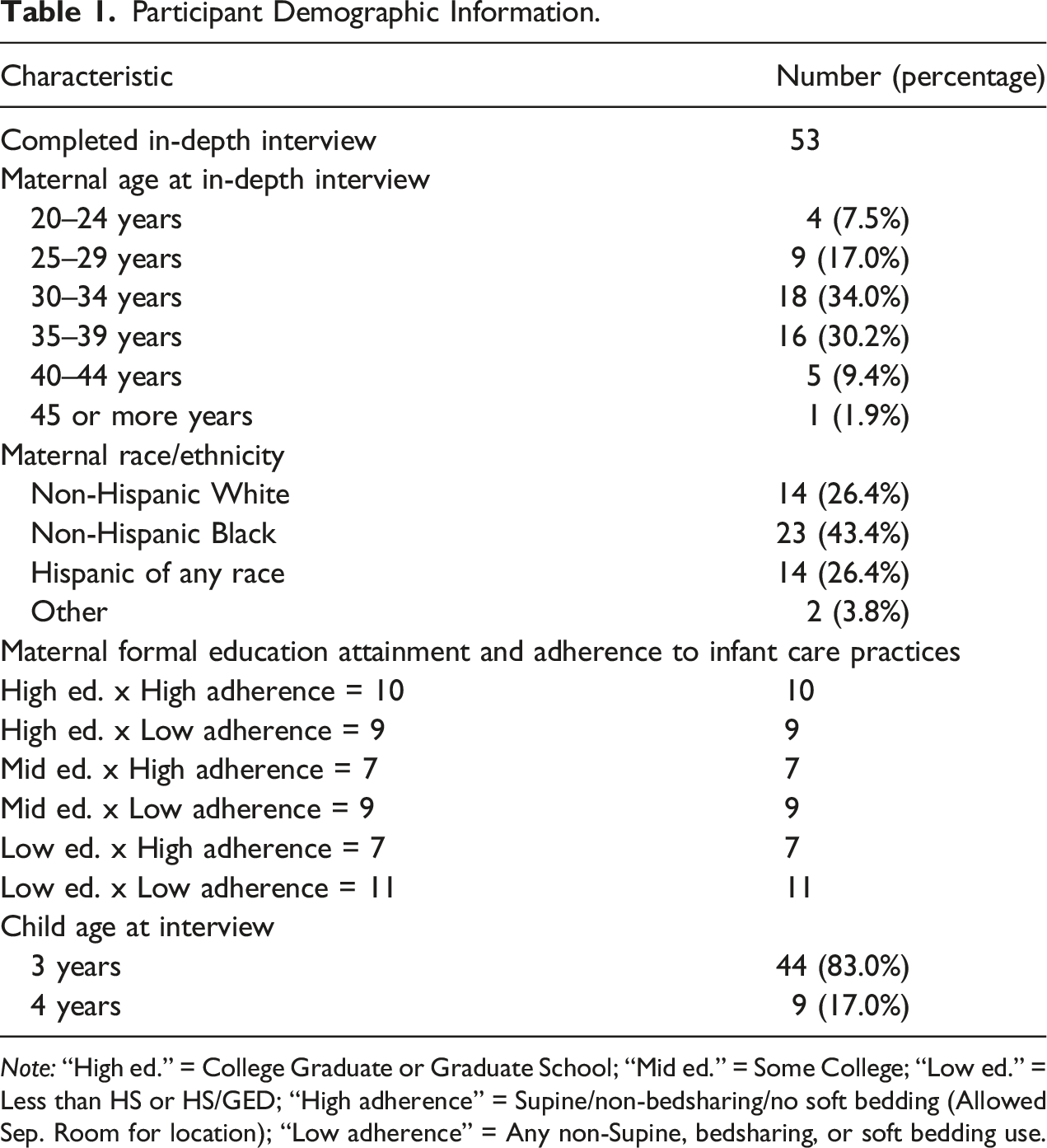
Note: “High ed.” = College Graduate or Graduate School; “Mid ed.” = Some College; “Low ed.” = Less than HS or HS/GED; “High adherence” = Supine/non-bedsharing/no soft bedding (Allowed Sep. Room for location); “Low adherence” = Any non-Supine, bedsharing, or soft bedding use.
Data Collection
The interview guide was designed to elicit information about maternal informal learning experiences occurring throughout the lifespan, as well as how informal learning experiences shape parenting decisions and practices concerning child health and development. Interview questions targeted decision-making processes in the following general domains: safety, pediatric visits, vaccinations, nutrition, and routines. When asking about decision-making processes, interviewers probed for and prompted sources of mothers’ informal learning experiences. Per standard practice in qualitative research, the interview guide was modified and refined, iteratively, to capture emerging ideas (Crabtree & Miller, 1999).
Data Analysis
All interviews were audio-recorded and transcribed using a professional, HIPAA-certified transcription service. Employing the Grounded Theory approach, we systematically and iteratively analyzed the data (Strauss & Corbin, 1997). We followed three phases for the data analysis. In the first phase, all investigators reviewed interview transcripts (53) independently, prior to developing initial codes as a team. In the second phase, the team generated themes from the codes (Hanson et al., 2011). In the third phase, the team confirmed themes by reviewing the data using Dedoose version 8.3.35, web application for managing, analyzing, and presenting qualitative and mixed method research data (2020) and resolved all disagreements through group discussion. The team addressed the trustworthiness of the findings by including multiple researchers from varied disciplines (e.g., medicine; education and human development; and public health) in the analytic process and through using skillful interviewing techniques including open-ended questions and carefully placed, thoughtful probes (Hanson et al., 2011).
Results
We identified seven main themes representing distinct types of maternal informal learning experiences that prompt parenting practices, including (1) experiential learning during childhood (e.g., cultural experiences); (2) experiential learning during adulthood (e.g., prior caregiving experience with children); (3) interpersonal interactions including social media (e.g., receiving advice on social media, or from friends, family, or professionals); (4) experiences with non-interactive media sources (e.g., websites and podcasts); (5) informal trainings (e.g., job-related learning); (6) beliefs (e.g., tacit knowledge and intuition); and (7) current circumstances (e.g., laws and living situation). We describe each theme in more detail in the following section.
Experiential Learning During Childhood
Regarding experiences during childhood, participants recounted how they themselves were raised, how they observed the behaviors of others around them, and how cultural experiences and interactions with younger siblings prompted their own current parenting practices. “I’m Haitian, we eat eggs all the time, if not every day. I grew up eating eggs almost every day,” said one mother, when describing how she decides what to prepare for breakfast [participant 18]. Another mother, when describing how she decides what to prepare for her child for breakfast, explained, “This is something I learned growing up from my mother” [participant 13]. Other mothers indicated they had intentionally decided not to implement particular parenting practices based on their own childhood experiences. One mother, for example, said “From my lack of it as a child growing up…it definitely made me view motherhood from another perspective because mine really wasn’t around to do her job” [participant 14], when describing why she decided to make an effort to bond with and maintain open communication with her child. Overall, many mothers recalled informal learning experiences from their own childhood, and they described how childhood experiences have prompted them to either enact similar or different child-rearing approaches with their own child.
Experiential Learning During Adulthood
Some participants described how they had learned certain skills and practices that inform their current parenting decisions and practices during adulthood, such as through experience caring for other children. For example, one mother indicated she learned many of her parenting practices through previous experience working with children as a nanny. In reference to her use of homeopathic medicines with her own child, she stated, “Most of that was more out of being a nanny…” [participant 22]. Other mothers described learning about parenting using trial and error or through general parenting experience. For instance, one mother, when describing how she decided to maintain an evening routine for her son, explained, “I mean, just parenting experience, at this point” [participant 50]. Participant 21 indicated learning about parenting from having a previous child earlier in life, “I have a 17-year-old. So I was made aware of a lot of things with her. She was my experimental baby!” Other mothers described how observing other parents and children informed their own parenting practices. As an example, participant 35 described how she selected a Head Start program for her son, indicating, “It’s a lady that lives a couple doors down from me. Her granddaughter is autistic and they, like help her a lot with, like, speech and all that stuff. You know once I seen the improvement, I was like, ‘That would be a good Head Start for him.’”
Interpersonal Interactions Including Using Social Media
Many mothers described how intentional and incidental interpersonal interactions in a variety of settings and contexts (e.g., in-person and online) have shaped their parenting decisions and practices. Mothers frequently described learning about parenting through interactions with professionals, friends, family members, co-workers, and community members, to name but a few. Mothers reported engaging in a number of such interactions through apps or social media sites. For example, when describing how she had learned about the practice of introducing new foods to her child slowly, one mother explained, “It’s just their Instagram or someone that I follow…maybe somebody I follow mentions ‘oh, try this or I did this and now she’s eating that.’ So that’s kind of where I pick up some of those [video] clips…” [participant 15]. Another mother recounted how her interactions with a coworker had informed her decision to sign up for a useful email newsletter, BabyCenter, as she explained, “When I was pregnant…I had coworkers that were pregnant with almost the exact same due date as me. So, we were trading notes and stuff…So that’s how I started getting those emails” [participant 6]. Another mother described how her interactions with her own mother, as an adult, had influenced her decision to feed her son eggs every day, indicating, “Again, my mom is a very big influence…So, help from my mom” [participant 41]. Although many mothers described direct interpersonal interactions influencing their parenting decisions, one mother referenced the social norms that played a part in her decision to vaccinate her child, indicating, “Well, I think it’s just, it was an obvious choice and also just a social norm in my social circles for my community that is also an understood norm for protecting kids against illnesses” [participant 11].
Experiences with Non-Interactive Media Sources
Several mothers interviewed described how they would seek and obtain information about parenting through non-interactive media sources. Some examples mothers cited included podcasts, websites, TV, radio, magazines, manuals, news programs, documentaries, scholarly journal articles, books, and non-interactive apps. In some cases, mothers’ informal learning experiences using non-interactive media sources were intentional, such as when they reported seeking out specific information online. For example, when elaborating on her use of seatbelts and other car safety practices with her child, one mother explained, “There is news articles you can scroll through your phone and different things pop up in Google” [participant 13]. Another mother, when describing how she decided to use a chart to track her child’s meals explained, “there’s this website I was going through with, like, ideas or crafts and stuff for toddlers and that’s just showed up on it, about making a graph…” [participant 37]. Another mother, when describing the process she used to inform which childcare option to pursue, indicated, “…we went to their website and we really like what we saw” [participant 12]. Some mothers described learning about parenting by reading books and articles. One mother indicated, “I read a lot of nonfiction and I read a lot of scientific journalism and stuff like that,” as she elaborated on her decision-making concerning her child’s nutrition, continuing to say “I’ve read articles about those kinds of things in parenting magazines” [participant 6].
In other cases, mothers described learning about parenting through incidental exposure to information and ideas they encountered while using non-interactive media sources. For example, one mother described learning about a playgroup at her local library as she encountered the information posted there. In response to the interviewer’s question about how she learned about the playgroup, the mother indicated, “It was a flyer, a little flyer was posted” [participant 17].
Informal Trainings
Another way mothers reported learning about parenting practices was through informal trainings occurring outside a formal schooling context, such as through work-related professional development or by attending or completing in-person or online programs and training sessions that did not count toward a degree or certificate. As one example, a mother described how she enrolled in an informal parenting program prior to her child’s birth, explaining, “I was in one of those birthing classes where you go in and you have to do the Lamaze…” [participant 13]. As another example, a mother reported learning about nutrition for her child through a state-sponsored program, indicating, “It’s through the state of [location]” [participant 38].
Beliefs
During the interviews, there were a number of occasions when mothers could not necessarily identify how they had learned about a given parenting practice or could not cite a specific source for information they used when making parenting decisions. Instead, mothers alluded to relying on their beliefs, intuition, and other tacit knowledge to inform their parenting. Such beliefs included religious or spiritual beliefs, science- or medicine-based beliefs, and beliefs stemming from prior experiences. For example, one mother stated, “there’s just a taste difference to an animal that’s raised off grass and natural ways…” when asked to elaborate on why she purchased organic foods for her children, and why she believed organic foods to be superior to non-organic foods [participant 22]. As another example, in describing how she selected a preschool program for her child, one mother cited drawing on a faith-based organization, stating, “once we knew, like, the child care for church, that’s how we kind of gauged that this would be a good fit” [participant 15].
Current Circumstances
Finally, when describing how they made parenting decisions and enacted parenting practices, mothers often referenced their current living circumstances and living situations, including aspects of their current socioeconomic conditions, family structure, home environment, and laws and regulations that they perceived to affect their parenting. As one such example, a mother described how current circumstances helped her decide where to send her child to school, by explaining, “We chose one in [city name] based on the fact that her dad lives and works there…” [participant 22]. Current circumstances, such as where one lives, were cited to influence other decisions as well, such as decisions concerning a child’s diet. For example, Participant 49 indicated, “[City name]’s, you know, very well known for, you know, specific foods, so of course things that we love to eat just from living there.”
Some mothers cited knowledge of current laws as being influential to their decision-making about safety practices. For example, when asked about the importance of and her choices concerning car seat safety, participant 37 stated, “I know it’s a state law.” Another mother [participant 50] stated, “I mean, a personal choice was the rule of the law…Because I’ve read it and you know, they won’t even, at the hospital, they don’t let you leave without putting your kid in a car seat.”
Interactions Among Themes
Although interviews revealed seven distinct themes pertaining to maternal informal learning experiences that prompt parenting practices, in many cases, overlap between themes was evident in mothers’ descriptions of their parenting practices and decision-making. As one such example, a mother described how a combination of experiences with non-interactive media (in this case, articles) and experiential learning in adulthood (working as a teacher) prompted her to read to her son nightly before bed, and reinforced the importance of literacy for children. She responded to the interviewer’s question about why she decided to read to her son nightly, saying, “That I read [that I should do that] in a million different articles…and just being a teacher for 20 years” [participant 9]. As another example, one mother described how interpersonal interactions with her friends prompted her to seek information from non-interactive media sources concerning how to address her child’s sleep issues. In response to the interviewer asking how she learned about melatonin and its benefits, the mother said, “…. what I’ve learned from my friends and I’ve researched it and I’m just like, okay 1 mg” [participant 38]. Another mother, when talking about vaccinating her child for the flu said, “if I Google it, what it’s for, I’ll read about it. But if I have more questions, I’ll just ask the doctor” [participant 41], illustrating how she used both non-interactive media sources and sought information through an interpersonal interaction to make a parenting decision.
Mothers also expressed how a combination of experiential learning during childhood and interpersonal interactions has informed their parenting decisions. For example, in response to the interviewer’s question about making balanced and healthy food choices for her child, one mother indicated, “Not so much from my mom, I guess, social media does help a little bit. Like, first, I try to watch what I eat, so it does influence the way I feed my kids” [participant 45].
Discussion
In this study, we interviewed mothers of differing levels of formal educational attainment and adherence to infant care practices, with the goal of better understanding their lived experiences of informal learning that drive decision-making related to parenting. Through this research, we identified seven main themes that represent distinct domains of informal learning experiences: (1) experiential learning during childhood; (2) experiential learning during adulthood; (3) interpersonal interactions including via social media; (4) experiences with non-interactive media sources; (5) informal trainings; (6) beliefs; and (7) current circumstances. In addition, we found that mothers often cited their experiences with multiple, distinct informal learning experiences that together led to parenting decisions and practices related to safety, nutrition, and early care and education.
As in other work, we confirmed that individuals learn from childhood experiences and that these experiences influence adult decisions. For example, a qualitative meta-synthesis of mothers’ adverse childhood experiences (ACEs) and parenting practices revealed several examples of how mothers’ childhoods affected their parenting style (Herbell & Bloom, 2020). In that research, mothers described how they had learned from past experiences and were intentional about implementing parenting practices as a means to “break the cycle.” Whereas some mothers in our study indicated enacting practices different from those they experienced in childhood, others described how they intentionally maintained certain parenting practices from their childhood with their own children. This finding corroborates previous findings that supportive parenting practices are transmitted across generations through social-environmental processes (Simons, Beaman, Conger, & Chao, 1993).
Perhaps not surprisingly, mothers continue to learn into their adult years, and participants discussed many informal learning experiences that influenced their parenting practices. As with prior research finding that parents intentionally combine professional and nonprofessional sources of information to triangulate information to inform child-rearing decisions (Radey & Randolph, 2009), mothers in the present study reported drawing on multiple informal learning experiences to inform parenting decisions and practices.
Similar to our previous work that demonstrated social norms serve as mediators between formal education and infant care practices (Moon et al., 2019), the impact of social norms on parenting practices was evident in the current study. Mothers described following parenting practices that they had observed with their own parents, friends, or co-workers. When mothers perceive that a particular practice is prevalent within their social network (i.e., a social norm), they are more likely to conform to that practice (Schultz, Nolan, Cialdini, Goldstein, & Griskevicius, 2007). Similarly, attitudes strongly influence choices of infant care practices and act as potent mediators of formal education level. Mothers in the current study discussed their beliefs, which encompassed intuition and tacit knowledge. Beliefs are precursors to the formation of attitudes which can then impact behavior (Ajzen, 1991, 2011). Thus, informal learning that influences beliefs and attitudes may mediate formal education leading to parenting choices that impact child health and well-being.
Implications for Practice and Future Research
Mothers in the present study described several distinct informal learning experiences that they perceived to inform their parenting decisions and practices. Findings from this research have a number of implications for future research as well as for the design and refinement of interventions to support child health and well-being. Concerning practical implications, the frequency, timing, and iterative components of informal learning experiences make them well-suited to being adjusted and refined, iteratively and flexibly, in alignment with targeted parenting practices. For example, researchers and clinicians can design and implement low-cost interventions to engage parents in informal learning experiences that prompt them to apply specific advantageous parenting behaviors. To illustrate, Moon and colleagues (2017) determined that text messaging may be a particularly successful modality for engaging parents in viewing educational videos and responding to queries about their implementation of targeted parenting practices (e.g., Moon et al., 2017). Indeed, mothers who viewed educational videos about safe infant sleep were more likely than those in a control group to adhere to safe infant sleep recommendations, and these changes were largely mediated by improvements in attitudes and perceived social norms about the recommendations (Moon et al., 2019). A similar approach might be taken using, for example, our own findings that mothers learn about parenting practices through social media and other online sources (Moon et al., 2017). Findings of the present study also point to the need for further research to quantify both the prevalence of informal learning experiences for parenting and factors associated with particular informal learning experiences for parenting. It could be useful to know, for example, if informal learning varies by socioeconomic status or other social determinants.
As with all research, this study has certain limitations. The mothers’ interviews may not capture all applicable informal learning experiences. Further, as is true of qualitative research, we cannot make any statement about either the prevalence of any of these experiences or the generalizability of our findings. However, we have the advantage of recruiting mothers from across the United States with differing levels of formal education and adherence to infant care practices and therefore a wide array of maternal experiences which will inform future work.
Footnotes
Declaration of Conflicting Interests
The author(s) declared no potential conflicts of interest with respect to the research, authorship, and/or publication of this article.
Funding
The author(s) disclosed receipt of the following financial support for the research, authorship, and/or publication of this article: This article is finacially supported by National Institutes of Health; 2R01HD05149806A1.
