







Abstract
The aim of this study was to develop a culturally relevant scale of satisfying marriage for dual-career couples. In order to explore the phenomenology of satisfying marriage, 25 participants, 25–42 years of age, were interviewed and their responses were recorded. Responses were then collated and duplicate and vague items were discarded. The remaining responses were transformed into a four-point Likert scale to assess the content validity; 45 items constituted the Satisfying Marriage Scale (SMS). meaning] After expert validation by 13 experienced psychologists, the scale was administered to 250 married couples with age ranging from 21 years to 50 years (M = 31.40, SD = 6.27) to establish psychometric properties. meaning] SMS along with a demographic performa, Couple Satisfaction Index (CSI), and Multidimensional Scale of Perceived Social Support (MSPSS) were administered. Exploratory factor analysis (EFA) yielded three factors cooperation and coordination, mutual support, and mutual respect. The scale was found to have high internal consistency (α = 0.95), and split-half reliability (r = 0.81) with moderate levels of concurrent and construct validity. Results of the indigenous scale were further discussed in relevance to Pakistan’s cultural context.
Marriage is considered as one of the most sacred bonds that consequently sustains a strong nation (Murphy, 2011). Marriage is a legal, social, and emotional bond forged between two individuals to establish mutual goals, cooperate economically, and engage in child-rearing (Darmaki et al., 2014; Madathil & Benshof, 2008). Marriage bestows the spouses with a compassionate partner who fulfills the basic needs of safety (Fellizer, 2017). Being a husband and a wife, father and a mother, being a part of extended family of in-laws brings liabilities and fulfilling those responsibilities would lead to nurturance of human character. The success of a marriage can be reflected through the quality of and satisfaction in a marital relationship, which refers to a person’s state of happiness, sense of mutual support, and sexual intimacy that he/she derives out of his/her marriage (Abamara et al., 2018; Baumiester & Vohs, 2007; Shackelford & Emily, 2006). The construct of marital satisfaction is found to be positively associated with psychological well-being and quality of life (Rostami et al., 2013).
Marital satisfaction can be attributed to a number of factors including satisfaction in sexual relationship (Nezhad & Goodarzi, 2011), effective communication, effective conflict resolution skills, financial stability (Britt & Huston, 2012), having children (Guttmann & Lazar, 2010), spending free time together, sharing common religious values (Olson et al., 2015), and quality of relationship with in-laws (Vil, 2015). Families who share the issues and dynamics with the new member are more likely to promote satisfaction between the spouses (Quek & Fitzpatrick, 2013). In addition, many factors can lead to dissatisfaction in a marital relationship including lack of commitment (Bodenmann et al., 2007), poor mental health status of a spouse, financial issues, dual career (Lewin et al., 2009), prolonged life stressors like a chronic illness (Muscatell, 2013), absence of any religious affiliation between spouses, and belonging to a different religion (Rosand et al., 2013).
Keeping in view the importance of marital satisfaction and associated positive outcomes, the current study will consider the construct with focus on couples in which both spouses work. There had been a remarkable change experienced by industrialized communities of the world during the last quarter of the twentieth century. This shift led to a shuffle in roles of men and women in the labor force (Roehling et al., 2003). Research on dual-career couples originated when the term “dual-career couple” came into existence and its definition was compiled. It is defined as a couple where both heads of the household work professionally while attempting to maintain a family life together as well (Rapoport & Rapoport, 1969). Throughout the world, around 40%–70% couples are dual earners (Coleman & Coleman, 2012; Rudra De, 2017).
Dual-career couples are also more likely to face problems in their marriage as a result of gender discrimination and unfair gender roles distribution (Shujja et al., 2013). Consequently, the problems faced by such couples are different from those of a conventional couple. The problems experienced by working women are quite unique and different including career versus relationship, male trailing spouses, lack of flexibility at the workplace, and childbearing conflicts (Fatima & Sahibzada, 2012). The present study, therefore, aims at developing a scale, especially for the said population, so that this emerging category of marriages could be attended to. Belonging to a dual-career marriage has been found to be a risk factor for a healthy marital relationship (Mitchelson, 2009). When both spouses are highly educated, working professionally to pursue their individual career goals, there are ample chances for the marriage to suffer (Ochsner, 2012). The most common factors that are studied in dual-career couples with respect to marital satisfaction include conflict resolution (Perrone & Worthington, 2001), mutual trust (Cottrell et al., 2007; Shujja et al., 2013), religiosity (Rahman & Ali 2018), sexual satisfaction, love, and effective communication (Perrone & Worthington, 2001).
Marital satisfaction is a complex yet a dynamic process and is determined by a number of personal, social, and cultural factors. The concept of marriage and marital satisfaction is influenced by the cultural context; in individualistic cultures, person’s individuality, choices, and preferences are promoted, whereas in collectivistic cultures, family harmony, adherence to societal norms, and in-group loyalty are promoted (Triandis, 1995). Literature has identified many cross-cultural differences in marriage-related aspects including choice of mate, romanticism, meaning of marriage, and marital satisfaction (Wong & Goodwin, 2009). In Western societies, marriage is a bond between two people, which encompasses individual’s needs and emotions (Lucas et al., 2008). In collectivistic cultures like Pakistan, marriage represents a religious and social contract, an association and alliance of two extended families with more focus on maintaining family harmony and cohesiveness than on spousal intimacy and emotional bonding (Goodwin & Cramer, 2000).
Moreover, contrary to individualistic cultures, couples in traditional, collectivistic societies use indirect ways of conflict resolution by involving other extending family members and experience inequality in spousal role where men have a predominate role in major life decisions (Walter, 2003). Taking into consideration the cultural differences in the meaning, experience, and expression of marriage, the present study proposes satisfying marriage as an alternative term for marital satisfaction. “Satisfying marriage” is a term that had not been used in literature, and therefore, no assessment procedure is available to cater the cultural meaning. There are several scales that have been developed to measure the construct of marital satisfaction including Kansas Marital Satisfaction Scale (Schumm et al., 1983), ENRICH Marital Satisfaction Scale (Fowers & Olson, 1993), and Revised Dyadic Adjustment Scale (Spanier, 1976).
All these measures are based on the philosophy of marriage as a relationship, which calls for adjustment from both spouses, but the authors failed to provide an operational definition of dyadic adjustment in the context of marriage and that can be used for assessment of romantic relationships (Chonody et al., 2016; Isanezhad et al., 2012). Satisfaction with Married Life Scale (Johnson et al., 2006) measures marital satisfaction from a different perspective where “work life” in the original scale was simply replaced by term “married life”. Therefore, the psychometric characteristics of the scale have been compromised (Ward et al., 2009). Couples Satisfaction Index (CSI) (Funk & Rogge, 2007) was also found to be a valid and reliable measure, widely used in the most recent literature, but the authors used the previously existing scales to develop the items which lead to a continuation of potentially problematic sections (Chonody et al., 2016). The American version of Dyadic Adjustment Scale (mentioned earlier), advocated that frequency of kissing is an aspect of marital satisfaction, while Shek and Cheung (2008) did not endorse the same for Chinese culture. Likewise, Lee and Ono (2006) concluded that a marriage in which the husband works and the wife does not is considered satisfactory in Japan, while in the United States, the husband’s ability to financially support his wife is not one of the most important factors to constitute a satisfying marriage.
There are number of studies that have been conducted in Pakistan to identify the role of marital satisfaction with different psychological constructs (Qadir et al., 2013). An attempt was made to develop an assessment tool, namely Marital Satisfaction Scale (Ayub, 2010), yet the author failed to explore the construct in a cultural context by keeping the essence of marriage in Pakistani society and only relied on previous literature to generate the item pool for the scale. As mentioned earlier, there are several scales available to measure the construct of interest, but all scales are of Western origin. It had already been established that a satisfying marriage is a culturally relevant construct (Allendorf, 2012). In a collectivist culture like ours, roles and responsibilities are generally designated according to society’s sex role division, while in Western cultures, both spouses tend to contribute equally (Uddin, 2009). Dual-career couples have different dynamics, which need to be explored in a cultural context. Likewise, in Muslim cultures, the role of sexual intimacy between the spouses has a culture-specific orientation, and sexual relationship is only permissible under the umbrella of marriage. This leads to a different understanding, which, in turn, leads to a different set of expectations of spouses from each other.
To sum up, marital satisfaction is a dynamic construct influenced by persona and social, emotional, and cultural factors in which being a dual-career couple is the most significant predictor. A satisfying marriage denotes the level of satisfaction that an individual derives out of their marriage. In an individualistic culture, how both spouses perceive their marital relationship can be treated as just a state of personal satisfaction, while in a collectivistic culture like Pakistan, both have to contribute in order for them to refer to their marriage as satisfactory. As stated, contextual differences raise the challenge of developing measures of a satisfying marriage, which are relevant to a particular context. Therefore, the present study aimed to develop a scale that could be used as a valid measure of satisfying marriage for dual-career Pakistani couples.
The basic aim of the study is to develop an indigenous scale of measurement for satisfying marriage: first, to explore the characteristics that married individuals in dual-career couples attribute to a satisfying marriage; second, to develop a valid and reliable scale for measuring the construct of satisfying marriage; and lastly, to determine the psychometric properties of the developed scale.
Method
Stage I: Item Generation
Participants and procedure
This phase aimed to explore the phenomenology associated with satisfying marriage. The sample was selected by using purposive sampling technique. Working married individuals whose spouses were also working were purposefully selected to constitute the sample. The construct of satisfying marriage was explored through phenomenological approach. In the current study, the construct “mental toughness” is operationally defined as “A Marital Relationship that is a source of contentment and happiness for the couple”. Initially, all the participants were given an operational definition of the construct and were then asked to narrate the characteristics or attributes of a satisfying marriage. They were precisely asked “how would you describe a satisfying marriage, what are the characteristics of a satisfying marriage?”
A total number of 28 individuals participated in generating the characteristics of satisfying marriage. All individuals had been married for at least 2 years and not more than 15 years. A list of 63 items was prepared. This list was then reduced to 52 items as a result of refining and categorizing repetitions. The finalized list was reviewed for any overlapping and vague and difficult-to-comprehend sentences. Then the identified items were either excluded, merged, or amended, while keeping it relevant to the original perspective. As a result of this rigorous activity, a total number of 45 items were retained. The scale was then given the name Satisfying Marriage Scale (SMS).
Stage 2: Empirical Validation through Experts
Participants and procedure
In order to gather empirical validation of the final list of the characteristics of satisfying marriage, 13 psychologists who have had a working experience of at least five years were briefed regarding the purpose of said research. The identified experts were asked to rate each of the 45 items on a four-point rating scale ranging from 0 (not at all) to 3 (extremely common) for their frequency of occurrence among married individuals. By the end of this stage, the items were listed in descending order according to the occurrence frequency as identified by the experts. Any item getting less than 50% average score was omitted from the finalized list. None of the items could be excluded.
Pilot study
A pilot study was conducted, and the basic purpose of this phase was to find out the user friendliness of the scale in terms of its language, layout, and instructions. For this purpose, 20 participants were purposefully selected. The 45-item scale was piloted to 10 married working individuals (five males and five females) for readability and to test the layout. The total time taken by the participants to fill in the protocol was averaged out to be 15–20 minutes. The participants found the test language comprehendible and reported no difficulty in understanding.
Stage 4: Psychometric Properties
This phase aimed at exploring the factorial structure, reliability, and validity of the final set of items termed as SMS.
Participants
A purposive sampling technique was used to select the sample. The sample included working married men (n = 122) and women (n = 128) whose spouses were working as well. The age range of participants was 21–50 years (M = 34.1, SD = 6.26). The participants had attained at least 14 years of formal education, had at least one child and had been married for at least 2 years and not more than 15 years. Ninety-four (37.6%) participants belonged to nuclear family system, while 156 (62.4%) to combined family system.
Measures
Demographic Performa
This performa included the basic characteristic information of the sample, which included questions based on age, education, occupation, income, years of being married, type of family system, number of children, and information regarding spouses’ occupation and income as well.
Satisfying Marriage Scale
This measure was developed in the earlier stages and consisted of 45 characteristics of satisfying marriage. It was a four-point rating scale with options that included 0 (never), 1 (sometimes), 2 (often), and 3 (always). Scores ranging from 0 to 135 were obtained by adding scores on each item of the scale, and higher scores on SMS denoted that the marriage was quite satisfactory.
The Couples Satisfaction Index (CSI; Funk & Rogge, 2007)
Couples Satisfaction Index was used in order to establish concurrent validity. It constituted of 32 items, which have been designed to evaluate spouse’s level of satisfaction from their relationship. The scale does not have uniform rating criteria. Items 3–16 are rated on a six-point rating scale where 0 (not at all), 1 (a little), 2 (somewhat), 3(mostly), 4 (almost completely), 5 (completely). This scale can be used as reduced forms, which may consist of 16-item or 4-item versions, respectively, depending upon a researcher’s needs. The 16-item version of the scale was used a part of the study. The total scoring ranged from 0 to 80.
Procedure
The data were collected through snowball sampling technique. Initially, working married individuals were approached at the workplace of the researcher. Those participants further introduced the researcher to more married individuals belonging to dual-career couple category. Firstly, the researcher introduced herself to the participants and then informed in detail regarding the purpose of the research. All the participants who agreed to be a part of the study and were fulfilling the inclusion criteria were then provided with the final testing protocol. The final research protocol consisted of the newly developed scale, that is, SMS, Couple Satisfaction Index (CSI; Funk, & Rogge, 2007), and Multidimensional Scale of Perceived Social Support (MSPSS; Zimet et al., 1988). All participants were assured that their information would be kept confidential and the data would be kept anonymous. The general instructions were given verbally, but the participants were encouraged to read the scale-specific instructions thoroughly once they started to fill in the scale. It took the participants about 15–20 minutes on average to complete the protocol.
Results
Factor Analysis
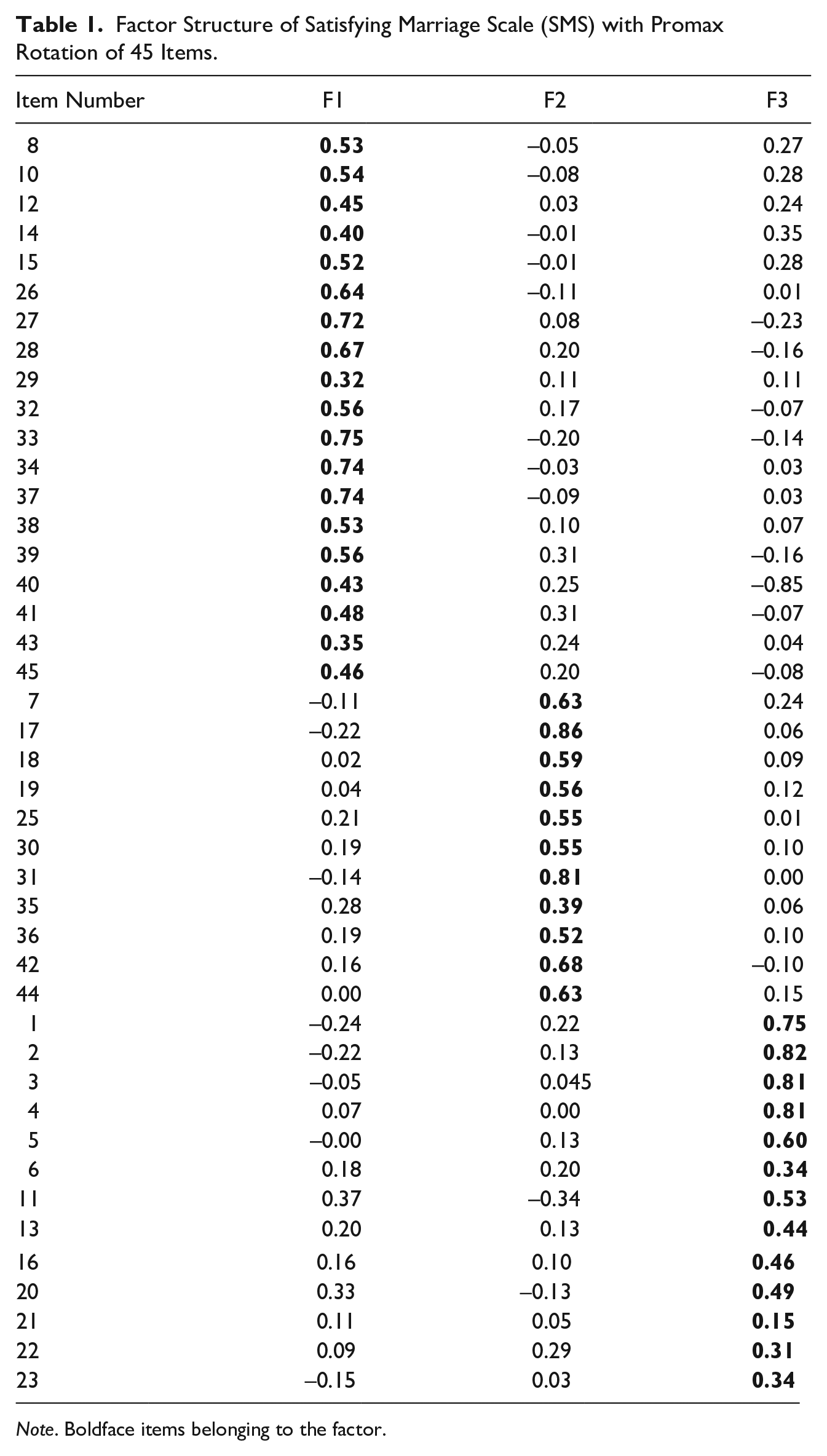
Exploratory factor analysis was conducted with the help of Principal Axis Factoring (PAF) by using Promax rotation on the 45 items of the SMS; 42 items showed significant item-total correlation. Table 1 presents the high inter-item correlation where items with loading of 0.30 or above were retained in their respective factor. To check the adequacy of the factor analysis, Kaiser–Meyer–Olkin (KMO) measure of sampling adequacy was also used, which was found to be 0.94. Bartlett’s test of Sphericity was also significant (p < 0.001), indicating that current data are suitable for factor analysis.
Factor Structure of Satisfying Marriage Scale (SMS) with Promax Rotation of 45 Items.
Note. Boldface items belonging to the factor.
Scree Plot
The Kaiser–Guttman’s criterion (Kaiser, 1974) for retaining factors was used with Eigenvalues greater than1 Eigen depicted three factors to be retained in this item analysis of SMS. Items with factor loadings of 0.30 and below were excluded.
Factor Description
As a result of EFA, three factors were retained. The scree plot of satisfying marriage scale extracted factors has been depicted in Figure 1. The content of each factor was observed in detail and a title was assigned to each factor based on the thematic relevance between the items.
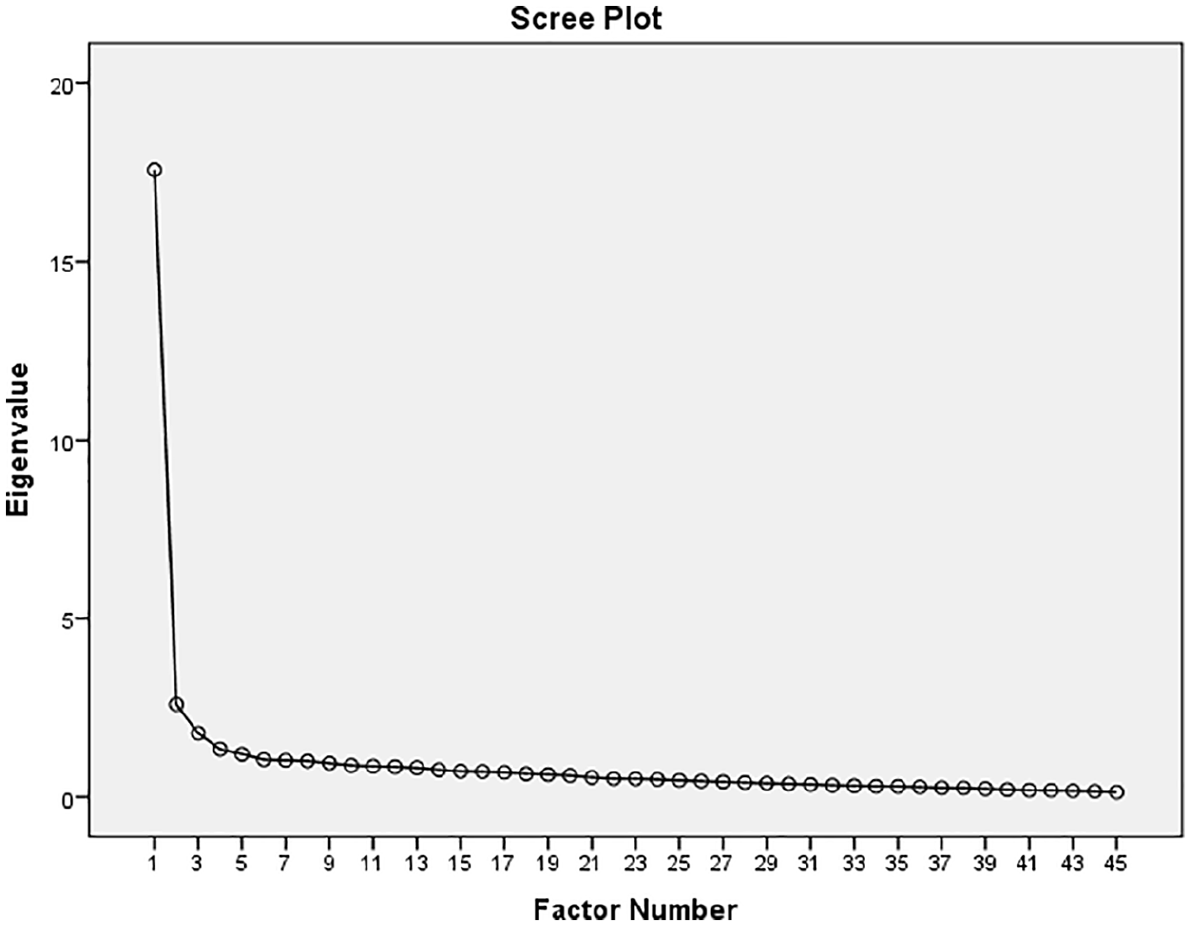
Scree plot of satisfying marriage scale extracted factors.
Factor 1. Cooperation and coordination
This factor was based on 19 items, and the theme of this factor implied that the partners work as team and mutually cooperate with each other in different domains of life. The included items were “helping each other in household chores,” “giving each other equal rights,” “contributing their parts in raising the children,” “satisfying each other sexually,” and “forgiveness.”
Factor 2. Mutual support
This factor was based on 11 items, and the theme of this factor referred to the components of support and care. The items included were “taking care of each other,” “treating the marriage as a mutual responsibility,” “supporting each other in health/ financial crisis,” “encouraging each other in their professional endeavors,” and “facing the difficult times together.”
Factor 3. Mutual respect
This factor was based on 12 items, which mainly highlighted the component of respect and understanding. This factor refers to accepting your partner the way they are and appreciating individual differences. Respect entails giving the partner freedom of choice, respecting each other’s temperament, respecting your partner’s opinions, and trusting your partner. The items included were “appreciating each other,” “trusting each other unconditionally,” “being friends with your spouse,” “respecting individuality,” and “saying positive things about partner in front of others.”
Psychometric Properties of Satisfying Marriage Scale
The psychometric properties of SMS were also established in order to make it a reliable and valid scale, which could be used effectively in Pakistani culture.
Concurrent validity
The concurrent validity of SMS was established with the help of CSI, which was developed in order to measure the level of satisfaction one derives from a marital or a romantic relationship. The results highlighted that there is a highly significant positive correlation between both scales (Table 2).
Summary of Intercorrelations, Means, Standard Deviations, and Cronbach’s Alpha of SMS Factors Scores on CSI and MSPSS (N = 250).
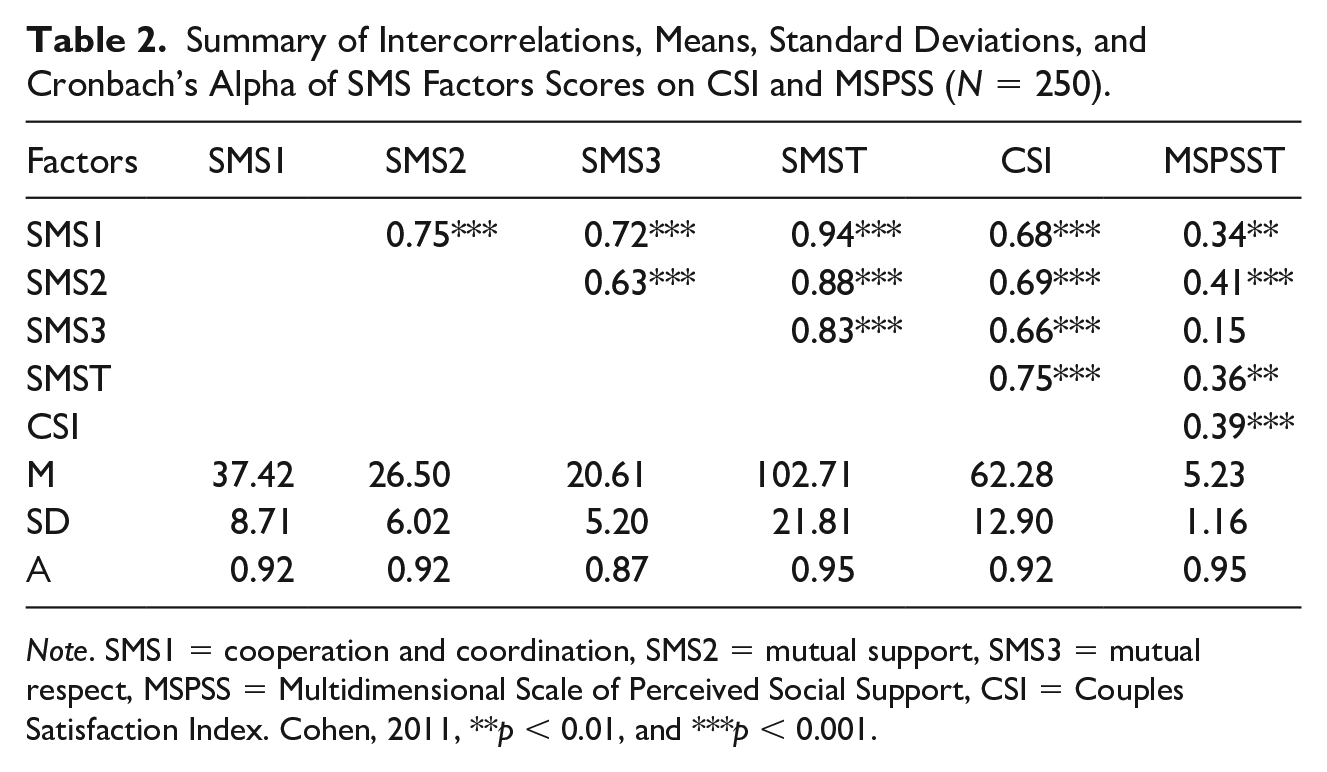
Note. SMS1 = cooperation and coordination, SMS2 = mutual support, SMS3 = mutual respect, MSPSS = Multidimensional Scale of Perceived Social Support, CSI = Couples Satisfaction Index. Cohen, 2011, **p < 0.01, and ***p < 0.001.
Construct validity
The construct validity of the scale was established using MSPSS, which had been used to measure the perceived social support of the participants. The results showed a significant positive correlation between SMS and MSPSS scale (Table 2).
Reliability analysis
The scale was further tested for its reliability. Split-half reliability analysis was conducted in order to fulfill the objective. The scale was found to have high internal consistency (α = 0.95) and split-half reliability was found to be 0.81.
Discussion
Marriage is considered an emotional, social, and legal bond that provides a foundation for a sustainable society. The quality of marital satisfaction is an indicator of the presence or absence of mutual support, trust, and a sense of belongingness between couples with the aim of fulfilling basic needs of each other (Abamara et al., 2018; Fellizer, 2017). The more satisfied a couple is with his or her marriage leads to many positive outcomes, including improvement in overall well-being and quality of life (Rostami et al., 2013). However, poor marital relationship becomes a risk factor for social and emotional functioning of an individual. Many studies have been found that marital relationship is influenced by numerous personal, emotional, familial, social, and cultural factors (Vil, 2015). One important factor that is being given importance at present is the dual-career or dual-earner couple and quality of marital relationship. The changing socioeconomic horizon has led many couples to establish their individual careers and to contribute equally in the household, which has remarkably influenced the family functioning and created an imbalance in work–home responsibilities (Shujja et al., 2013).
Since marriage has a distinct role and meaning in a collectivistic culture like Pakistan, which is predominately a Muslim society, marriage is considered a means of connection between two families. High parental expectations, joint family system, specific demands from a women, acceptance of a working and professional women in an orthodox culture, and societal pressures to start a family make this relationship even more demanding and complicated (Epstein et al., 2005; Goodwin & Cramer, 2000; Qadir et al., 2013; Uddin, 2009). The current study aimed to develop a culturally valid and reliable tool to assess the construct of satisfying marriage, which denotes an individual partner’s contribution to the success and satisfaction of a marital relationship.
Using a phenomenological, open-ended approach, factor analysis was applied to identify the dimensions of satisfying marriage in dual-career couples. Three factors explained 45% of variance with acceptable KMO and initial internal consistency. The first factor shows a sense of cooperation and coordination in couples. This first factor denotes a sense of having a mutual cooperation and sense of understanding in dealing with stressors, issues, and problems that arise in a marital relationship. meaning] This harmony in relationship also stands out in terms of the demand and a need of understanding a dual-career couple needs to have from one and other. The key characteristics of mutual cooperation and coordination comprise helping in daily routine matters and coordination in raising children. Also, this affirms the literature that having a coordinated, cooperative, and harmonious relationship with each other is an important component of satisfied marital relationship (Britt & Huston, 2012). Mutual cooperation and coordination are very important in traditional collectivistic cultures, in which wives are expected to look after the children and men are supposed to earn bread and butter for the family, but in dual-career couples, sharing of mutual family responsibility leads to a higher marital satisfaction.
The second factor that emerges from factor analysis is mutual support. This factor denotes a sense of understanding and supporting each other. Mutual and reciprocal support is an essential ingredient of a satisfied and happy married life where both partners accept and respect differences and still support each other to make their marriage successful and a source of satisfaction for each other (Cottrell et al., 2007). The manifestation of mutual support comprises supporting each other in difficult times, appreciating each other’s success, sacrifice for each other, and being loyal. As regards a dual-career couple, the demands and expectations that can affect the quality of marriage are higher, and being in a collectivistic culture, where familial and societal demands and expectations are very high, one needs a sense of support and cooperation from loved ones to functioning better and effectively.
The last factor denotes mutual respect, which is a key determinant of success in a marital relationship. This component has a central importance in the life of a dual-earner, where an acceptance of professional role, understanding of work-related stress, and helping in creating a harmony in work–home life balance have a significant influence. The specific manifestations of mutual support comprise respecting each other, understanding habits, respecting and mutual decision making, spending time together, and so on. These findings are also in line with previous literature (Abamara et al., 2018; Baumiester & Vohs, 2007; Shackelford & Emily, 2006).
Taking the findings mentioned earlier into consideration, it is important to note that components of satisfying marriage are unidirectional in nature and measure the key positive characteristics of the quality of the marital relationship observed in literature (Baumiester & Vohs, 2007; Perrone & Worthington, 2001; Shackelford & Emily, 2006). Unlike previous scales like KANSAS Marital Satisfaction Scale (Schumm et al.,1983), which measure only degree of satisfaction with 3-items, or Satisfaction with Married Life Scale (Johnson et al., 2006), which does not specifically measure the quality of marital relationship, the indigenous SMS measures the positive dimensions of marital relationship and can be used either for a partner or as a measure for dyadic relationship, and it has been found to be positively associated with the constructs of social support. SMS has been found to be internally consistent and shows acceptable reliability. The construct validity was established with CSI, which implies that SMS has a strong validity.
Limitations and Future Suggestions
There are certain limitations of the present study. The first one is the selection of sample. The sample for the study had been drawn from married dual-career couples who were residing in an urbanized city of Lahore. Therefore, the research cannot be considered appropriate to be used with people living in rural areas. Moreover, the collected data were self-reported, which leaves a risk for the participants to be biased in their responses. Expansion of the present study would enable the researchers to gather more knowledge regarding satisfying marriage for dual-career couples. The research has achieved its basic goal of constructing a theoretically sound and psychometrically robust scale of satisfying marriage. The results of the study indicate prospective usefulness of the SMS. Further research should be conducted in order to build a better understanding of satisfying marital relationship among dual-career couples.
Conclusion
Based on the analysis and factor structure of the current research, it is found that SMS has a strong reliability and validity, which measures the construct in dual-career couples in a specific cultural context. This measure can be further used for a diverse population by including rural samples as well and with different psychological constructs.
Footnotes
Declaration of Conflicting Interests
The author(s) declared no potential conflicts of interest with respect to the research, authorship, and/or publication of this article.
Funding
The author(s) received no financial support for the research, authorship, and/or publication of this article.
