







Abstract
In Italian society, known for the massive presence of so-called traditional families, different forms of it are nowadays spreading. The scientific and political debates on this issue are very intense and the common view of family is changing. Taking as a reference the theory of social representations and in particular the central nucleus theory, the present study aims to evoke the social representation (SR) of family in two different Italian groups: 220 young adults and 83 older adults. A semi-structured questionnaire divided into two sections was used: an open question (content) and a task of free associations, based on the technique of hierarchical evocations (structure). A content analysis and a representational structure analysis were applied. Comparing the SRs emerged among the two groups, young adults evoking family as an entity connoted predominantly in an affective way, while older adults evoking positive values declined in a more concrete and pragmatic way.
Introduction
There are many theories concerning family in social psychology; each one is characterized by a specific epistemological matter and a unique feature (Cigoli & Scabini, 2006; Gurman & Kniskern, 1981). Cigoli and Scabini (2006) propose a definition of family based on three principles: organizational, symbolic, and dynamic. In their relational–symbolic model, family is defined as an “organization of primary relationships based on three differences – gender, generation and family lineage” (p. 26)—its aim is generativity. Some authors (e.g., Fruggeri & Mancini, 2001) state that this definition describes the traditional family form, next to which, however, several family forms have spread. Even in a familistic and traditional culture like the Italian one, a cultural process is gradually beginning to question the idea that the nucleus composed of heterosexual couples and biological children is the only and indisputable point of reference of what should be understood by family. The development of this cultural process, that is also of great psychological importance, was accompanied by some important changes. Western Europe, and Italy in particular, is now characterized by several demographic changes: marriages are decreasing, spouses are older, and most people prefer to cohabit than to get married. Moreover, the average number of children per family is diminishing, while the rates of separations and divorces after an increase between 2014 and 2015 are now stable (Eurostat, 2016, 2018; Istat, 2015). Furthermore, young people leave their family later (25 years old) in most European countries, and they tend to be even older (29 years old) in Italy. These trends are common in Europe, even if each country has its own specificities (Alfieri & Marta, 2016). Because of media attention to these arguments, family debate is deeper than it once was. These trends clarify that both demographic behaviors and culture about familiar boundaries have changed during recent years. The concept of “family” has been negotiated in order to sustain the current diversity of familiar nucleuses (Scabini & Iafrate, 2003). Literature defines “new families” as single-parent, recomposed, same-sex parents’ families, and the ones that only cohabit without being institutionally recognized (Saraceno & Naldini, 2013).
The common view of family is probably changing. Some authors stated that one of the causes may be the “culture of love.” It consists of viewing love as the main motivation for a conjugal union (Saraceno & Naldini, 2013). We assume that features of social context impact people’s shared idea of family and, consequently, on their behaviors concerning it (Scabini, 1995).
What is the general representation of family? Are these recent sociodemographic changes having the same impact on different age groups? In order to answer these questions, we decided to collect data from two distinct groups of people in Italy: young and older adults. Young adults are characterized by a deep use of Internet, technology, and mass media communication devices (Boldizzoli & Sala, 2009); a longer stay with parents, approaching adulthood later (Scabini et al., 2006); and a liberalistic-inclined educational approach received from their parents, with a consequential orientation to get immediate satisfaction, making less sacrifices, and finding it harder to care about their relationships and long-term future projects (La Marca, 2011). Conversely, older adults have, in most cases, built their own families during the years when demographic trend radically changed. The two groups can report different representations of family. Their age differences have resulted in being exposed to different cultures and values. Detecting which representation people really have of such a complex social object requires an adequate methodology such as the one offered by the Social Representation Theory (SRT).
The Social Representation Theory and The Central Nucleus Theory
SRT, developed by Moscovici (1961), is a dynamic theory of knowledge aimed at identifying and explaining the ways in which social actors produce and organize their thoughts (social representation—SR) according to the needs of everyday life. SRs consist of a cognitive and evaluative corpus of statements and concepts socially constructed in interpersonal communications; they anticipate the formation of an opinion. Therefore, they orient collective thinking, action, and behavior (Abric & Tafani, 2009; Moscovici, 2001). Moscovici (1961) laid the solid foundation of a multifaceted and eclectic theory, declined by numerous scholars in distinct epistemological and methodological trajectories (Abric & Tafani, 2009; Farr & Moscovici, 1984; Moscovici & Markovà, 2000; Palmonari & Emiliani, 2009). Among these, Abric (1994) elaborated the Central Nucleus Theory (CNT) giving life to the so-called Structural School of Aix-en-Provence. In accordance with this theory, the structure of a social representation is organized around two distinguishable cognitive systems. One is the central core, which identifies the consensual elements that determine representational identity and manage its structure, defining the object or evaluating it. The other is the peripheral system, composed by less shared elements that refer to specific situations and is characterized by flexibility. It gives the possibility to integrate the individual knowledge to the representation (Abric, 1994; Flament, 1994). It is well documented in literature that differences in social practices related to an object are associated with different representational central systems and the activation of different cognitive schemes, meaning different social representations (Abric & Tafani, 1995; Guimelli, 1994; Guimelli & Jacobi, 1990). It is also true that identical contents can correspond to a totally different symbolic universe and, consequently, imply dissimilar social representations (Abric, 2003; Galli et al., 2018; Moscovici, 1986). The CNT assumes that SRs consist of both a content and a structure: the content reflects information, opinions, and explicative models that a group shares about a specific social object, while the structure consists of organizing the meanings attributed to that same object. Therefore, in order to get a complete understanding of an SR, it is necessary to study both its content and structure (Aresi et al., 2018; Pozzi et al., 2018). Abric (1989), in accordance with Moscovici (1976), argues that not all social objects can become objects of SR. In order to be socially represented, the object in question must be socially relevant, subject of social exchange, and related to other social objects. Moreover, it must be referred to all the norms and values shared by a group (Fattori et al., 2015; Galli, 2006; Marzana et al., 2016; Pozzi et al., 2017). In accordance with this perspective, a family can certainly be considered an object of social representation. Thus, we propose that the analysis of family SR means to define the contours of a social object in transformation that has a multifaceted meaning.
Research question is: how do groups of different age, in the Italian population, consider the concept of family? The present study is an attempt to fill a gap in the empirical literature by exploring the SRs of family in young and older adults, comparing their view of family as a social object. Only few studies have focused their investigation specifically on SRs of family, and none is based on the CNT (Abric, 2001). The present study wants to exceed these limits recurring to concurred mixed-method approach (Galli et al., 2019; Gelo et al., 2016; Pozzi et al., 2014). First, a qualitative part examines the content of SRs of family, giving respondents the freedom to write their own narratives about this social object; second, the structure of the SR of family is investigated, asking them to write and rank the first five names and adjectives that the word family evokes. By using this technique, we obtain a set of two qualitative items (nouns/definition; adjectives/evaluation) and two quantitative indicators for each structural component produced: its frequency of appearance and the score of importance accorded from the subject to that item. Thus, recurring to open descriptions of family and to the hierarchical order of the nouns and adjectives referred to it, both the content and the structure of SR are examined. Young adults were recruited via social network, since the initiative was announced in public and private groups in Facebook. Conversely, a wide part of older adults was recruited by researchers in person because they were not used to surfing the internet on a regular basis in Italy (Istat, 2015). Using the mailing list created after the recruitment, we sent an email, briefly explaining the research objectives and a link was provided to an anonymous and autonomous online questionnaire.
Method
Participants
Three hundred and three subjects were engaged: 220 young adults (18–36 years; Mage = 23.9 years; SDage= 3.4 during the research period in 2016) and 83 older adults (37–70 years; Mage = 54.01 years; SDage= 6.22 during the research period in 2016). Young adults were 19.1% males and 80.9% females. Older adults were 33.73% males and 66.27% females.
Research Design
Data collection
In order to (a) investigate the content and the representational structure of the family SR and (b) to identify its constituent elements and their articulation (Abric, 2003) a semi-structured questionnaire, divided into two sections, was used:
An open question, aimed at investigating the content of social representation (Today we hear about FAMILY. In your opinion, what is FAMILY?).
A task of free associations, based on the technique of hierarchical evocations (Vergès, 1994) to detect the representational structure of the SR. Participants were asked to indicate the first five nouns and adjectives associated with the stimulus word family (We ask you to write the first 5 nouns that come to your mind when you think about FAMILY; We ask you to write the first 5 adjectives that come to your mind to evaluate FAMILY). Subsequently, the questionnaire asked them to order these nouns and adjectives by their personal degree of importance. To avoid misunderstandings, they were asked to briefly explain why each word had been chosen, in order to make the necessary disambiguation during the analysis phase (You wrote X, why?) (Fasanelli et al., 2005; Pozzi et al., 2014; Schember et al., 2015).
Data analysis
Using a convergent parallel mixed-method design (Pozzi et al., 2018), data were analyzed. First, a qualitative analysis enabled us to reconstruct the content of the SR; then a mixed-method analysis allowed us to study its representational structure.
Content analysis
Using a thematic analysis, the content of family SR was described. Following the indications of Braun and Clarke (2006), at a first level of analysis (Level 1 coding) labels have been provided. At a second level of analysis (Level 2 coding), labels with similar meaning were collected in broader linguistic clusters—called themes. After a process review, both labels and themes were defined by the means of a consensus-reaching procedure between three independent judges. The inter-rater reliability was good (Cohen’s K = 85%) (Cohen, 1960); cases of disagreement were considered and discussed until consensus was reached. In order to increase the dependability of the analysis, the process was supervised, at regular intervals, by a content analysis expert auditor (Gelo et al., 2016; Pozzi et al., 2014, 2018).
Representational structure analysis
The data matrix obtained through the free associations, with subsequent hierarchization and justification, was subjected to a dual analytical procedure, through the use of the Interface de R pour les Analyses Multidimensionnelles de Textes et de Questionnaires (IRaMuTeQ) software (R interface) (Galli & Fasanelli, 2020). First, a prototypical analysis, useful to advance the first centrality hypotheses, was carried out. Subsequently, an analysis of similarities, with the aim of confirming/disconfirming these hypotheses and identifying the real interconnections existing between the constituent elements of the investigated representational structure, was executed. In accordance with the sample size, the thresholds for inclusion of the themes in the elaboration process were defined. All the nouns and adjectives evoked by at least 10% of respondents, belonging to each subsample, were elaborated.
Results
Young Adults
Content analysis
Analysis of family definitions provided by young adults revealed several important thematic nodes. In accordance with the thematic analysis, 565 different codes emerged. Starting from this point, the number of codes and the respective percentages of every theme have been indicated in brackets. Concerning sub-themes, only percentages have been indicated. Types of bond is the first theme, by taking frequency into account (155; 27.43%). Specifically, within this macro-theme, it was possible to differentiate the following sub-themes (Level 2 coding): love bonds (47.74%), blood bonds (11.61.%), family bonds (7.74%), union (7.74 %), legal bond (5.16%), not only blood bond (3.87%), deep bond (2.58%), generic bond (1.93%), not only biological bond (1.93%), not only kinship bond (1.29%), biological bond (1.29%), relational bond (1.29%), instinctive bond (0.64%), affinity bond (0.64%), indissoluble bond (0.64%), interpersonal bond (0.64 %), beyond biological bond (0.64%), friendship bond (0.64%), social bond (0.64%), normative bond (0.64%), and stable bond (0.64%). Structure emerged in 22.65% (128 codes) of the descriptions, referring to family as something organized. Support emerged as third in frequency (77; 13.62%), and it was analyzed in the sub-themes (Level 2 coding) mutual support (51.95%), received support (35.06%), generic support (7.79%), and given support (5.19%). Some other themes also emerged: purpose (41; 7.25%%), safe harbor (36; 6.37%), acceptance (22; 3.89%), children (20; 3.53), vital foundation (18; 3.18%), cohabitation (16; 2.83%), family types (13; 2.30%), time (13; 2.30%), well-being (10; 1.76%), discussions, contrasts and exchange of opinions (5; 0.88%), presence and transmission of values (5; 0.88%), life goals (3; 0.53%), roots (2; 0.35%%), and system dynamics (1; 0.17%). Regarding family types, the following sub-themes (Level 2 coding) emerged: homo/hetero (69.23%); only traditional (23.07%); and traditional, adoptive, extended, and single parent families (7.69%). The theme Discussions, contrasts, and exchange of opinions was declined in three sub-themes (Level 2 coding): generative (40%), generic (40%), and degenerative (20%).
Representational structure analysis
There are two elements presenting the structure of representations. The first one related to prototypicality derives from the rank–frequency correlations that exist between the constituent elements of family SR (see Table 1). The second one is an analysis of similarities and shows the weight and interrelation of each semantic aggregate of nouns and adjectives.
Representational Structure Analysis: Young Adults.
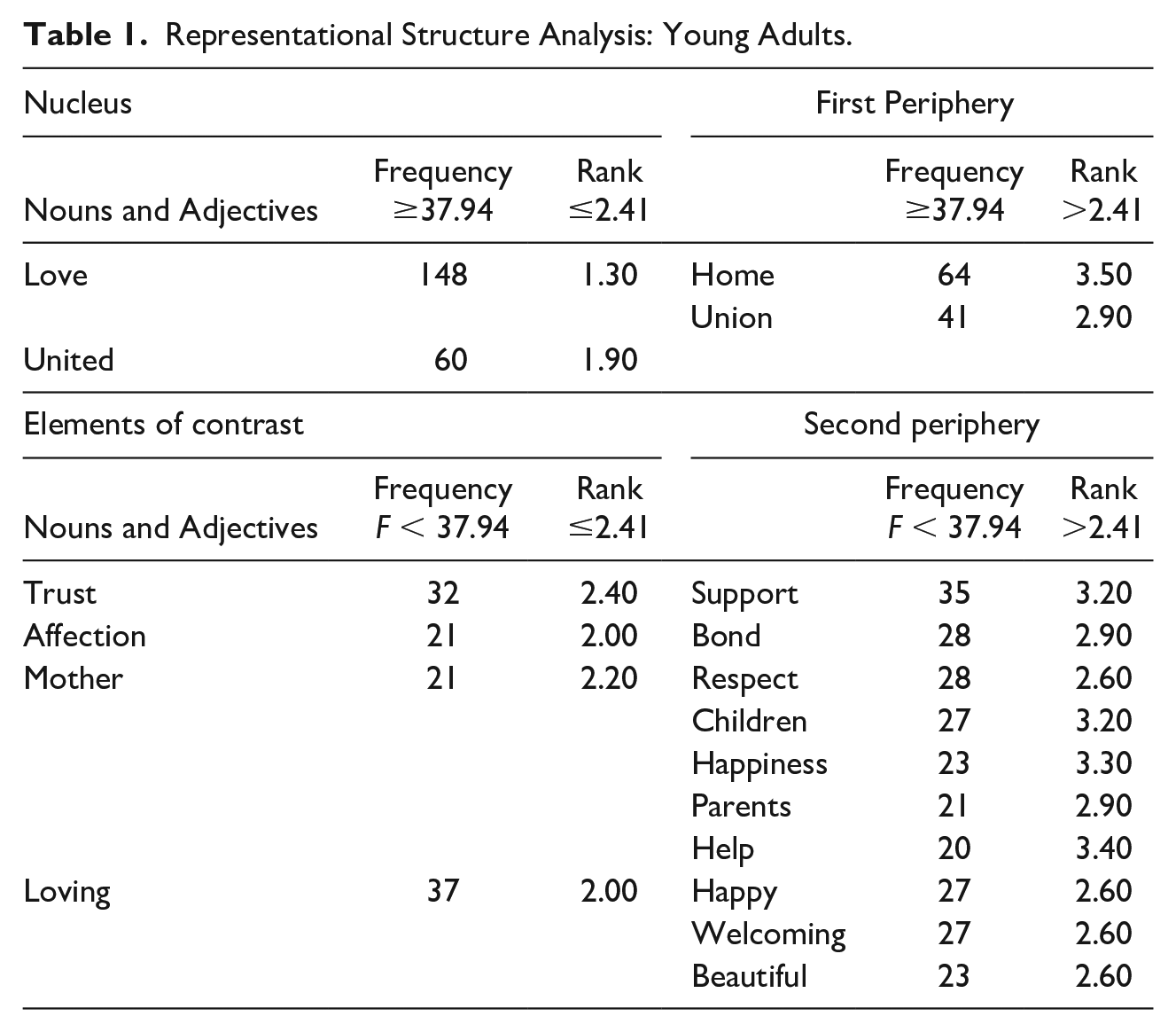
The noun love and the adjective united are in the first quadrant on the upper left, characterized by high frequency and high rank of importance. The noun home belongs to the first periphery (upper right quadrant, characterized by high frequency and low rank). No adjectives appear in this cell according to the chosen thresholds. The adjective loving and the nouns trust, affection, and mother are in the lower left quadrant, characterized by elements with low frequency and high rank, usually complementary to the central core ones. The second periphery (lower right quadrant, characterized by low frequency and low rank) collects nouns such as union, support, trust, bond, respect, children, happiness, and adjectives such as welcoming, happy, and beautiful. The analysis of similarities, related to this data, allows us to confirm and qualify the results of prototypicality. In detail, the term love identifies the core of family SR, confirming the prototypical analysis. Love is described as necessary because relationships between family members are based on love (Participant 1) as if there is no love, family does not exist (Participant 3) because love is at the base of the family (Participant 4) and family is based on love (Participant 15). The strong interconnection between all these themes in this cluster allows us to identify love as the central core of the entire representation of family. All the cognitions that characterize this first semantic cluster show the highest coefficients of Co-occurrence: union (Co-occurrence 36), support (Co-occurrence 27), respect (Co-occurrence 25), trust (Co-occurrence 25), children (Co-occurrence 20), happiness (Co-occurrence 18), and bond (Co-occurrence 11). According to young adults, union is a family topic because binds people with blood and/or emotional bonds (Participant 24) and if you are not united, there is no family unit (Participant 25). These explanations allow us to understand that it is precisely from their families that these young adults get support because family will always be there and is the greatest source of support (Participant 52). The best explanation to the presence of respect in this network was given by Participant 11 who wrote how to respect a person’s needs, dreams, limits, the way they are. I was lucky enough to grow up in a family that has always supported me in my choices and the way I am without judging me. In accordance with this, we can infer that one of the most important beliefs young adults have about family is trust, because you trust your family more than any other person (Participant 45). It is also important to consider the presence of children because without children, a family is only a couple. Children are the fruit of love and the heart of the family (Participant 65). Also, happiness is worthy to be considered because family is feeling good together and being happy (Participant 55) and a beautiful family is a happy family (Participant 60). Finally, in our participants’ opinion, the connection between family members is ensured by bond, that is, not chosen but will last forever (Participant 61). It is worthwhile to notice that, despite what has been pointed out here earlier, the strongest correlation of the analysis of similarities in this cluster is the one between the vertices love and home (Co-occurrence 39). The reason for this particular relationship was explained by Participant 6, who wrote Home is the place where one grows and lives. Family evolves, changes, and the home remains its nest, its safe place. It is a place also characterized by affection (Co-occurrence 9) because family is the first place for the individual’s emotional growth (Participant 67). A second cluster, highlighted by the analysis of similarities, goes around the adjective united that together with the terms happy (Co-occurrence 13), loving (Co-occurrence 12), beautiful (Co-occurrence 9), and welcoming (Co-occurrence 5) probably identifies a sub-representation of a subgroup of participants. Furthermore, it is worthy to consider that the connection between love and united registered the smallest value of interconnection (Co-occurrence 1). This cluster collects adjectives that give an image of family based on an idealized and stereotyped view of it. Family is united because it is hoped that all members are united (Participant 35) or simply because a family must always be united (Participant 41). This quality of family is also evoked through the adjective happy having a family is one of the reasons why a person can be really happy (Participant 41) and also because having a family makes people happy (Participant 40). Even this semantic cluster is well described by some participants: having a family is a beautiful thing (Participant 40), because you feel good, it is a beautiful environment, like when you say “this is a familiar environment” because it is beautiful (Participant 42). Family must be a nice place in which to grow and where you are respected and loved (Participant 72), a loving place because it generates and creates love (Participant 52) and welcoming because no one is left aside (Participant 64).
Older Adults
Content analysis
According to the thematic analysis, different themes emerged. Most of older adults’ definitions evoked family structure (40; 30.95%): generally, it is described as a group of people, two people, or a triangle composed of father–mother–children. A substantial part of the definitions focused on the types of bonds (37; 22.44%) between family members. Specifically, within this macro-theme, it is possible to differentiate the following sub-themes (Level 2 coding): love bond (43.24%), family bond (18.91%), legal bond (10.81%), blood bond (8.10%), union (8.10%), biological bond (5.40%), bond not only of kinship (2.70%), and generic bond (2.70%). Another theme concerns the aim (19; 14.70%) that family has for both its members and society. Family is a founding nucleus of civil coexistence whose members must give a future to themselves and to the world. According to Participant 5, family is the cell of society in which the human species is perpetuated, and which strengthens all its components from birth to death. It is also important to highlight the support (17; 13.15%) guaranteed by family. Out of a total of 17 codes, 4 types of support were identified in sub-themes (Level 2 coding): mutual support (58.82%), generic support (23.53%), received support (11.76%), and given support (5.88%). Most definitions defined the following themes as important: sharing (13; 10.06%), life goals desired by the couple (11; 8.51%), children (8; 11.27%), and vital foundation (5; 3.86%). Other themes that emerged are presence and transmission of values (5; 3.86%); family as a safe harbor (4; 3.09%); discussions, contrasts, and exchange of opinions (4; 3.09%) divided into sub-themes (Level 2 coding) generic (75%) and generative (25%). Finally, the themes that emerged with minor frequency are cohabitation (3; 2.32%), acceptance (3; 2.32%), time (2; 1.54%), roots (2; 1.54%), religion (2; 1.54%), and well-being (1; 0.77%). In the end, only one person highlighted what different types of family could exist (1; 0.77%): homo/hetero (Level 2 coding; 100%).
Representational structure analysis
For older adults, the representational structure analysis (see Table 2) ranks the following in the nucleus: the nouns love and respect, and the adjectives united and welcoming. The first periphery presents the nouns union, children, and home. The elements complementary to the central ones, in this case, are the nouns affection and solidarity. The last quadrant, the second periphery cell, shows the nouns sharing, happiness, and help and the adjectives challenging, open, serene, happy, and beautiful.
Representational Structure Analysis: Older Adults.
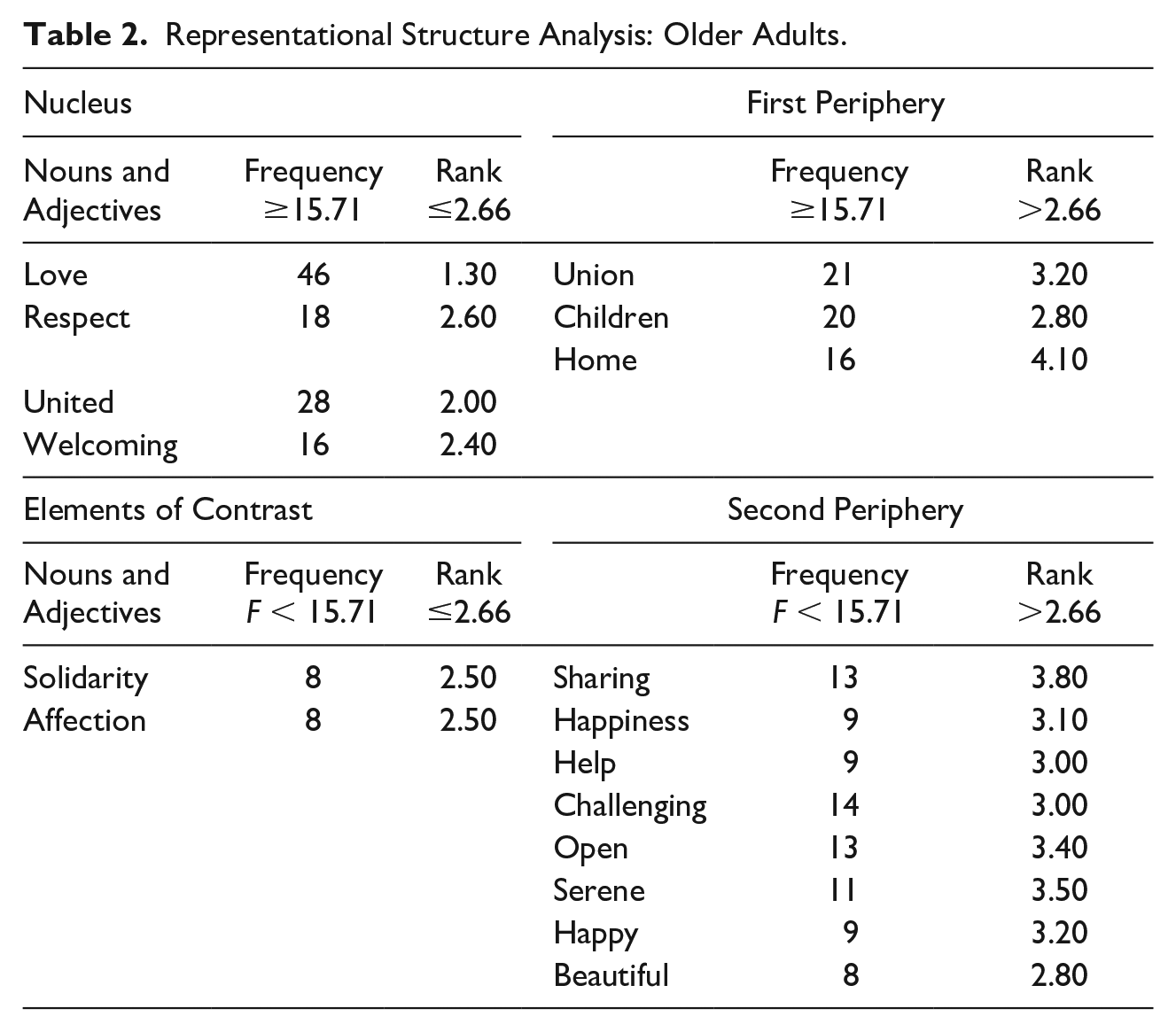
The analysis of similarities will allow us to confirm and qualify the elements of prototypicality, giving us the internal organization of the structure. These elements are gathered here by their bond’s strength.
The first cluster contains the term love, most likely the nucleus of the representation. Older adults evoked the noun love strongly connected with union (Co-occurrence 12) because it is the fundamental element that links people who share a life goal (Participant 10). In other words, union makes family a point of reference for each of its members; a sort of beacon to refer to when you feel good or bad, where you do not feel judged but appreciated or criticized but in a constructive way (Participant 11). For these respondents, love means sharing (Co-occurrence 11) because it is necessary to share information, opinions, points of view, in particular if they do not converge. This helps [family members] have a perspective (Participant 15). The concept of respect is very connected (Co-occurrence 11) to the term love because one must observe oneself, listen to oneself and try to understand each other (Participant 15); without respect there is no love (Participant 40). Family is the first social gym concerning help (Co-occurrence 7): you learn [how to help], you give it and you receive it (Participant 78). Family is a place of happiness (Co-occurrence 6): having children and a wife who loves me makes me happy. It is a place in which you can have support (Participant 1). This first cluster highlights the idea of family as a bridge with community, having an important social function: in fact, this cluster is characterized by the term solidarity (Co-occurrence 3) meaning that family cannot be closed [to its community] but also sympathetic to its community (Participant 36). Participant 44 highlighted that family is not self-referential but must be open to others because it has to share (Participant 65). Children (Co-occurrence 8) become the structural element that links the nucleus to the periphery of family SR, the second cluster, that reflects social practices. In fact, children are considered the aim of starting a family (Participant 11), inside a home (Co-occurrence 9), the place where security is communicated, where the family lives, where joys and problems are shared, where people help each other, discuss, quarrel, make up, live (Participant 13). Home is a physical place, the nest where family is consolidated (Participant 17), a place where affection is (Co-occurrence 4) the basis of every bond (Participant 15). The adjectives united (Co-occurrence 7), open (Co-occurrence 7) (with welcoming [Co-occurrence 6] and happy [Co-occurrence 3]), serene (Co-occurrence 5) and beautiful (Co-occurrence 2), (with challenging [Co-occurrence 3]), are gathered in the last cluster of the topological representation of older adult’s conceptions about family. Family is united because it is in the unity of purpose that the members of the family find the basis for growing together (Participant 12). Family is open to the beautiful things that surround it (Participant 4), but it is also open because family unit is destined to expand with children, spouses of children and their relatives, friends etc. . . . (Participant 29). However, this is connected to the idea that inside a family, you are welcomed because when you are inside you must feel at ease and be well (Participant 30), and this makes a person happy when [precisely] you feel the closeness of all members of their own family (Participant 5). Family must be serene, serenity is an excellent goal to transmit (Participant 17), a quiet place in the chaos that surrounds you (Participant 21). The term beautiful was used in accordance with the fact that for most participants it is nice to have a family (Participant 9), although this term refers to the adjective challenging because like all beautiful things, you have to take care of family and cultivate its bonds with love every day (Participant 22). Family is a source of responsibility (Participant 32).
Discussion
Comparing the SRs that emerged from the two groups, young adults consider family as an entity connoted predominantly in an affective way, characterized by love, union, and happiness; a place full of emotions in which to be welcomed, understood, and where people can feel good and supported (Marta et al., 2018). Family is seen as full of abstract values (idealized and stereotyped family). The culture of love that permeates the SRs of young adults is also found in those older adults, in whom love is central. Nevertheless, they highlight the importance of commitment to the bond, such as respect. Older adults evoke positive values, but they are aware of having to work hard to guarantee family functioning. They seem to balance affective and ethical qualities. This result has practical implications. It is important that those qualities are balanced in families (Alfieri et al., 2014) in order to guarantee children’s well-being. Young adults highlight the centrality of support received from other family members. They evoke this theme (support) in a higher percentage than older adults (37.57% for young adults; 23.29% for older adults).
An important aspect is family as a safe harbor and as a place of acceptance: these themes are, respectively, 17.56% and 10.73% of the total themes in the descriptions evoked by young adults, while older adults’ percentages were only 5.48% and 4.11%, respectively. Concerning young adults, these data show the vision of family as a place where people can find refuge because it makes them feel happy, welcomed, and loved. Regarding older adults, this idea is combined with the commitment and effort required to raise children and take care of them that also concerns the emotional aspect. These considerations make us reflect on the evidence provided by literature that reports a greater difficulty for Italian young adults to leave their parents’ homes in young adulthood, compared to their European peers (Alfieri & Marta, 2016). In this regard, especially for older adults, the role of children is questioned: in the structure of the SR, it occupies an indispensable role, contrary to the marginality that emerged from the content analysis, in which the theme children emerged at 19.96% of the total themes. Older adults seem to be unaware that their family’s SR is based on children, especially in everyday practices. This data can suggest that children have the role of compacting and uniting the family bond (Scabini & Cigoli, 2012; Scabini et al., 2006), even if they are not aware of it. Young adults evoked children less than older adults (9.76%) and it is positioned, in the structure, in the second periphery. This position may suggest that the theme is in transit—in or out of the social representation. Understandable, if we consider the late independence of young adults from their families, young adults probably consider themselves in the role of children and still do not think concretely to form a new family as parents.
It is interesting to note that young and older adults have not attributed centrality to the type of family but to the characteristics that define it, therefore, considered as having priority over the form. The data are also interesting in operational terms because the idealization—or stereotypization—of the family definition by young adults shows how important it is to offer paths of accompaniment to marriage/cohabitation and family making that help to maintain high idealization but also introduce reflective elements about the real and concrete family life, necessarily characterized by the presence of commitment. Today’s culture seems to be far from this perspective as the fundamental value attributed to the couple and family is to live feelings and consume emotions, as intense as possible. It is, after all, a new way of reviving a contractual vision: the individuals, with their needs and rights, are at the center, while, in the background, there is the commitment to the other and to the bond, and left in the shadow is also the child as the fruit of the bond. Older adults, on the other hand, show that family means having a high ideal tension and, at the same time, committing themselves to meet the challenge posed by promises, such as “living together in joy and pain, health and sickness.” Offering paths to young people to help them reflect on these aspects can help them both to bear the burden of possible disillusionment due to the fall of idealization and to prevent fractures and relational and personal suffering.
Possible limitations of the present study include the use of a single instrument to evoke the SRs of family. Even if it is a reliable, effective, and time-saving tool to uncover SRs (Abric & Tafani, 2009; Fasanelli et al., 2005), interviewing the participants would have highlighted a deeper understanding of social representations. Moreover, it would be interesting to contact participants belonging to the same family in order to control the exposition to the same experience and culture.
Footnotes
Declaration of Conflicting Interests
The author(s) declared no potential conflicts of interest with respect to the research, authorship, and/or publication of this article.
Funding
The author(s) received no financial support for the research, authorship, and/or publication of this article.
