






Abstract
Positive effects of parent–child play have been documented but little is known about what drives this play. We observed eight-one children (kindergarten through 1st grade) of their play with the mother and father separately to determine how the play role of parents changed based on parent gender, child gender, and play context. Two significant 3-way interactions were identified: (1) parents of boys acted more often as directors in a puppet game, as facilitators in a building block game, and as co-players in a ball game, whereas parents of girls were more likely to be co-players in the puppet and building block games but facilitators in the ball game; (2) fathers tended to be directors more often than co-players in the ball game, while the opposite was true for mothers. Findings point to the important interplay of gender and context in determining the roles that parents enact when playing with children.
Keywords
Introduction
Play is a significant developmental activity for children from infancy through childhood (Gray, 2015). The notion that children learn and practice social roles and skills in the context of play is supported by constructivist theorists like Piaget and Vygotsky (Thibault & McKee, 1982; Vygotsky, 1978) as well as by much empirical research (see review, Lillard et al., 2013, and meta-analysis, McWayne et al., 2013). In 2007, the American Academy of Pediatrics (AAP) released a clinical policy report providing evidence of the power of play (Ginsburg et al., 2007), and since then it has become evident that play may be even more important than previously understood. Toxic stress created by adverse childhood experiences tends to impair executive functioning, yet play in childhood appears to enhance brain structure and function, including improving executive function. The positive benefits of play are so compelling that the AAP updated their 2007 policy to encourage pediatricians to write prescriptions for parent–child play (Yogman et al., 2018). This AAP recommendation highlights what socialization researchers have long known, namely, that parents are crucial agents of socialization (see review, Harrist & Bakshi, 2022), and parent–child play is one of the key processes by which that socialization occurs in the family context (see review, Roopnarine et al., 2019). In middle childhood, parent–child play can enhance the emotional bonds between the parent and child (Dubois-Comtois et al., 2013; Ginsburg et al., 2007), and may facilitate positive peer-relations via scaffolding and allowing children to practice social skills (e.g., cooperation, turn-taking, making suggestions; Zisser-Nathenson et al., 2017) and emotional regulation skills (Feldman, 2015) that will increase peer acceptance (Blair et al., 2014; Parker & Gottman, 1989). The current study furthers the empirical line of research about parent–child play by examining determinants of the roles parents enact when playing with their children in middle childhood.
Parent Roles During Parent–Child Interaction and Play
When focusing on style of play—how play ensues—parents’ behavior can be meaningfully classified according to (a) how much control they attempt to assert over the content and outcome of the play activity, and (b) how focused and responsive they are during play. These interactional characteristics of control and responsiveness have been studied most often by observing parent–child interaction in contexts other than play, however.
Parent–Child Interaction
Except in special cases (viz., with children who have experienced pre-term birth or developmental delays; for example, Cielinski et al., 1995; van de Weijer-Bergsma et al., 2016), observational studies of parent–child interaction have found that too much “directiveness” is non-optimal for children’s cognitive, social, and emotional development (Lamb & Lewis, 2011). For example, in longitudinal studies, high maternal directiveness with one-year-olds predicted declines in child engagement and positivity through age 5 (Ispa et al., 2015); mother’s directiveness with 3-year-olds was negatively related to cognitive skills and social independence when the child was four (Landry et al., 2000); and mothers’ restriction of autonomy with toddler sons predicted less child positivity in middle childhood (Ispa et al., 2015).
Conversely, a focused, responsive, and supportive-but-non-directive parent interaction style tends to be related to children’s positive socioemotional outcomes. For example, mothers’ emotional availability—operationalized in terms of sensitivity, structuring, non-intrusiveness, and non-hostility—is related to subsequent positive developmental outcomes such as secure attachment and language development in early childhood (see review, Biringen, 2000; Leigh et al., 2011). Parental responsiveness and scaffolding—sensitively guiding the child contingent upon the child’s behavior—with toddlers and older children seems to be particularly helpful in fostering children’s later emotion regulation and effortful control (e.g., Kochanska et al., 2000; see also review, Mermelshtine, 2017).
Recent neuropsychological research confirms these past observational findings. For example, maternal directiveness (i.e., vocal or behavioral demands) during social play with an infant has been positively associated with increased neural sensitivity to anger as assessed via fNIRS (Zhao et al., 2019), and maternal sensitivity/supportiveness in early childhood predicts hippocampal volume growth in later childhood and pre-adolescence (Luby et al., 2016).
Parent–Child Play
When observations of parent–child interaction have been focused specifically on play, similar types of play interactions have been associated with child socioemotional competence. For example, concurrent peer competence has been correlated with high levels of parental play involvement with preschoolers (Lindsey & Mize, 2000) and joint, mutually compliant parental play with 5-year-olds (Pettit et al., 1998). Parents’ scaffolding with preschoolers—the provision of support contingent on the child’s state or behavior—has been found to predict later child effortful control and social skills (Lengua et al., 2007), even into middle childhood (Colman et al., 2006). And fathers’ sensitive play with their infants predicted adolescents’ healthy attachment representations at age 16 (Grossman et al., 2002).
Codebook Description of Parent Play Roles.
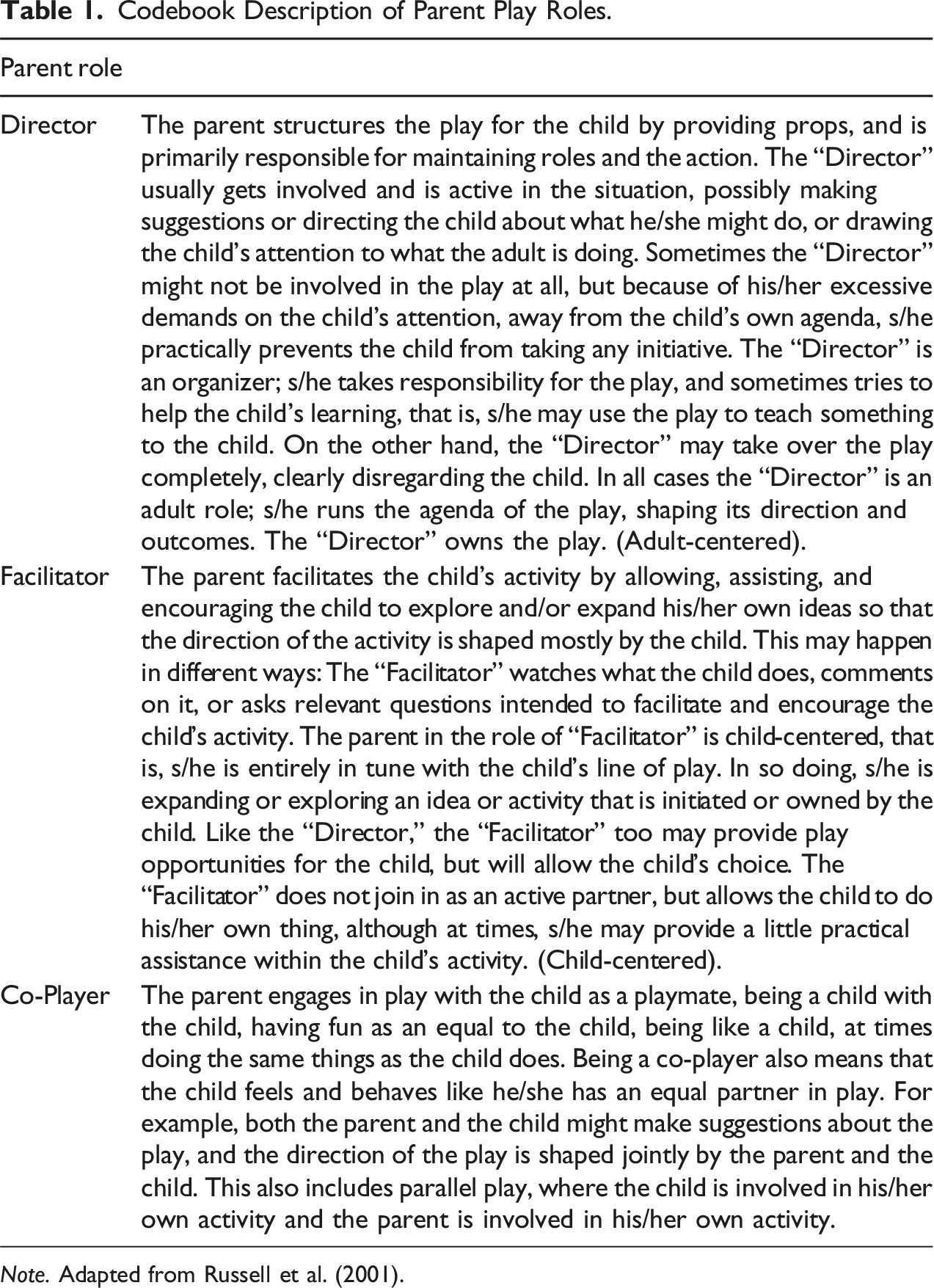
Note. Adapted from Russell et al. (2001).
Parent–Child Play in Middle Childhood
Most studies of parent–child play—particularly observational studies—have used infant, toddler, or preschool samples. Yet parent–child interaction differs as a function of child developmental stage (see review and meta-analysis by Collins & Russell, 1991; Teubert & Pinquart, 2010, respectively) and so, too, does parent–child play. In the current study, we focused on parent play with children in early middle childhood (1st-2nd graders). Mother– and father–child play during these early school years is significant to observe for several reasons. For the first time, parents of children in early middle childhood spend more time in positive engagement activities like play and conversation than they do in caregiving activities (Child Trends, 2002; Keown & Palmer, 2014). Also, in this stage, mothers and fathers spend similar amounts of time with their children, whereas during early years mothers tend to spend more one-on-one time with them than do fathers (Yeung et al., 2001). Together, these findings suggest that some of the parent gender differences reported in early childhood (e.g., mothers tend to be more responsive than fathers in their interactions with children) may have subsided by the time children reach early middle childhood (Russell & Russell, 1987). Consequently, mothers’ and fathers’ roles during play in early middle childhood may be less confounded by age-related and societal factors, as well as the distribution of caregiving responsibilities within couples during the early childhood years.
What Drives Parent Play Style?
Besides child age, parent play style is determined by factors including gender and contextual/situational demands. In the current study, we examined both factors as they related to parental play roles.
Parent Gender
The number of empirical studies of mother–child play is three times the number of father–child play studies, and that rate has not changed since 1970 (Cabrera & Roggman, 2017), despite play being a primary way many fathers engage with children (see review, Robinson et al., 2021). When both mothers and fathers are studied simultaneously, parent–child play interaction may be impacted by three gender configurations: Play roles may be a function of the parent’s gender, the child’s gender, or the gender constellation of the parent–child dyad (i.e., whether the parent and child gender match).
There are fairly consistent gender differences in the play styles of mothers and fathers. For example, in an observational study of parent–child interaction with 3- to 6-year-old children, Wilson and Durbin (2013) found a gender difference in the types of bids parents made, with mothers making more mood-regulating and social bids and fathers making more bids for influence. This finding fits with a larger trend in which fathers have been found to be more directive, arousing, and assertive, and mothers more sensitive, responsive, and autonomy granting across various types of interaction (e.g., Hallers-Haalboom et al., 2014; see also meta-analysis by Leaper et al., 1998; a scoping review by Vallotton et al., 2020, and a review of 15 data from over 15 countries by Yaffe, 2020). Rates of play type also tend to differ across parents (Roopnarine & Mounts, 1985). However, both mothers and fathers can and do engage in didactic, pretend, cooperative, object, and physical play with their children (see review by Roggman, 2004). Whether fathers’ and mothers’ behavior are “interchangeable” or whether they contribute unique developmental experiences when they interact with their children is a matter of continued debate (see Cabrera & Roggman, 2017, special issue, and Carone & Lingiardi, 2022), although evidence tends to indicate effects are additive (Robinson et al., 2021).
Developmental research has demonstrated that some behaviors fathers tend to enact more often than mothers may serve specific developmental functions. Fathers tend to engage children in more rough-and-tumble play than do mothers (e.g., MacDonald & Parke, 1986) and rough-and-tumble play is related to children’s social competence and regulation of aggression (see review, Amodia-Bidakowska et al., 2020; also Paquette & Dumont, 2013). In a meta-analysis of 16 studies (n = 1521 father–child dyads; StGeorge & Freeman, 2017), weak-to-moderate effects of father’s physical play were found on child aggression, social competence, self-regulation, and emotional skills. The authors noted that future studies of father–child play could be strengthened when “definitions clearly identify the nature of play, settings facilitate boisterous play, and measures include frequency and quality of play interactions” (p. 709).
Piskernik and Ruiz (2020) pointed out that recent findings of parent gender differences in play are somewhat surprising, given that mothering and fathering constructs appear to be converging over the last few decades as mother and father roles become more similar (see also review, Fagan et al., 2014). They further suggested that there could be a latent play quality mothers and fathers share, but that is obscured in “phenotypically different games” (e.g., father-preferred physical play vs. mother-preferred cognitively stimulating games). In the current observational study, we examined parent gender differences in play roles while accounting for factors such as the nature of play and the play setting (including a setting facilitating boisterous play), to help determine whether the mother-father differences observed in past research were actually a function of parent gender, per se, or whether they may have been caused by other variables such as child gender or characteristics of the play context.
Child Gender
In addition to—or instead of—parents’ gender driving their play styles, differences in parent–child play interactions may be a function of children’s gender (see review by Leaper & Friedman, 2007). Girls and boys in middle childhood have been observed to choose different types of play. For example, boys tend to engage in more group, rough-and-tumble, solitary-dramatic, and exploratory play, and girls in more conversation, parallel play, and constructive play (Moller et al., 1992; see review by Kung, 2022). There are also relatively stable gender differences in the play/leisure activity of children in Western culture during middle childhood. Boys have been found to prefer playing sports and computer games significantly more than girls; they also tend to prefer manipulative toys, vehicles, and action figures, whereas girls tend to prefer educational activities, dolls, and stuffed animals (e.g., Cherney & London, 2006). Some of these differences may be due to genetic differences: A meta-analysis across ages 3 months to 13 years showed gender differences in effortful control and surgency (Else-Quest et al., 2006) which likely impact toy and other play activity preferences.
There are also some commonly found differences in how parents interact with sons versus daughters. For example, parents have been found to engage in more supportive speech (e.g., approval) when talking to their young daughters compared to their sons (Leaper et al., 1998) and mothers tend to engage in more “emotion talk” with daughters than sons (Fivush et al., 2000). In the current study, we were interested in whether parent play style was determined more by child or parent gender, or by one as a moderator of the other’s effect.
Parent–Child Gender Match
Parents’ play style also may be impacted by the gender configuration of the play dyad, in other words, by whether the child’s gender matches the parent’s gender. For two decades, scholars (e.g., Maccoby, 2003; Parke, 2002) have argued for examination of the distinct patterns of parent–child interactions that take into account the gender of both parent and child. Russell and Saebel (1997) reviewed studies that compared the four binary gender constellations (i.e., father-son, mother-daughter, father-daughter, mother-son) and found the highest level of negative affect in father-son dyads; more non-intrusive parenting and indirect parent communication in mother-son dyads; more authoritarian parental control in father-daughter dyads; and higher levels of equality in mother-daughter dyads. Leaper et al.’s (1998) meta-analysis of observed parent–child interaction found that mothers used more directive speech with daughters than with sons. This effect was stronger as children moved into middle childhood, and Leaper et al. suggested that perhaps mothers were allowing sons (but not daughters) more autonomy as they got older. Similar patterns have also been identified in more recent studies. For example, Brown et al. (2015) found gender differences in emotion socialization, with mothers being more supportive of girls’ emotions compared to the other gender constellations. These parent-by-child gender differences seem to be particularly strong when parents hold gender stereotypes (Endendijk et al., 2016). They also appear to be less likely when researchers have used observational rather than self-report methodologies. Self-report studies, which are more common, may capture parents’ expectations about interactions with their children rather than their actual experience (Deaux & Major, 1987). The current study explored parent-by-child gender effects using laboratory-observed play interactions.
Play Context
Props and Prompts Used in Parent–Child Observation Sessions.

The Interaction of Gender and Context
Mothers and fathers and girls and boys tend to engage in different behaviors depending on the play context (see review, Deaux & Major, 1987). For example, in an observational study, Leaper (2000) found that in an unstructured play setting, there were no parent gender differences in affiliation, whereas in other play settings, mothers were significantly more affiliative than fathers. Leaper et al.’s meta-analysis (1998) examined parent gender differences in communication and found that gender effects were larger when unstructured activities were observed rather than problem-solving tasks. In the current study, we examined the possible interaction of play context and gender in relation to parent play roles.
Because past research on play styles has not simultaneously tested the role of gender and context, we consider our analysis to be exploratory and offer no directional hypotheses. Rather, we sought to describe the play styles of parents of first- and second-grade children, and then to examine the (possible) unique contributions of parent gender, child gender, play context, and their interactions with play style. We used an observational coding scheme—the Parent-Toddler Play Coding Scheme (PTPCS, Russell et al., 2001)−that captures the social elements of play on which mothers and fathers may differ with sons versus with daughters while also summarizing styles that may be associated with play context.
Method
Sample
Demographic Characteristics of Children Participants.

Procedure
Families came to the university for two 24-min observation sessions, one mother–child and one father–child session. The observations took place in a laboratory room that contained a table and two chairs. Parent–child interactions were videotaped behind a one-way mirror that looked like a window. Informed consent was obtained from parents to authorize their children’s participation in the study and to be assured about the confidentiality of the data. The research project received IRB approval from the university where the study was conducted. Families were provided with pizza during the observation visit and the children received a university t-shirt and/or a poster signed by a university athlete as compensation.
The order of observations (child with mother vs. father) was counterbalanced. Each observation consisted of three 8-min sessions. In each 8-min session, a different play context was presented: one session was a pretend play context with puppets, one session was a task-oriented play context involving a building task, and one session was a physical play context involving a ball. Different sets of toys were used for the mother-versus father–child interactions so that the play evoked with the second parent would be novel (e.g., as opposed to a continuation of the play the child engaged in with the first parent). The toy sets were pilot tested and chosen to be equivalent in terms of play opportunities (e.g., all pretend play sets had both scary and friendly characters, all physical play toys encouraged movement). Table 2 summarizes the play contexts, toy types, and specific toy sets, as well as the verbal instructions given to the parent–child dyad.
The parent and child were seated in the observation playroom, they were told that the team was interested in finding out which toys were the most fun to play with. The first set of toys was presented, and the dyad was asked to play with the toys in any way they wished. The researcher left and returned in 8 minutes. The procedure was repeated for two more 8-min sessions. The parent then left and the other parent was brought into the room. The procedure was repeated but with different toy sets. When both observations were complete, the real purpose of the observations was explained to the parents and child.
Operationalization of Parent Play Role (PR)
Parent’s play style was assessed using an adaptation of the PTPCS (Russell et al., 2001). Parent’s play role (PR) was coded based on whether the parent was in control and directing the play (the director role), whether the parent was facilitative and the play was child-centered (the facilitator role), or whether the parent–child dyad engaged in joint, co-constructed play (the co-player role). Table 1 presents the full description of each PR used by coders as they assessed the parents’ play.
Each of the three play sessions—pretend, task-oriented, and physical play—was divided into four observational periods during which parent roles were coded: (1) 1st minute, (2) minutes 2–4, (3) minutes 5–7, and (4) last minute. Therefore, for each child, there were 12 total observational periods (4 periods × 3 toys) coded with mother and 12 with father, for a total of 24 periods per child and 1944 periods to be rated for the whole sample (81 children × 24 periods/child). Thirteen percent of the observational periods (n = 245) were not rated due to the parent being out of the camera view or inaudible, thereby reducing the final number of periods to 1747.
Using a 1-to-3 scale, coders ranked the relative salience of each of the three PRs—director, facilitator, and co-player—in each observational period. This ranking approach was deliberately chosen over Likert-style ratings to hone in on the “core element” of parent’s role in the interaction. In other words, coders were forced to process what was happening in the interaction in relation to each of the three roles. A ranking of “1” indicated that the PR was most prominent in the parent’s behavior during that period, “2” the second most prominent, and “3” the least prominent. For example, in a pretend play session where a child and their parent engage in a puppet show, the coders would analyze each 4-period segment of the interaction, paying close attention to how the parent assumes the roles of director, facilitator, and co-player. If during minutes 5–7, the parent predominantly directs the narrative, guiding the storyline and character interactions, while occasionally joining in as a co-player to interact with the puppets alongside the child, the coding for that period might reflect a ranking of “1” for director, “3” for facilitator, and “2” for co-player.
If two PRs were equally prominent, they were given the same rank. This however occurred less than 2% of the time, with 14 ties between director and co-player, 28 ties between director and facilitator, and 3 ties between facilitator and co-player. If the parent displayed only two PRs during a period, the unobserved role received a rank of “3”. If the parent engaged in one PR only, the remaining two PR both received “3”s. PR rankings of “1” were tabulated and used in the current analyses.
Reliability
Inter-coder reliability was assessed by having videotapes for 650 (37%) of the play periods double coded. Coders were unaware of when they were coding a tape for reliability purposes. Cohen’s
Results
Descriptive Analysis of Role Salience
Counts for Parent Role Rated as the Most Salient During Each Observation Perioda.
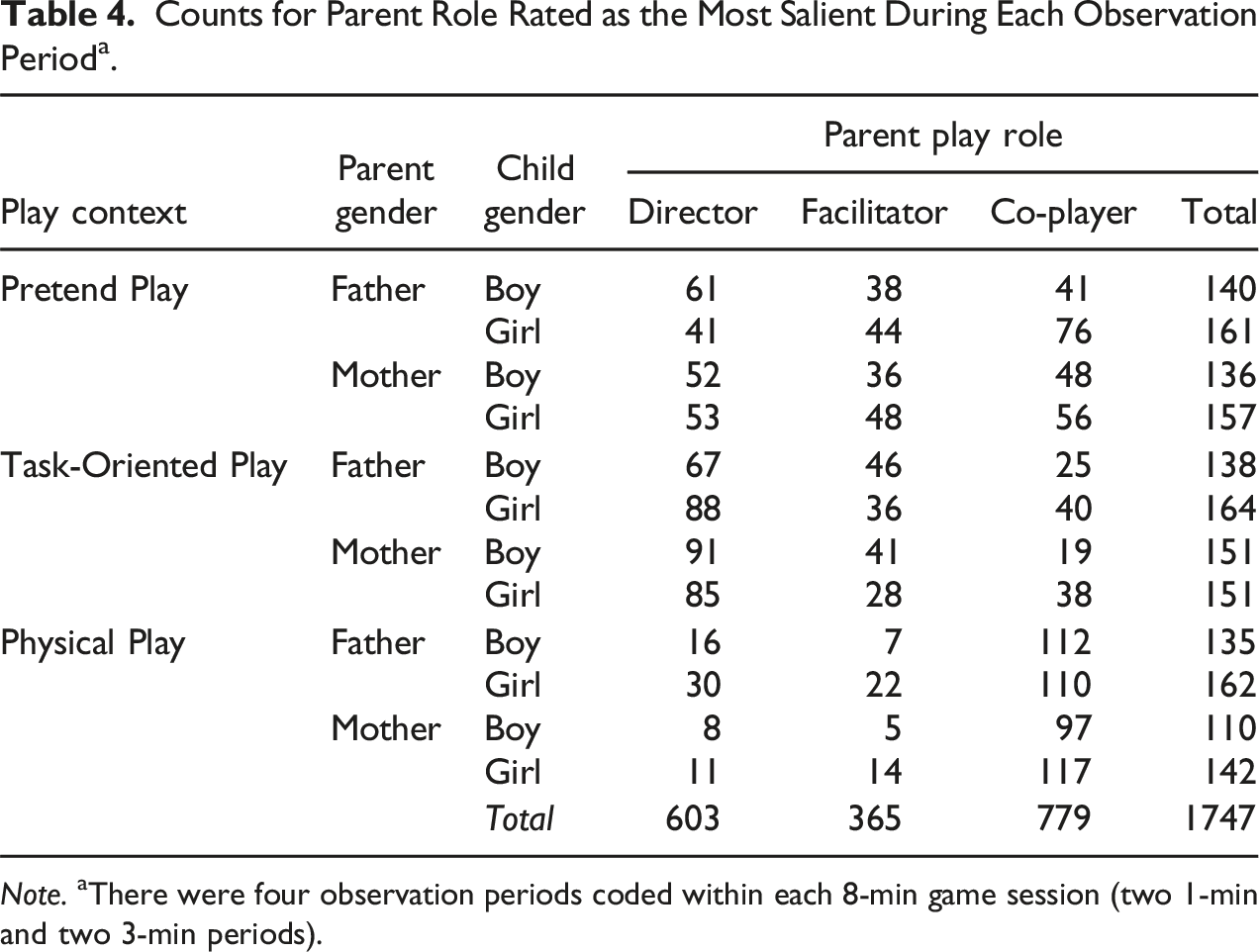
Note. aThere were four observation periods coded within each 8-min game session (two 1-min and two 3-min periods).
Because we focused on the occurrence of the target event (i.e., which PR was rated as most salient) during each observational period, our unit of analysis was count (number of times a PR was rated as most salient within a period) rather than individual participant. When we collapsed across parent and child gender and play context, co-player was found to be the most salient PR, followed by director and then facilitator. Significance tests were conducted by dummy-coding variables to compare the relative prevalence of each play. Results showed that parents acted as co-players more often than directors (Z = 4.72, p < .001) and facilitators (Z = 11.95, p < .001), and more often as directors than facilitators (Z = 7.57, p < .001).
Log-Linear Analysis
Given that our unit of analysis was count, we conducted a log-linear analysis on the cross-tabulated data to test whether PR counts varied by the associations among child gender, parent gender, and play context. Log-linear analysis is an extension of chi-square test for multivariate frequency tables. The goal of log-linear analysis is to identify the main effects or interactions that characterize the joint distribution of the cross-tabulated data (von Eye & Mun, 2013). Here, we chose to use log-linear analysis to test a series of models in a hierarchical order. Starting with the fully saturated model that contained all 2-way, 3-way, and 4-way interactions where a PR was involved, we determined whether deleting specific interaction terms significantly deteriorated the model based on the result of chi-square difference test: a significant result suggests that elimination of that particular term would worsen the model, and therefore, we should keep the term, whereas a non-significant result entails a removal of that term. Typically, when using this approach, if higher-order interactions are significant, lower-order constituent terms are of less interest because the presence of higher-order interactions indicates moderation effects (Bakeman & Quera, 2011). Therefore, we refrained from interpreting lower-order effects (e.g., main effects, 2-way interactions) if any of the higher-order effects (e.g., 3-way interactions) were present.
Three-Way Interactions
Hierarchical Log-Linear Analysis of the Associations Among Parent Role, Parent Gender, Child Gender, and Play Context.
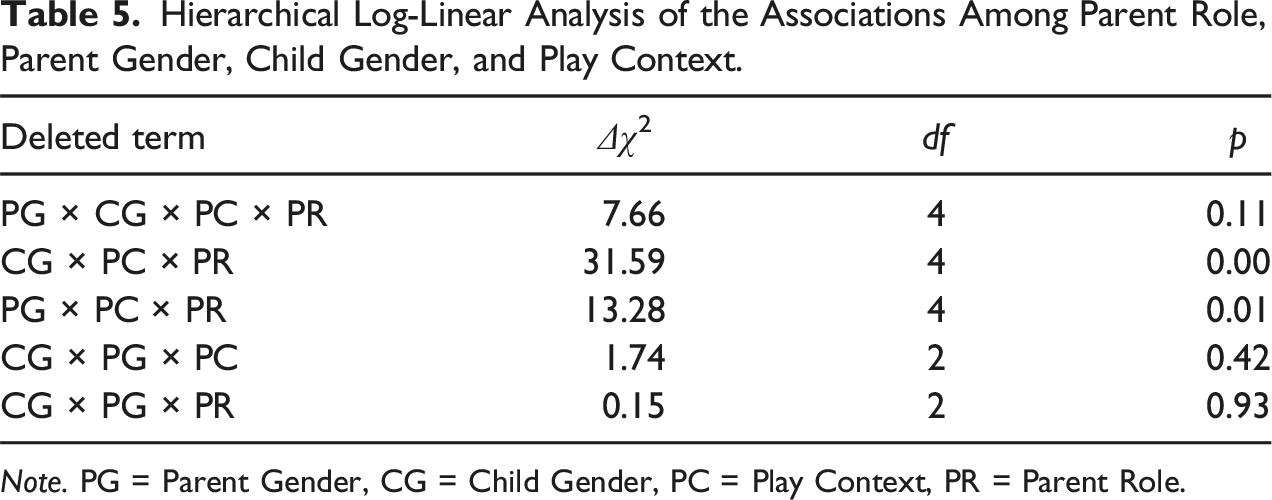
Note. PG = Parent Gender, CG = Child Gender, PC = Play Context, PR = Parent Role.

Adjusted residuals for counts of parental roles (Dir = Director, Fac = Facilitator, Co-P = Co-player) comparing boys with girls within three play contexts.

Adjusted residuals for counts of different parental roles (Dir = Director, Fac = Facilitator, Co-P = Co-player) comparing fathers with mothers within three play contexts.
Follow-Up Analyses
Post-hoc analyses were conducted to further examine the two significant 3-way interactions. We ran a Pearson chi-square test on the contingency table derived from each of the two significant 3-way interactions and then inspected the adjusted residuals within the tables’ cells. Adjusted residuals reflect the extent to which an observed joint frequency differs from chance; a positive value (above +2) indicates a greater-than-chance occurrence of an event whereas a negative value (below −2) indicates a less-than-chance occurrence (Bakeman & Quera, 2011). To guard against type I error, adjusted residuals were checked in post-hoc analyses only when the corresponding chi-square test was significant at a .05 significance level.
Although examination of adjusted residuals indicates which observed events occurred more often than chance, the adjusted residuals do not allow direct comparison of the occurrence of events between two levels of a factor. To explore such effects for the two significant 3-way interactions, we followed up with Z-tests. In these tests, we compared the standardized proportion of parental roles enacted by boys versus girls and mothers versus fathers, respectively, within each play context.
Child Gender Differences
Z-Test Comparing Proportions of Parent Roles Enacted by Boys versus Girls.
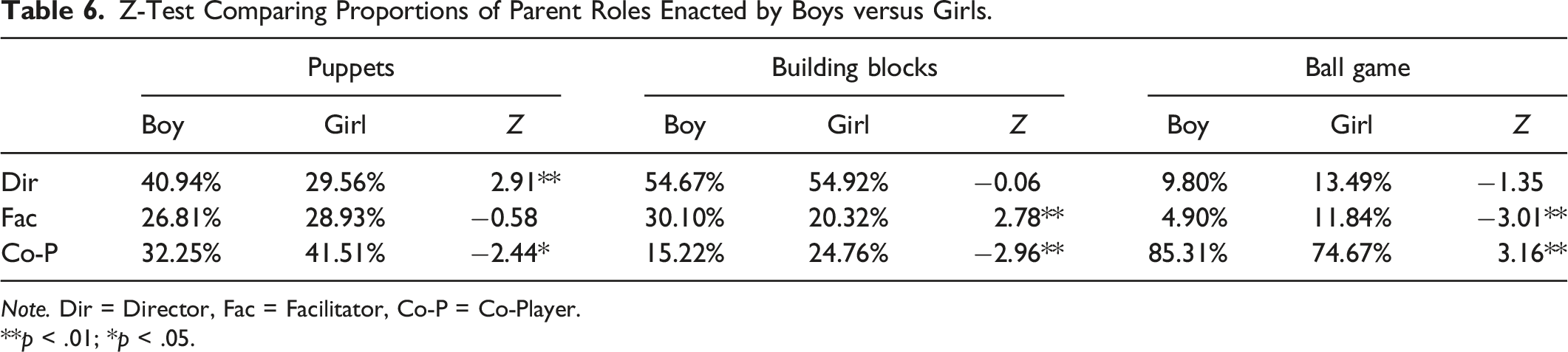
Note. Dir = Director, Fac = Facilitator, Co-P = Co-Player.
**p < .01; *p < .05.
Parent Gender Differences
Z-Test Results Comparing Proportions of Parental Roles Enacted by Fathers versus Mothers.
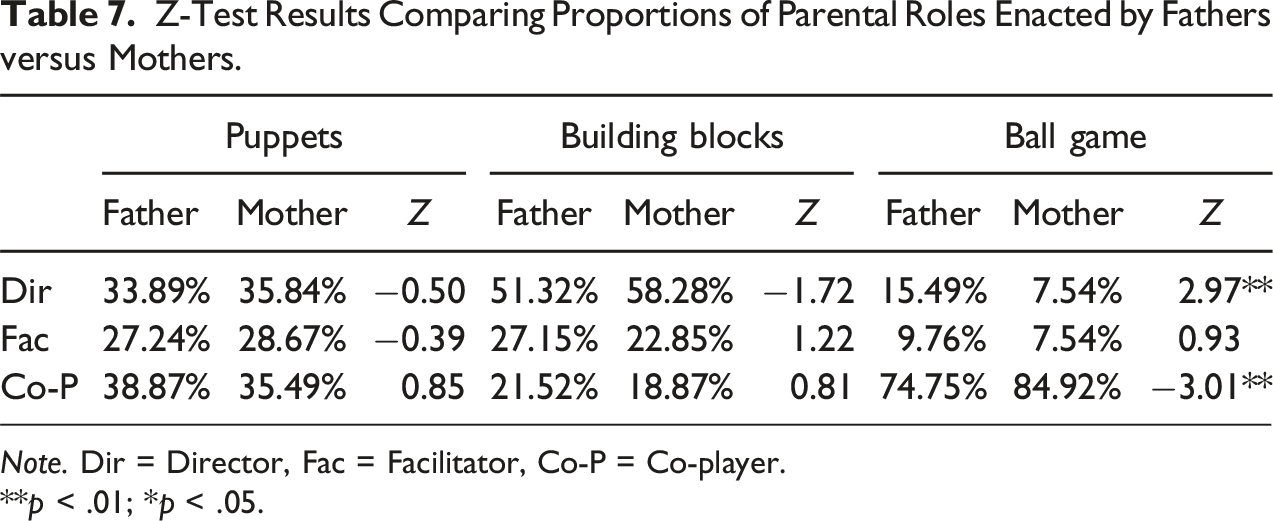
Note. Dir = Director, Fac = Facilitator, Co-P = Co-player.
**p < .01; *p < .05.
Discussion
In the current study, we explored play in middle childhood, something that is much less common than play studies of children aged five and under, particularly when fathers are included. We specifically examined how parent play styles differed by parent gender, child gender, and play context, something else that is not commonly explored (see review, Robinson et al., 2021). The results showed that play styles were, in many cases, a product of the interactions of these factors.
When examining parent play style, we found that co-player was the most commonly observed parent role followed closely by director and then facilitator. When parents engage as co-players, they are acting as “developmental equals” with their children. To co-play, the parent must evaluate the play context as one where the child is competent to understand the situation and the possibilities inherent in the play, allowing parents to immerse themselves in the play; all this may be more likely in middle childhood than in earlier years. Our findings on child gender and play context interaction—parents were most often co-players in the ball game with boys and in the puppet and building games with girls—provide evidence to complement past findings regarding gender and child play competencies. If the ball session in our study is considered a rough-and-tumble, sport-type play, our findings support the conclusions of Cherney and London (2006) that parents are more likely to engage with boys in more physical situations. Likewise, the observation that parents engaged in more co-play with girls during the puppet and building games aligns with the finding that girls, compared to boys, tend to participate more in activities involving dolls and stuffed animals, as stimulated by the puppet game, as well as in constructive play, as facilitated by the building game, which often involves conversation. Because we did not assess parents’ perceptions about their children’s competencies to perform each task, it is possible that parents were not in fact influenced by the capabilities of their children. Instead, it is conceivable that parental attitudes and gender-role stereotypes regarding perceived distinctions between boys and girls could be influencing their interactions with their children more so than the children’s own developmental capabilities (see Endendijk et al., 2016).
By comparison, the director play style may be evoked when parents perceive a “developmental mismatch” between their child’s capabilities and the task at hand. When parents perceive that a child needs assistance, direction may achieve that outcome most readily. This aligns with Yu et al.’s (2020) finding that when parents engaged with preschool children who were playing with new computer coding kits, they were most likely to take on teacher and scaffolder roles (rather than, say, a collaborator role). Our task—a 24-min play consisting of three 8-min segments—may also have placed an unintended pressure that led parents to move away from co-play to guidance and direction. (We did not, however, observe more director PR in the block task as compared to the other tasks, given that the block task was the only one with a goal). The director role is a familiar one to parents who are often guiding and directing the actions of their children. Although play implicitly creates a context for co-play and facilitation between parents and children, parental speech with children tends to be more assertive than affiliative (Shinn & O’Brian, 2008), and some parents may lack the ability to adapt their relations with their children in a way that accommodates themselves to the role of co-player.
The facilitator role may be the most challenging for parents because it requires a level of “double subjectivity,” where parents view the play from both the child’s and an outsider’s point of view (Hakkarainen et al., 2013), which entails relatively difficult behaviors such as active listening. Because behaviors like active listening are promoted via eye contact and reflective statements, such facilitating behaviors may be difficult for parents in the context of other daily activities in families (e.g., meal preparation, transporting child to school), and thus, parents may be less accustomed to engaging in them.
When we consider the role that play context had in parent behavior, two notable non-findings merit attention. First, based on previous work on parent gender differences, we might have anticipated that mothers and fathers would apply different play styles to the play contexts. One significant interaction (parental role × parent gender × play context) showed that in the ball game only, fathers tended to be directors more often and co-players less often, whereas the opposite was true for mothers. This is in keeping with Teufl and Ahnert’s (2022) recent finding that among younger children, the type of game (physical vs. cognitive), not parent gender, predicted parental play behaviors. Our finding highlights a trend among fathers to take on the most directive role during the ball game, even though this period of ball play allows for the greatest freedom in terms of unstructured play. However, we observed no parent gender differences between the puppet play context and the block building context, suggesting that those play contexts might have dictated how play progressed more than parent gender. Our findings also show that child gender has a closer connection with parent play style than does parent gender. Specifically, we found that parents of boys acted more often as directors in the puppet game, as facilitators in the building block game, and as co-players in the ball game. Given the findings of Deaux and Major (1987), it is not surprising that parents showed the most direction toward boys in the puppet task because it was a largely unstructured activity. Parents of girls, however, were more likely to be in the role of co-player in the puppet and building block game but were more likely to be facilitators in the ball game. That facilitation was more common with boys in the task-oriented game and with girls in the ball game suggests, perhaps, that parents’ responses to those play contexts were implicitly or explicitly influenced by expectations for the child’s behavior.
Limitations and Future Directions
Because our study described patterns of play styles observed among parents, study design and statistical limitations are present in our work that merit further investigation. First, because we focused exclusively on children in early middle childhood, it is unclear whether our finding for predominance of the co-play style would generalize to other age groups. Although parents are actively involved socialization agents in early middle childhood, at school children are exposed to peers and teachers who have a variety of play and interaction styles. Our finding that toy types appear to evoke different behaviors from parents suggest that the variety of toys available at homes and in classrooms—regardless of whether the toy was chosen by a child, a parent, or made available in a classroom—may influence the type of play. It is possible that during this developmental period parents may transition from a directive role with a younger child to a more collaborative play style, adjusting to the growing competence of their school-aged child.
The repeated-measure design employed in our study possesses both strengths and limitations that warrant consideration. On the positive side, this design effectively minimizes the impact of individual differences among participants, thus enhancing the internal validity of our findings compared to an independent-group design. Nevertheless, the potential for carryover effects in the repeated-measure design is also worth pointing out. In the context of our study, the carryover effect refers to the possibility that interactions during a parent–child play session may influence subsequent interactions with the other parent. Even though the implementation of counter-balancing can mitigate the influence of parent gender on play style, the quality and dynamics of playtime interaction may still persist from one session to the next, independent of parental gender. For instance, an engaging play experience with one parent can uplift a child’s mood, creativity, and cooperation, which can positively influence subsequent interactions with the other parent. Conversely, a prior negative or unengaging play experience may dampen enthusiasm, potentially impacting subsequent interactions. Therefore, while repeated-measure designs offer valuable insights into the patterns of play styles within individuals over time, future research utilizing different designs is necessary to further validate the findings of our study.
A related limitation in our current study is statistical in nature, namely, the lack of attention to within-session change in play styles among parents. In our study, we described prevalence of play styles and factors that moderated those rates. As a result, our findings are limited in our ability to describe patterns of (a) continuity, (b) variability, and (c) adaptability in parent play style expression. By continuity of parent play style expression, we refer to how often each play style is expressed by parents. In our study, each eight-minute play session received four codes: one to capture the dominant play style in the first minute, a second code for the second to fourth minutes, a third code for the fifth to seventh minutes, and a fourth code for the last minute. While in our study we counted how prevalent each play style was, an alternative statistical approach could have been to assume a person-centered approach and examine whether some parents tended to adopt certain play styles over other styles. Such a focus on typologies of parent players could be linked to child adjustment outcomes and could provide guidance in describing the optimal play style for parents. Such typologies may also be prescriptive for intervention with parents, especially if parent play styles are ill-matched to adaptive child functioning. By variability of parent play style expression, we refer to the within-parent patterns of change in play style. While we described differences in prevalence of play styles across moderators, it is possible that the same moderators affected how parents changed their behavior within situations. In fact, such attention to variability in parenting is warranted because a typological or parenting-style perspective implies that parent behavior is consistent across time, situation, and children. However, there is considerable evidence that parents are continually changing in their parenting (Holden & Miller, 1999; Madigan et al., 2016). Last but not least, our inattention to the adaptability of parent play style expression can restrain our comprehension of the adjustments parents make in response to their children’s behavioral demands. In many ways, the play styles that a parent chooses at any given moment represents the parent’s perception of what is required and may be driven by perceived developmental mismatches between parent and child competencies. While further exploration on the variability and changes in parenting is beyond the scope of the present paper, such a sequential analysis approach to changes in parenting in response to child behavior would enhance our understanding of parent–child relationships.
Conclusion
We believe a primary contribution of the current study lies in its methodological approach. Historically, studies examining parent–child play, parent–child interaction, and parent socialization have typically taken an individual difference approach that focused on either the parent or the parent–child dyad as the unit of analysis. A research question might be something like, “Do parents who are more directive have children who are less socially competent?” This approach assumes that the parent’s style of interaction is trait-like (e.g., there are “directive parents” and “non-directive parents”). However, meta-analyses and reviews (Holden & Miller, 1999; Parke, 2013) have indicated that parenting variables exhibit a certain level of stability and yet not at a trait-like level, with less stability across situations than across time and across children. Parental control, in particular, shows lower cross-situation stability than other constructs (e.g., negative affect). The fact that the correlation between parent play behavior and child outcomes is more pronounced at the microsocial coding level rather than the global level (Bardack et al., 2017) also suggests that factors beyond static traits−possibly contextual influences−may warrant greater research attention.
In our study, instead of assuming there were meaningful parent individual differences in play style, we asked whether observed play style was a function of play characteristics (viz., who is involved, what are they playing). The unit of analysis was therefore play episode rather than parent (or dyad). Our guiding research question asked whether parent play style was more significantly related to the parent’s gender, the child’s gender, the play context, or combinations of the three. The results of our study extend beyond merely understanding individual differences and offer insights that can inform strategies for improving the quality and effectiveness of parent–child interactions across different settings. It is thus important for intervention strategies to acknowledge the broader context and dynamics at play within these interactions when designing parent training and educational programs.
Footnotes
Authors’ Note
Data for this manuscript were collected as part of the dissertations of the 3rd and 4th authors under the direction of the 2nd author.
Acknowledgments
Thanks go to Stacey Wright and Suzanne Jones Hefner for their work coding the video data, and to the families who came to the experimental sessions on campus where it was so difficult to park.
Declaration of Conflicting Interests
The author(s) declared no potential conflicts of interest with respect to the research, authorship, and/or publication of this article.
Funding
The author(s) disclosed receipt of the following financial support for the research, authorship, and/or publication of this article: This research was supported, in part, by funding from OSU’s College of Education and Human Sciences to A. Harrist.
