






Abstract
At its core, the family unit is composed of individual members. The way in which an individual engages in self-care practices has been shown to influence their ability to interact with others. Minimal research has explored the impact of an individual’s self-care on broader family functioning. Through a systems theory lens, this paper aims to elucidate two specific mechanisms through which self-care may affect family harmony through dyadic communication constructs. A parallel mediation model was tested using a sample of participants who completed the ELEVATE relationship education program (N = 1578). Findings revealed two positive indirect effects of self-care on family harmony via affectionate communication and negative conflict management. Results also indicated a positive direct relationship between self-care and family harmony. This study represents an important empirical step towards understanding the complex relationships among intrapersonal self-care, interpersonal communication, and broader family harmony. Theoretical and practical implications are discussed.
Introduction
When considering desirable family outcomes, a variety of constructs come to mind such as family satisfaction (Carver & Jones, 1992), overall family communicative patterns (Ritchie & Fitzpatrick, 1990), and levels of closeness among members (Campos et al., 2014). An additional variable indicative of family health is family harmony, representing “warmth and closeness among all members of the family group” (McHale & Rasmussen, 1998, p. 43). Perceptions of such harmony are related to a slew of important outcomes, such as interdependent happiness (Demirci, 2022), relationships with friends (Jang et al., 2014), and fewer negative emotional reactions in children (Kolak & Vernon-Feagans, 2008).
Recognizing the importance of family harmony, contributory factors must be considered as to how this can be achieved. In other words, what forces within the family system are likely to affect family harmony? Family systems theory (FST) indicates that each individual member, as well as each subsystem, is shaped by and helps shape the overall family experience (Johnson & Ray, 2016; White et al., 2019). The broader success of the family system (in the case of the present study, operationalized via family harmony), then, may ultimately depend on intrapersonal influences that shape interpersonal and family experiences. For example, it is logical to assume that when an individual is best caring for themselves, they will have a greater capacity to care well for their romantic partners (e.g., communicate in healthy and caring ways) (e.g., Kishida et al., 2018; Only You Forever, 2015). The health of this subsystem between dyadic romantic partners should, in turn, contribute to the overall harmony within the family (Chuang, 2005).
While logical, this theoretical pathway has not been previously explored to the knowledge of the authors, leaving both family and interpersonal scholars without a precise understanding of the process in which individual members’ self-care affects family harmony more broadly. The present study seeks to illuminate the relationship between individual members, dyadic subsystems, and family units at large. To provide a fuller understanding of ways family harmony could be affected, both positive and negative couple communication patterns are considered in the proposed model as parallel mediators to explore how differing communication processes ultimately relate to broader family outcomes.
Family Harmony
Positive family relationships are considered central to individuals’ well-being (Merz et al., 2009; Thomas et al., 2017). Nurturing family environments further promote the welfare of their members (Biglan et al., 2012; Brown, 2010), with particular emphasis on how marital or long-term relational health impacts children’s well-being. One way to conceptualize positive family relationships is through assessing family harmony. Family harmony is defined as the degree to which members of a family unit can trust, support, and communicate differences in adaptive ways across the entire family system. These processes assist in promoting long-term healthy connections in addition to individuals’ well-being found within the family unit (Houden, 2015). Family harmony could also be understood as a global evaluation of family satisfaction. Fauziah (2020) conducted a systematic review assessing the concept of family harmony in multiple cultural settings and found the determinants of family harmony include open communication, mutual trust and respect, family conflict, family commitment, alignment of personal needs, and family governance. While family harmony can be examined from individual, dyadic, or systemic perspectives, this study evaluates this construct on an individual level. Individuals’ perceptions of family functioning provide unique examinations for overall family harmony and provide a foundational understanding of family well-being, as it is individuals that construct the component parts to form and sustain a family unit (Heatherington & Lavner, 2008; Henry et al., 1996). If a family is to function well and exist in a state of greater family harmony, each individual must function well independently, which is why intrapersonal factors (individuals) matter when investigating family matters.
Theoretical Foundation: Family Systems Theory
Family systems theory assumes that each family unit has its own characteristics, roles, and communication patterns that promote interdependent relationships among its members, which directly and indirectly influence each other as well as subsystems within the family (McGinnis & Wright, 2023). One way in which each subsystem interacts with others is through communication, which supports both the creation and maintenance of familial bonds (Bavelas & Segal, 1982). Thus family, as viewed through the systems lens, is defined as an integrated and unified whole that is based on the individual, mutually influencing relationships between family members (Rogers, 2006). The simultaneous emphasis of individual relationships, members, and the family system as a whole (see Johnson & Ray, 2016; White et al., 2019) makes FST a particularly useful perspective for the present study. Specifically, each dyadic relationship (i.e., subsystem, see White et al., 2019) comprising the family unit will ultimately impact the family unit’s communicative health. Additionally, each dyad cannot adequately function if either of its members are not engaging in self-care. Thus, just as each individual cog in a machine will contribute to the ultimate functioning of the machine, so too does the success of the family system rely on the healthy functioning of each of its individual members (Johnson & Ray, 2016).
This study seeks to build upon previous literature (e.g., Chuang, 2005; Harris et al., 2019) that highlights one relational pathway that occurs within family systems (i.e., individual to dyadic, or dyadic to family) and to provide a fuller picture of communication within the family: the individual factors that relate to dyadic communication and the relationship of such communication with family harmony. It is important to note that the present study does not evaluate how one’s self-care, discussed next, impacts the overall harmony of the family system but rather how one family member’s self-care relates to their own perceptions of family harmony. Beginning this exploration at the micro level (i.e., the individual’s experiences within the family) aims to provide empirical justification for future study of dyadic and family-level impacts.
Self-Care
Caring for oneself lies at the root of most family therapy and psychology literature as an important skillset for positive individual and relational outcomes (Barnett & Cooper, 2009; Barnett et al., 2007; Butler et al., 2019). Self-care is a multi-faceted construct. According to the World Health Organization (WHO), individual self-care includes exercising, pursuing adequate mental health, eating well, and maintaining proper hygiene (Godfrey et al., 2011). This definition of self-care supports findings utilizing Maslow’s hierarchy of needs framework (1968), which states that basic needs, such as physiological and safety needs, must be met before higher-order needs can be fulfilled (e.g., esteem and self-actualization). Because of these needs, individuals must feel safe and secure before they can begin to address needs higher in the framework, such as developing and sustaining close interpersonal relationships, including those with a romantic partner (Harris et al., 2019).
Caring for oneself develops intrapersonal efficacy, confidence, self-compassion, and high degrees of caring, which then lead to enhanced ability to self-regulate when experiencing stressors, whether personally or relationally (Dupasquier, 2020; Neff, 2016; Quaglia et al., 2022; Siegel, 2021). Strong self-regulation skills (a component of self-care) support the process of co-regulation with one’s spouse (Silkenbeumer et al., 2016). Co-regulation is the process of influencing another’s emotions and well-being (Only You Forever, 2015). Discussing co-regulation is important in this context because this process highlights how self-care impacts dyadic communication with other family members, moving from intrapersonal to interpersonal interactions. Couples’ emotions have been shown to become quickly interconnected after completing individual activities. Cortisol levels and moods often mirror each other. Through developing and sustaining adaptive self-care and self-regulation practices, this mindful practice impacts romantic relationships, promoting positive relational health and supporting a healthier family system (Double, 2021). To empirically assess this relationship, the following research question is posited:
Is there a direct relationship between self-care and family harmony?
In addition to the direct influence of self-care on family harmony, as hypothesized in line with FST, it is likely that self-care also indirectly affects relationships through distinct mediating variables, most notably negative conflict management and affectionate communication.
Negative Conflict Management
As discussed above, self-care is foundational to promoting healthy relationships. When one’s relationship with themselves is inhibited (intrapersonal), this becomes detrimental to the partner relationship as well (interpersonal) (Doumas et al., 2008; Gross & John, 2003; Only You Forever, 2015). For example, Doumas and colleagues (2008) found in their study of single-earner couples that both husbands’ and wives’ reports of lower levels of self-care predicted more marital withdrawal. In other words, when one is not able to self-regulate, this causes an increase in maladaptive behaviors both intra- and interpersonally, often impacting romantic relationships. Gross and John (2003) found that when people use suppression as a self-regulation strategy, they experience and express lesser positive emotion, while simultaneously experiencing greater negative emotion. They also noted that when reappraisal is employed as a self-regulation strategy, people exhibit greater positive emotion and less negative emotion, as well as enhanced interpersonal functioning (Gross & John, 2003). These findings show that the use of reappraisal supports intrapersonal and interpersonal well-being, whereas using suppression negatively impacts these relational domains.
Considering the subsequent implications of the self-care to partner-care relationship from a family systems theory perspective (see Bavelas & Segal, 1982; Johnson & Ray, 2016; Rogers, 2006; White et al., 2019), experiencing this increase in negative affect within a dyad could then affect the broader family system, negatively impacting family harmony (Chuang, 2005). For example, Chuang (2005) found a negative association between the overall hostility between family members and their reported family harmony. Therefore, the following hypothesis is offered:
There will be an indirect effect of self-care on perceptions of family harmony via negative conflict management, such that greater self-care will be negatively associated with negative conflict management, and negative conflict management will be negatively related to family harmony.
Affectionate Communication
As mentioned above, when individuals prioritize self-care, this effort enriches not only personal well-being but also the well-being of their romantic relationships (Doumas et al., 2008; Harris et al., 2019). This effect is logical when considering that a person who is emotionally healthy is much more likely to offer supportive communication and affection to those they love as they have greater capacity to do so than do individuals who are emotionally, mentally, and/or physically depleted. For example, in single-earner couples, husbands provided more warmth to their wives when they personally reported sleeping and relaxing more. Husbands’ expressions of warmth were also greater when their wives reported engaging in self-care such as working less and eating more regularly (Doumas et al., 2008). Put simply, when a person properly cares for themselves, they have a greater likelihood of caring better and receiving better care from others (Doumas et al., 2008).
When people communicate in healthier, more supportive ways as dyads, this healthy interaction promotes family harmony (Chuang, 2005; Jazmi et al., 2022). This process is perhaps most powerfully evident when considering the parent dyad subsystem. Just as negative communication between family members is hypothesized to negatively relate to family harmony (e.g., Chuang, 2005), when a couple is communicating and living in harmony (i.e., when greater affectionate communication is occurring), this communication should result in a trickle-down effect on the family system’s harmony as a whole. For example, Chuang (2005) found that the overall amount of love shown by family members to one another positively predicted family harmony. Therefore, when considering the overall model, the following hypothesis is presented:
There will be an indirect effect of self-care on perceptions of family harmony via affectionate communication given to one’s partner, such that self-care will positively relate to affectionate communication given to one’s partner, and this affectionate communication will be positively related to family harmony.
See Figure 1 for our conceptual parallel mediation model. Conceptual model.
Methods
Procedure
Recruitment Details and Program Requirements
Data was collected as part of the ELEVATE relationship education program, a free curriculum from the larger SMART Couples curriculum, which is a multi-million-dollar federal grant project with the goal of strengthening marriages, relationships, and families across ethnicities and income levels (SMART Couples, 2021). Grounded in the National Extension Relationship and Marriage Education Model, ELEVATE provides couples with education to enhance individuals’ relationship knowledge and behaviors by instructing them how to use practical skills informed through evidence-based scholarship (Bodenlos et al., 2021). Adults who were eligible were recruited by SMART facilitators and employees through social media (e.g., Facebook), media outlets (e.g., newspaper and radio), email listservs, word-of-mouth, flyers, brochures, and community partners whose programs would also benefit from supporting SMART recruitment efforts. Participants were only included in this study if they had completed all available workshops in ELEVATE.
Data Collection
This study received Institutional Review Board (IRB) approval from the authors’ institution. Data collection began June 2016 and ended in September 2020. All necessary IRB informed consent, demographic, case management, and outcome data were collected and managed electronically using Qualtrics. Few cases of data collection occurred using pencil-and-paper surveys (e.g., when technology or internet connections failed), which were later entered into the Qualtrics database by SMART Couples staff. To protect the integrity and validity of the data, any participant who did not answer at least ⅔ of items composing every scale used within our model was removed from the data set (n = 195).
Data collection occurred at two time points between participant enrollment and completion of the program: a traditional pretest survey prior to beginning ELEVATE and a retrospective pretest-then-posttest electronic survey. This study reports the retrospective pretest scores. 1 Participants’ knowledge, confidence, and behavior change at the end of the SMART Couples program were assessed. Demographic data was collected and managed using the federal Applicant Characteristics Survey (ACS) and stored in their database (nFORM). Each participant represents one family system (i.e., this study reports individual data).
Justification for the Use of the Retrospective Pretest-Then-Posttest Design
To justify use of the retrospective pretest-then-posttest design (of which only the retrospective pretest data was analyzed and reported here), we provide here a brief explanation of the traditional experimental pretest–posttest design (TEPPD) often employed in social science research and highlight some of its limitations as it pertains to studying and evaluating community-based educational programs. The TEPPD is considered one of the most respected methods to measure change in individuals (Campbell & Stanley, 1966; Kaplan, 2004) and is highly regarded for its control over internal validity as well as its ability to compare results of the same population across numerous time points.
Although this TEPPD has its advantages, there are significant limitations as well. With this method, finding an adequate comparison group can often prove difficult. This makes employing the TEPPD particularly challenging for community-based programs to complete comprehensive comparisons due to a lack of resources and time necessary for successful evaluation (Brooks & Gersh, 1998). Also, to ensure these pretest–posttest comparisons are meaningful, participants would have to complete the full program in its entirety (Pratt et al., 2000). Since attrition and sporadic attendance are common issues in community education programs (Pratt et al., 2000), the TEPPD may not be as effective in these settings.
In addition to difficulties establishing valid comparison groups in social science research, researchers may encounter challenges when attempting to assess changes in attitudes, behaviors, or skills between time points if participants overstate their pretest responses (Howard & Dailey, 1979; Moore & Tananis, 2009). This overestimation may happen due to participants not having a clear understanding of the various concepts the program is targeting (Pratt et al., 2000). Although education programs often attempt to address lack of knowledge (e.g., attitudes, behaviors, and skills) of participants, this same issue may demonstrate to participants throughout the program just how limited their knowledge was when they first finished the pretest. Because of this, researchers and program facilitators must remain aware of the possibility of participants providing misleading information between pretest and posttest comparison much in part due to their change in perspective surrounding the intervention topics (Howard & Dailey, 1979). Howard and Dailey (1979) first described this misleading information as response shift bias, which explains the “program-produced change in the participants’ understanding of the construct being measured” (Pratt et al., 2000, p. 342). Response shift bias, in addition to the problems noted above, needs to be weighed carefully when assessing findings from TEPPD comparisons.
Although the retrospective pretest-then-posttest design can fall prey to multiple internal validity threats, it can also mitigate many issues stemming from the TEPPD (Little et al., 2020). This particular evaluation design allowed participants to assess changes more adequately in the attitudes, behaviors, or skills learned during ELEVATE through the comparison of each variable side-by-side upon completion of the relationship education intervention. Providing these assessments directly after one another gives participants the opportunity to reflect back on what they have learned throughout the program and what they came into the program knowing in order to visually compare their knowledge gain across the intervention, helping reduce response shift bias and other issues seen when using the TEPPD.2
Participants
Demographically, the sample (N = 1578) was 51.1% female (with one individual not reporting their sex) with participants ranging from ages 19 to 87 (M = 41.68; SD = 12.63) (with 63 individuals not reporting their age). When self-reporting their race, 68.7% identified as White, 17.3% as Black, 5.8% as “other,” 3.8% as mixed race, 3.1% as Asian, 0.6% as American Indian/Native Alaskan, 0.6% as Native Hawaiian or other Pacific Islander, and 0.2% did not identify their race. Ethnically, our sample was 84.5% Non-Hispanic/Non-Latino. When examining represented marital statuses, 88.2% were married and the remaining 11.8% of participants were engaged. Participants reported having 0–8 children (M = 1.19; SD = 1.42), with 32 participants not reporting how many children they had. Of the participants who reported their number of children, 54.2% reported having at least one child.
Measures
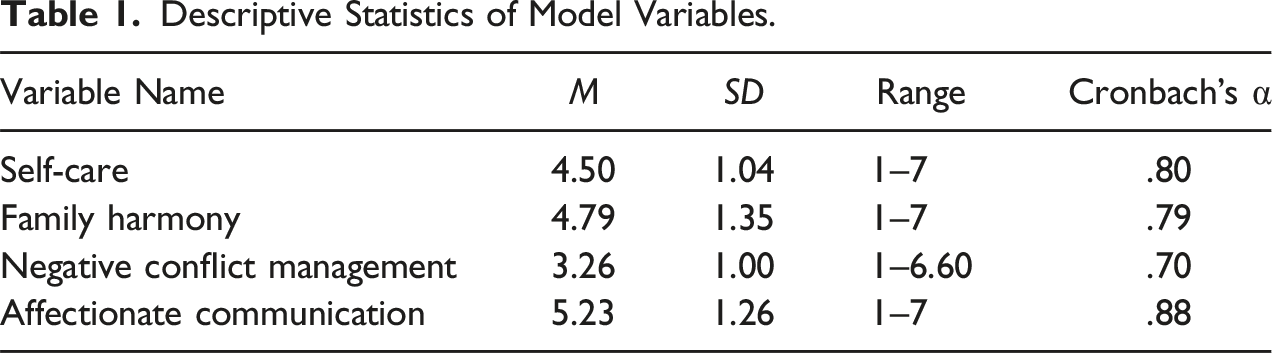
Descriptive Statistics of Model Variables.
Independent Variable
Self-Care
To assess participants’ levels of self-care, an eight-item scale (titled Self-Care) was formed with four items adapted from Adler-Baeder and colleagues (2010) and four items created for the purposes of the study. These Likert-style items on a seven-point scale (1 = “very strongly disagree” to 7 = “very strongly agree”) included items such as “I ask for help from others when needed,” “I eat healthy meals every day,” and “I have quiet time for myself every day.” The internal validity for this scale was good (Cronbach’s α = .80), thus an index was formed for self-care (M = 4.50; SD = 1.04).
Dependent Variable
Family Harmony
To measure the general feeling of harmony within participants’ familial relationships, a three-item scale was adapted (titled Family Harmony) from Halberstadt and colleagues (1995). These seven-point Likert-type items (1 = “very strongly disagree” to 7 = “very strongly agree”) included “Generally, there is a feeling of contentment and happiness in my house,” “Overall, there are more happy feelings than unhappy feelings in my house,” and “There are many disagreements in my house” (reverse-coded). This three-item scale was also found to be reliable (Cronbach’s α = .79), so an index was formed (M = 4.79; SD = 1.35).
Mediators
Negative Conflict Management
To assess the negative communication habits participants reported having with their partner, an eight-item scale (titled Manage-Self) was created with a combination of adapted items (Buhrmester et al., 1988; Christensen & Sullaway, 1984; Stanley et al., 2002) and new items created for the purposes of the study. These seven-point Likert-type items (1 = “very strongly disagree” to 7 = “very strongly agree”) included both positive (e.g., “I can easily forgive my partner,” and “I am able to see my partner’s point of view and really understand it, even if I don’t agree”) and negative (e.g., “I shout or yell at my partner,” and “I hit, grab, or push my partner”) forms of partner communication, but the four positive items were reverse-coded, resulting in a measure of negative communication habits with one’s partner. Due to initial low-scale reliability, two items were dropped: “I express my feelings to my partner” (reverse-coded) and “I avoid discussing the problem.” Once the scale reached sufficient reliability (Cronbach’s α = .70), an index was formed (M = 3.26; SD = 1.00).
Affectionate Communication
To measure positive communication habits with one’s partner, a five-item scale (titled Show You Care - Self) was formed using adapted items from Huston and Vangelisti (1991) and Buhrmester and colleagues (1988). These seven-point, Likert-type items (1 = “never” to 7 = “more often than once a day”) included “Do something nice for your partner” and “Share emotions, feelings, or problems with your partner.” The five-item scale was reliable (Cronbach’s α = .88), thus an index was formed (M = 5.23; SD = 1.26).
Data Analysis
A parallel mediation model was conducted using the PROCESS macro for SPSS with 5000 bootstrapped samples and 95% bias adjusted confidence intervals. Two possible indirect effects were tested: (H1) through negative conflict management and (H2) through affectionate communication. The statistical parallel mediation model can be seen in Figure 2. Parallel mediation model. *p < .001.
Data Availability
Materials and analysis code for this study are available by emailing the corresponding author.
Results
Hypotheses and Research Question
The indirect effect of self-care on family harmony via negative conflict management was significant, indirect effect = .19, 95% CI [.16, .23]. Self-care and negative conflict management were negatively related (β = −.37; p < .001), as were negative conflict management and family harmony (β = −.52; p < .001). Thus, H1 was supported.
Similarly, the indirect effect of self-care on family harmony via affectionate communication was also significant, indirect effect = .11, 95% CI [.09, .14]. Self-care was positively related to affectionate communication (β = .36; p < .001), and affectionate communication was positively related to family harmony (β = .32; p < .001). Thus, H2 was supported.
Finally, to address the research question, there was a significant direct effect of self-care on family harmony independent of negative conflict management or affectionate communication (direct effect = .18, p < .001), indicating that self-care was positively related to family harmony.
Supplementary/Control Variables
Due to the diverse and complex nature of contemporary family systems, it was important to examine a set of foundational demographic characteristics (i.e., marital status, age, race, gender, income, and number of children) to validate the reported results. The model described above was run again in PROCESS using Model 4 with all controls entered as covariates. Even with these control variables, the indirect effects of self-care on family harmony via (1) affectionate communication and (2) negative conflict management were both still significant as was the direct effect of self-care on family harmony.
The model accounting for control variables revealed that several of these covariates were statistically significant. Specifically, family harmony (the dependent variable) was predicted by marital status (β = .20, p = .02) and number of children (β = −.06, p = .002). With further probing, a two-tailed t test showed that the effect of marital status (i.e., engaged vs. married) on family harmony was significant, t (1,576) = −2.45, p = .02, d = −.19, such that engaged individuals (M = 5.02, SD = 1.38) reported higher degrees of family harmony than did those who were married (M = 4.76, SD = 1.35). Additionally, a simple linear regression indicated that the number of children was a significant predictor of family harmony, β = −.17, t (1,544) = −6.91, p < .001, such that having more children negatively predicted family harmony.
When considering the first mediator, marital status (β = .38, p = .0001), age (β = −.02, p < .001), gender (β = −.15, p = .02), and number of children (β = −.08, p = .001) each predicted affectionate communication. Further probing using a two-tailed t test showed that engaged participants (M = 5.64, SD = 1.17) reported higher levels of affectionate communication than their married counterparts (M = 5.18; SD = 1.27), t (1,576) = −4.69, p < .001, d = −.37. Men (M = 5.31; SD = 1.25) were also significantly more likely to offer supportive communication to their partners than women were (M = 5.16; SD = 1.27), t (1,575) = 2.43, p = .02, d = .12. Additionally, a simple linear regression indicated that number of children was a significant predictor of less affectionate communication, β = −.12, t (1,544) = −4.86, p < .001, such that having more children negatively predicted the giving of affectionate communication to one’s partner. Another simple linear regression showed that greater age was also a significant predictor of less affectionate communication, β = −.16, t (1,513) = −6.30, p < .001.
Means of Negative Conflict Management Across Race.

Note. The only statistically significant difference in negative conflict management was between Black and White individuals. Specifically, White individuals reported significantly greater negative conflict management than Black individuals (p = .002).
Discussion
Principal Findings
The present study makes several notable contributions to both family and interpersonal scholarship and provides empirical evidence into how one’s self-care relates to interpersonal relationships and the broader family unit. Specifically, self-care positively related to family harmony both directly and indirectly via affectionate communication and related to family harmony indirectly via a negative relationship with negative conflict management, as well as showing a subsequent negative relationship between negative conflict management and family harmony. Both the theoretical and practical implications of these findings will be discussed in turn.
Theoretical Implications
Our study results indicate strong support for family systems theory and provide empirical evidence for two logical, yet largely untested pathways of how a person’s self-care can ultimately affect the broader family unit. First, in line with the concept of subsystems within the larger family system so integral to FST (White et al., 2019), our results demonstrate how communication in the parental dyad subsystem is related to family harmony. Indeed, our findings in this regard are aligned with those of Chuang (2005) and Hesse and colleagues (2014) which indicate that health and positive communication between couples is important for family harmony and satisfaction. The associations were consistent, whether the couple was communicating in positive ways with one another (associated with greater family harmony) or negative ways (associated with lower levels of family harmony). Just as every subsystem cog in the family system must be properly functioning (see Johnson & Ray, 2016), results indicate that healthy couple communication is key to supporting a thriving, happy, and healthy family unit.
Additionally, it is worth briefly discussing here some particularly salient findings from the inclusion of demographic control variables as they relate to FST. For example, the number of children in one’s family significantly related to lower family harmony levels as well as less affectionate communication given to one’s partner. When viewed through a systems lens, this is not surprising given the fact that with more children come more subsystems that must be adequately maintained to promote the overall functioning of the family system (see Johnson & Ray, 2016; White et al., 2019). Managing more children leaves less time and mental/emotional capacity to be affectionate with one’s partner. Marital status also proved to be an interesting control variable, with engaged individuals reporting higher levels of family harmony and affectionate partner communication given than were reported by their married counterparts. This finding could be indicative of a “honeymoon” period wherein the day-to-day realities of family life have not been as fully experienced, as is the case with married individuals.
Gender was the next control variable of interest, as men reported higher levels of affectionate communication given and lower levels of negative communication given to their partner than did women. This is in line with Ubando’s (2016) study of college students in which men reported higher levels of both verbal and nonverbal expression than women (including actions such as holding hands and saying things like “I love you”). Women in this same study reported higher levels of supportiveness, but the verbal and nonverbal expression items of Ubando’s study much more closely resemble items used here to measure affectionate communication. When considered from a systems perspective, both of these latter findings (i.e., regarding marriage status and gender) highlight how once again, each dyad’s characteristics (e.g., whether engaged or married) and every individual’s unique characteristics (e.g., gender) should be expected to eventually influence the broader family system via their effects on couple communication. Here again, it is clear that just as individuals are incredibly complex and multi-faceted, scholars studying families composed of individual members must take into account these unique characteristics and consider their function in shaping the family system more broadly.
Amidst the lack of the literature on the relationship between self-care and couple communication (with Doumas et al., 2008, as a notable exception), our study provides much-needed empirical evidence for such an intuitive relationship. While it is logical to assume that individuals properly maintaining their own mental, physical, and emotional health would be better equipped to communicate in healthier ways with their partner (see Only You Forever, 2015), this relationship deserved greater empirical attention and validation. Importantly, not only was self-care related to family harmony indirectly via this couple communication, but it was also directly, positively related to family harmony. Just as each dyad in the family system plays an important role in supporting overall family health, so too does each individual (Johnson & Ray, 2016; White et al., 2019). This is an exciting demonstration of the family systems metaphor of the family as a machine. Each person clearly plays a significant role within the family system and its well-being.
Practical Implications
This study provides important practical findings for researchers, practitioners, and families alike. Having discovered the relationships of intrapersonal emotional and physical management (i.e., self-care) to dyadic relationships and broader family systems, researchers can tailor future relationship education programs to encompass the necessary skills on each level of functioning to better address and enhance relationships, not only with others but individually as well. Practitioners, such as family therapists and counselors, can now utilize this empirical understanding that each level of connection (intrapersonal → interpersonal → family system) feeds into the next in a cyclical pattern. This knowledge can help develop communication techniques, cognitive behavioral therapies, and other strategies, all while understanding that individual self-care is at the root of positive or negative relational and family functioning.
Just as this study can assist practitioners, there are practical takeaways for families as well. There is a common phrase used in family therapy and education fields, telling clients to “fill their bucket” (McCloud & Martin, 2016; Rath & Clifton, 2007). In simple terms, this means individuals with full buckets have built emotional reserves to where they can easily pour into others’ cups. If this bucket is empty, nothing remains to support others. This study tested and statistically substantiated this notion that it is important to first care for oneself before attempting to care for others, providing support for this therapeutic metaphor. Family members can support themselves and others within the family unit through this deepened understanding of just how important it is to lay a strong foundation individually if the family system is to thrive.
Limitations and Future Directions
This study has limitations that should be noted. First, given the cross-sectional data collected in addition to the regression-based modeling technique employed, causality was not able to be proven pertaining to the model’s directionality. The model presented here offers one theoretically informed and empirical possibility of the pathway in which intrapersonal factors may relate to family harmony—but this is not to say this study advocates this is the only manner in which to achieve this outcome. Families are intricate, complex systems; as such, there may be multiple avenues to achieve enhanced family harmony outside of what is posed within this model. However, this model does offer novel insights as to how long-reaching outcomes relate to intrapersonal and interpersonal means. By starting empirical investigation at the individual level, specifically how an individual family member’s self-care relates to their own perceptions of family harmony, this provides scholars and relationship education program developers a baseline understanding of how self-care is perceived as an important factor in influencing family harmony. This could be used in future studies to inform dyadic and system-level investigation. Future studies may also consider employing additional quantitative methods, such as structural equation modeling, to continue exploring the causal directionality of such individual and familial phenomena.
Additionally, the robust sample size used to conduct our statistical analyses made it more likely to find significant results (Levine et al., 2008). An a priori power analysis indicated that 863 participants were needed to achieve 95% power with an effect size of f = .02. This minimum sample size was surpassed due to the eligible number of participants who completed the ELEVATE program. Although overpowered, the sample reported was carefully and conservatively cleaned based on narrow eligibility parameters to ensure the most accurate depiction of couples and families were included in the final analysis. Additionally, a retrospective pre-then-posttest survey design was used. This form of data collection and reporting, while known to reduce participant bias pertaining to their knowledge before participating in an education program (Little et al., 2020), is a relatively uncommon way of measuring behavioral outcomes and requires additional validation studies to provide support for its use and statistical efficacy. Whether collected from traditional pretest or retrospective pre-then-posttest surveys, the data collected throughout the ELEVATE program was self-reported and was thus susceptible to social desirability bias (Althubaiti, 2016) which may cause an inaccurate representation of the model presented.
When examining data derived from education programs, it is also important to address the potential for various selection effects that could influence generalizability. All participants voluntarily elected to participate in the ELEVATE relationship education program, so remaining mindful of self-selection bias is crucial. Carlson and colleagues (2020) discuss that certain people, such as those who care about and want to improve their relationships, willingly choose to participate in these programs and are not typically representative of populations at a higher risk for negative health outcomes. Future studies should consider examining this model with specific family structures, such as homes with same-sex heads of household, low-income families, minority families, or families with at-risk youth to capture a more diverse sample and assist program facilitators in tailoring future education programs to address these groups’ unique needs.
This study also showcased several avenues for future research regarding intervention development, implementation, and subsequent data analysis. With the empirical foundation laid showing direct support for intrapersonal influences on the broader family system, this can inform future relationship education programs, not only for marriages but also for those in diverse relationship orientations. Understanding that the ways in which individuals care for themselves has an impact (either positively or negatively) on partners and ultimately families can provide the baseline for developing a multi-phased (i.e., personal, partner, and family) education program tailored to enhance the communication and subsequent relational strength of individuals, dyads, and systems based on the different facets of interaction individuals encounter.
Conclusion
In the pursuit of family harmony, each member matters. When each member is prioritizing their mental, emotional, and physical health, this self-care, in turn, should promote healthy communication among members, ultimately resulting in the harmony of the larger family system. Our study offers a valuable application of family systems theory by highlighting the link between the couple subsystem (and even each individual member of the family) and the broader family system. It is our hope that our exploration of family harmony from a systems theory approach is of use to future family scientists in their study of this specific indicator of a thriving family unit.
Supplemental Material
Supplemental Material - From Me to You to Us: Exploring the Relationship Between Self-Care, Partner Communication, and Family Harmony
Supplemental Material for From Me to You to Us: Exploring the Relationship Between Self-Care, Partner Communication, and Family Harmony by Taylor S. Vasquez, Chelsea M Bruno, Victor W. Harris, and Brian Visconti in Journal of Family Issues.
Footnotes
Acknowledgments
The authors would like to thank the SMART Data Research Collective. The authors verify the results from this study are derived from primary, original research conducted by the research team.
Declaration of Conflicting Interests
The author(s) declared no potential conflicts of interest with respect to the research, authorship, and/or publication of this article.
Funding
The author(s) disclosed receipt of the following financial support for the research, authorship, and/or publication of this article: Funding for the SMART Couples Florida Project was provided by the U.S. Department of Health and Human Services, Administration of Children and Families, Grant 90FM0079. Services are available to all eligible persons regardless of race, gender, age, disability, or religion.

Supplemental Material
Supplemental material for this article is available online.
Notes
References
Supplementary Material
Please find the following supplemental material available below.
For Open Access articles published under a Creative Commons License, all supplemental material carries the same license as the article it is associated with.
For non-Open Access articles published, all supplemental material carries a non-exclusive license, and permission requests for re-use of supplemental material or any part of supplemental material shall be sent directly to the copyright owner as specified in the copyright notice associated with the article.
