







Abstract
Co-parenting relationships have a significant impact on the involvement of all fathers. Fathers who report better relationships with the mother of their child report less parenting stress and more positive parenting strategies. We explore the impact of a group-based male-led and father-focused intervention on co-parenting behaviors of 385 Hispanic and non-Hispanic Black fathers. Multivariable linear mixed effects regression was used to evaluate the association of time period (pre-intervention vs. post-intervention) on co-parenting behaviors of undermining, alliance, and gatekeeping. The intervention had an impact on experiences of undermining (p = .002), but showed no significant impact on alliance or gatekeeping. There was significant difference in all subscales by father’s ethnicity with Hispanic men reporting less undermining (p = .001), more alliance (p = .001), and less gatekeeping (p = .021) than non-Hispanic Black men. Time spent with child was predictive of father’s reports of co-parenting experiences on all three subscales. Implications for group-based father-focused interventions are discussed.
Introduction
Parenting behaviors are influenced by a strong co-parenting relationship (Schulz et al., 2023). This includes fathers being more engaged (Fagan & Palkovitz, 2019). Positive interactions, agreements, and collaboration between parents regarding decisions related to raising their children are associated with positive parental behaviors (Schulz et al., 2023). These behaviors can include being warm, consistent, and involved which are essential in furthering children’s overall health and wellbeing (Chen, 2020; Schulz et al., 2023). However, co-parenting can be challenging, particularly when there are strains in the co-parent romantic relationship, after romantic relationships have ended, and when parental sense of competence is low/parent and overwhelm is high (Eira Nunes et al., 2021; Pilkington et al., 2019). A systematic review of fatherhood interventions showed that the quality of evidence for impacting co-parenting relationships was low (Pilkington et al., 2019) suggesting the need for further examination of which interventions may provide more promise and what factors influence the intervention’s impact on co-parenting relationships. In this work, we explore the impact of the 24/7 Dad (Holmes et al., 2020) intervention on fathers’ experiences in their co-parenting relationships. Specifically, we explore sub-domains of undermining, alliance, and gatekeeping to better understand how to further strengthen interventions targeting fathers, with the goal of creating healthy family systems that positively influence children.
Importance of Co-Parenting Relationship on Children
Parenting is found to have had the most influence on whether the father was more involved in their child’s life (Varga & Gee, 2017). When children are raised in supportive co-parenting environments, they show fewer behavioral problems over time (Choi & Becher, 2019). Parent participation in interventions focused on mending the co-parenting relationship have been shown to lower negative emotionality and reduce externalizing symptoms in children (Tomfohr-Madsen et al., 2020). Furthermore, stronger co-parenting relationships are positively correlated to a child’s ability to emotionally regulate (Tomfohr-Madsen et al., 2020; Qian et al., 2020).
Challenges in the Co-Parenting Relationship
Common challenges relating to the co-parenting relationship are undermining, alliance, and gatekeeping (Fagan & Kaufman, 2015; Ferraro et al., 2018; Thompson-Walsh et al., 2018). Acts of undermining can include mother’s talking negatively about the child’s father in front of the child, disregarding the fathers parenting approach, and trying to replace the father’s role with another male figure or by taking on the role herself (Fagan & Kaufman, 2015). These undermining behaviors contribute to a negative co-parenting relationship, which in turn interferes with cooperative child-rearing (Ferraro et al., 2018). Greater undermining is also associated with more competitive co-parenting; in these relationships, parents are more likely to contradict one another, struggle for control, and compete for the child’s attention (Murphy et al., 2017). These behaviors negatively impact the co-parenting relationship and the child.
In contrast, co-parenting alliance can be protective for the co-parenting relationship. As described in prior qualitative work, co-parenting alliance is when co-parents work as a team and back each other up, trust and understand each other’s point of view, and effectively communicate and compromise (Fagan & Kaufman, 2015). Further, co-parenting alliance has an indirect impact on children whereby greater alliance is associated with more responsive parenting and in turn, more prosocial behaviors in children (Lee et al., 2021). The importance of the co-parenting relationships on parents and children suggests the need to understand the factors that contribute to strengthening these relationships.
Challenging co-parenting relationships are most prone to gatekeeping behaviors (Fagan & Kaufman, 2015). Examples of gatekeeping can include purposely not letting the father see the child and keeping the father’s new partner or significant adult figures out of the child’s life, which can restrict the father’s influence and decision making in his child’s life (Fagan & Kaufman, 2015). Gatekeeping can be influenced by mother’s expectations of fathers to be perfect (or do things the same way as they do), when the romantic relationship is less stable, and when mothers report poorer mental health (Schoppe-Sullivan et al., 2015). Gatekeeping is associated with a decline in parenting quality (Altenburger et al., 2018), lower fathering self-efficacy (Schoppe-Sullivan et al., 2015), and less father-child closeness (Fagan, 2021). In contrast, maternal gate-opening is associated with dyadic adjustment and co-parenting closeness (Olsavsky et al., 2020) and positive paternal engagement over time (Fagan & Cherson, 2017). Father identity has been shown to impact how men see gatekeeping, with stronger father identity associated with less perceived gatekeeping (Fagan, 2021).
Current Study
A meta-analysis about the impact of co-parenting programs on parents’ wellbeing, quality of the co-parenting relationship, and romantic relationships reports a slight but significant impact of fatherhood intervention on the outcome measures (Eira Nunes et al., 2021). Fathers that participated in interventions reported less negative communication styles (Cowan et al., 2021), less gatekeeping (Randles, 2020), and interventions have been shown to improve father involvement (Holmes et al., 2020). While one prior study on 24/7 Dad found the curriculum to be effective in fatherhood knowledge acquisition, an important step towards behavioral change (Wilson et al., 2020), we have identified no published study that has examined how the intervention may impact co-parenting. To fill this gap, we explore the impact of the 24/7 Dad on father’s reports of co-parenting relationships (specifically gatekeeping, undermining, and alliance) and whether there are differences between Hispanic, and non-Hispanic Black fathers. Given the potential influence of a parent’s own childhood adversity experiences on romantic relationships, and in turn, co-parenting relationships, we control for adversity experiences in childhood to help us better understand how a father-specific intervention can strengthen co-parenting relationships.
Methods
In this study, we use pre- and post-intervention survey data collected from Hispanic and non-Hispanic Black fathers (N = 385) living in Los Angeles, CA. All fathers were recruited from one community-based organization. Individuals were included if they had successfully completed all 12 session of the 24/7 Dad® intervention (Wilson et al., 2020). Data are part of a larger evaluation study exploring the impact of the 24/7 Dad® on father identity and father–child engagement, along with co-parenting relationships. All individuals provided informed consent; study procedures were approved by the Institutional Review Boards of the community-based organization and the university partner. All participants were compensated for completion of surveys.
24/7 Dad® Intervention
The 24/7 Dad curriculum is an intervention developed as part of the National Fatherhood Initiative (Olshansky, 2006). The 12, 2-hour sessions are focused on building and strengthening father–child relationships to promote healthy relationships and responsible parenting. The 24 hours of curriculum is delivered in a group format and includes: (1) self-awareness, (2) parenting skills, (3) fathering skills, (4) relationship (co-partner and co-parenting) skills, and (5) self-care to promote positive relationships with children (Wilson et al., 2020). Facilitators utilize a manual to carry out sessions and fathers have a handbook that mirrors the topics of the facilitator manual. Awardees of the funding were able to choose a curriculum from several fatherhood interventions selected by the federal funder. Because the intervention has been used with socioeconomically and racially diverse fathers, and available from the developer in English and Spanish, it was deemed by the community partner as most appropriate curriculum for the population served.
The 24/7 Dad intervention includes 2-units (4 hours) of content aimed at directly or indirectly influencing behaviors of men that may have contributed to their experiences of co-parenting. Session 5 of the intervention focuses on communication skills generally, having fathers identify strengths and areas for growth in how they communicate, teaching fathers about fight and flight behaviors, including closed postures that can be read by a co-parent as defensive and postures that show willingness to change (Brown & Bavolek, 2017). Fathers discuss the postures they most often use with the mother of their child and those they may also use with their children directly. Skills related to better communication are addressed. Session 10 is focused specifically on co-parenting. In this session, fathers discuss partner relationship issues that can impact co-parenting, including parenting styles, and values and beliefs. Fathers are asked to list differences they feel they can resolve and discuss the importance of listening, perspective taking, and empathy. Strategies for enhancing communication and behaviors to strengthen co-parenting are reviewed and practiced (Brown & Bavolek, 2017).
Data Collection
Data was collected between April 2021 and March 2024. Men were referred to the agency’s fatherhood program through several avenues, including referral from an outside organization, referral from another program within the organization, self-referral (often through word of mouth information learned from fathers who had been participants), and community outreach events. When a potential participant called, he was provided an overview of the program and expectations for participation were discussed. Fathers who remained interested scheduled an intake with a fatherhood specialist (facilitator); this meeting occurred within 24–48 hours. This intake (using standard organizational protocol) lasted anywhere from 1–1.5 hours. Wait time for the start of the intervention varied anywhere from 1 to 4 weeks, with groups starting monthly. All groups occurred in a virtual format and included, on average, 12–15 fathers. Spanish-speaking intervention groups were smaller on average (6–10 fathers per group).
One week prior to the start of the intervention, fathers were re-engaged to complete the measures mandated by the funder (Information, Family Outcomes, Reporting, and Management [NFORM]; U.S. Department of Health and Human Services, 2020). Measures were completed with their fatherhood specialist before the first session. A two-week window was provided for completion of the post-intervention survey, occurring in weeks 11 and 13 (when 90% of the intervention was completed, the required amount of session to be considered complete attendance).
Participants
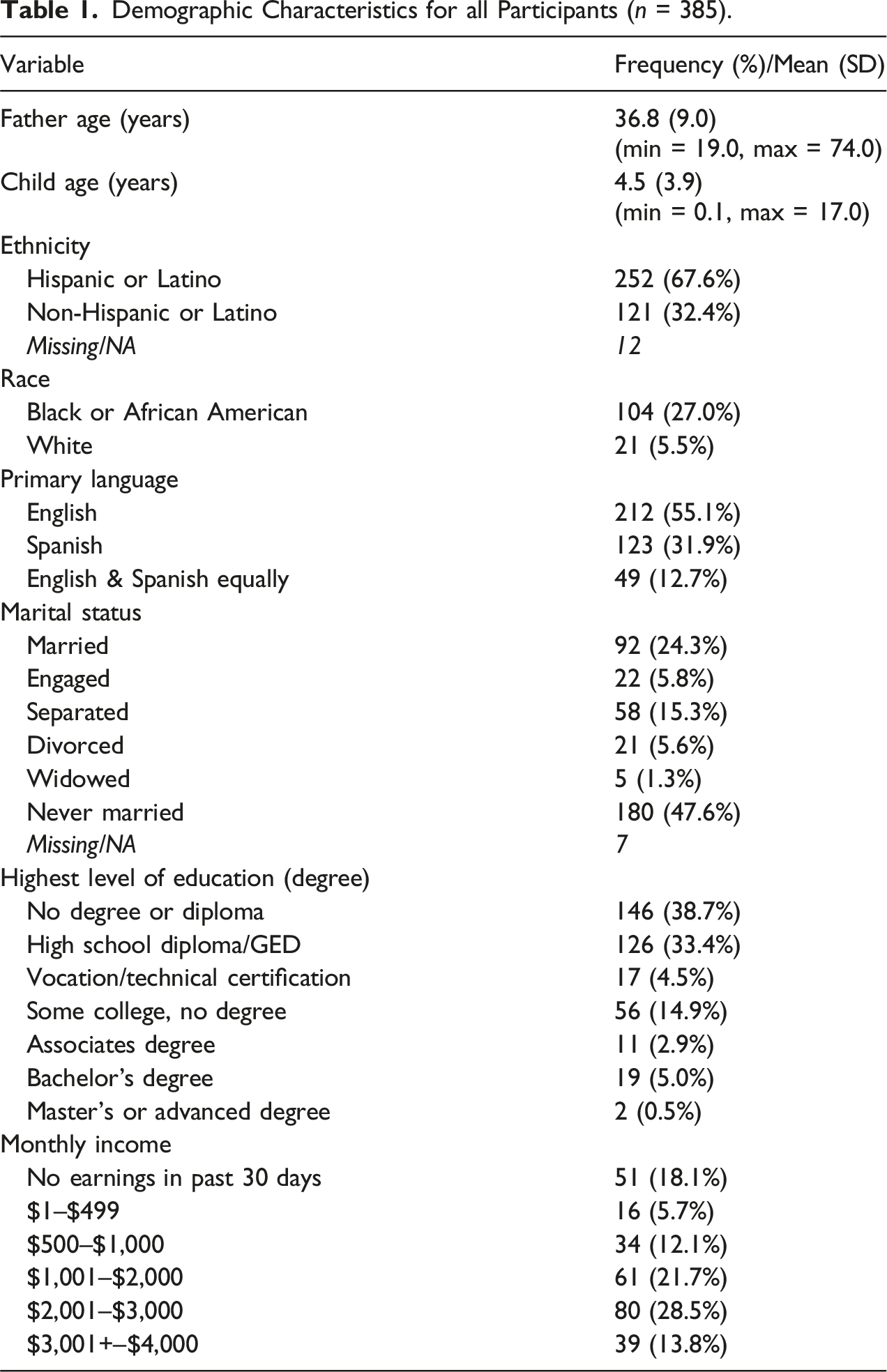
Demographic Characteristics for all Participants (n = 385).
Measures
Along with single-item demographic questions, we collected data on father’s childhood adversity experiences and co-parenting behaviors using standardized measures.
Demographics
In these analyses, we included father ethnicity (Hispanic vs. non-Hispanic Black), father’s age (continuous), child age (continuous), and time spent with child (live with child/seen in past month vs. have not seen child within last month).
Co-parenting
We used the co-parenting relationship scale (Dyer et al., 2018), an 11-item scale aimed at describing how a father and mother work together as parents. Subscales include undermining (three items), alliance (five items), and gatekeeping (mother controlling access to the child; three items). Scores are on a 5-point Likert scale ranging from Strongly Disagree (1) to Strongly Agree (5). Cronbach’s alphas for subscales were: undermining α = .91, alliance α = .96, & gatekeeping α = .93. Higher scores on subscales are interpreted as more undermining, better alliance, and more gatekeeping. Thus, higher scores on undermining and gatekeeping are considered problematic (poorer co-parenting) whereas higher score on alliance suggest better co-parenting relationships.
Data Analysis
Data were summarized using frequency (percent) for categorical variables and mean (SD) or median (IQR) for continuous variables, dependent upon distribution. Bivariate differences were assessed using Wilcoxon signed rank test. Multivariable linear mixed-effects regression was used to evaluate the association with time period (pre-vs. post-intervention) on co-parenting scores while controlling for ethnicity, father’s age, and time spent with child. Covariates included in the model were based on their univariate and clinical significance. To account for repeated measures participant ID was included as a random effect (intercept) in each model. All tests were two-sided and a p-value <.05 was considered statistically significant. All analyses were done in R version 4.2.3 (R Core Team, 2021).
Results
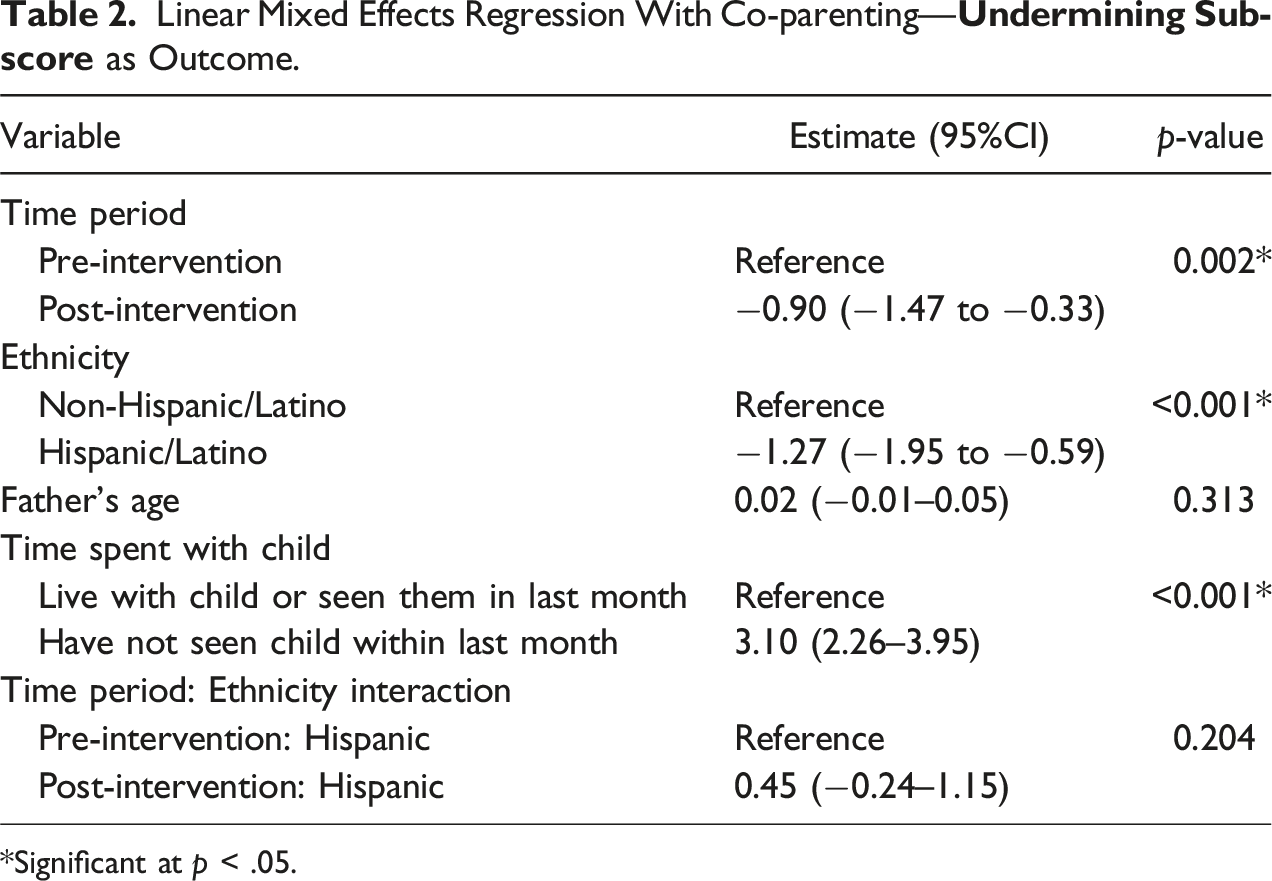
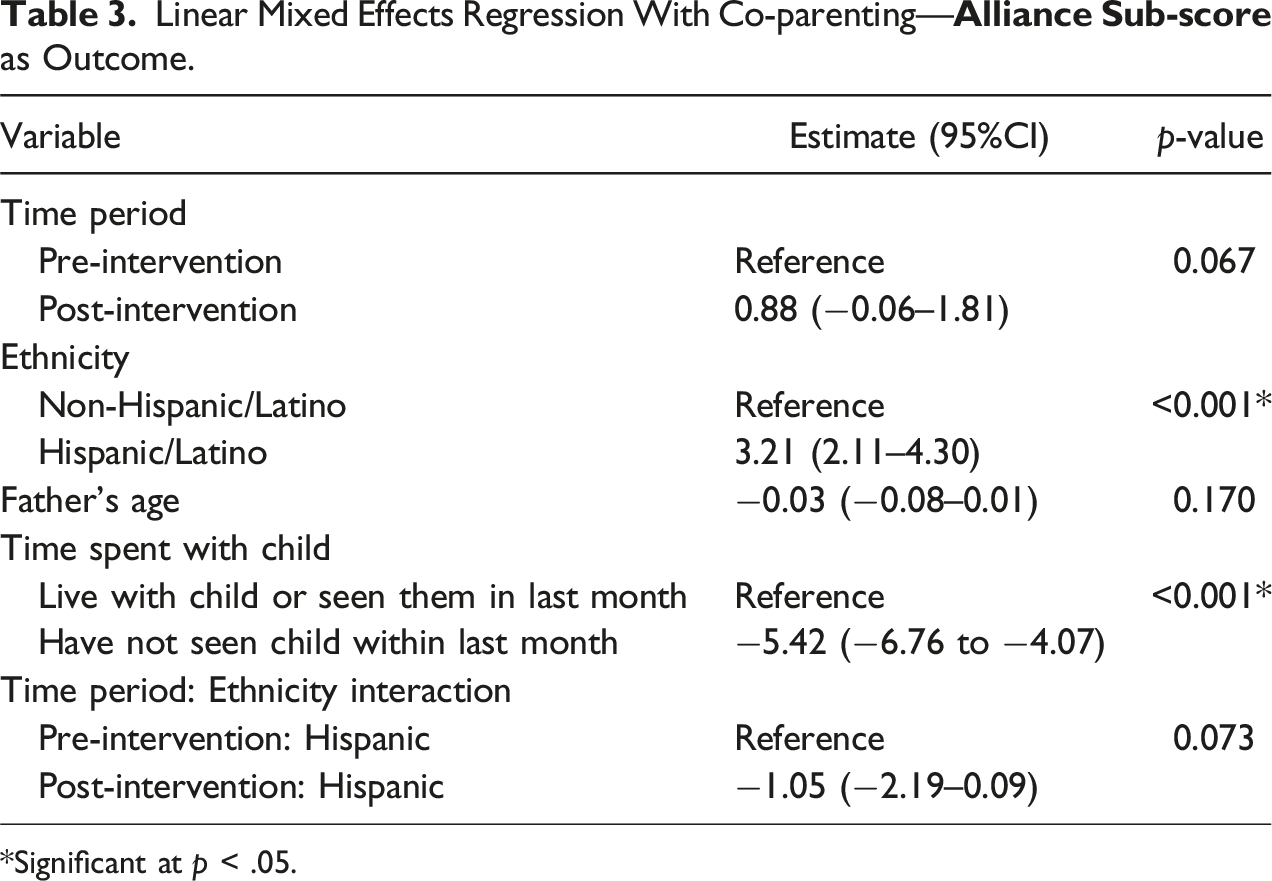
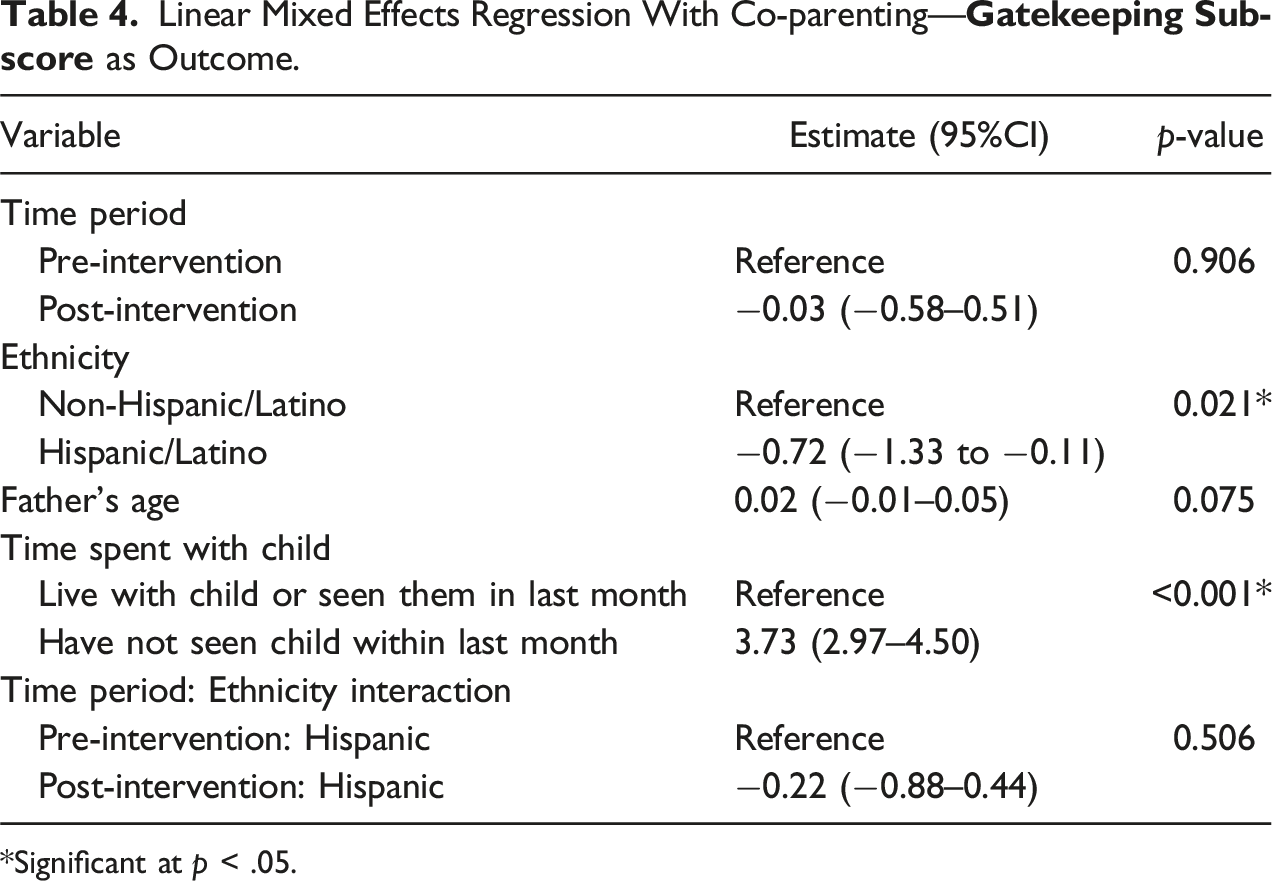
Bivariate analyses showed differences in undermining score, which was significantly lower at post-intervention compared to pre-intervention (7.4 vs. 6.8; p = .016), but not alliance or gatekeeping scores. We then ran three linear mixed effects models examining the effect of the intervention on co-parenting domains of undermining, alliance, and gatekeeping across time periods while adjusting for covariates such as ethnicity, father age, and time spent with child. We present our findings in this order.
Undermining
Linear Mixed Effects Regression With Co-parenting—
*Significant at p < .05.
Alliance
Linear Mixed Effects Regression With Co-parenting—
*Significant at p < .05.
Gatekeeping
Linear Mixed Effects Regression With Co-parenting—
*Significant at p < .05.
Discussion
Co-parenting interventions have shown only preliminary positive evidence for their impact on men, particularly in domains of quality of co-parenting and parent wellbeing (see systematic reviews; Eira Nunes et al., 2021; Pilkington et al., 2019). A major challenge in co-parenting interventions is engagement of fathers; this is critical for influencing behaviors over time. As such, father-focused interventions may contribute to this gap in father engagement by centering the experiences and needs of fathers. Findings of this work highlight the potential of father-focused intervention programs to positively impact the father’s experiences of co-parenting relationships and differences in perceived co-parenting strengths and challenges by father ethnicity and father’s ability to spend time with the child. Specifically, we found that the 24/7 Dad intervention has a particularly impact on co-parenting alliance, suggesting that even when individuals are attending a father-specific intervention, there is potential to influence behaviors that positively impact experiences of co-parenting. The father-specific group-based approach delivered in community settings is in line with prior work noting these elements as most effective for successful fatherhood interventions (Henry et al., 2020).
Undermining
We found no intervention impact on undermining behaviors. This may be explained by two things: (1) the content of the intervention did not target undermining behaviors, and (2) this sub-category of co-parenting is better suited for an intervention that involves both parents. Generally, undermining behaviors in co-parenting are described as those in which parents compete, criticize, blame or belittle (Feinberg, 2003). The intervention’s focus on strengthening communication, perspective taking, and empathy could have potentially influenced the undermining behaviors fathers were engaging in, but could not have any direct impact on the behaviors of the child’s mother (for whom the co-parenting experiences were reported). Unlike positive change in behaviors (like alliance), which could be influenced by the behavior change of fathers, the null findings reported here may merely be a function of intervention being solely focused on and delivered to fathers. We did see difference in reported undermining scores whereby Hispanic fathers reported fewer undermining behaviors as did those who lived with or had seen their child in the past month. Given that Hispanic fathers are more likely to be residential (U.S. Census, 2019), it may be that more Hispanic fathers resided with their co-parent, reducing challenges related to undermining. Co-residence and/or less contentious relationship dynamics may also have played a part in lower reports of undermining among those who lived with or had seen their child in the past month.
Alliance
Parenting alliance is an established predictor of father involvement (McBride & Rane, 1998; Singley et al., 2018), with better alliance resulting in more present and engaged fathers. Strengthening co-parenting alliance can have a positive impact on the adult relationships, but also on the parenting behaviors of men, particularly reducing harsh parenting (Kopystunska et al., 2020; Matte-Gagne et al., 2023). Our findings that the intervention has a positive influence on co-parenting alliance is likely a result of the focus in the 24/7 Dad curriculum on increasing effective communication (with co-parent and child) and behaviors that can influence co-parenting. These findings build on two-parent based interventions showing the value of co-parenting focused content, even when only one parent is involved in the intervention. Along with intervention effects, we also saw differences in co-parenting alliance by time spent with child and ethnicity. Fathers who had not seen their child in the past month were less likely to report changes in co-parenting alliance. This may be due to the factors that were restricting their access to seeing the child, including relationship challenges with the mother. In our work, Hispanic fathers were less likely to report challenges in co-parenting alliance. This is different than prior work which found that Black fathers displayed more effective co-parenting than Hispanic and White fathers (Ellerbe et al., 2018), though in line with work that found that relationship quality and co-parenting were similar for ethnic/racially diverse families (Broderick et al., 2019).
Gatekeeping
Gatekeeping behaviors include those that limit the father from seeing his child (Fagan & Kaufman, 2015). These behaviors are reported more frequently among nonresidential fathers. Reducing gatekeeping behaviors is important because gatekeeping is associated with poorer parenting quality (Altenburger et al., 2018), self-efficacy (Schoppe-Sullivan et al., 2015), and can influence the father–child relationship (Fagan, 2021). While some prior studies have no found racial/ethnic differences in reports of gatekeeping behaviors (Olsavsky et al., 2020), we found that Hispanic fathers reported less gatekeeping than non-Hispanic Black fathers. Again, those who lived with or had contact with their child in the past month reported less gatekeeping. This is likely related to residential status, which is in line with that of others who note greater challenges with gatekeeping among non-residential fathers (Fagan & Kaufman, 2015).
Limitations
While the findings in this study highlight the potential of father-specific interventions to influence aspects of co-parenting relationships, findings should be considered in the context of study limitations. First, the sample was drawn from one community-based organization in Los Angeles and only included Hispanic and non-Hispanic Black men. While the 24/7 Dad intervention is a promising intervention selected by the Responsible Fatherhood Initiative (Father Source, 2024) and is being tested in community agencies across the United States, our findings cannot be generalized to all fathers. Further, we were unable to compare our findings to a control group; this will be important in future work. Also, all facilitators of these groups were Hispanic and non-Hispanic Black men. This is a strength of the agency/program, but perhaps more unique than typical in fatherhood programs. Faciliators use of a relational approach (the establishment of authentic mutual connections; Grossmark & Wright, 2014) in the facilitation of the 24/7 Dad groups may have positively impacted fathers’ outcomes.
Conclusion
While the 24/7 Dad intervention did not have a post-intervention impact on all sub-domains of co-parenting, our work highlights the positive influence of the intervention on increasing co-parenting alliance by men in a father-specific parenting intervention. As found in prior work, fathering is strengthened when men are able to get encouragement from other fathers in a supportive environment, where they can be honest about their challenges without fear of judgment (Powe et al., 2023). Our findings provide evidence for the value of group-based interventions for father (Cederbaum et al., 2024; Doyle et al., 2022; Lyu et al., 2023). In fact, it is the normalization of fatherhood strains and stresses that can support men in insight building and change making (Powe et al., 2023). Overall, the study adds to our understanding of the relationship between fatherhood, co-parenting, and intervention effectiveness, highlighting the importance of providing support to fathers to promote healthy families.
Footnotes
Author Contributions
Declaration of Conflicting Interests
The author(s) declared no potential conflicts of interest with respect to the research, authorship, and/or publication of this article.
Funding
The author(s) disclosed receipt of the following financial support for the research, authorship, and/or publication of this article: This work is funded by a grant from the U.S. Department of Health and Human Services, Administration of Children and Families, Healthy Marriage, and Responsible Fatherhood to Children’s Institute, Inc (90ZJ00-19-01-00). These analyses represent interim findings from an ongoing grant program and do not demonstrate program impact.
