







Abstract
This research explored Americans’ responses to dual questions from the “Constructing the Family II” survey asking if it was “all right” for wives and husbands to refuse to have children with their spouses. We reviewed the data descriptively, demographically using multinomial logistic regression, and qualitatively, investigating subset respondents’ rationales. Most respondents supported or opposed refusal equally, with only about five percent of respondents supporting refusal for one partner but not both. Among subset respondents, qualitative themes varied by refusal type and included Family Considerations, Rights, and Nuclear Family Ideals. Together, the quantitative and qualitative findings suggested that those who supported refusal for both spouses were the most egalitarian; however, these respondents along with those who supported refusal for one partner but not both were also likely to provide dissimilar, and often quite traditionally gendered, rationales. We conclude that despite surface-level egalitarianism, attitudes about fertility decision-making were not free from gendered thinking.
Keywords
Introduction
Amid sociopolitical instability, waning federal and workplace support for childcare, rising costs of college, and less favorable attitudes towards children and childrearing altogether (Miller, 2018), it seems like there are more reasons than ever for Americans not to have children. These changes are reflected in behavior: many different-sex couples postpone childbearing or engage in voluntary childlessness, the active decision not to parent at all (Hayford et al., 2014; Shapiro, 2014). Between the mid-1970s and mid-2000s, U.S. childlessness rates doubled, from 10% to 20% of the adult population (Frejka, 2017). During this same period, the debate over abortion pervaded public discourse, complicating the U.S. landscape as it pertains to fertility decision-making.
Scholarly research suggests that most fertility decisions are made by couples, not individuals (Stein et al., 2014). Still, abortion—one way couples might choose not to have children with their partners—is persistently framed as a women’s issue (Ferree, 2003; Rohlinger, 2002). A recent New York Times Magazine article, “My Son’s Ex-Girlfriend Wants to Keep Her Pregnancy. Is That Unfair to Him?”, demonstrates that the ethical implications of such fertility decisions are far from resolved (Appiah, 2024). Can women refuse, given the bodily demands and health implications of pregnancy? And without such physical ties, what rights do men have to refuse? Or, as our research asks, do Americans believe that it is “all right” for both wives and husbands to refuse to have children with their spouses? And why?
We examined Americans’ attitudes about different-sex, married couples’ fertility decision-making using data from the “Constructing the Family II” survey, which randomly sampled 815 U.S. adults to investigate perspectives about family life, including attitudes about refusing to have children with one’s spouse (Powell, 2006). Using “rules” of fertility decision-making described in literature on couples’ childbearing intentions and outcomes, we explored quantitative patterns in the dual questions, “If the wife/husband in a family wants children, but the husband/wife does not, is it all right for the husband/wife to refuse to have children?” We categorized respondents who supported refusal for both partners, opposed refusal for both partners, or supported refusal differentially by gender and examined demographic differences between the groups. Lastly, with a subset of respondents who were asked an open-ended “Why/Why Not” question, we coded the qualitative data in two stages. First, we completed a round of open-coding followed by a second round of closed coding, where we applied the emergent dominant and subthemes to each case.
Our data showed widespread parity in Americans’ attitudes about it being “all right” for wives and husbands to refuse to have children, findings that supported the couple consensus rule of fertility decision-making. Still, our qualitative data suggested that even from a perspective of couple consensus, many respondents provided gendered reasonings to explain why they believed each partner could (or could not) refuse. Our findings highlight how seemingly egalitarian thinking is gendered with women, who are presumably more responsible for childcare and childrearing, having more say than men when the scales are tipped. This contradiction sheds light on similar patterns found in research on couples’ childbearing intentions and outcomes, as well as fertility decision-making more broadly.
Background
Couples’ Fertility Decision-Making
Unlike a 2008 Pew Research Center Report stating, “In the typical American family, it’s the woman who wears the pantsuit” (Pew Research Center, 2008), the role of gender on couples’ childbearing intentions and outcomes is more complex and embedded in various “rules”: the golden mean or social drift/veto rules, the sphere of interest model, and the power rule (Duvander et al., 2020). We describe these “rules” in detail below. For clarity, we group the rules into two clusters that we name the couple consensus and gender rules. 1
Suggesting parity in couples’ decision-making are the golden mean (Jansen & Liefbroer, 2006) and social drift/veto rules (Bauer & Kneip, 2014). These rules assume that both partners have an equal say in deciding whether to have children; in disagreements, the partner who does not want the situation to change decides (golden mean). Expressed another way, without consensus, nothing changes (e.g., the couple does not have children) (social drift/veto). Scholarly research demonstrates empirical support for these rules. For example, Duvander et al.’s (2020) study found that Swedish couples with shared positive fertility intentions were the most likely to have a child. Further, although the study was conducted on individuals (not couples), Kuhnt and Trappe’s research on German women and men’s fertility intentions found negative childbearing intentions to be more predictive than positive ones, a finding suggestive of the social drift/veto rule (Kuhnt & Trappe, 2016). Because of their similarities, we refer to this cluster of rules as couple consensus.
Gender roles appear in the sphere of interest model, which sees childbearing as a woman’s area of decision-making (Jansen & Liefbroer, 2006), and the power rule, where the decision to have or not have children lies with the partner with the most socioeconomic resources (most commonly the man) (Bauer & Kneip, 2014). The sphere of interest model bases predictions on traditional gender ideology: women, expected to take on the major share of childrearing responsibilities, have a stronger say than their less invested partners. Research that supports the sphere of interest model shows that different-sex partners often jointly make fertility decisions, but when tipped, the scale leans in women’s favor. For instance, using a small sample of U.S. respondents, Beckman (1984:193) found that “in cases of conflicting desires, either wives have somewhat greater influence over fertility outcomes than do husbands or spouses are equally influential,” particularly when the wife does not want a child in the near future. Other studies have drawn similar conclusions, identifying the stronger influence of women’s fertility decisions relative to men to have children (Berrington, 2004; Duvander et al., 2020; Stein et al., 2014). In contrast, little empirical support exists for the power rule, which itself has gendered outcomes. Specifically, powerful wives “persuade their partners to beget a child,” whereas powerful husbands “tend to insist on the status quo,” or said differently, not have a child (Bauer & Kneip, 2013, p. 545). Because of these rules’ emphasis on the roles played by men and women in relationships, we combine them into a single gender rule.
Taken together, empirical evidence supports both the couple consensus rule of joint decision-making and the gender rule that gives preference to women’s choices. 2 These previous findings are, in many cases, embedded in cultural contexts that differ from US gender and fertility norms (England, 2010; Ferree, 2003; Rohlinger, 2002). Specifically, whereas Beckman’s (1984) study uses US data, Berrington’s (2004) research uses British data, Bauer and Kneip’s (2014), Kuhnt and Trappe’s (2016), and Stein et al.’s (2014) studies use German data, Duvander et al.’s (2020) study uses Swedish data, Jansen and Liefbroer’s (2006) study uses data from the Netherlands, and Testa et al.’s (2014) study uses data from Italy. Our analysis of Americans’ attitudes, therefore, offers a unique understanding of fertility decision-making in the US context.
Lastly, these rules stem from literature focused on lived experiences of different-sex couples actually making fertility decisions. The attitudinal data we analyze allows us to assess what rules Americans believe should apply, one of the innovative contributions of our study. As Gerson’s (2010) research shows, ideals about family life may be more egalitarian than lived experiences, which are subject to structural constraints. Given this understanding, it may be the case that individuals prefer equality in fertility decision-making, echoing the couple consensus rule, even if they are unable to achieve such egalitarianism in their day-to-day lives.
Research Questions
Although previous studies examine real couples’ fertility decision-making, we know less about public opinion on such decision-making. In this way, our study moves the debate from lived experiences to normative beliefs, investigating whether Americans feel it is “all right” for hypothetical, different-sex partners to refuse to have children with their spouses. Outside the structural confines of one’s own relationship in which many may live with second-best options, do Americans equally support (or oppose) refusal to have children with one’s spouse? Studying societal fertility norms, as well as personal ones, with survey data is common in research on ideal or expected family size, figures that also vary from actual fertility rates (Bacci, 2001; De Santis & Bacci, 2001; Ray et al., 2018).
Understanding who Americans believe should be allowed to refuse to have children in different-sex, married partnerships provides a new viewpoint into gender attitudes. Past studies demonstrate the utility of gendered family practices like marital name change in this regard, especially given that typical separate spheres measures may suffer from social desirability bias (Hamilton et al., 2011).
Finally, the questions asked in this survey (“If the wife/husband in a family wants children, but the husband/wife does not, is it all right for the husband/wife to refuse to have children?”) are interesting because they sidestep more politicized, longstanding debates about abortion, another aspect of fertility decision-making that has been extensively examined in public opinion research with attitudes relatively stable over time (Pew Research Center, 2022b). While “refusing to have children” might involve abortion, it may simply specify an individual’s unwillingness to have sex without contraception or within fertile time frames.
In this study, we first investigate whether Americans’ attitudes about it being “all right” for hypothetical, different-sex partners to refuse to have children with their spouses reflect the couple consensus rule (supporting or opposing refusal equally) or gender rule (favoring either men or women) of fertility decision-making. Next, we demographically explore which Americans are mostly likely to assign the couple consensus or gender rules. Last, we examine the rationales individuals give for their positions.
Methods
Data
To investigate our research questions, we used data collected in the “Constructing the Family II” computer-assisted telephone survey conducted in 2006 by Brian Powell, PhD at Indiana University’s Institute for Social Research. The sample for the “Constructing the Family II” survey was located through random digit dialing using the Genesys list-assisted method. In total, 815 randomly sampled U.S. adults completed the survey, representing a 24.7% response rate of eligible interviews (Powell, 2006).
The “Constructing the Family II” survey asked respondents to identify which living arrangements counted as a family, assess which family forms were entitled to various rights such as filing joint income tax returns, consider whether women should be required to change their names when married, assess the role of nature and nurture in child outcomes such as school performance and adult outcomes like level of education completed, and share opinions about same-sex marriage and traditional gender roles (Powell, 2006). With the first wave of the “Constructing the Family” survey that was collected in 2003, data from this second wave formed the basis of Powell et al.’s (2010) work on how Americans define family. Most importantly for our analysis, second-wave respondents were also asked about refusal in fertility decision-making, questions that have yet to be analyzed or published.
Although the data for this study were collected in 2006, recent studies on gender attitudes confirm their continued relevance. Specifically, as viewed as a single index, gender egalitarianism plateaued in the 1990s and changed little through the late 2000s (Cotter et al., 2011). When viewed as having multiple dimensions, there has been more change in gender attitudes, with movement away from traditional values to ambivalence, most often mixing gendered home roles with equal work roles, and some growth in egalitarian ideals, which were most likely to be held by younger generations (Generation-Xers and Millennials) than prior cohorts (Scarborough et al., 2019). The continued coupling of wives with the home and traditionally feminine roles suggests that if we collected these data today, they would be similar to what was collected in this wave of the “Constructing the Family” research.
Furthermore, the structural conditions under which Americans parent are largely unchanged since 2006. Policies and programs that might improve family life for many like universal pre-k, subsidized childcare, and paid family leave remain “wish list” items instead of realities, even after decades of debate (Cain Miller, 2021). That said, the overturning of Roe v. Wade, the Supreme Court decision dating back to 1973 that legalized abortion nationwide (Roe v. Wade, 1973), might impact results had this survey been conducted after the 2022 Supreme Court decision (Dobbs v. Jackson Women’s Health Organization, 2022), especially given that Americans largely disagreed with the court’s ruling (Pew Research Center, 2022a). We attend to this issue more fully in the discussion, especially as it relates to possibilities for future research.
Regarding attitudes about refusal in fertility decision-making, all respondents (N = 815) were asked, “If the husband in a family wants children, but the wife does not, it is all right for the wife to refuse to have children?” (asked first) and “If the wife in a family wants children, but the husband does not, is it all right for the husband to refuse to have children?” (asked second). Possible responses included “Yes,” “No,” and “It Depends.” A subset of respondents (N = 275) was asked to explain their closed-ended responses in follow-up questions that read “Why is it all right…” or “Why is it not all right…” To analyze the data, we used a mixed-method design incorporating both the closed and open-ended responses to the questions about refusal in fertility decision-making.
Quantitative Analysis
To answer our research questions about patterns of refusal, we conducted a quantitative analysis of the closed-ended responses. Quantitative analyses of the data were facilitated through Stata 18.0, a statistical software package for social scientists (StataCorp, 2023).
We created two measures of refusal attitudes. The first measure of refusal attitudes was nominal and captured whether respondents felt (1) refusal was okay for both wives and husbands, (2) refusal was not okay for wives or husbands, (3) it was okay for wives to refuse, but not husbands, and (4) it was okay for husbands to refuse, but not wives. We grouped “it depends” responses together with opposing refusal based on patterns we found in the qualitative data. We explain this decision in more detail in our supplementary coding notes (see “Quantitative Coding and Analytical Notes” in the Supplemental Materials).
Because of the small numbers of respondents who answered it was okay for wives to refuse, but not husbands (N = 29) and it was okay for husbands to refuse, but not wives (N = 13), we only reviewed this variable descriptively. For readers who are interested in the multinomial logistic regression analysis of refusal attitudes in four categories, we provide this analysis as a supplementary table (see Supplemental Table 2. Multinomial Logistic Regression of Type of Refusal (Refusal in 4 Categories; Referent Category: Okay for Both to Refuse).
We used multinominal logistic regression to analyze a second, nominal refusal attitudes variable that combined the categories it was okay for wives to refuse but not husbands (N = 29) and it was okay for husbands to refuse, but not wives (N = 13) into one indicating that one partner could refuse, but not both (N = 42). This measure of refusal attitudes in three categories rather than four both attended to the issue of small cell sizes and focused our analysis on the primary demographic differences in the data, namely, between those who supported refusal for both wives and husbands, opposed refusal for both wives and husbands, or who supported refusal for one partner but not both.
We also incorporated the following attitudinal and demographic independent variables in the multinomial logistic regression analysis. Gender attitudes was a scaled measure that ranged from one (1) to four (4) with higher scores indicating more liberal gender attitudes (mean = 3.17, alpha = .687). Specifically, to measure gender attitudes, respondents were asked if they “(1) strongly agree,” “(2) somewhat agree,” “(2.5) neither agree nor disagree,” “(3) somewhat disagree,” or “(4) strongly disagree” with the following three statements: “It is more important for a wife to help her husband’s career than to have one herself,” “It is much better for everyone involved if the man is the achiever outside of the home and the woman takes care of the home and family,” and “A working mother can establish just as warm and secure a relationship with her children as a mother who does not work (reverse coded).” To generate the gender attitudes scale, all measures were added together and then divided by three (3).
Religious fundamentalism was a dichotomous variable with respondents who reported, “The Bible is the actual word of God and it is to be taken literally, word for word” set equal to one. Religious affiliation was measured with a set of four dichotomous variables with Catholic set equal to one, Protestant set equal to one, Other Religion set equal to one, and No Religious Affiliation, the reference group, omitted from the multinominal logistic regression analyses. Political identification was measured on a seven-point scale that ranged from (1) extremely liberal to (7) extremely conservative. Age was a continuous measure, ranging from 18 to 92 years old. Gender was a dichotomous variable with woman set equal to one. Race was a dichotomous variable with white set equal to one. Marital status was a dichotomous variable with married set equal to one. Income was an ordinal variable with higher scores indicating higher income categories. Education was a dichotomous variable with respondents who had earned a bachelor’s degree or higher set equal to one. Lastly, interviewer’s gender was measured with a dichotomous variable set equal to one for women interviewers.
After reviewing descriptive statistics, we performed multinomial logistic regression analysis of demographic and attitudinal differences between those who said that “both wives and husbands could refuse,” “neither wives nor husbands could refuse,” and “one partner could refuse, but not both.”
We retained missing cases where possible with multiple imputation then deletion (MID) using chained equations (von Hippel, 2007). 3 As specified by MID, we used all possible cases for imputation but then deleted cases missing on the dependent variable (N = 17) before analysis. Although there are various perspectives on how to best handle missing data, research suggests that multiple imputation using chained equations produces unbiased estimates, especially when “the proportion of missing data is moderate” (less than 20%) and sample sizes are appropriate (i.e., including more than 50 respondents) (Hardt et al., 2013, p. 376). Our final analyses included 793 respondents.
Qualitative Analysis
To answer our third question about the rationales Americans gave about their position on refusal we thematically coded the open-ended, qualitative responses to the questions “Why is it all right…?” or “Why is it not all right…?” for the husband/wife to refuse to have children answered by a subset (N = 275) of respondents. We excluded cases dropped from the quantitative analysis (N = 16) and also those who refused to respond to the qualitative questions (N = 7), leaving us with 252 cases with open-ended responses. We show descriptive statistics for the qualitative subset respondents, which were comparable to those from the larger sample, in our supplementary materials (see Supplemental Table 1. Qualitative Subset Descriptive Statistics). The qualitative comments lent context to the quantitative analysis so that in addition to categorizing refusal types and exploring demographic differences between the groups, we could tell the respondents’ stories and include quotes that demonstrate common sentiments within each group.
Our thematic coding consisted of two stages. Initially, we imported transcripts of responses to the survey’s fertility questions into the Atlas.ti9 software package for analyses (Scientific Software Development GmbH, 2020). Independently, each author performed close readings of the responses before collectively deciding on the following three dominant themes in respondent comments: (1) Rights (with sub-themes of Personal Rights and Body Autonomy), (2) Family Considerations (with sub-themes of Relationship Quality and Parenting Ability), and (3) Nuclear Family Ideals (with sub-themes of Children’s Centrality to Marriage and Gendered Family Roles). To facilitate further coding, we developed a codebook with general suggestions for coding cases. We include our codebook in the supplementary materials (see the “Qualitative Analytic Codes” in the Supplemental Materials).
Next, we performed a round of closed coding, sorting comments according to the three major themes (and six sub-themes) observed (Hsieh & Shannon, 2005; Krippendorff, 2012). Aside from three respondents who claimed “I don’t know” to these questions, all other respondents fit into at least one of the six sub-categories. When comments included more than one theme, we coded all themes that applied. Our inter-rater reliability for this stage of closed coding was 98.9%, indicating extremely high agreement in our coding. During this process, we identified quotes that exemplified each theme. When quotes were included, we assigned the case with a pseudonym.
Results
Quantitative Patterns
Descriptive Statistics.
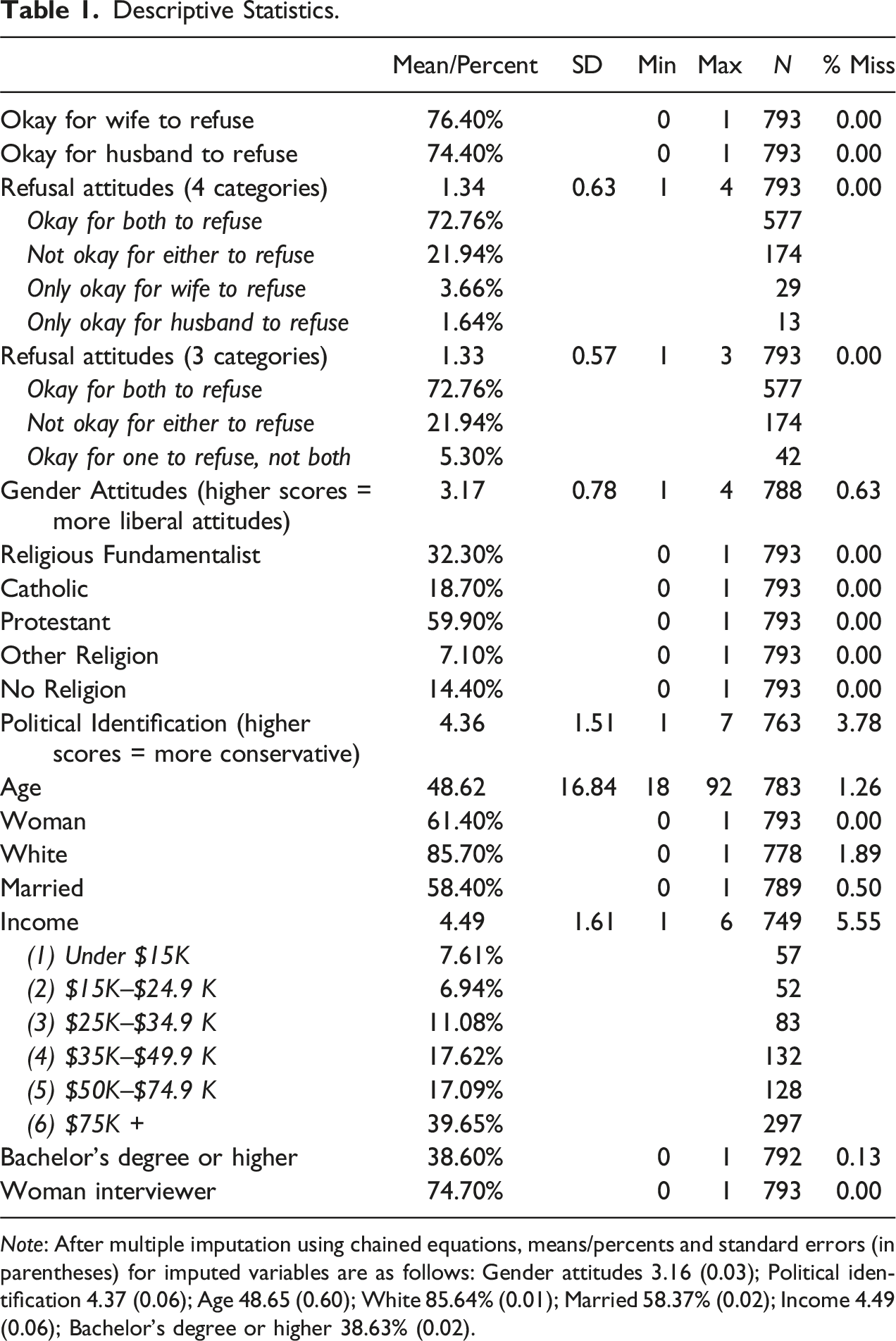
Note: After multiple imputation using chained equations, means/percents and standard errors (in parentheses) for imputed variables are as follows: Gender attitudes 3.16 (0.03); Political identification 4.37 (0.06); Age 48.65 (0.60); White 85.64% (0.01); Married 58.37% (0.02); Income 4.49 (0.06); Bachelor’s degree or higher 38.63% (0.02).
On average, gender attitudes were quite liberal with a mean of 3.17 out of a maximum of 4.00. About one-third (32.30%) of respondents were religious fundamentalists, answering that they believed “The Bible is the actual word of God and it is to be taken literally, word for word.” Relative to religious affiliation, 18.70% of respondents were Catholic, 59.90% were Protestants, 7.10% reported other religious affiliations, and 14.40% said that they had no religious affiliation. On average, political identification was centrist—with a mean of 4.36 on a 7-point scale, with higher scores indicating more conservative beliefs. The average age of respondents was 48.62 years old, with a range from 18 to 92 years old in the sample. The majority of the sample were women (61.40%), white (85.70%), and married (58.40%). The median household income ranged between $50–75,000 annually. Just over one-third of respondents, 38.60%, earned a bachelor’s degree or higher. Lastly, nearly three-quarters of interviews, 74.70%, were conducted by women interviewers.
Multinomial Logistic Regression of Type of Refusal (Refusal in 3 Categories; Referent Category: Okay for Both to Refuse).
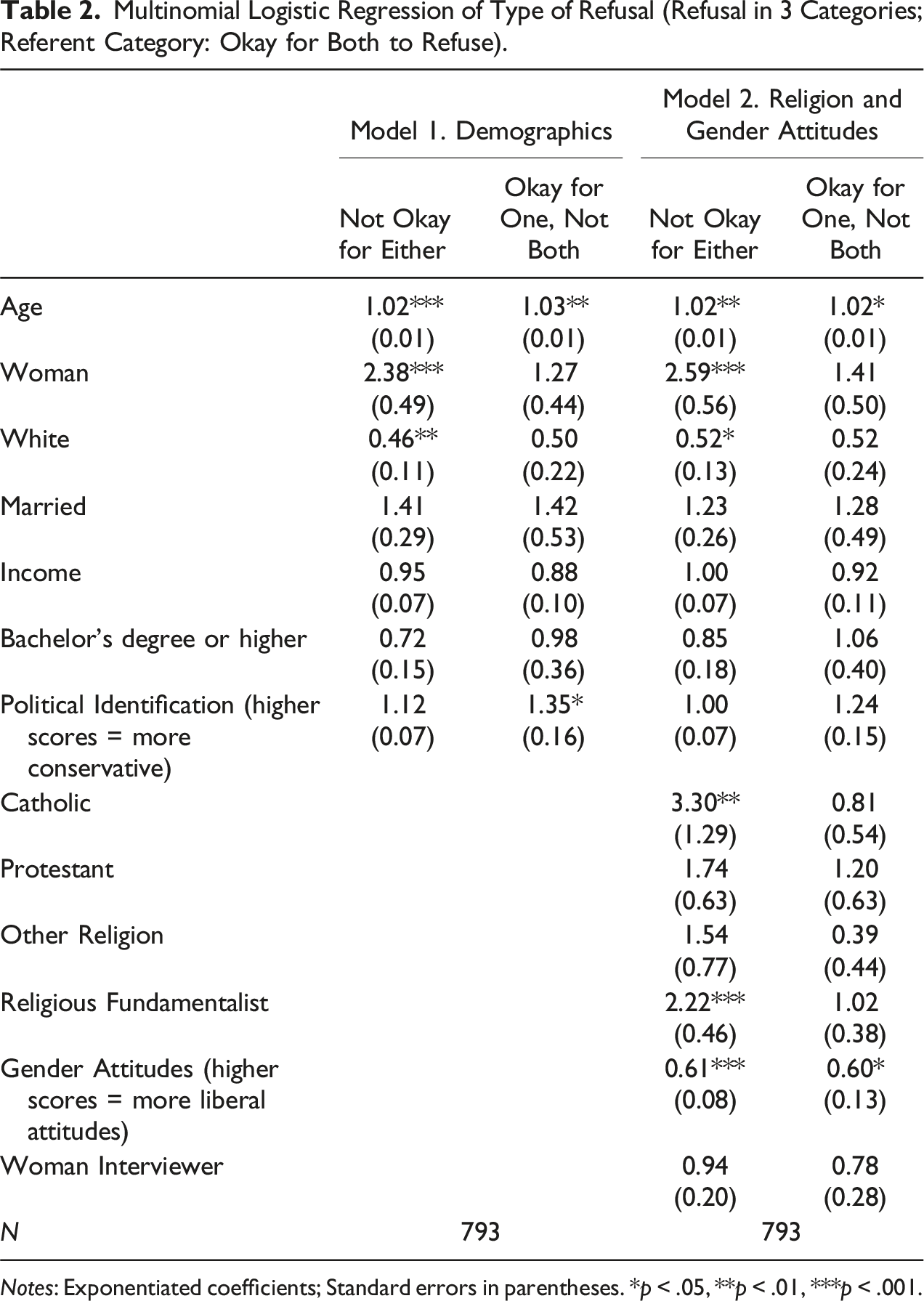
Notes: Exponentiated coefficients; Standard errors in parentheses. *p < .05, **p < .01, ***p < .001.
In Model 1, we found that age, gender, race, and political identification were significant predictors of refusal type. For every one-year increase in age, respondents had increased odds of answering that it was “not okay for either” by a factor of 1.02 (p < .001) or that it was “okay for one, but not both” by a factor of 1.03 (p < .01) as compared to the referent category that that it was “okay for both wives and husbands to refuse to have children.” Women had increased odds of answering that it was “not okay for either” by a factor of 2.38 (p < .001) and whites had decreased odds of answering in this way by a factor of 0.46 (p < .01). Lastly, for every one-unit increase in political views, meaning that as attitudes got more conservative, the odds of answering that it was “okay for one, but not both” increased by a factor of 1.35 (p < .05).
When religious affiliation, religious fundamentalism, gender attitudes, and interviewer’s gender were added in Model 2, the demographic findings remained consistent except for the risk ratio for political identification, which retained its direction, but lost significance. Additionally, we saw increased odds of answering that it was “not okay for either” for Catholics by a factor of 3.30 (p < .01) and religious fundamentalists by a factor of 2.22 (p < .001). For every one-unit increase in gender attitudes, meaning that as attitudes got more liberal, the likelihood of answering that it was “not okay for either” decreased by a factor of 0.61 (p < .001) or that it was “okay for one, but not both” decreased by a factor of 0.60 (p < .05). Finally, risk ratios for interviewer’s gender did not reach significance, but suggested that responding that refusal was “not okay for either” or “only okay for one, not both” was less likely when interviewers were women.
Qualitative Patterns
Beyond documenting the overall patterns in the quantitative responses, we also explored the open-ended justifications from a subset of the full sample (N = 252). All respondents from this subset fell into at least one of the three major thematic categories identified in the methods section (Family Considerations, Personal Rights, and Nuclear Family Ideals), as well as at least one of six sub-themes (Personal Rights, Body Autonomy, Relationship Quality, Parenting Ability, Children’s Centrality to Marriage, and Gendered Family Roles).
Over three-fourths (78.17%) of subset respondents expressed Family Considerations in their justifications for why partners should or should not be able to refuse to have children. In both Family Considerations’ sub-themes of Relationship Quality and Parenting Ability, subset respondents emphasized the life-long commitments that are marriage and parenthood. Specifically, related to Relationship Quality, subset respondents discussed the impacts of fertility disagreements on partners’ relationship quality and their ability to effectively parent. They frequently used terms like “team,” “together,” and “joint” to argue that the decision to have children is one that should be negotiated between partners, ideally before they choose to get married. In fact, the sentiment, “They should have decided this before they got married” was employed no less than 91 times across all subset interviews (over one-third of this subset of respondents). For example, Ella explained that it was okay for both wives and husbands to refuse, but that mismatched desires would be damaging: “Well, I think they need to figure that out before they get married… It’s too bad when they get married and then they try to figure it out because it has to be a heartache for one or the other who wants children and the other one refuses. I think that’s heartache.” That incompatible attitudes toward childbearing would hurt couple relationships frequently appeared in interviews, with some subset respondents mentioning divorce as a possible outcome of such disagreements.
Related to Parenting Ability, subset respondents frequently expressed concerns that adults who didn’t want to have children would lack investment in their children and would in turn be bad parents. Sarah explained that both wives and husbands could refuse with this logic: “If she [the wife] has a child that she does not want, it’s detrimental to the child. We have lots of evidence of that, don’t we?” In the next question about husbands, this respondent affirmed that husbands should be able to refuse “for the same reason.”
The second dominant theme employed by half (56.35%) of subset respondents was Rights, with sub-themes of Personal Rights and Bodily Autonomy. Subset respondents commonly employed the idea that it is one’s personal, legal, or God-given right to say no to decisions that affect them. To force a partner to have children, Nat explained, would be “a violation of her rights as an individual and as a human being.” Bodily Autonomy also appeared in the open-ended responses. In particular, “her body, her choice” was commonly expressed (even if in a couple of cases, that phrase was followed by a clarification that the respondent was not pro-choice). Some subset respondents further articulated medical considerations that may affect one’s decision to have or not have children.
The final theme, employed by a quarter (26.19%) of subset respondents in justifying their responses was Nuclear Family Ideals. These ideals were expressed in subset respondents’ assertions that the primary reason people get married is to have children, a sub-theme we labeled Children’s Centrality to Marriage. For example, Bessie shared, “One of the things about marriage is that it sanctions having kids, so if you say you don’t want to after marriage it’s strange.” Some subset respondents implied Children’s Centrality to Marriage in explaining that couples could refuse to have children because they could always adopt.
Nuclear Family Ideals were also expressed in subset respondents’ descriptions of appropriate gender roles for men and women in a marriage, a sub-theme we define as Gendered Family Roles. Phrases emphasizing men’s roles as head of the household and/or breadwinner and women’s roles as caretaker/nurturer were employed in subset respondents’ explanations. Similarly, several subset respondents shared sentiments like Dinah’s, as follows, essentializing the naturalness of parenting for women, “I think most women look forward to becoming a mother. It’s just a natural thing.” Finally, some subset respondents indicated that God and the Bible dictated appropriate fertility decisions, reinforcing the idea that the purpose of marriage is to “bear fruit” and that distinct roles for women and men are both natural and ordained by God. For example, Billie discussed religion and Gendered Family Roles in her response, “Because God said in the Bible that it should be the man’s choice to have children unless she has a very good reason, a health reason or whatever, I think she needs to bear his children or she shouldn’t have married him.”
Type of Refusal by Theme
Qualitative Themes Overall and by Type of Refusal (Percent).
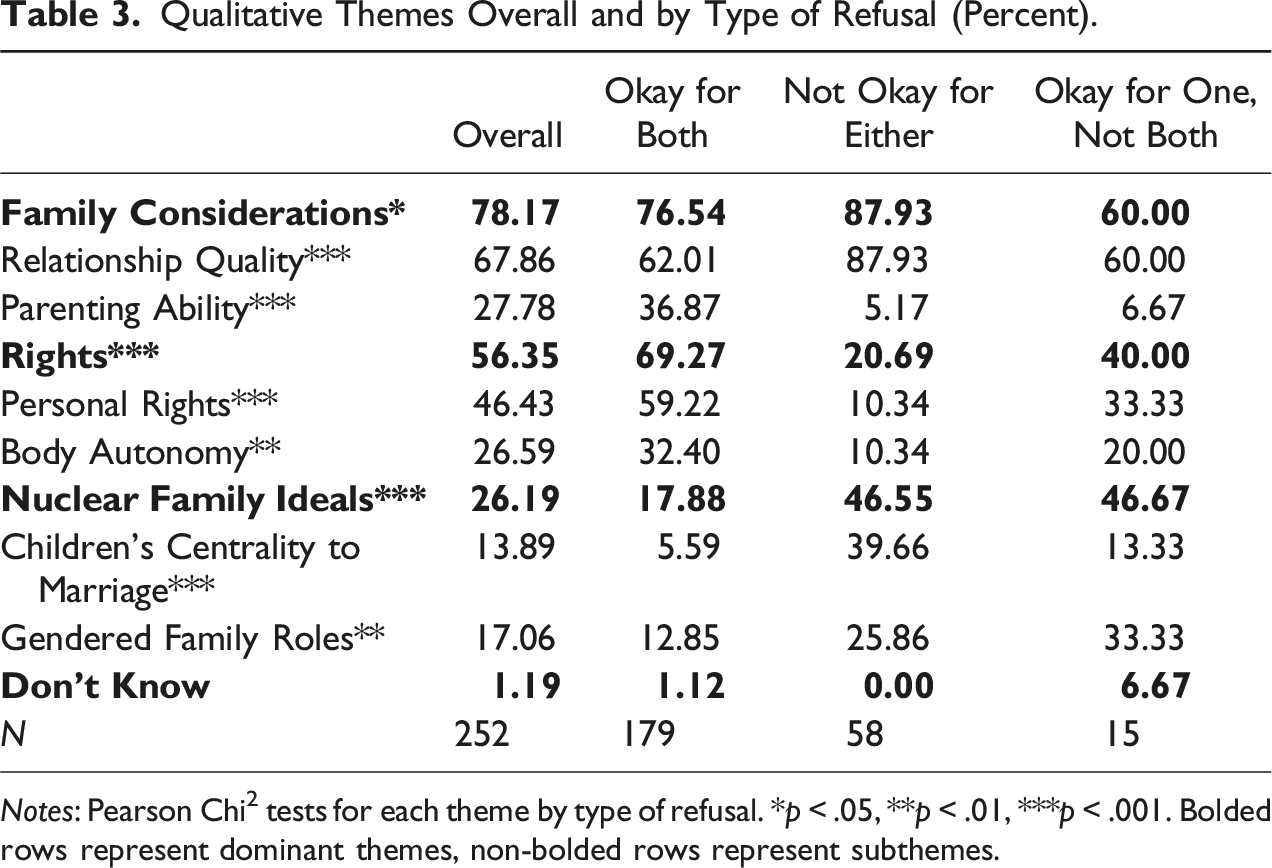
Notes: Pearson Chi2 tests for each theme by type of refusal. *p < .05, **p < .01, ***p < .001. Bolded rows represent dominant themes, non-bolded rows represent subthemes.
Family Considerations was the most common theme in all groups. That said, those who said it was okay for both wives and husbands to refuse were more likely to discuss the subtheme of Parenting Ability (36.87%) than those who said it was not okay for either partner to refuse (5.17%) or that one partner could refuse, but not both (6.67%). Further, those who said that neither wives or husbands could refuse were most likely to discuss the subtheme of Relationship Quality (87.93%) as compared to those who said refusal was okay for both partners (62.01%) or for one partner, but not both (60.00%).
Beyond differences in Family Consideration subthemes, the groups also differed relative to the second-most discussed themes. Those who said both wives and husbands could refuse often discussed Rights (69.27%), including the subthemes of Personal Rights and Body Autonomy. The theme of Rights appeared with much less frequency for those who said neither partner could refuse (20.69%) nor that one partner could refuse, but not both (40.00%). Instead of Rights, the second-most discussed theme for the groups who disallowed refusal in some way was Nuclear Family Ideals, indicated by about 46% of those who said neither partner could refuse or that refusal was okay for one partner, but not both. On the other hand, only 17.88% of those who said it was okay for both wives and husbands to refuse discussed Nuclear Family Ideals.
Similar or Dissimilar Reasoning
As we coded the data, we noticed that a majority of respondents provided similar rationales for both wives and husbands (73.41%) to justify their positions. For instance, Nina justified her responses that wives and husbands could refuse with the statements, “Because it’s her personal choice (laughs)” and “Because that’s also his choice (laughs),” reflecting the subtheme of Personal Rights.
That said, this meant that 26.59% of respondents provided dissimilar rationales for wives and husbands. Most often subset respondents who provided dissimilar rationales referred to women’s bodily experience of fertility (70.15% of dissimilar cases) with other explanations given for men. For instance, nearly 24% of respondents who provided dissimilar rationales discussed wives’ Bodily Autonomy and husbands’ Personal Rights. For example, Carmen, who said both wives and husbands could refuse, discussed Body Autonomy and Relationship Quality subthemes: “Because it’s her body. That’s something that should be discussed before you even get married. Then you don’t have those problems.” This same respondent discussed husbands’ refusal with Personal Rights, Parenting, and Gendered Family Roles subthemes: “Well if he doesn’t want to he shouldn’t be forced into having them because odds are he’s not going to be around to be the Daddy.” Another example (31.34% of dissimilar cases), also reflected in the quote shared above, was where husbands’ Parenting Ability was discussed but another theme was given for wives.
Type of Refusal and Similar or Dissimilar Justifications.
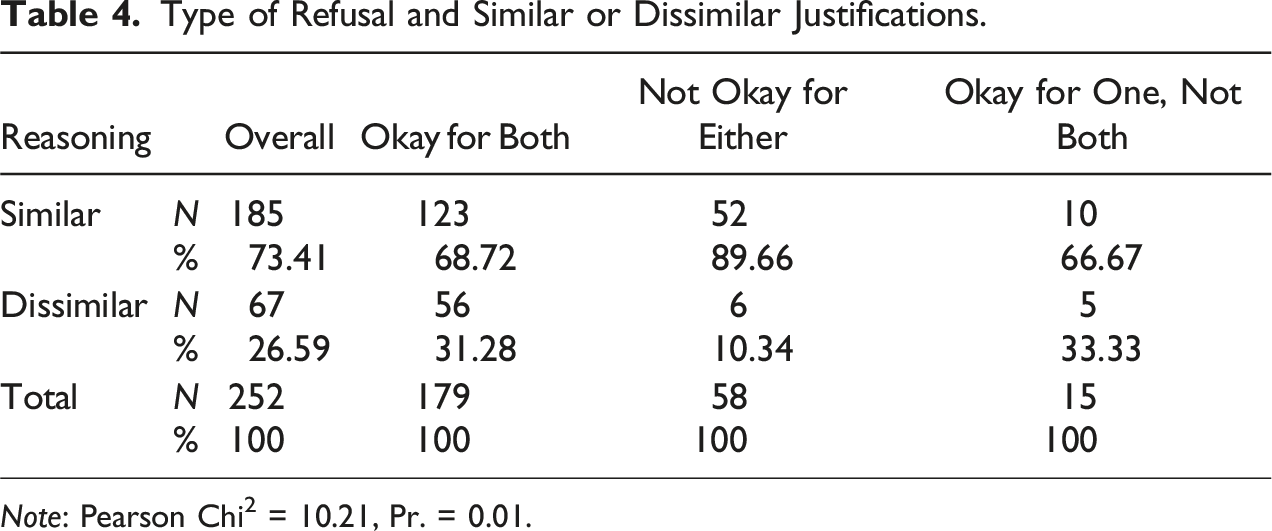
Note: Pearson Chi2 = 10.21, Pr. = 0.01.
Discussion
Previous studies examining real different-sex couples’ fertility decision-making suggest that most couples make fertility decisions together, even if sometimes wives’ preferences are prioritized. Yet, real couples’ fertility decisions likely differ from public opinion about decision-making, as evidenced by the abortion debate which frames pregnancy and childbirth as women’s issues. Do Americans feel it is “all right” for hypothetical, different-sex wives and/or husbands to refuse to have children with their spouses? This study explored this question, filling a gap in the literature while providing a new lens into Americans’ gender attitudes.
We found that, when presented with a hypothetical scenario, Americans largely approved or disapproved of refusal for both wives and husbands, supporting the couple consensus rule. The modal response in our data, given by almost 73% of respondents, was that both wives and husbands could refuse to have children with their spouses. The second-most frequent response given by almost 22% of respondents opposed refusal for both wives and husbands. As compared to the modal response, older respondents, female respondents, religious fundamentalists, and Catholics, whose religion has historically prioritized childbearing as a central function of marriage and discouraged the use of hormonal birth control (“Roman Catholic Church”, 2023), were more likely to believe that neither husbands nor wives could refuse. Further, white respondents and those with more liberal gender attitudes were less likely to answer in this way. Still, at face value, attitudes were not shaped by the hypothetical, different-sex partner’s gender in either of these groups.
Only about 5% of respondents approved of refusal for one partner but not both, cases that supported the gender rule. In this small percentage of cases that supported refusal differently by the hypothetical, different-sex partner’s gender, respondents’ gender attitudes, political identification, and age were predictive. Respondents with more liberal gender attitudes were less likely to support or oppose refusal differently by gender, whereas older respondents and those with more conservative political beliefs were more likely to do so. Overall, however, refusal attitudes were mostly applied to the hypothetical, different-sex partners similarly, which may reflect more modern practices of childrearing in which men and women are expected to and do participate more equally than ever before.
A subset of respondents from this survey were asked to explain their refusal attitudes. Our qualitative analysis revealed that these explanations addressed family relationships, either between spouses or parents and children, rights as individuals and/or to make decisions about one’s own body, and nuclear family ideals that centered children as a primary function of marriage or assigned traditional feminine and masculine roles to wives and husbands. In general, the themes themselves reflect the commitment we see in the quantitative data to parity between wives and husbands, again reflecting the couple consensus rule. Still, gender was not absent from subset respondents’ rationales—either directly or in the way in which they were applied. For instance, the theme of Nuclear Family Ideals, and specifically the subtheme of Gendered Family Roles, explicitly assigned traditional feminine and masculine roles to wives and husbands. Perhaps not surprisingly, the theme of Gendered Family Roles was most often discussed by respondents who disapproved of refusal for one or both partners. These subset respondents drew on women’s disproportionate responsibility for children or on men’s role as the head of the household.
Further, other themes were applied in gender-specific ways. Although many subset respondents similarly supported or opposed refusal, some were inconsistent in their rationales, which were themselves gendered. Interestingly, respondents who supported refusal for both wives and husbands were about as likely as respondents who supported refusal for one partner but not both to provide dissimilar justifications. In many of these dissimilar cases, wives were embodied in reproduction, and in some cases their embodiment gave them more say in fertility decisions especially as it related to medical concerns. On the other hand, husband’s bodily role in reproduction was rarely examined, but men were viewed as unwilling or unable to parent and provide for children whose lives were created without their consent. Both explanations reflected the gender rule of fertility decision-making.
The literature on couples’ childbearing intentions and outcomes suggests that different-sex couples commonly make fertility decisions together, but when the scales are tipped, wives’ preferences are sometimes prioritized over husbands’. Our findings lend insight into this pattern—although parity in fertility decisions may be the preference of most Americans, the differently-gendered family roles for wives and husbands shape the assumed desires, costs, and benefits of having children. Thus, even a decision that “should be made together” or even “before marriage” as we often heard in our qualitative subset data might favor women’s preferences when different-sex couples disagree. As a lens into gendered attitudes, our findings suggest beneath the surface-level egalitarianism, attitudes about fertility decision-making are not free from gendered thinking, which might seem innocuous, but have far reaching outcomes. Philosophically, egalitarianism refers to equal treatment and opportunity, although never promising equal outcomes (Arneson, 2013). Sociological research on the “stalled” gender revolution, especially within the private sphere of home life (England, 2010; Knight & Brinton, 2017; Scarborough et al., 2019), suggests that without breaking down gendered thinking, we may undermine even the most basic egalitarian intentions.
The limitations of this research included the relatively small sample size (N = 793 for the quantitative data, and N = 252 for the qualitative data), which limited the statistical power and also representativeness of the sample to the population of US adults.
Further, attitudes about refusal in fertility decisions likely differ from those about choosing to have children or abort unwanted or medically dangerous pregnancies. Nowhere else in the survey was “abortion” mentioned; in other words, respondents were not primed to think about abortion attitudes when answering this question. Without the politicized language of abortion, we found that generally, Americans believed both wives and husbands (arguably women and men) have a say in their reproductive futures. This decision-making power is justified as personal, legal, and/or stemming from individuals’ bodily autonomy, even if refusal might damage one’s relationship quality. For some Americans, the risk to relationship quality was seen as too great, or their beliefs in traditional gender roles or children’s centrality to marriage were too strong to support refusing to have children within the confines of marriage.
However, we can’t be sure that respondents who supported refusal for both wives and husbands (about 73%) would remain steadfast in their responses had our questions explicitly referred to abortion. Directly measured between 1995 and 2022, about 50 to 60% Americans reported that abortion should be legal (Pew Research Center, 2022b). Side-stepping the heated abortion debate with the language of “refusal,” which might both be seen as a strength and limitation of this study, may have also increased public support in this case.
Lastly, the language used in this study (“husbands” and “wives”) may have influenced respondents, who may have answered differently if presented with non-marital signifiers. Many respondents reported that fertility decisions should have been made before marriage; attitudes about refusal for different- or same-sex cohabitors and/or partners might strike up different results. Future research on fertility decisions in various types of families is especially important given the prevalence of cohabitation (Sassler & Lichter, 2020), non-marital childbearing (Guzzo & Hayford, 2020), and same-sex parenting (Wilson & Bouton, 2024) in the US today.
Future studies should also continue investigating Americans' ideals and realities relative to fertility decision-making, especially using larger, nationally representative samples. Using more in-depth and context-oriented qualitative methods like in-depth interviews, future researchers should better contextualize the rules of fertility decision-making. Specifically, most previous studies about fertility decision-making support either the couple consensus or gender rules. That said, our data showed that most Americans support or oppose refusal for both wives and husbands equally (couple consensus rule), but many provided quite gendered explanations that better support the gender rule of fertility decision-making. How do such egalitarian ideals stem from such gendered thinking?
Next, qualitative researchers might unpack the unique finding that women, who espouse more liberal gender ideologies on average compared to men, were also more likely to believe that neither wives nor husbands can refuse to have children within the confines of their marriage. Perhaps women take to heart the messages we heard in our qualitative data: refusal to have children with one’s spouse might be damaging to the marital relationship, the primary reason people get married is to have children, or that men and women had complementary family roles, with women being natural caretakers. Still future studies should continue to investigate if and how women marry together liberal gender ideologies with traditional ideas about family life.
Lastly, using experimental methods, researchers might also test the language of it being “all right… to refuse” used in this study in comparison to other possible fertility decisions—like “to choose to have children” or “to abort unwanted or medically dangerous pregnancies,” perhaps in marital, nonmarital, same-sex, and different-sex contexts. Attitudes may vary by language, particularly when the politically charged language of “abortion” is used especially given the current social context of the 2022 Supreme Court overturning of Roe v. Wade (Pew Research Center, 2022a), and according to the marital status and sex composition of the couple. Experimental methods might also show more difference in refusal attitudes as compared to the survey respondents from this study. In some cases, our respondents may have reacted to the perceived sex of the interviewer or been primed to answer the second question about husbands similarly to the first about wives.
Supplemental Material
Supplemental Material - Who can refuse? Attitudes About the Fertility Decisions of Wives and Husbands
Supplemental Material for Who can refuse? Attitudes About the Fertility Decisions of Wives and Husbands by Jamie Oslawski-Lopez, and Jaclyn A. Tabor in Journal of Family Issues.
Footnotes
Acknowledgments
We would like to thank the following organizations and individuals. Jamie Oslawski-Lopez would like to thank Indiana University Kokomo for financial support through a Summer Faculty Fellowship and Grant-in-Aid of Faculty Research, which provided time to complete this research as well as financial support for presenting the resultant work. She would also like to thank Indiana University for financial support in the form of an Emergency Equity Grant for Research, which provided funding for the purchase of qualitative analysis software. Lastly, she would like to thank Elizabeth Anderson, Consulting Associate with the Indiana Statistical Consulting Center, for support with multiple imputation. Both authors would like to thank Brian Powell, PhD for sharing this unstudied, rich data from the “Constructing the Family II” survey and offering us mentorship even after the completion of our PhDs.
Declaration of Conflicting Interests
The author(s) declared no potential conflicts of interest with respect to the research, authorship, and/or publication of this article.
Funding
The author(s) disclosed receipt of the following financial support for the research, authorship, and/or publication of this article: We would like to thank the following organizations and individuals. Jamie Oslawski-Lopez would like to thank Indiana University Kokomo for financial support through a Summer Faculty Fellowship and Grant-in-Aid of Faculty Research, which provided time to complete this research as well as financial support for presenting the resultant work. She would also like to thank Indiana University for financial support in the form of an Emergency Equity Grant for Research, which provided funding for the purchase of qualitative analysis software. Lastly, she would like to thank Elizabeth Anderson, Consulting Associate with the Indiana Statistical Consulting Center, for support with multiple imputation. Both authors would like to thank Brian Powell, PhD for sharing this unstudied, rich data from the “Constructing the Family II” survey and offering us mentorship even after the completion of our PhDs.

Supplemental Material
Supplemental material for this article is available online.
Notes
References
Supplementary Material
Please find the following supplemental material available below.
For Open Access articles published under a Creative Commons License, all supplemental material carries the same license as the article it is associated with.
For non-Open Access articles published, all supplemental material carries a non-exclusive license, and permission requests for re-use of supplemental material or any part of supplemental material shall be sent directly to the copyright owner as specified in the copyright notice associated with the article.
