







Abstract
The gender of a child is considered an important predictor of parental gender ideology. However, cross-cultural studies suggest opposite directions of such association. For some countries, having daughters is associated with holding a more egalitarian gender ideology, while for others, more traditional gender ideology. In this paper, I use variation within China to try and identify potential contextual features that may explain these patterns. Analyses of a sample of five waves of Chinese General Social Survey data (N = 42,861) demonstrate that having more daughters is associated with a more egalitarian gender ideology. However, the strength of the association is conditional on contextual factors. For those living in areas with lower levels of gender inequality, the daughter is a stronger predictor of egalitarian gender ideology. I introduce the Sensitivity Threshold Hypothesis to explain the heterogeneity in the association and propose a potential causal pathway. This paper highlights the importance of social environments in studying attitude transformation and life-course events.
Are parents of daughters more supportive of women’s rights? Many studies based on western societies have found that having daughters is associated with parents holding a more egalitarian gender ideology (Shafer & Malhotra, 2011; Warner & Steel, 1999). However, this issue remains unresolved because other studies have found the opposite relationship: daughters are associated with parents having a more traditional gender ideology (Kamo & Warner, 1997; Perales et al., 2018).
Extending the empirical research on this question to China may help resolve this puzzle. As a society with a long-rooted history of patriarchal gender norms, China has been experiencing a compressed modernization. Traditionalism, liberalism, collectivism, and individualism coexist, integrating into a complicated mosaic picture (Ji, 2019). The institutional transition from a redistributive economy to a market economy has rapidly expanded China’s societal development (Nee, 1996; Wu, 2019), with women gaining increasing educational and employment opportunities (Hannum, 2005; Qian & Sayer, 2016). Despite this progress, there remain considerable individual- and geographical-level inequalities within Chinese society (Jian, Sachs, and Warner 1996; Nee, 1996; Wu, 2019). One reason for the remaining disparity is that the benefits of economic growth have not been evenly distributed to women residing in different parts of China due to the uneven embrace of feminism and gender equality. This significant heterogeneity within China provides an opportunity for researchers to explore how varied contextual features shape parents’ gender ideology, particularly when they have daughters.
In this paper, I introduced the Sensitivity Threshold Hypothesis to explain the heterogeneity in the association between gender of child and parental gender ideology and propose a potential causal pathway. Specifically, the research questions are: (1) Does having more daughters predict more egalitarian gender ideology among parents in China? (2) Does the strength of such an association vary across different contexts? (3) Is the strength of such association conditioned by individual characteristics (e.g., gender and education) of the parents?
Literature Review
Gender Ideology: Concept and Transition Theories
Gender ideology, also referred to as gender role attitudes, represents individuals’ level of support for a division of each gender’s paid work and family responsibilities (Davis & Greenstein, 2009). Some of the most common survey items include “When jobs are scarce, men should have more right to a job than women” (World Values Survey and Chinese General Social Survey) and “A woman’s place is in the home, not in the office or shop” (National Longitudinal Survey of Youth, 1979 Cohort).
Individual gender ideology is malleable. Individual changes in locations within the social institutions in tandem with significant life-course events shape their expectations and interests, encouraging certain attitudes while disapproving of others (Brooks & Bolzendahl, 2004).
Family, a prominent social institution, plays an essential role in shaping individual members’ expected behaviors and related interests (Parke & Cookston, 2019). The traits of other family members can influence individuals’ own attitudes, norms and behaviors. In addition, familial changes associated with individual life transitions are expected to contribute to the transformation of attitudes and beliefs. As one of the most important life transitions, parenthood is related to many changes in relationships and responsibilities and has been proven to produce a traditionalizing effect on adults’ gender ideology—people tend to become more supportive of traditional gender division of labor after having children (Endendijk et al., 2018; Morgan & Waite, 1987; Perales et al., 2018).
Despite the similarities in increased childcare responsibility, raising a daughter or a son can also yield different parenting experiences and potentially influence parents’ gender role attitudes differently. It is unclear whether having daughters or sons can change parents’ gender attitudes toward more gender-egalitarian ideologies, as existing studies based on data from different countries have produced inconsistent findings (discussed below). Furthermore, whether the association between the gender of children and parental gender ideology is conditional on parents’ characteristics (e.g., gender and social position) and larger social structures remains unsolved.
Gender of Children and Gender Ideology: Theoretical Mechanisms and Empirical Evidence
In this section, I will review two significant perspectives introduced by Bolzendahl and Myers (2004) to offer potential mechanisms of the association between gender of child and parental gender ideology.
Exposure-Based Perspective
The exposure-based perspective posits that individuals’ exposure to egalitarianism through socialization, education, and others increases support for gender equality (Bolzendahl & Myers, 2004). Parents devote considerable time and energy to their children, trying to impart knowledge, skills, and particular ideological predilections. However, parent–child interaction is not a one-way process. Parents’ exposure to kids also allows the younger generation to change their parents’ points of view. Parents absorb their offspring’s new worldview through this social learning process (Lee & Conley, 2016). Parents are inclined to look at issues from a perspective that aligns with that of their children and feel empathy for their children’s situations. As such, having a daughter (versus a son) prompts parents to empathize with their daughter and her constrained prospects under a traditional gender regime. This may push parents to embrace more gender-egalitarian attitudes to make society fairer for their daughters and advocate for societal change that will provide them with the most advantaged educational and employment prospects, among other life changes. Raising daughters should make parents more aware of the inequalities women face and, thus, become more supportive of women’s rights.
Interest-Based Perspective
According to the interest-based perspective, people adopt certain attitudes and behaviors that help them realize their interests. People tend to hold gender-egalitarian attitudes when they can benefit from them (Bolzendahl & Myers, 2004). Individuals adjust their gender ideology in response to changes in goals, needs, or interests. Because the family is a social system where each member’s experiences are also relevant to others, welcoming a new member into the family reshapes the interest structure of parents. The gender of the newcomer and the sex composition of all of them introduce an additional element to this change. In general, gender equality is believed to be beneficial to women. As a result, parents of daughters would extend their self-interest to their children, leading to more gender-egalitarian attitudes and behaviors (Warner, 1991).
Although focusing on different aspects, the exposure- and interest-based perspectives are also closely connected. Increased exposure is a reflection and consequence of a changed interest structure. For my purposes, it is preferable to leverage those theoretical ideas as potential channels through which the presence of daughters can exert influence on parents’ attitudes than to view them as independent forces. In fact, these two theories both point to similar predictions—having daughters or a higher proportion of daughters prompts parents to be more supportive of gender egalitarianism.
There is much evidence on daughters’ positive effect on parental liberalism. Scholars found that having a daughter is positively associated with a CEO’s tendency to promote more female managers (Dasgupta et al., 2018). Similarly, congresspersons with daughters have a higher tendency to vote liberally (Washington, 2008), and judges with daughters (versus those with only sons) are more likely to vote for feminist issues (Glynn & Sen, 2015). More specific to gender ideology, Warner (1991) analyzed data collected in Toronto and Detroit and found that in both cities, having daughter(s) was associated with less traditional gender role attitudes. A more recent study by Shafer and Malhotra (2011) analyzed the U.S. data (National Longitudinal Survey of Youth or NLSY79) and found similar patterns. After restricting the data to couples with no child at time t and one newborn at time t+1, the authors compared how parents’ gender role attitudes changed between the two-time points, depending on whether they had a daughter or son. Their results showed that in the U.S., the birth of a daughter had a liberalizing effect. Similarly, another analysis of the UK parents also confirmed such a “daughter effect” (Borrell-Porta et al., 2019).
While most research suggests a liberalizing daughter effect, several significant studies indicate the opposite direction, producing mixed patterns. Using fixed-effects models, Perales et al. (2018) analyzed the nationally representative data of Australian parents and found that having a firstborn daughter make parental transition to more traditional gender attitudes. Similarly, Japanese data revealed this negative daughter effect as well. A study based on cross-sectional data from the Tokyo metropolitan area found that Japanese parents with daughters (daughters only or sons and daughters) were more supportive of the unequal gendered division of family responsibilities (Kamo & Warner, 1997).
Furthermore, scholars have yet to agree on whether the effects are identical for fathers and mothers. Some studies find significant daughter effects for both fathers and mothers (Warner, 1991), while others only find either a stronger impact on mothers (Warner, 1991) or fathers (Borrell-Porta et al., 2019; Kamo & Warner, 1997; Perales et al., 2018; Shafer & Malhotra, 2011).
For my focus on China, to my knowledge, there is only one study that explored the relationship between child’s gender and parents’ gender ideology. Based on a cross-sectional dataset (China General Social Survey, CGSS 2013, N = 8339), Sun and Lai (2017) used two binary measures for child’s gender—having at least one son and having at least one daughter. They found that having son(s) was associated with more traditional ideology among mothers but not fathers, but the association was not significant for the “having daughter” variable. This research informatively provided a general picture of the relationship between child’s gender and parents’ gender attitudes. However, they did not consider the significant variation among regions and social groups in modern China, which may hide the heterogeneity in the association across social-cultural environments. In addition, their robust testing using another wave of data (CGSS 2012) showed different patterns from CGSS 2013 in terms of parental gender’s moderating effect.
There is value, therefore, in assessing the relationship between having daughters and parental gender ideology and exploring whether and how the variation in contexts matters with more recent data.
By now, we have been considering the influence of children on parents and its unsolved debate. Next, I propose a framework to explain the incongruity in studies.
Sensitivity Threshold Hypothesis and Current Study
Sensitivity Threshold Hypothesis
How can we understand the different patterns produced by studies assessing whether having daughters prompts parents to develop more liberal gender role attitudes?
I propose that contextual differences across societies play an essential role, 1 and existing gender inequality is one of those contextual factors. This is because a society’s overall gender inequality decides both individuals’ exposure to gender egalitarianism and how they perceive the benefits and costs of a certain gender ideology—two forces for changes in gender ideology as described by exposure-based and interest-based perspectives (Bolzendahl & Myers, 2004). Thus, individuals in different social contexts have varied sensitivity to the introduction of a daughter, leading to contrasting findings in previous studies.
I use the Sensitivity Threshold Hypothesis to summarize the patterns discussed above. Figure 1 provides a visualization, with phases 1, 2, and 3 denoting different contexts in the continuum of gender ideology. The Y-axis presents parents’ inclination toward gender egalitarianism. The solid curve indicates the relationship of interest. The varying effect of the birth of a daughter on parents’ gender role attitudes.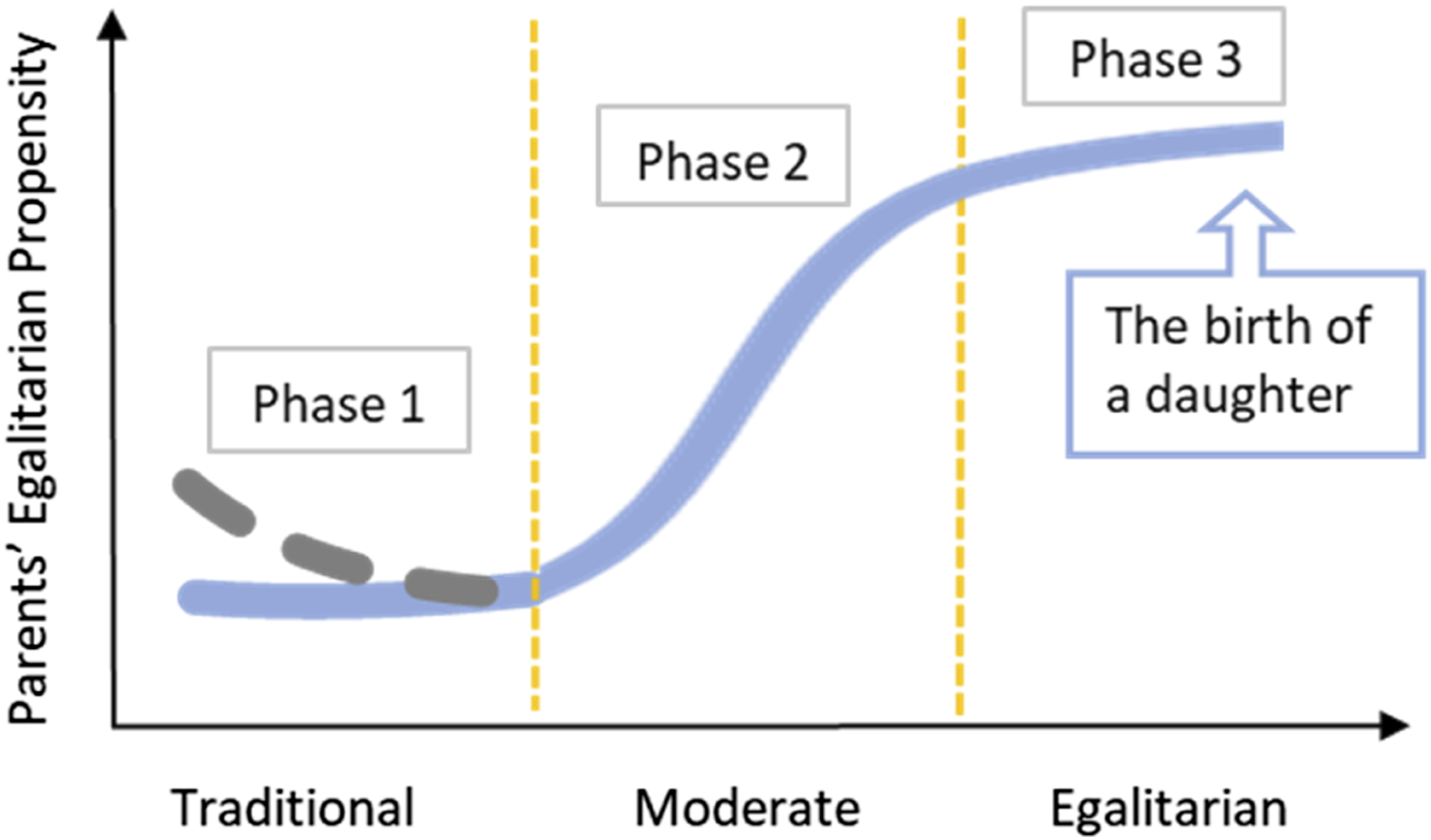
First, in extremely gender-unequal societies, raising a girl may not make parents develop a desire to change it (presented by the mostly horizontal solid line in Phase 1). From the exposure-based perspective, these parents’ prior exposure to gender egalitarianism is limited, and the increase caused by daughters may not be sufficient to overcome inertia and make a difference. From the interest-based perspective, for those in highly unequal gender contexts, traditional gender norms are preservative and might not be considered harmful for daughters. An extreme instance is that parents would even become more traditional after having daughters because they believe that traditional gender roles protect their daughter or because they do not want to exhibit an oppositional ideology against daughters’ status quo and to reduce cognitive dissonance, like the case in Japan (Kamo & Warner, 1997). Thus, in societies where significant gender inequality already exists, the birth of a daughter may prompt parents to become less gender-egalitarian (denoted in a dotted downward line in Phase 1).
Second, in more gender-egalitarian societies (Phase 3), I also do not anticipate that the birth of a daughter will affect parents’ gender ideology in a significant way. Since people’s existing acceptance of gender egalitarianism should be high, there is little space left for them to change attitudes further. Thus, for those individuals, the changes brought about by the daughter are marginal (denoted by the mostly horizontal solid line in Phase 3).
Finally, I expect the birth of a daughter to matter the most under conditions where gender ideology is malleable and contested, as shown by the steep vertical solid line in Phase 2. Here, I expect the birth of a daughter to produce more gender-egalitarian attitudes because, in this context, traditional gender role attitudes are being challenged, and universal acceptance of gender egalitarianism has not been established.
Of note is that at either end of this spectrum (Phase 1 or Phase 3), the birth of a daughter is less likely to increase parents’ support for gender egalitarianism, but the underlying mechanisms are different.
Chinese Context as Microcosmic to Test Sensitivity Threshold Hypothesis
Based on existing studies, it is not easy to assess the validity of the Sensitivity Threshold Hypothesis. In a perfect setting, data from countries with varying levels of gender inequality would help us adjudicate these contextual factors. However, at present, that data are not available. It is useful, however, to leverage the complexity of Chinese society to test whether having a daughter predicts different parental gender ideologies in environments of varying levels of gender inequality.
Modernization theory posits that societal development towards industrialization and post-industrialization brings women more educational and occupational opportunities and greater political influence, leading to more gender-egalitarian societies (Inglehart et al., 2003). 2 As a country, China’s progression in modernization enjoys sizeable spatial variation. For example, foreign direct investment is concentrated in eastern coastal provinces/cities such as Shanghai, Jiangsu, and Guangdong, and these three areas contributed more than 60% of total foreign trade in 2000 (Huang & Dennis Wei, 2016; Kanbur & Zhang, 2005). Modernization’s demand for a labor force has pulled more women into paid jobs, increasing women’s status and weakening patriarchal ideology (Jackson, 1998). Data collected in 2010 suggested that in Shanghai, one of the most developed areas in China, married men’s average time spent on domestic labor was about 1 hour higher than in the rest of China (Jia, 2014). Therefore, China’s social development/modernization disparities across regions of the country are associated with different levels of acceptance of gender equality. As such, this variation provides a potential tool for examining how social context shapes the relationship between having daughters and parents’ gender ideology.
In addition to macro-level features of the environment, gender and education as individual factors can also moderate the association between having a daughter and gender ideology by impacting parents’ prior exposure and interests. Thus, I also assess whether the association differs by parent’s gender and education.
In the following section, I will use nationally representative data from China to examine if having more daughters predicts a more egalitarian gender ideology for parents in China and whether the association, if any, varies for people in different social contexts and positions.
Methods
Data
The data used in this analysis are drawn from the available years of the China General Social Survey (CGSS) that included measures of gender ideology −2010, 2012, 2013, 2015, and 2017. CGSS employed a three-stage stratified sampling design. The primary sample units (PSU) are county-level units. The secondary sample units (SSU) are community-level units (villages in rural areas or neighborhoods in urban areas). In each selected SSU, 25 households (tertiary sample units) are sampled with the probability proportional to size (PPS) method. In each selected household, adults aged 18 and above were sampled with a Kish grid table with pre-assigned random numbers. Each wave of CGSS data contained information for about 11,000 individual respondents collected via face-to-face interviews. 3 After listwise deletion on childfree respondents or those without a valid value on variables included, a sample of 42,861 respondents was analyzed in this study.
Measures
The outcome variable is gender ideology. All five years of data include an identical set of five questions. Responses for each question were coded on a five-point scale (1–strongly disagree; 2–disagree; 3–hard to tell; 4–agree; 5–strongly agree). The five questions are as follows: 1. Men put career first. Women put family first. 2. Men are naturally more capable than women. 3. A good husband is better than a good job for women. 4. When the economy is down, female employees should be laid off first. 5. Husband and wife should share housework equally.
I operationalize gender ideology (GI) using a continuous variable summarizing respondents’ degree of agreement with the five separate statements. The answer to item 5 is reversed, thus ensuring that larger values represent more traditional ideas before generating the GI variable. For an easier interpretation, I rescale the GI variable to range from 0 (most traditional attitudes) to 100 (most egalitarian attitudes).
The core independent variable is the sex composition of children measured by the proportion of daughters (the number of daughters divided by the number of children). The value of this variable ranges from 0 to 1. Although this method of operationalizing a child’s gender is just one of the many possible approaches and might not fully capture certain family dynamics, such as the birth order among children, it is straightforward to interpret, allows for comparisons across family sizes, and avoids subjective categorizations.
I used province-level means of the gender ideology variable as the measure of gender inequality context. Provincial-level administrative divisions (hereinafter provinces) were sorted and categorized into three groups with roughly equal sample sizes. 4 I acknowledge that this proxy is an exploratory measure and has limitations. Nevertheless, it helps to identify varied cultural environments where parents perceive and interpret changes brought about by raising a daughter, which speaks to two theories I discussed—interest- and exposure-based perspectives.
Income is the natural logarithm of annual income. Higher education is binary (1 = received higher education, 0 = high school or less). 5 SES (socioeconomic status) is continuous variable generated through the principal component factor method from three variables: respondents’ education, income, and Communist Party of China membership. 6 After 0-1 standardization, the value range is 0–100. For models examining the moderating effect of higher education, I used Communist Party of China membership and income variables; for other models, I used the SES index variable. Other control variables include age, gender, total number of children, hukou (rural = 1, urban = 0), danwei, 7 and year of data.
Analytic Strategy
First, I used ordinary least squares (OLS) regression to estimate the effect of sex composition on parental gender ideology. Second, I conducted separate regression analyses for respondents from different gender inequality cultural environments to test whether the association between the sex composition of children and gender ideology varies across levels of gender inequality. Then, I run separate regression models for each gender and for people with higher education and those without. Last, I used the Seemingly Unrelated Estimation test 8 to examine whether there is a significant difference in coefficients for the core independent variable, the sex composition of children, across groups after considering the possible correlation of error terms among models. 9
Results
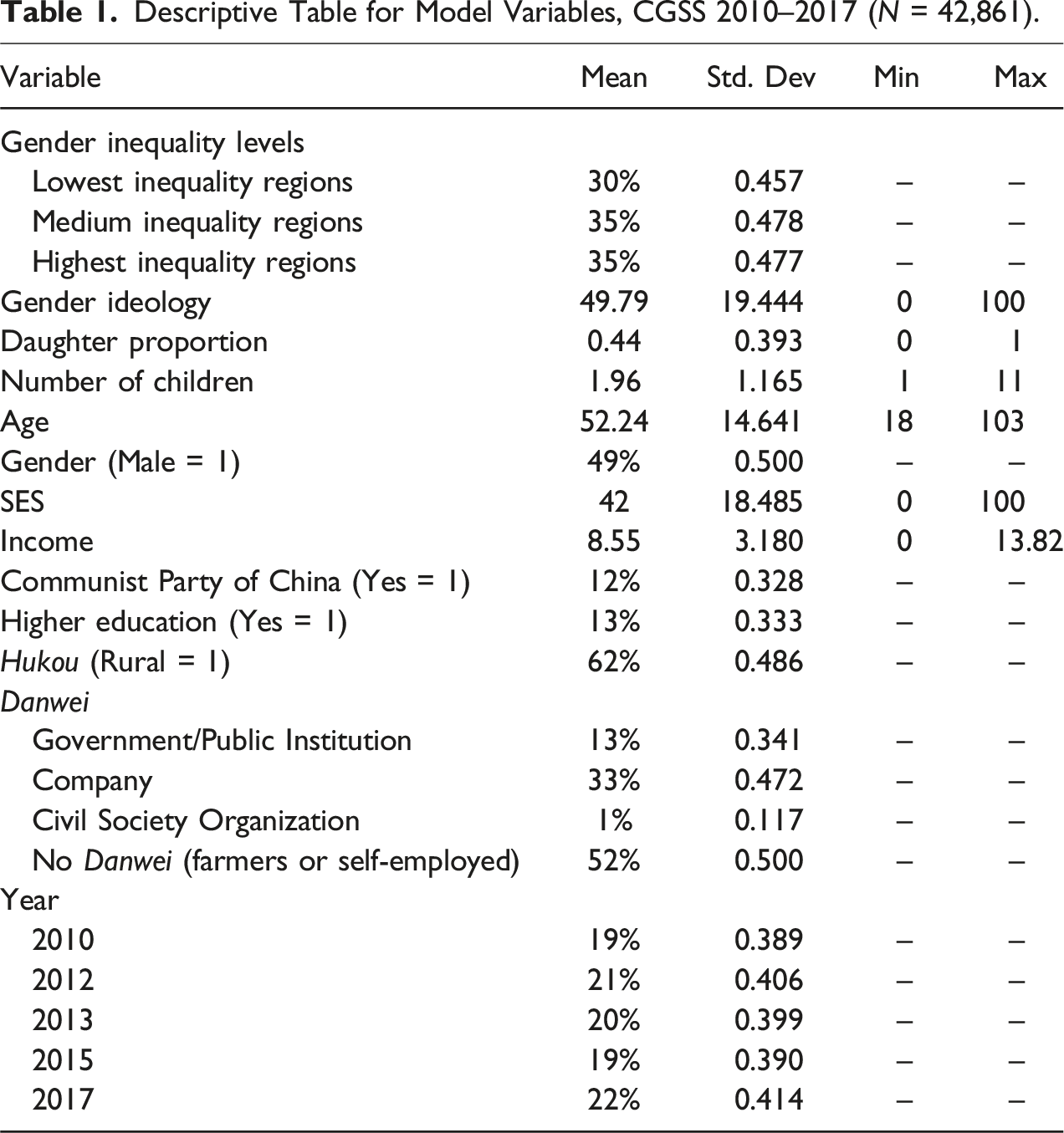
Descriptive Table for Model Variables, CGSS 2010–2017 (N = 42,861).
Predictors of GI, Separate OLS Regression by Gender Inequality Level, CGSS 2010–2017 (China).
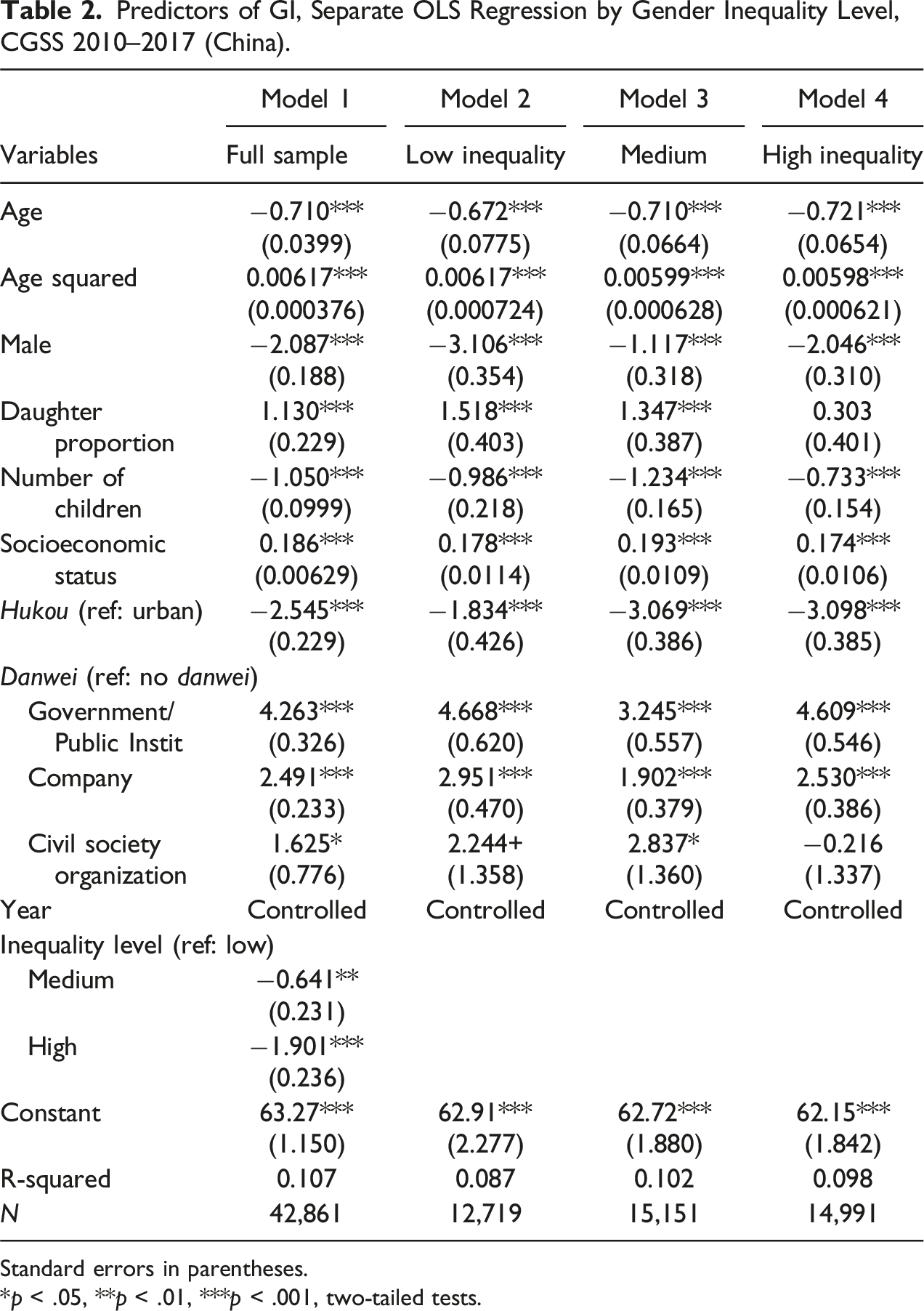
Standard errors in parentheses.
*p < .05, **p < .01, ***p < .001, two-tailed tests.
Comparing Coefficients Among Models Using Seemingly Unrelated Estimation Test (Levels of Gender Inequality).
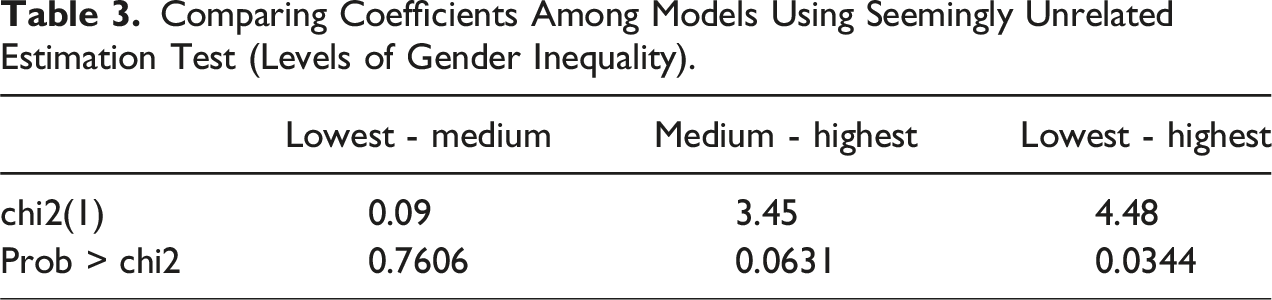
However, this does not mean that the Sensitivity Threshold Hypothesis is not valid. The case might be that in China, many people still hold very traditional views towards gender roles. Those who exhibited a higher level of support for egalitarianism compared to the rest of the respondents do not necessarily have a very strong attachment to gender egalitarianism per se; they are still in the middle range of the gender ideology spectrum. This suggests that the lower inequality groups are in Phase 2 and have not reached Phase 3, where the changes brought by daughters should become marginal.
Predictors of GI, Separate OLS Regression by Gender and Higher Education, CGSS 2010–2017 (China).
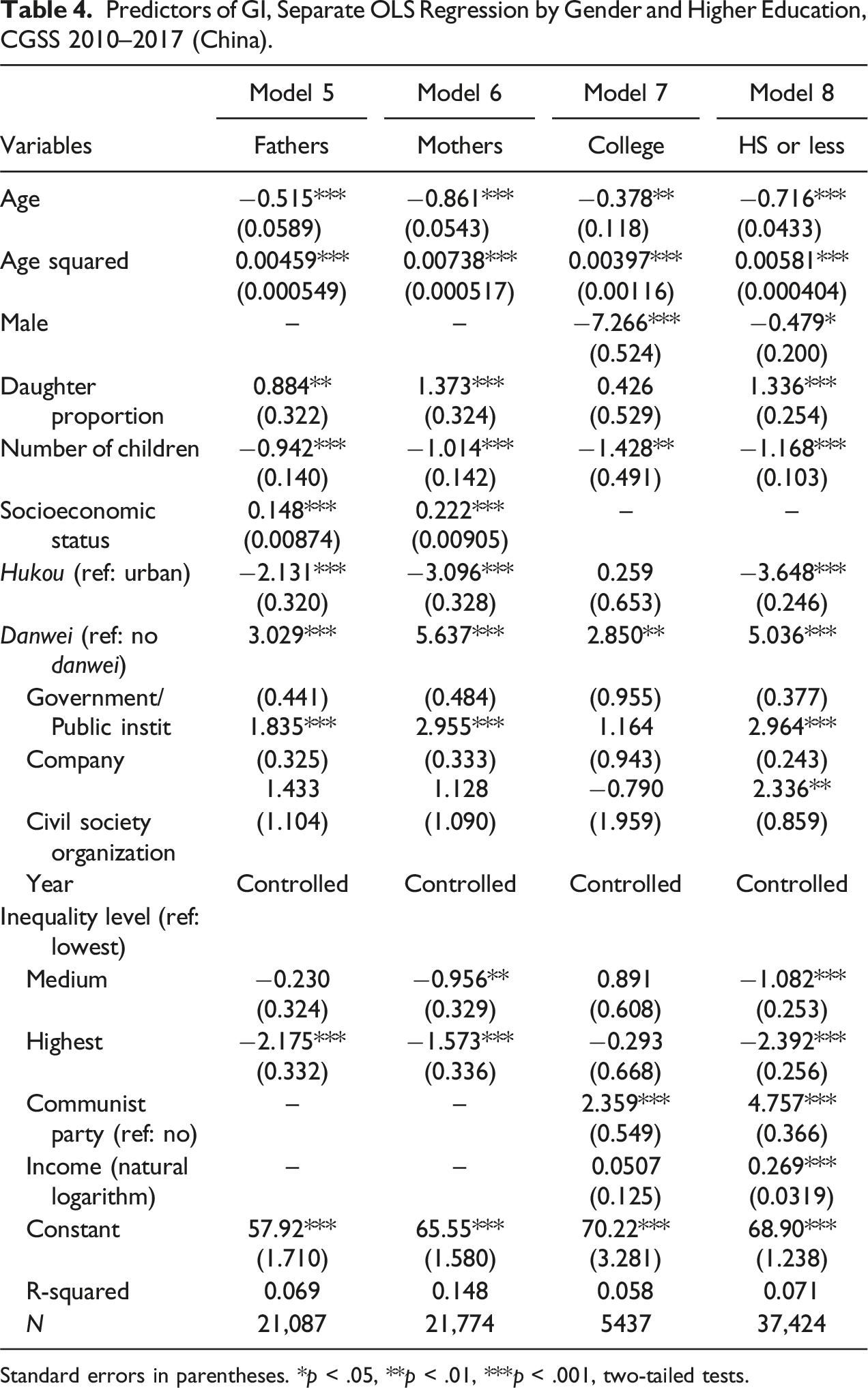
Standard errors in parentheses. *p < .05, **p < .01, ***p < .001, two-tailed tests.
Comparing Coefficients Among Models Using Seemingly Unrelated Estimation Tests (Gender and Higher Education).
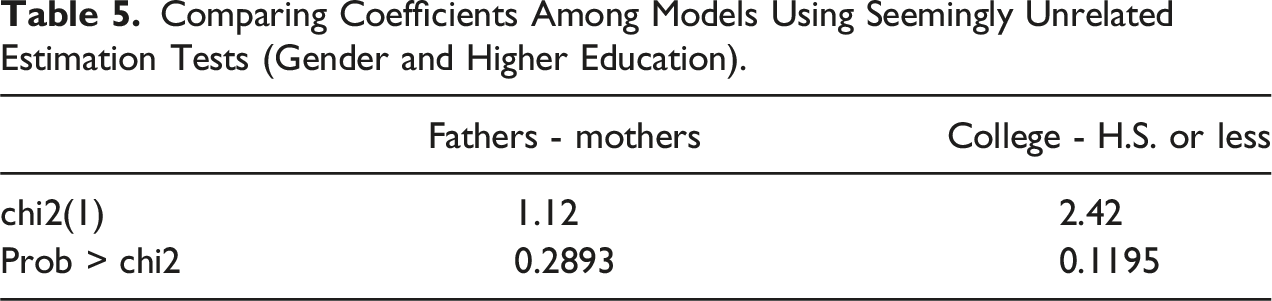
Model 7 and Model 8 examine the association for college graduates and those with less education. The coefficient for daughter proportion is significantly positive for the less education group (Model 8) but not for the higher education group (Model 7). However, the SUEST indicates no difference after adjusting the error term correlation.
Conclusion and Discussion
Conventional wisdom usually assumes that the arrival of a child is often linked to more traditional gender divisions (Morgan & Waite, 1987; Perales et al., 2018). However, such association might be conditional on the family dynamic and social contexts. In this study, I focused on the sex composition of children and used macro-level (gender inequality) and individual-level measures (gender and educational experience) as indicators of contextual backgrounds. I introduced the Sensitivity Threshold Hypothesis and proposed that contexts shape individual previous gender role attitudes, making certain social groups less likely to experience a substantial liberal change after having a daughter. The empirical results showed that in China, a higher proportion of daughters is associated with a more egalitarian gender ideology for both mothers and fathers. However, the association is not significant for parents living in regions with high levels of gender inequality.
The results from regions within China supported the Sensitivity Threshold Hypothesis that inequality level could moderate the strength of the association between having daughters and gender egalitarianism. This is in align with some of the previous research where scholars found that parents in Japan—a country with large gender inequality according to the World Economic Forum’s Global Gender Gap Report 2024 12 —did not become more liberal after having daughters. Instead, they supported the traditional gender division of labor (Kamo & Warner, 1997). In other words, Japanese parental gender ideology was insensitive to having daughters, and the entrenched gender gaps even pushed them toward traditionalism, the opposite of liberalism. In contrast, the studies of US, Canada, and the UK—countries exhibiting much better performance than Japan in promoting gender equality—showed that the parents of daughters in these three countries became more liberal than the parents of sons after the birth of the child (Borrell-Porta et al., 2019; Shafer & Malhotra, 2011; Warner, 1991).
It is worth mentioning that China’s overall gender gap is also large according to the aforementioned Gender Gap Report, which, from a holistic view, means that there should be a null or a negative association between parenting a daughter and gender egalitarianism, like in Japan. 13 However, as noted above, sizeable within-country heterogeneity necessitates a detailed examination of Chinese society; an overall gender gap score might not necessarily predict how the Sensitivity Threshold Hypothesis plays out in the relationship between Chinese parents’ ideology and the gender of the child. More importantly, gender inequality environments should not be viewed as an absolute and static background. Instead, individuals’ perception of gender inequality is based on their reference frame that involves both the past and the present. China has been experiencing rapid modernization in a shorter period compared to other countries. Although the current gender inequality in China is still severe, women’s status has improved significantly, and many traditional gender norms are challenged compared to the previous generations. It may be that fast social change also produces a larger space to negotiate what behavior is appropriate for each gender. Thus, daughters’ birth tends to make Chinese parents more supportive of gender egalitarianism, a pattern similar to that in the US and other countries with a smaller gender gap.
This study also has some unsettled issues. We should be cautious in interpreting the results; the positive association between daughters and egalitarianism is the ultimate product of multiple dynamics. At least two individual-level mechanisms are at play—(a) the experience of raising a daughter makes parents more egalitarian, and (b) more egalitarian parents tend to raise more daughters. For example, when couples with “son preference” do not have at least one son among their present children, they tend to give birth to more children, known as “male preferred stopping rules” (Filmer et al., 2009). The analysis of cross-sectional data in this paper is subject to estimation bias due to such differential fertility choices where parents’ traits affect the sex composition of children. However, in addition to introduction of the covariates that are believed to be associated with the likelihood of manipulating the sex composition of their children, the separate regressions I employed to examine contextual differences provided some leverage on this issue. The exposure- and interest-based perspectives suggest that individual attitudes are subject to change and less traditional environment promotes gender egalitarianism. Thus, if those living in more traditional gender ideology areas, meaning more likely to have son preference, had a stronger association between having daughters and egalitarian gender ideology, we will not be able to distinguish whether the stronger association is due to “child-to-parent” or “parent-to-child” influences because both directions point to the same stronger association. However, Model 4 suggests no significant association between sex composition and gender ideology in regions with more severe gender inequality. Therefore, we have some evidence supporting “child-to-parent” impact.
Going beyond the focus on children’s bottom–up impact on parents and its causal inference issues, the stronger positive association itself (no matter if it is pure causality) in provinces with lower levels of gender inequality has significant implications—it urges attention to the uneven distribution of motivations and barriers towards gender equality within China. The association we observed suggests a dividing family gender ideology environment where daughters are more likely to live with egalitarian parents. At the same time, sons are more likely to have parents with traditional gender ideology in support of men’s privileged role. Such difference is more significant for areas where the cultural environment is more liberal regarding each gender’s appropriate roles. This may help to explain a series of questions regarding parenthood, family dynamics, and marriage formation. For example, are men with more traditional parents less likely to resonate with women with egalitarian family environments? Does it partially cause the decline in the marriage rate or postponing of the first marriage?
The gender of the child is essential for understanding how children affect parents (Warner & Steel, 1999). Race and class are assigned to the child with the same attributes as the parents. Middle- and upper-class parents raise children who live in favorable environments, and African Americans cultivate their kids who are also identified as Black. However, the gender of a child can hardly be predicted by any parental characteristics, 14 and therefore, it offers a unique window for examining how the parents’ lived experiences, belief systems, and behaviors are influenced by the child. This study examined the role that the gender of the child plays in differentiating parents’ gender ideology, which might shed light on future research to put more emphasis on other characteristics of children and, furthermore, their agency in analyzing dynamics within the family and beyond.
Although the data analyzed are from one country, the patterns that emerged across various regions of China offer primitive predictions when studying other societies. In this regard, the Sensitivity Threshold Hypothesis should be used more as an ideal type than an empirical scheme. The way that I differentiated gender inequality contexts in China, relying on the province-level mean values and balanced subgroup sizes, is one of the many possible methods and is subject to specific cultures and structures. Undoubtedly, gender inequality takes the form of a continuum rather than separated points with clear boundaries. Thus, it is hard to determine the exact threshold points where the association between having a daughter and gender ideology changes. Devising more measurements and proxies for contextual situations would help us better adjudicate the validity of my findings. Nevertheless, the framework proposed here is still valuable in predicting different patterns for how daughters matter between highly gender-unequal and gender-egalitarian contexts. For example, the Sensitivity Threshold Hypothesis points to a marginal or no liberalizing effect of daughters in gender-egalitarian countries, such as Sweden and Iceland, and a marginal or even negative impact in countries with significant gender gaps, such as Iraq and Afghanistan. Furthermore, by bringing cultural features into the analytic framework, this research extended the interest- and exposure-based theories from individual characteristics to structural factors, highlighting the premise that the formation of attitudes is a product of dynamic interaction between social positions associated with varied experiences and social contexts where people interpret and respond to specific life-course events.
Supplemental Material
Supplemental Material - Child’s Gender, Parents’ Gender Ideology: Association and Contextual Variation in China
Supplemental Material for Child’s Gender, Parents’ Gender Ideology: Association and Contextual Variation in China by Rui Cao in Journal of Family Issues.
Footnotes
Acknowledgments
I would like to express my deepest gratitude to Professors Douglas Downey, Claudia Buchmann, and Rin Reczek for their invaluable guidance and unwavering support throughout the development of this manuscript. I also wish to acknowledge a heartfelt source of inspiration: a conversation with my father ten years ago, which sparked the initial idea for this research. His wisdom and perspective have remained with me and continue to inspire my academic journey.
Declaration of Conflicting Interests
The author(s) declared no potential conflicts of interest with respect to the research, authorship, and/or publication of this article.
Funding
The author(s) received no financial support for the research, authorship, and/or publication of this article.
Ethical Statement

Data Availability Statement
Supplemental Material
Supplemental material for this article is available online.
Notes
References
Supplementary Material
Please find the following supplemental material available below.
For Open Access articles published under a Creative Commons License, all supplemental material carries the same license as the article it is associated with.
For non-Open Access articles published, all supplemental material carries a non-exclusive license, and permission requests for re-use of supplemental material or any part of supplemental material shall be sent directly to the copyright owner as specified in the copyright notice associated with the article.
