







Abstract
Active-duty servicewomen’s experiences of motherhood provide an important window into the impact of DOD family leave policies, as servicewomen are expected to meet gendered expectations attached to mothering and military service, which negatively impacts career longevity and job performance. Considering the stakes of work-family conflicts and social reach of the armed forces, servicewomen’s experiences of work-family conflict warrant further investigation. Accordingly, 21 semi-structured interviews with active-duty mothers from the Marines (7) and Air Force (14) were conducted. Interviews were analyzed using thematic analysis. Family systems and organizational culture theories structured analyses. Participant accounts were organized into three themes: Childcare Woes, Inconsistent Leadership, and Policy Solutions. Childcare issues were a pressing concern for all participants, who described three work-family conflicts related to childcare. To navigate work-family conflicts in their male-dominated profession, participants enacted a range of strategies we termed military motherhood. Study implications for policy and research are discussed.
Introduction
The U.S. Department of Defense (DOD, 2021) is the world’s largest employer, with nearly 2.9 million employees stationed globally. Approximately, 17.3% of DOD’s employees are active-duty servicewomen (Department of Defense [DOD], 2021). The distribution of women troops varies across branches of the military. For example, the U.S. Air Force (USAF) has the highest concentration of women service members (21.3%), while the U.S. Marine Corps (USMC) has the lowest (9.1%). Despite the increasing diversity of the armed forces, the gender composition of the military creates unique policy challenges for servicewomen, particularly mothers, within its ranks. It is estimated that 35% of all active-duty service members have children, a third of whom are under the age of five (DOD, 2021), making family leave and childcare policies an important element of military service.
Like civilians, military personnel face challenges finding safe, high-quality, and consistent childcare (McFarlane, 2021). And like civilians, when childcare is inconsistent, care-giving duties default to mothers, a fact of family life in the military due to DOD policies conceptualizing mothers as primary caregivers (McFarlane, 2021). Because military mothers’ work-family conflicts have implications for servicewomen’s families, national defense, and a continuation in their careers (McFarlane, 2021; Williamson et al., 2021), a deeper investigation into military motherhood is warranted. Currently needed, is research highlighting how existing family leave and childcare policies impact the stability of military mothers, their families, and the armed forces. Accordingly, the current paper presents the findings of a semi-structured interview study of 21 servicewomen with children aged five and younger, seven from USMC and 14 from USAF. Schein (1983) model of organizational culture and Yoshimura and Galvin’s (2018) articulation of family systems theory provided broader theoretical frameworks for the study. The purpose of this project was to explore how servicewomen with children make meaning of the military’s family-leave and childcare policies with the purpose of better understanding their experiences of military motherhood.
Military Family Related Policies
Historically, the U.S. military has been a pioneer when it comes to family-friendly policies. To convince reluctant full-time mothers to leave their homes for the factories during World War II, the U.S. government provided subsidize childcare for nearly 600,000 children (Little, 2021). While federally run childcare centers were dismantled at the end of the second World War, a decision reflecting a gendered cultural preference for women to be in traditional caregiving roles, through its support of working mothers during war time, the U.S. government developed the framework that would later become organized daycare (Little, 2021). In the decades since the end of World War II, the number of servicewomen has increased and mother’s roles in families have evolved, but the need for safe, affordable, and consistent childcare has only increased, despite the fact there is only limited availability of on-base care. To adapt, the military has developed a broader suite family-related policies to support active-duty troops. These policies, and the broader cultural norms that inform them, shape servicewomen’s experiences of motherhood from planning pregnancy to child-rearing on base. Most relevant to the current study are military policies regarding new motherhood and childcare.
Servicewomen report that when pregnant they were perceived as ill or injured and their pregnancy was thought of as risky, erroneous beliefs shaped by male leaders’ lack of familiarity with female bodies (Cowan & Bochantin, 2009; McFarlane, 2021). Ill-timed or unintended pregnancy can reflect negatively on female service members, as military leaders can hold beliefs that pregnancy is a way for them to dodge work (McFarlane, 2021). To assuage leaders’ fears, military mothers have reported pressures to hyper-plan pregnancies to meet their unit’s needs, in some cases, timing pregnancies such that they do not conflict with planned deployments or work exercises (Cowan & Bochantin, 2009). For postpartum mothers, the DOD provides 12 weeks of job-protected paid parental leave in addition to their normal paid leave accrued annually. The Family and Medical Leave Act of 1993 currently only requires that employers who meet a predetermined list of prerequisites (e.g. have more than 50 employees) are required to provide 12 weeks of job-protected leave but are not required by federal law to pay employees during their leave of absence (Family and Medical Leave Act, 1993).
For postpartum women returning to work, body composition standards and inadequate access to breast pumping rooms create added issues. Body composition standards dictate the acceptable weight and body fat percentage for service members (Potter et al., 2022). Female bodies are generally fattier and less muscular than their male counterparts and the acceptable body composition for servicewomen reflects these realities (Potter et al., 2022). But for postpartum women who may be carrying extra weight or have lost muscle tone, they face pressures from branch leaders to return to military standards; in some cases being encouraged to rapidly and unhealthily lose weight (McFarlane, 2021). Compounding these issues, nursing mothers often report limited access to facilities needed to pump and safely preserve breastmilk (McFarlane, 2021). Although the military is not a standard workplace, life on base is still subject to legislation like the Pregnancy Discrimination Act (1978), or the Pregnant Worker Fairness (2022), which require employers to providing nursing mothers with appropriate facilities and supports as they navigate new motherhood (National Women’s Law Center [NWLC], 2024). As young children age, military mothers face additional concerns.
The armed forces require the use of family care plans (FCP), which tasks active-duty parents to designate a primary and secondary caregiver (U.S. Department of the Navy, 2018; U.S. Department of the Air Force, 2019). For families where only one spouse is active-duty, primary status almost exclusively defaults to the civilian, veteran, or inactive parent, but for families where both parents are active-duty, primary caregiver status often defaults to mothers (U.S. Department of the Navy, 2018; U.S. Department of the Air Force, 2019; Wadsworth & Southwell, 2011). Military members are required to designate an emergency caregiver, a non-military parent or other trusted non-military support like a family friend to respond emergencies like rapid deployment or unplanned military exercises (U.S. Department of the Navy, 2018; U.S. Department of the Air Force, 2019; Wadsworth & Southwell, 2011). While designed for flexibility, emergency provisions of FCPs can be misused with some service members reporting leaders invoked the emergency clause of FCPs to address disruptions that fall outside of emergency classifications (Wadsworth & Southwell, 2011). It is important to note that there is no DOD-wide family care plan policy, meaning FCPs are implemented and overseen by each individual branch of service making their implementation and oversight difficult to track (U.S. Department of the Navy, 2018; U.S. Department of the Air Force, 2019).
Collectively, these policies provide a foundational framework through which working parents can infer the dominant family and cultural values of the DOD (Schein, 1983). Conflicts between family formation and work duties are constructed through policy and culture, constructed conflict between women’s roles as mothers and service members ultimately impacts women’s decisions to remain enlisted, with many servicewomen choosing to step-away from their careers to support their families (Kelley et al., 2001). For servicewomen who remain enlisted, they invoke a range of professional strategies to demonstrate their commitment to their career.
Navigating Active-Duty Work-Family Conflict
Work-family conflict refers to the tension that arises when the demands of one role interfere with the ability to fulfill the other role effectively (Brumley, 2018; Trzebiatowski & Triana, 2020). For military mothers, this conflict is often amplified by the unique demands of military service, including frequent deployments, relocations, and the pressures of military duty. The broader social construction of childrearing is gendered, a feminine social role typically defaulting to mothers. Traditional motherhood is comprised of accessible emotionality, tenderness, a mastery of domestic affairs, and a limited work outside the home (Lankes, 2022; Shinall, 2018; Vuga & Juvan, 2013). Within the military, a traditional conceptualization of motherhood is operative, a complimentary gender role in relation to the hypermasculine culture of the military (Cohen, 2022; Goodman et al., 2013; Shinall, 2018). Yet military women see themselves in a different light, as working women with children serving in an all-volunteer army. The roles of mother and soldier create palpable tensions for working military mothers, observed in the context of the organizational support, or lack of, they receive for mothering.
In most professions, motherhood is a viewed as a disruption to career progression. In the absence of effective policy, professional working mothers have reformulated motherhood to meet the demands of the workplace, enacting “good” working motherhood in the process (Buzzanell et al., 2005). “Good” working motherhood often means bearing the brunt of household, organizational, and caregiving responsibilities along with fulfilling professional roles (Buzzanell et al., 2005; Cowan & Bochantin, 2009). “Good” working mothers organize reliable childcare for their dependents and understand they are unequal partners in their parenting relationships due to the distribution of gendered labor (Buzzanell et al., 2005; Cowan & Bochantin, 2009). In the absence of policy, “good” working motherhood often means women are overcompensating on the job to prove their worth, the product of family responsibility discrimination a form of ongoing workplace discrimination as the result of caregiving duties (North, 2016; Shinall, 2018; Trzebiatowski & Triana, 2020). And despite these inequities, “good” working mothers take pride in their roles as mothers and workers (Buzzanell et al., 2005; Cowan & Bochantin, 2009). Researchers have linked the emotional exhaustion and conflicts with work-life balance to experiences with family responsibility discrimination, which is more frequently reported among female caregivers who are also subjected to gendered expectations of their work (Trzebiatowski & Triana, 2020, p. 25). Trzebiatowski and Triana (2020) state that perceived family responsibility discrimination happens when employees believe that they were denied equitable workplace treatment due to their responsibilities related to the caregiving of children, elderly parents, or disabled children or relatives (p. 15). And North (2016) reminds us, the motherhood dilemma includes the normalization of the perceived impossibility of balancing family and career without professional retribution.
Women in other male-dominated professions like law enforcement face similar workplace discrimination and stereotyping. For example, in policing, caregiving isolates mothers from their colleagues, many of whom see women’s family roles as incompatible with “ideal” work identity—the ability to be flexible when work demands (Cowan & Bochantin, 2009). In male-dominated professions like policing and military, “ideal” work identity hinges on the unspoken assumption that there is a traditional female caregiver to manage responsibilities at home, allowing workers to focus on mission first (Cowan & Bochantin, 2009). Rigid gender constructions of work and family box women into roles their experiences transcend. The current project further interrogates these tensions, exploring in more detail the range of policy concerns and fixes affecting the lives of active-duty military mothers.
Theorizing Military Motherhood
Policy and culture shape worker roles within organizations. Deconstructing military mothers’ experiences of family and career requires theorization of their dual roles as members of organizations and family units. Schein (1983) describes organizational culture as “patterns of basic assumptions which a given groups has invented, discovered, or developed in learning to cope with its problems of external adaptation and internal integration” (pg. 1). Schein (1983) asserts these patterns of thinking have “worked well enough to be considered valid, and therefore are taught to new members as the correct ways to perceive, think, and feel in relation to those problems” (pg. 1–2). Artifacts of the organization (i.e. facilities) and patterned behavior (i.e. work duties) shape the values (i.e. policies) of organizational culture, which then go on to impact basic assumptions about individual roles or how relationships function within the organization (Schein, 1983). Relationships between concepts are bidirectional and their impact is reciprocal (Schein, 1983), therefore studying organizational culture requires a multi-layered approach, examining the underlying assumptions, values, and artifacts upon which a culture is built (Yilmaz, 2014). The military is comprised of numerous branches with their own distinct cultures, situated within a broader military network. The culture of the armed forces relies heavily on stereotypically masculine norms like nationalism, intensive work ethic, a rejection of emotionality, an embrace of hierarchical authority, violence, dominance, and specific forms of caregiving through team building and group cohesion; gendered values upheld by cultural practices and reinforced by the policies of the organization (McFarlane, 2021; Taber, 2013; Vuga & Juvan, 2013; Wadsworth & Southwell, 2011).
Another important facet of organizational culture are the lives of its members, who are the bearers of values, the producers of artifacts, and the stewards of facilities (Schein, 1983). Individual member’s experiences within an organization will differ based on their positionality, which is subject to numerous forces of gender, class, and social roles (Keyton, 2005). Family structures and roles shape an individual’s identity, which they then carry into an organization. Family systems theory views families as interconnected systems in which members within the system influence and are influenced by other members (Yoshimura & Galvin, 2018). A core focus of this theory is that there is a greater emphasis on communication patterns and interactions between members than on individual behaviors. Yoshimura and Galvin (2018) make clear, individuals examined through this lens are viewed in relation to their participation within the whole system and how their behaviors contribute to or detract from the family’s functioning.
By synthesizing Schein (1983) conceptualization of organizations and Yoshimura and Galvin’s (2018) approach to family systems this project is able to interrogates mother’s roles as ideal workers and good working mothers in male-dominated professions. This study examines the efficacy and implications of family leave policies, gendered childcare norms, work roles, and institutional values shaping military motherhood, through the prism of active-duty military mothers experiences and meaning making. Given the broader context for the issue of female retention in the military, especially among new moms (Williamson et al., 2021), the issue of family role discrimination, the transferability of this study to other male-dominated professions, and recent shifts in U.S. military and national family policy, this study aims to add perspective to existing scholarship through the lens of mothers’ experiences of working for of the world’s largest male-dominated professional sectors. Accordingly, this study explores how policies governing family leave and childcare as well as cultural norms that construction women as primary caregivers impact the daily lives of active-duty military mothers in the USMC and USAF. This study is guided by the following research questions. RQ1: How do Department of Defense policies shape female service women’s experiences of motherhood? RQ2: How do active-duty service women make sense of the intersection of working motherhood, organizational culture, and military service?
Method
Participants’ Descriptive Information.
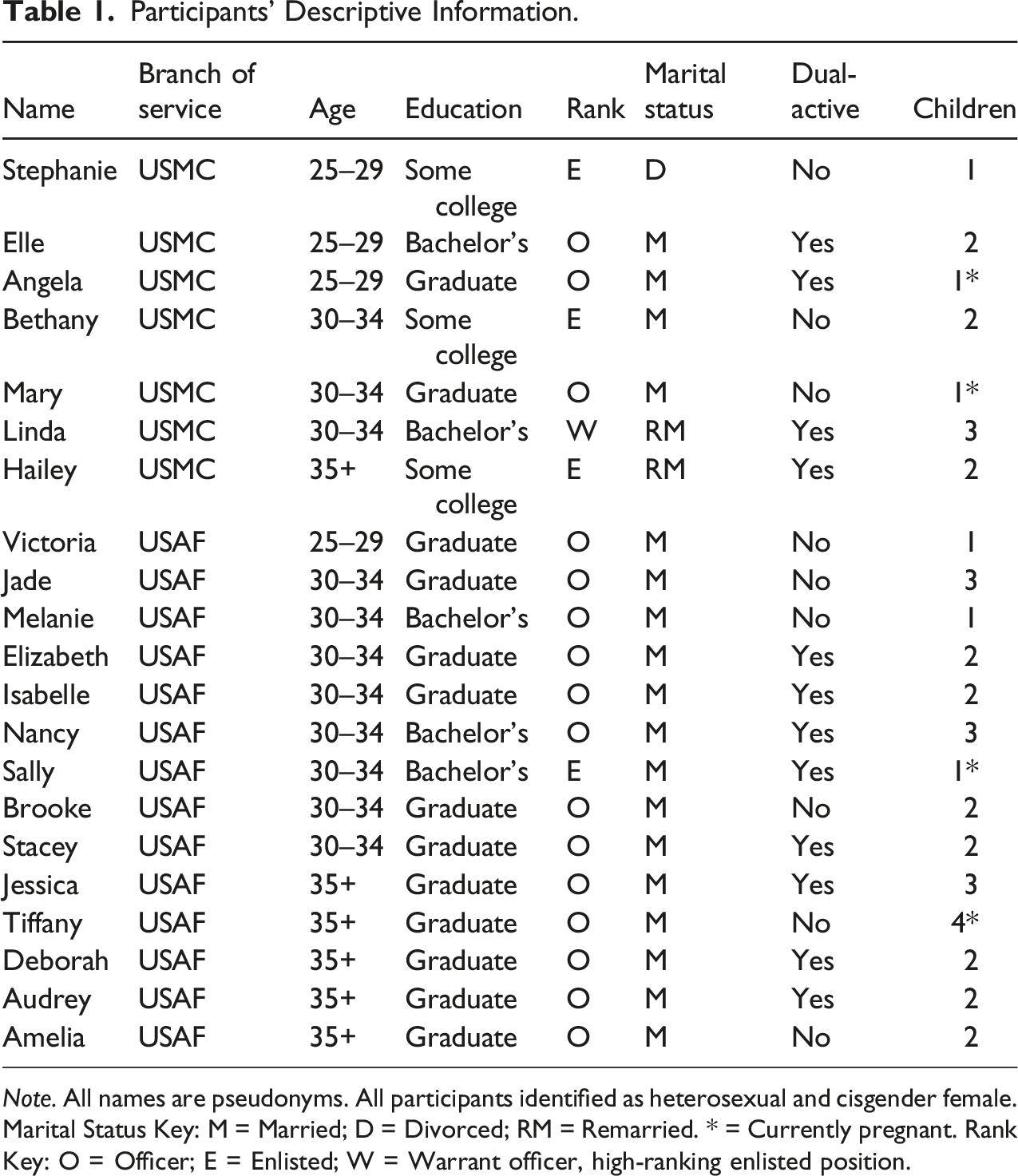
Note. All names are pseudonyms. All participants identified as heterosexual and cisgender female. Marital Status Key: M = Married; D = Divorced; RM = Remarried. * = Currently pregnant. Rank Key: O = Officer; E = Enlisted; W = Warrant officer, high-ranking enlisted position.
Data Collection
Due to COVID-era restrictions on in-person data collection, we were unable to conduct face-to-face interviews. We leveraged these restrictions to recruit a geographically diverse sample of participants that the first author interviewed via Zoom. Interviews were audio and video recorded, with zoom providing the initial transcript, averaging 70 minutes in length. Semi-structured interview questions examined participants’ home life and household demographics, command climate and its impacts on parenthood, and their personal experiences of and thoughts on the military’s family-related policies. Participants were compensated with a $20 Amazon gift card.
Data Analysis
Data were analyzed using a codebook approach to thematic analysis (Braun & Clarke, 2006, 2021). Deductive analyses exploring policy were paired with inductive coding to capture emerging themes, which largely centered on childcare. The first-author led analysis, and the second-author served as a debriefer and mentor. Only audio and its related transcripts were included in analysis. First, raw zoom-transcripts were reviewed to resolve discrepancies between transcripts and audio, redacting identifiable information about participants as part of the process. Second, codes were developed through an open-coding process. By reading and rereading finalized transcripts, the first author began to identify recurring trends in the data. Initial codes were developed and revised over this stage of coding. Third, interview transcripts were coded, and collated by code for further analysis. Fourth, collated coded data were reviewed and initial themes were constructed. Initial themes emerged by examining the topics and questions participants discussed related to childcare burdens. Fifth, themes were named, defined, and finalized. Finally, themes were written up, hence this report.
Reflexivity and Trustworthiness
Reflexivity is the ongoing practice of researchers monitoring and accounting for how their background, positionality, and training impact the qualitative research process (Lindloff & Taylor, 2019). Both authors simultaneously occupied emic, insider of the research community, and etic, outsider, positionalities for this project (Lindloff & Taylor, 2019). As insiders, the first author is a USMC veteran and mother, while the second author has over a decade of experience researching family and gender issues, which enabled us to develop a rigorous plan of research while leveraging knowledge of military culture and policy to inquire about participant experiences. As outsiders, the first author’s novice status as a researcher and the second author’s civilian status tasked us to be deliberate and thorough in our understandings of military mothers’ experiences. To ensure our positionalities did not impact the production of qualitative findings, we enacted a number of strategies, many of which also ensured the trustworthiness of the current study.
Trustworthiness is a metric of scientific rigor in qualitative research, akin to reliability and validity in quantitative work. Trustworthiness is comprised of credibility, the accuracy of analyses; transferability, the applicability of findings to contexts outside the study; confirmability, the grounding of analyses in participants’ constructions; and dependability, the meticulous documenting of the entire research process (Lincoln & Guba, 1985; Means Coleman, 1998). In this project, reflexivity and trustworthiness were achieved through various methods. To ensure credibility, the first author conducted rudimentary member checks throughout and at the end of each interview, which allowed participants to ask questions about the study, elaborate on their answers to interview questions, and challenge the first author’s emerging thoughts about the project as she was collecting data. The first author engaged in peer debriefings by discussing analyses with the second author and MA thesis advising committee. Confirmability was achieved through progressive subjectivity. Authors took four years to conduct, review, analyze, and write-up the data, deeply immersing themselves in study findings. Transferability was achieved through thick description, including a detailed description of the interview setting and nonverbal interactions with participants via Zoom videoconferencing, along with use of direct participant quotes. Finally, dependability was supported through an audit trail, where the first author maintained detailed notes on the study process.
Results
The current study revealed many important factors shaping military motherhood. Servicewomen navigated the complexities of pregnancy, postpartum recovery, and infant care while on active duty. Three themes were identified: Childcare Woes, an inductive theme describing how limited caregiving options impacted women’s ability to parent while on active duty; Inconsistent Leadership, an inductive theme examining how the experiences and background of unit command leaders impacted implementation of DOD family leave policies; and Policy Solutions, a deductive theme summarizing participants’ family leave policy suggestions.
Childcare Woes
Childcare Woes coalesced around participants difficulties accessing reliable on-base childcare, and the impact limited care options had on military mothers’ families, work roles, and broader workplace missions. Participants described the negative impact of the lengthy waitlists and limited operating hours of on-base CDCs [child development center], as well as particular issues accessing childcare for participants in dual-active marriages, especially for those stationed overseas. Elizabeth, Linda, Deborah, and Nancy provided examples.
Waitlists for on-base childcare posed one of the most consistent issues for interviewees. Elizbeth, a USAF officer, explains. I don't know that [I] completely touched on this, but the childcare waitlist right now for CDC use are insane. Even if I was to put my name on the waitlist right now for PCS [permanent change of station] over the summer, by the time I got to whatever base, they're probably still wouldn't be childcare for me, because childcare, they can't—there's such a high turnover rate in the CDC they can't keep it stocked with quality caregivers. So I don't know if you need to throw money at the problem, but the childcare situation for military members is probably one of the biggest stressors especially to dual-mil. (Elizabeth, USAF)
Long waitlists are due to limited funding and high turnover rates in caregivers; factors driving national shortages in childcare more broadly (NWLC, 2022). The national childcare worker shortage was worsened by mass closures of care facilities during COVID, many of which never reopened after stay-at-home orders were lifted (NWLC, 2022). A lack of off-base options for care, make on-base options that much more important, especially for families where both spouses are active-duty military and tied to work on-base.
Elizabeth also identifies how regular military moves impact caregiving. Military families can move every two to three years, disrupting their ability to access family support or establish consistent childcare. PCS moves, and the lack of childcare support that accompanies them, have the potential to impact retention. A 2021 special report on active-duty military women found 66% made a PCS move within the past five years and only 55% want to remain active-duty, with family and children cited as a key factor motivating a servicewoman’s departure (Department of Defense, 2021), highlighting the critical importance of expanding childcare options for military mothers. Even when military mothers could secure on-base childcare, however, participants explained there were still barriers to utilizing it.
CDCs are open during hours that often do not align with military mothers’ working schedules. Linda, a USMC warrant officer, highlighted how most on-base childcare facilities did not account for early morning physical training (PT) sessions, which are a mandatory component of active-duty service. A person with a family, having PT at 5:30 [a.m.] when daycares open at six [a.m.]—like okay, well do you want me to bring my kids…they're like no you got to find a way. So, now I got to pay a nanny to watch it, you know what I mean? (Linda, USMC)
Joining Linda’s concerns, Nancy, a USAF officer, explained the implications of CDC hours for shift workers, which include nurses, military police, and on-base first responders. … And the hours were dependent on aircraft schedules and weather, so it was usually like a 14-hour day. And you had to be there very early in the morning, well before any normal daycare was open and the daycares there, the CDC, and none of the German daycares would be open earlier than 6:30 [a.m.], but oftentimes I would have to be there at 4:30 [a.m.] or four o'clock in the morning. So, the way that we got around, that is, I actually – I literally had to have my sister who had just graduated from college like moved overseas with us in [insert foreign duty station], so that she could watch my daughter while we're doing this. (Nancy, USAF)
Inaccessible hours meant mothers had to pay for off hours care, in addition to CDC costs, or go to extreme lengths to fill gaps in care, all of which pose tremendous additional costs to military families, acute stress as additional care is secured, and disruptions to family and work responsibilities.
Elizabeth and Nancy were both in dual-active marriages, and Nancy was stationed abroad, which introduced added burdens. In our study, servicewomen stationed abroad reported being entirely dependent on the “economy,” a term they used to describe the foreign nationals providing childcare. Participants saw a reliance on foreign nationals for childcare as a potential threat to national security and as ultimately harming their missions abroad. Nancy sidestepped this problem by moving her sister to Germany, but other participants reported being instructed to pursue other equally extreme options. Like Elizabeth and Nancy, Deborah, a USAF officer, was a dual-active military spouse. During her station in Germany, when her child was home sick from daycare, Deborah described being coached to misuse her FCP to remain in her duties. I think my son was sick, the daycare won’t take him…My boss, instead of saying ‘hey can you retroactively take leave for those days’ was like ‘you know you got two free days off of work, maybe we should look at enacting your family care plan.’ And my husband was gone [deployed], I'm in Germany, and like literally to me that meant get rid of your kids and send them back to the States. And I'm like what are you trying to tell me – I was so pissed. I was like I can't believe you said that, that's not what the family care plan is for—the family care plan is, for if you have to leave the country or if you die while deployed, that's what a family care plans for, it is not a you recall me at five in the morning and I can't show up to work with my kids that's not what that's for. (Deborah, USAF)
Service members stationed in Germany have faced numerous challenges in receiving proper family and childcare support, prompting larger discussion in military publications (Riedel, 2022). Like our participants, other service members have discussed the misuse of an FCPs; highlighting how if the abuse of policy is the only option for caring for a sick child, there is clearly a policy and resource gap in on-base childcare in the military (Riedel, 2022). It was unclear from Deborah’s interview how she ultimately resolved this matter, but she did not have to send her child away. In the end the lack of support and directives to misuse her FCP left her feeling vulnerable in the workplace. Linda, Elizabeth, Nancy and Deborah speak for many mothers in the study, making clear military childcare is strained and inefficient, particularly for dual-active families or those stationed abroad. As Deborah demonstrated, command leaders play an important role in family leave and childcare policies; an experience shared by others, necessitating its own theme.
Inconsistent Leadership
Because the implementation of family leave and childcare policies can vary by branch and direct supervisors control work schedules and performance expectations, participants viewed a command leader’s personal experience with parenting as a critical factor impacting military motherhood. Angela, Brooke, and Jade offer examples. Angela, a USMC officer, spoke about how leaders with stay-at-home wives did not understand the struggles of servicewomen with working partners, let alone women like her in dual-active military marriages, contributing to a work-family conflict born of family-structure, professional rank, and military branch. “…They [command leaders] have said that my wife holds down the home front, I can do what I need to do [at] work without needing to worry about any of that at all. And definitely, like sometimes schedules are sometimes set for that expectation where somebody else is doing the childcare drop offs pickups. After care and after hours is not always a consideration. (Angela, USMC)
By invoking gendered constructions of family roles in the workplace, Angela’s supervisor highlights gaps in his own understandings of parenting. The responsibilities, disruptions, and flexibility required for parenting young children were invisible to many participants’ supervisors, particularly among those whose careers were made possible by spouses who could “hold down the home front”. When supervisors did have competence in family matters, however, participants received greater support in their work roles. Brooke, a USAF officer, describes how her supervisor, who had an enlisted spouse, was able to modify requirements so she could care for her children while balancing work responsibilities. My supervisor is military, he's a [officer rank]. His wife is also [officer rank] so they're doing well, and they have an 11-year-old daughter. So, he understands. He thinks he understands like parenting and children, and things just randomly like popping up and happening and, like I said, that he's been very good and easy going about taking care of [family] … I don’t have a hard like set time that I have to be in. He’s like as long as you are getting like your job done then like I don’t necessarily care. (Brooke, USAF)
In addition to military leaders’ personal experiences, a servicewoman’s specific work assignment was relevant. For example, when she was breastfeeding, Jade’s supervisors allowed her to schedule lactation “breaks” during her shift, going so far as to allow her to bring her baby to work. As an on-base labor and delivery nurse holding an officer rank in the USAF, she felt that her role as a medical provider, and her supervisors’ experiences supporting new moms, likely made a difference in her work assignment as she returned from leave. People are at least understanding, like I remember when I went back to work… I was breastfeeding, and I think she like didn't eat for like a couple hours because, like the first day that I went back my bosses [said] bring her in it's fine like there's nothing on the floor … yeah, everyone was understanding because that's what we do, like that is our job anyways as nurses. I teach people how to breastfeed all the time, so there's this general like education within our unit specifically that was helpful to me. (Jade, USAF)
As Angela, Brooke, and Jade make clear, in the absence of consistent policy, a supervisors family structure and servicewoman’s professional duties played an outsized role in shaping participants ability to balance work commitments with childcare. Differences in Angela, Brooke, and Jade experiences likely reflect cultural differences among branches and knowledge discrepancies by job role. Compared to the USAF, the USMC has the lowest percentage of female troops (DOD, 2021), and is steeped in culture of elite hypermasculinity, which informs who rises through the ranks and reinforces a particular archetype of military success, which is partly rooted in a soldier’s family structure, reliant on a stay-at-home partner (McFarlane, 2021). Additionally, no one is likely to be more understanding of the needs of new mothers than the medical personnel working in labor and delivery. And while it is wonderful Brooke and Jade had supportive command leaders, for women like Angela, a supervisor’s personal judgments should not create barriers for military mother’s experiences of childrearing, highlighting a critical area for policy reform.
Policy Solutions
Finally, as a closing interview question, participants were asked, “What changes to USMC/USAF family-related policies, if anything, would impact your decision to stay on active duty?” This deductive theme explores participants suggestions for family-leave and childcare policy changes that could improve the retention of servicewomen in the armed forces. Participants consistently offered three policy changes. The first policy change related to expanding childcare options. Whether it is through increases in the number of caregivers at the CDC or fully funded alternatives to on-base care, participants felt more options were critical. Recall, Elizabeth saw the fundamental issue with on-base childcare as “not enough caregivers” suggesting higher-ups needed to “throw money at the problem”. Below, Elizabeth expands on her earlier comments. I don't know if you need to increase the salary, increase the timeline for the hiring process, because a lot of times you’ll have people submit, but by the time they get hired and get through the interview process they've already gone somewhere else, because they can't sit around and wait for a job… (Elizabeth, USAF).
When Elizabeth refers to “increasing the timeline for the hiring” she is referring to “to increase[ing] the rapidity of hiring”, quickening the speed by which caregivers are hired. Elizabeth highlights how competition with civilian childcare centers for quality caregivers places the armed forces at a disadvantage due to slow hiring speeds and low salaries; meaning, people who qualify to work on-base are getting poached by offsite centers due to the military’s hiring process and compensation. Other participants expanded on Elizabeth’s suggestion, offering that the expenses accrued to secure off-base providers should be fully covered by the DOD, which only provides subsidized funds for offsite care in specific circumstances (Military Childcare.com, 2025).
A second dimension of policy reform relates to leadership. Because enforcement of policies was on branch by branch, commander by commander basis, participants saw the inclusion of more women and parents in leadership as one potential path to greater support for active-duty parents. Mary, a USMC officer, offered the following: I think it's not so much a policy change but examples. There's not many female leaders right now that you see, and if they are, they're not working moms, you don't have children. So I think having more examples [of working moms] in senior ranks. You know, if there's arguments against it, I’m not saying that somebody who's unqualified [should] be in that position but I’m saying that there's just not really many examples of having women with children in higher ranking positions that people can look up to and try to emulate and understand. Because I think that—like from my own experience having a kid—understanding, everything that that takes makes you a more empathetic leader and I think that just needs to be pushed down from the top of all of them (Mary, USMC).
While female leaders were not the only parents in leadership or the only leaders that demonstrated empathy or compassion for active-duty parents, Mary highlights the importance of diversity in leadership to ensure active-duty mothers receive the supports they need. Mary backs-off from calling her suggestions policy, but hiring and promotion decisions are a feature of policy; mentorship for mothers can be mandated by policy. Both of Mary’s ideas, however, are individual solutions to address gaps created by sound policy, which may further inequities for working moms.
A final policy suggestion concerned family leave policies regarding when and how long birthing parents take leave. Participants wanted leave policies extended, phased in job duties, and access to parental leave for non-birthing parents who were also active-duty. The rigidity of current military family leave policy, which at the time of our study required servicewomen to return to full job duties after three months of leave, is driving servicewomen from active-duty roles and subjecting them to unnecessary injuries while on the job, demonstrating the importance of reform. I don't know, maybe extended maternity or parental leave policies, I think. Or giving the option to some kind of like part time thing for your first year postpartum to where like maybe you're getting half the pay but you're only working part time. I don't know. Like I was talking to one of my friends and she recently gave birth and she was saying, like she's actually now transitioning to the reserves, because she just can't make it work—you know, being a full-time mom and then also being at the duties. So I think, having just more flexibility in that sense to where—like just I guess having more options than coming back to work full time in three months or getting out just having some like some other option more (Melanie, USAF).
In addition to Melanie’s comments, other participants suggested that birthing parents receive up to six months of paid leave and part-time working schedules for the six-months following a new mother’s return to work, but a longer path of return to active-duty has other implications for new moms. Tiffany, a USAF officer, spoke about her experiences with postpartum recovery. And you know, I was younger, of course, and like in better shape, but we also used to have to take the fitness test after six months as opposed to now it's a year. And you know, like, I was younger, I was in better shape, I was able to get back in shape. But I have long-term like diastasis recti because, I don't know if this is necessarily a direct cause, but because I was you know trying to get back into shape quickly, and I did not have postpartum care that was telling me how to exercise correctly. You know, get my muscles back to what they should be. I was just doing regular sit ups and push-ups and stuff you know, and that was actually probably doing more harm and I just didn't realize it. (Tiffany, USAF)
Diastasis recti is the unresolved separation of abdominal muscles that occur as a result of pregnancy. It is a relatively common condition for postpartum mothers and something rigorous abdominal exercises would worsen. Extending the physical fitness testing requirement, as Tiffany alluded to, allowed her a bit more time to rest after her most recent pregnancy, but the imperative to return to military fitness standards too quickly in her previous pregnancies had long-term health consequences for her. By phasing in work duties and fitness standards over a longer period of time, servicewomen can have a healthier return to their duties and spend more time with their babies, which has the downstream consequence of lightening burdens for on-base childcare. Collectively, while participants’ policy suggestions did not resolve all policy gaps highlighted, the interventions offered by participants provided insights into their own experiences of military motherhood and demonstrated the acute need for more support and greater job flexibility for active-duty mothers.
Discussion
The current study provided greater insight into servicewomen’s experiences of motherhood highlighting the unique factors, circumstances, work-family conflicts, and implications of mothering young children while active duty. Schein (1983) model of organizational culture and Yoshimura and Galvin (2018) conceptualization of family systems theory, along with the concepts of “ideal” work identity and “good” working motherhood, were used as interpretive frameworks to guide this study. Our findings answer our two research questions. In response to the first research question, this current study found family leave policies were inconsistently implemented, FCPs were improperly activated, and convenient childcare options were scant, which created work-family conflicts for participants in the study. The work-family conflicts participants described coalesced around scheduling and work duties, flexibility to leave work to tend to family emergencies, and limited access to childcare support. A servicewoman’s family structure (dual-active or not), professional rank, military branch, work roles, supervisors, and station location (international or domestic) were key factors shaping their experiences. Ultimately, retention in the military and injury to new moms were the immediate consequences of inflexible family leave policies for servicewomen, with threats to national security comprising a broader concern for the armed forces.
In response to question two, the findings of the current study illustrated the range of complications emerging from the intersection of servicewomen’s careers and family lives. Schein's (1983) model of organizational culture helps explain how military mothers experience and respond to the rigid structures and gendered norms within the armed forces. The military’s cultural foundation is rooted in hierarchal rank systems, self-sacrifice, hypermasculinity, and ideal worker norms. These components reinforce a traditionalist framework that prioritizes mission readiness over other obligations servicemembers may have, often positioning obligations such as caregiving duties as incompatible with military service. Despite wanting to invoke an “ideal” work identity, which tasks workers with being flexible when the job demands (Shinall, 2018), participants found that existing policies and less knowledgeable supervisors were not willing to be flexible with them. The rigidity of the workplace for military mothers, demonstrates the one-sided nature of the idealized worker identity and the importance of employers giving what they expect to take by creating more fluid working environments when it can be safely allowed.
From a family systems perspective (Yoshimura & Galvin, 2018), military mothers exist within a network of interconnected relationships where changes in one member of the system effect the entire unit. Participants’ struggles with childcare, policy restrictions, and leadership inconsistencies not only effected their work performance but also extended to their family dynamics. “Good” working motherhood—bearing the brunt of caregiving responsibilities while fulfilling professional roles, accepting gendered inequalities in parenting relationships, and overcompensating on the job to prove their worth, while taking pride in their roles as mothers and workers (Buzzanell et al., 2005; Cowan & Bochantin, 2009)—was not a reality for participants, whose ability to function at home and at work was threatened by military culture and policies.
Instead enacting “ideal” work identity or “good” working motherhood, participants enacted military motherhood, a midrange theoretical concept we developed from our interviews that describes how women in male-dominated careers navigate their family duties in the context of institutions that do not meet their needs. Military motherhood is marked by meeting professional standards, in the absence of family support. Military motherhood requires women to look past the threats to mission created by insufficient support for families. And military motherhood is shaped by family role discrimination in the workplace and inequitable gender relations in the home-space. Therefore military motherhood required participants to enact strategies allowing them to sidestep work-family conflicts that stem from insufficient policy. For example, Nancy moving her sister to Germany to support her family in the absence of reliable childcare or a flexible work environment is just one of many extreme approaches participants were forced to take in the absence of flexible work responsibilities or sufficient family support. Such an act comes at great expense for military families—providing transportation, room, board, and salary for a live-in nanny—and personal cost to the family member as they must be willing to defer their plans to support another’s nuclear family unit. None of this would be necessary if sufficient family leave policies and childcare supports were in place for military families.
A woman’s rank was less important than the branch in which she served or job duties she had. The USAF had far more servicewomen than the USMC, which meant higher-ups had more familiarity in working with military mothers. Job duties and work roles provided their own culture within a culture either shielding or making women more vulnerable to family role discrimination. Shift work came with schedules that did not allow servicewomen to access CDCs, while duties certain job duties afforded servicewomen access to supports their peers in other job duties could not access. As Jade made clear, her job as a labor and delivery nurse provided her with leadership sensitive to the needs of new mothers as well as the time, flexibility, and resources—she literally worked in a hospital nursery—she needed to support her new baby. While the benefits are many for those who can access them, the consequences are great for those who cannot, highlighting a glaring set of inequities in the military workplace.
In the context of military motherhood, good working mother and ideal worker status are in conflict, creating a series pressures driving women out of the armed services. As Shinall (2018) noted, the societal and employer expectation is that childcare falls on the mother’s shoulders, while other scholars remind us that in the home-space caregiving duties fall to mothers (Buzzanell et al., 2005; Cowan & Bochantin, 2009). In the current study, the improper use of FCPs, a workplace factor, and leaders’ schemas about family that construct wives as taking care of the home, a gendered construction of family labor, provide examples of the compounded nature of these inequities in the workplace. Gender and family role inequities were most plainly observed for dual-active military marriages where couples are stationed abroad, where threats to mission due to unknown caregivers and a lack of family support were felt most acutely.
Given the number of DOD members that have children, and the broader society-wide problems with childcare, fixing one of the biggest frustrations facing military families is critically necessary to troop readiness and retention, the benefits of which will hopefully be felt in other professional sectors of American society (DOD, 2021). As it has historically demonstrated, the DOD has the ability and the opportunity to pave the way for workplace changes that benefit both employees and the institution alike, which will lessen the burden on working moms allowing them to shift away from military motherhood as a strategy to navigate work-family conflicts in the armed forces.
Future Directions for Policy and Research
Since this study has been conducted there have been numerous policy changes affecting the armed forces. On the upside, in 2023 under the Biden administration, the military announced an increase from 6 weeks of maternity and care leave to 12 weeks of both, effectively bringing about the request for 6 months of leave to new parents (DOD, 2023). Non-birthing parents can avail themselves of these benefits, accessing parental leave alongside the birthing parent (DOD, 2023). However these wins were short lived. Under the second Trump administration, there have been numerous changes undermining military mothers’ careers. Programs supporting the recruitment to and promotion of women in the armed forces are being canceled (Shane, 2025). Policies supporting gender diversity in the military are being reversed (The White House, 2025). This rapidly shifting policy and cultural landscape, poses a number of risks to servicewomen and their families, exacerbating many of the policy needs highlighted by participants.
As threats to military families evolve, future research will have to index the creation of new policies, while tracking their impact on military mothers and their families. Researchers should plan to replicate and expand on our study, to explore how shifting military family policy impacts mothers across the armed forces, including the navy, army, space force, and coast guard, as each branch has its own culture and concerns that warrant deeper study. Focus group studies are also needed. An exploration of the collective challenges and meanings military mothers make of changing policy will grant further insight into the current experiences of the armed forces. Finally, one of the major issues befalling most governmental agencies are increasing restrictions on the public’s access to federally collected data. In the case of military policy, quantitative researchers outside the armed forces will have to fill the gap created by a lack of surveillance data to quantify the impact of new policies on military families. Large scale survey studies with active-duty and recently detached service members will provide some guidance on the efficacy and impact of new Trump-era military policy.
Limitations and Conclusion
Like all studies, the current study had limitations. First, this study had unequal demographics between USAF and USMC members as well as officers and enlisted women biasing the results towards better paid, more highly educated, older women serving in a branch with higher concentration of servicewomen. Second, recruitment was limited due to our inability to recruit participants on-base. Instead, recruitment was limited to online and word-of-mouth methods. Third, scheduling created a limitation given that service members sometimes work unpredictable shifts, and many participants were stationed at foreign duty stations. Despite these concerns, the decision was made to not pursue IRB-approval through the DOD which limited the primary investigator’s ability to collaborate with on-base family readiness units and advertise for this study through their channels. This decision was made to protect the confidentiality of the participants because of the chance that the DOD could ask for declassified participant interviews according to their IRB guidance. Future work will have to address these study gaps.
In spite of these limitations, this study examined military mothers meaning making and experiences of caring for children while active duty. Gaps in childcare and family leave policy posed the biggest challenges to participants careers, creating work-family conflicts due to long waitlists for and inflexible operating hours of CDCs, issues unique to foreign duty stations, inconsistent leadership and policy implementation, and rigid policies that dictated fitness standards for new mothers. Servicewomen’s lack of childcare support, however, is just one manifestation of a larger national crisis of caregiving affecting working women, including those in other male-dominated professions like policing. Addressing childcare concerns will be critical to shifting organizational cultures that view mothering as incompatible with military family life. Correcting these burdens for military families would set a standard for other male-dominated professions. It is our hope that just as it did during World War II, the military once again becomes a leader in creating family-friendly childcare and leave policies, lightening the burdens placed on active-duty mothers and their families.
Footnotes
Author’s Note
This study reports findings from data collected as part of the first author’s master’s thesis.
Declaration of Conflicting Interests
The author(s) declared no potential conflicts of interest with respect to the research, authorship, and/or publication of this article.
Funding
The authors disclosed receipt of the following financial support for the research, authorship, and/or publication of this article: This work was supported by the Wayne State University Graduate School Thesis Research Support award.
Ethical Approval
This study received ethical approval from the Wayne State University IRB (approval #IRB-21-05-3585) on September 9, 2021. Respondents were given an information sheet for review before starting interviews.

Data Availability Statement
Data sharing not applicable to this article as no datasets were generated or analyzed during the current study.