







Abstract
Self-perception shapes how individuals view themselves and interact with the world. For parents with a history of childhood maltreatment, these self-perceptions are often influenced by past trauma and negative relational experiences. However, there is still very little research done on how the looking-glass self is processed in parents with maltreatment experience as a child; and how they perceive the experience. This study explores how parents who experienced maltreatment during childhood perceive and interpret their experiences. The study is analyzed through the lens of Symbolic Interactionism, with a particular focus on the Looking-Glass Self perspective. Using a qualitative case study approach, in-depth interviews were conducted with seven parents (five mothers and two fathers), aged 32–50 years old, from a variety of sociodemographic backgrounds, including high socioeconomic urban, low socioeconomic urban, and low socioeconomic rural. Content and thematic analysis was assisted by Nvivo version 12.6.0. All parents are aware of the maltreatment experienced in childhood. Despite the maltreatment experience that happened decades ago, all parents mentioned that those experiences affected the way they see themselves up until now. However, they had difficulty changing this mindset. These results point out the catastrophe of experiencing maltreatment during childhood: it can affect a person in the long term, even until they grow and enter the stage of parenthood. The finding also highlights the need for help for parents with maltreatment experiences as a child to improve their self-representation.
Introduction
Bitter pill to swallow, even though it causes many negative impacts; experiencing maltreatment during childhood occurs frequently all over the world (Stoltenborgh et al., 2015). There have been many studies that prove the impact of childhood maltreatment on someone, for example, the development of posttraumatic stress symptoms (Dovran et al., 2016), difficulty in emotion regulation and coping with stressful events (Heleniak et al., 2016), and increasing the chance of depression (Nelson et al., 2017) even a deficit in functional brain structure, function, and connectivity (Teicher et al., 2016). Experiences of maltreatment during childhood are typically linked to disruptions in children’s and teenagers’ self-systems (Berzenski et al., 2019). More specifically, children of abusive and/or neglectful parents are more likely to form negative self-representation (Harter, 2015). All of those effects may persist until an individual reaches adulthood.
A recent study proves that parents who experienced childhood maltreatment are at increased risk for negative parenting behaviors (e.g., aggression and overcontrol), difficulty in applying positive parenting (e.g. responsivity and impaired parent–child relationships and interactions), and perpetrating maltreatment against their child (Madigan et al., 2019; Savage et al., 2019; St-Laurent et al., 2019). Experiencing maltreatment as a child can also impact how someone constructs their self-representation (Silva & Calheiros, 2021).
Positive self-perception is built through support from close family or significant others. Social contact, particularly with significant persons, is how someone forms their self-perception (Silva et al., 2016). It is safely said that children who lack approbation, encouragement, responsiveness, and nurturing are less likely to receive the support they need to develop positive self-perception In other words, someone who has experienced maltreatment is, therefore, more likely to have severe and unreachable expectations for their behavior, which may lead to feelings of personal failure. At worst, someone who experiences severe and ongoing abuse may start to believe they are essentially defective (Turner et al., 2017). Maltreated children and adolescents eventually internalize the maltreatment experience as they integrate the viewpoints of significant persons into their self-perception (Downey & Crummy, 2022).
The Looking Glass Self Hypothesis
Concepts of the self and its connection to society form the basis of symbolic interaction theory (West & Turner, 2021). In other words, self and society are inseparable; society is the bowl that facilitates people to stir objects subjects, or events to create meaning. Three presumptions form the basis of the concept of symbolic interactionism (Carter & Fuller, 2016): (1) people use communication to create meaning; since meaning is not inherent to an object or concept, people need a communication process to create meaning, (2) self-concept serves as a driving force behind actions; human cognitive, affective, and behavior is motivated by one’s self-concept, (3) and there is a special bond between people and society; as a thorough sociological theory, symbolic interaction theory acknowledges that behavior is influenced by both social structural and individual elements.
Charles Horton Cooley’s Looking-Glass Self Theory (1902) provides a useful framework for understanding how self-perception is formed through social interactions and reflected appraisals. According to this theory, individuals develop their self-image based on how they believe others perceive them. Social interactions shape people’s perceptions of themselves (Silva & Calheiros, 2021), especially how they think their parents or other significant others view them. The term “looking-glass self,” which describes the notion that a person’s view of themselves is influenced by how they think other people see them. It implies that people’s perceptions of themselves are formed by the feedback they get from others and that this feedback serves as a mirror, reflecting an internalized self-image. The looking-glass self emphasizes the value of social connection and the part that other people play in forming our sense of self in this way.
Looking-Glass Self concept holds that people’s perceptions of themselves are influenced by how they think other people perceive them (Silva & Calheiros, 2021; West & Turner, 2021). Cooley used the phrase looking-glass self to describe how people come to see themselves as they think others do and how others, especially those close to themselves, serve as a “social mirror” to oneself. The looking-glass self contends that a person’s self-representation is impacted indirectly by how other people assess their personal qualities by way of the person’s assessments of how others view them (Carter & Fuller, 2016). Particularly describes the notion that a person’s view of themselves is influenced by how they think other people see them (Farrel, 2018). It implies that people’s perceptions of themselves are formed by the feedback they get from others, and that this feedback serves as a mirror, reflecting back to them an internalized self-image. The looking-glass self emphasizes the value of social connection and the part that other people play in forming our sense of self in this way. According to this viewpoint, certain relationships are more significant than others in the process of constructing an individual’s self-representation, even while it accepts the relevance of social interactions in general (Serpe et al., 2020).
Self-perception is more flexible in the early years of life (Paulus et al., 2018). Significant persons have a particularly strong influence on how people construct their self-perception throughout childhood and adolescence and this self-perception can impact and endure throughout their lifetime. In a child, early life interaction is the most influential relationship in his life, which is the relationship with the parent or other caregiver, with whom he spent most of his childhood. This relationship becomes the foundation for a person in forming a perception of himself (Brooks, 2013). Parent–child relationship is essential for constructing oneself and influencing one’s sense of oneself. Relationships with parents continue to play a crucial role as building blocks for self-construction and influence self-perception (McLean, 2016).
Numerous studies have demonstrated that a person’s relationship with their parents is significant and has an ongoing impact on them throughout their life, for example, children raised in sympathetic, encouraging, and reasonable family environments typically grow up to have better self-concept (Wang, 2015), beyond the impacts of genetic relatedness, adolescent self-worth is linked to parental warmth and closeness to the child (McAdams et al., 2017), improving the mental health of teenagers requires fostering stronger family ties and encouraging young people to express their emotions (Trong et al., 2023), healthier parent–child attachment influence self-efficacy in adulthood (Abraham & Abraham, nd), children’s social self-concept was solely predicted by their mothers’ early sensitivity and non-hostility and general self-worth of children was correlated with their mother’s growing structure and sensitivity (Paulus et al., 2018).
For parents with a history of childhood maltreatment, the negative self-concept formed in early relationships often persists into their adult lives and influences their parenting. Studies indicate that these parents frequently struggle with feelings of inadequacy, low self-worth, and a pervasive sense of shame (Alexander, 2014). On the other hand, not much research has been done on how parents who were exposed to maltreatment as children perceive that experience.
The Present Study
This paper explores how parents who have experienced maltreatment during childhood may internalize negative self-concepts about themselves years after this happened. Childhood maltreatment, which includes physical, emotional, and sexual abuse as well as neglect, is a widespread issue affecting millions of individuals worldwide. Often, this mistreatment is inflicted by caregivers who are expected to provide security and nurturing (Rockhold, 2023). Research has consistently shown that maltreatment during childhood can lead to long-term consequences, disrupting emotional regulation, cognitive functions, and social relationships (Warmingham et al., 2020). These effects do not fade with time; instead, they shape a person’s mental well-being, interpersonal connections, and, significantly, their parenting practices (Van Wert et al., 2019).
Experiencing maltreatment during childhood can profoundly shape an individual’s sense of self and their future role as a parent. Childhood maltreatment, which includes physical, emotional, and sexual abuse as well as neglect, disrupts fundamental aspects of self-perception, leading to a distorted self-concept that often persists into adulthood (Rockhold, 2023). According to Cooley’s Looking-Glass Self Theory, self-perception is constructed through interactions with others, particularly caregivers. For children subjected to maltreatment, these early reflections are often negative, fostering feelings of worthlessness, inadequacy, and a belief that they are inherently unlovable (Silva et al., 2020). The way maltreated children internalize these experiences can shape their worldview and how they perceive their worth in relationships, including those they later form as parents.
As these individuals grow, their self-perception remains deeply intertwined with the messages they received during childhood. The symbolic interactionist perspective suggests that children develop their self-concept based on how they believe others see them (Silva et al., 2020). Maltreated children, who often experience rejection, harsh criticism, or neglect from their caregivers, internalize these negative appraisals, which may lead to chronic self-doubt and low self-esteem (Van Wert et al., 2019). Research indicates that these individuals often struggle with emotional regulation, interpersonal relationships, and trust, making it difficult to establish a stable sense of self. This fragmented self-concept can persist into adulthood, influencing how they perceive themselves as parents and shaping their ability to provide emotional support to their children.
Ultimately, the impact of childhood maltreatment on self-perception and parenting is profound, yet not deterministic. While early maltreatment can lead to feelings of worthlessness and insecurity, the ability to reconstruct one’s self-image through healing relationships and self-reflection offers hope for breaking intergenerational cycles of trauma (Warmingham et al., 2020). Understanding the role of self-perception in parenting is crucial for developing interventions that support survivors in fostering a healthier sense of self and, in turn, creating nurturing environments for their children (Chamberlain et al., 2019).
Method
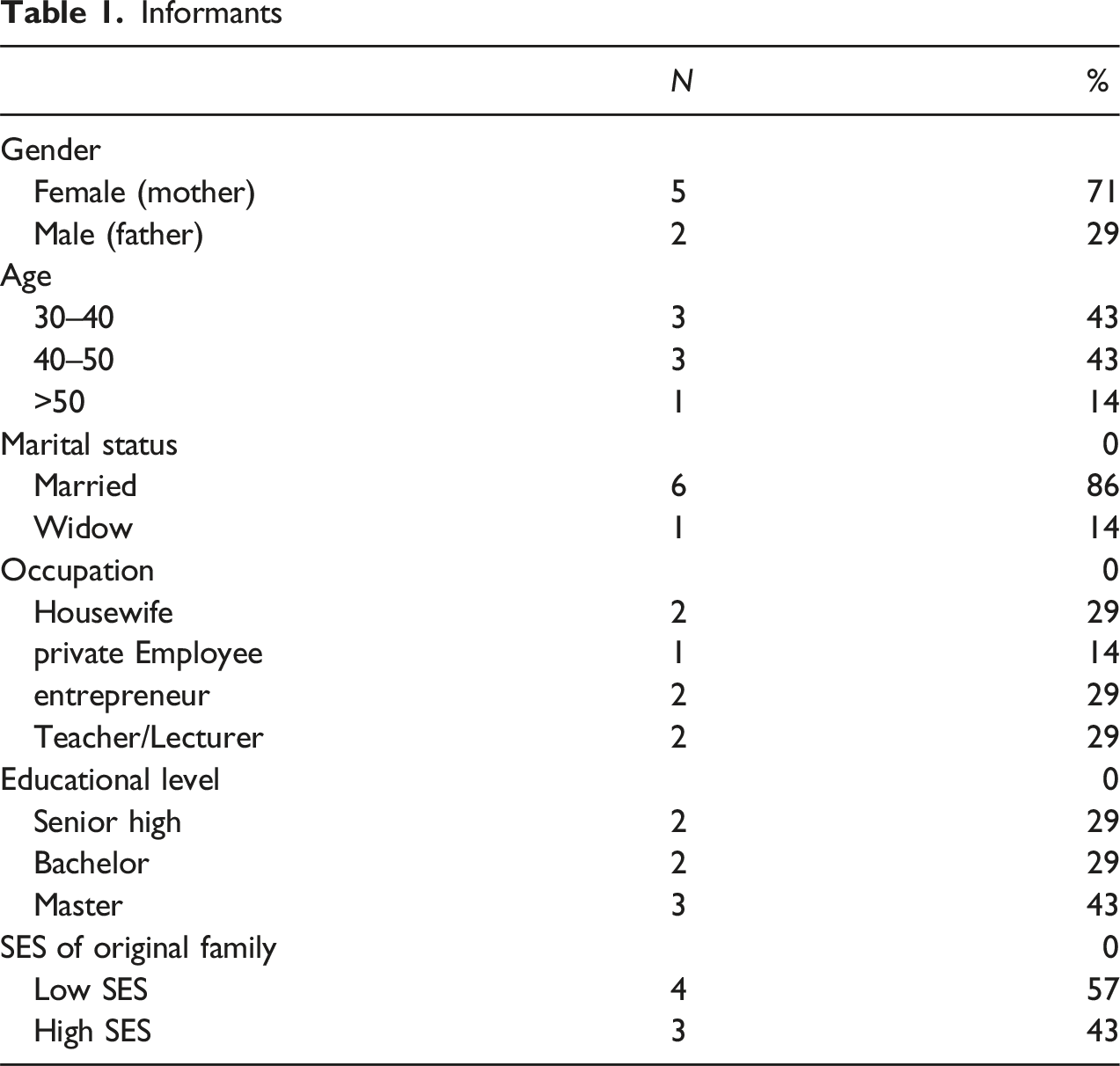
A semi-structured interview guide was used for in-depth interviews that took place between July and August of 2024. This study employs a qualitative case study design, using in-depth interviews with seven parents (five mothers and two fathers) who have experienced childhood maltreatment. Informants were recruited through purposive sampling to ensure diverse experiences and before the interview, each informant immediately filled out a quick anonymous questionnaire to record sociodemographic information.
Data Collection
Following discussion among the study team, a semi-structured discussion guideline was created, improved, and tested with one parent (the mother). At the beginning of each interview, which took place in a setting where the informant felt at ease-the anonymity of their identities and the option to halt recording during certain conversations were explained before the interview started. Signing informed consent was also acquired before interview.
The duration of the interview is also adjusted according to the informant’s comfort. Due to the topic being discussed is sensitive, the researcher prioritizes the informant’s comfort. Four main topics were covered in every interview: a description of the maltreatment experienced in childhood, what cause the maltreatment, the methods they employ when facing the maltreatment, and parents’ perception of why the violence happened to them. Interview were captured on audio and then transcribed for examination. The comprehension of the interview transcript was checked with the local expert resources.
Analysis
After the interview is conducted, the researcher performs verbatim so that the data can be analyzed. The primary author, RI, had to go over and reread the transcriptions in order to find emerging themes in order to develop a codification framework. Following completion of the coding framework, the transcriptions were imported into NVivo (Version 12.6.0) to aid in the encoding and electronic retrieval of the data. To help with the systematic interpretation of the data, we employ theme analysis. With each informant represented throughout each topic, a table of data containing the titles of the specific codification framework has been created.
This made it possible to highlight every answer from informant about a certain subject. The English-translated quotes are taken from informant who are recognized as the mother or father and are categorized based on whether they reside in a high-SES urban region, a low-SES urban area, or a low-SES rural area (Banten or West Sumatra). Additionally, we categorized quotes about parent’s perspective on maltreatment experience based on Charles Horton Cooley’s Looking-Glass Self Theory; how informant develop their sense of self through social interactions and other people’s judgments; in other words, they mold themselves according to how other people view and evaluate them. No quotes exist that might be used to identify certain people.
Ethical Approval
The ethical guidelines established in the 1964 Declaration of Helsinki and its subsequent revisions were followed in the conduct of this investigation. The study received permission from Universitas Padjadjaran’s ethical committee (approval number 96/UN6.KEP/EC/2024). Before being included in the study, each informant completed a consent form and received an information statement.
Result
Informants
Theme 1
Theme 2
Theme 3
Theme 4

Theme 5
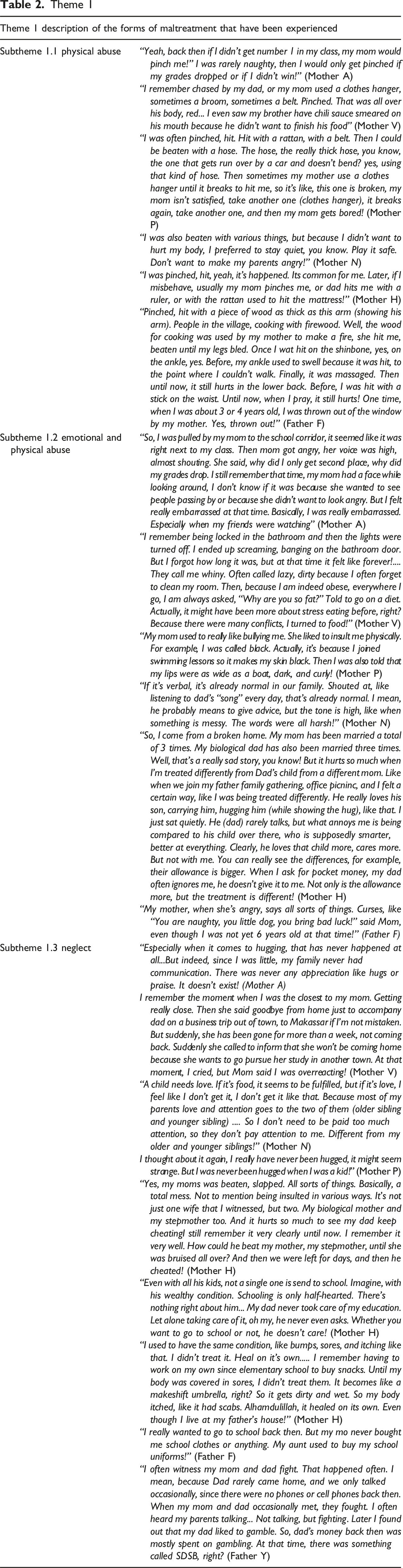
Theme 1: Type of Maltreatment Experience by Parents as a Child
Informants’ narratives revealed distinct categories of maltreatment, including physical abuse, emotional abuse, and neglect. The age range when experiencing this violence is from 3 years old to 17 years old. Many described experiencing corporal punishment or physical punishment as a common form of discipline, while others recalled persistent verbal criticism and emotional rejection. Some forms of physical violence experienced by the informants include being hit with a belt, firewood, a hose, a broom, or a rattan stick. In addition, other forms of physical violence include being pinched and thrown by parents.
Some forms of emotional and psychological violence include being called unpleasant names, including being called animal names and other harsh words. Some Informant also experienced being threatened to be killed. In addition, another form of emotional and psychological violence is being constantly compared to other children who are smarter and more accomplished.
The form of neglect experienced by the informant is receiving different treatment compared to other siblings, whether biological or step-siblings. The form of neglect in this treatment, for example, is that parents show different levels of affection towards siblings, or siblings do not receive the punishment or maltreatment that the informant experiences. In addition, some informants were also exposed to domestic violence by witnessing conflicts between their parents.
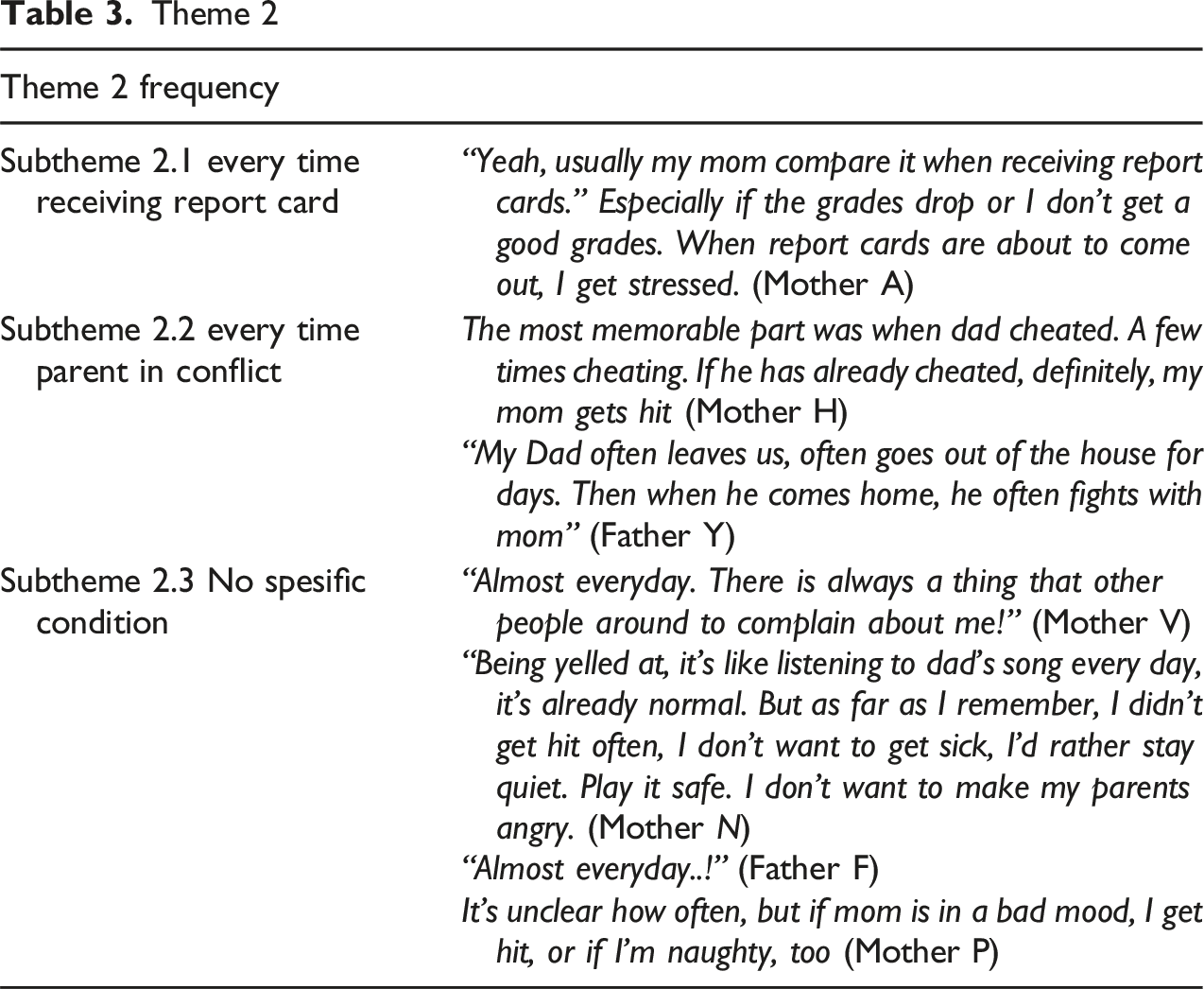
Theme 2: Frequency
As to what frequency in the research is, it is defined, as to how often the maltreatment occurs. Informants shared different patterns in the frequency of maltreatment they experienced during childhood. Three major patterns emerged. One of the frequencies of maltreatment linked to academic performance. One informant recalled being pinch whenever she received a report card or when her grades declined. She also will receive verbal abuse, where the mother will yell at her in front of her friend.
Another pattern of frequency is triggered by parental conflict. Some informants described experiencing maltreatment whenever their parents were engaged in conflicts. They perceived themselves as scapegoats in these situations, where their parents redirected frustration and aggression onto them. One informant recalled become the victim of parents conflict when the family have financial problem. Other informants recounted witnessing the violence the father inflicted on the mother because the father was cheating. Another informant mentioned witnessing conflicts between the parents when the father, who rarely comes home, returns and spends money on gambling.
The last pattern of frequency of is that there are no specific conditions or unpredicted. A few informants reported experiencing maltreatment on a daily basis with no specific trigger or justification. These individuals described their caregivers as being consistently harsh and punitive.
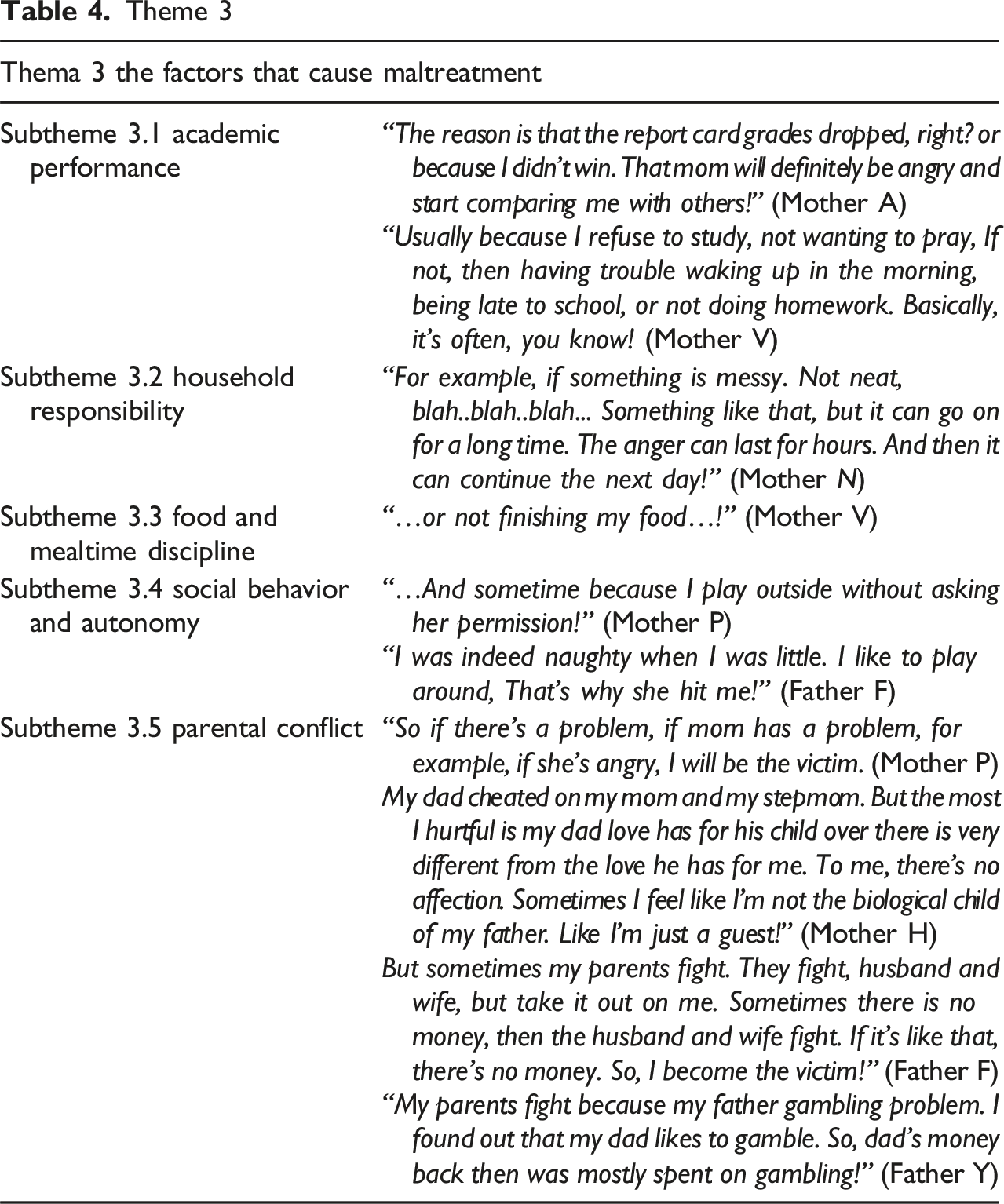
Theme 3: Reason
Informants identified several common reasons for the maltreatment they endured as children. The main themes included. Academic Performance is one of the reasons why the maltreatment happen. Parents of informants resorted to punishment when children failed to meet academic expectations, such as receiving lower grades, not being a top performer, and failing or refuse to complete homework.
Another reason related to household responsibilities: Some informants were physically punished or verbally berated for refusing to complete household chores, reinforcing rigid expectations about obedience and labor contribution. For example, when informants didn’t put stuff where it belong. Some informants are also called unpleasant names associated with that, such as lazy and dirty.
One informant reported to received maltreatment; beaten because of food and mealtime discipline. She was being punished for not finishing her meals, which was seen as wasteful behavior that required strict correction.
Several informants recalled to receive maltreatment for social behavior and autonomy. For example, going out to play with friends without permission. Engaging in unsupervised activities often led to punishment, reflecting parental fears about control and discipline.
Parental Conflict is also another reason of why informants experience maltreatment. Some informants noted that they were punished simply because their parents were experiencing stress or conflict with each other, using them as an emotional outlet for their frustrations.
Theme 4: Defense Mechanism
Defense mechanisms, define as mental mechanisms that allow the mind to resolve issues that it cannot resolve through compromise or unconscious resources used to eventually reduce internal stress. Informants developed various defense mechanisms to cope with their maltreatment during childhood.
Some informants mentioned trying to study harder or doing academic overcompensation; informants coped by studying harder, pushing themselves to excel in school to avoid punishment. One informant recalled to have negative creative expression by writing death-themed songs or self worthless stories as an outlet for their emotional pain. Two informants seeking for escape by pursuing education at dormitory schools to physically remove themselves from their abusive home environments. Other informants seek for financial Independence. Others sought work at a young age to earn money, with the goal of gaining independence and escaping from home.
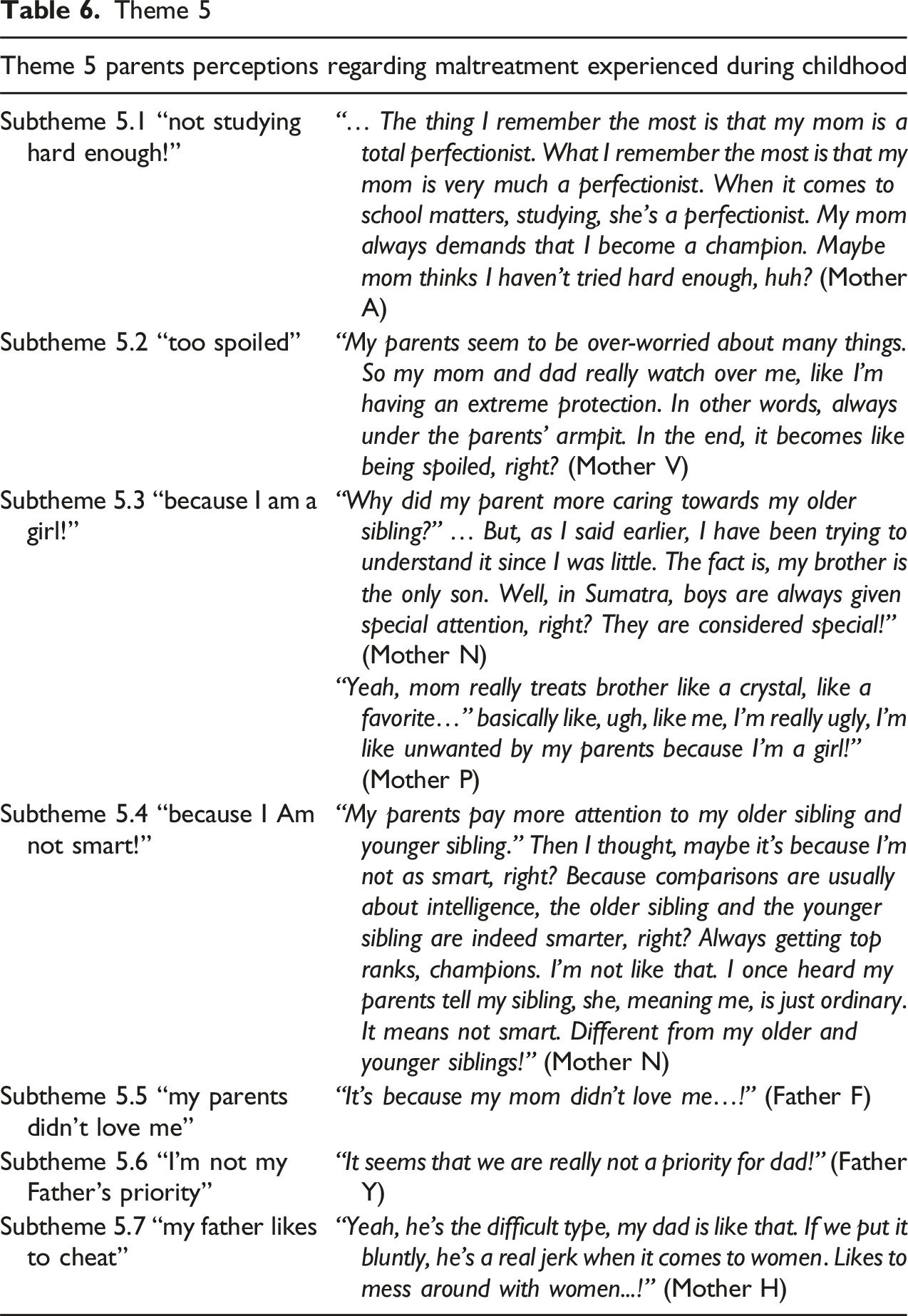
Theme 5: Parents Perceptions Regarding Maltreatment Experience
Perception can be defined as sensory experience of the environment; It is the process by which we use our senses to become conscious of things and connections. According the in-depth interview, there are some perception appear regarding the maltreatment experienced by parents. Perfectionist parenting, specifically perfectionist parents in terms of education, leading to physical punishment and verbal abuse when they failed to be the top of their class. This makes the informant perceive that their parents think they are not trying hard enough to become a champion; One informant stating that her parents are overly cautious parent. This overly cautious, driven by fear and anxiety, justified their strict discipline as necessary to prepare informant for the worst. Gender-based discipline is also perceived by some informants as why they experience maltreatment. Some informants perceived maltreatment as gendered, with female children being punished more harshly than their male siblings.
Favorism based on intelligence-based also stated by informant. Parents showed favorism toward their smarter siblings, reinforcing feelings of inadequacy. One informant internalized the belief that they were unloved due to the repeated maltreatment they experienced. Last but not least, is low parental priority. Others perceived themselves as not being a priority in their family, with resources and attention directed elsewhere.
Discussion
This study highlights the profound and lasting impact of childhood maltreatment on self-perception and parenting. Using Looking-Glass Self Theory, the findings illustrate how parents who experienced childhood maltreatment internalize the perceptions of their parents and caregivers, shaping their self-image into adulthood. The narratives collected from informants reveal that childhood maltreatment affects not only emotional and cognitive development but also influences their self-worth and coping mechanisms.
The Looking-Glass Self Theory suggests that individuals form their self-concept based on how they believe others perceive them. For the informants in this study, childhood maltreatment often resulted in a distorted self-image shaped by repeated negative feedback from their caregivers. Many informants reported internalizing feelings of inadequacy, unworthiness, or rejection, which persisted into adulthood. The emotional and psychological abuse described, such as being called derogatory names or being compared unfavorably to siblings, reinforced these negative self-perceptions.
This aligns with previous research indicating that children who experience maltreatment develop maladaptive self-representations, leading to long-term struggles with self-esteem, emotional regulation, and interpersonal relationships (Silva & Calheiros, 2021). Informants in this study acknowledged that, despite recognizing their past maltreatment, they struggled to alter the ingrained negative perceptions of themselves. This highlights the enduring impact of maltreatment on an individual’s ability to view themselves positively, even after years of personal growth and life experiences.
Informants demonstrated various defense mechanisms in response to their childhood maltreatment. Some sought academic excellence as a means of gaining approval, while others turned to creative expression or sought independence at a young age. These coping mechanisms reflect an attempt to regain control over their self-perception and assert their sense of worth.
However, for some, these strategies were maladaptive, such as suppressing emotions, withdrawing from relationships, or engaging in self-deprecating thoughts. This aligns with prior findings that maltreatment survivors may struggle with trust and emotional vulnerability, often developing rigid defense mechanisms that persist into adulthood (Turner et al., 2017).
Parental Perceptions of Their Own Maltreatment
An important aspect of this study was the informants’ perceptions of why they were maltreated. Some attributed it to parental perfectionism, gender biases, or favoritism towards more academically successful siblings. Others perceived their maltreatment as a reflection of their parents’ personal struggles, such as financial stress, marital conflict, or unresolved trauma. These perceptions influenced how informants rationalized and internalized their experiences, further shaping their self-concept.
The variation in perceptions suggests that maltreatment is not always seen as intentional cruelty but rather as a complex outcome of parental circumstances and societal expectations. This perspective may influence whether survivors feel empowered to break the cycle or feel trapped in repeating the patterns of their own upbringing.
Implications for Support and Intervention
The findings of this study underscore the need for tailored interventions for parents with a history of childhood maltreatment. Since self-perception is deeply influenced by early relationships, therapeutic interventions focusing on self-worth, emotional regulation, and healthy parenting practices can be beneficial. Parenting programs that incorporate self-reflection and address the emotional consequences of maltreatment may help break the intergenerational cycle of abuse.
Additionally, social support plays a crucial role in shaping self-perception and parenting behavior. Encouraging strong support networks, therapy, and peer support groups can provide positive reinforcement and alternative perspectives that help survivors reframe their self-concept and adopt healthier parenting styles.
Conclusion
This study highlights the long-term effects of childhood maltreatment on self-perception and parenting, reinforcing the importance of social feedback in shaping an individual’s self-image. While the Looking-Glass Self Theory explains how negative childhood experiences are internalized, it also suggests that self-perception is not fixed—it can be reshaped through positive social interactions and support. Recognizing the complexity of maltreatment survivors’ experiences allows for more effective interventions that promote healing, resilience, and the prevention of intergenerational trauma.
Footnotes

Ethical Considerations
This study was conducted in accordance with the ethical principles of the 1964 Declaration of Helsinki and its subsequent revisions. Ethical approval was obtained from the Ethics Committee of Universitas Padjadjaran (Approval No. 96/UN6.KEP/EC/2024). Prior to participation, all participants received an information sheet regarding the study and were provided written informed consent. Participation was voluntary, and were informed of their right to withdraw at any time without consequence. Confidentiality and anonymity were ensured, and all data were securely stored and accessed only by the research team.
Funding
The authors received no financial support for the research, authorship, and/or publication of this article.
Declaration of Conflicting Interests
The authors declared no potential conflicts of interest with respect to the research, authorship, and/or publication of this article.
Data Availability Statement
The participants of this study did not give written consent for their data to be shared publicly, so due to the sensitive nature of the research supporting data is not available.