







Abstract
In recent years the construct of fatherlessness has been a well-researched topic. The topic has been heavily researched from the lens of the fathers themselves, the adults their children grow to be, and the sons that they have abandoned. Boyd (2018), noted that although there are several studies on the effects of absent fathers and their sons, the studies for the father daughter relationships are limited and more so for the African American father daughter relationship. In addition to examining the father daughter relationship, Dorsey & Buckley (2024) note that the role of the Black father or his absence, may inform the daughters social and emotional well-being as well as her life choices regarding mental health and well-being. Schafer (2020) also notes that a gap in research exists exploring the experiences of young African American females who have absent fathers throughout their formative years of life. In addition, it is relevant to note that the construct of resilience has not yet been studied in relation to fatherless African American adolescent girls. This study is needed because of the gap in literature combining the constructs of fatherlessness, resilience, and Black adolescent girls. There is also a need based on the underwhelming literature on Black adolescent girls. Objective: This study investigates the resilience experiences of African American adolescent girls who have or are currently navigating the construct of fatherlessness. This study focuses on how the participants perceive their resilience was built and the protective factors that contributed to the development. Method: For this study, an inductive, ground up approach was utilized. Consensual Qualitative Research (CQR) methodology was employed. CQR was selected as the design for this study due to the consensual process as well as the rigorous and consistent data collection and analysis used in the design (Hill, 2012). Following a thorough CQR training with the research team, participant reflections of their lived experiences were analyzed and then sorted into domains including Understanding of Absence, Finding Strength Despite Challenges, and Looking to the Future. Limitations of the study, as well as implications for practice and research are discussed.
Fatherlessness among Black adolescent girls is a multifaceted phenomenon with psychological, emotional, and social implications that warrant deeper exploration. In the United States, structural inequities such as mass incarceration, systemic racism, and economic disenfranchisement have disproportionately impacted Black families, contributing to the high prevalence of fatherlessness in the Black community (Alexander, 2015; Western & Pettit, 2010). While the absence of a father figure is not inherently negative, it has been associated with increased risk for internalizing and externalizing behaviors, identity confusion, and difficulties in forming healthy interpersonal relationships, particularly among adolescent girls navigating critical stages of self-concept and emotional development (East et al., 2006).
To be a fatherless child can be a traumatic and life altering experience for any child. These experiences can play a vital role in shaping the kind of adult the fatherless child will be. The rapidly increasing epidemic of fatherlessness can also be a driving force to the resilience that is built through adverse challenges in Black girls. The resiliency built through the experience of fatherlessness can launch a new generation of Black scholars, doctors, lawyers, and other prominent figures. This study aims to highlight the positive achievements and resilience experiences of Black high school aged adolescent girls that are currently navigating the phenomenon of fatherlessness. A term that for years has held such a negative connotation.
Fatherlessness
Fatherless is defined as a state of being without a father or fatherhood, either physically or emotionally. Fatherlessness is also defined as the lack or absence of regular interaction with the individual as well as not fulfilling his role in their growth (Yusriyah et al., 2024). African American fathers have long been criticized for not living up to the ever-changing demands of parenting (Boyd, 2018). Through previous studies, it was found that that African American fathers tend to engage more with their sons more so than their daughters. The father daughter relationship has been found to be one of the most vital and influential relationships that a female will be involved in (East et al., 2006). The presence or absence of a father in the early years can determine how the adolescent girl will handle both platonic and romantic relationships in their adult life (Mora, 2021). It can also define a number of the resilience experiences an African American girl will experience during their adolescent years.
Resilience Theory
Resilience is defined as the capacity to maintain competent functioning in the face of major life stressors (Kaplan, Turner, Norman & Stillson, 1996). In the context of African Americans as a whole, Luthar et al. (2015), define Black resilience as, a phenomenon or process reflecting relatively positive adaptation despite significant adversity or trauma. According to Zimmerman (2013), resilience theory has its roots from the positive, contextual, social, and individual variables which are all promotive factors in the face of adversity. Kaplan et al. (1996) argues that it is not the nature of adversity that is most important, but rather how an individual deals with the adversity. Zatura et al. (2010) notes that resilience focuses on two dimensions. One being the recovery or means of rebounding from stressful situations. The second dimension is the sustainability. The sustainability is the capacity to continue forward and maintain growth and development as a result of the stressful experience. Resilience factors derived from the experience of fatherlessness can heavily impact the way an adolescent girl looks at the world (East et al., 2006). Some of the resilience experiences may motivate them to do better in other aspects of their life (Zimmerman et al., 2013). Despite the negative aspect of growing up fatherless, many Black girls gracefully accept this challenge and go on to achieve long term goals set for themselves.
African American Fatherless Adolescent Girls
Black girls aged fourteen to eighteen go through many changes as well as challenges in high school. Black girlhood is a developmental period of innocence when girls are provided protection and afforded opportunities to explore, identify, and strengthen hobbies and other interest ahead of adulthood (Bentley-Edwards & Adams, 2024). Due to many unfortunate circumstances some Black girls are not given this opportunity. It is because of this that the resilience of Black girls who are growing up without fathers is often overlooked and disregarded (Miller, 2022). As noted by Cartwright & Henriksen (2012), the majority of prisoners, juvenile detention inmates, high school dropouts, pregnant teenagers, adolescent murderers, and rapists come from fatherless homes, and the effects of growing up in absent father homes can last a lifetime. This along with other life adversity factors such as low socioeconomic status, familial conflict, drug use, behavioral difficulties, and low graduation rates can all contribute to the early demise of African American adolescent females (Mora, 2021). When looking at all of these factors it is easy to overlook the positives that can come from the daughters of absent fathers. The placement of Black girls in advanced placement courses has increased in the past ten years (National Center for Education Statistics, 2021). Black girls also account for 62% of the African American population who go on to college after graduating high school (Sanders et al., 2022). Recent trends have also identified a drop in African American teen pregnancy rates, meaning Black girls are postponing early parenthood and therefore decreasing the risk of unhealthy sexual behaviors (Dorsey et al., 2024). Ultimately, these positive outcomes demonstrate that even in the face of adversity, Black girls continue to prove wrong negative stereotypes and rewrite the narrative of what it means to be a fatherless child.
Rationale
This study is being conducted to provide insight and to explore how Black adolescent girls make meaning of their experiences of fatherlessness and to examine the ways in which this absence influences their identity development, emotional well-being, resilience, and coping strategies. Through the use of Consensual Qualitative Research (Hill & Knox, 2001; 2012), this study seeks to center the voices of Black girls by capturing their nuanced, lived resilience experiences in navigating fatherlessness. By investigating these experiences through an interpretive and collaborative lens, this study aims to identify patterns of resilience, sources of support, and potential areas for culturally responsive counseling and intervention. Ultimately, the findings are intended to inform practitioners, educators, and researchers seeking to better understand and serve Black adolescent girls affected by fatherlessness.
Research Question
The research question for this study aligns with the bottom up, inductive approach that coincides with CQR methodology (Hill & Knox 2021). This methodology seeks to account for the participants lived experiences within their world. The research question for this study is as follows: What are the resilience experiences of African American adolescent girls who are currently experiencing fatherlessness?
Methodology
This study utilized a qualitative design to effectively explore the lived experiences related to participant experiences, perceptions, and perceived beliefs (Flynn, 2022). Consensual Qualitative Research methodology is utilized due to its rigorous approach and emphasis on multiple perspectives, interpretations, and considerations of other team members (Hill et al., 1997; Hill & Knox, 2021). This approach also allows for exploration of internal events. It is ideal for exploring topics that have not been previously studied (Hill & Knox, 2021). In recent years, the methodology of CQR has gained considerable traction within the counselor education research community (Limberg et al., 2021). The post-positivism traits of CQR require a heavy amount of consensus from all members of the research team. In addition, CQR requires auditors to ensure consensus is reached to achieve an accurate representation of data (Hill & Knox, 2021). This methodology is deemed most appropriate for this study due to the nuanced experiences Black adolescent girls experience without their fathers. It also allows for the participants perspectives to remain unique while also striving to identify commonalities within their experiences (Hill & Knox, 2021).
Research Team
The research team for this study consisted of four primary members as well as one internal and external auditor. In line with CQR methodology, both an internal and external auditors are utilized to achieve consensus on the data to most accurately reflect participants perspectives (Hill & Knox, 2021). At the time of the study, research team members were in their mid-twenties to early forties. Of the six research team members, four of them identified as African American and two identified as white. All research team members were English speaking, and all identified as women. Several factors were taken into consideration when choosing research team members. The considerations are as follows: (a) time commitment to project, (b) open and accepting of feedback; (c) open to honesty disclosing biases and reaching consensus; and (d) a diverse representation in the research team (Hill & Knox, 2021).
The first author of this study initiated the recruitment of participants, conducted all but one interview, organized weekly research meetings, and organized all data and materials. Of the total six research team members, four actively engaged in the analysis process and collaborated to reach consensus at each stage of coding. The internal auditor of the study was previously experienced with CQR and has contributed to multiple studies with this design. The external auditor serves as a major professor and specializes in CQR methodology. Both the external and internal auditor worked independently from the primary research team as well as from each other (Hill & Knox, 2021).
Positionality of Research Team and Trustworthiness Measures
During the first research team meeting, the purpose of the study and mechanics of CQR were discussed. Prior to beginning data collection and analysis, research team members discussed both biases and positionality. This was done independently before the meeting and again in a group setting with all research team members present. After all biases were recorded, each the research team discussed their anticipated findings for the study. One research team member as well as the first author identified as having an absent father throughout the duration of their childhood & adolescent years. The remaining team members reported having their fathers active through their childhood, adolescent years and well into their adult years. All members of the research team have experience working with African American adolescent girls whether though previous personal or school counseling, internships, or other various personal experiences. The first author of this study has worked with African American adolescent girls extensively providing counseling and behavioral intervention through previous employment with The Department of Mental Health and The Department of Social Services. Through both these experiences, they were familiar with the interpersonal relationships and dynamics that many adolescent Black girls experience in fatherless situations. These varied perspectives informed the understandings of the unique challenges faced by fatherless African American girls and guided the approach to research with both sensitivity and depth.
As it relates to trustworthiness of this study, the proposed protocol by Glesne (2016) was adopted for engaging in qualitative research. This protocol instructs researchers to utilize an audit trail, conduct member-checking processes with participants, address research team biases and subjectivity, and cross reference all data that was obtained during the collection phase. After interviews were completed, participants were given the opportunity to choose their own pseudonym and review any direct quotes used in the manuscript as recommended by Glesne (2016). Member-checking measures were also utilized through the distribution and summary of individual participant findings (domains, categories, and subcategories). After this, the findings were sent to participants via email and offered a virtual meeting to discuss, explore, or confirm data reflected from interviews. This measure was conducted to ensure accuracy of findings to the best of the participants’ knowledge (Glesne, 2016). Out of the thirteen participants, two responded back confirming correspondence for member-checking.
Participants and Setting
Participants for this study included 13 high school aged African American girls. All participants self-identified as being African American and having had minimum to no contact with their biological fathers for a period of longer than five years. Girls with biological fathers who were imprisoned or deceased were excluded from participation. Participant inclusion criteria included: (1) self-identify as an African American female (2) current enrollment in high school (3) between the ages of 14–18 and (4) minimal to no contact with biological father for a period of longer for 5 years.
Participant Demographics
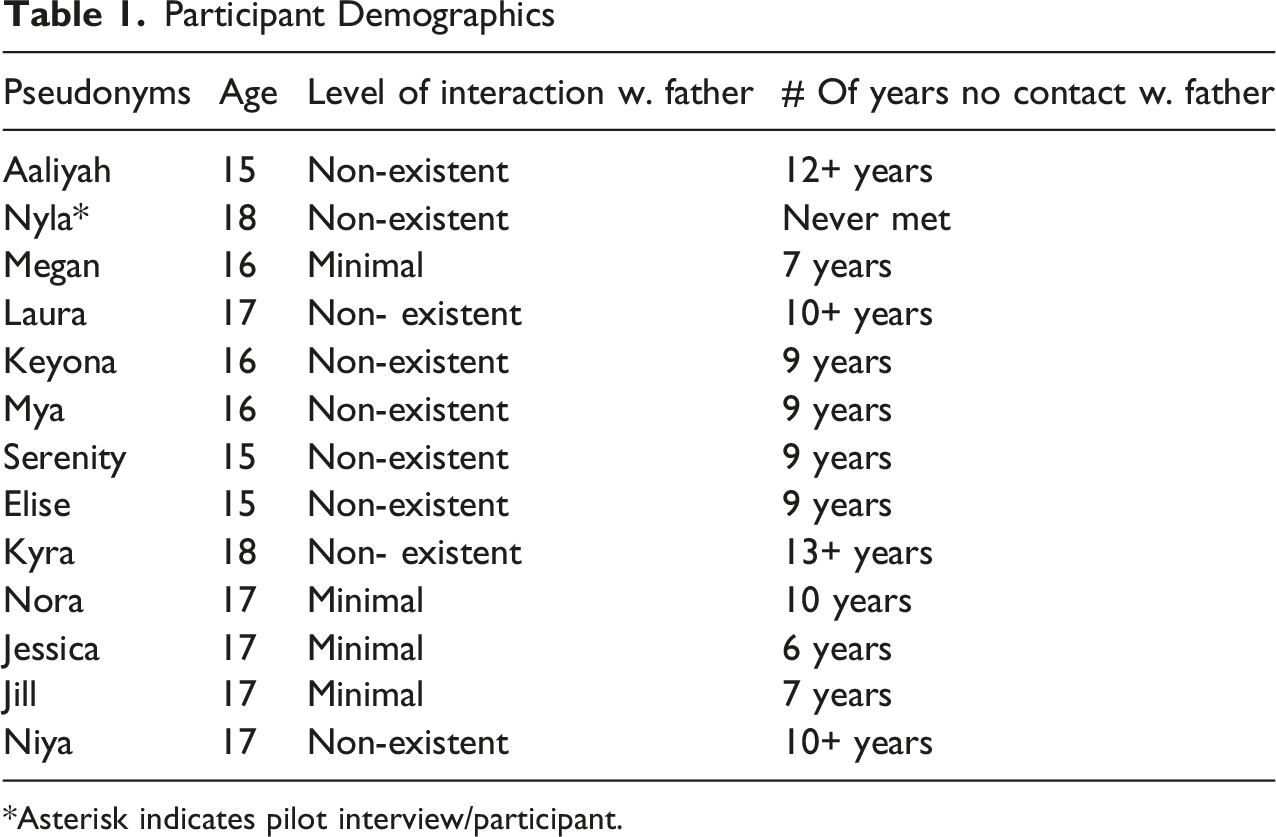
*Asterisk indicates pilot interview/participant.
Data Collection & Analysis
Upon obtaining approval from the Institutional Review Board (IRB), all research team members received training in CQR methodology aligning with the guide provided by Hill and Knox (2021). During the first research team meeting interview protocol was reviewed with all members of the research team. All interviews (n = 13) were conducted through a secure video platform then stored and organized in a private drive. Only members of the research team were able to access this drive. Raw data is stored within an internal system of a password protected personal computer. Upon approval, and recruitment of participants, the interview protocol was piloted with 16-year-old, Nyla. The purpose of the piloted interview was to test the interview questions, make necessary revisions, and consider other areas to explore (Hill & Knox, 2021).
Prior to sitting for the interview interested participants were sent a link to an inclusion criteria form. The inclusion criteria form also collected information related to participant demographics. After this initial from was submitted, a research team member collaborated with the participant to schedule the interview. Once the interview was scheduled, the participant was emailed an informed consent as well as a secure link to the video platform for interview. Following the conclusion of the interview, the participant was given the autonomy to identify their preferred pseudonym, and information was collected on where to deliver their $20 incentive. On average, participant interviews lasted between 25-30 minutes. At the conclusion of data collection, 15 interests completed the inclusion criteria form, thirteen participants were interviewed for the study, and two participants provided a confirmatory response for member-checking. Two interested girls were excluded from inclusion criteria based on the close amount of time since they had last spoken to their biological father.
Consensual Qualitative Research can best be explained in three steps: (1) develop domain or start list based on participant words (2) develop core ideas based on the essence of participant words and (3) develop categories and subcategories based on reoccurring themes from core ideas phase (Hill & Knox, 2021). For this study, the research team met multiples times to identify, discuss, and reach consensus for all domains, core ideas, and categories (Hill et al., 1997). Before analyzing any data, the research team began by compiling a start list of expected domains. Data analysis began by assigning all members of the research team one participant interview to review to begin a start list of domains. After this each member of the team was assigned two interviews to review independently and come up with core ideas. These were then all added into a data codebook shared with all members of the team. After each step of the analysis process the preliminary results were passed on to the internal auditor for review to ensure participant experiences were being accurately represented. After adhering to the recommended feedback and making corrections the preliminary domains were sent to the external auditor for review and consensus as well.
Domains
Following recommendations by Hill et al. (1997), the research team developed a start list of 19 domains. After reviewing the two previously assigned interview transcripts independently, the research team was able to condense the domains down to 10. After coming to a consensus on domains as a team, the findings were disseminated in a consensus version domain list to the internal auditor first. As recommended by Hill and Knox (2021), research team members met with the internal auditor on multiple occasions to go over the formulated domains and receive feedback. After the internal auditor provided feedback, the domain list was then sent to the external auditor for review. During review from both auditors, there was a constant feedback loop between research members and reviewers to identify appropriate domain titles, and descriptions to capture participants meaning (Hill & Knox, 2021). After feedback from both the internal and external auditor as well as consensus among the research team, 4 final domains were formulated. When the research team was able to reach consensus on the domains, the next step was to proceed to core ideas (Hill et al., 1997).
Core Ideas
Since domains serve as summaries of interview themes, core ideas are the items that are pulled directly from participant interviews. These ideas use the participants language to describe the feelings (Limberg et al., 2021). In this stage of analysis, the research team should not seek to infer meaning from the participants words but further summarize the raw data as concisely as possible (Hill et al., 1997; 2021). Each member of the research team worked to establish core ideas for each of the four final domains. When the core ideas were unanimously decided on, the research team then began the cross-analysis process to establish categories that describe consistencies within domains and across cases.
Cross Analysis
In the cross-analysis phase of CQR, each domain was analyzed and used to establish categories and subcategories to reflect themes across participant core ideas (Hill et al., 2021). After final domains, categories, and subcategories were finalized, all categories were labeled in order of frequency as either general, typical, or variant (Hill & Knox, 2021). A general label means that the category was present in all or all but one interview (12 or 13 of the participants). A typical label reflected that the category was present in at least 50% of the interviews (7 to 11 of the participants). A variant label refers to the category only being present in 2 to 6 participant interviews. Rare categories are those that are only present in on interview and not reported in the final data analysis (Hill et al., 1997).
Findings
Cross Analysis Frequency Count by Domain, Category, and Subcategory
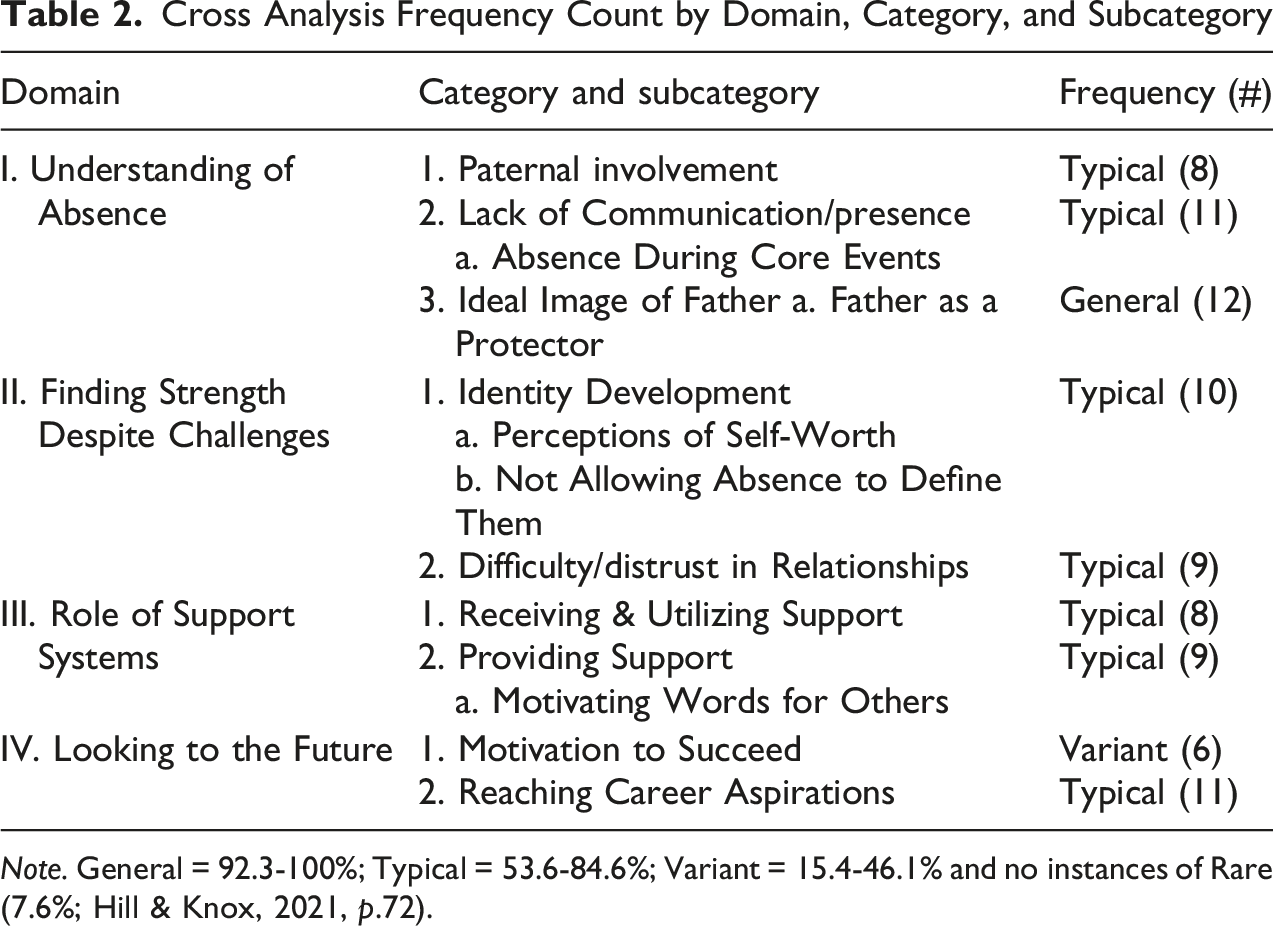
Note. General = 92.3-100%; Typical = 53.6-84.6%; Variant = 15.4-46.1% and no instances of Rare (7.6%; Hill & Knox, 2021, p.72).
Domain I: Understanding of Absence
The first domain of this study details participants accounts of growing up and understanding the absence of their father. Several participants noted that they knew their father but some way or another he distanced himself from them or stopped communication all together. From participant experiences it seems that understanding the actual absence of their father is a deeply personal process that develops over a span of time. In their early years his absence may seem just like as a missing presence but as they mature, their awareness expands leading them to seek explanations. These explanations may entail unanswered questions about their father, why he chose to leave, if his absence was a choice, and what role, if any, did they play in his decision to leave.
Out of the twelve participants, eight led the interview letting the interviewer know the dynamics of why their father is absent or barely present in their lives. Some detailed stories of divorce, abandonment, and one participant disclosed that she had never met her father. Additionally, participants spoke of both communication and presence of their fathers, as well as their fathers living in close proximity to them but still refusing a relationship with their daughters. Frequencies are included in the following subsections along with additional information descriptions and participant quotes to further detail the first domain identified by the research team.
Domian I, Category 1: Paternal Absence
The first category of domain one describes paternal absence across participants. In this typical (n = 8; 61.5%) category, the interviewer asked specific questions in relation to their fathers’ involvement in their lives. Several participants noted that they knew their father and had a previous relationship with him but some way or another he distanced himself from them or stopped communication all together. Nora details, “He would call me on the phone every so often and eventually all contact just like stopped, I haven’t heard from him again in years.” Megan notes that “He started distancing himself. And then after that, I think it was around MLK day seven years ago, he just stopped talking to me.” She details that this sudden distance was difficult to understand because before this they would talk on the phone, and her father would visit periodically. “I think it maybe had something to do with him and my aunt getting into it but I’m not really sure” Megan says. Mya held a different view stating that, “I don’t even know what to say, I don’t think I’ve ever had a relationship with him.” Keyona was one of the participants who had only met her father once and heard stories about him from family members. She noted that “I really don’t have no memories with him cause he was never around.” Laura noted that she knows her father and he lives in the same town as her but makes no effort to see or communicate with her. Keyona notes the lack of memories she shares with her father saying, “He was never around, I don’t have no memories with him at all.”
Domain I, Category 2: Lack of Communication/Presence
In category two of domain one, participants described typical (n = 11; 84.6%) experiences of their father’s lack of both communication and presence throughout their lives. Many reflected on early childhood memories when their fathers were present to some extent but that his present was shirt lived and eventually faded completely. Both Elise and Kyra recalled only vague or distant memories with their fathers noting how this limited their ability to truly know their fathers. Aaliyah described the lack of communication and presence as “confusing,” when her father would reenter her life for a short period of time only to leave again without explanation. Mya and Serenity explained how these instances of inconsistency made it difficult to rely on their fathers, as their promises to stay present and involved in their life were frequently broken.
Domain I, Subcategory a: Absence During Core Events
The idea of the participants fathers not being present at core events in their lives surfaced many times during interviews. Whether it was prom, father daughter dances, or parent teacher conferences, many participants felt the emotional effects of their fathers not being present during these events. Kyra described feeling sad about when these events would come around and knowing she would not have a father to attend with, “Sometimes see like for parent teacher conferences or like when parents come to eat with you for parents day, I would see people with their dads then get a little sad but I tried not to think too much of it.” Laura describes these events as being important in development, saying “Like daddy, daughter events and stuff like that, because I feel like those events are important growing up.” Aaliyah recounts, “Like my prom days, not having my dad there to see me off really made me sad and not getting to see him every day.” Elise describes her father’s absence at these core events as “hurtful” detailing, “I needed my father when I was younger. When I was younger, we would have dances like father daughter dances and donuts or dad right? So, most of the time I just didn’t end up going and that use to hurt.” This subcategory echo’s the lasting wounds of not only a father’s emotional absence but their physical absence as well. This shows that Black fathers must understand that their presence is power and their daughters struggle to grow without it.
Domain I, Category 3: Ideal Image of Father
Category three of the first domain explores participants perspectives on their perceptions of what a father is supposed to do for their daughter. This domain also involves participants generally (n = 11 84.5%) sharing characteristics of their ideal image of a father as well as the characteristics they would have hoped to experience with their own father. We acknowledge that many for many Black girls with absent fathers the idealized image of father is heavily influenced by the media or their own observations of a father daughter relationship. During this study several participants shared sentiments of longing for their father when seeing other girls that had active fathers. These comparisons can heighten the awareness of their father’s absence leading the girls to feel that they are missing a key relational model. This may therefore oscillate between longing for an idealized figure and anger towards a man who failed to fulfill his role (Parker & Benson, 2004). These multifaceted emotions will all be encompassed in the categories and subcategories to follow including the frequency of responses and excerpts from participant statements.
Domain I, Subcategory a: Father as a Protector
In the first subcategory of category three, we inquired about participants think fathers are supposed to do for their daughters. Six out of twelve participants all agree that fathers are intended to be protectors. It appears that participants describe the father’s role as a protect to extend beyond physical protection. Participants describe the father providing a sense of emotional protection that includes stability, guidance, and reassurance. Kyra states, “They should protect them. I feel like there’s only a certain amount that your mom can teach you and that’s where you would need your dad to teach you just like regular stuff and general about life and relationships and how to go about certain things.” Both Aliyah and Keyona describe fathers as protecting their daughters more than physically with Keyona noting “Protect, provide, you now, just be there for their daughters, not only in person but other ways too.” Serentiy describes more of an emotional protection saying, “They’re supposed to be there for them when they need them, and when they do things, they’re supposed to be there to help and stuff and really just to check in, make sure they’re ok, you know?”
Domain II: Finding Strength Despite Challenges
The second domain of this study details participant experiences of finding strength throughout the challenges that fatherlessness brings about. Within this domain, participants reflected on how they have constructed their sense of identity, often redefining who they were in their father’s absence. They also detail their perceptions of their own self-worth and personal perceptions of resilience as well as not allowing the absence of their father to define them. At the same time, participants acknowledged the challenges of finding a sense of strength. Feelings of distrust and skepticism toward others, particularly men, surfaced in multiple interviews complicating the way participants formed relationships both romantic and platonic.
Domain II, Category 1: Identity Development
The category Identity Development details the ways in which fatherlessness shaped their identity and their understanding of themselves. When asked what their definition of resilience was, Laura shared, “to me it means a lot more perseverance that anything. I think resilience in my opinion means that against the odds of what you were given, you rise up to the occasion.” Jessica says, “I think it means to still push through even thought things are hard, and to still be strong even though you might be broken down but still show up, give 100%.” Jill noted, “Instead of resilience, I use the words bounce back.” This emphasizes the sense of recovery needed and the ability to keep moving forward.
After this, participants were asked about their own resilience. A typical number of participants (n = 10;76.9%) indicated that they were in some capacity. Niya shared, “I feel like I always push through hard things, I always learned to keep my head up.” Nora echoed this sentiment saying, “I adapted to a lot of situations most people probably wouldn’t be able to. It would have been nice to have my father there but he wasn’t. I learned to adapt and survive through those situations.” Kyra identified a sense of growth and emotional maturity in her identity explaining, him not being there taught me to forgive but not really forget. Also noting her experience taught her not to “burn every bridge” but instead process her feelings both sadness and anger. These quotes illustrate how fatherlessness not only presents challenges but opportunities for change and growth in their sense of agency.
Domain II, Subcategory a: Perceptions of Self Worth
The absence of their father had a profound impact on participants perceptions of their own self-worth. This more than often sparked feelings of inadequacy, self-blame, and a longing for a sense of validation. Lauren describes this struggle emotionally, explaining that the absence her father made her question herself as a person. She asked herself questions like, “why wasn’t I good enough?” and “what did I do?” She says, “Even though I know it wasn’t my fault it still made me question myself like I was the problem.” Similarly, Jessica recalled moments of comparison, stating, “when I saw my friends with their dads I would think why don’t I have that or why do I not deserve that kind of connection with my dad?” Jill shared these feelings saying, “Like if I see somebody else with their dad and they have dads I their household sometimes it made me think like dang, what if my dad was there or why doesn’t my dad want to be there for me?” These reflections highlight the internal burden fatherlessness can place on girls often leading to self-doubt and lowered self-perceptions.
Domain II, Subcategory b: Not Allowing Absence to Define Them
At the same time some participants shared intentional efforts to not let the absence of their father dictate how they value themselves. Keyona explained, “I don’t allow him not being around to upset me or change the way I am to other people.” Kyra echoed this saying, “I feel like it’s stereotypical to be Black and not have a dad. I don’t let it upset me or hold me back.” These statements show how even amid self-doubt and negative stereotypes; participants continue to engage in self-preservation and resilience by striving to separate their self-worth from the negative choices of their fathers.
Domain II, Category 2: Difficulty/Distrust With Relationships
The second category of Domain II is typical (n = 9; 69.2%) in nature and includes participants highlighting the difficulties they have faced in relationships. These relationship struggles range from developing platonic relationships to sustaining romantic relationships. Many participants detailed how the absence of a father’s consistent emotional support, affirmation, and modeling, lead to struggles with trust, vulnerability and the establishment of healthy relational boundaries. In examining romantic relationships, Kyra described her experiences as follows, “it’s always been hard for me trying to have and deal with romantic relationships. It was difficult ‘cause I didn’t really know too much of what I was doing, like my mom told me but there wasn’t a man telling me so it’s a difference.” Jessica says, “I haven’t really been able to be treated like how a man should treat a woman. I think if my dad was able to show me how a man is supposed to treat me, I wouldn’t develop this type of attachment to boys.” Both Kyra and Jessica went on to describe their patterns to seek out help or validation from boys. Kyra discloses, “I started doing a lot of running to boys with my problems instead of having a father to help me with whatever or just answer questions or anything to make it easier and not deal with a bunch of other people.” When the interviewer asked Kyra was seeking from boys helpful, she responded “Not at all, I noticed I started doing it in middle school and it just kind of became a pattern for me. I figured out that they didn’t really want to help, they just wanted one thing from me.” Jessica explains, “I sought out to like try and find that type of love in boys when that love should have been coming from my father. I fought really hard for it [love from boys].” This further emphasizes the damage that can be done to both the self-worth and self-esteem of Black adolescent girls when navigating relationship expectations. Without a positive model of paternal interaction, we see first-hand the uncertainty that can be experienced in defining what constitutes respect, mutuality, and care within romantic relationships.
This same domain continues to detail the participants experiences of distrust and the relational instability this distrust can surface. The experiences highlighted in the following section show how a father’s absence significantly shapes how Black girls approach and perceive trust in their relationships. When asked about how the absence of their fathers affected their relationships, Megan shares, “I guess it made me more cynical. Which I’ve always been a cynical person, but to me it made me more cynical towards others. I’m not too trusting with anybody anymore.” Mya says “He [her father] made a lot of promises he couldn’t keep so now I just have a hard time trusting people.” Serenity shares the same sentiment noting, “I just can’t trust him or anything he says. He said he was going to do better but like, it never happened so I just don’t believe anything he says.” Kyra shares that because of her father’s absence she just does not trust men in general rather it be a teacher or authority figure. She also details that she is not open with men, “I am not really open with many men in general. I can’t be anywhere as open with men as I am with women.” Distrust in this category is not only limited to males or romantic contexts. Participants explain how this distrust can also expand into friendships. Nora shares “Maybe it impacted my trust issues because he just up and left one day with no reason or explanation to why. It kind of takes a while for me to let people into my circle and to actually let them begin knowing me.” Despite these challenges, it is important to acknowledge the resilience that can be drawn from these difficulties. In domains to come, some participants will detail experiences of trust built through consistent bonds with maternal figures, siblings, or mentors. These protective relationships can counteract distrust and a more balanced approach to interpersonal connections suggesting that while paternal absence can predispose Black adolescent girls to relational skepticism, it does not determine their capacity to trust in future relationships.
Domain III: Role of Support Systems
The third domain of this study explores the role of support systems and the impact that they can have on Black girls navigating fatherlessness. We found that various support systems often serve as a critical protective factor in cultivating resilience. The presence of these caring and consistent relationships, whether through maternal figures, extended family members, siblings, or mentors can provide a sense of stability and encouragement when facing paternal absence. We also discovered that in addition to receiving and utilizing support systems, participants also found solace in proving that same kind of support and motivation to other girls who may experiencing the same phenomenon.
Domain III, Category 1: Receiving & Utilizing Support
Receiving and utilizing support encompasses the various forms of support and guidance received from family members. A typical (n = 8; 61.5%) number of participants reflected on their support systems and the impact of their assistance. Nearly every participant emphasized the sacrifices and the strength of their mothers, who were described as fulfilling both parental roles while instilling resilience and determination.
Elise noted the dual role her mother played in the household. She shared, “my mom is both the father and the mother in the house because she does everything by herself and tries to make everything good for us [her siblings].” Similarly, Aliyah described her mother as “being there every step of the way,” while Mya repeatedly emphasized how her mother, “did everything she could for me and my siblings.” She also noted that her mother “helped them get over the hard stuff in life.” Laura shared appreciation for her mother noting, “It definitely helped me have a lot more appreciation for my mother because, you know, she’s doing everything on her own.” Keyona shared the same sentiment saying, “Even though my father’s not around, I still get by because I have my mother, and she does everything for me and stuff.”
In addition to the support from their mothers, participants highlighted the importance of other family members who stepped in to fill the gaps left by their absent fathers. Jessica explained, “I think it’s helped me open up to reach out to other people, for example, I’m really close to my aunts and uncles so I’ll always reach out to them.” Nora noted, “My older sister motivates me a lot because well we have the same father and he’s not in either of our lives and so it motivates me seeing how much she accomplished, and she just motivates me to be like her, I guess.” She also described her aunt, uncle, and grandparents as supportive figures with her uncle and grandfather “filling in that father figure place” by spending time with her and offering guidance.
Collectively, this domain highlights how participants utilized the support of mothers, siblings, and extended family members as a protective factor. These factors aided in helping them adapt to the many challenges of fatherlessness. By drawing strength from these relationships, participants were able to maintain a sense of stability, motivation, and belonging which in return reinforces both aspects of their resilience as well as their identity development.
Domain III, Category 2: Providing Support
In the second category of domain three, participants typically (n = 9; 69.2%) reflected on not only receiving support but proving that same support for others experiencing fatherlessness. Many envisioned programs, mentorship opportunities, and safe spaces where girls could feel understood, encouraged, and empowered to process their experiences.
Several participants emphasized the value of peer connection and shared experiences. Elise noted the importance of “girl talks” similar to the interviews themselves that could offer an open dialogue for girls. Megan shares, “Support groups are important, like a group where we could meet once a month or every two weeks and you basically talk about your families.” Jill echoed this by describing the power of hearing other experiences, “sometimes hearing other people’s situations could make you feel less alone about yours.” These perspectives highlight the importance of community and the collective support that comes from realizing you are not alone.
Domain III, Subcategory a: Motivating Words for Others
In addition to reflecting on their own journeys, participants offered words of encouragement to other girls facing similar fatherless situations. A common theme across their motivating words was the idea of persistence. Elise gave the encouraging words of, “Keep pushing and believing in yourself even when it seems like no one else does.” Mya shared this sentiment saying, “You have to keep pushing because you should let nobody who wasn’t in your life stop you from what you’re doing or who you want to be.” Jessica urged others to “worry about yourself because when you become successful, he’s going to want to come around and you’ll be long gone.”
Both Jill and Megan encouraged others to reframe the absence as a source of strength rather than defeat. Jill advised others to use the sadness and pain as “fuel to keep going,” drawing from her own motivation to succeed academically and in her life despite her circumstances. Megan described her approach as “shaking back better” explaining that while setbacks are inevitable, it’s the ability to come back stronger that defines your resilience. Kyra emphasized “don’t blame yourself because these are adults we’re talking about and they know they have a child. Don’t let it define you.” Aaliyah offered a musical perspective encouraging other girls to “keep your head up, like the Tupac song.”
This domain overall reflects on participants resilience and desire to uplift others in similar circumstances. Their messages center perseverance, self-love, and independence. By offering these affirmations, participants to only express their own growth but position themselves as beacons of hope for other girls living through fatherlessness.
Domain IV: Looking to the Future
The final domain of this study focuses on the participants aspirations and goals in the future. Despite the challenges faces navigating fatherlessness, participants expressed a forward-looking perspective that emphasizes determination, motivation, and the achieving of long-term goals. Rather than feeling defeated by their father’s absence they envisioned futures shaped by resilience, achievement, and the desires to create lives different from the circumstances they endured.
Domain IV, Category 1: Motivation to Succeed
Category one of domain four describes the variant (n = 6; 46.1%) reflections of the participants inner motivations to succeed. For some, this motivation stemmed from an internal drive to affirm their value and pursue their goals regardless of their fathers’ choices. Laura explained, “regardless of anyone else’s choice I still have to figure out what I want and I’m just as important as someone who does have a father.” She also emphasized that the absence of her father would not “stop [her] from achieving [her] goals.” Jill also describes moments of self-motivation noting, “School helps me sometimes, I’m a senior this year so sometimes I just motivate myself by thinking about graduation and just end up getting it done.” She also described the absence of her father as a motivator tied to milestones, envisioning how graduating high school would serve as a viable testament to her perseverance.
Others expressed a deep desire to prove those who doubted them wrong, including their fathers. Megan expressed this sentiment directly stating, “I got a point to prove now, since you’re not here [her father], I got to get it out the mud myself because no one’s going to do it for me.” Mya echoed this determination saying, “I’m not ever giving up, I don’t want to let him see me fail.” Jessica explained her hopes of being a first-generation college student noting, “I want to show them that even with me not having my father in my life that I can still push through, I can still go to college, I can still get a degree and be the most prominent me I can be.”
Domain IV, Category 2: Reaching Career Aspirations
In addition to a motivation for success participants in the final category of this study described typical (n = 11; 84.6%) aspirations of reaching their future career goals. Despite their father’s absence they expressed ambitious plans to enter diverse professional fields demonstrating a refusal to let their current circumstances limit their long-term goals.
Most participants noted they wanted to go onto career that required higher education and professional training. Laura details, “I want to go to a four-year institution and major in pre-med. I’d like to be an anesthesiologist.” Jessica, who is already enrolled in an early college program described, “I want to be a lawyer, either a tax lawyer or an immigration lawyer.” Nora expressed interest in the financial industry stating, “I’m thinking about pursuing finance and becoming an investment broker or financial manager.” Keyona described her desire to work in animal care as veterinarian. Other participants were drawn to hands on professions. Elise, Kyra, and Niya all expressed interest in careers in beauty and cosmetology. Jill described her goals as “driving 18 wheelers” and Serenity expressed a passion for childcare, highlighting the nurturing aspect of her aspirations.
These career goals demonstrate both ambition and diversity spanning medicine, law, finance, and trade industries. Their visions for the future serve as a testament to their resilience. Rather than being bound by the absence of their father, these young women describe career paths that reflect independence, determination, and a belief in their ability to thrive.
Discussion
The findings from this study contribute to a growing understanding of the phenomenon of fatherlessness as well as to the under explored experiences of Black girls navigating this phenomenon. Participants in this study reflected on their understanding of their father’s absence, his lack of communication and presence, and their idealized image of a father. This domain sheds light on the multifaceted ways the participants came to understand the dynamics around their fathers absence, highlighting how his lack of presence in their life was not only physical but emotional as well. For instance, participants discussed how the absence of their father was felt at core events whether they were academic or personal events. These findings highlight the critical importance of the physical presence of a father which coincides with previous research that has identified the physical presence of a father as a protective factor in the lives of their children (Miller et al., 2022; Schafer, 2020). The domain of finding strength despite challenges, encompasses the complex identity development these young women encounter while navigating the absence of their father. Several participants detailed sentiments of feeling unwanted or unloved by their fathers. They also spoke of feeling as if they were the problem or the reason their father decided to leave. Despite these painful emotions, the participants continually emphasized not allowing these feelings to define who they are or stand in the way of their future endeavors.
Participants strongly emphasized the significance of support from others in the journey of navigating life without their fathers. Many described their mothers as a primary source of motivation and stability. They also spoke about the support of their grandparents, siblings, as well as extended family members. These interwoven familial systems highlight the importance of encouragement and care from multiple directions and how they contribute to strengthening the resilience of these young women.
In the final domain of the study participants shared their hopes for the future. Many of them spoke about the motivating forces behind their desires to success. They explained how they would never want their father to see them fail and how their family members were also a reason why they want to succeed. Several discussed the desire to be the first in their family to go to college and wanting to be a role model for other girls who may be experiencing similar circumstances. These findings contribute significantly to our understanding of the resilience of these young women despite the many challenges they have encountered related to the absence of their fathers.
Overall, this study provides valuable insights into the multifaceted understandings of paternal absence, support systems, and the hopes and dreams of Black adolescent girls. By analyzing these findings across the four domains, researchers, school counselors, and mental health clinicians can gain a comprehensive understanding of the factors influencing resilience, thereby informing interventions and strategies to further support and enhance the personal and educational development of these remarkable young women.
Limitations
As is the case with all studies, limitations must be acknowledged. These limitations could possibly impact the interpretation and transferability of the research results (Hill & Knox, 2021). One limitation of the present study was the geographical location of participants. All participants were recruited from counties within one state in the South, which is not representative of other adolescent girls experiences in other regions of the US. The socioeconomic, cultural, and community dynamics specific to these counties may differ greatly from those in other regions of the United States, potentially affecting the applicability of the results.
Another limitation and potential threat to the validity of this study is the possibility of researchers’ bias. Researcher bias can arise from pre-existing relationships with participants and prior experiences with the phenomenon being explored (Flynn, 2022; Glesne, 2016). Despite best efforts from the research team, the researchers’ assumptions and biases were still present regarding the phenomenon. It is relevant to acknowledge that two members of the research team both had personal experiences with father absence, which may have influenced their interpretations of findings. To address this concern, the research team employed strategies such as member-checking to try and mitigate this threat to ensure the validity of participant responses.
The niche sample of the population selected represents another limitation of this study. All participants were between the ages of 15 and 18 and currently enrolled in high school. This excludes several other developmental stages whose experiences with resilience and fatherlessness may differ. Some participants who were 16 or younger when the study was conducted provided short answers that lacked depth and an overall lack of understanding of the absence of their father as it relates to their resilience. In addition, the sample was limited to individuals who identified as African American girls. This excludes the members of other cultural backgrounds who may experience fatherlessness in unique ways. Furthermore, this study relied solely on self-reported data which arises potential concerns of memory recall, interpretation mishaps, and the influence of participants emotional states at time of interview.
Participants were provided a $20 incentive at the end of the interview. While incentives are commonly used in qualitative research to acknowledge participants time and contributions, it is relevant to consider the potential influence of compensation on participation (Kelly et al., 2017). Some individuals may have only participated for the financial incentive which could impact the depth of responses. Finally, the interviews for this study were conducted using a secure virtual meeting platform. This format could have limited the interviewers’ ability to observe and address any subtle nonverbal cues, body language, or emotional reactions that may have been readily observable in person.
Implications
Counselor educators, school counselors, and clinicians can gain insight into the unique resilience experiences of fatherless African American girls. Understanding these experiences can be particularly helpful in informing practice as well as research, including the designing of counseling interventions and community-based groups. These domains provide extensive guidance for creating culturally responsive and field relevant strategies that foster resilience, healthy coping, and a positive sense of self-efficacy. By integrating these insights and strategies, counselor educators, school counselors, and clinicians can better support the wellness and personal development of African American adolescent girls navigating fatherlessness while also contributing to a growing body of evidence-based work on resilience in marginalized populations.
Since the category of Identity Development emerged as a common theme, counselors and counselor educators could prioritize interventions and research that seeks to affirm pride in Black culture, differing family structures, and highlight individual strengths. Since this study focused specifically on Black adolescent girls, opportunities for future research could focus on expanding inclusion criteria to include diverse ages, genders, and cultural backgrounds to deepen the understanding of this phenomenon across a larger population.
The findings from this study also bring forward the importance of counselor education programs preparing future counselors to work effectively with clients from diverse families. Training measures emphasize the use of culturally grounded, strength-based approaches that avoid deficit narratives about fatherless Black girls. This also solidifies the growing need to incorporate resilience-based research in counselor education so that future educators and clinicians can recognize and build upon the adaptation strategies Black adolescents already possess. Additionally, future research could aim to replicate this study across various geographic region to determine if location plays a role in the resilience of fatherless daughters. Finally, future studies could implore a more quantitative, or mixed methods approach to examine whether these patterns hold true across other populations which could increase the generalizability of the study.
Footnotes

Funding
This research was supported by a grant from The Dr. Cindy Nord Scholarship. A special thanks to The Institute for Families in Society at The University of South Carolina.
Declaration of Conflicting Interests
The authors declared no potential conflicts of interest with respect to the research, authorship, and/or publication of this article.