







Abstract
The transition to parenthood is often a challenging and stressful time for couples, with partners’ experiences possibly varying by gender and timing of childbirth. We surveyed married couples (two-phase n = 124 couples; roughly 45% Hispanic) within 6 months post-wedding and 2.5 years later to assess changes in marital disillusionment and satisfaction as a function of parenting statuses (children from premarital pregnancy, children from postmarital pregnancy, and no children during the study). Parenting couples (regardless of pregnancy timing and spouse gender) exhibited sharper rises in disillusionment from the newlywed phase to 2.5 years later than did consistently childless/childfree couples. These results were robust to controls for satisfaction, demographic characteristics, and couples’ dating and cohabitation histories. Controlling for dating and cohabitation history, an interaction emerged in which wives’ satisfaction remained stable over time, whereas husbands’ declined. Possible mechanisms for these effects and practical applications were discussed.
Keywords
Introduction
There can be no doubt that parenthood produces changes in the lives of mothers and fathers. New parents become true experts on things like strollers, car seats, bottles, diapers, and late-night feedings. Not only does everyday life change for couples as they add more tasks to the seemingly full list of family chores, but having a baby also absorbs much of their time and attention—particularly for new mothers. — Huston & Holmes (2004, p. 105)
Becoming a parent is a transformative phase within a marriage or relationship, potentially impacting partners’ self-concepts, roles, responsibilities, and stress levels (Nomaguchi & Milkie, 2003). As vividly evident in the above quote from Huston and Holmes (2004), this transition often requires significant adjustments as couples navigate the demands of parenting alongside maintaining their relationship. Numerous studies have documented a decline in relationship satisfaction from pregnancy to approximately 1–2 years postpartum, as documented in meta-analyses by Bogdan et al. (2022) and Mitnick et al. (2009). An earlier meta-analysis found parents’ marital satisfaction to be lower than that of nonparents (Twenge et al., 2003). 1
Despite general coherence in the literature (i.e., parenthood predominantly linked to negative psychological and behavioral outcomes), gaps remain. First, most studies have focused exclusively on couples who became parents, relying on pre- to post-birth comparisons of relationship satisfaction. The inclusion of nonparent couples as a control group to account for changes due to the mere passage of time remains rare (Bogdan et al., 2022; for exceptions, see Lawrence et al., 2008; Nomaguchi & Milkie, 2003). Second, there is little research on the transition to parenthood and changes in spouses’ disillusionment (Willis-Grossmann et al., 2025). Disillusionment is theorized to result from unfulfilled or violated expectations (e.g., Niehuis et al., 2011). Although multiple studies (Lawrence et al., 2007; Mitnick et al., 2022) have found associations of expectancy violation and declining marital satisfaction during the transition to parenthood (TTP; for moderators of this association, see Hackel & Ruble, 1992), these researchers did not study disillusionment.
Third, whereas most parenting research examines mothers, fewer studies have explored the experiences of fathers during the TTP (Lawrence et al., 2007). Notable exceptions do exist, however (e.g., Deave & Johnson, 2008; Don & Mickelson, 2014; Figueiredo & Conde, 2015; Nomaguchi & Milkie, 2003). Fourth, studies on relationship satisfaction during the TTP often compare couples with significant variation in marriage duration, which can obscure findings (Lawrence et al., 2007, 2008). The present study examines changes in satisfaction and disillusionment during the transition to parenthood for three types of newlywed couples: Those who became pregnant (resulting in a live birth) before marriage (and gave birth either before marriage or less than 9 months after the wedding), those who became pregnant and had a child between their wedding day and a (roughly) 2.5-year follow-up assessment, and those who did not have children either premaritally or within the first 2.5 years of marriage.
Pregnancy and Childbirth at Different Relationship Stages
Couples with premarital pregnancies and childbirths, those with marital pregnancies and childbirths, and ones who remain childless/childfree 2 experience different relationship contexts. The following sections describe these.
Premaritally
Premarital pregnancies are the result of an unmarried couple engaging in sexual intercourse without contraception, improperly using contraception, or using faulty contraception, resulting in the conception of a child (Willis-Grossmann & Niehuis, 2023). Premarital pregnancy presents a unique relationship dynamic for these parents as they navigate both their romantic relationship and their newfound coparenting relationship. Previous research has shown that men and women (within different-sex relationships) may have different concerns when it comes to a premarital pregnancy and the coparenting relationship. Women are at heightened risk for becoming single mothers, and those who do are more likely to live in poverty, compared to women who experience a pregnancy during marriage, as the latter tend to have more support from the father (Livingston, 2019). Men may be more open to cohabitating with the mother but show a decreased commitment to wanting to marry her (Parker et al., 2021). O’Reilly Treter et al. (2020) found that after childbirth, female (but not male) cohabiters’ commitment declined, both cohabiting partners’ negative communication (e.g., criticizing, belittling, and withdrawing) rose, and cohabiting couples were more likely to break up than their married counterparts. For further review, see Willis-Grossmann et al. (2025).
After the Wedding
Though married couples’ relationships are more stable, on average, than unmarried couples’ relationships, married couples are not immune from adverse effects after childbirth. O’Reilly Treter et al. (2020) found husbands’ and wives’ negative communication to increase after childbirth and wives’ (but not husbands’) commitment to fall. Birth of a child also reduces spouses’ “couple time” such as joint leisure or conversation (Huston & Holmes, 2004). Importantly, Huston and Holmes make the additional point that, among married couples, some adjust more smoothly to parenthood than others. Characteristics of spouses and couples potentially affecting this transition include gender-role traditionalism, beliefs about marriage, and labor-force participation and schedules.
Nonparents
Huston and Holmes (2004) report that, among married couples, parents and nonparents appear similar in many ways (e.g., satisfaction, conflict, and sex frequency). Though not experiencing the same kind of disruptions (e.g., to their sleep) as parents of newborns and young children, nonparents face other types of stress. Involuntarily childless couples may experience stress/distress from their medical situation (Simionescu et al., 2021). Voluntarily childfree spouses may confront limited social integration with families and communities and, in highly pronatalist cultures, stigmatization (Nomaguchi & Milkie, 2003; Smith et al., 2020). Other common stressors such as work overload and financial difficulties may also be present.
Relationship Disillusionment
Relationship disillusionment has been defined as feeling that one’s partner or relationship no longer meets (sometimes unrealistically lofty) initial expectations (Niehuis, Reifman, Al-Khalil et al., 2019). According to the disillusionment model (Huston et al., 2001; Niehuis et al., 2011), many romantic couples experience great excitement, infatuation, and idealization early in their relationship, which carries over into cohabitation or marriage. These exhilarated states are thought to persist into early marriage both because partners seek to present themselves favorably and partners are motivated to see each other favorably (Huston et al., 2001). Once partners begin to spend more time with each other (e.g., living together), however, partners may not try as hard to present themselves favorably and negative aspects of the partners and relationships (e.g., habits one dislikes and arguments) become unavoidable (Huston et al., 2001), defying partners’ idealized expectations of each other. In this context of fading idealization and unmet expectations, disillusionment may ensue (Lee et al., 2010; Niehuis et al., 2011; Niehuis, Reifman, & Oldham, 2019).
Individuals who experience disillusionment often report feeling regret, hopelessness, dissatisfaction, depression, and disappointment (Niehuis et al., 2011; Weigel & Shrout, 2021).
Previous research has found disillusionment to be a unique, separate aspect of relationships from satisfaction and commitment, as disillusionment represents a perceived change for the worse, whereas satisfaction and commitment are perceptions at one point in time. For example, social exchange theory would link satisfaction to a concurrent match between what individuals believe they have in their relationship, on the one hand, and what they think they should have and what alternative relationships are available, on the other hand (Stafford, 2008). The disillusionment model focuses on the extent to which one’s marriage/relationship has measured up after some time has elapsed to what one had hoped for and expected prior to marriage or other transitions. Prior research shows that this latter comparison tends to carry greater weight in the long run. Niehuis et al. (2015), in a national (U.S.) survey of married and cohabiting couples, found not only that disillusionment predicted self-perceived breakup likelihood in respondents, but did so controlling statistically for relationship satisfaction, commitment, and length. This association held for married couples and even more strongly in cohabitating couples (Niehuis et al., 2015). Being reminded of disillusioning vs. dissatisfying events in one’s relationship while in a functional Magnetic Resonance Imaging scanner has even been shown to activate different brain regions (Niehuis, Reifman, Al-Khalil et al., 2019), supporting the distinctiveness of disillusionment and (dis)satisfaction. This same study found greater activations for disillusionment than dissatisfaction, suggesting the former may encompass stronger feelings and cognitions than the latter. Multiple studies (Lawrence et al., 2007; Mitnick et al., 2022) have found associations of expectancy violation and declining marital satisfaction during the TTP (for moderators of this association, see Hackel & Ruble, 1992), but these researchers did not study disillusionment.
In a separate line of research, Maher and colleagues (Maher et al., 2020) defined disillusionment as a violation sufficient to shatter individuals’ core sense of meaning in some domain (e.g., what it means for a spouse to be a good parent and partner). The transition to parenthood holds tremendous meaning (e.g., whether one’s spouse/partner will make a good parent, be a good provider), where a partner not measuring up can call into question the entire meaning of the marriage and parenthood. With disillusionment, things tend to get worse rather than better, whereas, per social exchange theory, satisfaction may be more likely to fluctuate because it is tied to current expectations, rather than expectations that are fixed at marriage or the transition to parenthood.
Given that disillusionment revolves around spouses’ unmet expectations regarding their partner and marriage (Niehuis et al., 2011), we theorize that violated expectations surrounding the TTP would likely produce disillusionment in the perceiver. We did not measure spouses’ specific expectations for each other during the TTP but simply propose them as mechanisms to bolster our hypotheses and research questions (listed below). Violated expectations in this context could include one’s partner contributing less to child caregiving and home maintenance than the perceiver expected (Hackel & Ruble, 1992; Mitnick et al., 2022), one’s partner not being as supportive as one expected (Gremigni et al., 2011), couples’ post-birth sex lives not being as satisfying as expected (Rosen et al., 2022), or one or one’s partner having a lower-quality relationship with the child than expected (Flykt et al., 2014). Using a national dataset of married and unmarried couples, Zhang and Razza (2022) found new mothers’ reported couple relationship quality to be positively associated with fathers’ sharing of parenting responsibilities (e.g., taking the child to appointment) in Black, Latinx, and White fathers, and with fathers’ direct parenting (e.g., playing with or reading to the child) in Latinx fathers. These findings thus highlight fathers’ low parenting involvement as a possible risk factor for poor relationship quality. In addition, the profound joy and excitement some women and men feel upon learning of their pregnancy may also reignite some of their former idealized feelings for each other, as suggested in qualitative interviews conducted with first-time pregnant women (Carin et al., 2011). These interviews yielded, among other themes, one of growing closer to one’s partner (e.g., deeper love and appreciation of the partner’s importance in childrearing; Carin et al., 2011). These feelings, in turn, could raise expectations so high that violations of them in parenthood could be even more harmful to the relationship than violated expectations about the early marriage.
Gender
Findings have been mixed on whether there are gender differences in relationship satisfaction during the TTP. Don and Mickelson (2014) found an overall trajectory of declining relationship satisfaction in couples from the third trimester of pregnancy to 1, 4, and 9 months postpartum, with no differences in mothers’ and fathers’ mean levels at any time point. However, fathers were overrepresented among participants who had undergone a sharp decline in satisfaction over time. Don and Mickelson suggested two factors that may have worked to lower some fathers’ satisfaction over time, namely, maternal gatekeeping so that fathers could not spend as much time with their children as they desired, and loss of physical intimacy. Lawrence et al. (2007, 2008) likewise found little difference in mothers’ and fathers’ satisfaction decline. Other factors, however, would likely lead to declining satisfaction in mothers, as they have been found to do more of the unpleasant caregiving (e.g., waking up in the middle of the night, changing diapers; Gay et al., 2004; Huston & Holmes, 2004) than fathers. Negraia et al. (2018) hypothesized that, although women generally continue to spend greater time than men in parenting activities, men’s and women’s share might converge outside of physical caregiving to infants. According to these authors, greater gender equality in caregiving might occur when researchers examined affective/enjoyable activities (e.g., watching television and recreation), the child had reached school age, and parents were highly educated. However, even in these contexts, women were found to perform a greater share of parenting tasks than men.
Hypotheses and Research Questions
The current study compares three types of newlywed couples: Those who became pregnant before marriage (resulting in a birth either before or less than 9 months after the wedding), those who became pregnant and had a child between their wedding day and a (roughly) 2.5-year follow-up assessment, and those who did not have children either premaritally or within the first 2.5 years of marriage.
We hypothesize first (H1) that parents (whether premaritally or during marriage) will experience greater increases in disillusionment and declines in satisfaction during the first 2.5 years of marriage than consistent nonparents. As noted above, this prediction reflects the predominant trend in the literature. Second, based on Twenge et al.’s (2003) meta-analytic finding that presence of an infant had a stronger negative association with marital satisfaction than did presence of a child older than 2 years, we hypothesize (H2) that spouses who became parents after marriage (i.e., with their child being younger at the Phase-2 assessment than the children of premarital parents) will exhibit the greater increases in disillusionment and declines in satisfaction. We raise as Research Question 1 (RQ1) whether the transition to parenthood will be associated with increased disillusionment and reduced satisfaction more strongly in wives or in husbands.
Methods
Sample and Procedures
The sample was drawn from the initial two phases of a three-phase longitudinal study (2009–2023) on newlywed couples in a southwestern U.S. university town. All phases of the project received approval from the home university’s Institutional Review Board. Eligibility criteria included being in a first marriage, married for 6 months or less, at least 18 years old, and proficient in written and spoken English (ineligible couples who inadvertently passed through the screening were excluded from analyses). During Phase 1 (P1), 183 couples were recruited through public marriage-license records and advertisements (e.g., in bridal shops and magazines), with data collected within 6 months after their wedding. In Phase 2 (P2), respondents were recontacted roughly 2.5 years after their initial participation, on average. Compensation was $100 per couple at P1 and $50 per couple at P2. At Phase 1, our Hispanic husbands and wives closely matched Census data for Texas on educational attainment for Hispanic men and women, respectively, of similar age and marital history. In contrast, our White participants had higher educational attainment than their counterparts in Census data for Texas (Wood et al., 2017).
The present study analyzed the 124 newlywed couples who participated in both Phases 1 and 2 with intact marriages (and only slight missing data). Attrition analyses comparing participants who did and did not return for P2 on husbands’ and wives’ mean disillusionment and satisfaction showed no significant differences via t-tests. Demographic information is provided for the two-wave participants. The sample was primarily White (49.2% of husbands and 48.4% of wives) and Hispanic (46.0% of husbands and 45.2% of wives).
The sample included four lesbian couples and one gay-male couple. Because childrearing is more common in lesbian couples than in gay-male couples (Goldberg & Conron, 2018) and male partners could not be pregnant and, thus, not share in some of the experiences of female partners, the gay-male couple (which did not have a child) was excluded. Lesbian couples were included, as long as they completed Phases 1 and 2. To fit the structure of the dataset (i.e., distinguishable dyads), in lesbian couples, one partner was arbitrarily designated as the “female” participant and the other as the “male” participant.
Assignment to the three pregnancy-parenting groups was based on participants’ responses to several items (whether one or one’s partner was pregnant before marriage, whether one had a child with their current partner, whether one had a child with a previous nonmarital partner, one’s wedding date and children’s [if any] birthdates). Wives’ reports were used in the small number of couples in which husbands and wives were discrepant. 3 Couples with both premarital and postmarital pregnancies were categorized as premarital. Two of the authors made and reviewed assignments to pregnancy-parenting groups, with only seven couples (6%) determined to warrant a shift from one group to another. Detailed descriptions of the three pregnancy-parenting groups are as follows:
Premarital-Pregnancy Group
The premarital-pregnancy group contained 33 couples. Most couples (21) reported giving birth to their child before their wedding day. Two couples reported giving birth around the same time as their wedding day (roughly 1 month before or after, complicated by slight discrepancies in spouses’ reports of their wedding day). Another six couples reported giving birth 2 to 8 months after their wedding day. Two couples were placed in this group based on their reports of having a pregnancy before marriage and not an abortion or miscarriage (or had a child after abortion or miscarriage on a previous pregnancy) and one couple was assigned based on a Phase-1 answer of having a child with their current partner. One couple was classified as having a premarital pregnancy based on one partner having had a child from a previous (nonmarital) relationship, on the grounds that the newlywed couple potentially would have to care for the child (unless the child lived exclusively with their other parent).
Postmarital-Pregnancy Group
The postmarital-pregnancy group contained 27 couples. All were verified to have given birth to their child 9 or more months after their wedding,
Nonparent Group
The nonparent group contained 64 couples. All were verified based on reporting no children (biological/non-biological, with current/former partner), and no birth date of a child. 4
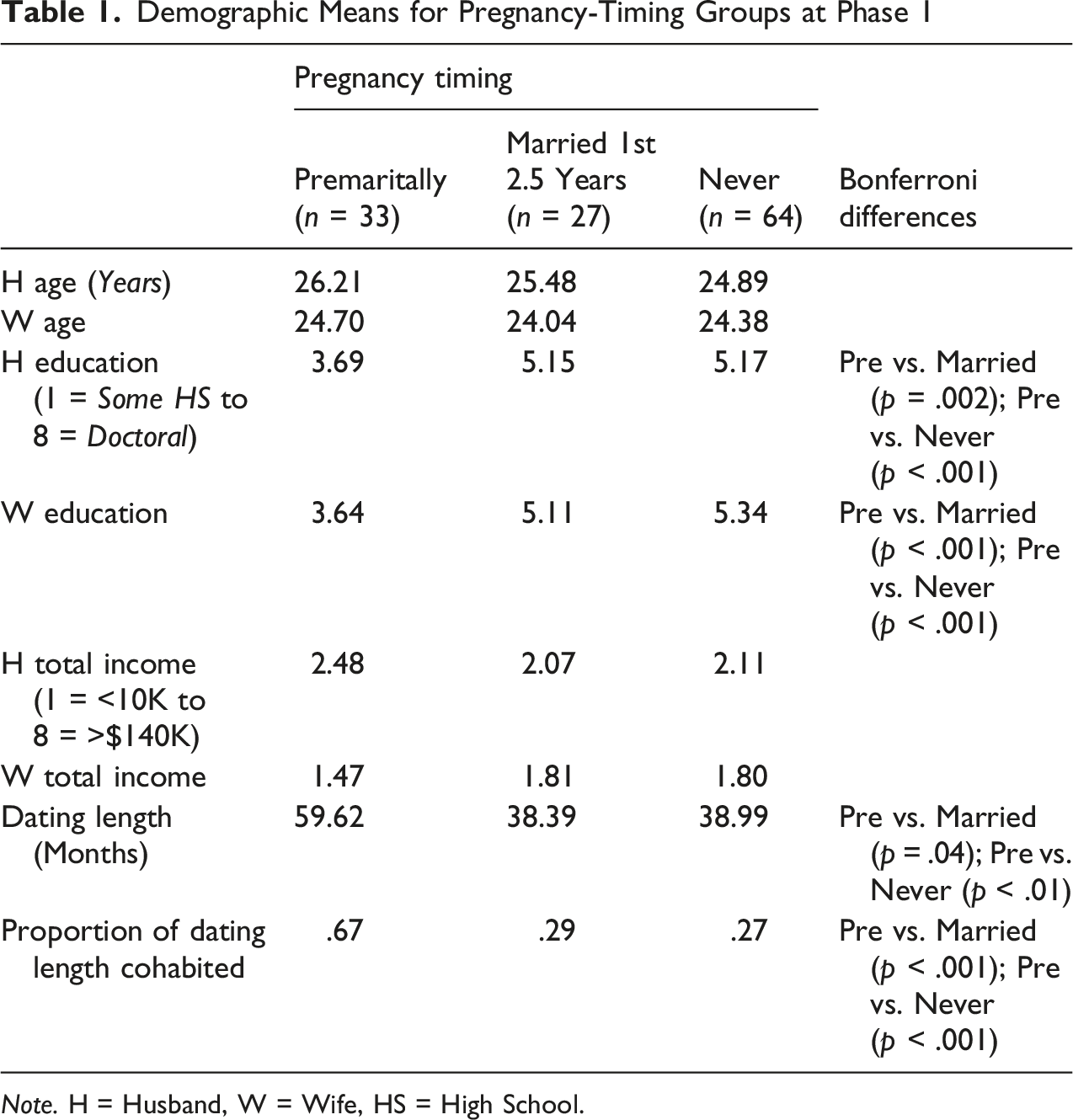
Demographic Means for Pregnancy-Timing Groups at Phase 1
Note. H = Husband, W = Wife, HS = High School.
As shown in Table 1, participants were roughly 24-25 years old at P1, on average. Premaritally pregnant participants averaged around 3.6 on the education variable, corresponding to some training beyond high school (e.g., associate’s degree and technical school). Those who had children after the wedding and those who did not have any children at all exhibited means of roughly 5, corresponding to some college. Husbands’ average total income (means ∼2) corresponded to the interval $10,000–29,999), with wives’ average slightly lower. Whereas couples with a premarital pregnancy dated for over 5 years, on average, those who were postmarital and nonparents dated for roughly 3 to 3.5 years. Finally, because length of cohabitation would be confounded with length of dating, we created a variable for proportion of dating length during which partners cohabited to assess extent of cohabitation. Whereas premaritally pregnant couples cohabited for two-thirds of their premarital relationship, postmarital and nonparents cohabited for roughly 25–30% of their premarital relationship.
Measures
Relationship Disillusionment
The Relationship Disillusionment Scale (Niehuis et al., 2015) was used to measure disillusionment at Phases 1 and 2. Participants rated 16 items (e.g., “Our relationship has changed for the worse” and “I am very disappointed in my marriage”) on a scale from 1 (Strongly Disagree) to 7 (Strongly Agree), with responses averaged into an index on which higher scores denoted greater disillusionment. Among participants present at both waves, internal consistency (alpha) reliability ranged from .85–.97 across husbands and wives at the two waves. Test–retest reliability over the two waves was r = .41 in husbands and r = .48 in wives. Niehuis and colleagues (Niehuis, 2007; Niehuis & Bartell, 2006) found evidence supporting the criterion, construct, convergent, and discriminant validity of the Marital Disillusionment Scale.
Relationship Satisfaction
The Marital Opinion Questionnaire (Huston et al., 1986) was used to measure satisfaction at Phases 1 and 2. It contained 11 semantic-differential word pairs (e.g, “Miserable-Enjoyable,” “Satisfying-Dissatisfying”). Using a 1–7 scale, participants indicated a point either at one of the descriptors (endpoints), close to one of the descriptors, or midway between them, based on what they felt most closely aligned with their perception of the relationship. Responses were coded from 1 (at the negatively worded descriptor) to 7 (at the positively worded descriptor), before being averaged into an index with higher scores denoting greater satisfaction. Alpha reliability ranged from .90–.95 across spouse gender and wave. Test-retest reliability was r = .39 for husbands and r = .36 for wives. Huston and Vangelisti (1991) demonstrated the MOQ’s convergent validity through its strong correlation (r = .79) with the Dyadic Adjustment Scale satisfaction subscale.
Analysis Plan
A three-way Analysis of Covariance (ANCOVA) was used to compare spouses on the dependent variables of marital disillusionment and satisfaction between (a) Phases 1 and 2 (paired comparison of time); (b) the three pregnancy-status groups (between-groups comparison); (c) spouse sex (male/female; paired comparison); and (d) statistical interactions between the three factors. We included several covariates to not only account for possible confounds but also increase statistical power by “soaking up extra noise in a dependent variable” (Wang et al., 2017, p. 118). However, to avoid inflating the Type I (false positive) error rate, associations between the covariates and outcomes and interactions involving the covariate are ignored (Wang et al., 2017). Covariates in the models included the social-science staples (Cherlin, 2009) age, education, income, and Hispanic race/ethnicity vs. all others (dummy variable, which divided the sample roughly half and half on race/ethnicity), and common close-relationship control variables (e.g., Joel et al., 2020) dating length before marriage and extent of premarital cohabitation. To avoid putting too many covariates in any one analysis, we created four sets of covariates (husband demographics; wife demographics; relationship-history variables; and, because relationship satisfaction correlated concurrently with disillusionment at Phases 1 and 2 for husbands and wives from −.31 to −.69, husbands’ and wives’ P1 and P2 satisfaction), with one set included per analysis.
We could not conduct a priori power analyses because the data were already collected, so we instead report a sensitivity power analysis (power for various plausible effect-sizes; Lakens, 2022). With n = 125 and a (potential) medium effect (f = .25), our analysis would have 70% power to detect a two-way interaction involving a between-groups and a repeated-measures factor, and 91% power to detect the same interaction with a medium-large effect (f = .325) (Zhang & Yuan, 2018). Because our model is more complex (i.e., with two repeated-measures variables instead of one, plus covariates), these power determinations are rough estimates.
Results
Relationship Disillusionment
The most robust finding for predicting disillusionment in the ANOVA and ANCOVA models was a Time X Pregnancy Group interaction. With controls for relationship-history variables (dating length and cohabitation), F (2, 116) = 3.32, p = .04 for this interaction. Significance levels for the Time X Pregnancy Group interaction in other versions of the model included: F (2, 112) = 2.87, p = .06 when controlling for men’s demographics; F (2, 113) = 2.89, p = .06 when controlling for women’s demographics; F (2, 113) = 3.12, p = .05 when controlling for both spouses’ P1 and P2 satisfaction; and F (2, 118) = 2.71, p = .07 with no covariates. The form of this interaction (plotted when controlling for dating and cohabitation history) appears in Figure 1. It shows that, whereas average disillusionment rose considerably over time for the premaritally (by .60 point) and postmaritally (by .55 point) pregnant groups, it rose much less sharply for the nonparent group (by .24 point). Mean disillusionment by phase and pregnancy-parenting group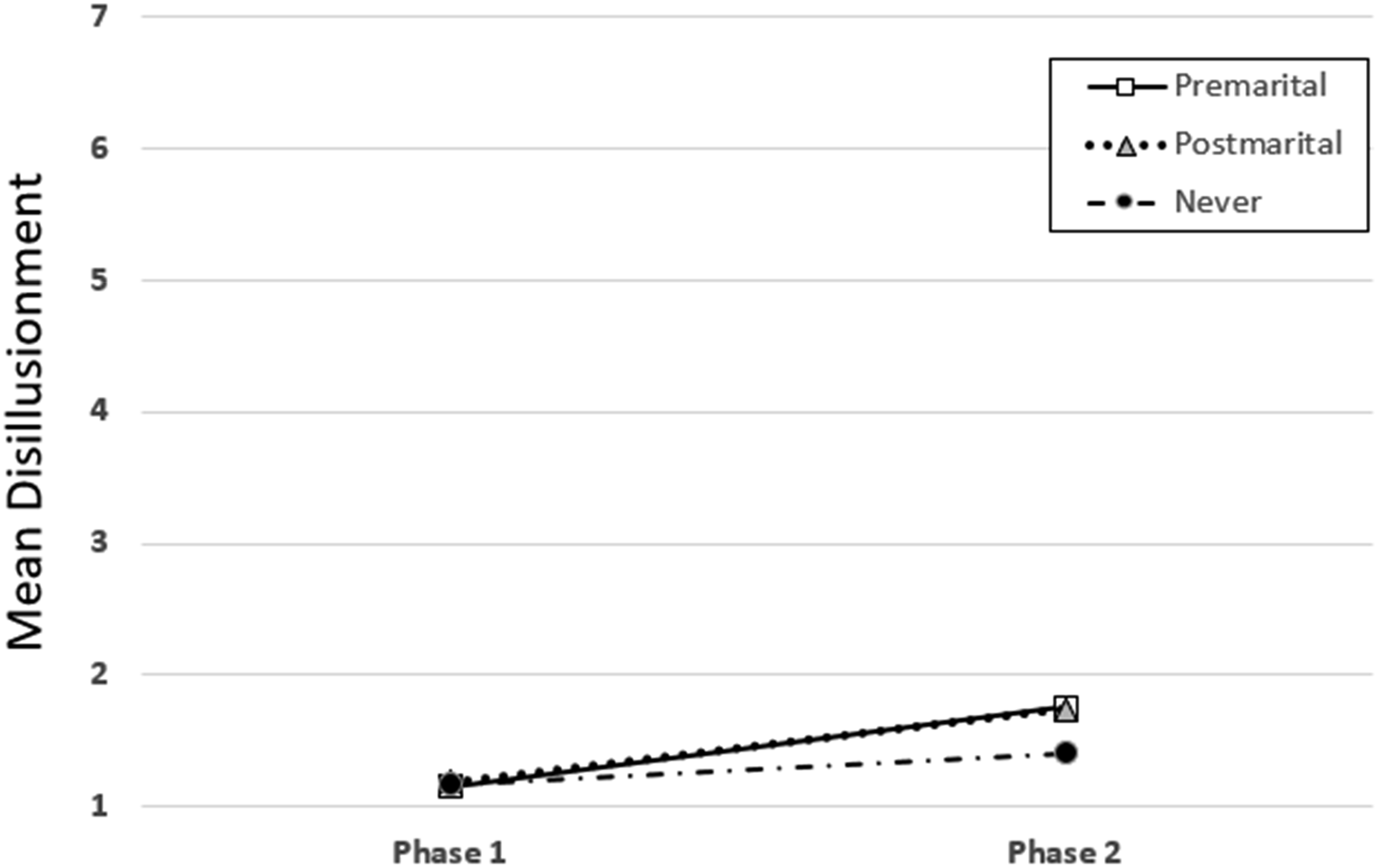
There was a significant main effect of time on disillusionment without covariates (F [1, 118] = 35.80, p < .001), but it became nonsignificant with controls for husbands’ (time effect p = .18) and wives’ (p = .78) demographics. There was also a significant gender main effect without covariates (F [1, 118] = 9.40, p = .003), but this effect washed out with controls for husbands’ (gender effect p = .90) and wives’ (p = .66) demographics.
Relationship Satisfaction
The model without covariates showed significant main effects of time (F [1, 117] = 6.35, p = .01) and gender (F [1, 117] = 4.23, p = .04) on satisfaction. Specifically, satisfaction declined from P1 to P2 and was higher in wives than in husbands. However, the time effect was eliminated (p’s = .36 and .49) with controls for husbands’ and wives’ demographics, respectively. The gender effect was likewise eliminated (p’s = .31 and .86) when controlling for husbands’ and wives’ demographics. Controlling for relationship-history variables washed out the gender effect (p = .30), but the time effect remained significant (p = .01).
One interesting interaction, although significant only when controlling for relationship-history variables, was between time and gender (F [1, 115] = 8.12, p = .005). Whereas husbands’ satisfaction declined from P1 (M = 6.08) to P2 (M = 5.77), wives’ satisfaction was more stable (M ‘s = 6.17 and 6.03) over time.
Discussion
Findings revealed interesting patterns in how husbands’ and wives’ relationship disillusionment and satisfaction varied over time and according to parenting status. H1 posited that parents (regardless of when they were pregnant and gave birth) would experience greater increases in disillusionment and declines in satisfaction after marriage (wedding to 2.5-year follow-up) than consistent nonparents. H2 qualified H1 in predicting further that spouses with postmarital pregnancies (i.e., with the youngest children at Phase 2) would exhibit greater increases in disillusionment and declines in satisfaction than spouses with premarital pregnancies. Results partly supported H1, as the two parent groups exhibited more sharply rising disillusionment from P1 to P2 than the nonparents. These results may reflect childless/childfree couples not experiencing the increases in life disruption and responsibilities that go with parenthood (as described in the opening quote from Huston & Holmes, 2004).
Parenting status was unrelated to relationship satisfaction, failing to support H1 and H2. This finding was inconsistent with prior meta-analyses (Bogdan et al., 2022; Mitnick et al., 2009). In the more recent meta-analysis, however, Bogdan et al. found what they termed a “medium” (roughly −.30 effect-size) decline in satisfaction during the first year postpartum, whereas the decline was “small” (roughly −.15) from 12–24 months postpartum. It is possible therefore that, because all our premarital parents and many of our postmarital parents had been parents for more than a year, parenthood’s effect on satisfaction had diminished, yielding no significant differences due to parenting status. Lack of variability on a measure is also a possible explanation for its lack of association with other variables. Other significant findings emerged in our study for satisfaction, however, suggesting that low variability was not the problem.
The disparity between our significant parenting-status effects on disillusionment but not satisfaction may instead stem from theoretical differences between the two outcomes. As noted, we theorize disillusionment to be heavily driven by violated expectations. In this vein, we suggested several possible mechanisms linking parental status to disillusionment. We proposed that the transition to parenthood could affect individuals’ disillusionment to the extent that one partner did not contribute as much to child caregiving and home maintenance, show supportiveness, or develop as positive a relationship with the child as the other partner expected. Conceivably, the concreteness of these expectations would make a spouse’s failure to fulfill them highly visible to the other spouse. Satisfaction, while possibly affected by violated expectations to some extent, would also be driven by factors such as perceived quality of potential alternative partners, according to social exchange theory. In addition, sleep deprivation (likely to occur in new parents) has been shown to have various deleterious effects on mood, impulsivity, and social-cognitive skills (Deliens et al., 2015), making it likely to decrease satisfaction and increase disillusionment. According to Deliens and colleagues, “sleep-deprived participants report a diminished understanding of their own, as well as of other people’s emotions, indicating a lowered perceived emotional intelligence” (p. 2). Hence, sleep deprivation may lead new parents to perceive and act toward each other in a harsher manner than usual, exacerbating disillusionment. We did not assess these mechanisms directly, however, so they must remain speculative, a limitation future research can address.
Gender Differences
RQ1 asked whether the transition to parenthood would be associated with increased disillusionment and reduced satisfaction more strongly in wives or in husbands. There were few gender-related findings. One that emerged, albeit only when controlling for the dating- and cohabitation-history variables, was that wives demonstrated stably high satisfaction to a greater extent than their husbands, whose satisfaction dropped over time. The latter finding is consistent with a meta-analytic finding (Jackson et al., 2014) that, in nonclinical couples married four or fewer years, wives exhibited higher average satisfaction than husbands. Although the interaction of time and sex emerged only when controlling for relationship-history variables, it carries potentially important implications. Surveying all couples within 6 months of their wedding and following them up roughly 2.5 years later helped hold constant all couples’ time since marriage. Controlling further for dating length and extent of premarital cohabitation helped make couples even more similar to each other (in a statistical sense), increasing our confidence that changes in spouses’ disillusionment and satisfaction truly reflected the context of early parenthood (or non-parenthood) and not other aspects of their premarital and marital relationships.
Strengths and Limitations
As with all studies, the present one had limitations. As noted, we lacked measures of variables representing potential mechanisms. Further, the relatively small, geographically localized sample, drawn partly from convenience sampling, limits the generalizability of the findings. The present study also, however, had several notable strengths. Comparing the disillusionment and satisfaction trajectories of parents and nonparents provides a broader context for understanding the transition to parenthood and shows that some associations with parenthood reflect more than the mere passage of time. In addition, the longitudinal design allows temporal ordering between occurrence of a birth and later relationship quality (although there is also evidence that more satisfied couples are quicker to have a first child; Lawrence et al., 2008). Using a diverse and partly representative community sample (i.e., Hispanic participants’ education resembling Hispanics in the entire state) and including parents with premarital pregnancies help alleviate the previous underrepresentation of certain groups in the TTP literature. The sizable subsample of Hispanic couples (even though no associations were found between the outcomes variables and Hispanic ethnicity) helps document the robustness of our findings across racial/ethnic groups. Further investigation and analysis of diverse groups is strongly encouraged.
Implications
The findings indicate a potential need for parenting education and counseling that addresses the needs of fathers, mothers, and nonparents (with the latter group receiving information on expectations and potential stressors other than pregnancy and parenting, such as economic challenges). Tailored educational materials could help equip couples who become parents with strategies to navigate the associated challenges. Though parents exhibited more sharply rising disillusionment over time than nonparents, parenthood alone is likely not the sole predictor of disillusionment and dissatisfaction in early marriages. Instead, relational challenges could emerge from idealized expectations for marriage in general, as well as for the specific experience of becoming a parent. Twenge et al.’s (2003) meta-analytic finding that presence of an infant had a stronger negative association with marital satisfaction than did presence of a child older than 2 years suggests that relationship quality fluctuates as children grow and parental roles evolve.
Conclusions
In conclusion, different transitions to parenthood (or childless/childfree status) in the early years of marriage were associated with different temporal patterns of disillusionment. Results were also suggestive of gender differences in (in)stability of satisfaction over time. Along with our findings, various features of the present study—its inclusion of disillusionment as a key outcome, a substantial longitudinal follow-up interval including a nonparent control group, and dyadic data—importantly advance the literature and point the field toward pressing future research ideas. Foremost among the latter is the need to directly measure possible mediating mechanisms within longitudinal designs to document temporal ordering among proposed processes from childbirth to violated expectations to marital outcomes.
Footnotes
Authors’ Note
An earlier version of this paper was presented at the 2024 conference of the International Association for Relationship Research, Boston, MA. We acknowledge the many undergraduate and graduate research assistants who have worked on the Newlywed Study, the participating couples who shared their experiences with us, and Carson Dover for providing feedback on earlier drafts of this manuscript. Dr Willis-Grossmann is now at the School of Public Health, Indiana University-Bloomington. Correspondence should be addressed to Dr Sylvia Niehuis, Department of Human Development and Family Sciences, College of Health and Human Sciences, Texas Tech University, Lubbock, Texas, 79409-1230, email:

Ethical Considerations
The study received human-subjects approval at our home university.
Consent to Participate
The study was approved by the Institutional Review Board at the home university. Participants completed a written consent form at each wave, which included the basic elements (e.g., study purpose, procedures, privacy/confidentiality, and ability to cease participation).
Consent for Publication
Not applicable, as no information about specific individual participants is presented.
Author Contributions
Sydney Gendron (undergraduate)—Conceptualized the study, conducted initial analyses under the supervision of Dr. Reifman, and wrote first draft in consultation with two advanced graduate students (now Ph.D. Recipients), Dr. Willis-Grossmann and Dr. Boyles.
Emma Willis-Grossmann—Mentored Ms Gendron in overall execution of the project and with writing, contributed expertise on transition-to-parenthood research to the manuscript, played a large role in data collection as project manager in some years of the longitudinal study, and reviewed manuscript and provided feedback before submission.
Alan Reifman—Provided advice on repeated-measures ANCOVA design, supervised initial statistical analyses and conducted later advanced analyses, and assisted with writing.
Annie Boyles—Helped mentor Ms Gendron and helped with the writing. Reviewed manuscript and provided feedback before submission.
C. Rebecca Oldham—Played a large role in data collection as project manager in some years of the longitudinal study, reviewed manuscript and provided feedback before submission.
Sylvia Niehuis—Developed overall newlywed project as principal investigator, consulted on ANCOVA design for this specific study (especially on covariates to include), monitored team progress in conducting analyses and writing the manuscript, reviewed manuscript drafts at periodic intervals, and provided feedback throughout the process.
Funding
The authors disclosed receipt of the following financial support for the research, authorship, and/or publication of this article: The authors received funding for this research from the College of Health and Human Sciences Undergraduate Research Experience Grant to Ms Gendron and Dr Niehuis; from the Office of the Vice-President for Research, College of Human Sciences, and Department of Human Development and Family Sciences to Dr Niehuis; from the Nancy J. Bell Graduate Faculty Excellence in Mentoring Award to Dr Niehuis, and from the Office of Institutional Diversity, Equity, and Community Engagement to Dr Niehuis, all at Texas Tech University.
Declaration of Conflicting Interests
The authors declared no potential conflicts of interest with respect to the research, authorship, and/or publication of this article.
Data Availability Statement
Because our consent form promised participants that only the immediate research team would have access to individuals’ survey responses, we cannot provide full data files. However, we would like to accommodate those who have questions about our data to the greatest extent possible through aggregated information. For example, if a reader wondered whether an alternative analysis (e.g., using a different technique or controlling for one or more variables not already examined) might change a substantive finding, we would be happy to conduct the proposed new analysis and report back to the reader. As another example, if a reader were concerned about outliers on one or more variables and how we handled them, we would be happy to share univariate frequency distributions of the variables in question. We will also share two-way cross-tabular frequencies, as long as no cell-specific frequency is smaller than 5. Other types of requests will be addressed on a case-by-case basis.