







Abstract
This study investigates the role of close relatives who, while providing support, may also perpetuate prejudice and discrimination against women with widowhood status. Employing a qualitative methodology grounded in a multi-layered phenomenological approach, the research reveals that such prejudices and discriminatory practices are often subtle and normalized. These include perceptions that portray widowed women as incomplete or as bearers of misfortune; narratives that cast suspicion on women for allegedly enticing other men; accusations that they bring curses following consecutive spousal deaths; and the framing of widowhood as a destiny cloaked in affection, which in reality functions as a mechanism of social control.
Introduction
Research on the experience of bereavement indicates that the family generally functions as the primary source of support. In East and Southeast Asian societies, including Indonesia, mourning rituals and family support play an important role in the grieving process (Le et al., 2025). These rituals help individuals adapt to their loss and maintain bonds with the deceased (Lim et al., 2025). Moreover, social networks, particularly the family, are the most important means of providing emotional, social, and material support to bereaved individuals; therefore, the quality of these interpersonal bonds significantly influences the effectiveness of the support provided (Marek & Oexle, 2025). However, in some cases family support is not protective and can turn into psychosocial pressure within the bereavement experience, such as for women grieving the loss of a husband (Öztürk & Yildirim, 2025). Societal perceptions of women who are widowed can affect their access to support and their overall well-being. Therefore, these women often face social isolation and are regarded as a burden by their extended families, which leads to a lack of social support (Motsoeneng & Modise, 2020).
Conceptual framework scholarship indicates that widowhood status is generally framed through social stigma rather than the family dynamics that also shape moral judgments and social boundaries (Odhiambo et al., 2025). However, a systematic review shows that relationships within the nuclear and extended family often constitute the first arena in which women receive judgment, surveillance, or restrictions on movement after losing a husband (Delalibera et al., 2015). As a result, discriminatory practices in the domestic sphere tend to be overlooked and are not recorded as a primary concern in scholarly inquiry (Gaikwad & Rao, 2014). Yet the effects are direct and ongoing for the emotional and social well-being of women who are widowed.
To date, research on this topic has focused more on broader public perceptions, thereby rendering the family’s contributions to the formation, reinforcement, and perpetuation of stigma less visible (Motsoeneng & Modise, 2020). However, a study conducted by Mezzanotte et al. (2022) clearly underscores that the family can be a key actor in reproducing prejudice and discrimination against women following bereavement.
Although it may appear to be an expression of care or protection, it essentially contains elements of control that limit and regulate the morality of women who are widowed (Samal & Mishra, 2023). For example, strict norms surrounding women’s sexuality and modesty further restrict their interactions with men outside their immediate family (Walter, 2016). Through these power relations, the family frames and reconfigures the identity of women following the loss of a husband in accordance with their norms and expectations (Tohan et al., 2025). Accordingly, stigma that emerges in the domestic sphere is often enacted through abstract forms of power that are difficult to recognize as control, thereby leading to subtle prejudice and discrimination (Tohan et al., 2025).
The process of identity reconstruction after the loss of a husband involves reconciling the former self with the present self (Wehrman, 2023). Based on a scoping review, at this stage social interaction and support from others play an important role in the process; therefore, strategies used to reduce stress and build sources of social support are highly beneficial for identity reconstruction (Teichman et al., 2024). However, various forms of restriction packaged as “care” or “protection” often create ambiguity that appears to be support but in fact undermines women’s freedom to act and their ability to make decisions about their own lives, particularly when imposed by close relatives (Hökkä & Aho, 2025).
It is ironic that the family often serves as the first and primary site for constructing moral judgments about the “respectability” of women who are widowed (Chadha et al., 2025). However, the absence of this perspective creates an important gap in the literature, especially in understanding how mechanisms of social control, behavioral regulation, and gender expectations operate at the domestic level (Amoo et al., 2022). In this context, this study is important because it reveals covert forms of exclusion that have long escaped recognition as discrimination, both by society as a public sphere and within the scholarly sphere. This study also offers an approach that weaves together analysis of family dynamics, cultural norms, and the processes of identity formation among women after loss.
By highlighting the complexity of affective relationships within the family, this study reveals layers of discrimination that operate subtly and often go undetected within common theoretical frameworks. This approach also shows that expressions of affection in the family do not always signify support, but can function as a means of moral regulation that directs subtle prejudice and discrimination toward women following bereavement (Moss & Moss, 2014). Accordingly, there is a need for research that positions the family not only as a provider of support, but also as an entity with the potential to produce and enact stigma, prejudice, and discrimination against women after the loss of a husband.
Methods
Study Design
This study uses qualitative methods with a multi-layered phenomenology approach (Kara & Khoo, 2021). This method was chosen because it offers a robust lens for understanding complex phenomena by viewing human experience from multiple angles at once, including the surrounding context (Cipriani et al., 2025). This approach has also proven useful for capturing human experience more deeply and for understanding how individuals interact in their daily lives (Kara & Khoo, 2021), thereby aligning with the aims and objectives of the study, namely, to examine forms of prejudice and discrimination enacted by close relatives toward women who are widowed.
Participants
Participant profiles
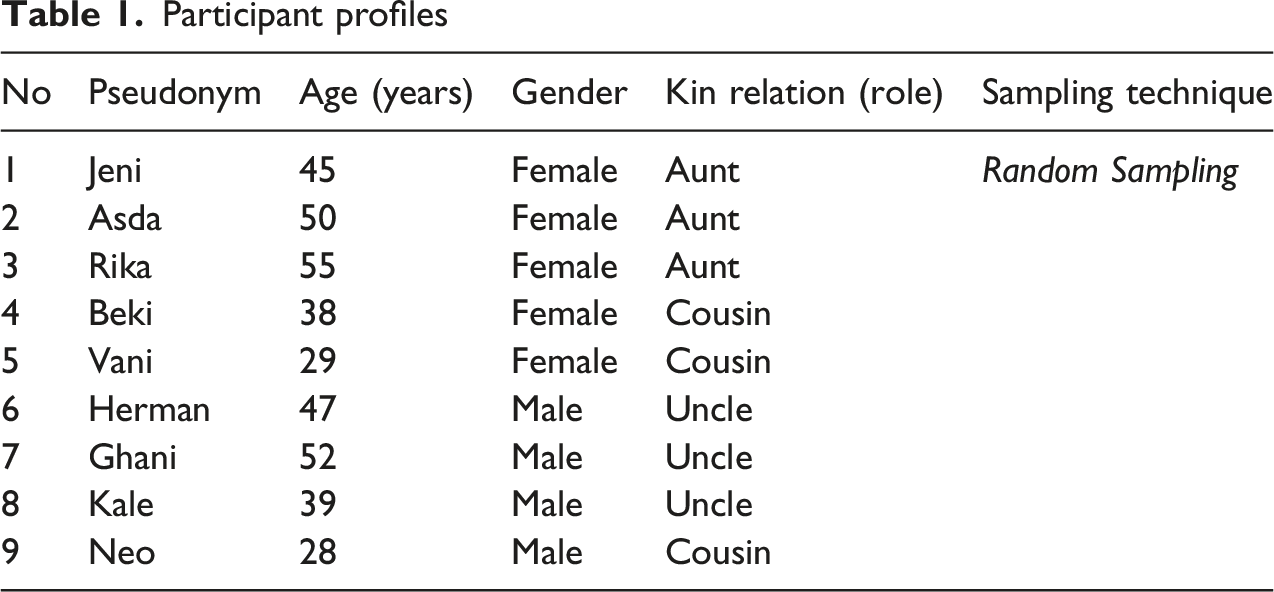
Participants were selected through random sampling, which began with the development of a sampling frame. Once the sampling frame was completed, participants were then selected using random sampling to minimize selection bias and strengthen the validity of the findings. Nine participants were subsequently obtained, namely, Jeni, Asda, Rika, Beki, Vani, Herman, Ghani, Kale, and Neo (pseudonyms), who agreed to share their experiences systematically and comprehensively.
Data Collection
Data collection began with the development of a sampling frame that contained a complete list of close relatives who had a direct relationship with women who are widowed in the study community. From this sampling frame, participants were selected through random sampling to ensure that every individual within the kinship category had an equal chance to be involved in the study, thereby minimizing selection bias and strengthening the validity of the findings. After the sample had been determined, the researcher conducted initial contact and rapport building to create a safe space for participants to share their experiences, particularly because the topic of prejudice and discrimination carries high social and moral sensitivity.
Subsequently, semi-structured in-depth interviews were conducted using a multi-layered phenomenological elicitation approach (Kara & Khoo, 2021), which systematically probed dimensions of relatives’ experience, including corporeality (embodied experience and affect that arise when interacting with women who are widowed), relationality (configurations of relations and power within kinship structures), spatiality (social spaces that enable or constrain interaction), and temporality (shifts in meaning or stance over time). During the interview process, the researcher engaged in bracketing using the epoche technique to hold initial assumptions and avoid premature interpretation that could oversimplify the complexity of relatives’ experiences.
All data were recorded, transcribed verbatim, and supplemented with contextual field notes that documented nonverbal dynamics as well as situational contexts that influenced the production of meaning. This stage ensured that the data collection process was not only procedurally accurate but also consistent with the principles of multi-layered phenomenology, which enable the identification of meaning structures that underpin the emergence of prejudice and discriminatory practices within kinship systems.
Data Analysis
In this study, the multi-layered phenomenology approach was applied by tracing how relatives experience and make meaning of their actions through four existential dimensions, namely, corporeality, relationality, spatiality, and temporality. The analysis began with intensive reading of the transcripts to capture how relatives sensed corporeality when encountering women who are widowed, for example, tension, caution, or a sense of unease that they used to justify restrictions on rituals or interaction. Relationality was explored by examining how relatives negotiate their moral positions as “protectors,” “guardians of family honor,” or “enforcers of custom,” which inadvertently undergird practices of surveillance and social distance. Then, in the dimension of spatiality, the analysis examined how relatives organize social space (who is placed where, who is permitted to participate in particular rituals) and how family space is restructured as a form of moral ordering that they regard as appropriate. Meanwhile, temporality was traced by looking at how relatives construe time as a course of fate, a chain of misfortune, or a “life path” that cannot be altered, which is then used to normalize social restrictions on women who are widowed. By mapping each narrative onto these four existential layers, the analysis reveals how prejudice and discrimination are not only enacted by close relatives but are also experienced, rationalized, and sustained as part of their everyday lived reality.
Ethical Consideration
Ethical approval for the study was obtained from the appropriate university review board. All participants provided informed consent, confirming their full understanding of the study’s objectives, their rights, and the voluntary nature of their involvement. Data were securely stored to safeguard participant privacy, and all procedures were conducted with strict adherence to confidentiality and anonymity.
Trustworthiness
Furthermore, data trustworthiness was implemented following the framework of Lincoln and Guba (1985), comprising (1) credibility: member checking was conducted with two participants to ensure that the analysis truly represented participants’ experiences, and a reflexive journal was maintained to support researcher reflexivity and cultural sensitivity; (2) transferability: transcription was carried out with attention to cultural fidelity and with in-depth description of the forms of prejudice and discrimination enacted by close relatives toward women who are widowed; (3) dependability: a peer review was conducted by two researchers covering the coding process, interpretive logic, and study conclusions to ensure consistency and analytic rigor; and (4) confirmability: all research data were securely archived to build an audit trail and ensure transparency in representing the findings (Maher et al., 2018).
Results
Result categorization
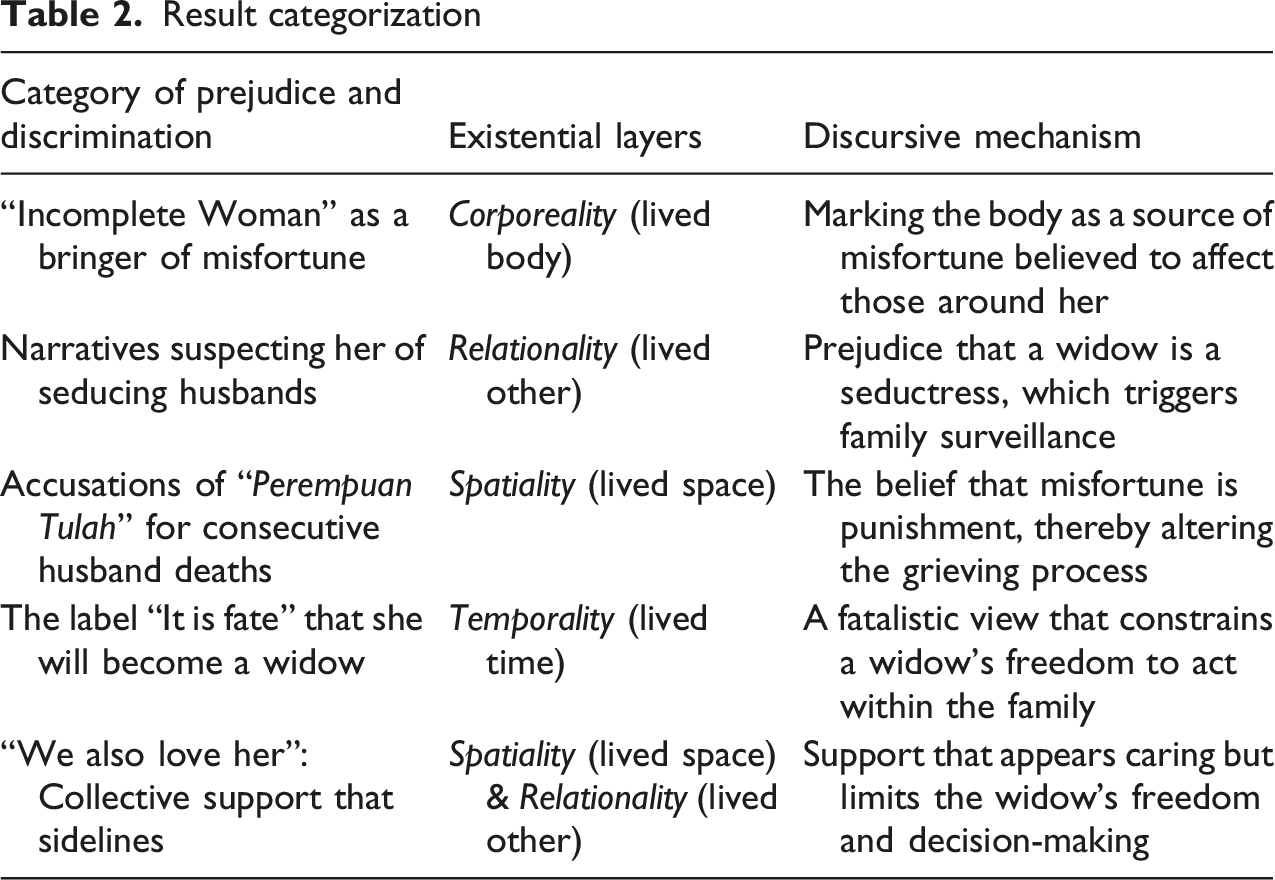
“Incomplete Woman” as a bringer of misfortune
The first theme shows how relatives construe widowhood as a condition of being “incomplete,” which is believed to disrupt the sanctity of the Mapacci ritual sequence, a sacred wedding rite. Close relatives consistently place widowed women in an ambivalent position, accepted as part of the family but restricted in access to ritual activities deemed sacred. Jeni stated, “We still invite her, but she should not hold the pacci, that is not good for the pengganti, it can bring misfortune.” Meanwhile, Asda also affirmed this position through a justification that appears protective but functions as exclusion, such as “It is not to belittle her, it is just that her status now is indeed different, it is better and safer if she only watches.”
These beliefs show that cultural and symbolic layers work together to construct a framework of legitimacy applied to women who are widowed. Widowhood is treated as an attribute positioned outside the standards of ritual purity, so such restrictions are regarded not as exclusion but as an ordinary measure to safeguard the smooth conduct and sacredness of the ritual (in this case, mapacci). At the same time, this rationalization reveals the function of the interactional, or even relational, layer, in which relatives use cautious language to maintain an image of harmonious relations while still regulating social distance. Accordingly, these exclusive actions are not merely a spontaneous response toward women who are widowed, but part of social practices long legitimized by historical-traditional layers and grounded in moral beliefs about what is proper in a ritual context. This aligns with Rika’s statement that “Women who are widowed, that is just how it is from the outset, they are not allowed to participate in the mappacci ritual.”
Narratives Suspecting Her of Seducing Husbands
The second theme reveals how close relatives frame widowhood as a potential threat to the stability of other households. At the level of personal experience, relatives narrate these suspicions as a form of moral vigilance that gives rise to negative narratives. Vani stated, “She is kind, but she still needs to be kept at a distance… after all, she is on her own now, we do not know what might happen.” Beki then articulated a similar concern, “Not to accuse, but if she is often too close, people can misunderstand.”
However, Asda explicitly expressed concern that another widowed relative is highly suspected of seducing a husband, because her house is adjacent to that family. Therefore, this justification indicates that the relational layer operates when close relatives express social control packaged as relationship management in order to avoid gossip. However, this suspicion does not stand alone, but is supported by the cultural-symbolic layer, in which the widow is constructed as a liminal figure, that is, outside the category of the “Safe” wife and not yet within the category of the “Clear” single woman. This ambiguity of status makes the woman vulnerable to being suspected as a “Perebut perhatian” in the social imagination of relatives. The tension between “Niat melindungi keluarga” and these exclusionary practices shows how the moral-spiritual layer functions as a justification, in which keeping distance is regarded as a highly moral act, while indirectly reinforcing the sexual stigma attached to widowed women.
Accusations of “Perempuan Tulah” for Consecutive Husband Deaths
In this theme, relatives interpret the successive deaths of husbands as an indication that the woman carries “tulah,” that is, a moral-spiritual charge believed to trigger a chain of misfortunes. This explanation operates through a cultural-symbolic framework that links tragedy with an individual’s moral quality, so bad luck is treated not as coincidence but as a sign of imbalance carried by the woman herself. Herman stated, “If her husbands die in succession like that… there must be something. It is not just ordinary fate,” and Ghani added, “Sometimes there are people who bring misfortune without realizing it.” Through these statements, it becomes clear how relatives narrate and reflect on the concept of “tulah” as an explanatory frame that organizes their understanding of successive deaths, thereby forming an interpretive pattern rooted in tradition and handed down as a guide for reading misfortune in the family.
The belief that the woman carries “tulah” then influences how relatives interact with her and make social decisions about her. In interviews, relatives conveyed that they began to keep their distance and manage her involvement more carefully, albeit without overt rejection. Vani described this change in attitude by saying, “It is not that we avoid her, but we must be more careful… afraid we might be affected too,” while Kale noted, “If there is a family event, she is still invited, but she should not be too close either.” This subtle avoidance shows that the “tulah” narrative does not stop at the level of meaning, but shifts into a mechanism for regulating social distance. Accordingly, construing the woman as a source of misfortune, which previously functioned as an interpretive framework, has transformed into a discriminatory practice legitimized as ordinary, so the widowed woman remains accepted as part of the family yet is placed in a relationally vulnerable position that is treated with caution.
The Label “It Is Fate” That She Will Become a Widow
The fourth theme shows how relatives use the “fate” narrative as a way to make meaning, normalize, and simultaneously distance themselves from the loss experienced by widowed women. At the moral-spiritual layer, the concept of fate functions as a language that soothes relatives’ emotional discomfort; rather than acknowledging the intensity of grief or the social injustice that may accompany widowhood, they shift it into something “determined.” Neo said, “That is just the way it goes, she was indeed fated to be a widow,” while another informant added, “Sometimes people’s path is simply set that way.” These statements show how the fate narrative is employed as an interpretive framework that gives an impression of resignation, yet substantially shifts the focus from suffering and structural context toward a metaphysical explanation that cannot be questioned. Accordingly, fate becomes not only a spiritual explanation but also a cultural-symbolic mechanism that renders widowhood an ostensibly natural condition rather than a product of social relations laden with prejudice.
The belief that widowhood is “a life path already determined” then moves from the realm of meaning into relational practices that constrain the woman’s scope for agency. At the interactional layer, the fate narrative functions as a justification that weakens the urgency to provide emotional support, to involve the widowed woman in important family decisions, or to acknowledge her capacity as an individual capable of directing her own life. Jeni illustrated this when she said, “We feel sorry for her, but what can be done? That is simply her fate,” showing how fate is used to reduce the family’s moral and social responsibility. In this way, the fate narrative becomes a metaphysical device of legitimation that normalizes the marginal position of widowed women: if that status is regarded as inevitable, then social restrictions appear as reasonable consequences rather than discriminatory actions. Ultimately, the discourse of fate is not neutral; it converts resignation into a subtle yet effective structure of exclusion that maintains social distance and prevents more egalitarian changes in relations.
We Also Love Her: Collective Support That Sidelines
The fifth theme reveals the most subtle form of prejudice, in which support that is claimed as “affection” in practice functions as a mechanism of exclusion wrapped in protective language. At the relational level, relatives position restrictions as a reasonable form of care, so the act of distancing a widowed woman from social spaces is not seen as exclusion but as a step to protect the family’s dignity. Herman stated, “She is family, so we look out for her… she should not get too involved so she does not become the subject of gossip,” while Kale added, “It is a pity if she is misunderstood by people, so it is better for her to just rest at home.” These statements affirm a paternalistic pattern in which relatives assume the position of those who know what is “best,” while simultaneously determining the boundaries of a widowed woman’s movement in the name of social caution. At the cultural-symbolic level, the rationale of “keeping her away from talk” becomes a seemingly reasonable norm, yet structurally it reinforces social restrictions without having to state them as rejection.
This protective narrative then moves into the moral-spiritual layer, where social restrictions are framed as moral actions that heighten relatives’ legitimacy to regulate a widowed woman’s freedom of movement. By using language such as “caring for,” “protecting,” or “preventing misunderstanding,” relatives not only normalize exclusion but also construct a self-image as actors who are acting ethically. Neo said, “She already has too many burdens, so there is no need to trouble her further in decision-making,” showing how worry is attached to practices that in fact reduce the woman’s social participation in the extended family. In this context, affection becomes an instrument of exclusion that is not recognized as discrimination because it has been fused into moral justification. This is the irony at the core of the findings, because support from close relatives appears to be given, yet it takes a form that consolidates relational inequality, making empathy a medium for legitimizing the subtle but persistent exclusion of widowed women by their own close relatives.
Discussion
The findings show that prejudice and discrimination from relatives toward widowed women arise through meaning structures that are not only interpersonal in nature but also materialize across four existential layers, corporeality, relationality, spatiality, and temporality, as in the framework of multi-layered phenomenology (Ergün-Başak, 2024; Lamba, 2025; Tal et al., 2024; Ugwu et al., 2020). These patterns do not appear as explicit hostility, but as everyday practices regarded as “morally right” by close relatives. When close relatives interpret widowhood through body, space, time, and relations, they produce forms of moralized discrimination (Ajayi et al., 2019; Ude & Njoku, 2017) that are difficult to recognize as discrimination because they are wrapped in the language of tradition, politeness, and affection. Here lies the fundamental irony, because the family ought to be a source of protection, yet it becomes biased in producing prejudice and subtle discrimination toward women who are widowed.
In the first theme, widowed women are designated as “incomplete” and “bringers of misfortune,” a construction that operates at the layer of corporeality (lived body). Women’s bodies are treated not merely as physical bodies, but as symbols deemed capable of contaminating the sacredness of family rituals. The discursive mechanism of “marking the body as a source of misfortune” shows how the body becomes a medium of collective morality (Ornella et al., 2015). When relatives say that a widow’s presence can “affect the luck of the bridal couple,” they are not describing a fact, but activating a symbolic belief that governs who may touch ritual objects and who may not. These restrictions appear subtle, but they constitute a form of existential discrimination that reduces a woman’s body to a symbolic threat.
The second theme moves to the layer of relationality (lived other), in which widowed women are positioned as a risk to family harmony through the “seductress” prejudice that triggers surveillance. The discursive mechanism that leads to the “prejudice casting widowed women as seductresses” aligns with Cosacov (2019), who notes that at times relatives feel the need to keep their distance in order to preserve family morality so that presumed negative suspicions can be avoided. This suspicion is not based on concrete experience, but arises from a relational schema that marks widowed women as a “potential disturbance” (Martinez et al., 2025), leading relatives to limit men’s interactions with widowed women, to recommend physical distance, or to arrange seating positions at family gatherings. Here, social relations become an arena for the production of prejudice, and the family performs a function of social control that marginalizes women in the name of caution (Schultner et al., 2024).
In the third theme, the category of “Perempuan Tulah” operates strongly at the layer of spatiality (lived space). The accusation that a woman carries “tulah” not only explains misfortune but also modifies the social spaces she may enter. The discursive mechanism “the belief that misfortune is punishment” (belief that misfortune is punishment) constructs widowhood status as a center of moral risk, so that certain family spaces become inappropriate for her to enter (Platzer, 2018). From the perspective and consensus of participants, space is not a physical entity but a moral experience, so when relatives avoid a woman with widowhood status “so as not to be struck by calamity,” they alter the relational configuration and the spaces of family interaction (Rahmawati, 2025). As a result, spaces that were previously communal are transformed into segregated spaces that constrain the presence of women who are widowed.
The fourth theme involves the layer of temporality (lived time) through the narrative that “it is fate that she will become a widow.” Relatives frame widowhood as a life course set from the outset, so all forms of social difficulty are regarded as a natural consequence of her “life path.” The discursive mechanism that leads to the “fate perspective that constrains a widow’s freedom to act” adopts a pattern of spiritual bypassing (Dorais et al., 2025), in which spiritual explanations are used to negate the need to offer empathy or active affective support. By placing the woman within a timeline of fate that cannot be changed, relatives reduce her autonomy and justify the continuation of social restrictions as something unavoidable. As a result, time that ought to be a process of recovery becomes a framework for justifying exclusion (Odhiambo et al., 2025).
The fifth theme combines the layers of spatiality and relationality, because support that appears loving in fact produces exclusion through restrictions on social space and relations. Relatives express that a widowed woman “should not get too involved so she does not become the subject of gossip,” a discursive mechanism that packages social control as protection. This phenomenon can be understood as benevolent discrimination (Romani et al., 2019), in which actions that appear caring actually reduce women’s freedom and decision-making. By disguising restrictions on freedom of movement as a form of care, the family creates conditions in which the widowed woman loses access to decision-making, family gatherings, and social activities she once engaged in, with the effect that an affection that ought to be inclusive becomes exclusive.
Overall, the five findings show that relatives’ prejudice and discrimination operate not through malicious intent but through lived structures that shape experiences of the body, space, time, and relations. A multi-layered phenomenology underscores that discrimination can be rooted in social life taken as normal, so families do not realize that actions they regard as “protective” actually diminish the autonomy and dignity of widowed women. The greatest irony is that emotional closeness does not prevent the reproduction of prejudice; on the contrary, closeness becomes the most effective medium for normalizing harmful practices because it is framed in morality, spirituality, and affection (Makashvili et al., 2018; Talaska et al., 2008).
Conclusion
This study shows that the family’s symbolic power operates most forcefully when it goes unnoticed, generating subtle bias through deep social restrictions, thereby producing prejudice and discrimination against widowed women, such as the “incomplete woman” as a bringer of misfortune, narratives suspecting her of seducing husbands, accusations of “Perempuan Tulah” for consecutive husband deaths, and “We love her”: collective support that sidelines. These findings affirm that kinship relations are not only an arena of emotional closeness but also a site for the reproduction of social meanings that can soften, normalize, and entrench prejudice and discrimination.
Limitations and Suggestions
The main limitation of this study lies in the data focus that comes entirely from relatives’ perspectives, so the dynamics of prejudice and discrimination can only be traced through the actors’ discursive mechanisms and do not probe the lived experience of women who are widowed. Reliance on this one-sided narrative may obscure certain forms of bias, particularly moral and cultural biases that are considered “normal” by relatives but may be felt as far more oppressive by the affected women. In addition, the kinship context and strong local norms may influence how informants self-censor, especially when discussing practices that are morally or socially sensitive.
Therefore, future research is recommended to integrate the perspectives of women who are widowed, or to use dyadic and cross-perspectival approaches, so that the tension between relatives’ justifications and actual experience becomes more transparent. A longitudinal approach can also enrich understanding of how these subtle prejudices change or persist over time within family relationships.
Footnotes
Acknowledgement
We extend our heartfelt thanks to all the participants and generously shared their time and experiences with us. Their courage and openness made this study possible.

Ethical Considerations
Ethical approval for the study was obtained from the appropriate university review board.
Consent to Participate
All participants provided informed consent, confirming their full understanding of the study’s objectives, their rights, and the voluntary nature of their involvement. Data were securely stored to safeguard participant privacy, and all procedures were conducted with strict adherence to confidentiality and anonymity.
Author Contributions
Muhammad Rafli Anugrah: Conceptualization, Methodology, Project administration, Software, Data collection, Formal analysis, Writing—original draft, Writing—review and editing. Nurul Alwiah: Data collection, Formal analysis, Visualization, Validation, Participant recruitment, Writing—review and editing.
Funding
The authors received no financial support for the research, authorship, and/or publication of this article.
Declaration of Conflicting Interests
The authors declared no potential conflicts of interest with respect to the research, authorship, and/or publication of this article.
Data Availability Statement
The data that support the findings of this study are available from the corresponding author upon reasonable request.
Generative AI Statement
The authors acknowledge the integration of generative artificial intelligence tools in the preparation of this manuscript. Specifically, Microsoft 365 Copilot was utilized as an assistive resource during the drafting, revision, and structural organization of the text. All intellectual content, scientific interpretations, and conclusions presented herein are entirely attributable to the authors. The authors declare that Gen AI was used in the creation of this manuscript. The authors acknowledge the use of M365 Copilot as an assistive tool in the drafting, revision, and organization of this manuscript. All intellectual content, scientific interpretations, and conclusions remain the sole responsibility of the authors.