






Abstract
The rise of voluntary childlessness among men represents an important shift in family formation, yet research in this area continues to focus primarily on women. Drawing on 20 semi-structured interviews with childless men from Santiago de Chile, this article explores the experiences of men who opted for permanent sterilization as a strategy to forgo fatherhood. The findings show that orientation towards autonomy, individualism, and hedonism, alongside the pursuit of personal passions and projects, are key factors in men’s decision to forgo fatherhood. At the same time, concerns about time poverty, prohibitive living costs, fears of failing as a parent, and an uncertain future also emerge as decisive issues in their decision. These insights advance current scholarship on voluntary male childlessness by highlighting that reasons for forgoing fatherhood span from personal motivations to social and structural pressures, reflecting emerging societal changes and challenges around family formation.
Introduction
Fertility is declining worldwide with an increasing number of people not becoming parents. Research on childlessness has centred on women’s experiences, with men who voluntarily choose not to have children remaining a largely understudied group, particularly in low- and middle-income countries (Keizer & Ivanova, 2017; Pérez, 2021). Yet, recent evidence suggests that, like many women, an increasing number of men are actively choosing not to have children (Kessler et al., 2013; Maříková, 2021; Miettinen et al., 2015; Smith et al., 2019). This limited attention to men’s reproductive behaviour leaves many important questions unanswered (Almeling & Waggoner, 2013; Inhorn et al., 2016). Understanding men’s perspectives on family and fatherhood is essential to fully grasp the reconfiguration of reproduction underlying the fertility decline currently unfolding in many countries around the world.
This article explores the experiences of childless men who have undergone vasectomy as a strategy to forgo fatherhood in Chile, a country where the Total Fertility Rate (TFR) has dropped steeply to 0.99 (INE, 2026), the lowest in the Americas and one of the lowest in the world (Yopo Díaz, 2025a). Rather than offering a causal explanation for the fertility decline in Chile, this article provides an empirical foundation for understanding one of the emerging reproductive trends contributing to decreasing birth rates: voluntary childlessness and the decision of adult men not to become fathers. This approach provides unique insights into men’s contemporary reproductive behaviours as well as wider societal changes and challenges around family and fatherhood.
Background
Fatherhood
Men’s family roles and responsibilities have undergone profound transformations in recent decades (Inhorn et al., 2016; Miller, 2010). Historically, fatherhood has been central to men’s lives and identities, serving as a key marker of masculinity. Within hegemonic models, assuming the role of father and being the family provider have been considered central markers of adult manhood (Connell & Messerschmidt, 2005). While virility and the capacity to produce children, as well as provision for dependants, reinforced a man’s masculine status, unemployment and engagement in reproductive tasks such as childcare were framed as endangering manliness (King, 2015). Although fatherhood remains and important marker of masculinity and adulthood, recent studies suggest that becoming a parent and having children are no longer perceived and practiced as defining attributes of manhood (Smith et al., 2019; Yopo Díaz & Watkins, 2025).
Traditionally, models of fatherhood have been based on the idea of emotionally distant and disengaged breadwinners, whose involvement in family life is limited to providing financial support and disciplining children (Maskalan, 2016). While traditional notions of fatherhood emphasized distance and authority, recent cultural and social transformations are reshaping what it means to be a father. Despite enduring gendered expectations and institutional structures that continue to link fatherhood to authority and economic provision (Miller, 2011), shifts towards gender equality have challenged the traditional gendered division of labour, pushing fathers to take active involvement in housework, childcare, and unpaid domestic chores, leading to changes in attitudes towards fatherhood (Tan, 2017). Nowadays, there is a complex interplay between the enduring expectations of the traditional provider and the emerging ideal of the emotionally involved, caring father (Hunter et al., 2017), reflecting changing norms around parenting and caregiving (Elizalde-San Miguel et al., 2019).
Contemporary fatherhood now encompasses diverse and active caregiving roles, including controlling the timing and spacing of reproduction, co-parenting, and providing emotional and practical support to children (Inhorn et al., 2016; Joshi, 2021). Fathers increasingly engage in everyday care, from feeding and bathing young children, to assisting with homework and attending parent–teacher conferences (Inhorn et al., 2016). These new models of fatherhood have also been influenced by intensive parenting, an ideology that redefines having and raising children as a process that is child-centred, expert-guided, emotionally absorbing, labour-intensive, and financially expensive (Faircloth, 2023; Hays, 1998). This influence suggests that childrearing is also becoming a much more labour-intensive and demanding task for men.
As the parental role becomes more demanding, men increasingly perceive prerequisites before embarking on parenthood (Hviid Malling et al., 2022). These include being in a stable relationship, achieving financial security, securing stable housing and employment, fulfilling career aspirations, and readiness to relinquish personal freedom. Striving to meet these life goals before considering parenthood often leads to postponing or forgoing family formation (Hviid Malling et al., 2022).
Childlessness
One of the key transformations in contemporary fatherhood is the growing number of men who are choosing not to have children. This shift is part of broader changes in cultural norms and social expectations around family formation, where the prevalence and acceptance of childlessness have grown steadily in recent decades (Merz & Liefbroer, 2012; Mynarska & Rytel, 2019). While childlessness can result from a range of personal, biomedical, or circumstantial factors, voluntary childlessness refers specifically to a conscious, deliberate, and often permanent decision not to become a parent (Shapiro, 2014).
Research on childlessness has centred mainly on women’s experiences and motivations around family formation (Abma & Martinez, 2006; Hummer, 2024; Kreyenfeld & Konietzka, 2017; Merz & Liefbroer, 2012; Miettinen et al., 2015; Shapiro, 2014; Tocchioni et al., 2022). Studies addressing men who do not have children have focused primarily on infertility, portraying childlessness as an involuntary condition that shapes identities, relationships, and life trajectories (Hadley, 2021).
The few existing studies on voluntary male childlessness have been conducted in the Global North and indicate that the number of individuals identifying as childfree, undecided, or ambivalent has increased (Neal & Neal, 2025). In the United States, Bozick (2022) showed that there is an increasing disinterest in becoming fathers among childless men. Similarly, a study conducted in the Czech Republic reveals that the expectation to become a parent is weakening amid recent social transformations altering perceptions of life opportunities and available resources (Maříková, 2021). Recent studies also suggest that voluntary childlessness is gaining increasing prevalence compared to involuntary childlessness. A study conducted in the United States found that most childfree adults were early articulators who decided in their teens or twenties not to have children, rather than postponers who decided not wanting to have children much later in life (Neal & Neal, 2022).
Non-parents vary in their attitudes toward having children and in whether they face barriers to family formation (Neal & Neal, 2025). Some studies show that men’s childlessness intentions are shaped by personal values, life goals, and perceptions of readiness for parenthood. For many, the decision not to have children is influenced by a desire for autonomy, self-realization, and lifestyle flexibility (Avison & Furnham, 2015; Hviid Malling et al., 2022). For example, in Denmark and Sweden, Hviid Malling et al. (2022) showed that many men associated having children with loss of freedom such as the freedom to establish a career, travel around the world, and do what they want when they want. Therefore, being ready to give up freedom and individuality were factors that affected participants’ attitudes towards parenthood.
However, emphasis on the role of freedom, autonomy and individualism shaping men’s reproductive experience tends to overlook the diversity of motivations and the multiple pathways that lead individuals to choose voluntary childlessness (Shapiro, 2014). Men’s attitudes toward parenthood are also shaped by social conditions that determine when and under what circumstances it is appropriate to have children. Many men express a desire to follow the “right chronology”: get educated, having a stable relationship, employment and a good financial status before having children (Hviid Malling et al., 2022). Although most men reported feeling mature enough for fatherhood, they often believed they lacked the necessary conditions to do so (Hviid Malling et al., 2022). These perceptions are reinforced by concerns about the negative dimensions of childcare, including the demands on time and energy as well as the associated financial costs, which have been shown to correlate with lower desires to have children (Mynarska & Rytel, 2019). Broader structural and cultural factors further contribute to men’s decisions to forgo parenthood, including fear of fatherhood, negative personal experiences with parenting, lack of positive role models, economic instability, uncertainty about the future, and limited social support, among others (Tori et al., 2023).
The Current Study
This article advances current scholarship on voluntary male childlessness by empirically exploring the experiences of men in Chile who opted for permanent sterilization as a strategy to forgo fatherhood. Together with broadening the cultural and geographical scope of current scholarship on voluntary male childlessness, Chile represents and interesting case to empirically explore men’s experiences around not having children due to a substantive reconfiguration of reproduction in recent decades.
In Chile, as in the rest of Latin America, fatherhood has been central to male identity, constituting one of the most significant experiences in a man’s life (Viveros Vigoya, 2001). At the same time, men have been depicted as absent and irresponsible fathers who often abandon their children and play a marginal role in their care and upbringing (Gutmann, 1996; Montecino, 1996). In Chile, fatherhood also has an important historical burden, rooted in an authoritarian and emotionally distant male figure, disengaged from domestic and caregiving roles (Montecino, 1996). This cultural imaginaries of fatherhood have been reinforced by legislation and public policy. Until 1998, the law established that children born outside marriage were “illegitimate” (Biblioteca del Congreso Nacional de Chile, 1998), exempting fathers from all social, economic, and affective responsibilities. To date, fathers are entitled to only 5 days of parental leave and less that 1% of fathers make use of the parental postnatal leave extension benefit (Benvin & Olmedo, 2020).
However, in recent years, changes in gender roles, ideals of parenthood, and childhood status have challenged traditional models of authority and family structure in the country (Sembler & Valencia, 2023). Men’s role as authority figures, family breadwinners or absent fathers have started to shift amid more dialogical forms of authority, greater sharing of domestic responsibilities, and a decline in the proportion of male-headed households (Olavarría, 2014; Sembler & Valencia, 2023). These shifts are driven by increasing demands for gender equality, the influence of feminist movements, and societal emphasis on co-responsibility in childrearing, reflecting changes in family configurations, father involvement, and gender roles within Chilean households.
One clear indicator of these changes is the growing attention to child support and paternal responsibility. In Chile, where most child support cases are filed by women and non-payment remains widespread, cultural and institutional demands are challenging the normalization of paternal absence. Until recently, non-compliance with family court–ordered child support payments exceeded 84%. The recent National Registry of Child Support Debtors enforces economic co-responsibility in parenting and caregiving through the public regulation of non-compliant parents, driving important transformations in social expectations and institutional regulations around fatherhood (Vargas Pavez & Pérez Ahumada, 2021; Yopo Díaz & Fuentes-Landaeta, 2024).
These transformations around fatherhood are also reshaping men’s intentions and practices towards having children. Data from the Ministry of Health show that the number of vasectomies in Chile increased by 1,796% in the last 15 years, rising steeply from 455 in 2010 to 8,627 in 2024 (MINSAL, Ministerio de Salud, 2026). This trend emerges amid broader transformations in reproductive patterns, with an increasing number of young men expressing no desire or intention to have children. According to data from the National Youth Institute, more than 35% of Chilean men between 15 and 29 without children, declare not wanting to become fathers (INJUV, 2023). Building on these trends, this article seeks to understand why men in Chile are increasingly choosing permanent sterilization as a means to forgo fatherhood. By examining the personal, social, cultural, and structural factors shaping this decision, this article aims to illustrate the rise in voluntary male childlessness amid declining fertility in a context where fatherhood is being simultaneously required, regulated, and redefined.
Methods
Sample and Participants
The findings presented in this article are based on data from semi-structured interviews conducted with 20 childless men who had a vasectomy as a strategy to forgo fatherhood. We recruited participants through social media platforms such as Instagram and Facebook, informative posters in medical centres and subway stations, through personal networks, and via snowball sampling. The recruitment materials invited childless men who had undergone a vasectomy to participate in a study on reproductive experiences in Chile. Those interested, or seeking further information, were encouraged to contact the research team via the email address provided. No incentives were offered to participants.
Sociodemographic Characterization of the Sample
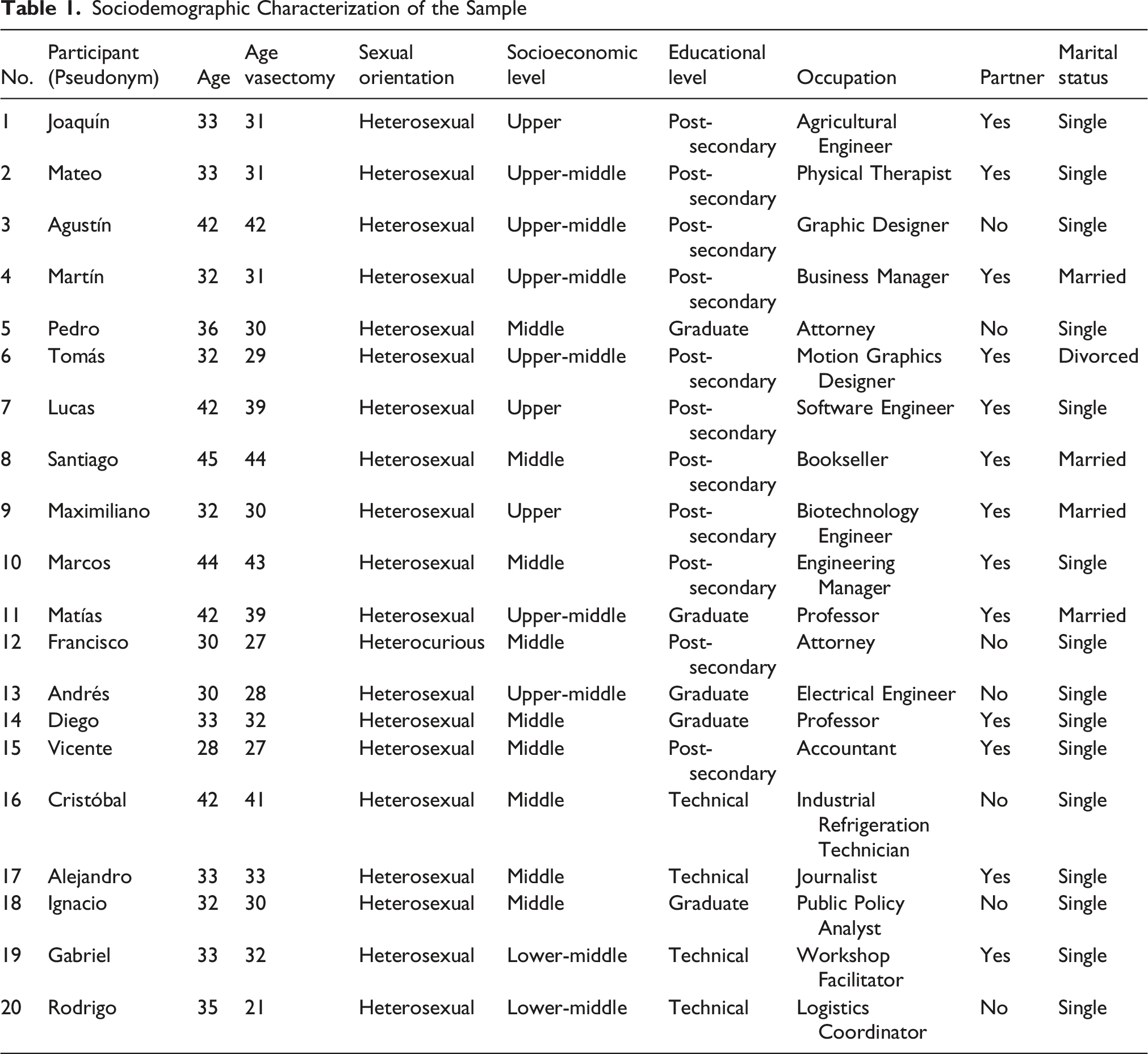
Due to data limitations, it is not possible to know exactly how many Chilean men who have a vasectomy are childless. Evidence elsewhere suggests that most men who undergo vasectomy are already fathers who have completed their desired family size (Lamberts et al., 2017; Najari et al., 2021). However, it has also been suggested that an increasing number of childless men are resorting to permanent sterilization (Huang et al., 2023). So, while our sample might not be representative of the population of Chilean men with vasectomies, its unique value lies in its potential to empirically explore increasing trends of permanent sterilization among childless men and to understand how men engage with vasectomy as a reproductive strategy to enact voluntary childlessness and forgo fatherhood.
At the same time, while our sample of urban and mostly well-educated men shares important sociodemographic features with men who have vasectomies elsewhere (Pile & Barone, 2009), it is important to note that the sample is not representative of Chilean men and that their age, class, cultural capital, and place of residence could have made them more inclined toward co-responsibility in caregiving and intensive fatherhood. These sociodemographic differences, and their implications for perceptions and practices around parenthood, should be considered when generalizing the findings to make sense of fatherhood for other men.
Data Production and Analysis
We used a qualitative research design (Denzin & Lincoln, 2005) to privilege rich and thick descriptions of a small number of cases to gain an in-depth understanding of men’s experiences forgoing fatherhood through vasectomy. The semi-structured interviews were conducted in Spanish between June and August 2023 and took place in cafés, the house of the interviewees, or the workplace of the research team. The interview guide included questions related to men’s reproductive intentions, their decision not to have children, and their views on fatherhood and family. The interview also covered issues related to perceived conditions required to raise children and their perceptions on changing gender roles and responsibilities. Questions were open-ended to allow deep, detailed, and unexpected insights into their experiences of voluntary childlessness. We were positively surprised by the men’s willingness to discuss their decisions to forgo fatherhood, particularly given that fatherhood is often assumed to be the natural and expected path for men – and not having children is commonly viewed negatively. Many expressed a strong desire to make their experiences visible, emphasizing the importance of questioning dominant norms around fatherhood and shedding light on alternative reproductive choices such as voluntary childlessness.
We recorded the interviews using digital recorders. The audio files range from 40 to 98 minutes and have an average duration of 72 minutes. The interviews were transcribed by a research assistant using a flexible verbatim method and later checked for accuracy using the original recording. The interviews were analysed through thematic analysis (Ayres, 2008) and coded through open, axial, and selective coding (Strauss & Corbin, 1998) using NVivo14. The research team conducted the analysis by 1) reviewing the transcripts, 2) noting emerging topics, 3) identifying preliminary codes, 4) creating a code book, 5) organizing the data according to the codebook, and 6) identifying patterns in the data. Sampling decisions of empirical material presented in this article aimed at selecting relevant quotes to illustrate why men forgo fatherhood through vasectomy.
Ethics and Positionality
This study was reviewed and approved by the Ethics Committee of Universidad Diego Portales (N°017-2023). Participants received detailed information about the study, including benefits, potential risks, participation details, and specifications regarding audio recording, data storage, and confidentiality. All participants signed informed consents. To ensure anonymity, their names have been replaced with pseudonyms, and any personal information has been removed.
We acknowledge that our position as researchers could have influenced men’s narratives on forgoing fatherhood and opting for voluntary childlessness. Overall, conversations with the participants were facilitated by our shared language and cultural background. The fact that half of the interviews were conducted by a heterosexual woman could have influenced the participants’ inclination towards co-responsibility in caregiving, greater involvement in childrearing, and intensive parenthood. At the same time, the fact that the other half of the interviews were conducted by a non-heterosexual man could have enhanced rapport and contributed to neutralize social and gender desirability in men’s narratives on why they chose not to pursue parenthood.
Results
In the following section, we explore the reasons why childless men decide to have a vasectomy to forgo fatherhood. The findings suggest that men’s reasons not to have children span from personal motivations to social and structural pressures, including a desire to preserve individual freedom as well as concerns about time constraints, financial insecurity, the demands of modern parenting, and uncertainty about the future.
“Why Don’t I Want to Have Children? I Like Being Free”
In Chile, increasing numbers of men are choosing not to become fathers. For many, this decision is motivated by values such as individualism, hedonism, and self-fulfilment. Forgoing parenthood represents an effort to align their lives with personal and professional goals that exclude children, reflecting a deliberate rejection of the responsibilities and lifestyle traditionally tied to fatherhood. Like many other interviewees, Agustín (44), sees fatherhood as incompatible with his personal interests and long-term goals. Observing his friends who are parents, he reflects: “I enjoy my individual life very much. I also see the lifestyle that my friends with children have, and I realized that I don’t want that for myself.”
From the perspective of those interviewed, fatherhood demands significant sacrifices in various aspects of life, including work, sociability, partnership, leisure, and personal freedom. Alejandro (33) shares his depiction of the critical lifestyle of men who have children: “Fathers do not sleep […], do not rest, cannot make plans, do not travel, do not have friends, do not have leisure, do not have any of that. Their life […] ultimately revolves around their child. They wait until their children are grown up, in university, to finally be able to live their own lives. So, that kind of fatherhood was like a pattern I saw very clearly in my uncles, my grandparents, my great-grandfather, my neighbours, my peers, even classmates who wanted to follow that path. But I didn’t really want that path for myself.”
Like Alejandro, other participants often framed fatherhood as a role associated with sacrifice, exhaustion, fatigue, and limited personal time and freedom. Positive aspects of fatherhood receive little to no attention or recognition in their narratives. This framing stems from the belief that parenthood is incompatible with pursuing plans, projects, and activities that bring happiness, satisfaction, and personal fulfilment. Pedro (36) exemplifies this when he explains his decision to forgo fatherhood: “I don’t think I’m the kind of person who would enjoy having children, mainly because of the responsibility that comes with raising them. […] I have other life projects—to travel, to go abroad, and if I want to change jobs, I quit […]. So, that’s super important [to me]. Why don’t I want to have children? Because I like to be free.”
Similarly, Maximiliano (32) also feels that his hobbies and personal interests are incompatible with fatherhood: “I have interests that are not really suited to having a small kid next to me. I like to play PlayStation, ride my motorcycle, go out with my wife, have a good time, spend money on food—spend, but no, no, no, no. We are incompatible with children, really.”
Among the men, fatherhood is often perceived as a form of abnegation which involves ceasing to be the most important part of their own life. Men who choose to remain childless consistently demonstrate an attachment to individualistic values by resisting the expectation to place others’ needs and desires above their own. Mateo (33) describes how deeply he values his personal freedom and the ability to dedicate time to himself; something he believes would be impossible with children: “I’m not going to work for someone else, and I’m not going to work reluctantly for someone else. So […] I mean, if I have a child, I’ll have to work for that boy or girl; I wouldn’t enjoy it, and that’s something I don’t want to feel toward a child, you know? Like, if I feel obliged to take care of them […] it’s not that I wouldn’t love them, but rather, I wouldn’t want to — it’s not a responsibility I chose, […] it would be something imposed on me. And that thing, being forced into things, I just can’t deal with it.”
Following instrumental reasoning, the men consider that as they have limited resources – time, money, and energy – they would rather invest those resources on themselves than on another person. As Andrés (30) argues: “In the end, for me, the decision comes down to what I prefer: to invest my time and money in these passions I have, or to invest my time and money […] in another living being. I would much rather invest it in my passions.”
Overall, these testimonies account for perceptions of parenthood as both a loss of personal freedom and as incompatible with one’s passions, plans, and projects. For some of the men, having children is further perceived as a loss of oneself. This is why, for Maximiliano (32), forgoing fatherhood ensures he can continue living life on his own terms: “When you are a father, a part of you is no longer yours; it belongs to your child. It’s ‘Oh, I won’t go so fast on the bike because my son is waiting,’ or ‘Oh, no, we’re not going to eat that burger; we’d better buy clothes for the kid.’ I feel that at that point, you’ve already lost—maybe I’m very egocentric and narcissistic—but you’ve lost a part of yourself that you’ll never get back, and you’ll spend the rest of your life worrying, from the moment they’re born until you die.”
Some men’s decisions to forgo fatherhood reflect a strong personal orientation towards individualism, hedonism, and a desire to preserve personal freedom and autonomy. These traits are not framed as rejectable but rather as rational, legitimate, and desirable values. Through the pursuit of self-fulfilment, the perception of parenting as a loss of freedom and self-sacrifice becomes more prominent. This belief is a key factor in many men’s decisions not to have children – though it is not the only one.
“I Can’t Give Them All the Time They Need”
Time poverty is another reason why many Chilean men choose not to have children. Moving beyond the stereotype of the hedonistic and individualistic man, several participants express concerns about their ability to secure the time required for raising children. Joaquín (33) reflects on the importance of having time to dedicate to family as a fundamental aspect of fatherhood: “I think it’s the most important thing. If I were to become a father, what would matter most to me would be having the option to truly dedicate time to a child. I think that’s something that doesn’t happen very often nowadays.”
For the interviewees, having time to spend with one’s children is an essential requirement to become a parent. This emphasis reflects contemporary cultural expectations that parenting should be present and attentive, highlighting how the quality and availability of time have become key markers of responsible and valued fathering.
Santiago (45) frequently discussed the possibility of having children with his partner. Not being able to give the baby all the time and attention needed was the main reason he decided not to become a father: “There was always the possibility that, as I studied art, I could dedicate myself to something more domestic […], to have more time available. But even when the child was a baby, I would not be able to give it all the time and attention he or she needed. So […] it was very complicated, and, in the end, it was a no.”
For some of the participants, the decision not to have children stems from the challenges that come with balancing parenthood with other personal and professional commitments. This lack of time for children is often the result of long working hours in a country where providing for one’s family and maintaining a certain living standard requires substantial personal effort. This tension between the time dedicated to work and the time dedicated to children is clearly reflected in the narrative of Matías (42), who had numerous discussions with his partner about whether or not to have children: “With [my partner], we talked about how, of course, if we had had a son or a daughter, we probably would never have seen them, because we would have been trying to give them the best, which would have meant working a lot. In the end, it’s like a circle. So, especially in education and health, here in Chile, it’s expensive, so it’s done, and you want to try to give the best you can. All this means working more and seeing less of the child.”
As cultural norms and social expectations surrounding fatherhood shift, having time for children is increasingly perceived by men as an important requisite for the transition to parenthood. In a context where long working hours are required to provide for one’s family and achieve a good living standard, men anticipate a contradiction between work time and family time that contributes to their decision to forgo fatherhood and remain childless.
“How Am I Going to Feed Another Mouth?”
Financial insecurity is one of the main reasons why many men decide not to have children. Men’s narratives speak both to the economic costs of raising and caring for children, as well as to the instability of the labour market hindering their ability to provide for their families.
For the participants, the costs of having and raising are perceived as a significant economic burden, affecting, in turn, their reproductive intentions and practice. Tomás (32) considered having a child, but realized that the financial burden of fatherhood was just too great: “School, clothes, diapers […]. Everything is an expense, it is an extra person you have to take care of, who comes with all the expenses of an extra person, and you have to take care of all that, because they cannot take care of themselves.”
In general, participants are aware of and critically reflect on the high living costs and the scarcity of social security. This scenario overburdens the private responsibilities associated with the transition to parenthood and leads many to make the decision not to have children because money is simply not enough. Francisco (30) sums it up: “The cost of living [in Chile] is super high, and people earn very little […]. More than half of the population earns less than 500 USD, and I don’t know, diapers alone cost around 20 or 25 USD. Then there are doctor visits, nursery school if both parents work or if the father has to take care of the child and has no one to help—nursery is expensive. Special food, imagine if the baby has an allergy—everything is even more expensive. So no, too many costs, too many expenses, and the money just isn’t enough.”
These financial burdens associated with childcare are a major concern for many of the men who decided not to have children. In a country where access to quality healthcare, education, and social insurance often relies on private capital and market dynamics, many men fear they will be unable to provide adequate care and security for their children.
Among the most significant economic barriers named by the participants are the high cost of housing and the increasing difficulty to achieve homeownership, making it impossible for many to have a stable and adequate living space for having and raising children. Martín (32) highlights this concern: “A very restricted percentage [of the Chilean population] has the option of buying their own home, which is… I think it is vital to have a family […]. And I have to look for an apartment or a house that has enough rooms, that has enough space, that has, I don’t know, access to public transportation; these are variables that I cannot control and that at the same time are very necessary at the moment of having a larger family, with children.”
Economic insecurity also emerges as significant barriers that prevent many participants from even considering the possibility of having children. In particular, job instability and financial uncertainty play and important role in shaping men’s reproductive decisions and limiting their aspirations to expand their families. Economic uncertainty is the main reason Santiago (45) decided to remain childless: “Economic uncertainty. Not knowing what… I mean, I’m renting, I don’t know if I’ll have a job, I barely make it to the end of the month myself—how am I going to feed another mouth? If I’m expecting a baby, where would the resources come from? How am I going to work and feed that mouth, you know? So, I think a large part of it comes down to economic uncertainty.”
The perception that Chile’s economic environment is restrictive and discouraging for starting a family is widely shared among participants. The combination of high living costs, job insecurity, and low wages fosters a sense of impossibility when it comes to building a future with children. Beyond personal circumstances, men highlight the deep social and economic inequalities shaping life in Chile. In this regard, Ignacio (33) reflects on how the country’s structural conditions make parenthood feel like an unfair burden: “[Chile] is a country that does not guarantee you anything […]. It has more to do with a cultural problem than a legal one, and yes, I think the disadvantage is that, uh, safe spaces and respect are rare—they are not common in Chilean society. […]. I think it has to do with the fact that a child’s opportunities for development depend exclusively on the economic conditions their family can provide, and that is wrong.”
For Ignacio, structural inequalities in the country, where a child’s future depends largely on the family’s financial capacity, make the idea of having children feel unfair and untenable. This financial insecurity is aggravated by the absence of a support network for childrearing and care. As Matías (42) points out: “Here in Chile, the support network from the state or society is almost non-existent, unlike in other places.” In Chile, where childcare responsibilities fall on families, those without family support find it impossible to assume the roles and responsibilities of parenthood.
Given the perception that raising children is expensive and that men do not have the financial means to support a family, some of the participants commented that they would only reconsider having children if they were wealthy. For example, Santiago (45) acknowledges that he would consider parenthood if he were certain of receiving: “a sustantial inheritance.” Similarly, when asked under which circumstances he might reverse his vasectomy, Joaquín (33) responds: “I don’t buy lottery tickets, but to win the lottery” Economic stability is, therefore, perceived as an indispensable prerequisite for having a child.
The costs of childcare, including food, diapers, education, and healthcare, combined with unaffordable housing, labour instability, precarious employment, and broader structural inequalities, limit the ability to plan for parenthood in Chile. In this context, decisions to remain childless reflect not only personal preferences but also a response to structural conditions that make the prospect of raising children increasingly challenging.
“I Don’t Think I Can Be a Good Father”
Concerns about their ability to be “good fathers” also significantly influenced men’s decisions to remain childless. Growing expectations of the parenting role together greater demands for gender equality in reproductive labour pose challenges that many men do not feel able to meet. Most interviewees share stark criticism of men as absent fathers and acknowledge growing expectations for them to take a more active role in childrearing. Rodrigo (35), who perceives that being a man has become more challenging since the rise of the feminist movement, comments: “[Men] have become more involved in birthdays, illnesses, trips to the doctor […]. The man also has to worry about the children’s illnesses and not just about leaving the money to pay for the doctor. I think things have been changing, men have become more involved at home.”
The participants also perceive that “good parenting” increasingly demands new skills and capabilities such as greater involvement in the emotional and affective dimension of care, something that most doubt they can achieve. Francisco (30) explains that his decision not to have children is rooted in the fact that being a good father requires much more than financial stability: “To be a father, you have to be present in every sense, you know what I mean? Because, of course, if it were just about providing money, I could adopt young kids until I’m 70 years old, as long as I have enough money for them to have everything they need. But being a father is much more than that […]. One doesn’t necessarily have the skills to be a father […]. Emotional tools, knowing how to provide support, knowing how to communicate, knowing what it means to truly be a father. For example, if a kid has a crisis, they can’t regulate it on their own—you can’t just ask them to calm down or hit them to calm down.”
Similarly, Diego (33) links his decision not to have children to his concerns about his ability to provide the kind of childrearing he believes is essential: one that requires significant emotional and affective dedication. Reflecting on his own childhood experience, he emphasizes the importance of being present and involved in a child’s life: “The whole point of having a child is to give them an upbringing, a relationship that is worthwhile, isn’t it? […]. It’s about giving them affection, educating them in every sense, right? Not just teaching them mathematics, but educating them, loving them, taking care of them, and making their life happy […]. I was lucky. My mother was able to stop working for five years to raise me, so I was with her every day until I started school […]. But I can’t give that to a child; if I could, I would think about it.”
Struggling with the new demands and expectations of “good parenting,” many of the men also mentioned ambivalent relationships with their own fathers and not wanting to replicate the models of fatherhood they experienced growing up. Ignacio (33) explains how his decision not to have children has a lot to do with having a bad experience with his own father: “In the end, what one does is to be less harmful to others, in general. But, of course, I decided, I made that decision because I have a bad experience with my father […] and not to repeat a little bit the story of my father, who in reality was like… he had the money, that is, dad was present, yes, but it was only the money in the end.”
Reflecting upon his own childrearing, Ignacio also notes important changes in childrearing standards that further complicate the possibility of having children today. Acknowledging that his current living conditions limit his ability to be a “good father,” he made the decision not have children as an act of personal and social responsibility. Unable to meet the minimum standards for providing adequate care, he comments: “It is more complicated because today the level of life expectation, the lifestyle is very different from the one I was raised with […]. Before, as long as there was food, education, and shelter… Nowadays you have to take the children to a psychologist, you have to provide, I don’t know… a math teacher, I don’t know […]. I want to be a good father, and today I don’t feel prepared to be a good father, neither emotionally nor economically […], I want to guarantee certain minimum things that today I don't know if I can guarantee.”
Amid increasing demands on the parenting role, some men view forgoing fatherhood as a strategy to enact responsibility and fairness. Acknowledging his own limitations, Francisco (30) asserts: “I don’t think I have the skills, the patience, or the temperance to be a good father. And I wouldn’t pay for the consequences of that—my child would. That wouldn’t be fair.”
The perception that being a “good father” requires a complex set of emotional, relational, and caregiving skills leads many men to forgo fatherhood. Participants describe a desire to be good fathers but recognize standards and expectations that they feel unable to fulfil. This sense of inadequacy reflects cultural and social pressures, including the rise of intensive fatherhood, which frames responsible parenting as a highly demanding role. As a result, some men decide to forgo fatherhood, highlighting how reproductive decisions are intertwined with normative expectations of what it means to be a “good father.”
“It is Not a Good Time to Have Children”
Reproductive decisions are also deeply intertwined with concerns about the future. Many of the men we interviewed viewed the years ahead with fears and anxieties regarding an uncertain future, significantly influencing their decision to forgo fatherhood. Issues such as climate change, natural disasters, overpopulation, pandemics, wars, crime, inflation, artificial intelligence, and cancel culture, among others, lead them to believe that bringing a child into the world would be neither fair nor safe.
Climate change played a crucial role in Vicente’s (28) decision to have a vasectomy to avoid having children. He believes that by not bringing another human being to the planet, he does his part for the environmental cause. When asked why he does not want to have children, the first thing he says is: “Uh… because of all this stuff about… ah! overpopulation, climate change. I mean, it would be kind of sad to bring someone into the world to fight for water, I don’t know. Or to live through summers of 50°C. So, I see it from that angle. And… well, I’m also a vegetarian, so I try to get involved a bit more, to see if I can do my part so that the world lasts five minutes longer—you know, if there’s anything one can do”
Alejandro (33) also shares a dystopian vision of the future. Confronted with social, economic, political, and environmental conditions that he perceives as increasingly uncertain and precarious, he considers it irresponsible to bring a child into the world: “You have nothing guaranteed. You are bringing them to a planet that is polluted, you are bringing them to a place where opportunities are scarce, you are bringing them to a world that has been very damaged by other generations. So, I feel that these are many cons when it comes to being a parent, it’s like, what are we really going to bring them to? […]. Society itself has brought and generated an ordinary world that is not really pleasant for children, you know what I mean? I mean, they are commercial wars, they are real estate bubbles, I mean, they can never buy a house, you know what I mean?”
Tomás (32) echoes the widespread concern about the deterioration of the world, emphasizing the rapid pace of change and the lack of effective solutions to global problems. This uncertainty leads him to question whether it is responsible to have children: “The world is changing at an incredibly fast pace. Life is difficult […]. The world is dying […] What kind of world are we leaving for our children? A world where, from what I’ve noticed, what has been said, it feels there’s no turning back.”
Similarly, Cristóbal (43) also believes it would be unfair to bring a child into the world. His pessimistic outlook on the future played a key role in his decision to forgo fatherhood: “I feel that it is not a good time to have children and be a father […]. Probably, in 30 years, we will run out of bees, food will run out and drinking water will run out, so bringing a kid now so that he can see how the world is ending and how we fight for a little water is unfair.”
Amid futures perceived as uncertain and dystopic, forgoing fatherhood becomes a strategy to live a peaceful and quite life. For Maximiliano (32), not having children is a choice he is unwilling to reconsider. He firmly states that fatherhood would compromise the tranquillity provided by childlessness, a tranquillity that he has intentionally secured to avoid engaging with crises in the present and the future. Envisioning his life without children, he comments: “Calm, completely calm. Just my worries and my partner’s worries—nothing more. Hopefully, in the Caribbean with a piña colada, no kids. But above all, peace of mind. That’s what I bought with the vasectomy—peace of mind. And peace of mind is priceless.”
In this context, forgoing fatherhood becomes a deliberate strategy to preserve their “peace of mind” by freeing themselves from the weight of future responsibilities. The imagined life without children is framed as one of peace and quiet, in contrast to the long-term obligations, anxieties, and unpredictability that parenthood entails.
Among the interviewees, the prospect of parenthood is weighed against a dystopian vision of the world, where social, economic, political, and environmental conditions – ranging from climate change and overpopulation to inflation, pandemics, and rising insecurity – are experienced as increasingly uncertain and precarious. In this context, some men view having children as irresponsible or unfair, fearing they could not procure stable and safe environments for their lives to unfold. These concerns and anxieties about the future emerge as decisive factors influencing the men’s decision to forgo fatherhood.
Discussion
Childlessness has recently emerged as a major factor contributing to low birth rates and raising the prospect of population decline in more developed countries (Rowland, 2007). Yet, research on childlessness has predominantly centred on women’s experiences and motivations (Abma & Martinez, 2006; Hummer, 2024; Kreyenfeld & Konietzka, 2017; Merz & Liefbroer, 2012; Miettinen et al., 2015; Shapiro, 2014; Tocchioni et al., 2022), leaving the experiences of voluntarily childless men markedly understudied. Addressing this gap is crucial for advancing a theoretical understanding of men’s thoughts, feelings, and practices towards childbearing and understanding the contemporary dynamics of family formation leading to ultra-low fertility regimes around the globe (Marsiglio et al., 2013).
This article advances current scholarship on voluntary male childlessness by empirically exploring the experiences of men who opted for permanent sterilization as a strategy to forgo fatherhood in Chile, a country where the TFR has dropped steeply to 0.99 (INE, 2026), the lowest in the Americas and one of the lowest in the world (Yopo Díaz, 2025a).
The findings indicate that orientation towards values such as autonomy, individualism, and hedonism as well as the pursuit of personal passions, plans, and projects are key factors in men’s decision not to become fathers. For many participants, maintaining control over their time, money, and energy is essential to sustaining the identities and routines they value. Parenthood, in contrast, is perceived as a life project that would significantly constrain these possibilities, demanding commitments and sacrifices that many men feel would compromise their sense of self and life trajectory.
However, men’s reproductive intentions are not only shaped by increasing aspirations for freedom and autonomy, but also by an awareness of the social and structural pressures that define contemporary family life. Concerns about time poverty, prohibitive living costs, fear of failing as a parent, and an uncertain future also emerge as decisive factors shaping their decision not to have children. These factors made many men feel the prospect of becoming fathers overwhelming and even ethically questionable.
The experiences of Chilean men forgoing fatherhood through vasectomy have several implications for understanding emerging reproductive trends contributing to decreasing birth rates as well as wider societal changes and challenges around family formation. First, the findings suggest that parenthood is losing its power as a marker of being an adult man (Connell & Messerschmidt, 2005; Inhorn et al., 2016; Miller, 2010; Yopo Díaz & Watkins, 2025). The critical distance that men take from the expectation that they should have children and become fathers, as well as the legitimacy with which they communicate and enact their decision to remain childless, could indicate changes in gender norms and family expectations allowing men more autonomy to negotiate their reproductive realities.
Second, our findings also shed important light on current debates regarding the temporal nature of voluntary childlessness. Consistent with recent studies (Neal & Neal, 2022), the men in our study were early articulators who decided in their teens or twenties that they did not want children, rather than postponers who decided that they did not want children much later in life. Importantly, their experiences reveal that forgoing fatherhood does not necessarily reflect a lifelong absence of desire for children, but rather the early recognition of personal, social, and structural conditions making parenthood undesirable or unattainable. Furthermore, the fact that these men choose to enact voluntary childlessness through permanent sterilization indicates that for them forgoing fatherhood is a definitive reproductive decision, and not one that is contingent and easily subject to change over time.
Third, the findings also reveal the extent to which changing norms and expectations surrounding “good parenthood” are reshaping men’s reproductive intentions and practices towards voluntary childlessness. The prevalence of an ideology of intensive parenting (Faircloth, 2023; Hays, 1998), combined with increasing social expectations for gender equality and men’s involvement in reproductive labour, has led men to perceive fatherhood as substantially more difficult and demanding than in the past. As the prerequisites for parenthood increase, fewer men are willing and feel prepare to become fathers. At the same time, and consistent with prior research, negative personal childhood experiences and the absence of positive paternal role models also shape participants’ decisions to opt for voluntary childlessness (Tori et al., 2023).
Fourth, the findings reflect broader concerns about the social and structural conditions for reproduction. Unlike previous studies suggesting that voluntary childlessness is mainly driven by personal preferences and requirements for parenthood (Hviid Malling et al., 2022), our findings suggest that the decision to forgo fatherhood is also closely linked to a structural infertility (Yopo Díaz, 2025b; Yopo Díaz & Watkins, 2024), in which men experience a lack of adequate social, political, economic, and environmental conditions for having and raising children. These findings underscore the need to rethink how reproductive choices are shaped not only by personal values or preferences, but also by the social and structural conditions that redefine reproduction in contemporary societies.
Finally, our findings reveal significant gender differences in men’s and women’s experiences of voluntary childlessness. The literature on non-motherhood both globally and in Chile has highlighted how factors such as not having the “right” partner, gender inequalities in reproductive labour, and the motherhood penalty in the labour market are important factors shaping women’s decisions not to become mothers (Escobar Estay & Sanhueza Alvarado, 2018; Mills et al., 2011; Paxon, 2004). In our study, the men did not frame fatherhood as a significant threat to their careers; however, they did express concerns about their ability to provide for their children and be “good fathers.” This concern stands in contrast to women’s accounts, in which emotional and affective capacities for motherhood are rarely questioned. Unlike women, who often report experiencing social pressure from colleagues, family members, and friends to become mothers (Temmesen et al., 2024), the men in our study described such pressures as weaker or absent, revealing important gender differences in social expectations towards childbearing. For men, the decision to not become fathers emerges strongly as a strategy to safeguard personal autonomy and freedom, a considerably more nuanced rationale in women’s testimonies. Despite these gendered differences, men and women converge around shared structural constrains: time poverty, the costs of childrearing and uncertainty about the future constitute common reasons to forgo parenthood (Alvarez & Marre, 2022; Yopo Díaz, 2025b).
Footnotes

Ethical Considerations
This study was reviewed and approved by the Ethics Committee of Universidad Diego Portales (N°017-2023). Participants received detailed information about the study, including benefits, potential risks, participation details, and specifications regarding audio recording, data storage, and confidentiality. All participants signed informed consents. To ensure anonymity, their names have been replaced with pseudonyms, and any personal information has been removed.
Funding
The authors disclosed receipt of the following financial support for the research, authorship, and/or publication of this article: This article was supported by the Chilean National Research and Development Agency through the grant FONDECYT N°11240100, by Universidad Diego Portales through the grant Fondo de Investigación para Académicas N°1-2022, and by Pontificia Universidad Católica de Chile through the grant Avanza UC AV25062.
Declaration of Conflicting Interests
The authors declare no conflicts of interest.
Data Availability Statement
The data are not publicly available due to the sensitive and confidential nature of qualitative data.