






Abstract
Fathers, especially Latino fathers, are underrepresented in research focused on parenting and families. This is despite fathers playing an important role in child development. The objective of the study was to explore Mexican American fathers’ perception of research on parenting and families and perceived barriers and contributors to their participation. Semi-structured interviews were conducted with Mexican American fathers via phone in either English or Spanish (n = 14). Interviews were audio recorded, transcribed, and coded. A team-based approach was used to analyze transcripts and identify themes. Interviews revealed 5 main themes: 1) Fathers’ motivation to participate – consisting of individual, family, and community benefits; 2) Key contributors to aid in recruitment – clear, complete, and transparent communication; 3) The key role that partners play – positive influence towards father participation; 4) Barriers to participate – work, lack of time, and priorities outside of work; 5) The importance of flexibility – length, time of day, and method. Researchers aiming to enroll Mexican American fathers in research on families and parenting should consider these findings when designing their studies. Approaches that consider the needs of fathers are critical to ensure representation.
Keywords
Introduction
Fathers have been and continue to be underrepresented in research on parenting and family life despite the important role they play in child development (Davison, Gicevic, et al., 2016). Historically, a much lower percentage of studies about parenting include fathers than include mothers (Davison, Gicevic, et al., 2016). Furthermore, even when fathers are included, sample sizes of enrolled fathers are typically smaller than those of enrolled mothers (Davison, Gicevic, et al., 2016). Although fathers remain underrepresented in research, enhanced efforts to include fathers over the past 40 years have led to an increase in studies that include both mothers and fathers (Parent et al., 2017). Across studies in general, mothers are widely recognized as the child’s primary caregiver while fathers are viewed as an economic provider with a less hands-on role in parenting/caregiving (Cabrera et al., 2018). Yet, evidence from studies that include fathers indicates that fathers play a key role in early childhood development and their involvement in coparenting provides benefits to their children (Allen & Daly, 2007). Thus, to fully understand child development, it is critical to include fathers in research on parenting and family life.
Despite the Latino community representing 19% of the US population, only ∼8% of human subjects research includes individuals from this community (Bureau, 2024; Perez-Brena et al., 2022). Latino fathers are especially underrepresented in research (Coley, 2001). Most studies that include fathers enroll mainly middle-class men, with a limited focus on lower-income and minority fathers (Coley, 2001). Studies suggest Mexican American fathers are more involved in family life than stereotypes suggest (Roubinov et al., 2016). By assuming specific roles, Mexican American fathers in general help coparent as early as infancy (Roubinov et al., 2016). Moreover, while Mexican American fathers are often labeled as macho, breadwinning, and uninvolved, studies show that Mexican American fathers tend to be more involved and split up childcare tasks with their partner, in part due to their family values and socioeconomic factors (e.g., education, income, and family size) (Coltrane et al., 2004). Given that ∼26% of all children in the US are Latino (Bureau, 2024), enhanced efforts to include Latino families in research, inclusive of both mothers and fathers, is needed to support optimal and accurate outcomes in this population.
Numerous barriers to father participation in research have been documented, including a lack of time due to work commitments or lack of confidence answering questions about their child (Moura & Philippe, 2023). While investigators have published on successful recruitment efforts for enrolling fathers, including in-person recruitment and support from a community liaison (Doyle et al., 2016), additional research is needed to fully understand Latino fathers’ perceptions of research, the participation barriers they face, and the effectiveness of different methods in addressing these barriers. With the goal of informing those working to address the lack of representation of Latino fathers in research, this study uses qualitative methods to understand Mexican American fathers’ perceptions of research and to identify barriers and promoters to their participation.
Methods
This qualitative study used in-depth, semi-structured interviews focused on Mexican American fathers’ perspectives on participation in research. This study was approved as exempt by the Colorado Multiple Institutional Review Board.
Data Collection
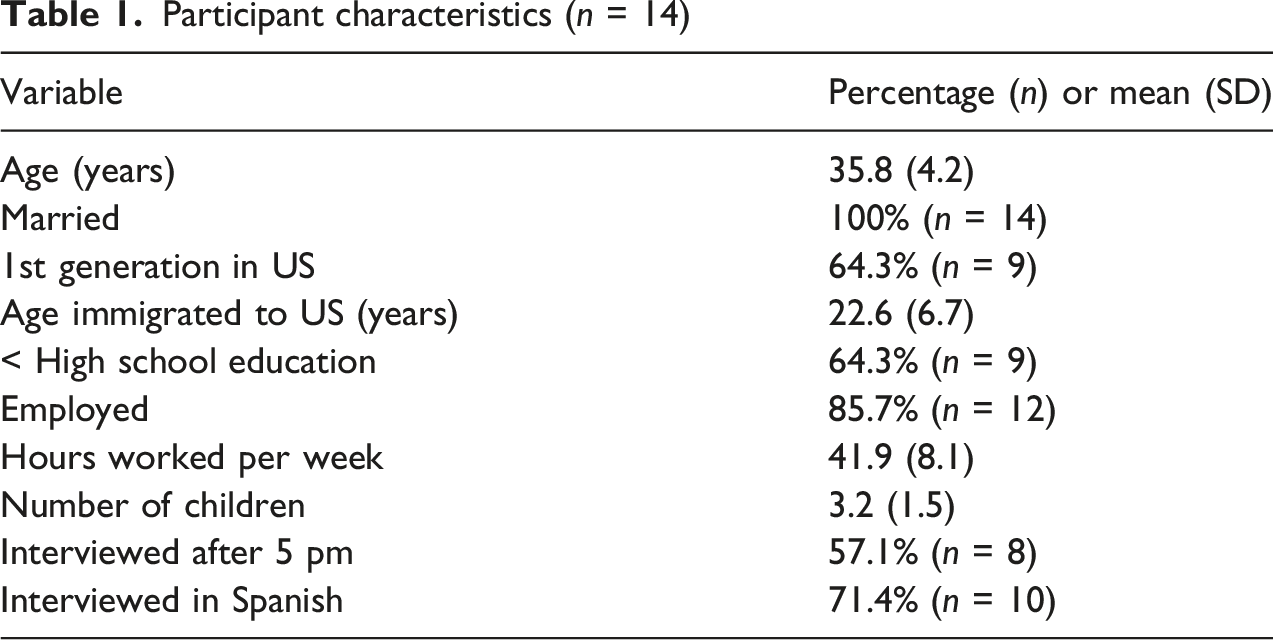
This study enrolled English- and Spanish-speaking adult individuals living in the greater Denver metropolitan area in Colorado. All participants self-identified as fathers of Mexican descent with a child <18 years old
The investigative team iteratively developed the semi-structured interview guide, which included questions about fathers’ knowledge and perceptions of research, their past research experience, the barriers and contributors to father participation in research, the time required to participate, and the trust or lack of trust in research.
Questions were translated into Spanish by two bilingual research assistants (RA). The interview guide was piloted with 3 different bilingual RAs, 2 in English and 1 in Spanish. Following the initial two participant interviews, the interview guide was finalized by adapting some questions and adding a few new ones. Interviews followed the guide but allowed for in-depth exploration of ideas as they arose.
Following informed consent, a qualitatively trained bilingual Mexican American male team member conducted audio-recorded interviews by phone ranging from 30 to 45 minutes. Interviews were conducted in either English or Spanish, depending on the participant’s preference. Upon completion of the interview, participants received a gift card. Data collection took place from December 2023 through January 2025.
Data Analysis
The team analyzed the transcripts using thematic analysis to develop themes from the coded transcripts (Braun & Clarke, 2008). First, a codebook was developed using a team-based approach (Guest & MacQueen, 2008) with three team members developing in vivo and deductive codes during transcript review and discussion. Codes were further refined and defined through an iterative process of application and team discussion. Once the codebook was finalized, one team member independently coded all transcripts. Atlas.ti software was used for data management. Twenty percent of the transcripts (n = 3) were double coded by a second trained bilingual and bicultural team member followed by a team meeting to discuss the minor differences in coding. All transcripts were analyzed in the language of the interview. One team member identified themes from the coded materials, followed by further refinement through team discussions with two other team members familiar with the transcripts.
Results
Participant characteristics (n = 14)
Themes and related quotes from semi-structured interviews with Mexican American fathers (n = 14)

Theme 1: Fathers Are Motivated by the Potential Benefits Research Offers Them, Their Family, and Their Community
Fathers reported that their main motivation for participating in research was the benefit that it brings to themselves, their family, and their community. Fathers mentioned that personal benefits, like learning about their health, how to take better care of themselves, receiving treatment for a specific disease, or a financial incentive, could serve as main motivators for others/their participation in a study. Even more motivating and highly appealing would be a direct benefit to their family, such as information on how to better care for their children. Some fathers specifically mentioned an interest in learning about parenting, including what to do and not to do as parents. Across interviews, many fathers mentioned wanting to participate to benefit their community and other families. For many, community benefit alone was rewarding enough to motivate their participation because it provides their community’s point of view, ensures adequate enrollment, and representative conclusions.
Theme 2: Clarity During the Recruitment Approach and Transparent Interactions Between Participant and Staff Build Trust and Influence Decisions to Participate
Fathers noted that the recruitment approach played a key role in their decision to participate. Specifically, both clear and complete communication and positive interactions with research staff were crucial contributors to their decision to participate.
Most fathers emphasized the importance of the research staff being clear and providing thorough explanations during recruitment. Some fathers said that individual doubts and distrust in research and studies in general can be a main factor in limiting father participation. To diminish doubt, fathers recommended that being clear about the details of the study could help fathers to participate. Specifically, clarity about what it means to participate in the study, for example, what participants are asked to do. Fathers also wanted to know the study’s main goal and expected outcomes, how the data would be used, and how their individual participation might help others and their communities. Fathers believed that the clear, transparent answers they received during recruitment and during their participation were highly valuable and influenced their decision to participate in the study. Both misinformation and their past research experiences contributed to their level of trust. Fathers recommended maximizing the clarity and completeness of information shared as a means to diminish pre-existing doubts and distrust related to research which negatively influences their decision to participate.
For some fathers, the gender and/or ethnic/cultural background of the research staff were also viewed as contributors to one’s decision to participate. Fathers expressed that having staff who are the same gender as them can make things easier, more comfortable, and can give them the confidence/trust to answer questions or participate in a study. A few fathers explained this has to do with certain topics or things more relevant and sensitive to men that come up in certain studies. A few fathers also mentioned that having a research team member who is also a father can help contribute to father participation in specific studies even more compared to just a male researcher. Ethnicity and cultural background were less important to fathers but the fathers who did find it important mentioned that similar cultural backgrounds provide a connection and understanding of what they go through and experience.
Theme 3: Partners Play a Role in Fathers’ Decision to Participate
The wife/partner can play a key role in a father’s decision to participate. Most fathers referenced their wives as the only person they knew who had participated in research before. For most, the wife/partner was the first to participate in a study, prompting the father to participate as well. Some fathers went on to say that if their wives did not participate first, they probably would not have participated if they were approached about the same study. Fathers often participated in studies to support their partners, or after they were asked by their partners to participate in order to learn more about their family and children.
The partner/wife also helped ease the fathers’ doubts by answering their questions about the study they were participating in. Fathers mentioned having multiple doubts about their wives or their own participation in research or the study itself. Most participants said that talking with their wives and staff about the study and getting their questions answered helped them feel comfortable about and agree with their own or their wives’ participation.
Theme 4: The Multiple Roles of Fathers can Be Barriers to Participation
Fathers expressed that they are very busy and have multiple demands of their time. Aside from their work schedules, some fathers said another barrier to participation could be how certain studies would impact their day-to-day life and tasks.
Fathers continued to talk about prioritizing certain roles, tasks, and responsibilities. Some fathers mentioned that work is very important to them and their main commitment and that as long as the study does not get in the way of their work or cost them hours of work, they are fine with participating. However, the time they have outside of work has its priorities as well. Fathers mentioned they have other priorities after work, like caregiving, helping their partner with children, but also just spending time with their children.
Fathers identified two more major barriers to participation. The two barriers mentioned were work and lack of time. Fathers made it clear that they have a very busy work schedule that conflicts with the usual times studies are conducted. Although the fathers had a diversity of jobs, they made it clear that fathers with more demanding hours and those working in high labor jobs struggle to find the time to participate in studies, especially in the summertime. Longer working hours in the summer limit their availability. Fathers mentioned that winter is a better time for them to participate or would prefer to participate. Inclement weather plays a role in the available hours some fathers can work, thus resulting in fewer hours worked per week in the winter compared to the summer.
Time was perceived as a barrier for these fathers as well. Fathers on average believed that anywhere between 45 minutes to 1 hour is a good amount of time to participate in a study, anything more than that gets in the way of being a father or is too much of a time commitment for them. Some went on to mention that after a long workday the last thing they want to do is get home and do a 2–3-hour interview. Fathers said that the amount of time required does play a role in their participation and were strongly positively influenced by the time commitment when asked to participate in this 30-minute interview.
Even with these barriers, fathers emphasized that they should participate in studies about family and children, since they play a key role in their children’s development. Some said that Mexican American fathers, especially in the US and more recently, are becoming more involved in the life and care of their children. Some expressed that it is very different than Mexico, mentioning that here in the US, both parents work, and both parents help with the care of the children. Fathers do believe that other fathers should participate and be included in the studies focused on family and parenting but say there are barriers that make it more difficult for Mexican American fathers to participate in these types of studies.
Theme 5: Flexibility of the Study Team Serves as a Contributor
Study team flexibility facilitates father participation. Fathers expressed that their schedules were a barrier to participating, but, in their past experiences and this interview, the study team’s flexibility regarding the length, the time of day, and method (i.e., phone call) allowed them to participate. Fathers mentioned flexibility as a contributor to other fathers’ participation since it would allow them to participate after work or on their days off.
While participants all agreed that 45 minutes to 1 hour was a good length of time to participate in a study, they also emphasized the need for study team flexibility. Since fathers said the amount of time they are required to commit influences their decisions to participate, they were asked about splitting up the time into multiple sessions. Fathers were asked about studies that require 2–3+ hours and whether they think splitting up the time into multiple 1-hour sessions would help them decide to participate in those studies. All fathers who were asked agreed that this would positively influence their decision to participate in a study that requires more than the 1-hour limit.
Discussion
Recognizing the limited inclusion of Latino fathers in research on parenting, this study aimed to understand Mexican American fathers’ perceptions of research and identify barriers and facilitators to their participation in research. Participants endorsed the importance of inclusion of fathers in research on families, while also noting multiple barriers, such as parenting, work, and time. They identified key motivators as well as the important role their partner/wife played in their decision to participate. Contributors to participation were identified, including the important role research staff play in building trust. Key topics described in the findings provide a rich and in depth understanding of Mexican American fathers’ perceptions of research, supporting and advancing current evidence in this area.
While fathers in this study recognized the importance of their participation in research, they noted barriers, like the multiple responsibilities of fatherhood, but also proposed solutions to these barriers, like flexibility in time. Commonly mentioned barriers included work and inadequate time, each of which have been identified in previous research on fathers (Wong et al., 2013). Additionally, participants emphasized the multiple responsibilities they assume in their day-to-day lives, including work, parenting/caregiving, being a husband, and being part of a family, all of which require time and effort and thereby impact their ability to participate in research. Fathers mentioned they would be interested in participating, as long as the study did not affect their ability to fulfill all their other responsibilities. While investigators may view after work as the best time to engage fathers, after work time, while technically unscheduled, is often when fathers prioritize spending time with family, especially their children. Many felt they were unable to commit too much time outside of work to a study. Fathers suggested a max time commitment of about 45 to 60 minutes, which is supported in other literature as well (Doyle et al., 2016). Fathers felt that splitting the time commitment for a study over multiple visits may make it more feasible for them to participate. They emphasized the need for flexibility and visit times outside of typical work hours. Other studies have shown that flexible and after work hours do help with recruitment of fathers (Wong et al., 2013). In this study, fathers appreciated that the interview was conducted by phone, but of course, not all research can successfully be conducted by phone or other virtual methods. Researchers making the effort to include fathers in research are commonly aware of the need to be flexible with time and location of participation (Deneault et al., 2025). Potential adjustments to these evening visits include breaking up study activities into multiple sessions lasting shorter times. Fathers getting home late from work and having to get up early the following morning may find the 45–60 minute commitment more feasible to do in the evening rather than 2+ straight hours. Future studies should consider the multiple roles and responsibilities fathers may have, the mode of collecting data (e.g., phone or home visits may be easier than office visits), as well as how much flexibility fathers may need when scheduling visits.
Fathers noted the importance of the recruitment approach, including the key role research staff play in building trust. Clear and transparent communication during the recruitment process ensured fathers understood everything about the study, like its purpose, who it benefits, and what they are required to do in the study, ultimately being key to helping gain their trust, diminishing their doubts, and positively influencing their decision to participate. Comments fathers made about the recruitment approach and the interactions with staff members support what the literature suggests can help with recruiting and gaining trust, like hiring staff from the same community/culture, detailed explanations about the study, and being transparent (Tietbohl et al., 2025). A study suggested that fathers perceived confidence in study content areas may influence their decision to participate (Moura & Philippe, 2023). Regarding the benefits of participation, many fathers emphasized that studies offering direct benefits to themselves was valuable, while also stressing that benefits for their family or community would also motivate their participation. Fathers in this study reported their altruistic motivations for participating, such as helping their own family and community, and learning how to better take care of their children, which aligns with the literature on fathers’ motivations to participate (Yaremych & Persky, 2022). The gender and cultural/ethnic background of participant-facing research staff were also considered important in the recruitment approach for some fathers. Lindsay et al. similarly identified the research staff’s interaction/identity as a crucial component for father recruitment in Latino communities (Lindsay et al., 2020). Depending on the focus of a study, having participant-facing staff who are fathers may also be influential. Whether this helps fathers overcome their self-doubt in specific content areas is unknown, but it is certainly possible. Engaging fathers in conversation about the study opportunity and ensuring they are provided with all relevant information about the study may help minimize self-doubt and thereby improve enrollment of fathers.
Participants emphasized the important role of partners/wives in supporting fathers’ decisions to participate in research. Fathers said that approaching their partner first would be a good idea for a recruitment strategy. Additionally, a majority of fathers with prior experience in research mentioned their partner as having participated first. Studies suggest direct recruitment of fathers can be more effective than recruiting parents in general or at the same time (Davison, Charles, et al., 2016). Partners/wives sharing a recruitment flyer with their partner is an indirect approach, that risks that partners/wives do not present the opportunity to participate to their partners (Davison, Charles, et al., 2016). Maternal gatekeeping, that is, mothers deciding for the father or simply not presenting the opportunity at all or correctly to fathers, is often cited as one of the reasons for the lack of father inclusion in studies (Doyle et al., 2016). Partners/wives may be concerned that their partner’s participation will take time away from fathers’ time with their families. Differences in whether researchers see the mother of the child as a barrier, or as a contributor for father recruitment do vary by country (Deneault et al., 2025). Focusing on future recruitment approaches specifically for Mexican American fathers, it is possible that partner/wives can facilitate and be an important factor in the Mexican American community.
A strength of this study was our focus on Mexican American fathers. Focusing on this population of fathers was important given that the Mexican American population makes up nearly 60% of the Latino population in the US and yet is often underrepresented in research (Bureau, 2024). The Latino population is the largest minority population in the US (Bureau, 2024), thus, it is vital to increase their participation in research. The high prevalence of diabetes, obesity, and many other diseases in Latino communities compared (Alemán et al., 2023) to other racial/ethnic groups further underscores the need to focus on inclusion of this population in research. Social determinants of health disproportionately impact Latino families, including lower education levels, lower median income, and less access to healthcare compared to other racial/ethnic groups, and contribute to these health outcomes. (Cleveland et al., 2023). Moreover, cultural values and beliefs in the Latino population influence health behaviors and health outcomes (Documét & Sharma, 2004), suggesting tailored interventions may be needed.
This study has a few limitations that warrant mention. To start, participants were either past or current fathers from two other studies or partners of mothers participating in a current study. Thus, research participation was not unfamiliar to the men we interviewed. It is possible that fathers with no prior interaction with research or research teams may have had different perspectives. Additionally, given the unequal participation of English and Spanish-speaking fathers, we were unable to evaluate differences between the two language groups. Since speaking a language other than English is associated with challenges accessing healthcare (Ramirez et al., 2022) and a proxy for acculturation (Alegria, 2009), it is possible that fathers speaking Spanish have less exposure to research or different cultural values influencing their perceptions of research. This study also focused on one ethnic group in one geographic region of the US, and thus, these findings may not apply to fathers in other ethnic groups or geographic regions. Finally, the person conducting participant interviews is not a father but identifies as a Mexican American man. While this fact was not shared with participants, it is unclear whether it influenced interview conversations. Nevertheless, to minimize bias in the analysis of interview findings, transcripts were reviewed by multiple reviewers.
Conclusions
These study findings offer Mexican American fathers’ perspectives on the barriers and factors that contribute to fathers’ participation in research. Interviews with these fathers allowed the research team to further understand a population that is difficult to recruit and underrepresented in research. Although many efforts have been made to include fathers in research, there is still a disparate lack of representation, especially Mexican American fathers (Davison, Gicevic, et al., 2016). This study found that, even though there are barriers that make it difficult for fathers to participate, there are contributors that can help reduce those barriers and increase enrollment of Mexican American fathers in research. Future research should focus on the contribution/impact that the partner/wife can have on recruiting Mexican American fathers, as well as the impact of having a relatable figure as the recruiter, for example, a father or a Mexican American individual.
Footnotes
ORCID iDs

Ethical Considerations
This study was approved as exempt by the Colorado Multiple Institutional Review Board on 05/30/2023 (23-1032). Participants gave verbal consent before starting interviews.
Funding
The authors disclosed receipt of the following financial support for the research, authorship, and/or publication of this article: Research reported in this publication was supported by the National Heart, Lung, And Blood Institute of the National Institutes of Health under Award Number R01HL163859 (MPI Thompson/Meltzer) and 3R01HL163859-03S2 (MPI Thompson/Meltzer). The content is solely the responsibility of the authors and does not necessarily represent the official views of the funding organization.
Declaration of conflicting interests
The authors declared no potential conflicts of interest with respect to the research, authorship, and/or publication of this article.