







Abstract
The Collaborative Project (CP) began as a pilot project in five North Carolina school districts in 2007 featuring a performance incentive initiative for teachers and administrators. The objective of this study was to document principals’ perceptions of the performance incentive initiative to determine challenges encountered during implementation. The researcher used a qualitative interview process to collect data from participating principals employed in the CP districts. The principals’ responses were analyzed and tables were constructed to show the responses for each question. For triangulation purposes, the results were compared with survey data from a 2009 evaluation completed by the Carolina Institute for Public Policy. Overall, the majority of principals interviewed believed that some components of the teacher performance incentive criteria helped their schools. The interview process revealed some unanticipated results not mentioned in the literature review and the results of the study provided insight into anomalies encountered during implementation.
Teacher compensation has been and remains an issue of debate in most areas of the United States (Odden & Kelley, 2002). Most stakeholders have an opinion on teacher pay—some think teachers are not paid enough, some think teachers are adequately compensated, and some think teachers are overpaid (Odden & Kelley, 2002). Regardless, there have been many efforts across the country in the past to pay teachers more (Martin, 2007; Odden & Kelley, 2002).
Some researchers argue the reasons for the increased efforts to raise teacher pay have grown out of the desire to recruit and retain teachers (Odden & Kelley, 2002; Wallis, 2008). Others believe the drive to increase teacher pay has resulted from the increased emphasis on accountability for student performance (Kaufmann, 2007; Martin, 2007; Podgursky & Springer, 2007). Others debate the need for performance pay because the results of standardized tests across the nation have shown the United States is lagging behind many other countries educationally (Gratz, 2010). Traditionally, teachers in the United States have been compensated using a single salary schedule based solely on the number of years of experience and/or the attainment of advanced degrees (Odden & Kelley, 2002; Palumbo, 2007). Many past efforts to reform teacher pay and move away from the traditional salary schedule have incorporated some type of performance-based incentives to reward teachers for student achievement and/or the successful completion of professional development modules (Odden & Kelley, 2002). Other efforts to reform teacher pay incorporated subjective teacher evaluations completed by school administrators as a method of determining whether or not a teacher earned a bonus (Baber, 2007; Palumbo, 2007). Until recently, nearly all attempts to change the way teachers are compensated have failed to produce any lasting results (LeFevre, 2001; Perkins-Gough, 2007). Therefore, the traditional teacher salary schedule continues to serve as the basic structure for teacher compensation nationwide (Koppich, 2010; Podgursky & Springer, 2007). William J. Slotnik, a technical advisor to a number of districts implementing performance pay programs, recently said,
We’re really at a very critical juncture because we’re now 25 years beyond the failed merit-pay experiments of the early 1980s. And if we replicate the same mistakes that burdened that movement, we’re going to lose a generation of compensation reform. (Olson, 2007, p. 2)
Setting
The Collaborative Project (CP) is a 3-year pilot project that began in August 2007 in five North Carolina counties: Caswell, Greene, Mitchell, Warren, and Washington (The Forum, n.d.). Funded by the North Carolina General Assembly as an experiment in the recruitment/retention of teachers, the $7 million project is administered jointly by the Public School Forum of North Carolina and the North Carolina Science, Mathematics, and Technology Education Center (The Forum, n.d.).
The CP features three main components: professional development, performance incentives, and after-school programs. This study will focus on the performance incentive component.
The pilot phase of the CP was slated to last 3 years, beginning with the 2007-2008 school year and ending with the close of the 2009-2010 school year. The General Assembly extended the life of the CP by providing a fourth year; therefore, the CP ceased existence as a pilot and became a program for the 2010-2011 school year.
According to its website, the CP has three main goals:
A positive impact on student performance
A positive impact on recruitment and retention
Access by participating school systems to quality professional development resources
Although the performance incentive component is the particular focus of the present study, it does not represent the entire CP approach to achieving these goals. The Project features three main components: intensive, high-quality professional development for teachers, principals, and central office administrators; the aforementioned performance incentives for teachers, principals, and central office administrators; and enrichment-based after school programs for two schools per participating district (Thompson et al., 2010). Five school systems defined by the state as small, rural, and low wealth are participants in the CP: Caswell County, Greene County, Mitchell County, Warren County, and Washington County (Thompson et al., 2010).
Method and Data Sources
The objective of this study was to determine, through an interview process with principals involved in the CP, successes, challenges, and dilemmas faced within five North Carolina school districts during the development and implementation of a performance incentive program. The participants were principals from four of the five participating districts in the CP who served as principal of their school for at least 2 years of the 3-year pilot. The three eligible principals from the fifth participating district were not interviewed because of the researcher’s role as superintendent of the aforementioned district and the unique problems that role presents for the study. To remind the reader, there were 24 schools from five districts involved in the pilot; therefore, there are 24 total principals eligible to be interviewed. With the removal of the aforementioned principals from the study, the number of potentially eligible principals is 21. Of the 21 potentially eligible principals, 17 served as principal of their school for at least 2 years of the 3-year pilot; therefore, 17 principals were interviewed. All interviews were done in December 2010.
Findings
Findings are presented for each interview question, including selected quotes. A summary of these findings concludes this section.
Interview Question 1
The first question of the eight posed to the principals during the interview process sought to determine whether principals felt the student achievement component of the performance incentive system helped, hurt, or had no effect on the school in which the interviewee was principal. Thirteen of the 17 (76%) felt the student achievement component helped his/her school, 2 principals (12%) believed the component had no effect on his/her schools, and 2 principals (12%) opined that the component hurt his/her school (see Table 1).
Principals’ Responses to Question 1
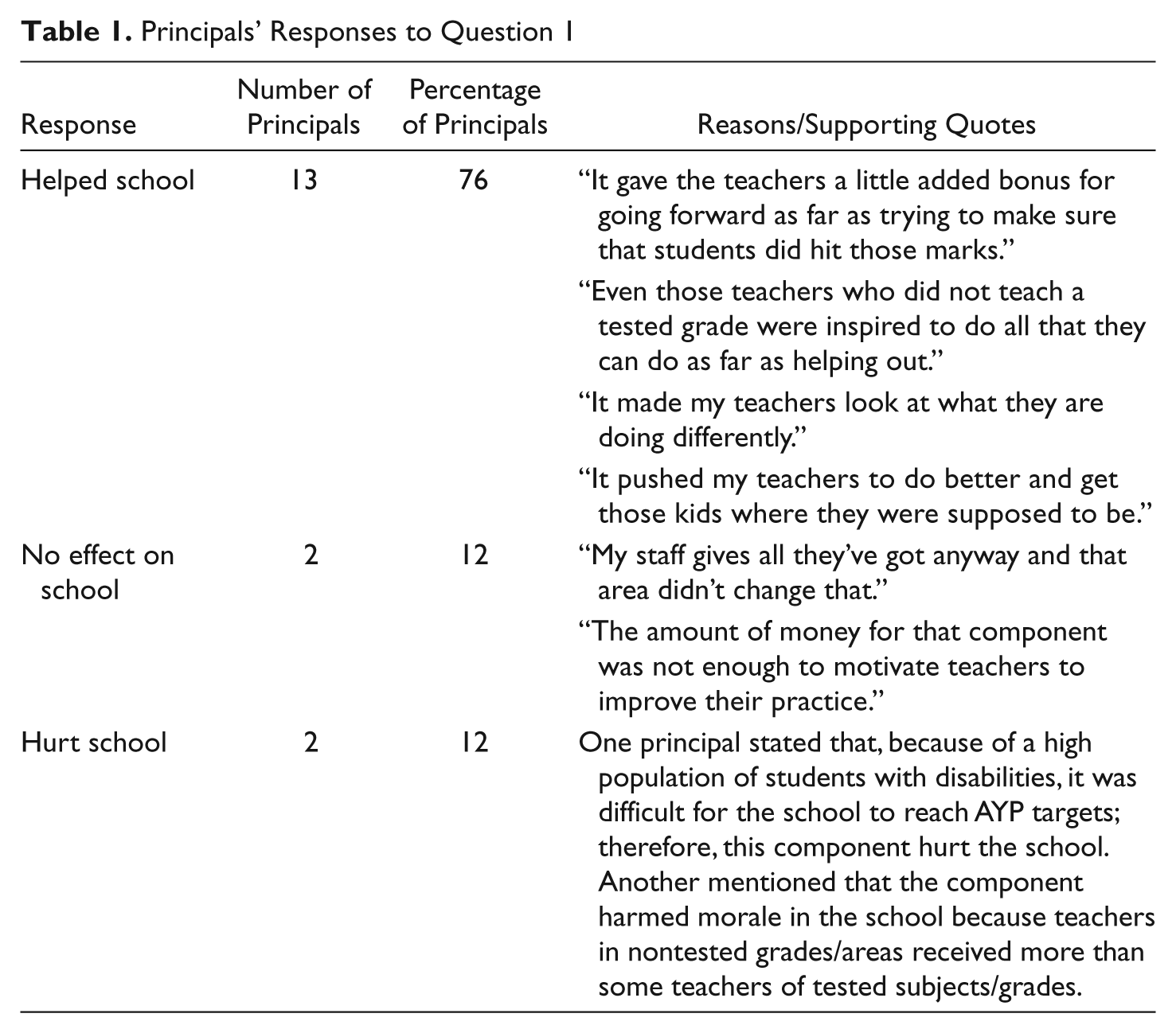
The principals who believed that the student achievement component helped the school gave varying answers for why he/she responded in that way. Most believed the component encouraged teachers to make more and better use of student testing data and motivated teachers to take a serious look at their instructional practice. Several principals attributed an increase in collaboration among teachers to the student achievement component. For example, across multiple schools and districts, principals noted that teachers of nontested subjects/grades voluntarily tutored students during school hours and/or after school. Before the implementation of this component, these teachers had not volunteered to assist struggling students. Other principals believed the student achievement component of the performance incentive system was responsible for the school meeting state and national proficiency targets.
The two principals who indicated the student achievement component of the CP had no effect on his/her school gave two different reasons for why he/she responded that way. The first principal indicated that he had a staff that puts forth maximum effort all the time and the student achievement component did not change that. The second principal indicated that $500 was not enough of a financial incentive to motivate his/her teachers to improve their instructional practice.
Two principals felt that the student achievement component of the performance incentive system hurt his/her school, and both provided different reasons. The first principal pointed out that his/her school housed a higher population of students with disabilities than others. Because of that, the principal believed it was more difficult for the school to meet national proficiency targets; therefore, his teachers could not receive the maximum performance incentive in that component. Although not explicitly stated by the principal, the principal’s statements appeared to indicate that teachers in this principal’s school were rankled by being offered an incentive to do something they felt they could not do. The second principal cited a morale issue stemming from an anomaly with the student achievement component mentioned by the Carolina Institute for Public Policy (CIPP) report on pp. 25-26 in the June 2009 report (Thompson et al., 2010). The principal indicated morale was harmed in the school because teachers in nontested grades/areas received more performance incentive than some teachers of tested subjects/grades. This anomaly was directly addressed in the interview with all principals in Questions 5 and 6.
Interview Question 2
The second question sought to determine whether principals felt the principal’s evaluation component of the CP helped, hurt, or had no effect on the school in which the interviewee was principal. Slightly more than half of the 17 principals (53%) felt the principal’s evaluation component helped his/her school, and 8 principals (47%) believed the component had no effect on his/her schools. None of the principals interviewed believed that the component hurt his/her school (see Table 2).
Principals’ Responses to Question 2
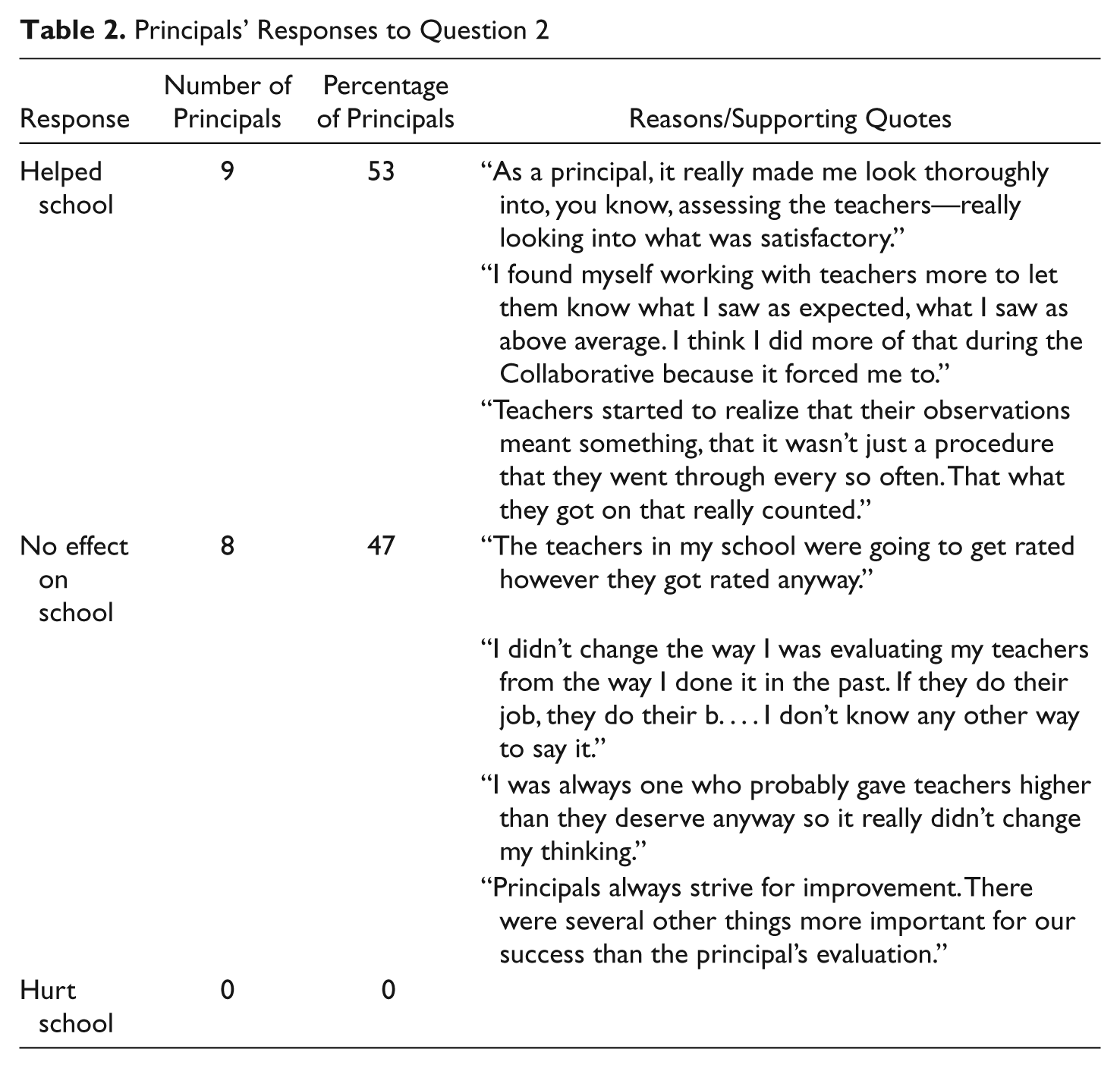
The principals who believed that the principal’s evaluation component helped the school gave several answers for why he/she responded in that way. Several principals believed the principal’s evaluation component motivated the teachers to go “the extra mile” and work harder to get the performance incentive. At least one principal mentioned that teachers did not want to be “the one” not to get the bonus. Others mentioned the personal effect the component had on them. For example, at least two principals admitted the component forced them to take the evaluations more seriously than they had before and to be more thoughtful with them. Yet another principal mentioned that he/she spent more time with teachers to be sure everyone he/she evaluated knew what he/she saw as satisfactory versus above average performance.
The principals who felt that the principal’s evaluation component had no effect on the school also gave several reasons for why he/she responded that way. Multiple principals in this category indicated that the teachers’ priority was the student achievement component, not the principal’s evaluation component; therefore, very little emphasis was placed on the principal’s evaluation. Many also responded that they did not change the way they evaluated their teachers as a result of the CP.
Interview Question 3
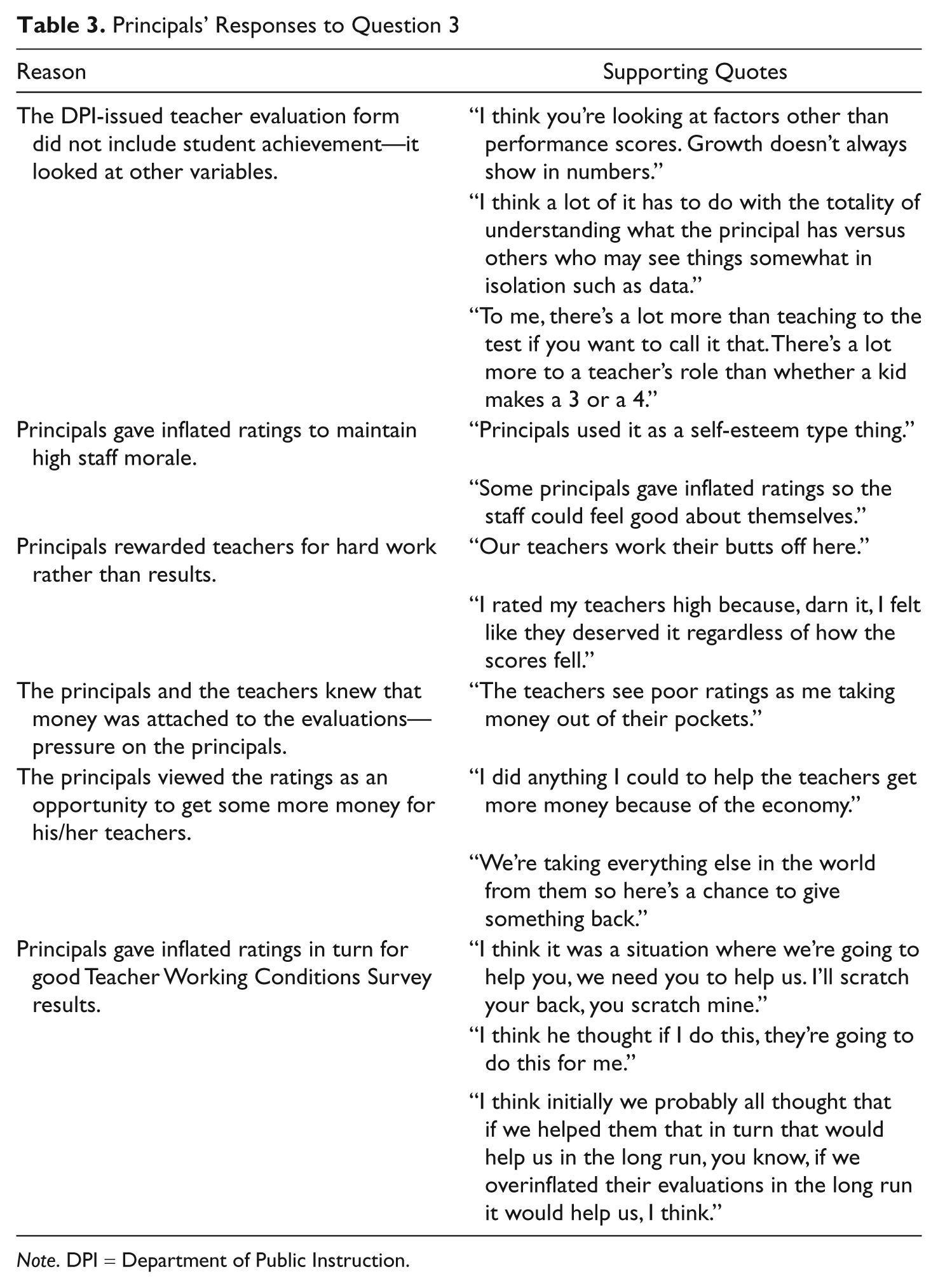
The third question dealt with overly inflated ratings of teachers on the principal’s evaluations. Despite serving in schools with serious student achievement challenges, almost all principals continued to assign teachers inflated ratings. The reasons provided by the principals for this phenomenon were varied and interesting (see Table 3).
Principals’ Responses to Question 3
Note. DPI = Department of Public Instruction.
The first of the six reasons principals primarily gave for inflating ratings to teachers dealt with the teacher evaluation form itself. The form, issued by the Department of Public Instruction (DPI), did not address student achievement in any of the elements. Therefore, a teacher could satisfactorily meet all the requirements listed on the form and have less than satisfactory student achievement outcomes. The June 2009 CIPP report addresses this very issue (p. 27) and mentions that the new evaluation instrument, mandatory for use in the state in the 2010-2011 school year, does indeed address student achievement (Thompson et al., 2010). However, for the first 3 years of the CP, the older evaluation instrument that did not address student achievement was used to evaluate teachers in the CP school districts.
The second reason provided above suggests that principals gave inflated ratings to keep morale of the faculty high. At least two of the principals interviewed suggested this as a reason, but both principals claimed to be describing other principals in the district, not themselves.
The third reason principals gave for continuing to assign teachers with inflated ratings was to reward teachers for hard work rather than test results. Multiple principals mentioned that his/her staff worked very hard and deserved high ratings based on effort alone.
The fourth reason principals used to defend high ratings assigned to teachers was pressure from teachers. The principal who gave this reason indicated that both principals and teachers knew there was money attached to the evaluations and that teachers in his/her school saw a poor rating as “taking money out of my pocket.” The principal hinted that the pressure to inflate teacher ratings was too much to bear.
Several principals viewed the principal’s evaluation component as a way to help provide extra money for his/her teachers at a time when teachers had not seen a raise in several years, the economy had taken a downturn, and the state cut bonuses for student growth. There was no quid pro quo evidenced from these principals—just a genuine attempt to secure more money for the teachers in the school.
The final, and perhaps most interesting, reason given by principals for inflating teacher ratings was the exchange of inflated teacher evaluation ratings for inflated ratings on the Teacher Working Conditions Survey (TWC), which affected the performance incentives available to the principals themselves. Four principals (24%) of the 17 interviewed either explicitly acknowledged a quid pro quo between teacher evaluation ratings and the TWC or mentioned it indirectly. Even more interesting is the fact that the two principals who mentioned the quid pro quo directly are in the same district. Two others acknowledged that they knew of the arrangement—one of those is in the same district as the two who acknowledged the quid pro quo directly.
Interview Question 4
The fourth question sought to determine whether principals felt the professional development component of the CP helped, hurt, or had no effect on the school in which the interviewee was principal. Falling in line with the enthusiasm with which teachers responded to this component in the June 2009 CIPP report (p. 26), 15 principals (88%) responded that they felt the professional development component helped their schools (Thompson et al., 2010). Only one principal (6%) responded that the component had no effect on the school and one (6%) responded that the component hurt the school (see Table 4).
Principals’ Responses to Question 4
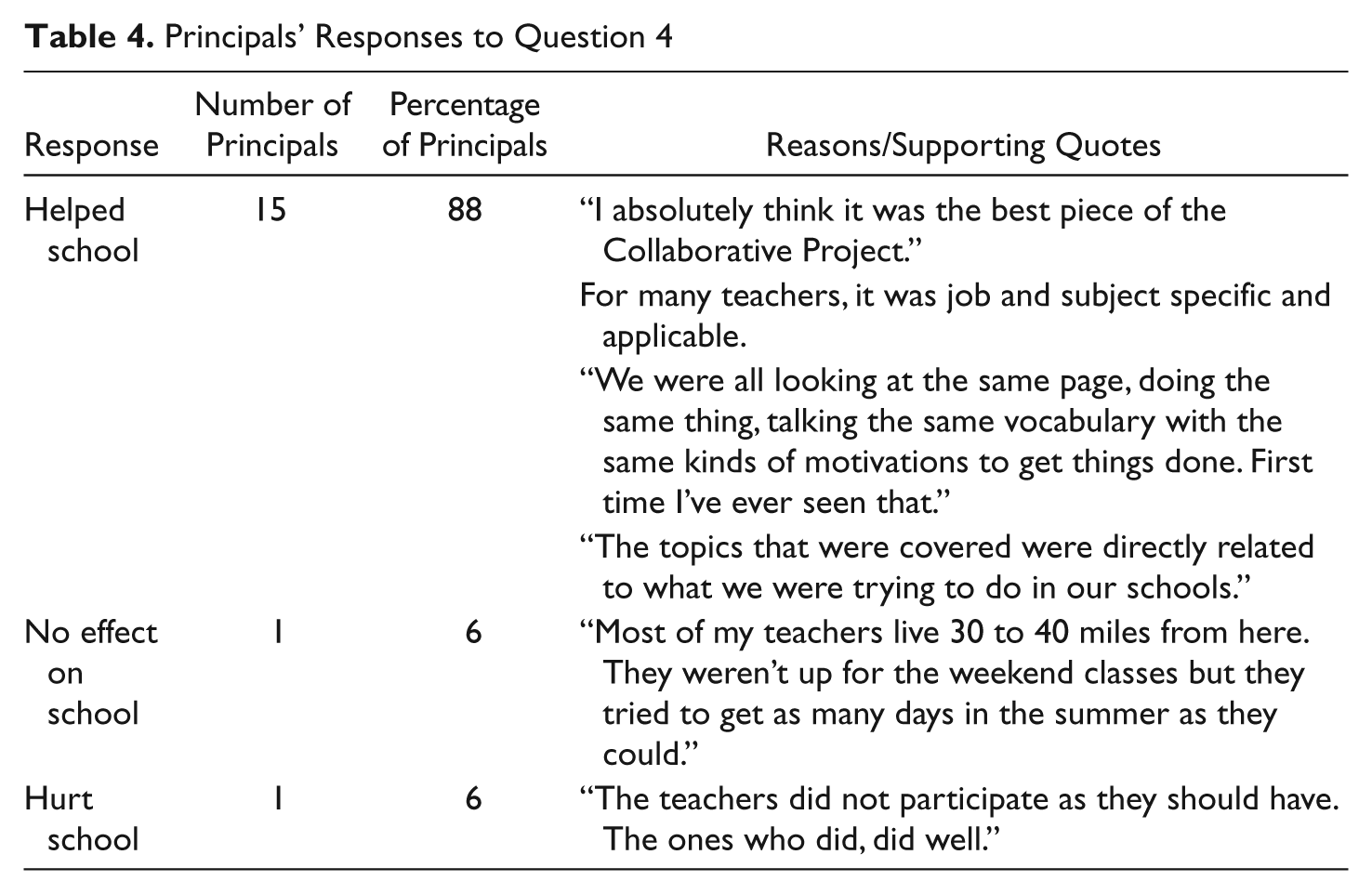
The principals who believed the professional development component of the CP helped his/her school were very enthusiastic in their reasoning and the high number of principals who felt the professional development component helped his/her school are supported by the research. It appears to be best practice to include a component in a performance incentive initiative that rewards teachers for attending/completing professional development that is relevant to school and district goals (Center for Teaching Quality, 2007; Harris, 2007; Odden & Kelley, 2002; Perkins-Gough, 2007). The inclusion of such in a performance incentive system for teachers is one of the generally agreed upon components of a successful performance incentive system (Center for Teaching Quality, 2007; Harris, 2007; Odden & Kelley, 2002; Perkins-Gough, 2007).
Almost all principals mentioned the high level of quality of the professional development. It was noted by more than one principal that teachers originally attended the sessions for the money but stayed for the quality. Most believed the professional development offered through the CP gave them access to training to which they would not otherwise have had access or been able to afford to have on their own. Other principals mentioned the timeliness of the training in light of the elimination of professional development funding by the state. A few principals addressed the issue of distance—some rural locations had too far to travel to cities for professional development. The CP allowed the professional development to come to the teachers. Specific professional development offerings mentioned by principals included Thinking Maps, Seven Habits of Highly Effective Teachers, and Lenses on Learning.
The single principal who indicated the professional development component had no effect on his/her school answered that way only because of the lack of participation of his teachers in the Saturday professional development offerings. The principals mentioned the distance most of the faculty had to drive to get to the school as the main reason for this phenomenon but he/she noted that participation picked up for the summer offerings.
The lack of participation by teachers also seemed to be the reason why a principal answered that the professional development component had no effect on his/her school. He/she indicated that only approximately a quarter of his/her staff participated in the offerings but the principal did indicate that those teachers who did participate, did well.
Interview Question 5
The fifth question addressed an anomaly discovered by the CIPP pertaining to the student achievement component of the performance incentive system. The anomaly revolves around the few teachers of tested subjects/grades who received less student achievement performance incentive than did some teachers of non-tested subjects/grades. The issue is addressed in the June 2009 report issued by the CIPP (Thompson et al., 2010, pp. 25-26). The question asked principals if any teachers complained about this anomaly in his/her school. Only 6 of the 17 principals indicated that teachers had complained to them regarding this phenomenon (35% of the principals). The remaining 11 principals (65%) did not receive any complaints of this nature (see Table 5).
Principals’ Responses to Question 5
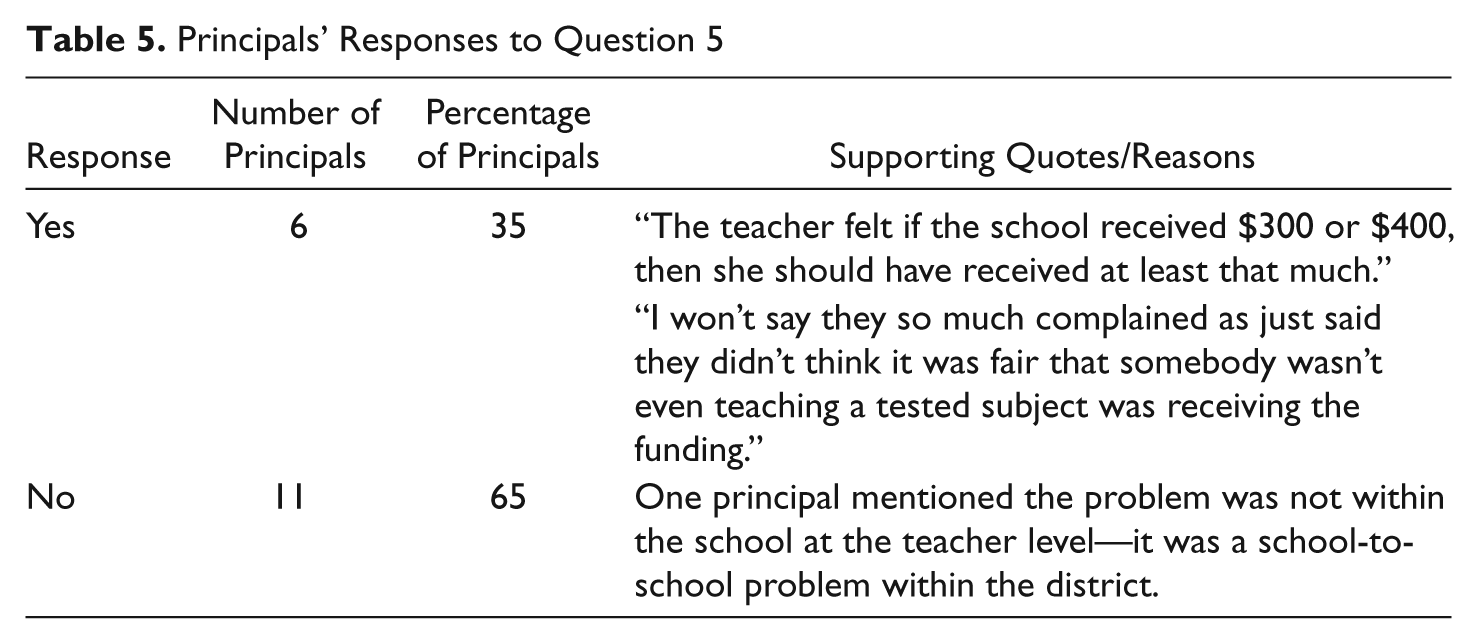
For the principals who indicated this was an issue in their schools, there were follow-up questions. The first asked the principals if the issue was widespread with none of the principals indicating affirmatively. One principal had 2 of 20 teachers (10%) complain to him about the anomaly—no other principal had more than two teachers complain.
The second follow-up question asked the principals to explain how he/she addressed the issue with the disgruntled teacher. Each of the six principals indicated that they sat down with the teachers in question and went over the criteria using the teacher’s individual results and in so doing, reached a level of equilibrium among the faculty once again.
At first glance, this finding that 35% of principals reported teacher complaints regarding the student achievement component rebuts the June 2009 CIPP finding that only 13% of teachers found the incentive payments to be a source of irritation (Thompson et al., 2010, p. 24). But if one takes into account the total number of teachers complaining (9 teachers) versus the total number of teachers in CP schools, the CIPP finding appears to be validated.
One interesting finding did arise when a principal mentioned that the problem he/she experienced was not teacher-to-teacher but rather school-to-school within a district. There was some conflict when one CP school outperformed another. In that instance, teachers at one school who did not teach tested subjects/grades received more than the other school, which caused grumbling that some principals felt obligated to address.
Interview Question 6
The sixth question was a follow-up to the fifth question. They were asked whether the exclusion of teachers of nontested subjects/grades from the student achievement component would have helped or hurt his/her school. Not surprisingly, 16 of the 17 principals (94%) felt the exclusion of teachers of nontested subjects/grades would have hurt the school. One principal (6%) responded that it would have had no effect on his/her school (see Table 6).
Principals’ Responses to Question 6
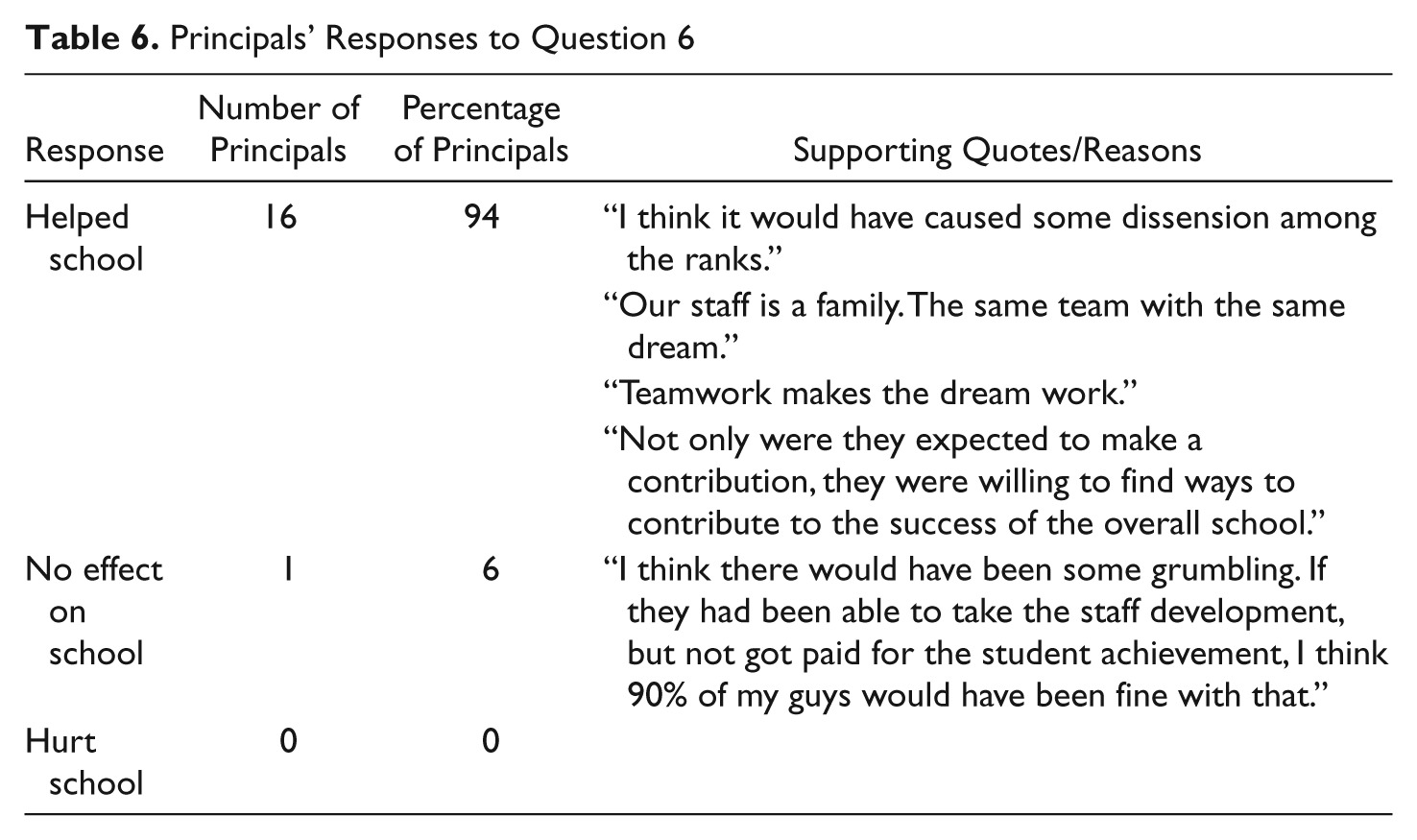
In addressing this issue, most principals acknowledged that all teachers contribute to the success of the school. Many principals noted that teachers of nontested subjects/grades tutored and worked after school to help ensure the school met its goals. Many principals also admitted such an arrangement would likely have caused major morale problems within their schools. This admission supports the June 2009 CIPP finding that 69% of the teacher polled indicated that the CP performance incentives boost school morale (Thompson et al., 2010, p. 24).
The one principal who felt the move would have had no effect on the school admitted there would be some discontent initially, but that as long as the teachers had the access to the professional development, they would “have been fine with that.”
One interesting finding did arise from this question. In at least one school, the grade levels pooled their money for student achievement and split it equally among all in that grade level so that each teacher in that particular grade level received the same amount.
Interview Question 7
The penultimate question had two distinct parts. The first part asked if they agreed with a statement made in the June 2009 CIPP report that indicated superintendents, central office contacts, and principals from all five participating districts confirmed that they had been “fully involved” (Thompson et al., 2010, p. 23) in the process for determining the performance incentive criteria. Seven principals answered positively (41%), four principals responded negatively (24%), and the other six principals (35%) were indecisive and provided a qualified response (see Table 7).
Principals’ Responses to Question 7—Part 1
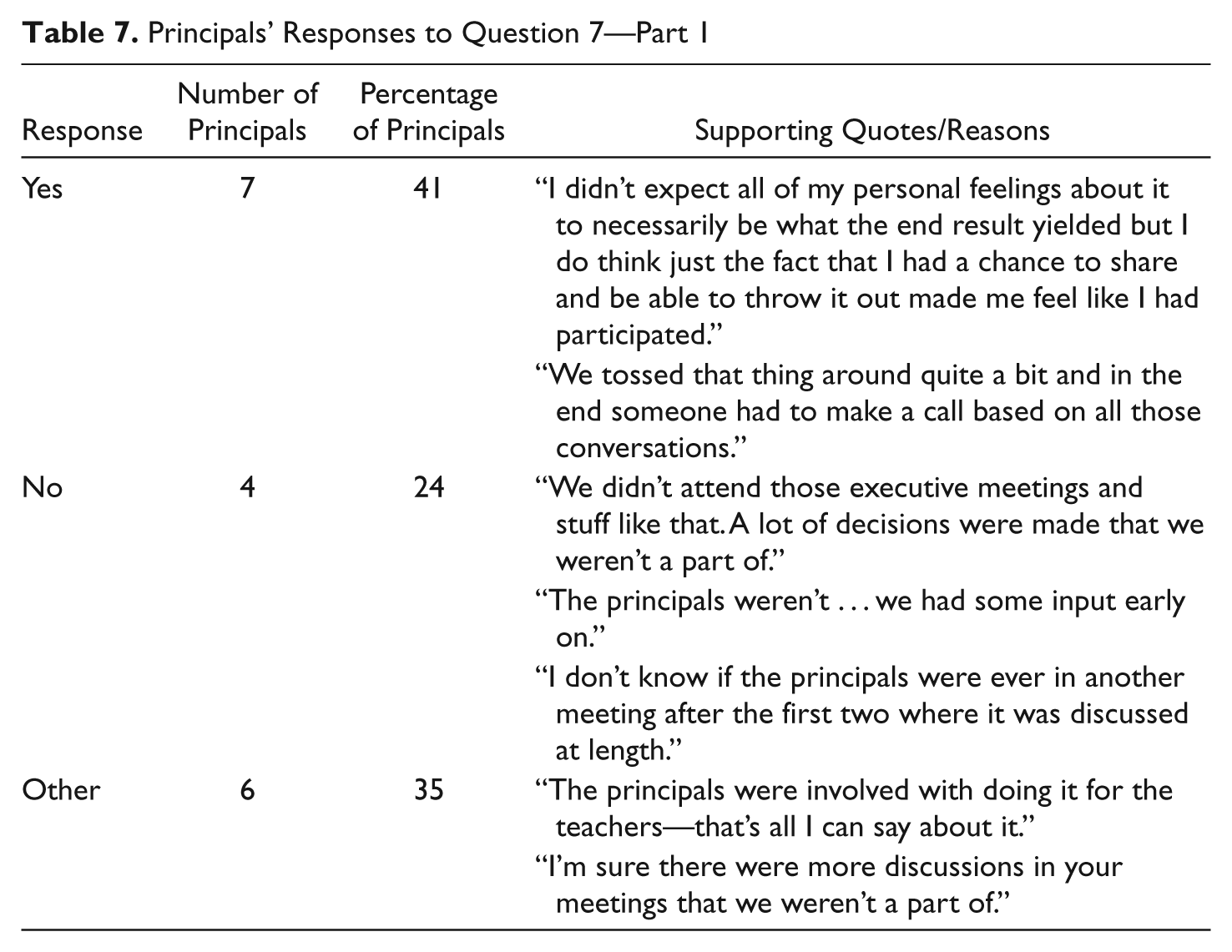
There appeared to be a significant amount of overlap in the responses of the principals regardless of how they answered the question. All the principals who were part of the CP for the first two Leadership Institutes agreed that they participated fully in the development of the criteria. It is after the first two Leadership Institutes that opinions began to change. Two of the principals who answered positively noted that their answers covered the first two Leadership Institutes only. Likewise, all the 6 principals who would not choose either answer agreed they were involved for the first two Leadership Institutes. After those first two Leadership Institutes, the principals felt less involved or not involved at all. One principal mentioned that the CP leadership “guided things the way they wanted it to go.” Of the four principals who responded to the question negatively, two did so because they joined the CP in Year 2 and were not a part of the first two Leadership Institutes. The other two noted mixed feelings after the first two Leadership Institutes.
The significant finding here is that all principals who participated in the first two Leadership Institutes felt fully involved in the process for determining the performance incentive criteria no matter how they answered the question. The feelings are mixed, if not negative, for their level of participation after those first two Leadership Institutes when the Advisory Committee, made up of CP leadership, the superintendent, and central office contact from each district, took over the tweaking of the criteria. There is agreement in the body of reviewed literature on specific components of a performance incentive system in education that increase the likelihood of a successful program (Center for Teaching Quality, 2007; Harris, 2007; Odden & Kelley, 2002; Perkins-Gough, 2007). Among these are stakeholders in the planning and implementation of new performance incentive programs (Center for Teaching Quality, 2007; Harris, 2007; Odden & Kelley, 2002; Perkins-Gough, 2007). Furthermore, the inclusion of these stakeholders in the planning and implementation of performance incentive initiatives appears to be crucial; in most failed attempts, stakeholders were not included in the planning and implementation of the programs (Center for Teaching Quality, 2007; Harris, 2007; Odden & Kelley, 2002; Perkins-Gough, 2007).
The second part of the seventh question asked principals if they thought the stakeholders of the CP had created performance incentive criteria that successfully blended high standards with achievability. Eleven principals answered positively (65%) and six principals responded negatively (35%; see Table 8).
Principals’ Responses to Question 7—Part 2
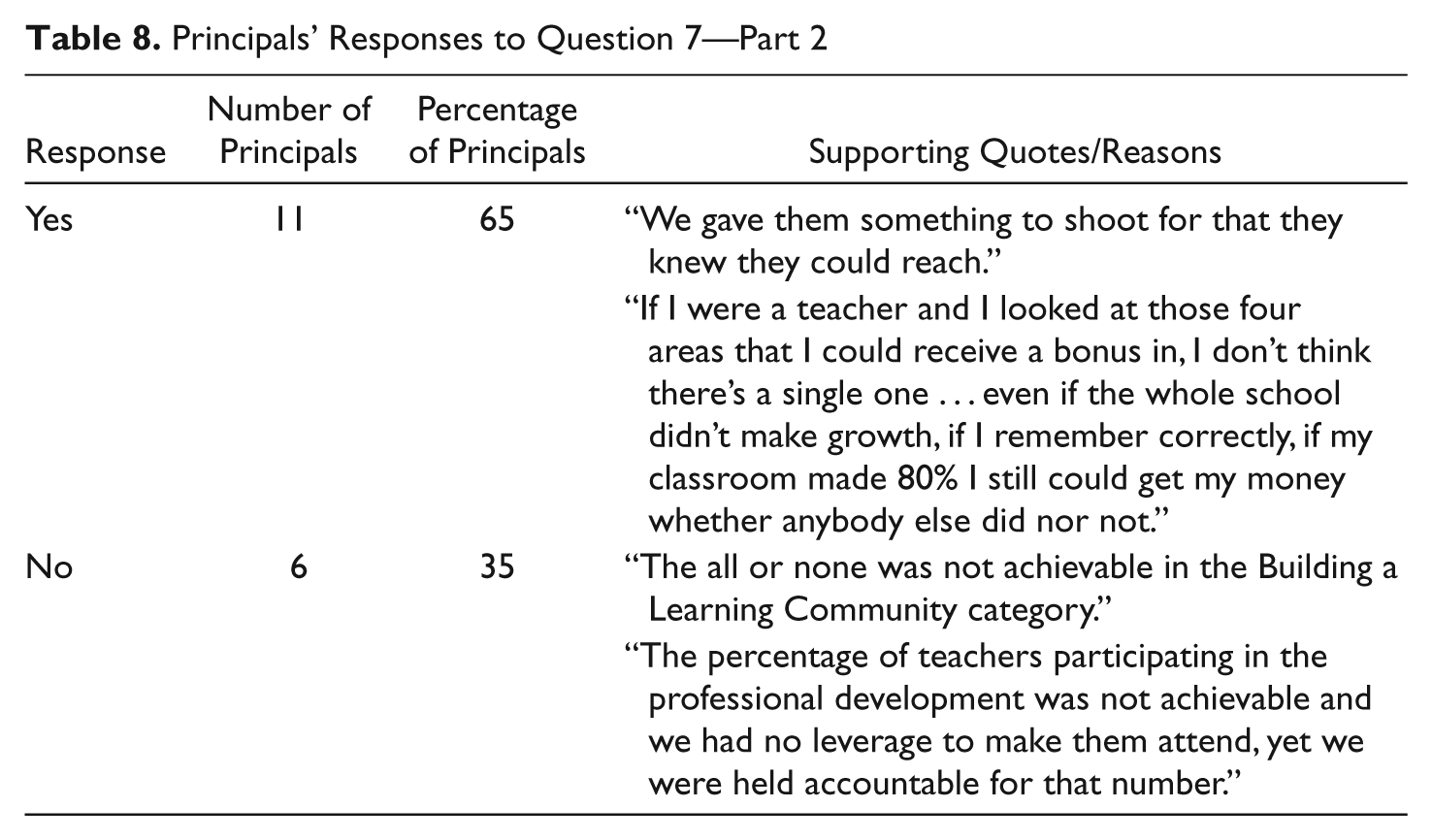
Overall, the principals felt that the stakeholders in the CP created a set of performance incentive criteria that balanced high standards with achievability. Most of the dissension came from the criteria for principals and superintendents regarding the percentage of teachers attending professional development. Another principal noted that the parent contact component, although valuable, was not a high standard.
The CIPP, in its June 2009 report, noted that 72% of teachers polled felt that the incentive criteria were well designed and linked to criteria that make sense (Thompson et al., 2010, p. 24). That finding supports the above finding suggesting that 65% of principals agreed that CP stakeholders created criteria that blended high standards with achievability.
Two interesting findings came out of this interview question. The first deals again with the issue of quid pro quo in education. One principal, in a discussion of the percentage of teachers attending professional development, noted that her teachers began to attend sessions once they found out she was paid based on the number of teachers who attended professional development. The principal said,
Now a lot of mine eventually did because they knew it would help me. . . . I mean I don’t know if you’re going to put that in your report or not but a lot of them said I’m gonna go because I know it would help you.
The second interesting finding came from a principal who answered the question positively but noted that “we set high average standards as opposed to high categorical standards.” The principal further explained that high average standards lump all students together whereas high categorical standards look specifically at one category of students (students with disabilities, gifted students, etc.). The principal did admit that categorical standards were not realistic for this project.
Interview Question 8
The final question asked principals whether they observed instances of teachers using the performance incentives associated with the CP to drive up their final average salary for retirement in his/her school. Four principals (24%) of the 17 noted they had observed this phenomenon. Table 9 outlines the responses of the four principals who responded positively.
Principals’ Responses to Question 8
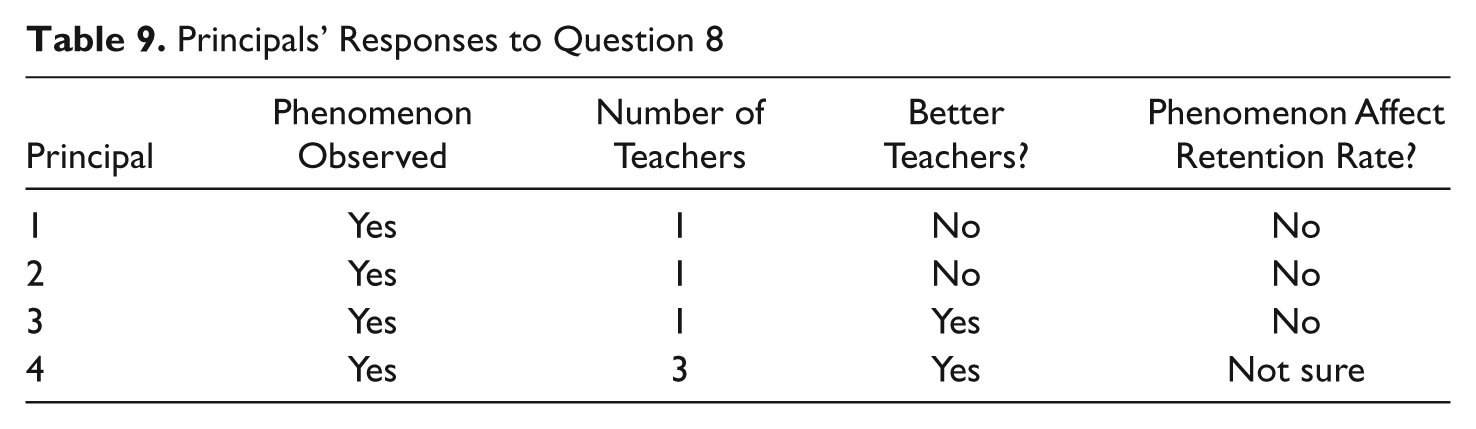
Although nearly a quarter of the CP principals interviewed observed this phenomenon, the total number of teachers who used the CP to drive up their final average salary for retirement is very small. None of the four principals who reported observing the phenomenon reported that his/her teacher retention rate was negatively affected. It is interesting to note that Principal 4 lost three teachers to this phenomenon out of 15 total teachers, which equates to 20% of the teaching staff. The principal responded that he/she was unsure whether or not the teacher retention rate was negatively affected; however, it almost certainly had to be with 20% of the faculty retiring after using the CP to drive up their final average salary. The teacher retention rate for a particular school is based on the number of teachers who leave during the school year for any reason. If 20% of the teachers of a school leave for any reason, the retention rate would be negatively affected.
Summary of Findings
Questions 1, 2, and 4 asked principals about three of the four components (student achievement, principal’s evaluation, and professional development) of the performance incentive criteria for teachers associated with the CP and whether or not they felt the component helped, hurt, or had no effect on their school. Overall, the majority of principals (37/51 principals or 73%) interviewed believed the components helped his/her school. The fourth and final component of the performance incentive criteria for teachers, parental contacts, was not a part of the interview protocol.
The third question asked principals why he/she felt principals participating in the CP continued to assign overly inflated ratings to teachers in schools that had, and continue to have, issues with poor student achievement on state-mandated testing. Among the reasons provided by principals were the following:
The teacher evaluation form issued by the DPI did not address student achievement.
The need to keep faculty morale high was significant.
A desire to reward teachers for hard work rather than the test results of his/her students.
Pressure from teachers to relate to the funding attached to the evaluation.
A desire to provide extra money to his/her teachers was important.
A quid pro quo—principals assigned overly inflated teacher evaluation ratings in exchange for favorable ratings on the TWC Survey.
Questions 5 and 6 were related to the issue noted by CIPP evaluators regarding teachers complaining about teachers of nontested subjects receiving more financial reward than teachers of tested subjects in some cases. Although six principals (35%) reported receiving teacher complaints in this area, the total number of teachers complaining about the issue (nine) was still very small compared to the total number of CP teachers in the five districts. However, the finding from this study related to the tested teachers versus nontested teachers issue is supported by the findings of CIPP in its June 2009 report.
Question 6 was a follow-up question that asked principals if the decision to exclude teachers of nontested subjects from the performance incentive for student achievement would have helped or hurt the school. All but one of the principals (94%) agreed that excluding teachers on nontested subjects/grades would have hurt the school.
The seventh question contained two parts. The first part of the question asked principals about his/her level of participation in the determination of the performance incentive criteria for the various CP stakeholders. This question featured the most mixed results of any of the eight questions. Seven principals (41%) believed that they participated fully, four principals (24%) felt that they were not fully involved, and six others (35%) did not answer “yes” or “no” but qualified his/her response with an explanation. Most principals believed that they were fully involved in the process to determine the performance incentive criteria for the first two Leadership Institutes. After that point, the CP leadership began to use an Advisory Committee made up of the CP leadership and the superintendent and central office contact from each of the five districts. Because of the Advisory Committee, the principals felt his/her full involvement diminished significantly.
The second part of the seventh question asked principals if they believed the performance criteria created by the stakeholders of the CP balanced high standards with achievability. Most of the principals interviewed (65%) believed the criteria successfully blended high standards with achievability.
The final question dealt with the phenomenon of teachers using the performance incentives associated with the CP to drive up their final average salary for retirement. Only four principals (24%) noted that they had observed this phenomenon in their schools.
Conclusions Related to Guiding Questions
To understand the implications of the findings of this study for school leaders, one must begin with the questions used to guide the study:
What are the major challenges and dilemmas for school leaders in designing a performance incentive system for individual teachers?
How did the leadership of the CP address the challenges and dilemmas that arose during the implementation of the performance incentive system?
How did principals, teachers, and others involved in the implementation respond to the design of the CP?
To what degree were the responses positive? To what degree were the responses negative? What unforeseen challenges or dilemmas emerged during implementation?
What are the implications for school leaders of the CP’s experience in designing and implementing a performance incentive system for individual teachers for future efforts to create performance incentive systems designed to improve student achievement?
The first guiding question addresses the major challenges and dilemmas for school leaders in designing a performance incentive system for individual teachers. One major challenge for school leaders is the creation of performance incentive criteria that may avoid opportunities for quid pro quos among the stakeholders. A surprising finding arose from the principals’ answers to the third interview question dealing with reasons why they continued to assign teachers inflated evaluation ratings. Several principals admitted to a quid pro quo during the interview process; in other words, the principal exchanged inflated ratings on a teacher evaluation, which provided a performance incentive for teachers, in return for favorable ratings from the teacher on the TWC Survey, which offered an opportunity for an incentive award for the principal. At least two principals admitted to this type of a quid pro quo. There may have been other principals who engaged in this type of quid pro quo; however, none of the others admitted to such during the interview. This finding presents an ethical dilemma as well. Is this type of quid pro quo a breach of professional ethics? Is this type of quid pro quo illegal? If it is illegal, where is the line between legal and illegal and is it clearly defined? Are quid pro quos such as this common in the private sector? These questions and perhaps others regarding quid pro quos in education are certainly areas that are ripe for future study.
A second challenge that was first identified during a more formal evaluation released by the CIPP in June 2009 and validated by this study found that there were instances of teachers of tested subjects/grades receiving less performance incentive for student achievement than some teachers of nontested subjects/grades (Thompson et al., 2010). Six of the 17 principals (35%) reported at least one teacher complaining about this phenomenon during the interviews. Although six principals (35%) reported receiving teacher complaints in this area, the total number of teachers complaining about the issue (nine) was still very small compared with the total number of CP teachers in the five districts; therefore, the phenomenon did not appear to be widespread. Another interesting aspect of this finding relates to how the principals addressed the issue with the teachers. Each of the six principals who reported a teacher complaint in this area indicated that he/she sat down with the teacher making the complaint and went over the criteria with the teacher individually. All the principals noted that sitting down the teacher individually appeared to resolve the issue. Interestingly enough, despite the few complaints, almost all of the principals (94%) felt that designing the students’ achievement component of the teacher performance incentive criteria would have harmed the school. One principal who received complaints from teachers stated that very succinctly, “I think the way they did it was the only fair way.” Thirteen of the 17 principals (76%) interviewed believed the student achievement component of the teacher performance incentive criteria helped the school; therefore, the implication for school leaders is to include the student achievement component for all teachers in future iterations of performance incentive programs. The caveat is for the stakeholders of the performance incentive programs to develop very clear criteria so that when anomalies occur, school leaders may fall back on the criteria.
The final challenge for schools leaders attempting to design a performance incentive program for teachers is that, despite the teacher recruitment and/or retention focus of many performance incentive programs, leaders must understand that some teachers will use the incentives for other purposes. In other words, nearly a quarter of the principals interviewed noted that at least one teacher in the building used the incentives associated with the CP to drive up his/her final average salary for retirement. In about half of the recorded instances, these teachers were better teachers within the school. However, the principals reported that teacher retention rates were not greatly affected by this phenomenon.
The second guiding question asked how the leadership of the CP addressed challenges that arose during the implementation of the performance incentive program. The best example, already noted, was the way the principals who received complaints from teachers of tested subjects about the student achievement performance incentive. In each of the six incidents, the principals responded in the same manner. Each sat down with the individual teacher and the student achievement criteria and went over the process for determining the student achievement performance incentives.
The third guiding question addressed how the principals and teachers responded to the design of the CP. Overwhelmingly, the responses of the principals were positive regarding the three areas of the performance incentive criteria for teachers. None of the eight questions asked during the interview had a majority of negative responses.
The final guiding question dealt with implications for school leaders wishing to design and implement a similar program in the future. This study has highlighted several implications for school leaders and policy makers.
Implications of the Findings
First, given what is now known from the CP principals regarding the principal’s evaluation component of the teacher performance incentive criteria, this study suggests that future iterations either change the principal’s evaluation component or not include principal’s evaluations in the teacher performance incentive criteria at all. Although 53% of principals felt the component helped his/her school, 47% believed the component had no effect on the school. There was also much discussion among the CP stakeholders regarding inflated teacher ratings despite most schools facing serious student achievement challenges. Based on the principals’ responses, the belief of this researcher is that the ratings were inflated before the CP ever started and that the phenomenon was only highlighted as a result of the principal’s evaluation component of the criteria for teachers. Moreover, the principals gave varied reasons for why the ratings were inflated, including the following:
The teacher evaluation form issued by DPI did not address student achievement
The need to keep faculty morale high
A desire to reward teachers for hard work rather than the test results of his/her students
Pressure from teachers related to the funding attached to the evaluation
There was a desire to provide extra money to his/her teachers
A quid pro quo where principals assigned inflated teacher evaluation ratings in exchange for favorable ratings on the TWC Survey
There are several possibilities for altering this component into a more viable option or future performance incentive programs. For example, the stakeholders of a potential performance incentive program could meet, examine the current teacher evaluation data, and set baselines for the evaluations. Also, the leadership of the performance incentive program should establish expectations regarding the evaluations in the initial stages of the performance incentive system and communicate those expectations clearly to the evaluators. Perhaps the CP leadership did not spend enough time in early 2007 stressing that the principal’s evaluation was designed to give principals more leverage to motivate teachers to perform better. At least one principal directly addressed this issue when he/she said, “It wasn’t emphasized enough to us in the beginning. I didn’t realize the impact. . . . I just don’t think it was emphasized enough.” Therefore, again, the recommendation of this study is to either modify the principal’s evaluation component or exclude the principal’s evaluation component from any future attempts at performance pay initiatives for teachers.
Student achievement and professional development components of the teacher performance incentive criteria are significant implications of this study for school leaders and policy makers. There is support in the literature and in the findings of this study for the inclusion of these two areas in future performance incentive programs. Odden and Kelley, in their 2002 book, wrote that many performance incentive programs reward teachers for student achievement and/or the successful completion of professional development modules. There is also agreement in the body of reviewed literature on specific components of performance incentive programs (Center for Teaching Quality, 2007; Harris, 2007; Odden & Kelley, 2002; Perkins-Gough, 2007). Included among these are the provisions of additional pay for individuals who participate in additional and relevant professional development (Center for Teaching Quality, 2007; Harris, 2007; Odden & Kelley, 2002; Perkins-Gough, 2007). The principals interviewed for this study supported the aforementioned research. Of the principals interviewed, 76% believed the student achievement component helped the school and 88% believed the professional development component helped the school.
Yet another implication for school leaders wishing to develop a performance incentive program grew out of the challenge regarding the few teachers of tested subjects who received less student achievement performance incentive than some teachers of nontested subjects. Despite receiving some complaints, the principals interviewed overwhelmingly responded that excluding the teachers of nontested subjects would harm their schools. Only one principal (6%) responded in any other way to the question. Nearly all the principals mentioned the increased collaboration and contributions from all teachers as a result of the student achievement performance incentives.
There appeared to be a large amount of confusion among the principals regarding their level of involvement in the process for determining the performance incentive criteria after the first two Leadership Institutes. Beginning with the third Leadership Institute, an Advisory Committee was formed. The committee was made up of the CP leadership, the superintendent of each of the five districts, and the central office contact from each of the five districts. Making minor adjustments to the performance incentive criteria and dealing with challenges as they arose was the primary tasks of the committee and the CP leadership was aware that its creation would exclude principals from the final decision-making process. However, the interview results would suggest confusion regarding the Advisory Committee.
There are perhaps two questions at stake. How much of the confusion surrounding the Advisory Committee is legitimate? How clearly was the transition to the Advisory Committee communicated to the principals? Research indicates that including stakeholders in the development and implementation of performance pay programs increases the likelihood of a successful program (Center for Teaching Quality, 2007; Harris, 2007; Odden & Kelley, 2002; Perkins-Gough, 2007). The implication for school leaders and policy makers is to make a decision from the outset as to the inclusion of all stakeholders in the decision-making process versus a committee and to communicate that decision clearly to all stakeholders.
The final implication for school leaders wishing to design a performance incentive initiative revolves around teacher retirement. Despite the teacher recruitment/retention focus of performance incentive programs, nearly a quarter of the principals interviewed acknowledged that there were teachers in their schools who used the performance incentives associated with the CP over the 3 years of the pilot to drive up their final average salary for retirement. After the 3 years, they then retired with a higher monthly check than they would have without the incentives associated with the CP.
Recommendations for Further Research
The first recommendation for further research revolves around the discovery of a quid pro quo within the CP, perhaps the most surprising and significant finding of this study. The most immediate question arising from this study is whether or not a performance incentive program on any level can be developed that insulates against a quid pro quo. That question raises more questions regarding quid pro quos for further study on a much broader level than just education. How common are quid pro quos, not only in education, but in the fields of business, politics, or medicine? What is the ethical boundary for quid pro quos, if there is one? Are there varying degrees of legality or illegality surrounding quid pro quos? Are quid pro quos simply part of the human condition? This researcher believes there are opportunities for further study on quid pro quos in education, anthropology, and psychology.
A second recommendation for further study is stakeholder involvement in the decision-making processes of performance incentive initiatives. As reported in the findings, there was some disagreement among the principals regarding their level of participation in the decision-making process of the CP; therefore, what degree of stakeholder involvement in the decision-making processes of the development and implementation is optimal for a successful program?
The third recommendation for further study involves the principal’s evaluation component of the performance incentive criteria for teachers. Is there a way to include subjective evaluations in a performance incentive program that insulates against opportunities for a quid pro quo? Is there a means for including the evaluations in a meaningful way that could help advance the goals of the school and/or the incentive program?
Another recommendation for further research treats the manner in which teachers regard the incentives themselves. Is there a way to create a performance incentive system for teachers that prevents opportunities for teachers to use the incentives in ways other than the developers of the program intended? Was it harmful to the CP for teachers to admit that they used the incentives to drive up his/her final average salary for retirement rather than to improve student achievement and teacher retention rates? This phenomenon affected both good teachers and bad, according to the principals.
One final question that this study has raised is why have incentives to motivate people to do the job for which they are hired for in the first place? Herzberg’s research suggests that incentives in the private sector did not work as expected. Does this research stand up to performance incentive programs in education? Should the federal government continue to encourage school leaders to move toward performance incentives in schools?
Footnotes
Declaration of Conflicting Interests
The author(s) declared no potential conflicts of interest with respect to the research, authorship, and/or publication of this article.
Funding
The author(s) received no financial support for the research, authorship, and/or publication of this article.