







Abstract
This article provides a tabular analysis of court rulings where public school principals challenged the adverse employment actions of involuntary transfer, suspension, demotion, nonrenewal, constructive termination, and termination during the period 1998-2012. The primary findings were that (a) the judicial outcomes were markedly in favor of the defendant school districts and (b) although the number of claims had increased during this 15-year period, the outcomes trend did not correspondingly shift in favor of the plaintiff-principals.
During the process of filling open teaching positions for the upcoming school year the Mancos School District superintendent accused his high school principal Laura Harper of divulging confidential district information to a candidate seeking employment. As a result, he recommended that the district’s board of education dismiss her from employment. Although having previously approved Harper’s reappointment, the school board placed her on administrative leave and rescinded the renewal of her contract without providing her with a hearing. After a year of unsuccessful job seeking, Harper filed a lawsuit against the school district and the superintendent in federal court, claiming (a) violation of Fourteenth Amendment procedural due process, (b) intentional interference with contractual relations, (c) breach of contract, and, alternative to the contractual claim, (d) violation of the equitable doctrine of promissory estoppel.
This case, Harper v. Mancos School District RE-6 (2011), illustrates the situations principals face when considering whether to litigate employment actions that adversely affect their job conditions. It is not uncommon for the principal to consider the adverse employment action—which may be involuntary transfer, suspension, demotion, or dismissal—procedurally unfair or substantively unjust, thus eliciting the impetus of suing the district to rectify the perceived illegality. However, one of the key considerations in invoking litigation is what the perception of the court is likely to be in terms of its decision in light of previous pertinent court decisions. The judge’s written opinion in Harper’s case, included dicta, or ancillary comments, expressing dismay at how poorly the school district had treated her; however, the decision was to dismiss each of Harper’s claims as insufficient for a trial.
The choice of whether to pursue litigation to challenge adverse employment actions depends on multiple factors, including the likely costs and benefits. The perceived facts, the legal claims, and the local culture are other, more specific contributing factors. Another major consideration is the likelihood of a favorable court ruling. Is the outcome of the Harper case representative of the court decisions for other nonrenewals? Is it also representative of the judicial outcomes of other adverse actions?
The answers to such questions are of interest to not only principals but also school districts. The merits of the case in terms of its likely judicial outcome will be one of the factors the school board will use in determining whether to settle or defend the case on receiving notice of the lawsuit. Additionally, the various stakeholders, including the organizations representing principals and school boards and the attorneys on both sides, as well as policy makers and professors would benefit from objective information about the longitudinal trends in the frequency and outcomes of these court decisions. Is this information readily available in the professional literature?
Relevant Literature
The professional literature specific to principals’ judicial challenges to adverse employment actions is markedly limited in terms of empirical information. The various published sources range from general analyses of employment issues without any legal component to an empirical analysis of the case law specific to adverse employment actions against superintendents.
Most coverage concerning principals’ employment issues provides an organizational perspective, exploring (a) the increasing complexity of school leadership (e.g., Hull, 2012; National Association of Secondary Principals, 2007), (b) candidate shortages for principal positions (e.g., Roza, 2003), or (c) superintendents’ motivations for terminating principals (e.g., Davis, 1998). While these sources are specific to principals’ employment, they do not address the relevant case law.
Other sources have analyzed court decisions specific to educator employment; however, they address relatively narrow legal issues with small, nonempirical case samples, and the majority of them only covers principals within a broader group of educators. For example, Kallio and Geisel (2011) focused on the limited protections that the First Amendment and state whistle-blower laws provide for the expression of educators generically, including principals only secondarily. Similarly, Davison, Strope, and Uerling (2003) discussed adverse employment actions for the off-duty conduct of educators, mixing administrator and teacher cases together without any systematic frequency and outcomes analysis.
Some sources are specific to employment case law of principals, but they address only a particular type of adverse action or legal claim with a traditional nonempirical treatment. More specifically, a regular column in Principal magazine has discussed the case law for the adverse actions of demotions (Zirkel, 2002, 2008) and suspensions (Zirkel & Gluckman, 1994). In other issues, this column included legal challenges to adverse actions in the context of free speech issues (Zirkel, 2003) and high stakes testing (Zirkel, 2013). Moreover, these specialized syntheses have not focused on the principal as the plaintiff challenging the adverse action; instead, in some of the covered cases, the principal was on the employer side, having contributed to the adverse action of a teacher. While providing snapshots illustrating various federal and state claims available for principals’ employment challenges, these columns do not provide systematic and longitudinal analysis of the frequency and outcomes of these claims and cases.
Coming closer to the requisite empirical analyses of principal employment litigation are occasional doctoral dissertations. For example, Harris’s (2011) dissertation analyzed trends in the frequency and outcomes of 100 court cases from 1982 to 2009 in which principals challenged the adverse actions of transfer, demotion, nonrenewal, and termination (including reduction in force [RIF]). He found that the number of published cases dropped during the latest decade of this period and that school districts prevailed in 79% of cases overall. Similarly, Flatt’s (2012) dissertation examined 125 cases from 1989 to 2010 where principals or assistant principals challenged adverse employment actions. In contrast to the results of Harris’s study, Flatt found an upswing during the most recent decade and that the outcomes were in favor of districts in only 58% of cases. These differences in findings appear to be primarily attributable to methodological limitations in both studies. These limitations included (a) relying on a single Westlaw search topic, (b) lacking sufficiently specific boundaries for inclusion and exclusion of cases, (c) analyzing outcomes based solely on the case rather than extending to the more precise unit of analysis of the separable legal claims, and (d) using an outcome scale without sufficient definition and differentiation, such as use of an intermediate “mixed” category that did not distinguish between conclusive and inconclusive rulings.
The most systematic, refined empirical analysis of school district adverse employment actions against administrators is specific to district superintendents, thus serving as a useful methodological model without providing directly pertinent findings. In this study, Cox and Zirkel (2009) analyzed the case law from 1972 to 2008 where the superintendent was the object of the employment action and, thus, the plaintiff challenging it. More specifically, they examined the frequency and outcomes of superintendents’ legal challenges to the adverse actions of contract buy-out, suspension, demotion, nonrenewal, and termination. For outcomes, they used a multicategory scale that distinguished inconclusive rulings and that extended to the unit of analysis of the separable legal claims within each case. The results included 89 relevant cases for the 35-year period with this distribution of outcomes: conclusively for superintendent = 24%, inconclusively for superintendent = 11%, split = 6%, inconclusively for district = 3%, conclusively for district = 55%. Their findings, however, were limited to the special role of the superintendent in relation to the school board, thus not being generalizable to principals.
In light of the overall gap in and the specific limitations of the previous research, the purpose of this study is to provide a comprehensive and current empirical analysis of the case law specific to principals’ challenges to districts’ adverse employment actions. More specifically, this analysis addressed the following questions for the period 1998-2012:
What was the overall frequency of the cases and the claim rulings within these cases?
What was the longitudinal trend in the frequencies of the cases and claim rulings?
What was the overall outcome distribution of the claim rulings and, on a best-for-plaintiff claim basis, the cases?
What was the trend in the outcomes of the cases on this same best-for-plaintiff basis (a) across the successive time intervals and (b) for each adverse employment action?
Method
As an alternative and supplement to the traditional narrative approach of legal analysis, this study used an empirical research methodology that was primarily quantitative but partially qualitative. Stefkovich and Torres (2003) noted the increasing use and acceptance of this type of hybrid approach for analyzing case law in the education context. Given its empirical nature and nontraditional application, the data collection and coding warranted detailed reporting. This section provides a relatively brief overview, and, for the sake of more complete transparency, the Appendices A and B provide more specific explanation with examples for those who seek to review or replicate the methodology.
Data Collection
The subjects of this study were the final published court decisions concerning principals or assistant principals who challenged the employment actions of involuntary transfer, suspension, demotion, contract nonrenewal, constructive termination, or termination while working in a public K-12 school system during the period January 1, 1998 to December 31, 2012. The primary sources for the cases were the Education Law Association’s Yearbooks of School Law (Russo, 1999-2012). For the sake of comprehensiveness, we used the Westlaw electronic database (a) to search for additional cases and (b) to ensure that the coding was based on the most recent published decision for each case. For the sake of precision, we developed specific selection criteria that determined whether to include or exclude marginal cases, as specified in Appendix A.
After the search and selection phases, the data entry, including coding, was via a spreadsheet (Appendix B [available online]), which tabulated eight items. When cases yielded incomplete information for one or more of the items, the entry was “NI” for no information. The tabulated items were (a) year of the final decision, (b) case name, (c) level of principal’s school, (d) specific role—assistant principal or principal, (e) type of adverse action, (f) general basis of legal claims, (g) specific basis of legal claims, and (h) outcome. Per recent refinements of this outcomes analysis approach (e.g., Zirkel & Lyons, 2011), the unit of analysis was not only the case but also each adjudicated claim. Thus, some cases have more than one row of entries for Items f to h. The outcome entry for each adjudicated claim was according to the following 5-category scale (Holben & Zirkel, in press; Zirkel & Lyons, 2011):
1 = conclusive ruling favoring the principal(s)
2 = inconclusive ruling favoring the principal(s)
3 = conclusive or inconclusive split ruling
4 = inconclusive ruling favoring the district defendant(s)
5 = conclusive decision favoring the district defendant(s)
As explained further in Appendix A, inconclusive rulings are those that preserve the claim for further, unreported proceedings, thus favoring either the plaintiff principal or the district defendants but not conclusively.
Data Analysis
The data analysis was primarily via descriptive statistics. To address the first two research questions, we tabulated the frequency of both cases and claim rulings on an overall basis and in 3-year increments. To show more precisely the relationship between these two units of analysis, we calculated the ratio of claims rulings to cases for the total period and for the 3-year increments. Moreover, for the longitudinal question, we used nonparametric inferential statistical analysis, more specifically Kendall’s tau correlation coefficients for the frequency of claim rulings and cases on a year-to-year basis.
To address the third research question, we first calculated the percentage for each of the five outcome categories for the claim rulings and next, using the Zirkel and Lyons (2011) conflating procedure, determined the corresponding outcomes distribution for the cases based on the claim ruling most favorable for the plaintiff principal—that is, the one closest to a 1 on the 5-category scale. This procedure was warranted because the plaintiff principals tended to file more than one claim per case, with each claim serving as an alternative avenue to relief. The rationale for choosing the claim most favorable to the plaintiff to arrive at the case outcome is that the plaintiff succeeds to the extent that any of their alternate, adjudicated claims is successful.
In response to the final research question, for Parts 1 and 2 we determined the case outcomes distribution for each 3-year interval and for each adverse action, again using the claim most favorable to the plaintiff. Due to insufficient cell sizes, we declined to apply inferential statistics (i.e., chi-square test) to the adverse actions outcomes, instead limiting our examination to practical analysis.
Results
In response to the first research question, the selection and tabulation stages resulted in a total of 125 cases with 253 claim rulings during the 15-year period 1998-2012. Thus, the average ratio of claim rulings per case was 2.0. Moreover, principals—as compared with assistant principals—accounted for approximately 80% of the cases, with three cases having at least one principal and at least one assistant principal as co-plaintiffs. The distribution of the cases according to the plaintiff-principals’ school level was as follows for the 108 court decisions that included this particular information: high school = 42%, middle school = 17%, and elementary school = 42%.
Addressing the second question of the study, Figure 1 illustrates the trend in the cases and claim rulings for successive 3-year intervals. Moreover, the ratios of the claim rulings per case for each interval are arrayed directly above each pair of bars.
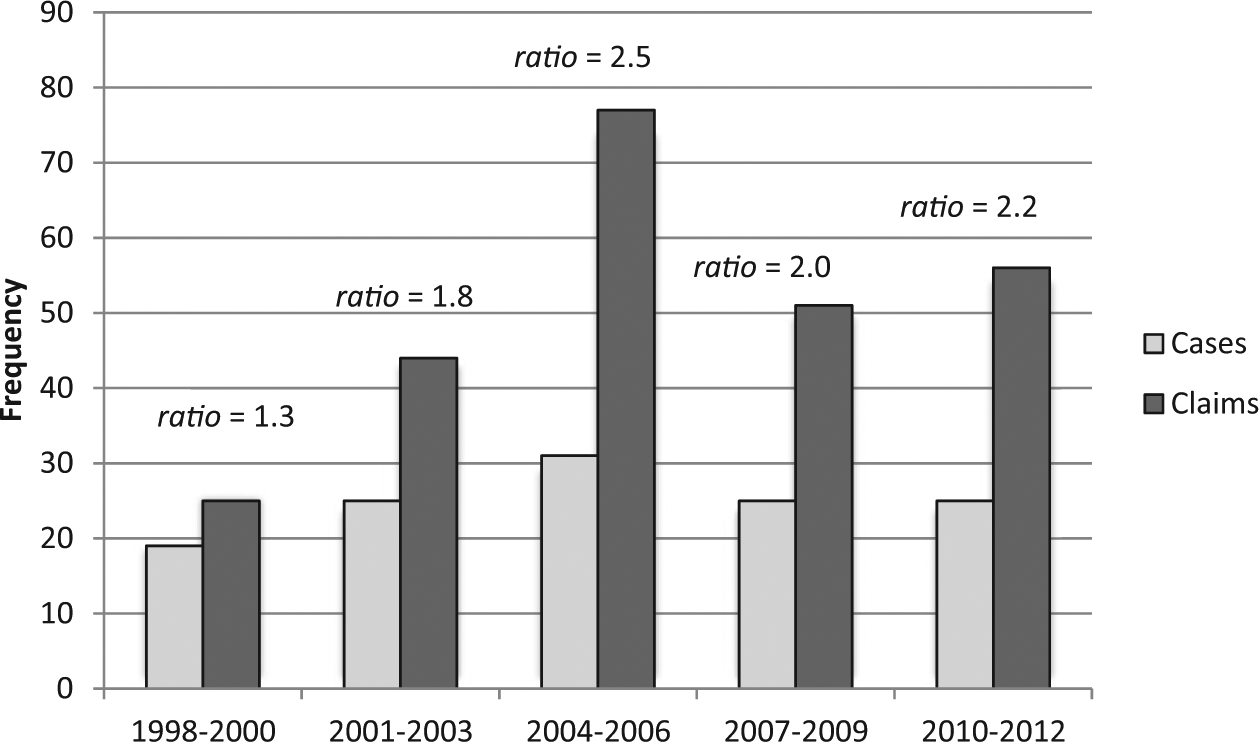
Longitudinal trend in the frequency of cases and claim rulings for principal challenges to adverse employment actions. Ratio = claims rulings divided by cases for the 3-year interval.
Examination of Figure 1 reveals no particular consistent longitudinal frequency trend in cases or claims. The number of cases increased during the first three intervals, followed by a lower, plateaued level during the two most recent intervals. The number of claim rulings followed a similar fluctuating pattern, except for a more accentuated movement upward during the third and the most recent intervals. The Kendall’s tau correlation coefficients for both cases (τ = −.051, p = .80) and claims (τ = .271, p = .16) were not statistically significant, thus showing no generalizable linear increase or decrease in these frequencies for the 15-year period of the study. Finally, at least partially accounting for the frequency differences between the case and claim units of analysis were the varying claim to case ratios, which were generally higher for the last three intervals compared with the ascending lower ratios for the first two intervals.
In response to the study’s third question, Table 1 provides the outcomes distribution of the claim rulings and, on the aforementioned best-for-plaintiff basis, for the cases, both on the 5-category—1, that is, conclusively for plaintiff-principal, to 5, that is, conclusively for the defendant-district—scale.
Outcome Distributions of Claim Rulings and Cases.
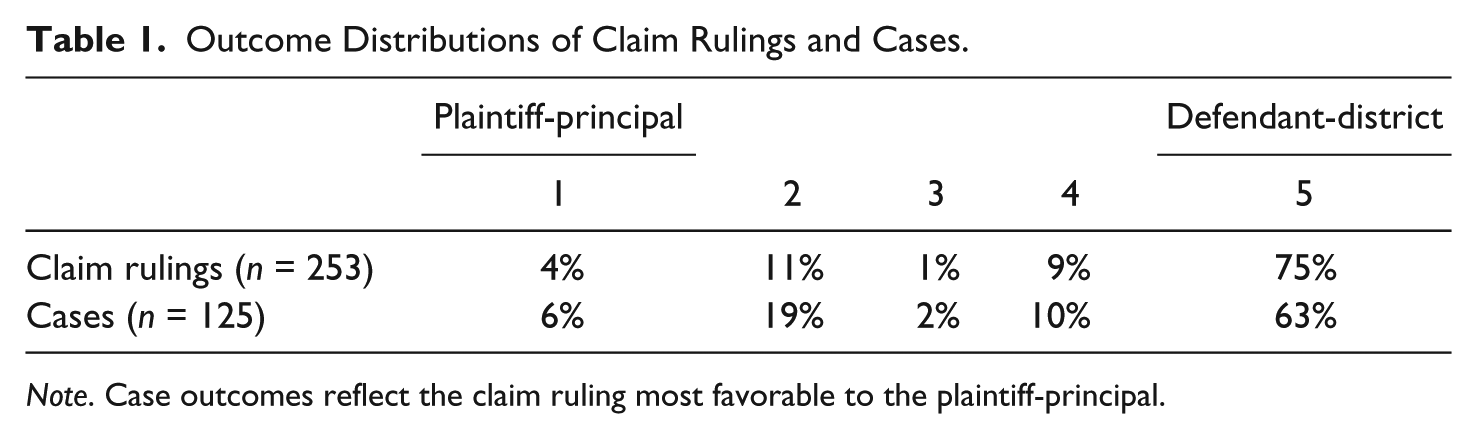
Note. Case outcomes reflect the claim ruling most favorable to the plaintiff-principal.
Table 1 shows that the district defendants won a clear majority (75%) of the conclusive claim rulings, whereas the plaintiff-principals won a very small minority (4%) of the conclusive claim rulings. On a best-claim-ruling-for-plaintiff basis for cases, the proportion of outcomes conclusively in favor of the district defendants was a more moderate majority (63%) but the outcomes conclusively in favor of the principals only increased slightly to 6%, with the more notable difference being in the increase from 11% to 19% of the cases inconclusively in the principals’ favor.
In response to the first part of the final question of the study, Figure 2 provides the distribution of case outcomes for the successive 3-year intervals within the entire 1998-2012 period. Following the conflation procedure in Table 1, the outcomes are based on the best-for-plaintiff approach for the claim rulings in each case.
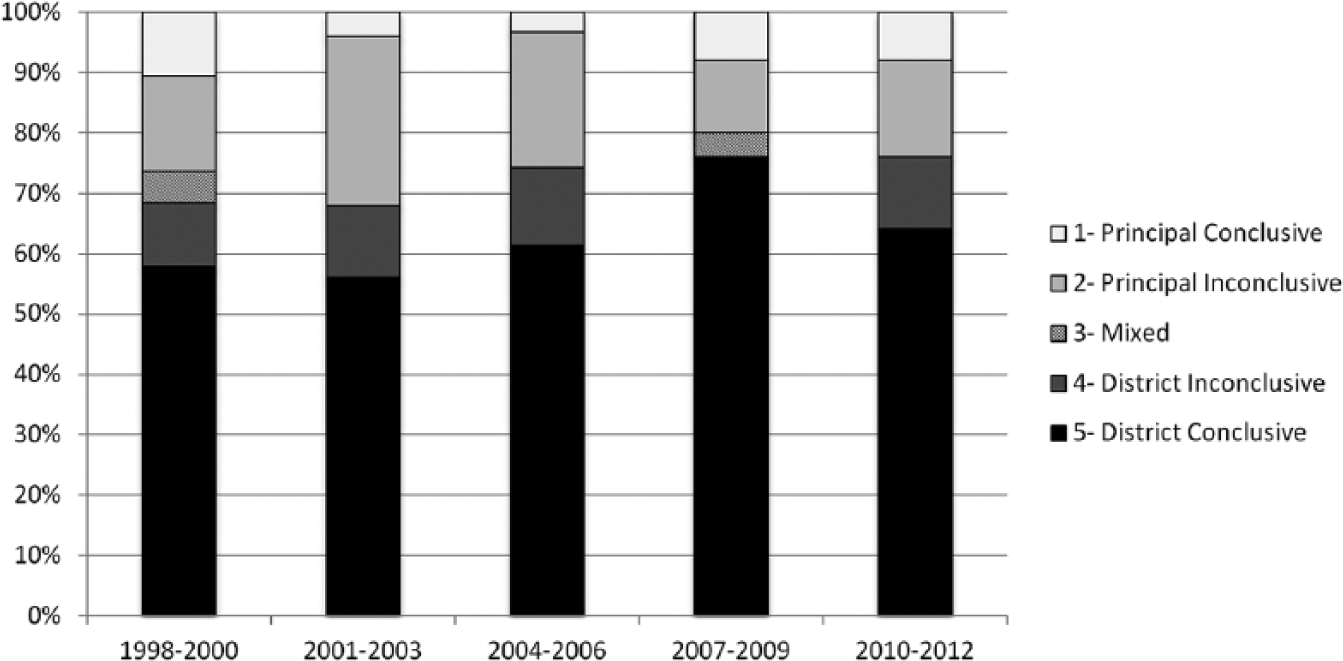
Longitudinal trends in outcome distribution of cases after conflation on the basis of most favorable claim ruling for plaintiff.
Review of Figure 2 reveals that districts conclusively won the majority of the cases for each interval, with the predominance particularly pronounced in the two most recent intervals. Conversely, principals’ proportion of conclusive wins was the highest (11% of the cases) for the first interval, but their corresponding conclusive percentages moved back toward that high point in the two most recent intervals. The gravitation toward these polar positions during the most recent 3-year segments appeared to be attributable to a reduction of the intermediate outcome categories.
In response to the second part of the final question, Table 2 provides the distribution of the case outcomes, on the same best-for-plaintiff basis, for each adverse action in order of their respective frequencies. The conflation in this table for the three cases that had more than one adverse action at issue was at the action rather than case level so as to more precisely disaggregate the frequency and outcomes for each adverse action.
Frequency and Outcomes Distribution for Each Adverse Employment Action.
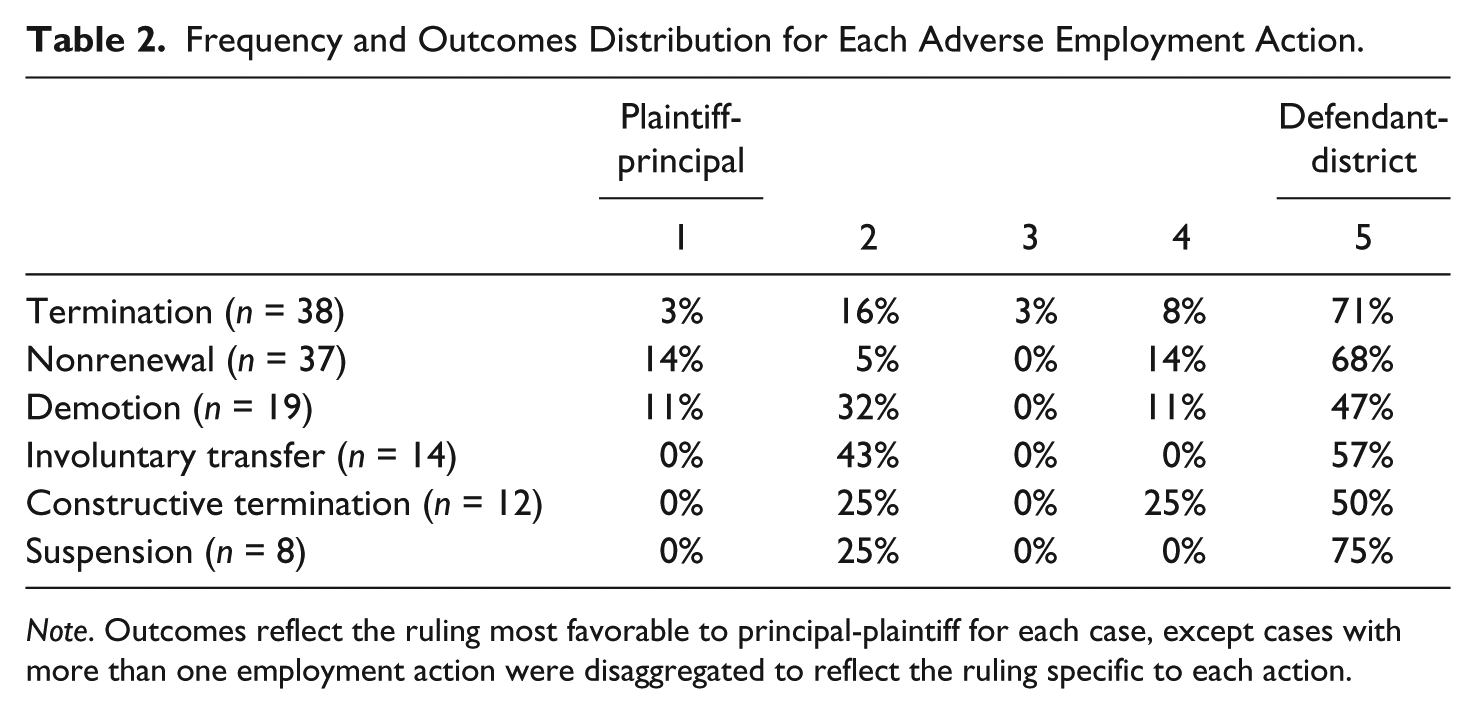
Note. Outcomes reflect the ruling most favorable to principal-plaintiff for each case, except cases with more than one employment action were disaggregated to reflect the ruling specific to each action.
The highly favorable results for the adverse action of suspension warrant extra caution in light of this action’s low “n.” Beyond this low-frequency action, termination and nonrenewal—the two actions with the highest frequency and the most severe consequences—had the highest predominance of conclusive outcomes in favor of districts. Conversely, the proportion of conclusive wins for districts was the lowest for demotions, at 47%, though still far higher than the polar opposite outcome. Instead, because of its relatively low proportion of intermediate outcomes, the adverse action of nonrenewal had the highest percentage of conclusive wins for principals.
Discussion
The first major finding was that the frequency of court decisions where principals challenged adverse employment actions was almost twice the number cited in the previous studies. More specifically, we identified 125 court decisions for a recent 15-year period in contrast with 100 and 125 for the overlapping 27- and 30-year periods of the Harris (2011) and Flatt (2012) dissertations, respectively. The difference in case counts may be partially attributable to the more precise scope of this study, which included constructive termination and suspension cases (n = 20); however, the primary explanation for the greater number of identified cases would appear to be the more thorough search strategy that we employed. In any event, this type of litigation is more frequent for principals than previously identified, and further research would benefit from such an assiduous search and selection process.
The distribution of court cases in terms of the plaintiff-principals’ school level suggests overrepresentation in the litigation for high school principals and underrepresentation for their elementary school counterparts when these frequencies are compared with national demographic data for principals. More specifically, the average between the available National Center for Education Statistics data for the beginning and end of the 15-year period leads to the following distribution of principals among the three school levels: high school = 22%, middle school = 16%, and elementary school = 62% (Gates, Ringel, Santibanez, Ross, & Chung, 2003; National Center for Education Statistics, n.d.). Compared with the national percentages, the distribution of principals in the cases in this study was substantially higher for high school (42%), commensurate for middle school (17%), and much lower for elementary school principals (42%). The differences may be partially attributable to (a) missing data, that is, the 13% of the cases that lacked this information; (b) school designation, that is, differential treatment of schools that ranged across categories; and (c) time period, that is, basing the national data on the beginning and end of the period as compared with a yearly basis. However, it may also be that the more challenging nature of high school working conditions—for example, larger school size, increased organizational complexity, and greater severity of problems—and the higher salaries of their principals compared with the other two levels (Gates, Ringel, Santibanez, Ross, & Chung, 2003; Louis, Leithwood, Wahlstrom, & Anderson, 2010) were contributing factors to this disproportionate tendency in the litigation concerning adverse employment actions.
The second major finding was the fluctuating longitudinal trend in the frequencies of the cases and claim rulings. This finding is contrasted with the two less precise previous studies (Flatt, 2012; Harris, 2011) that conflicted in their findings of rising and falling case trends, respectively. Although partially attributable to their longer periods and narrower, albeit less carefully defined scope, the more thorough search and selection strategies of this study and the addition of claim rulings would seem to suggest that fluctuation is the more accurate characterization of the longitudinal trend. In any event, it seems relatively clear that this area of litigation (a) remains relatively significant at a time when K-12 education litigation overall is also characterized by fluctuation rather than a dramatic rise or fall (Zirkel & Johnson, 2011) and (b) is becoming more multifaceted due to the increasing number of claims per case. Although the overall ratio of 2.0 claim rulings per case is considerably less than the 7.5 ratio that Zirkel and Lyons (2011) found for student disability challenges to restraints, it is in line with Paige and Zirkel’s (2014) finding of a 1.5 ratio for the more analogous, albeit more range-restricted, topic of employee disability challenges to adverse actions.
The third major—and likely most noteworthy—finding was the rather obvious overall outcome skew in favor of district defendants. Even when calculated on a best-for-plaintiff basis, the respective proportions of conclusive case outcomes were 6% in the plaintiff-principals’ favor in comparison with 63% in the district defendants’ favor. This high rate of success for districts corresponds with the judicial deference that courts typically accord to administrative agencies and more specifically accord to school districts. Similarly, these district-favorable success rates are congruent with the results of Zirkel and Lyons’s (2011) outcomes analysis of a segment of student cases, Paige and Zirkel’s (2014) outcomes analysis of a segment of teacher cases, and Cox and Zirkel’s (2009) outcomes analysis of superintendent cases.
However, two factors temper this skewed outcome ratio in favor of districts. First, 19% of the cases had inconclusive rulings in favor of plaintiff-principals. These inconclusive outcomes provided the plaintiff-principal with not only the possibility of a conclusively favorable decision on further proceedings but also—as the studies cited in Paige and Zirkel found—even higher odds of a settlement. Second, the case sample is limited to published court cases, thus not extending to the total population of principal employment action litigation. Consequently, the limits on generalizability include not only the facts of these cases and the jurisdictions of their courts but also the potentially different outcomes of the unpublished cases. Yet this final limiting factor should not be overestimated because (a) the advent of electronic databases has substantially lessened the extent of unpublished cases and (b) the published cases cumulatively affect the outcomes of the unpublished cases via the doctrine of precedent.
On the other hand, even in the relatively few cases with outcomes in the conclusively-for-plaintiff category, the remedies varied widely. In two of the cases where the principals lost their jobs, they won reinstatement or renewal (Foreman School District v. Steele, 2001; McFerren v. Farrell Area School District, 2010), and in a third the principal won partial reinstatement in terms of a teaching position (Midlam v. Greenville City School District Board of Education, 2005). Yet in another such case, the remedy for a statutory procedural due process violation was merely a new hearing (Murphy v. Saint Paul Public Schools, 2011). In the four cases where the court awarded monetary damages, the amounts ranged from $95,000 (Chadwell v. Lee County School Board, 2008) to $380,000 (Blume v. Denville Township Board of Education, 2000).
The fourth major finding was that the outcome trend did not dramatically change over this 15-year period. Thus, the substantial skew of outcomes in favor of district defendants was relatively pervasive. These results are rather sobering for plaintiffs who experience what they perceive to be adverse employment actions ranging from involuntary transfer to termination. Consequently, the knee-jerk reaction to sue warrants careful consideration as to (a) the forum, for example, mediation or arbitration, where available; (b) the federal and/or state claims; (c) the transaction costs, such as the amount of time and attorneys’ fees; and (d) the extent of negotiating leverage attained by filing a lawsuit or possibly obtaining an inconclusive ruling.
The fifth major finding was in terms of the adverse actions, specifically that nonrenewals and terminations were the most frequently challenged and that plaintiffs were most conclusively successful in challenging nonrenewals. Admittedly, the prevalence of nonrenewal and termination litigation is unsurprising because the stakes were highest in these cases due to the principal’s job being at issue. On the other hand, the higher percentage of conclusive principal-favorable outcomes for nonrenewals than for terminations is surprising because the legally required reasons and procedures for districts transacting nonrenewal proceedings are generally less demanding than for terminations. This unexpected difference between the conclusive outcomes for nonrenewals and those for terminations may be attributable to (a) districts opting in questionable termination cases to delay discharge of principals until the end of the contractual period, effectively skewing marginal cases into the nonrenewal category; (b) district diligence in documenting and processing termination cases; and, conversely, (c) districts overestimating the considerable latitude they have in cases of nonrenewal. However, the limited number of cases in each of these categories, the wide variety of claims and circumstances, and the varying effect of the inconclusive rulings serve as intervening factors that warn against overgeneralization of such conclusions.
These research findings have practical implications for both principals and school districts, because both parties must weigh the costs and benefits of litigation. Although the costs and benefits are largely otherwise discernible from attorneys and the literature, these empirical results, particularly for outcomes of claims and cases, are an additional worthwhile consideration for the parties.
The methodology and results of this study are also significant for researchers. Among the recommendations for follow-up study include determining whether the outcomes distribution differed between (a) the principals’ school levels and (b) their various federal and state claims. Moreover, a similar systematic study of the case law concerning certification sanctions levied against principals, such as suspensions and revocations of state certification is recommended. In general, the literature needs more empirical study of legal issues specific to principals both as overlapping with and distinguishable from teachers.
Footnotes
Appendix A
Declaration of Conflicting Interests
The author(s) declared no potential conflicts of interest with respect to the research, authorship, and/or publication of this article.
Funding
The author(s) received no financial support for the research, authorship, and/or publication of this article.
Author Biographies
References
Supplementary Material
Please find the following supplemental material available below.
For Open Access articles published under a Creative Commons License, all supplemental material carries the same license as the article it is associated with.
For non-Open Access articles published, all supplemental material carries a non-exclusive license, and permission requests for re-use of supplemental material or any part of supplemental material shall be sent directly to the copyright owner as specified in the copyright notice associated with the article.
