







Abstract
Much of the research on school shootings emphasizes the need for peers, not school officials, to share information about students of concern. This qualitative case study examined the information school officials had prior to a school shooting, which left two students dead. The data came from school officials’ deposition testimony and school records and revealed problems with information sharing and Federal Educational Rights Privacy Act interpretation prior to the shooting. Adaptive leadership strategies may allow school officials to build a culture of safety.
Introduction
Sharing information about students who exhibit problem behavior presents a challenge to school administrators, counselors, and teachers trying to both assist students in crisis and honor the Federal Educational Rights and Privacy Act (FERPA). Middle and high school administrators struggle to balance concerns for school safety with a student’s right to privacy. Research findings and law enforcement investigations, however, consistently find that sharing information about students of concern proves critical to the prevention of violence. In a study of 37 school shootings, the U.S. Secret Service found that “most attackers engaged in some behavior prior to the incident that caused concern or indicated a need for help” (Fein et al., 2002, p. 26), and prior to most school shootings, other people knew about the shooter’s concerning behaviors, safety threats, and weapons access (Erickson, 2001; Fein et al., 2002; Kaine, 2007; Newman, Fox, Hardin, Mehta, & Roth, 2004; Pollack, Modeleski, & Rooney, 2008). Unfortunately, classmates and school officials do not always report their concerns about students. The adolescent “code of silence” can discourage teens from telling their parents or teachers about a classmate’s plan to cause harm (Erickson, 2001; Newman et al., 2004).
Since Columbine, research on school shootings has emphasized the need to share information when students exhibit red flags or boast of an attack plan. In fact, the Columbine Review Commission’s 2001 report offered seven recommendations on information sharing in violence prevention, including the ways to identify concerning students, the need to dismantle the student code of silence, the creation of interagency information sharing agreements, and the development of an anonymous tip line (Erickson, 2001). The commission asked school officials to lead the effort to change student culture and open communication lines. Recent research suggests that confusion about FERPA may prevent school officials from sharing information about students (Chapman, 2009; Chute & Swain, 2004; Moyer, Sullivan, & Growcock, 2012). Yet little research examines the information school officials had prior to a shooting. The purpose of this qualitative study is to examine how teachers, administrators, counselors, and security personnel perceived and shared information about a student of concern, prior to a 2013 school shooting, which left two students dead. The study also provides lessons learned on the prevention of violence in schools.
Case studies provide detailed insight on uncommon forms of behavior without the need to screen a large population and with consideration for social and organizational contexts (Geis, 1991; Loftin & McDowall, 1988). The data for the study came from a larger project that sought to understand the school’s risk and threat assessment procedures and responses, the school’s approach to safety and climate, and the lessons to be learned from this incident that could improve youth violence prevention in school settings in the future. The data included law enforcement records, school and district records, and deposition testimony. To analyze and interpret the data, we relied on a grounded theory approach. This approach emphasizes the emergent nature of findings in qualitative research; it also acknowledges the interpersonal and social forces shaping and constraining school officials’ behavior.
Literature Review
School Shootings
Much of the research on school shootings has relied on a law enforcement or psychological perspective (Erickson, 2001; Fein et al., 2002; Kaine, 2007; Langman, 2009; Newman et al., 2004; Pollack et al., 2008). Law enforcement investigations have been the main mechanism for collecting information about school shootings (see Fein et al., 2002; Kaine, 2007; Pollack et al., 2008), and these investigations offer detailed accounts of the shooter’s background and behavior, such as a history of child abuse, bullying, weapons purchases, Internet searches, diary notations, and criminal activity. Langman (2009) looked at 10 school shootings and their shooters using a forensic psychological perspective to identify three types of shooters: (a) traumatized, (b) psychotic, and (c) psychopathic. Traumatized shooters had suffered abuse, and they had at least one parent who was a substance abuser and at least one parent with a criminal history. The psychotic shooters came from intact families with no abuse or trauma history, but they exhibited symptoms similar to schizophrenia or schizotypal personality disorder; these symptoms can include paranoid delusions, false conspiracy beliefs, delusions of grandeur, superiority complexes, and auditory hallucinations. The psychopathic shooters also came from intact families and had no abuse or trauma history, but they demonstrated narcissism, sadistic behavior, a lack of empathy, and a lack of conscience. While the Secret Service and others explain that there is no profile for a school shooter (Fein et al., 2002; O’Toole, 1999), these typologies can offer insight and suggest an intervention.
Psychologists have also identified the warning signs for a school shooter. Bondü and Scheithauer (2011) identified seven warning signs and risk factors, including planning the attack, leaking the plan, enjoying violent fantasies, experiencing peer rejection, experiencing a significant loss, and facing a negative school climate. School attacks are not spontaneous events; offenders develop their attack plans over the course of months and with cooperation from others (O’Toole, 1999; Verlinden, Hersen, & Thomas, 2000). Thus, potential shooters may be identified and their plans unearthed if their behaviors—such as making reference to the plan (e.g., in a school essay, to a peer) or showing abnormal interest in violent topics—are discerned (see also Meloy et al., 2004; Meloy, Hoffmann, Guldimann, & James, 2012; Rappaport & Thomas, 2004). These risk factors, coupled with motives such as being bullied or experiencing rejection, may be exacerbated by a negative school climate or a high pressure to perform (Bondü & Scheithauer, 2011). For example, Fox and Harding (2005) argue that when school administrators focus on addressing disruptive behaviors and improving academic success, they sometimes neglect the school climate conditions and personal risk factors that can contribute to deviant behavior. The Secret Service encourages school and district administrators to use warning signs and risk factors to assess a student’s level of threat (Fein et al., 2002).
Knowing the red flags, risk factors, and conditions, however, proves limited if school officials and others do not have a system for recording, relaying, and following up on information about those flags. An escalation in the patterns with problem behavior can be difficult to recognize when flags emerge over a period of several weeks, months, and years and in different settings and with different people. Without an adequate information system or culture, students in crisis proceed unchecked and unsupported. Sharing information remains key to the promotion of a positive school climate and the prevention of violence (Elliott, 2009; Erickson, 2001; Fein et al., 2002; Pollack et al., 2008; Vossekuil, Fein, Reddy, Borum, & Modzeleski, 2002).
The U.S. Secret Service found that someone knew about the shooter’s intention prior to the attack in 81% of the 37 school shootings that occurred between 1970 and 2000 in the United States (Pollack et al., 2008). These findings frequently identify the “code of silence” among adolescents, which discourages them from “ratting” on classmates. Students invested in the code dislike the idea of reporting a peer’s violent fantasies or attack plans, because it can label them a tattle tale and seem like an overreaction (Newman et al., 2004; Pollack et al., 2008). In addition, because of the commonality of provocative statements among teens, when a classmate threatens to kill someone or hurt their classmates, many peers dismiss the statements as evidence of bravado or an inappropriate joke (Newman et al., 2004). Newman et al. (2004) quoted several adolescents’ explanations for not reporting a shooter’s threats. One classmate said: [Mitchell, the shooter] said something about [planning the shooting], like joking around, but . . . nobody takes him serious, like that’s going to happen. (Newman et al., 2004, p. 160)
Mitchell Johnson, a 13-year-old student, shot and killed five students and teachers at Westside Middle School in Jonesboro, Arkansas in 1998, in a carefully planned attack. Relying on interviews with classmates of Mitchell and the shooters in other school shootings, Newman et al. (2004) found that even today, adolescents would likely repeat the same “not telling” mistakes, as has been documented in West Paducah and Columbine. Similarly, Pollack et al. (2008) found that bystanders did not believe the attack would actually occur, because it sounded so extreme and shooters often made it sound like a joke.
Organizational Leadership
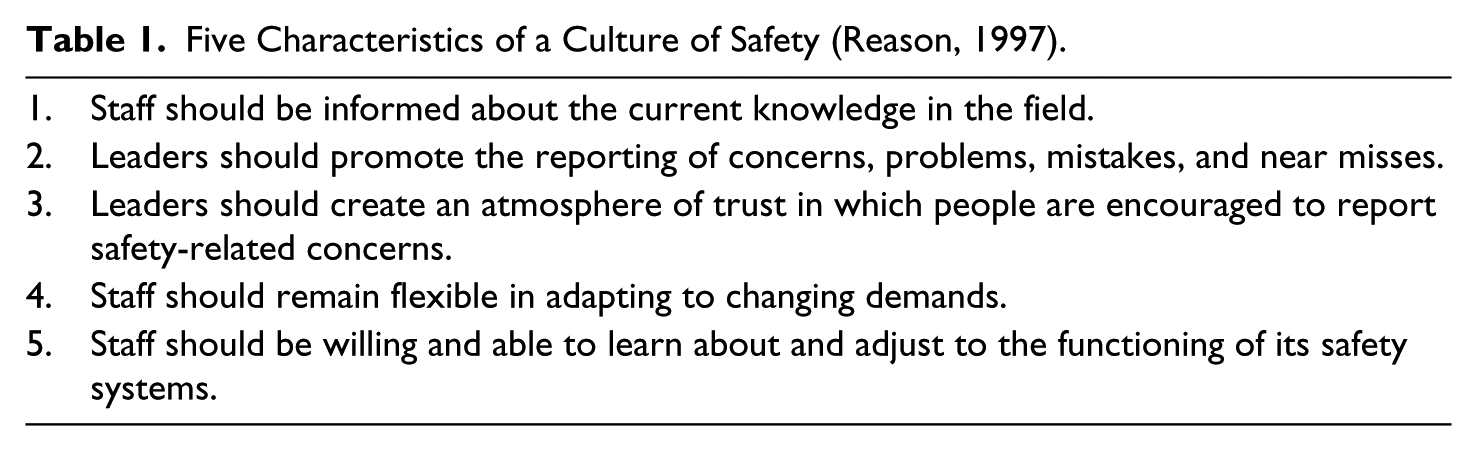
Leaders in all types of organizations, including schools, hospitals, and government agencies, find it difficult to identify solutions to complex problems, like the prevention of school violence and the promotion of a culture of safety. Costa (2010) argues that the most persistent and dangerous problems are systemic, and the solutions to systemic problems prove challenging to imagine and implement. When people do not have efficient processes for thinking about and solving systemic problems, they feel drawn to simpler explanations and behaviors, such as blaming a “bad apple” employee or poor training procedures (Costa, 2010). To improve school safety, it is critical to avoid the personalization of blame and the tendency for silo-thinking. This change requires the promotion of what Reason (1997) calls a “culture of safety” and a willingness to evaluate procedures and practices in a critical manner. Reason (1997) says a culture of safety: (a) ensures workers are informed about current knowledge in the field, (b) promotes the reporting of errors and near misses, (c) creates an atmosphere of trust in which people are encouraged to report safety-related information, (d) remains flexible in adapting to changing demands (by shifting from steeply hierarchical modes into “flatter” team-oriented professional structures), and (e) is willing and able to learn about and adjust the functioning of its safety systems (see Table 1). The shift toward a culture of safety in organizations, however, does not come easily and research on effective leadership identifies two approaches that school officials might use to facilitate this shift: (a) techniques of adaptive leadership and (b) a continuous improvement model of error review.
Five Characteristics of a Culture of Safety (Reason, 1997).
Adaptive Leadership
First, Heifetz, Grashow, and Linsky (2009) identify the single biggest failure of most organizational leaders as the tendency to treat adaptive challenges like technical problems. Technical problems are easy to identify, lend themselves to quick solutions, can be solved by an authority, exist within organizational boundaries, and require one or two small changes that—when implemented—encounter little resistance (Heifetz et al., 2009). Adaptive challenges, on the other hand, elicit emotional responses from others and call into question the organization’s norms, values, and beliefs. “One way you know there is an adaptive challenge facing your organization or community is that the problem persists even after a series of attempted technical fixes” (Heifetz et al., 2009, p. 70). Indeed, despite the implementation of federal threat assessment guidelines, 8-hour threat assessment trainings, and anonymous reporting systems in schools and districts across the country, school violence continues in the United States. Gladwell (2015) has recently suggested that Americans now view school shootings as a problem we live with, not a problem we work to solve (see also Blair, Martiandale, & Nichols, 2014; Doyle, 2010). As is common with adaptive challenges, this viewpoint may create a social paralysis that prevents the development of comprehensive strategies whereby multiple solutions get implemented simultaneously in institutions (e.g., schools, districts, and mental health care) and society (e.g., values, beliefs, and attitudes; Costa, 2010). To explore how school officials can lead the effort to promote a culture of safety on campuses, within districts, and in communities, this study uses Heifetz et al.’s (2009) adaptive leadership framework to interpret the findings.
Continuous Improvement
Second, in his discussion of organizational accidents, Doyle (2010) notes how evidence from medicine and aviation indicates that major mistakes, such as the Challenger shuttle explosion, wrongful convictions, and school shootings, do not arise from one person’s bad judgment or one procedural misstep. Major problems arise from a series of small errors combined with a system’s reluctance for self-examination, and these small errors can lead to major problems or events (Chassin & Becher, 2002; Dörner, 1996). Fox and Harding (2005) argue that school shootings represent an example of organizational deviance, an event that creates harm and conflicts with the organization’s larger goals.
To prevent major mistakes, institutions, such as hospitals, schools, and prosecutor’s offices, should develop regular routines for reflecting on small errors, major errors, and near misses in the management of individual cases (Doyle, 2010). Organizations can move away from an adversarial model of error review to implement a continuous improvement model of error review. Similarly, Danner and Coopersmith (2015) argue that the first step to improvement within organizations is admitting failure. “Accepting failure without learning from and leveraging it is a recipe for mediocrity” (Danner & Coopersmith, 2015, p. 26). Relying on evidence from the medical field where offering an honest apology reduced malpractice settlements (Doyle, 2010), an early admittance of failure can accelerate the lessons learned and save lives. Diagnosing problems and admitting failure is not easy. Newman et al. (2004) write, All bureaucratic environments are mixtures of good intentions and caring people who abide by the rules of the cultures in which they are immersed. There is a gap in all institutions between the formal rules—all relevant information should be reported—and the actual behavior—only favorable risk assessments reach [organization] officials. This is not on account of corruption, but rather reflects the imperatives of running an organization that has goals to achieve and a tendency to act on information that furthers achieving them. (p. 175)
With a complex problem like school safety, organizational errors prove difficult to resolve. The cultural shift in responses to errors must be led by adaptively oriented leaders. How can school leaders promote a culture of safety, while honoring a student’s right to privacy? Much of the current research on school shootings focuses on the shooter’s motivations and behavior, not the way school leaders interpreted, documented, or responded to those motivations and behavior. This tendency neglects the organizational context surrounding the shooter. Yet this context reveals the subtle ways that school leaders can either promote, neglect, or discourage a culture of safety. This research also rarely includes data from all levels of the school and district, including teachers, counselors, school administrators, district officials, school resource officers (SROs), and the superintendent. These different perspectives illustrate the ways that social status can influence perceptions of and responses to information. An examination of various school officials’ perceptions of and experiences with a school shooter remains essential to an understanding of the complexities surrounding information sharing for student care and violence prevention. The decisions to record, communicate, and act on information are active ones on the part of school officials. Teachers, counselors, and school administrators often know things about a student’s concerning behaviors that do not get recorded in official records, do not get shared with parents, and do not get acted on directly. Yet the management of this information proves critical to student support and violence prevention. The research questions guiding the study included the following:
Methodology
Background on the High School Shooting
In December 2013, 18-year-old senior “JD” shot and killed a classmate and then himself at a Colorado high school. In an effort to draw more attention to the prevention of violence and less attention to the individual shooter, a pseudonym is used for the shooter. The law enforcement investigation revealed that JD displayed inappropriate and concerning behavior at the school and at school-sponsored events on several occasions over a 2-year period (see Table 2 and Figure 1). In April 2013, he received a 1-day suspension from school for yelling “fuck” in response to a bad grade and “fuck you” to a student. In September 2013, he was removed as captain of one subset of the Speech and Debate Team, and yelled “I’m going to kill that guy,” referring to the Coach. JD was not formally suspended for the threat; instead, after a phone call with his mother, the assistant principal agreed that JD could stay home for 3 days. When he returned to school, a two-member threat assessment team consisting of an assistant principal (identified as AP#1 in the findings) and the school psychologist (SP#1) performed a threat assessment on JD with his parents present, and he was labeled a “low risk.” The assessment recommended a follow-up meeting 3 weeks later, but the follow-up meeting appears to have been brief. The law enforcement investigation revealed that JD began writing a diary shortly after his threat assessment, and in the diary, he described his hate for others, satirized the ineffectiveness of his medication and therapy, and outlined his plan for an attack at the high school during finals week in December. Following the “cultural script” created by other school shooters (see Newman et al., 2004), JD wanted fact finders to read the diary, discuss it, and wonder why.
Chronological List of JD’s Concerning Behaviors.
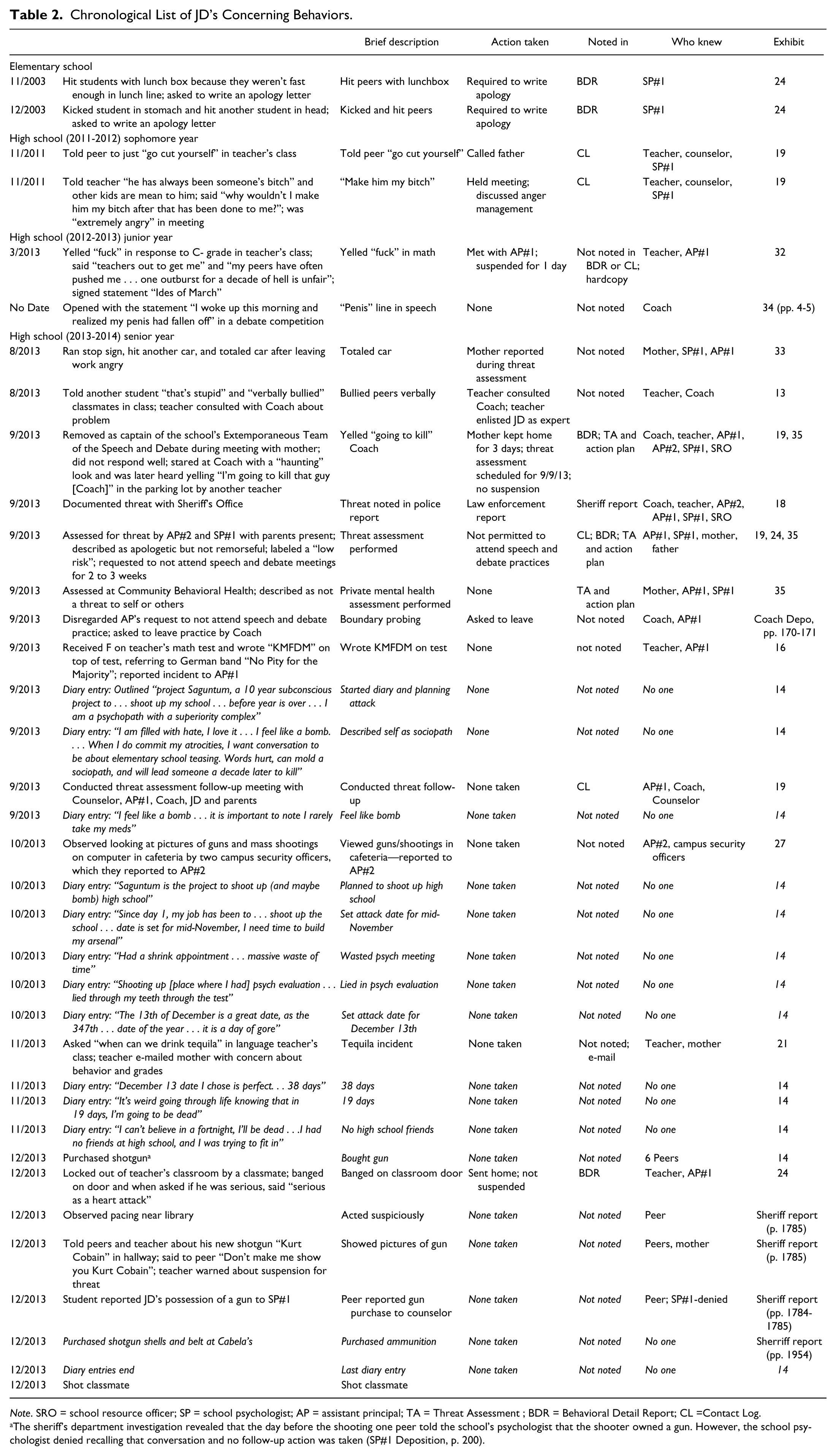
Note. SRO = school resource officer; SP = school psychologist; AP = assistant principal; TA = Threat Assessment ; BDR = Behavioral Detail Report; CL =Contact Log.
The sheriff’s department investigation revealed that the day before the shooting one peer told the school’s psychologist that the shooter owned a gun. However, the school psychologist denied recalling that conversation and no follow-up action was taken (SP#1 Deposition, p. 200).
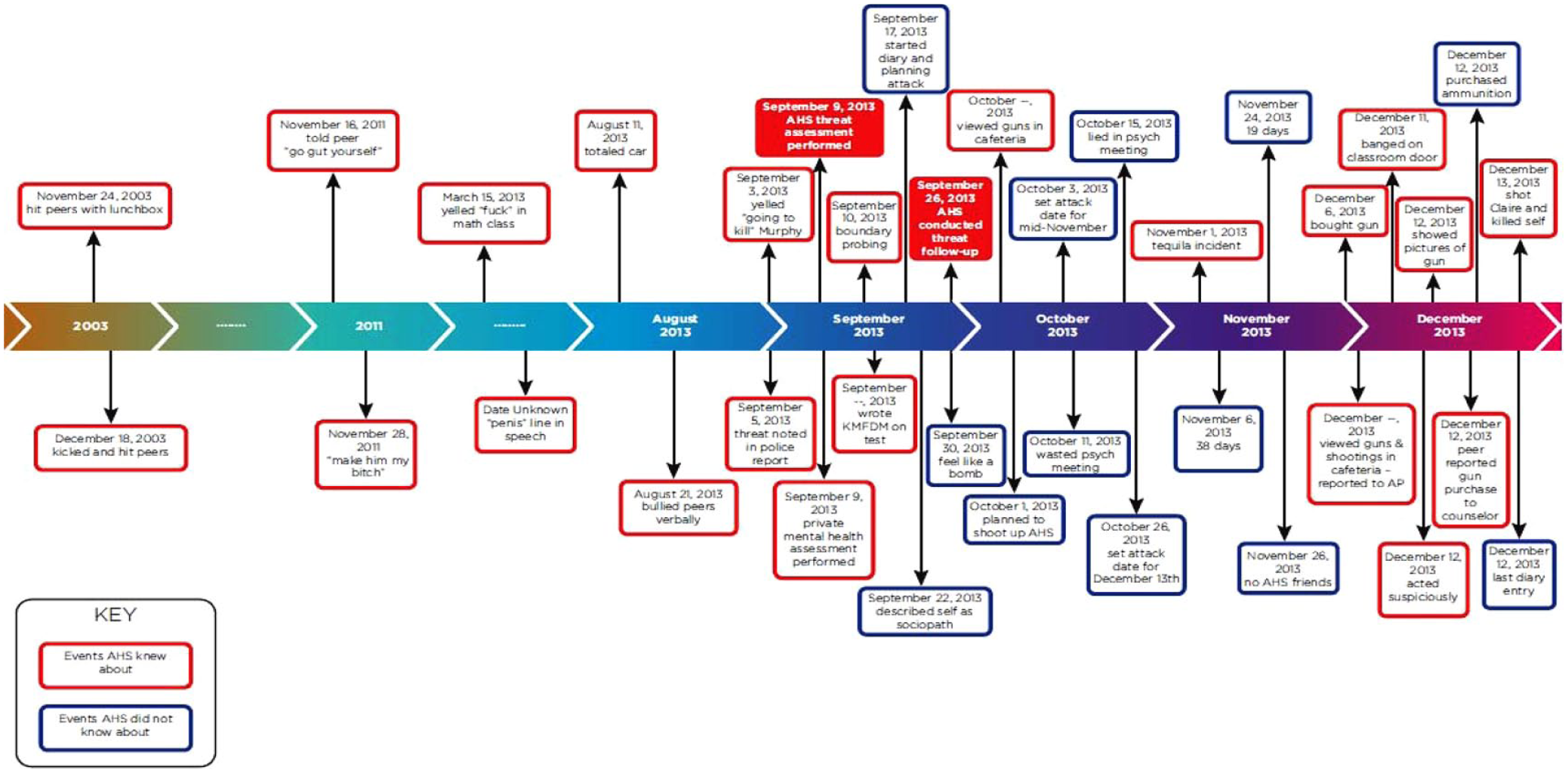
Timeline of JD’s concerning behaviors.
Just 2 days prior to his December attack, JD had an outburst in his foreign language class. A classmate locked him out of the classroom, and JD responded by banging very loudly on the door, scaring the teacher and students. When JD was let into the classroom, the teacher asked him if he was serious, he replied “serious as a heart attack” further startling the teacher (Teacher #1 Deposition, p. 47). The language teacher asked JD to gather his things and leave the classroom. A Campus Security Officer found him and brought him to the office of the assistant principal, who had participated in his September 9th threat assessment. JD gave a statement to the assistant principal; they called his mother and he was sent home for the remainder of the day. JD was not formally suspended. He returned to school the next day and apologized to his teacher for his outburst. The following day, JD entered the school through an unlocked door, armed with a shotgun, hunting knife, three Molotov cocktails, and several rounds of shotgun ammunition. Witnesses’ accounts indicate that he was looking for the Debate Coach, but when a classmate saw him shooting in the hallway, he shot her. JD then entered the library, apparently looking for the Debate Coach, stood between two bookcases and shot and killed himself. The classmate succumbed to her injuries 8 days later.
Data Collection
The data for this study came from an investigative arbitration agreement reached between representatives of the parents of the victim and the school district. The goals of the arbitration were to (a) provide policy recommendations for identifying students in crisis, (b) outline steps to reduce the likelihood of and the severity of harm caused by students in crisis, and (c) suggest effective response protocols for students in crisis. The project did not include a review of the physical aspects of campus security or emergency responders’ use of tactical responses. The project also did not include a biographical or psychological reconstruction of the shooter, as his mental health records were never made available and his family members, private counselor, and friends did not participate in the proceedings.
The data came from three main sources: law enforcement records, school and district records, and deposition testimony. The data included the following: (a) 27 pdf documents containing more than 4,000 pages of text from the law enforcement investigation, (b) 171 pdf documents containing more than 4,200 pages of text from the school district, (c) 12 deposition transcripts containing more than 2,500 pages of testimony, and (d) 64 exhibits produced and introduced during deposition testimony (which came from the law enforcement and district records).
The deposition testimony came from witnesses from the school and district, including nine high school staff (e.g., teachers, administrators, counselor, security officer, and SRO) and three district administrators. All deponents were Caucasian, and nine were male and three were female. At the time of the shooting, this large high school in an upper-middle-class community had a reputation for academic excellence. Due to a grant agreement between the district and the funding agency, all testimony and records were subject to use for research purposes. The agreement stated, “The parties understand that [the] university shall have the right to publish, consistent with its academic research mission.” In addition, the contract stipulated the authors’ right to use all of the data created.
Qualitative data, like in-depth interviews or deposition testimony, allow participants to describe their perceptions of and interactions with students and other school officials in their own words. These words capture the difficulties and contradictions that school staff sometimes face when trying to obtain, evaluate, and act on student information. It is important to note that the arbitration agreement required that the district produce witnesses knowledgeable about the shooter in the case, and all requested witnesses appeared for a deposition. Each deposition lasted between 4 and 8 hours, and as a rich type of interview data, provided detailed information about the shooter, school and district safety procedures, and school and district culture. All depositions were made public as part of the arbitration agreement; however, in an effort to depersonalize the testimony and emphasize the findings, the authors use the deponents’ job titles, not their names, with each quote. The first series of questions presented to deponents addressed the witness’s encounters with the shooter prior to the attack. The second series of questions examined the school staff’s response to the shooter in the years, months, and weeks leading up to the attack. The final series of questions addressed the school and the district’s practices and policies on student behavior problems, student privacy, discipline, threat assessment, and communication.
The authors did not recruit or interview the deponents. Thus, the group of individuals deposed for the arbitration proceedings may not necessarily represent the larger population of people with knowledge of the situation. Some might question the value of data obtained through an arbitration proceeding citing concerns about the voluntary and truthful nature of the testimony. It is certainly possible, but highly unlikely, that witnesses withheld information or spoke mistruths for three reasons. First, the law enforcement investigation produced thousands of documents and numerous interviews. On multiple occasions throughout the depositions, witnesses were asked to review and verify the accuracy of this evidence. Second, the authors reviewed all case documents and deposition testimony to confirm the accuracy of the deposition testimony, particularly when inconsistencies appeared. In a few instances, witnesses recalled an incident differently than others or than reported in case files; those inconsistencies are reported in the findings. Finally, at the start of each deposition, a lawyer explained the purpose of the deposition: [Some]thing that I think is important to get straight out of the box is the purpose of this arbitration. [It] is not, to assign blame and not to figure out whose fault [the victim’s] murder was. Okay. It was JD’s [fault]. We know that. We get that. This is not the purpose of the arbitration; rather . . . the purpose of this arbitration is to find out what happened in the days, weeks, months leading up to [the shooting] and what lessons can be learned from this tragedy. (AP#2 Deposition, pp. 8-9)
For the most part, deponents appeared genuinely invested in providing insights to produce lessons learned for violence prevention in schools. The depositions proved to be long and at times highly emotional for the witnesses and attendees. Several witnesses expressed remorse for not doing more to assist the troubled student who committed the attack, while others expressed frustration that the red flags the student displayed were not more proactively addressed by school administrators. In addition, the murder victim’s parents, along with their supporters, attended all of the depositions; their presence provided a poignant reminder of the devastating loss that occurs when the lessons on school safety are not yet learned. The first two authors attended all of the depositions and had the opportunity to suggest questions during the course of the testimony.
Data Analysis
We used Charmaz’s (2006) guidelines for qualitative data analysis to code and analyze the deposition transcripts and case file data. Each transcript was read twice by the authors and the transcript text was manually coded for three thematic categories: information sharing, threat and risk assessment, and systems thinking. These categories emerged from a thorough review of the research literature and the data analysis process. This article presents the findings on information sharing. A careful review of the information sharing data excerpts revealed two subthemes, including a failure to share information and misunderstandings about FERPA. Here, we present the quotes and documentary evidence that most clearly illustrate the information sharing theme and subthemes, and we note cases where there were exceptions. Because organizational health and function prove critical to the exchange of information, the adaptive leadership approaches are discussed where appropriate.
Findings
Prior research on school shootings emphasizes the critical role of information sharing in violence prevention (Fein et al., 2002). The discussion, however, frequently focuses on the information that peers had prior to a shooting, not the information teachers, counselors, principals, and assistant principals had. The findings presented here indicate that teachers, administrators, security personnel, and the school psychologist at the high school found it difficult to share information about the student of concern in this case. Two main findings emerged from the data. First, students, school administrators, and the school psychologist did not share information with teachers or other school staff about the student of concern in this case, which teachers and the SRO found frustrating. Second, school staff expressed confusion about FERPA, believing that FERPA—as the federal law which seeks to protect the privacy of students’ education records (20 U.S.C. § 1232g; 34 CFR Part 99)—prohibited them from discussing information about students of concern. In the final section, the authors offer recommendations for sharing information to promote a culture of safety in school settings.
Failing to Share Information
The deposition testimony, law enforcement report, and district documents indicate that the shooter engaged in concerning behavior on more than 30 instances in the weeks, months, and years before the 2013 shooting at the high school (see Table 1 and Figure 1). As Table 1 indicates, several school officials knew about some of those instances, but no one in the school knew about all of them. Not one school official knew about all of them because school staff failed to consistently: (a) document the student’s behavioral concerns in the student information system and (b) relay concerns about the student’s behavioral problems to relevant staff.
Documenting Behavior Concerns
First, in several instances, the high school administrators knew about problem behaviors from the attacker in this case, but those administrators did not consistently document those problems in the school’s student information database. The following incidents did not get noted in the school’s database:
March 15, 2013: Student yelled “fuck” in math class and “fuck you” to classmate; suspended for a day.
March –, 2013: Student opened debate competition speech with the statement “I woke up this morning and realized my penis had fallen off.”
September 10, 2013: Student disobeyed assistant principal’s request to not attend Speech and Debate meetings for 2 weeks.
September –, 2013: Student wrote “KMFDM” on top of failed math test, referring to German band “No Pity for the Majority”; suggested math teacher would enjoy the band’s music.
October –, 2013: Student observed viewing pictures of mass shootings and guns on his laptop in the cafeteria.
Admittedly, when reviewing these incidents individually—yelling “fuck,” viewing guns, and disobeying requests—they seem relatively minor. Taken together, however, they reveal an escalating pattern of boundary testing, starting in fall 2013 (see Figure 1). This pattern, however, proved difficult to recognize given the inconsistency in record keeping. When asked, “Whose job was it to input the information about that [March 2013] suspension in JD’s behavioral detail log?” The assistant principal responded, “That was my responsibility . . . [but] I just forgot. I didn’t do it.”
Doyle (2010) describes the communication problems plaguing some hospitals. Referencing Chassin and Becher’s (2002) report on major medical errors, he described the “patchwork of information mini-systems [prevalent in hospitals] that did not speak to each other . . . [such that] teams failed to function, and no one was surprised or bothered when the teams did fail to function” (Doyle, 2010, p. 124). The same patchwork system of communication can arise when school staff realize but do not address inconsistencies in the recording of information about behavior problems and disciplinary actions. For example, not knowing JD’s disciplinary record, the school psychologist who assisted with this student’s threat assessment mistakenly said, “I don’t think he had [ever] been suspended [prior to the threat assessment].”
Notifying Relevant Staff
Second, administrators did not notify teachers about the student’s problem behaviors, suspensions, or threat assessments. For example, when a student received a suspension, the assistant principal sent the student’s teachers a note describing the dates of the suspension and requesting any homework assignments. The note did not indicate the behavior problem prompting the suspension, even when that problem occurred in the teacher’s class or when a violation involved a safety risk to the student or others (see Teacher #1 Deposition; Teacher #2 Deposition). One teacher explained, [U]sually what happens is I’ll get an email with a form I can print out, and it will say, “This student has been suspended.” It will not say why. (Teacher #2 Deposition, p. 44)
In September 2013, when JD threatened to kill the debate coach, he underwent a threat assessment with a two-member threat assessment team, including the assistant principal and school psychologist, but the team never notified his teachers of the threat, the assessment results, or his safety action plan. When the student disregarded the assistant principal’s request that he not attend speech and debate practices for the 2 weeks following his threat assessment, the threat assessment team did not notify his teachers of the conduct violation and did not record the conduct violation in his record.
Several teachers expressed frustration with their inability to share or request information about a student of concern. A language teacher said, [B]efore the shooting, if I had an issue with a student, I couldn’t go to another teacher and say, “Hey, do you see the same behavior, because this is concerning me.” (Teacher #1 Deposition, p. 23)
Teachers viewed these restrictions as problematic, because they worked closely with students and could better identify a conduct relapse or safety risk than administrators. The language teacher continued, I think it takes all of us to keep the school safe . . . and information is important and communication is important . . . I think there should be a way that we know [about] every student in trouble in that school. (Teacher #1 Deposition, pp. 19, 85)
The SRO said, [I wish] we had more information given to us about students . . . like an information vortex . . . where everything [is] brought together and where law enforcement [is] involved, the therapist outside of the school [is] involved . . . [T]he information needs to be shared with everybody. Everybody needs to be brought in, and it’s frustrating for me. (SRO Deposition, p. 136)
Sharing information about students in trouble, however, represents a challenge to administrators and counselors trying to honor a student’s right to privacy. The challenge creates a tendency for information silos—where some school administrators and staff know about some of a student’s problems, threats, and failures. But no one knows about all of the problems. Instead, information is kept in silos, with teachers knowing about academic and classroom behavior, counselors knowing about threat assessment results, and the assistant principal knowing about the student’s discipline issues. Costa (2010) writes, “silo thinking [is] compartmentalized thinking and behaviors that prohibit the collaboration needed to address highly complex problems” (p. 123). The prevention of violence represents a highly complex problem that requires open communication between school administrators, counselors, teachers, and coaches in monitoring and promoting students’ well-being. Noddings (1984) argues that an “ethic of caring” can support the individual and the group in educational settings, and Shann (1999) found that high-achieving schools combined a culture of caring with an investment in academics.
When silos of information arise about a student of concern, the threat assessment team has difficulty accurately evaluating the severity of the threat the student poses and developing an effective intervention to address the problem (see Costa, 2010). The school’s Speech and Debate Coach said, I was working in isolation in the fall of 2013 when all of this was happening [with JD]. And it appears that [the language teacher] was having problems with JD and that [his junior year math teacher] had had some previous problems and [his senior year math teacher] had some issues. None of us knew this. None of the faculty that had direct interaction with the student was aware . . . I value student privacy, but I also value student safety. (Coach Deposition, p. 218)
When two security officers observed the student looking at pictures of mass shootings and guns on his laptop in the cafeteria in October 2013 (after his threat assessment), they reported their observations to another assistant principal but the security officers and the assistant principal never relayed that information to the student’s threat assessment team, assigned assistant principal, or teachers. When asked, When you got this news from [two school security officers] that they thought JD was looking at guns on his computer [in the cafeteria], did you tell either [the assistant principal or school psychologist who had performed the threat assessment] about it so that they could decide whether to follow-up on it?
The assistant principal said, I don’t think I did. (AP#2 Deposition, p. 172)
Students cannot receive appropriate support or compassionate care when school staff have an incomplete picture of the situation or problem. For this reason, the Secret Service notes, “It is the responsibility of the threat assessment team to gather this information from what may be multiple sources, such as teachers, parents, friends, counselors, after-school programs staff, part time employers, and others” (Fein et al., 2002, p. 35). However, the team that performed the threat assessment on JD did not meet the minimum requirements, as mandated by state guidelines, because it did not include a teacher knowledgeable about JD in the process. In not including people with various reference points to JD in the threat assessment process, the school missed an opportunity to identify the escalation in JD’s troubling behaviors and develop a caring intervention.
Later, the assistant principal involved in JD’s threat assessment said, “I did not [know that JD had been seen looking at guns on the Internet in the cafeteria after the threat assessment and prior to the shooting].” When one assistant principal asked the other why he did not share that information about viewing guns and mass shootings on a laptop in the cafeteria, the assistant principal said, I wish you would have told me . . . you knew we had a threat assessment on [the student]. [But] again, he said something along the lines of, “Well, yeah, but it’s not a violation of, you know, anything [in school policy] in terms of disciplinary measures at school for looking up guns.”
The assistant principal on the threat assessment team reflected, I would say it reflects negatively on the lines of communication [at the school] and that I should have been made aware of that [fact that he was seen viewing guns and photos of mass shootings on his laptop in the cafeteria]. (AP#1 Deposition, p. 198)
The importance of sharing information about a student of concern is a violence prevention strategy learned from earlier school shootings (see Erickson, 2001; Kaine, 2007; Malloy, 2005). In fact, 4 years prior to the shooting at this high school, Chapman (2009) wrote, The Virginia Tech Report found the failure of the school’s departments (including the student counseling center, campus law enforcement, and administrators) to share information with each other about [Seung Hui] Cho’s disciplinary and mental health issues, to be the primary reason why the university failed to identify Cho as a risk to the community [prior to the shooting in 2007]. (pp. 349-350)
Understandably, many school officials may read these findings and demand stricter requirements for the documentation of student concerns, but such a response represents a technical fix to an adaptive challenge. The consistent documentation of concerns represents one small strategy for addressing the complex issue of violence prevention. The larger problem in this, and in other school shootings, was that school administrators did not collect, record, or analyze information in a way that allowed them to see patterns and an escalation in problem behavior. In a discussion with an assistant principal about JD’s declining grades in November 2013 (1 month prior to the shooting), the Speech and Debate Coach said, So, I brought [JD’s declining grades] to his attention. He told me he was aware of it, [and] the counselors were aware of it. I think I may have said something to the effect [of] . . . “This is a big red flag.” And he kind of shrugged his shoulders and kind of brushed it off saying, “Let him hang himself” kind of thing.
The Coach’s concern about JD’s grades was not taken seriously, and he felt disappointed with and even “astonished” by the way the assistant principal responded. The Coach explained, [JD] had a 3.3, 3.4 average. He . . . was a B student [up until the fall of his senior year]. Now . . . he’s running the risk of not graduating? That’s huge. . . . That’s tremendous . . . [And the assistant principal] let me know [that] he was aware of it [but] that was pretty much it . . . I was kind of astonished [with his response].
In this case, school administrators failed to actively collect, share, and reflect on information about the student of concern. Instead, information remained in silos across the school staff, never getting integrated to allow for an understanding of the extent of the problem or the escalation in the problem. A culture of caring, however, can promote the documentation and investigation of information to support students, not harm them. Noddings (1984) argues that an “ethic of caring” in education settings “does not seek to ‘heap coals of fire on the head’ of the transgressor . . . [the ethic of caring is meant] to preserve and enhance caring” (p. 116).
Heifetz et al. (2009) argue that when a problem reemerges even after a “fix” has been imposed, it represents an adaptive challenge, a challenge not easily corrected with technical solutions such as additional training, tougher guidelines, or a new hire. Costa (2010) explains that, “[T]he big picture [can be] impossible to see, especially when we keep holding the smaller one in front of our face” (p. 130). In this and other shooting cases, school staff could not evaluate the extent of the threat or the increase in the behavior problems when they were dealing with each of the student’s outbursts one-at-a-time and in isolation. In trying to understand why we have not yet learned the lesson on collaborative information sharing to build cultures of safety in schools, Heifetz and colleagues (2009) encourage organizational leaders to ask, “What things, if they happened more frequently, or less frequently, would help make progress on the adaptive challenge I am working on?” (p. 193). Based on the findings from this case study and other school shootings (Erickson, 2001; Newman et al., 2004; Pollack et al., 2008), we argue that proactively seeking out and sharing information about students presenting a safety concern can help address the adaptive challenge of violence prevention and safety promotion in school settings. School officials’ confusion about FERPA, however, can prevent them from committing to a culture of safety.
Misunderstandings About FERPA
Like many school officials, the school administrators in this case feared violating FERPA, the federal law that protects parents’, guardians’ and students’ right to privacy for a student’s educational records (District Records, p. 1118; see also Family Educational Rights and Privacy Act of 1974). FERPA guidelines protect a student’s and parents’ right to read and correct a student’s education records. However, the guidelines also allow school officials to share records without the permission of a student or the student’s parents to other school officials with a “legitimate educational interest” and “in cases of health and safety emergencies” (34 CFR § 99.31). The safety exception states, [U]nder the health or safety emergency provision, an educational agency or institution is responsible for making a determination whether to make a disclosure of personally identifiable information on a case-by-case basis. (Family Educational Rights and Privacy Act and the Disclosures of Student Information Related to Emergencies and Disasters, 34 CFR 99.36; 34 CFR 99.32(a)(5))
Prior to the shooting in this case, however, school staff and the SRO indicated that they could not discuss a student’s concerning behaviors with other staff because school administrators had told them that FERPA guidelines prohibited it. The SRO said, The biggest obstacle [to keeping this high school safe] is just information sharing. The school is somewhat confused on what FERPA is. (SRO Deposition, p. 137)
Indeed, FERPA appears to have been widely misinterpreted by school administrators prior to the shooting, leading them to discourage teachers, the SRO, and others from discussing a student’s behavior problems or discipline record. In a statement to a law enforcement investigator, one teacher said, [T]he [high school] administration will not tell the teachers anything about student discipline, as it is a violation of the student’s privacy rights. (Exhibit 16)
Even the district’s superintendent at the time of the shooting could not recall the FERPA guidelines surrounding information sharing about students in crisis. When asked “[D]o you know whether [the district] had a specific policy or practice during your time leading the district on the sharing of information among schools and staff members about dangerous conditions or people?” The superintendent at the time of the shooting said, I don’t recall one off hand. My guess is there was at some time, but it may have been conversational or training consultation. (Superintendent Deposition, p. 67)
The confusion about FERPA—at all levels of the district and school—remain surprising because the district’s and school’s guidelines explained the FERPA safety emergency exception correctly. Under the section “Regulation for Board Policy,” the school district’s Student Code of Conduct stipulated that: To assure that information is shared with the professional staff that may be important to understanding the particular needs of individual students and any potential risk that a student might pose to the safety or welfare of others, state law requires that the principal take steps to communicate this information to teachers and counselors who have direct contact with the student. (District Records 01086 and 01015)
The problem arose in the staff’s overly cautious interpretation of the safety exception. When asked why the safety exception requirement from the district’s Student Code of Conduct was not followed in 2013, the high school principal explained, We wanted to make sure that kids weren’t inappropriately judged by teachers, that they were given a fair shot . . . that if something happened in one classroom, it didn’t necessarily mean that it was going to happen again. [We thought it would] give [the student] a fresh start with a new teacher . . . [We were] just erring more on the side of protecting the kid . . . [and we misunderstood FERPA in 2013] . . . [I] misinterpreted [it], I think, yes. (Principal Deposition, pp. 26-27)
In this case, school officials erred on the side of protecting the student’s reputation for antisocial behavior, not on the side of promoting care for his red flag behaviors. Other deposition testimony revealed that the school staff’s confusion about information sharing continued even after the shooting. More than 18 months after the shooting, the school psychologist said, I don’t know what information can be relayed about each student to general staff and teachers, because I think that there has to be some protection of confidentiality to protect that student’s rights. (SP#1 Deposition, p. 211)
Part of the confusion arises because FERPA’s “safety emergency provision” is not well-defined by the Department of Education or in current court rulings. Chapman (2009, p. 383) argues that “FERPA’s text, legislative history, and case law all foster ambiguity about when the emergency exception applies and leads to overly strict university policies of nondisclosure.” Chapman (2009, p. 371) references the Secret Service’s school safety recommendations, which support the position that a threat of violence to others should trigger FERPA’s emergency exception. Yet as currently drafted, FERPA does not explicitly include “a threat to others” as a trigger for invoking the health and safety exception (Chapman, 2009). Chute and Swain (2004) describe FERPA as “ambiguous.” In Mahoney v. Allegheny College, a Pennsylvania trial court urged campus leaders to resist the temptation to use the fear of a FERPA violation to avoid sharing information with parents and school officials about a student in crisis (Blanchard, 2007).
The U.S. Department of Education (n.d.) has tried to clarify confusion and alleviate fears about FERPA by stating, This is a flexible standard under which the Department defers to school administrators so that they may bring appropriate resources to bear on the situation. (Family Educational Rights and Privacy Act and the Disclosures of Student Information Related to Emergencies and Disasters, 34 CFR 99.36; 34 CFR 99.32(a)(5))
In other words, the Department will not second guess a school’s decision to invoke the exception, as long as the exception is explained. In testimony to the Colorado legislature, Dale King (2015), the Director of the Family Policy Compliance Office in the U.S. Department of Education, said that school staff and the SRO have the right to share information about a student of concern and that the U.S. Department of Education will not substitute its own judgment for a school’s decision to share information about a student, as long as there is a rational basis for that sharing of information. An action meets the “rational basis” criteria when “there is any reasonably conceivable state of facts that could provide a rational basis for the challenged action. See Quest Corporation v. Colorado Division of Property Taxation, Department of Local Affairs, State of Colorado, 304 P.3d 217 (Colo 2013)” (A. B. Dyl, personal communication, October 21, 2015).
It turns out that school administrators’ concerns about a violation of FERPA were unfounded, as no school or district has ever been financially penalized for a FERPA violation.
In Gonzaga University v. Doe, 536 U.S. 273 (2002), the U.S. Supreme Court made clear that students and parents have no private right of action against schools for unauthorized disclosure of education records. Schools cannot be held liable for damages for improper disclosure of student information. (Michael Roche Testimony, October 27, 2015)
The court stated, “FERPA’s nondisclosure provisions fail to confer enforceable rights” on students or parents (Gonzaga University v. Doe, 2002).
Conclusion
On first look, the difficulties with sharing information and understanding FERPA in school settings sound like technical problems, which can and should be addressed with more training and clearer guidelines. A more careful review of this and other research on school shootings reveals that information sharing presents an adaptive challenge in the prevention of violence in schools (see also Erickson, 2001; Fein et al., 2002; Newman et al., 2004). Heifetz et al. (2009) argue that when a problem persists even after implementing several technical adjustments, the problem represents an adaptive challenge. Adaptive challenges are not easily resolved with one or two changes or by a single expert. They also tend to provoke emotional responses among stakeholders, such as teachers, administrators, and district officials, and the solutions may lead people to question their long-held values and beliefs. According to the principal in this case, the school believed that students should get a “fresh start” each school year and with each teacher. A fresh start, however, may represent one of those long-held but problematic beliefs among school officials in the United States. A fresh start means that information about a student’s risk factors, red flags, and threats gets withheld from teachers and coaches who work with the student each day. Adopting an “ethic of caring” may helpful school officials balance the need to share information to promote safety with the goal of supporting and nurturing students to ensure positive growth and violence prevention (Noddings, 1984).
So, how can school officials begin to address the problem of information sharing to build a culture of safety? They can start by discussing and incorporating the criteria for a culture of safety on their campuses (see Table 1). School staff should be knowledgeable about the information sharing tools, information sharing procedures, and FERPA guidelines. Since so much confusion exists about FERPA, staff should be trained on the safety exception and rational basis with the goal of promoting care for students of concern, not imposing judgment on students.
The manifestation of the criteria for a culture of safety will require that leaders step back and (a) visualize the larger system of information sharing and violence prevention within the school and district, (b) model and reward both individual and organizational self-reflection on current communication systems, and (c) implement the improvements identified during those reflections to promote the organization’s future (Senge, Hamilton, & Kania, 2015). The organizations best positioned to address adaptive challenges have the following characteristics: workers name the elephants in the room, share responsibility for the organization’s future, encourage independent judgment and cultivate leadership among staff, and reflect on and pursue continuous learning (Heifetz et al., 2009). Here, we emphasize the role that three of these characteristics can play in building adaptive systems for information sharing within schools.
First, name the elephants. School officials can start by acknowledging the problems with current approaches to information sharing about students of concern. Information silos and FERPA misinterpretations cannot be adequately addressed if school officials continue to dismiss them as not relevant, too difficult, or nonexistent.
Second, the responsibility for sharing information about a student of concern and for building a culture of safety does not rest with one principal, assistant principal, school psychologist, or teacher; instead, the responsibility for information sharing and violence prevention is shared. In this case, school administrators’ lack of alarm about the poor communication among school staff prior to (and even 18 months after) the shooting indicates that communication failures may have been accepted as “normal” in this case (Chassin & Becher, 2002; Doyle, 2010). Of course, tensions may exist across the various roles that school officials play, particularly around the desire to support students in crisis, the wish to protect the reputation of students with behavior problems, and the need to ensure the safety of all students and staff. Using information sharing to promote a culture of caring—as opposed to a climate of judgment—may offer a framework for balancing student privacy with student support for all school staff. Shann (1999) found that, “The highest achieving schools combined an emphasis on academics with a culture of caring that was reflected in higher rates of prosocial behaviors and lower rates of antisocial behaviors among students” (p. 409).
Finally, Reason (1997) encourages organizational leaders to recognize that people make mistakes, but the school’s system should build a climate that allows for mistakes, encourages self-reflection on mistakes, and adopts thoughtful solutions to those mistakes. The Speech and Debate Coach suggested that the high school’s culture, however, prevented staff and students from admitting to and reflecting on mistakes. The Speech and Debate Coach (Deposition, pp. 125-126) said, You know, nobody likes bad news . . . We’re a school of 2,100 kids, you know, a large suburban high school . . . [W]e have to confront the fact that, you know, not every kid at this high school is the cream of the crop . . . [I]t would be healthier [to] . . . admit that, you know, it’s not perfect here, that there’s always room for improvement, that mistakes are made, and that you can learn from those mistakes. And we tell kids [that] all the time [but] sometimes I wonder how true it is: it’s okay to fail, it’s okay to make mistakes, but then we don’t let them.
The Coach’s statement, and other case evidence, suggests that the high school’s climate did not allow for self-reflection and continuous improvement. In fact, following the shooting, school leaders frequently referred to the campus mascot, the warrior, as an important symbol of their strength. The warrior mentality, however, may have led many to dismiss their own and others’ concerns about problems with the school’s system of communication about the student in this case.
Research on school shootings tends to focus on incidents and individuals, not on the system that allowed the shooting to occur or the organizational values that may have hindered prevention efforts. Thus, these recommendations call for a shift in our values. It is time to view these events as “centennial events,” as an opportunity to uncover the underlying flaws in our schools and in our society to develop creative solutions for information sharing to prevent violence and promote safety (Doyle, 2010). It is time to shift from the paralyzing belief that “this can’t happen here” to the inspiring actions that promote information sharing to support students of concern and build cultures of safety in schools across the United States.
Footnotes
Authors’ Note
The article reflects the opinions of the authors and not the official position of the Denver Foundation or the authors’ universities. All deposition transcripts, exhibits, and law enforcement investigation files were made public. However, to protect the identity of the witnesses, the quoted deponents are identified by an abbreviated job title and number. The shooter is identified by a pseudonym. The authors would like to thank Rachel Kennedy for her work on the timeline graphic and Michael Roche for his work on the project. The authors also thank Beverly Kingston and the Davis family for their tireless efforts to prevent violence in schools.
Declaration of Conflicting Interests
The author(s) declared no potential conflicts of interest with respect to the research, authorship, and/or publication of this article.
Funding
The author(s) disclosed receipt of the following financial support for the research, authorship and/or publication of this article: The research reported here was supported by a grant from The Denver Foundation.