







Abstract
Academic research has typically focused upon the importance of sports fandom for men, and there is also a lack of comparative work which examines fans of different sports. This article aims to address this omission by exploring the meaning and importance of sports fandom for women. Drawing on a “grounded theory” approach, 85 semi-structured interviews were conducted with female fans of men’s football (soccer) and rugby union in England. Building upon Giulianotti’s (2002) work, I develop a preliminary model of female fandom. I examine two female fan “types” (“hot’ and “cool” fans), and explore two different kinds of gender performance (“masculine” femininities and “feminine” femininities) which helped to connote these. My findings demonstrate the need to consider the range and diversity of women’s supporter styles.
Research on football (soccer) fandom has typically focused upon the importance of sport for male fans, with women’s voices largely absent (Free & Hughson, 2003). In rugby union, it is difficult to locate reliable academic studies which examine supporters of either sex. This article aims to explore the meaning of sport for UK female football and rugby union fans. There is also a lack of comparative sociological work which examines fans (male or female) of different sports, but this exploratory study marks one contribution toward changing this.
Drawing on Glaser and Strauss’s (2008) “grounded theory” approach, 85 semi-structured interviews were conducted with female fans of men’s professional football and rugby union in the UK city of Leicester. The article begins by outlining the existing, largely male-centered research on sports fandom. I consider various attempts to “measure” sports fandom, and also explore “performances” of femininity in sport. My findings draw tentatively upon Giulianotti’s (2002) “taxonomy of spectator identities in football” to develop a preliminary model of female fandom. I examine two broadly drawn female fan “types” which emerged from the data, and explore two different kinds of gender “performance” which helped to connote these fan types.
Research on Sports Fandom
More than two decades ago Duke (1991) outlined a research agenda for the sociology of football, and called for more studies into women’s experiences as well as cross-comparative research between fans of different sports. Yet neither of these potentially fruitful topics has since been explored in any depth. Although there is a small, but growing body of research which compares sports fandom with popular culture or media fandom (Jones & Lawrence, 2000), there is little research which has compared fans of different sports, let alone female fans of sport. Perhaps this could be attributed to some extent to the dominance of existing research on football fandom and the focus of such research on football as a site for constructing Connell’s (1995) “hegemonic masculinity.” Most academic research on sports fans—especially football fans in England—has focused upon hooligan cultures and/or issues of fan rivalry (see, for example, Armstrong, 1998; Dunning, Murphy, Williams, 1990; Spaaij, 2008). Fans of other sports have been largely invisibilized in academic studies to date, with little research examining fans of rugby union, for example.
Thus, the experiences of female sports supporters have been largely marginalized by this male-centric approach to the study of sports fandom. Free and Hughson (2003) in their critical examination of recent ethnographies of male football supporters have commented on the “startling” absence of women in these ethnographies, and they express the hope that “women’s voices will be heard in future studies” (p. 152). To incorporate women’s experiences, certainly as football fans, researchers need to move away from the simplistic viewpoint that “traditional” authentic fandom is likely to be working class and male, as I have argued elsewhere (Pope, 2011).
There is some evidence that the tide is perhaps beginning to turn and that gender issues are slowing moving on to the mainstream sports fandom research agendas. But issues are raised when researchers seem to “add” women into their analysis, almost as a side-product to the main research focus, and perhaps as a response to feminist critiques or else the alleged recent rising numbers of female fans at matches. Dunning (1999) for example, after decades of focusing on “sport as a male preserve,” claims to extend this focus in a “preliminary way,” by devoting one chapter of a recent text “not simply [to] sport and masculinity but aspects of sport and femininity as well” (p. 219). Yet Dunning does not draw upon any empirical data in his discussion of women as spectators or players. King (2002) attempts to incorporate female fans into his research which is primarily on “the lads” at Manchester United, but women are labeled by him as “new consumer” fans—fans who will seemingly have a naturally “weaker” and more contingent identification with the club.
Female fans are now estimated to make up around 19% of the football Premier League crowd, and 21% of rugby union Premiership fans, making up one-quarter of fans at some rugby clubs (Williams, 2003a; European Professional Football Leagues Website, accessed 2012, March 30). There are perhaps signs that research on female fandom is beginning to open up, with a few research studies scattered across the globe which centralize the experiences of female sports fans (Jones, 2008; Mewett & Toffoletti, 2008). But this emerging new research is also mainly centered upon football fans thus lacking the comparative focus I want to try to champion here.
“Measuring” Sports Fans’ Motives
There is a wide body of research which centers upon largely quantitative attempts to examine the motivations of sports fans. The rising numbers of female sports fans in the United States has prompted a recent interest in research on gender and fandom (Clark, Apostolopoulou, & Gladden, 2009), driven largely by sports marketing initiatives and a desire to recruit more women as consumers. But these studies reveal contradictory findings. Dietz-Uhler, Harrick, & End, (2000) for example, claimed that females are more likely to be motivated than males by social motives and the opportunity to spend time with friends and family (see also Clark et al., 2009; Wann, Melnick, Russell, & Pease, 2001). Yet other research suggests that social interaction is not an important motive for fans of either sex (James & Ridinger, 2002). Some studies have proposed that males are likely to identify more strongly with being a sports fan (Clark et al., 2009; Dietz-Uhler et al., 2000), but Wenner and Gantz (1998) in research on televised sports viewing found that if the level of interest is statistically controlled, the motivational differences between men and women disappear and so both sexes are similar in their behaviors and feelings.
There are obvious issues raised in research of this kind concerning the degree to which fandom can be “measured” and if quantitative methods are the best approach for this sort of project. There is no one agreed scale used by researchers to try and measure accurately sport fan motivations and differences in levels of motivation—Trail and James (2001) for example, criticized Wann et al.,’s (2001) earlier Sport Fan Motivation Scale (SFMS) and developed their own Motivation Scale for Sport Consumption (MSSC, p. 2). But the adapting and refining of such scales makes comparison between different studies extremely difficult.
Therefore, perhaps qualitative methods can provide a more satisfactory approach to assessing levels and types of fandom. Giulianotti (2002), for example, proposes that football spectators can be classified into four ideal-types: supporters, fans, followers and flâneurs (p. 30). These four spectator categories are also underpinned by two binary oppositions: hot–cool and traditional-consumer, thus there are four quadrants forming the taxonomy: traditional/hot spectators (supporters), traditional/cool spectators (followers), hot/consumer spectators (fans) and cool/consumer spectators (flâneurs). Giulianotti’s (2002) theoretical model can be applied to both male and female fans and I would argue that this is potentially a more useful schema for analyzing the particular kind of identification that fans feel toward their sports clubs, even if it relies more on the researcher’s own creative and discursive judgments than it does upon a linear questionnaire scale. My findings draw tentatively upon Giulianotti’s (2002) model, but I also draw upon Sisjord and Kristiansen’s (2009) important work on sport and gender “performance” which I will now turn to.
The Gender Order and “Performances” of Femininity
Connell (1987, 1995, 2002) has used patterns of power relations to explain the operation of the “gender order” and how men’s dominance over women is maintained. Sisjord and Kristiansen’s (2009) study of female wrestlers and “performances” of femininity in sport draws theoretically upon perspectives of gender relations and the “gender order” in society, and various conceptions of masculinities and femininities.
In short, Connell’s (1987, 1995, 2002) “hegemonic masculinity” is at the apex of the gender hierarchy, above both subordinated masculinities and femininities, and is the “ideal of masculinity [which is] centered around authority, physical toughness and strength, heterosexuality and paid work” (Pilcher, 1999, p. 12). The concept of “hegemonic masculinity” was originally developed in tandem with the concept of “hegemonic femininity,” but this was soon renamed “emphasized femininity” to recognize the asymmetrical position of masculinities and femininities in the patriarchal gender order (Connell & Messerschmidt, 2005, p. 848). Emphasized femininity is normatively “oriented to accommodating the interests and desires of men” (Connell, 1987, p. 183) and is linked to the private domain, especially in the arenas of marriage and childcare. More recently, Connell and Messerschmidt (2005) have called for a more holistic understanding of gender hierarchy, one which recognizes “the agency of subordinated groups as much as the power of dominant groups” (p. 848). Sisjord and Kristiansen (2009) suggest that those subordinated femininities which reject emphasized femininity have remained largely “invisible” because of the attention devoted to maintaining a version of emphasized femininity as the norm in society.
Ussher (1997) has provided a useful account of subordinated femininities that reject “emphasized femininity.” She suggests that women actively negotiate the various “scripts” of femininity and discusses four positions or “performances” women might adopt. None of these are said to be concrete or fixed and women may shift between them in different situations and at different points in time. “Being girl” refers to the archetypal position for most women, the position “taken up when a woman wants to be rather than merely do femininity.” “Doing girl” refers to how women might reflexively “perform the feminine masquerade” but knowing that this is about “playing a part” (1997, pp. 445, 450). When “resisting girl” women ignore or deny the traditionally signified “femininity,” such as the necessity for body discipline and adoption of the mask of beauty, but do not reject all that is associated with what it is to be a “woman” (1997, p. 455).“Subverting femininity” refers to those women who “knowingly play with gender as a performance, twisting, imitating and parodying traditional scripts of femininity (or indeed masculinity) in a very public, polished display” (1997, p. 458).
Sisjord and Kristiansen (2009) draw on this theoretical underpinning to examine the different ways in which their heterosexual female wrestlers “do” femininity. Their findings revealed differences between junior and senior female wrestlers in gender performance. Junior female wrestlers mainly positioned themselves within the “being girl” and “doing girl” categorizations—“doing,” for example, because of their participation in a masculine sport, but also “being” when “holding back” in their workouts as they were concerned about developing large muscles and so gave emphasis to their feminized “private body.” The seniors were said to perform “doing girl” and “resisting girl” variants—they “resisted” or neglected body discipline according to the traditional scripts of femininity by admitting and accepting the necessity of gaining muscle strength and mass and so embraced the “athletic body” (2009, pp. 238, 244).
This is a useful framework for thinking about the different ways in which heterosexual female sports fans might “perform” femininities in what is largely regarded as a masculine domain and I draw upon this model to develop my own preliminary account of female sports fandom and gender “performance.” But first I will introduce the case study city used in the research and the methodology that was employed.
Football and Rugby Union in Leicester
The East Midlands city of Leicester was selected as a case study site for the research. Leicester is unusual in the United Kingdom in hosting professional men’s sports clubs in both football (Leicester City FC) and rugby union (Leicester Tigers). Leicester City presently competes in the second tier of English football, the Championship, although harbors ambitions to return to the Premier League. But Leicester Tigers is one of the most successful rugby union clubs in Europe, with the club regularly winning the national club Premiership, as well as reaching the European (Heineken) Cup final on a number of occasions and being crowned champions. Leicester was therefore an ideal site for examining female fandom in two, highly distinctive and successful, local sporting cultures.
Although the respective stadia of the Foxes and Tigers are within half a mile of each other near the city centre, there seems to be little overlap in supporters who will attend matches of both of these sports (Pope, 2010; Williams, 2003a, 2004). This can be attributed to the different trajectories in the historical development of the two sports and the distinctive social class differences. Both football and rugby union have undergone major transformations over the past two decades which might be expected to open these sports up to spectators from across the social classes 1 , but class differences between football and rugby union in England have largely persisted. Whereas football in England has historically been associated with working class men, it is generally accepted that rugby union has remained largely a middle and upper-class game (Collins, 2009). Survey data has also revealed that support for Leicester City Football Club is strongly city based and still has a large working class and lower middle class constituency, but the rugby union club draws its fans much more strongly from the more expensive residential areas of the city and county of Leicestershire to the south of the city centre (Williams, 2003a, 2004). Thus, the rugby club has a rather more affluent, professional base to its active fan support.
Furthermore, whereas football accepted professionalism in 1885, rugby union rejected this, leading to the “great split” between rugby league and rugby union in 1895 (Collins, 2006). Given rugby union’s amateur ethos which is prevalent throughout much of the sports history, rugby supporters might be expected to attach less importance to results. This is supported by surveys which have shown differences between football and rugby union fans in how important the club is in their everyday lives, with football fans more likely to describe the club as “one of the most important things in their life” (Williams, 2003a).
Method
These findings draw on responses from 85 semi-structured interviews conducted with female football and rugby union fans between 2006 and 2008 (Pope, 2010). The sampling frame used to select the football sample was original survey replies from postal questionnaire surveys (Williams, 2003a, 2004). Many fans who made up these surveys were season ticket holders (STH’s) who attended all home matches or club members who attended the majority of club matches, but some supporters were also occasional attendees, so the sample included a range of female fans in terms of their involvement with the club.
Systematic sampling techniques were used to select potential female respondents from three broad age groups, using the age delineations from the football and rugby union surveys. The original pseudonyms have been used in this article, and the final football fan sample consisted of 10 “younger group” fans aged 20-27 (F1-F10), 25 “middle group” fans aged 28-59 (F11-F35) and 16 “older group” respondents aged above 60 (F36-F51). The final rugby sample was made up of 12 “younger group” fans aged 19-35 (R1-R12), 10 “middle group” fans aged 36-55 (R13-R22) and 12 “older group” supporters aged above 56 (R23-R34). I designed an interview schedule and interviews were usually conducted in the homes or workplaces of respondents. These averaged around two hours in length, with a small number of interviews lasting more than four hours.
I found “grounded theory” a highly useful theoretical tool to adopt for purposes of data collection and analysis. Glaser and Strauss (2008) define grounded theory as “the discovery of theory from data” (pp. 1, 5). After fully transcribing interviews the data was coded by drawing upon the “constant comparative method” (Glaser & Strauss, 2008), and data collection and analysis continued until a point of “theoretical saturation” was reached, whereby the categories were well developed and further data gathering was adding nothing or little new to the conceptualization (Corbin & Strauss, 2008). One of the key themes that emerged during data analysis was the meaning and importance of sports fandom for women. In this next section I develop a preliminary model of female fandom, I examine characteristics of “hot” and “cool” fans, and I explore two different kinds of gender “performance” which helped to connote the fan types.
Results and Discussion: The Meaning of Sports Fandom for Women
A Preliminary Model of Female Fandom
I interviewed a relatively large number of respondents (n = 85) to allow me to compare fans of the two different sports and to make some basic generational comparisons. This enabled the insights offered by the depth of information from qualitative interviews to be combined with the possibility of establishing trends and patterns in the data. From this, I developed my own preliminary model of female fandom, which may be useful to draw on in future research on sports fandom.
The main framework used to “measure” respondents’ level of fandom in my analysis was respondents’ response to the question: “Is being a City/Tigers fan an important part of who you are?” Hence, female fans were given the opportunity to reflect discursively on how important sport is in their everyday lives. This is in contrast to quantitative attempts to “measure” fandom, which use variables such as time, expenditure on the sports club or other quantitative measures to allocate respondents into a preprepared researcher categorization. Other indicators were also used in my analysis, including how respondents’ were affected when the club wins/loses; how much time they spent watching/thinking about sport; and if people who knew them normatively related to them “as a fan.”
The framework used to organize my data draws tentatively on Giulianotti’s (2002) “hot” and “cool” axis which is used to indicate the different degrees to which the club is central to a spectator’s project of self-formation: “hot” forms of loyalty emphasize intense forms of identification and “cool” denotes the reverse of this. Giulianotti subdivides those in the “hot” category into two further groups: “supporters” and “fans.” He posits that traditional “supporters” will have a longer, more local identification with their club, whereas the consumer “fan” relationship will be more market- centered. Although Giulianotti acknowledges that the classic supporter has a long-term personal and emotional investment in the club which may also be supplemented by a market-centered investment, such as buying club merchandise, he suggests that the rationale for this consumption is to offer financial support to the club. The hot/consumer “fan,” however, is one who enjoys sport’s new celebrity status. It is claimed that although “hot” in terms of identification, the relationship of these fans with their club is weaker than that enjoyed by “supporters” and their identification is “authenticated” mostly via the consumption of club products.
Clearly, this is enlightening and important work. But I would argue that the distinction between “supporters” and “fans” is relatively unhelpful in my own study of female fans. These data revealed considerable overlap between these two categories, and thus my findings suggest there is a need to reevaluate this model (Pope, 2012). Giulianotti’s (2002) “cool” fan groups (followers and “flâneurs”) are perhaps most helpful in describing fans of “global” football clubs who interact with their club largely through the “cool” electronic media of television and the internet. But these are less useful when examining active supporters of smaller, more local professional sports clubs. Unlike “flâneurs,” my “cool” fans did not typically switch allegiances between teams or players, and unlike “followers” all had a clear commitment to one sports club only. In my work, “cool” fans are defined as those for whom the club is not a central life interest but they still attend matches—occasionally or regularly—though this is usually viewed as one of many leisure activities.
When referring to “hot” and “cool” fans it should be noted that these are ideal fan types—some cases do not fit easily into either category, and within this continuum between “hot” and “cool” there were also varying levels of fan attachment. I have plotted my 85 cases as a crude visual reference point for general distinctions between “hot” and “cool” football and rugby fans (see Figure 1). The vertical axis also allows for some preliminary age comparisons to be drawn between the three generations of fans.
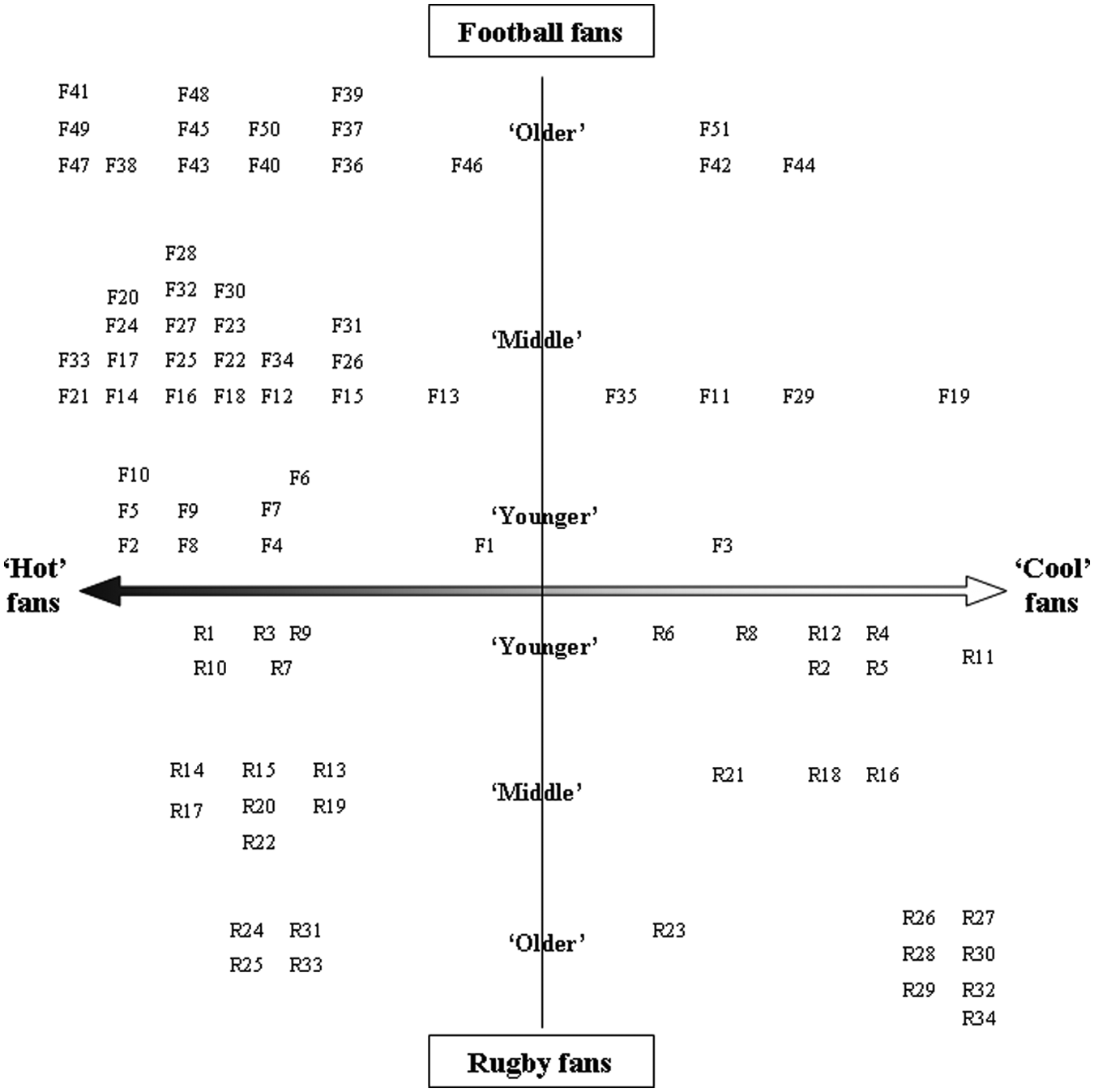
A preliminary model of female fandom.
The number of matches attended and if respondents’ were season ticket holders was not helpful as a quantitative “measure” of fandom. Some football and rugby union fans had season tickets but in their comments and attitude to sport clearly fitted better in the “cool” fan category. Indeed, a season ticket was usually necessary at Leicester Tigers to be able to attend any home matches due to the club’s capacity crowds. Likewise, some “hot” fans did not have season tickets (often due to financial reasons) but the club was clearly extremely important to them. This would seem to lend weight to the notion that qualitative methodologies may be more appropriate for examining the meaning and importance of sport for supporters.
Characteristics of “Hot” and “Cool” Female Fans
A deep commitment to sport has traditionally been argued to be almost exclusively important for the construction of men’s identities. Notions of “inauthenticity” typically surround female sports fans of men’s sports, who may feel that they are not regarded as “real” fans and are supposedly only interested in the heterosexual attractiveness of the players (Crawford & Gosling, 2004). But these findings demonstrate that sport is also central to the lives and identity interests of many women. Nearly 85% of the football sample (43/51) and just under half (16/34) of the rugby fans could be best described as “hot” sports fans. Figure 1 also shows that there were no obvious generational distinctions in this respect, except that “older” football fans were much more likely to fit the “hot” fan category (13/16) than were “older” rugby fans (4/12), who were also more likely to be at the extreme, “cooler” end of the axis.
For women in the “hot” fan category—especially football fans—sport was clearly an important facet of their identity. This might be illustrated by mentioning football on a personal CV, or a conscious determination to make new acquaintances aware of sport’s centrality to a personal narrative, for example: “Oh hello, I’m Kate, and I’m a Leicester City fan” (F5). A large majority of the football fans (28/51) commented positively on questions related to identity and the large amount of time that they invested in watching or thinking about football, describing the club as: “A big part of my life” (F13) or that it “Makes me, really” (F9). For some, identity and club had seemingly become fused: if they do not like my club, “then they’re not going to like me” (F6), and strong emotional responses would typically result for the question: “Is being a City fan an important part of who you are?”
Football’s always been my life. Like I said, playing it, watching it. . .I like lots of different sports but football’s always been the one if you like . . . the love of my life. That’s me; that’s part of me. (F25, Age 53, Occasional attendee, Long-term fan, Community Support Officer)
For some women, following sport clearly acted as a significant “backstage” (Goffman, 1990)—a space where they felt that they can actually be themselves, and explore this otherwise hidden or suppressed part of their identity. For example, some female sports fans identified intensely with the sports club as a means of escaping other identities (as mum, daughter etc.). This reflected back to their own preferred sense of self which was often masked or damaged by these other constraining responsibilities:
I just think during that era, you know, [1990s] Leicester never say die . . . that did seem to emphasize what Leicester were about. But,you know, for me that’s what I like. That is how I try to play my hockey, so I suppose that really grabbed me. Because that’s how I saw Leicester at the time . . . That’s how I like to see myself. [ . . . ]
How about in other areas of your life, can you relate to this there?
Yeah, I’d like to think I’m a grafter. And just get stuck in and get a job done.
(F18, Age 40, STH, Long-term fan, self-employed Accountant)
(R14, Age 45, STH, Long-term fan, Learning Mentor)
It’s an escape for me from being mum, wife, mentor at college, it’s me. It’s me, it’s individual and who I am, you know, it’s not being support to anyone else, it’s who I am, it’s me. It’s my time (laughs)
For the smaller proportion of “hot” rugby fans, sport also played an important role in their everyday lives and identities. People who meet these rugby women are very soon made aware that they follow the Leicester Tigers, and many used a family discourse to demonstrate the importance that the club held for them:
In order of priority it’s sort of, it’s Tigers and then it’s my other half and then it’s the kids and the grandkids you know, and everybody, they all know it. They’ve been told that that’s the order of importance. (R24, Age 68, STH, Long-term fan, Retired—worked as a Civil Servant)
However, in general terms, sport was more important to “hot” football fans than to the rugby fans in this group, and overall rugby fans were more likely to be located in the “cool” fan group. Unlike football, fandom for rugby union in the United Kingdom did not seem to bleed into other areas of fans lives in quite the same manner. Identity issues seemed relatively insignificant—in the words of R11: “I’m a part-time supporter . . . it [rugby] doesn’t describe me or characterize me in any way.” Detachment and choice were strongly to the fore in rugby union fans’ descriptions of sporting options, with sport being regarded more as a “hobby” (R16) or form of “entertainment” (R23). For example:
There’s plenty of other things [to sport]. It’s just one of the things I do in my spare time. I mean I’d be very disappointed if I couldn’t go, but I don’t think it would be the end of the world. (R27, Age 62, STH, New fan, Retired—worked as a Teacher) I don’t think it’s a huge part of my life. It probably is to some fans but I am quite busy and do a lot of things, so it’s not a big part . . . So it’s more of a hobby type thing, rather than like a big part of my life. (R4, Age 23, Occasional Attendee, Long-term fan, Beauty Therapist)
As discussed previously, this could be attributed to the combined impact of the effects of social class and cultural differences between the two sports. Perhaps women (and men) from more middle-class backgrounds are more likely to have other interests which provide them with life satisfaction besides sport—other leisure activities which they might be involved in or a higher level of satisfaction in the workplace—which might make it more likely that sport will form a minor, rather than significant part, of their identity (Pope, 2012). Rugby’s residual amateur ethos (Richards, 2006) in contrast to football’s traditional “win at all costs” mentality might also contribute to the lesser importance attached to rugby and the lower impact of results upon everyday lives.
For example, many rugby fans were dismissive of the alleged emotional incontinence of football supporters who, “Look like they’re going to die because they’ve lost a game” (R3). The minority of women who watched both football and rugby confessed to being more affected by the results of the football, rather than the rugby club. For “cool” rugby fans, any deep feelings connected to the outcome did not last very long and phrases such as: “It’s a game at the end of the day” (R18) or “there’s always next week sort of atmosphere to it” (R2) were used much more frequently, thus implying an emotional distance from the effects of losing.
“Cool” fans do not spend much time watching or thinking about sport in the week and are not typically affected by match results. But for “hot” fans things were very different. If the team is not performing well you “crush yourself” (F9), and a poor result could mean: “We’ll be miserable, the kids will be miserable at the same time, so everyone’s just on a downer” (F14). Sport can produce extremes in terms of emotional responses, with phrases such as: “bouncing,” “upbeat,” “euphoria,’ “buzzing” and “happy” used to describe feelings after a victory, but “foul” or “bad” moods, “depressed,’ and “down” when defeated, or even being “gutted,” “sick” or “devastated,” and needing time to “sulk” and “recover.’ R1 described how after a bad performance: “I get angry . . . I try and just go and sit somewhere and do something on my own so I don’t inflict my mood on other people,” and for R14 losing a European Cup Final: “Made me think twice about whether I should renew my membership. That was almost an influencing factor of “I can’t go through this again, I do not want to go through this pain again.” These data thus contradict James and Ridinger’s (2002) earlier study which suggested that sports do not provide an important source of identity for females in the way they do for males, and that women will not feel “empathy” after their team loses or plays badly.
Some of the more extreme “hot” fans admitted to thinking about sport or their club “constantly” (F24, F33). This could take up “50% of the week” (R22, R20) or “25% of my time” (F17). It was clear that for “hot” fans a large majority of their leisure time was devoted to their club and the results would also usually impact upon their mood. Consequently, for some, relations with close relatives were also demonstrably affected. Because the club formed such an important part of their lives, organizing other activities became extremely complex. Some respondents described how Saturday match days meant that family marriages needed to be planned carefully not to coincide with football. The club formed a central part of everyday lives:
I mean, once the season’s finished we’re waiting for the fixtures list to come out . . . so we can see when we’re free . . . It’s priority one, is the football. Everything else has to be worked round it. (F20, Age 48, STH, Long-term fan, Office Clerk) Rugby is the main part of my life . . . It’s almost like another career in some ways . . . It’s part of my life, like work is part of my life, you have to work. And okay, you don’t have to go to rugby, but it’s like “Oh, its Saturday, is there a rugby game on?” “Okay, we’re going.” (R10, Age 27, STH, Long-term fan, Speech Therapist)
Some of the more intense “hot” football fans confessed that they could not contemplate a relationship with a non-Leicester City fan, and in another, more extreme, example of the role of football in family life, F33 described a clear ultimatum for her husband, a man who initially “hated” football:
What happened?
Well it was either go and live with someone else, or take me [to] football really. . .He didn’t like sport, but he likes most of it now. Mind you, I did tell him he was a boring old fart! [ . . . ]
So how much time do you think you spend either watching or thinking about football?
Every day. All day. Well you can’t help it in here can you? (points to all the LCFC merchandise around the lounge) No, I’m always thinking about football. It’s constant. (F33, Age 50, STH, Long-term fan, Retired)
This couple now attends all of the club’s matches together. But for “cool” fans the club was usually not important enough to impact upon personal relationships in the same way or to impact upon their everyday work lives as it clearly did for “hot” fans.
These findings also demonstrate clear overlaps between Giulianotti’s (2002) categories of “supporters” and “fans,” and so based on my findings the separate spectator identities could be merged. “Hot” fans can be “traditional” as local supporters for whom switching to a rival club is impossible and the body is used to communicate solidarity with the club/community (Giulianotti, 2002, p. 33). But they can also be overt sports “consumers,” with the workplace or home decorated in club colors, posters of players and other club merchandise. “Hot” fans typically consumed live sport more than others; for example, some Leicester City fans attended all fixtures played at the club’s home ground, and also travelled to away matches. But although pretty much all respondents bought something connected with their club, it was “hot” fans who typically had rooms, or even a home, dressed in club colors and products, thus fusing the domestic and public realms.
This could not always be justified by an interest in offering monetary support for the club, as is the case for Giulianotti’s (2002) “supporters.” Although many respondents typically bought club merchandise, including clothing such as the club shirt, jumpers, coats, and gloves, there was no financial gain for the club in some of the selected home décor. Some “hot” City fans for example, avoided local rivals Nottingham Forest’s red club color, or opted to purchase carpets in Leicester City’s royal blue. Decorating the home and workplace with Leicester City images could include pictures purchased from the club shop, but also newspaper cuttings and personal photographs associated with the club. The more extreme cases of club consumption usually came from football fans—some football women even sported tattoos of the club to demonstrate their allegiance. But a smaller number of “hot” rugby fans also decorated their homes in a similar way, and again this included purchased products as well as originally designed fan displays, such as framed photographs with Tigers players.
Sports Fandom and Gender Performance: “Masculine” Femininities and “Feminine” Femininities
As discussed previously, Ussher (1997) suggests that there are typically four “performances” of femininity available to women: “being girl,” “doing girl,” “resisting girl,” and “subverting femininity,” and Sisjord and Kristiansen (2009) have drawn upon this model for their research on female wrestlers. This position is useful in my analysis of the diversity of supporter styles and motives revealed among female sports fans. Like Sisjord and Kristiansen’s (2009) female wrestlers, many of my respondents could be said to be “doing girl” by spectating at a predominantly masculine sporting event (p. 238). In some respects they could be said to be “ridiculing the very performance of [conventional] femininity.” Drawing upon Ussher’s (1997) framework, and Sisjord and Kristiansen’s (2009) application of it to the life-world of female wrestlers, crudely speaking, there were two different kinds of gender “performance” which can help to connote the female fan types:
“Masculine” femininities (those characterized by “doing girl” and “resisting girl” approaches to presentation of self. This was more typically displayed by “hot” fans).
“Feminine” femininities (those characterized by “doing girl” and “being girl” approaches. This was more typically expressed by “cooler” fans).
There was a considerable blurring between the two spectator types as women carefully “balanced” and nuanced their gender and sporting identities and not all “hot” fans, for example, took on aspects of a normative “masculine” femininity. But this schematic framework is useful to begin to unpack some of the general themes that emerged around the gender/sport axis in female sports spectatorship.
Many of those respondents who performed strong “masculine” femininities in their supporter identities described themselves as “tomboys,” who had often played competitive team sport (especially football), as has been found elsewhere (Caudwell, 2000). In some cases, these women identified more strongly with men and male fans than they did with most females. F21, for example, played badminton to a high level and suggested that this offered a connection with many male fans who usually also played sport: “A lot of people that go to a lot of these games have been very sporty . . . So they have that will to win, need to win.” F17 visited the gym regularly and felt physically strong enough to compete on equal terms with men: “I can probably out run anybody. I can lift more weights than most men.” These kinds of responses echo some of the narratives of Sisjord and Kristiansen’s (2009) wrestlers who have accepted the “athletic body” and thus “resist” body discipline according to traditionally signified femininity. By inhabiting and performing a “tomboy” identity during school age years this enabled many respondents to achieve better access to sport (especially football), thus rejecting the disempowerment that comes with conventional femininity (see Paechter, 2006).
Many of these heterosexual women maintained aspects of this “tomboy” identity into adulthood and expressed an enduring hostility to what they perceived to be extreme forms of conventional femininity—to “girlie girls” or to those women who more typically perform “being girl.” Jones (2008) suggests that there are three main gender strategies used by female fans to respond to their minority status in UK football: “defining sexist and abusive behavior as disgusting,” “downplaying sexist and homophobic abuse” and “embracing gender stereotypes as part of the game” (pp. 528-529). Women who adopted the third strategy accepted traditional ideas about gender within football. They distanced themselves from “emphasized femininity” and rejected those women who they felt did not “do fandom properly,” for example, by getting “dolled up” to go to football matches. “Hot” female fans in my research who performed “masculine” femininities typically adopted this third strategy. Like many of Jones’s (2008) respondents, some interviewees tried to differentiate themselves from women spectators who were not “real” fans in their eyes, and wanted to be seen, in this context, as gender neutral supporters.
Sisjord and Kristiansen’s (2009) senior wrestlers were compatible with “resistant girl” as they adhered to “the wrestling ethos of fighting—to beat the opponents and be able to take a beating—reflecting hegemonic masculinity” (p. 239, 241). Such toughness and guts was argued to place these women within the boundaries of what Halberstam (1998) terms “female masculinity,” referring to a more nuanced understanding of gender categories that incorporates gender expressions among “masculine” women rather than pathologizing them. This “resistant girl” presentation of self seems applicable to the small number of female fans performing “masculine” femininities, who were prepared to use violence at football if necessary. F33, for example, admittedly in an extreme case, cautioned that if women fans were not prepared to fight at football should the need arise then they should not sit in her almost exclusively male, sometimes unruly section of the Leicester football stadium. F24—who strongly objected to the “culture of femininity” (Scraton, 1996) among girls who were opposed to physical exertion in PE lessons—was contemptuous of women who see football matches as an “afternoon out.” These were “feminine” women who took “hot drinks and cakes” to games, and who wore high heels and lipstick, which was all “very strange.” The Leicester football fan quoted below had been involved in fan violence with young men during the 1970s and 1980s, and she strongly identified with men and with archetypically aggressive male fans:
I’ve always been one of the lads, cos I’ve always done what they’ve done. Apart from having to use the ladies toilets (laughs) . . . Because I talk about football so much, men are more entertaining for me than women are. They [women] talk about shopping and the latest clothes from wherever, all this designer stuff. I just haven’t got a clue. Whereas you can go anywhere in the world and with your knowledge of football, you can have a conversation with anyone. Well any man anyway. So I’ve always been in men’s company. (F24, age 51, Member, Returned fan, Production Operative)
In contrast, those fans who performed more “feminine” femininities did not tend to self-identify as tomboys or to play contact team sports. Playing football was often perceived as something that “girls did not do” for these women, and playing rugby was simply out of reach for most rugby fans. Of the 34 rugby fans interviewed only one respondent (R22) spoke about playing rugby—she played casually with brothers in the back garden when younger—in contrast to the 22 (out of 51) football fans who discussed how they would often have an informal “kick-about” usually with “lads” or male relatives, despite the lack of encouragement and barriers for girls to play organized football at school (see Williams, 2003b). Many (though by no means all) rugby fans performed “feminine” femininities, although some female football fans also clearly enacted this “type” of gender performance.
Some “cool” female fans performing “feminine” femininities viewed sport as an opportunity to spend time with their partner, but this domain of sport was also seen as very much his world. These women often criticized how men’s traditional gender roles have been challenged today in sport and other areas—by other women. Connell (1995) has argued that this challenge has been so powerful that one response from men might be a distorted (hyper) “protest masculinity,” one born of male alienation and frustration. By admonishing other women for being as apparently committed to football as men, these female respondents describe the role of sport in “doing” masculinity in the same way that many men and male academics talk normatively about the links between sport and the reproduction of masculinity:
I think men are losing their way. I think they’re losing what they’re supposed to be as a man, what their role is, and who they are [ . . . ]. For men, football is the culture isn’t it? . . . I think there’s certainly a lack of things that blokes can do together as blokes, because women push into everything and want to be included and take part. But I’m happy for blokes to do football, as I think it’s important that they retain something that they can do together as men. (F19, Age 45, Occasional attendee, On-off fan, Researcher)
Rather than “pushing into” football, it is claimed here that women should allow men to maintain their position as core sports fans: that UK sports grounds should be spaces for “performing” hegemonic masculinities rather than femininities. In contrast to women performing “masculine” femininities, here it is suggested that sport will “naturally” be more important for men—women have other interests and responsibilities that take primacy over sport:
Women are happy to see it at face value: going out for the afternoon. It’s going to be dead nice, I’ll go home, make tea, bla bla bla. Whereas blokes are . . . its life or death . . . Yeah, I think men are definitely more competitive. Whereas women, it probably forms a small part of their life. (R12, Age 35, Occasional attendee, Long-term fan, Part-time Conveyancer)
Conclusion
This article makes a contribution toward addressing the dearth of empirical research on female sports fans, as well as the relative lack of comparative studies on fans of different sports. Sport has traditionally been argued to form an important part of men’s identities, but drawing on Glaser and Strauss’s (2008) “grounded theory” approach, this research aimed to explore the meaning and importance of sport for female fans.
These findings illustrate the diversity and complexity of women’s attachment to sport as fans. Drawing loosely on Giulianotti’s (2002) “hot” and “cool” taxonomy axis, I developed a preliminary model to examine the meaning of sports fandom for women. As Giulianotti’s (2002) earlier model of sports fandom is mainly analytical rather than based on empirical research, it may be possible for different individuals to demonstrate aspects of more than one category. Here, my findings suggest that Giulianotti’s (2002) distinction between “supporters” and “fans” is difficult to sustain as some female fans exhibited typical characteristics of spectators in both of these ideal types.
There were also variations between football and rugby union fans, with UK football supporters more likely to be “hot” fans and rugby union fans more likely to fit the “cool’ fan type. Crudely speaking, rugby union fans were more likely to fit middle-class identifiers than their football counterparts, so these social class differences, along with cultural differences between the two sports, probably played a key role in the different levels of commitment apparent among these samples of UK football and rugby fans.
Drawing upon Ussher’s (1997) framework of “performances” of femininity and Sisjord and Kristiansen’s (2009) application to female wrestlers, I went on to develop a schematic frame to examine how “femininity” was typically constructed or “performed’ by women through their attachments to male sports as fans. Crudely speaking, two different kinds of gender “performance’ helped to connote female fan types: “masculine” femininities and “feminine’ femininities. Whereas those fans who explored “masculine” femininities often had experience of playing contact team sport, adopted a “tomboy” persona when younger, continued to identify strongly with men and male fans, and exhibited “hot” styles of support, those performing “feminine’ femininities demonstrated the opposite propensities. But this was not always a straightforward correlation and there was considerable blurring between the two categories. For example, some women had learnt to “balance” their gender and sporting identities and mobilized these different identities at different points in their lives. The sports ground was an ideal space to explore their “backstage” (Goffman, 1990) and escape other, more constraining “feminine” identities. It is hoped that the model of female fandom developed here will be a useful building block for future research in this area.
Although I would suggest that these findings illuminate the diversity of supporter styles and gender performances exhibited by female sports fans, there is clearly a need for further research to explore this complex terrain. There has been a tendency for research on sports fandom—especially in the United Kingdom—to focus almost exclusively on (male) fans of football, but there is a need to conduct further cross-comparative studies between fans of different sports and for future research to put women’s experiences on the sports research agenda. This research has been based on one case study city, Leicester in the United Kingdom, but it would be interesting to compare these findings with female football and rugby fans from other locations, and for future research to explore other largely marginalized sports, such as rugby league and cricket (in the United Kingdom) and basketball and baseball (in the United States). It is hoped that this exploratory study will prompt further cross-comparative research on female and male fans.
Footnotes
Acknowledgements
Thanks to John Williams (University of Leicester) and the two anonymous reviewers for their helpful comments.
Declaration of Conflicting Interests
The author declared no potential conflicts of interest with respect to the research, authorship, and/or publication of this article.
Funding
The author disclosed receipt of the following financial support for the research, authorship, and/or publication of this article: This work was supported by the Economic and Social Research Council [grant number PTA-030-2005-00310].