






Abstract
Doping, or performance enhancing drug use, has long been a social and health problem among athletes. Despite the issues associated with doping and the illegality of using these drugs, little criminological research has examined why athletes engage in this deviant behavior. The present study seeks to do so by applying key theoretical concepts derived from, and testing the predictive efficiency of, situational action theory on professional athletes’ past, current, and future performance enhancing drug use. We employ self-report data from a random sample of 680 professional athletes from Rasht, Iran. Ordinary least squares regression is used to analyze these data. Findings suggest that crime propensity and criminogenic exposure increase athletes’ doping behavior. In addition, we find the interaction term between crime propensity and criminogenic exposure influences performance enhancing drug use among professional athletes, while increasing the model’s predictive power. Finally, in contrast to situational action theory, we find that known correlates of deviance (education, age, and gender) still influence athletes’ doping behavior even when key theoretical variables are included in the model.
Introduction
The use of performance enhancing drugs (PEDs) among athletes has occurred since the inception of organized sport (Yesalis & Bahrke, 2002) and has continued throughout various sports with moderate to high prevalence rates (de Hon et al., 2015). Doping, or the use of PEDs, is difficult to detect and tests are easy to falsify. Athletes can use diuretics to mask the drugs, and new drugs are also being developed with effects analogous to PEDs that are undetectable through testing (Dimeo & Møller, 2018). Experts have demonstrated that the ineffectiveness of testing is not just a scientific problem, it is also political: Enforcement of anti-doping rules is challenging and expensive and many organizations and governments are unwilling to put forth the effort (Pound et al., 2013). In addition to the unlikeliness of detection and apathy of officials, athletes are faced with increasing financial and competitive incentives to dope (Dimeo & Møller, 2018). Prior research has indicated a number of societal pressures associated with doping (Kirby et al., 2011; Laure et al., 2004; Lucidi et al., 2004; R. J. Peters et al., 2005; Wiefferink et al., 2008), such as the subjective attitudes of others (Lucidi et al., 2004; Wiefferink et al., 2007), the culture (Kirby et al., 2011), the influence of coaches and peers (Laure et al., 2004; R. J. Peters et al., 2005), and social norms regarding body weight (Irving et al., 2002). Considering the public nature of sports and the organizational nature of professional/amateur athletics, experiencing societal pressures to perform at advance levels is hardly surprising.
Although very few cases of doping are sanctioned each year (roughly 2%), those athletes who are sanctioned are typically heavily and publicly punished. Athletes who are sanctioned for doping are stigmatized and labeled as negative role models (Dimeo & Møller, 2018). Doping is a serious problem with medical and ethical concerns that, despite its extensive history, has yet to be curtailed. A necessary step toward this end is to garner an understanding of the personal and environmental factors as they interact to influence an athlete’s decision to use PEDs despite the potentially public consequences.
The aim of this article is to examine a potential framework for understanding the etiology of doping among athletes in Iran by utilizing situational action theory (SAT). SAT is a general theory of moral actions/criminal behavior. A moral action, as explained by Wikström (2010), is the violation of a moral rule. In essence, this means that any violation of any set of rules can be explained through application of this theory. SAT incorporates a number of theoretical variables, representing person and place, which interact at various stages to produce an action, whether that be a criminal action or a just moral action. Once we understand how these variables relate to doping behaviors, we can begin to explore ways to reduce its occurrence in sports.
Literature Review
SAT
Wikström (2006) proposed SAT to explain not crime, per say, but breaches of moral rules, which he refers to as moral actions (Wikström, 2010). This distinction between crime and moral rules suggests that SAT can explain behaviors that are criminal in nature as well as those that break only moral, as opposed to legal, rules. SAT examines these types of behaviors by determining the underlying reasons behind an actor’s decision to break a moral rule. The decision made by an individual to break a moral rule is initiated by two variables, criminal propensity and criminogenic exposure. Wikström (2010) refers to this process as the perception–choice process.
Perception and choice
According to SAT, an individual’s perception of action alternatives is a process based on interacting elements. The process begins with temptations/provocations, which Wikström (2014) refers to collectively as motivations. Temptations are considered to be desired outcomes, while provocations are considered interference by others in the actor’s course of action. The second element is personal morality and moral emotions. Moral emotions are the shame and guilt attached to the breaking of moral rules. Wikström (2014) refers to this as a moral filter, explaining that if an actor has a high level of morality, it is unlikely that any variation in temptations or provocations would alter their decision to avoid deviant behavior. Therefore, morality is arguably the most important of all elements considered within SAT, as all other elements and processes are of no importance if the actor is high enough in morality (Wikström, 2014).
The second part of the perception–choice process is the choice element. Notably, this part of the process will only come into play if perception of action alternatives resulted in the actor seeing the potential for criminal behavior (Wikström, 2004). If the actor does see a behavior as available, the two components of the choice element, self-control and deterrence, become relevant. Wikström (2004) defines self-control as an actor’s ability to make choices based on their morality when they are experiencing temptations and provocations. Deterrence is an actor’s perceived risk of sanctions or interventions. Despite the fact that a deviant action has been determined as situationally available, self-control may act as a restraint if the actor’s level of self-control is high enough. Deterrence, on the contrary, is contingent on the perception of environmental controls. If they are perceived as high, the individual will refrain, if low the individual will be more likely to engage in the criminal behavior. The choice element can be habitual, based on deliberation, or both. For instance, if a person is exposed to the same situationally available crime, and their tendency is to commit the behavior, this can create a habit that no longer necessitates deliberation. Conversely, the actor could potentially take the time to deliberate on their decisions. Therefore, once the action is seen as available, the decision to move forward with the action is largely based on the efficacy of controls (Wikström, 2014).
Criminal propensity and criminogenic exposure
Similar to the above interactions, SAT proposes an interaction between criminal propensity and criminogenic exposure. Criminal propensity is comprised of personal morality/moral emotions and self-control. Criminogenic exposure is comprised of the moral context of the environment and deterrence (Wikström, 2010). This interaction underscores the importance of the person and the setting in determining the outcome of deviant behavior. If you remove the person from the criminogenic setting or alter the setting for the person, the outcomes will vary. The interaction of these two variables will initiate the previously discussed perception–choice process. The outcome would then determine whether a deviant action would occur or whether the individual will be controlled by the interaction of person by place controls.
As clearly evidenced, SAT is a multi-interactional theory. As such, there has yet to be a complete test of SAT. However, studies examining various proposed interactions have largely resulted in mixed support. In their narrative review, Pauwels and colleagues (2018) examined tests of SAT between 2006 and 2015. These authors found that most of the studies showed at least partial support for the theory, but that others showed no support. Studies published after the inclusion date for their narrative review have continued to show mixed support (Antonaccio et al., 2017; Cochran, 2016; Gerstner & Oberwittler, 2018; Hirtenlehner & Hardie, 2016; Hirtenlehner & Treiber, 2017; Kroneberg & Schulz, 2018; Schepers, 2017; Schepers & Reinecke, 2018; Serrano-Maíllo, 2018; Weerman et al., 2016; Wikström et al., 2018). Given the relative nascence of the theory and its unique focus on the interaction between person and place characteristics, it is worth continued exploration. The focus on situational and individual factors along with its applicability to both moral and criminal actions makes SAT appropriate for studying the use of PEDs among professional athletes.
PEDs
PEDs are any banned substances that are utilized to improve physical performance among athletes, a behavior often referred to as doping (de Hon et al., 2015; Lazuras et al., 2010). This behavior has a long history within sports, with the earliest recorded incidence of doping being during the Olympic games in the third-century BC, where ancient athletes would consume hallucinogenic mushrooms or sesame seeds to gain an advantage (de Merode & Schmamasch, 1998; Yesalis & Bahrke, 2002). Since then, doping has been seen in a number of sports, including (but not limited to) cycling (Zorzoli & Rossi, 2010), soccer (Vouillamoz et al., 2009), track and field (Sottas et al., 2011), speed skating (Kuipers et al., 2007), powerlifting (Wagman et al., 1995), and weightlifting (Angoorani et al., 2012). There is significant variation in the prevalence of doping among athletes which is, in part, due to diverse measurement tools, country of origin, and type of sport (de Hon et al., 2015; Lazuras et al., 2010). Type of sport can vary by individual or team sports, with athletes competing in individual sports often using more banned substances than those in team sports (14.4% and 7.4%, respectively; Lazuras et al., 2010). The range of prevalence rates can be from 10% to 70% (Allahverdipour et al., 2012; Angoorani et al., 2012; de Hon et al., 2015; Nakhaee et al., 2013).
Despite the long history and significant prevalence rates of PED usage, research on the etiology of doping is rather limited. Some causes of doping have been examined including body image (Blouin & Goldfield, 1995; Brower et al., 1994; Cohen et al., 2007; Kanayama et al., 2006; Kindlundh et al., 1999; M. A. Peters & Phelps, 2001; Pope et al., 2000), sports pressures (Tavani et al., 2012), social desirability (Gucciardi & Geoffrey, 2015), and gender (Soltanabadi et al., 2015; Zelli et al., 2010). In addition, research has consistently indicated an association between PED use and social and environmental pressures (Laure et al., 2004; Lucidi et al., 2004; R. J. Peters et al., 2005; Wiefferink et al., 2007). These findings, in conjunction with current prevalence rates, indicate a need for theoretically driven research and policy aimed to curtail usage.
A survey of 35 international sporting federations indicated that they held anti-doping as a highest priority (Mountjoy & Junge, 2013). However, research suggests that the general population disagrees with this statement in light of the various doping scandals (Wagner & Pedersen, 2014). Nevertheless, many countries, including Iran—the site of the current study—have formally accepted the World Anti-Doping Agency (WADA) restrictions and guidelines (see WADA, 2019, for a list of participating countries). Furthermore, Iran enacted its own anti-doping guideline, the Iran National Anti-Doping Organization (IRANADO). According to these various guidelines, any use of banned substances carries a penalty of 6 months to 4-year suspension and possible lifetime ban for continued offenses (WADA, 2019).
SAT and Illicit Use of PEDs
The illegality and sanctions of doping makes it a unique “criminal” behavior. For instance, human growth hormone and erythropoietin are substances that are banned by WADA but are not illegal to possess (WADA, 2019). Conversely, anabolic steroids, which are also used for doping, constitute a felony misdemeanor. Regardless of the type of substance used, doping is almost always dealt with through informal channels as opposed to the criminal justice system. The U.S. Anti-Doping Agency website lists sanctions since 2001, none of which include any criminal justice interventions. The listed sanctions range from public warning to expulsion from the sports, with varying time periods of suspension in between (U.S. Anti-Doping Agency, 2019). In addition, laws against doping are contingent on athletic association; despite WADAs efforts for unified policies, there are still agencies with their own individual policies. Even within WADA there are certain substances (e.g., beta-blockers) that are banned only for particular sports (WADA, 2019). The ambiguity of doping as either a criminal offense or a violation of a moral rule makes it an ideal behavior for applying SAT, as the theory purports to explain all moral actions defined as “any action that is guided by rules about what is the right or wrong thing to do or not to do . . .” (Wikström, 2014, p. 75).
According to Wikström (2010), the use of PEDs would be a moral action as it is the violation of rules defined by various agencies. In following the SAT framework, the goal would be to explain why athletes break the anti-doping rules despite the fact that they are aware of the rules. Application of the theory would consist of examining one’s criminal propensity (personal morality/moral emotion and self-control) and criminogenic exposure (moral context of the environment and deterrence). An individual’s personal morality and moral emotions associated with doping, essentially if they feel guilt or shame for using, will interact with their level of self-control to influence their criminal propensity. Personal morality and moral emotion could be affected by the high prevalence and competitive nature of doping, and prior qualitative research has found morality to be a consideration among athletes who admitted to doping (Kirby et al., 2011), whereas a lack of self-control has been found to predict both criminal and analogous behaviors (Pratt & Cullen, 2000). The next interaction proposed is criminogenic propensity by criminogenic setting. The criminogenic setting is an interaction between the moral context of the environment and deterrence. Aspects of the moral context of the environment are important to consider as use of PEDs has, in some instances, been initiated by coaches (Kirby et al., 2011; R. J. Peters et al., 2005) and is more likely if they know someone who is already doping (Papadopoulos et al., 2006). Considering that the sanctions for doping are infrequent and the prevalence is moderate to high, deterrence, or lack of deterrence, should be considered when examining doping behaviors (de Hon et al., 2015; Dimeo & Møller, 2018).
Current Study
Taken together, existing research has provided insight into the applicability of SAT in explaining various forms of crime and deviance. To date, there is limited criminological research on PED usage, and this is the first known examination of the predictive efficiency of SAT on professional athletes’ past, current, and future PED use. To further expand the scope of our understanding of both PED usage and the explanatory power of SAT, this study uses a sample of professional Iranian athletes to explore how one’s setting and individual propensity influence doping behavior. Using an Iranian sample is especially unique and beneficial for myriad reasons. Primarily, Iran has a culture of extreme fandom of sports. This culture contributes to problems like hooliganism, rioting, violence, harassment, and cyber bullying, and creates rivalries between sports teams’ and clubs’ fans (Heydarinejad & Gholami, 2012; Rahmati et al., 2014). These rivalries may work to create excessive pressure to perform at higher levels—increasing the likelihood of PED usage in this setting. As such, Iran provides a unique sample and professional sports provide a unique setting for the study of SAT.
Given the unique social and peer pressures that exist in sports, specifically examining propensity to use PEDs and exposure to PEDs provides perhaps the most pertinent and direct theoretical examination of doping behavior. Prior research has found that self-control and deviant peers, elements of crime propensity and exposure, are related to doping and other forms of sports deviance (Lovstakken et al., 1999; Shadmanfaat et al., 2018, 2020). Furthermore, the present study examines the interaction between propensity and exposure. Because this interaction is crucial in tapping into the importance of the person and the setting in examining deviant behavior and because the interaction between these two theoretical components has been found to explain other deviant behaviors (Cochran, 2016; Hirtenlehner & Hardie, 2016; Hirtenlehner & Treiber, 2017; Svensson, 2015; Wikström, 2009), it is expected that propensity and exposure will interact to further explain PED usage.
To conduct our examination of the predictive ability of key theoretical variables derived from SAT on PED usage, we propose a number of hypotheses:
Method
This study was conducted using a random sample of 680 professional athletes from Rasht, Iran, who have competed for at least 5 years in their sport, and who were registered in the Department of Physical Education in Rasht. The 2016 list of registered professional athletes from the city served as the sampling frame. Registration in the physical education department is important for it is through this process that professional athletes are distinguished from amateurs. Rasht was chosen for sampling because it is one of the most important cities in the Guilan province for sports, and thus has a high number of elite athletes. From among the list of registered professional athletes, power analyses indicated that a simple random sample of 700 should be drawn. Once this sample was drawn, the sampled athletes were invited to a large meeting area at a sporting complex. As per approved institutional review board (IRB) requirements, the purpose of the study was discussed, and voluntary consent was provided to the athletes. Then a self-administered questionnaire was distributed in Persian on pen and paper. This method yielded 680 usable questionnaires (i.e., questionnaires without extensive missing data).
Descriptive statistics on the socio-demographic characteristics of the sample show that 58% of the athletes were male and 42% were female. Also, 26% of respondents were below the age of 20, 37% were 20 to 25 years old, 18% were 25 to 30 years old, and 18% were above 30 years old. Regarding marital status, 58% were single and 42% were married. Finally, 34% of respondents had an undergraduate degree and 39% had a graduate degree. The percentage of individuals involved in the various professional sports are as follows: 6% weightlifting, 11% taekwondo, 12% karate, 7% handball, 13% swimming, 16% football (soccer), 7% futsal (indoor 5-on-5 soccer), 9% volleyball, 8% basketball, 7% bodybuilding, and 5% wrestling.
Dependent Variable
Athletes’ doping behavior (PED usage) is examined through three measures designed to gain information on athletes’ past, current, and projected use of PEDs (Kabiri et al., 2018). Participants were asked to report whether they “currently use a banned substance,” had “previously used a banned substance to enhance their performance,” or “intended to use a banned substance at least once within the next 12 months.” The responses ranged from 0 = never used/use/will use banned substances to 3 = systematically used/use/will use banned substances (α = .93).
Independent Variables
Propensity to commit crime
According to the tenets of SAT, people vary in their crime propensity depending on their personal morals and ability to exercise self-control (Wikström, 2014). Considering this, scales measuring low self-control and morality were multiplied to create a composite measure for a respondent’s propensity to use PEDs. Low values on the crime propensity index imply a strong law-relevant morality and a strong ability to exercise self-control, while high values imply a weak law-relevant morality and poor ability to exercise self-control (Wikström, 2014).
Weak morality
A three-item self-report scale was used to form an indicator of morality (wrongfulness of PED usage, feelings of guilt, and feelings of shame; Hirtenlehner & Treiber, 2017; Svensson, 2015). The items included were as follows: “how wrong is it to use a banned PED?” (very wrong = 1 to not wrong at all = 4); “how guilty would you feel if you used a banned PED?” (very guilty = 1 to not guilty at all = 4); and, “if you used a banned PED and a significant other like a coach, fellow athletes, close friends, or family members found out about it, would you feel ashamed?” (very much = 1 to not at all = 4; α = .86).
Low self-control
The ability to exercise self-control was measured using a truncated version of the Grasmick et al. (1993) scale intended to tap particularly, but not exclusively, into the impulsivity and risk-taking components of the construct, which have been shown to be most predictive of crime involvement (Hirtenlehner & Hardie, 2016; Svensson, 2015; Vazsonyi et al., 2001; Wikström & Svensson, 2010). The items are as follows: “I often act on the spur of the moment without stopping to think”; “I often try to avoid things that I know will be difficult”; “I lose my temper pretty easily”; “when I am really angry, other people better stay away from me”; “I often take a risk just for the fun of it”; and “sometimes I find it exciting to do things that are dangerous.” Responses ranged from strongly agree = 1 to strongly disagree = 4 and were coded so that high scores indicate a poor ability to exercise self-control (α = .81).
Exposure to crime
Tenets of SAT propose that a setting’s criminogeneity depends on its moral context, which involves the moral norms of the environment and personal morals of others, such as peers. Because moral context is difficult to measure, prior research has often employed measures of risky lifestyles and/or delinquent peers as proxies for setting measures. Exploring moral context and deterrence allows researchers to tap into how criminogenic one’s setting is when macro-level setting variables are unable to be used. Measures of moral context and deterrence are thus summed to create a composite measure for a respondent’s exposure to banned PEDs. A low value of criminogenic exposure means that a person spends little time in criminogenic places with criminogenic people and has a high level of perceived deterrence, whereas a high value means a person spends a lot of time in criminogenic places with criminogenic people and has a low perceived deterrence (Wikström, 2014).
Moral context
Two self-report subscales were used to form an indicator of moral context: peers’ moral beliefs about banned PEDs and proportion of peers perceived to be using banned PEDs. The peers’ moral beliefs about banned PEDs indicator were measured using a four-point scale (Hirtenlehner & Hardie, 2016; Hirtenlehner & Treiber, 2017). Respondents were asked how much they agreed with the following statements: “most of my close friends think it is okay to use a banned PED”; “most of my fellow athletes think it is okay to use a banned PED”; “most of my family members think it is okay to use a banned PED”; and “my coaches think it is okay to use a banned PED.” The responses ranged from strongly agree = 4 to strongly disagree = 1 (α =.89). The proportion of peers perceived to be involved in a banned PED use indicator was measured using a four-point scale (Hirtenlehner & Hardie, 2016; Hirtenlehner & Treiber, 2017). Respondents were asked the following questions: “how many of your close friends used a banned PED in the last 12 months”; “how many of your fellow athletes use a banned PED in the last 12 months”; and “how many of your family members use a banned PED in the last 12 months?” The responses ranged from none of them = 1 to all of them = 4 (α = .82).
Perceptual deterrence
A self-report scale was used to form an indicator of perceptual deterrence (perceived sanction certainty and severity). The perceived sanction certainty and severity of banned PED use indicator was measured using a two-point scale (Gallupe & Baron, 2014; Hirtenlehner & Treiber, 2017; Svensson, 2015). Respondents were asked the following questions: “do you think there is a great risk of getting caught if you use a banned PED,” with responses ranging from no risk at all = 4 to a very great risk = 1, and “how much trouble would you be in if you got caught using a banned PED?” with responses ranging from no trouble at all = 4 to very much trouble = 1 (α = .72).
Analytic Strategy
Analyses are conducted in a series of steps. First, we examine group differences between sports in past, present, and future doping behavior using a series of one-way analyses of variance (ANOVAs). Next, we calculate descriptive statistics and examine the zero-order correlations between the subscales used to create crime propensity and criminogenic exposure and our dependent variables. Finally, to test our hypotheses, we employ three ordinary least squares (OLS) regression models. OLS regression is appropriate because the distribution of our dependent variables approximates normality. In the first model, we examine the independent effects of crime propensity and criminogenic exposure on past, present, and future doping behavior. In the second model, we create and employ a mean-centered interaction term to gauge the interaction effect of crime propensity and criminogenic exposure on past, present, and future doping behavior. In the third model, we add demographic variables to assess whether known correlates of deviance are significant predictors of doping behavior when key theoretical concepts derived from SAT are presented in the same model.
Findings
Table 1 presents group differences between sports in past, present, and future doping behavior using a series of one-way ANOVAs with the Least Significant Difference procedure. These results indicate that significant differences exist between different sports in terms of athletes’ past, present, and future doping behavior. More precisely, regarding athletes’ past doping behavior, the highest level of doping occurred among weightlifters (M = 1.29, SD = 1.29), wrestlers (M = 1.09, SD = 1.14), and football players (M = 1.08, SD = 1.13). Past doping behavior was lowest among athletes who competed in basketball (M = 0.26, SD =0.52), volleyball (M = 0.31, SD = 0.64), and karate (M = 0.54, SD = 0.79). The group difference regarding past doping behavior is significant, F(10, 669) = 6.19, p < .001. Similarly, the highest levels of current doping occurred among bodybuilders (M = 1.12, SD = 1.22), wrestlers (M = 1.06, SD = 1.15), and weightlifters (M = 1.05, SD = 1.31), and the lowest levels among athletes who competed in basketball (M = 0.17, SD = 0.51), volleyball (M = 0.32, SD = 0.72), and karate (M = 0.51, SD = 0.88). The group difference regarding current doping behavior is significant, F(10, 669) = 5.38, p < .001. Finally, the mean group differences between sports reveal that the highest levels of future doping behavior were among bodybuilders (M = 0.04, SD = 1.14), football players (M = 1.00, SD = 1.14), and futsal players (M = 0.98, SD = 0.24), and the lowest levels were among athletes who competed in basketball (M = 0.31, SD = 0.80), volleyball (M = 0.45, SD = 0.92), and karate (M = 0.49, SD = 0.93). The group difference regarding future doping behavior is significant, F(10, 669) = 3.19, p < .001.
Group Differences Between Sports in Past, Present, and Future Doping Behavior (N = 680).
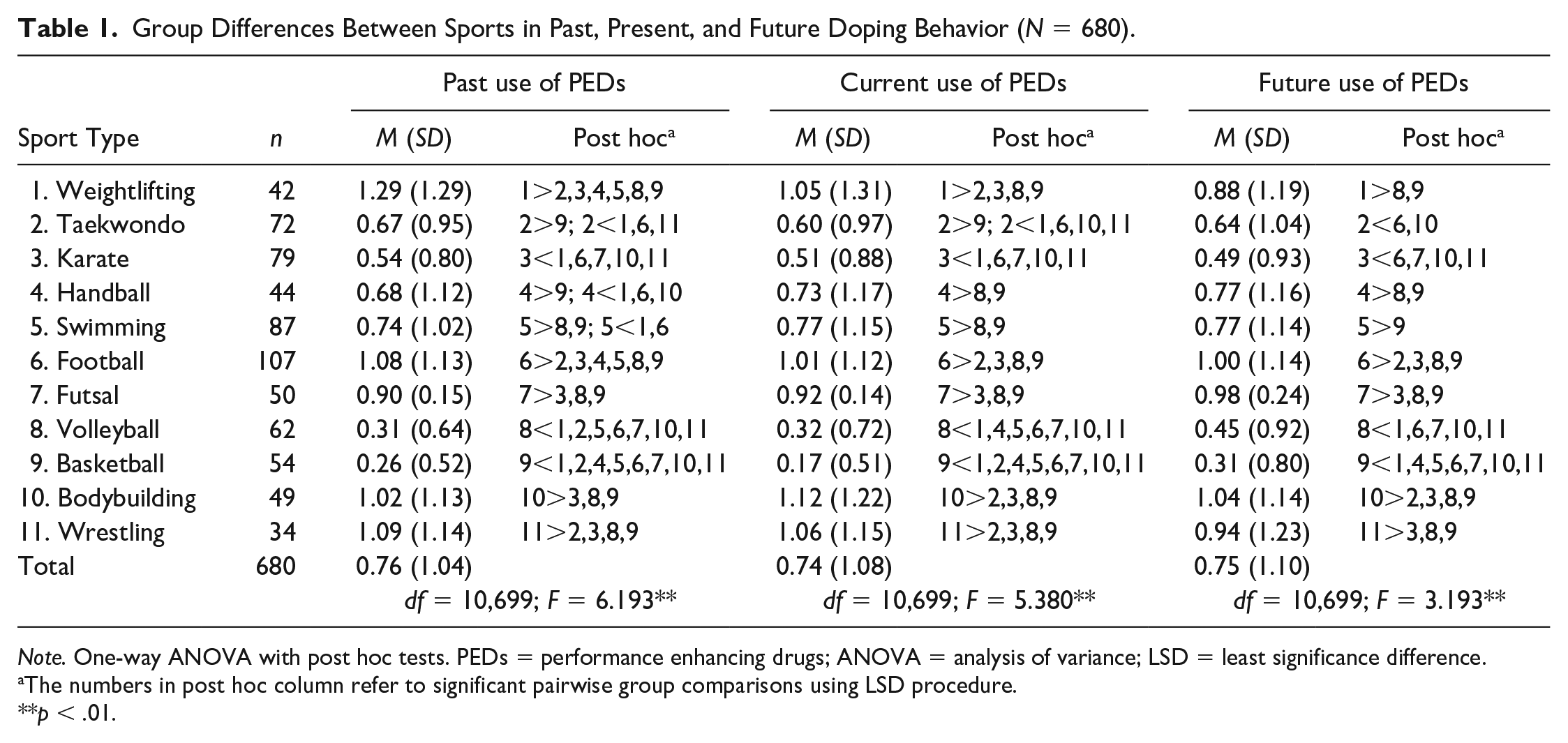
Note. One-way ANOVA with post hoc tests. PEDs = performance enhancing drugs; ANOVA = analysis of variance; LSD = least significance difference.
The numbers in post hoc column refer to significant pairwise group comparisons using LSD procedure.
**p < .01.
Table 2 reports the zero-order correlations between athletes’ doping behavior, and the subscales that were derived from the tenets of SAT. 1 A strong correlation exists between PED use and the variables derived from SAT. Specifically, a strong correlation exists between athletes doping behavior (past, present, and future) and weak morality (p < .01), low self-control (p < .01), deterrence (p < .01), and moral setting (p < .01).
The Zero-Order Correlations Between Independent and Dependent Variables (N = 680).
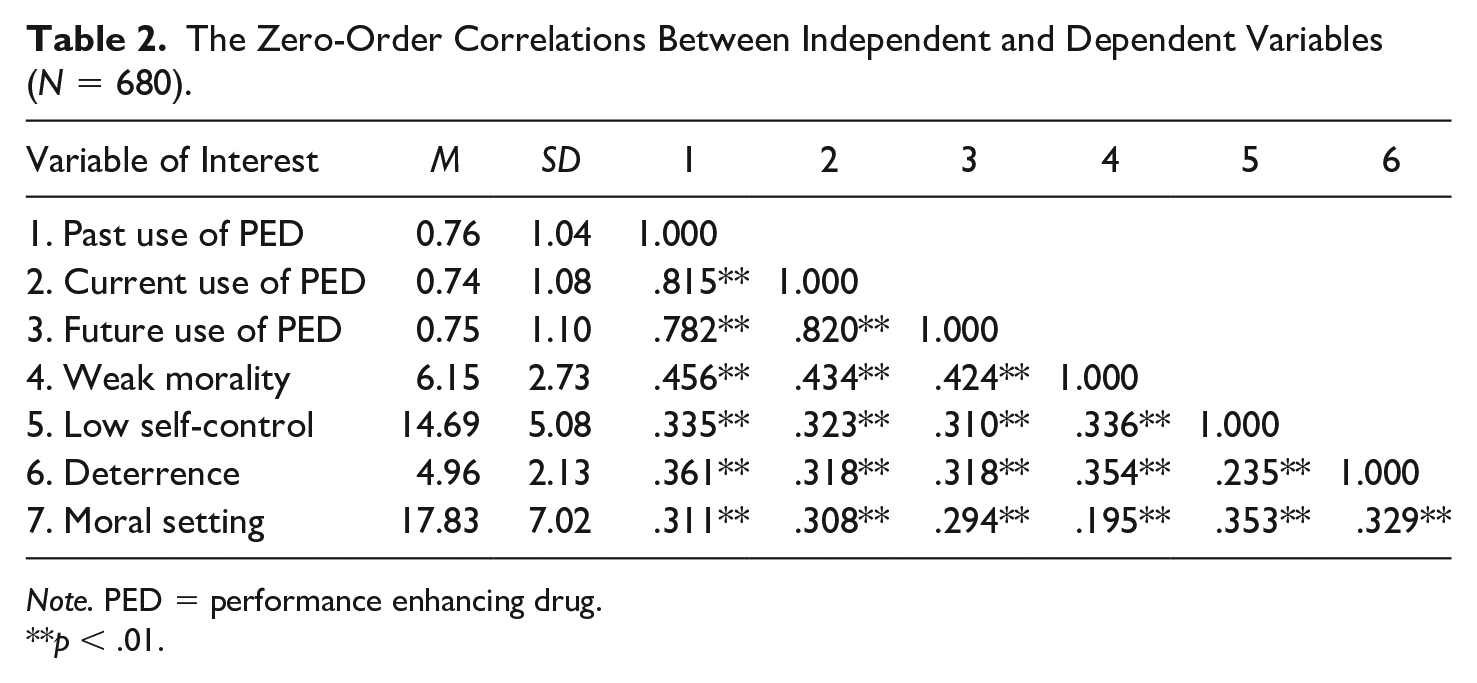
Note. PED = performance enhancing drug.
**p < .01.
Table 3 presents findings from three OLS regression models. Model 1 examines the independent effects of crime propensity and criminogenic exposure on past, current, and future doping behavior. The results indicate that both crime propensity and criminogenic exposure increase athletes’ involvement in doping at all three time points. More specifically, crime propensity is predictive of past (b = .007, p < .01), current (b = .007, p < .01), and future (b = .007, p < .01) PED use. Similarly, criminogenic exposure is predictive of past (b = .004, p < .01), current (b = .004, p < .01), and future (b = .004, p < .01) PED use.
Ordinary Least Squares Regression Predicting Professional Athletes’ PED Use (N = 680).
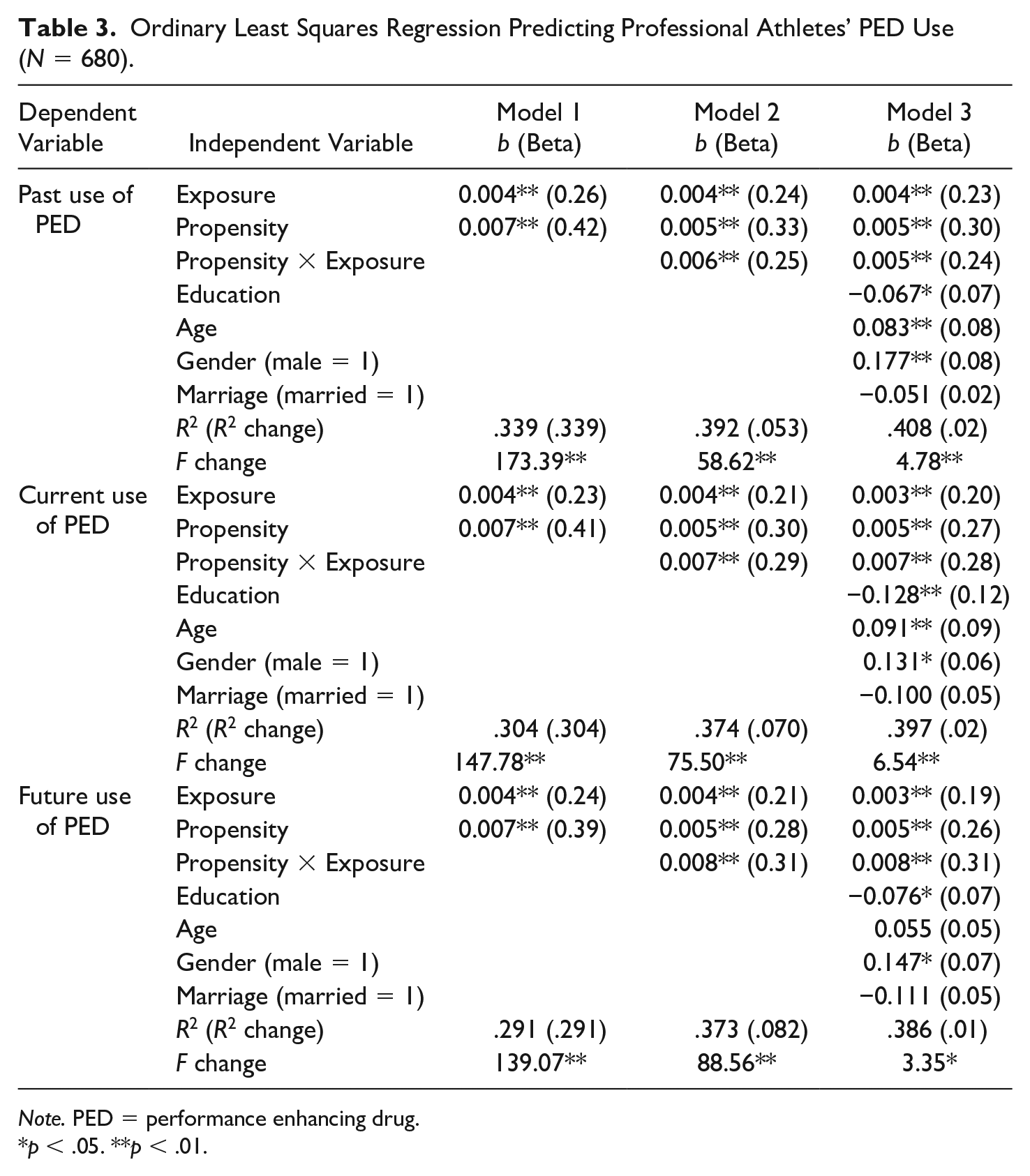
Note. PED = performance enhancing drug.
p < .05. **p < .01.
In Model 2, the product term capturing the interaction between crime propensity and criminogenic exposure is introduced. As previous researchers (Cochran, 2016; Hirtenlehner & Hardie, 2016; Hirtenlehner & Treiber, 2017; Svensson, 2015; Wikström, 2009) have predicted, and found, that propensity to commit crime moderates the effect of criminogenic exposure on deviant behaviors, such as doping, interactions between crime propensity and criminogenic exposure were created and then explored. More specifically, a mean-centered multiplicative interaction term was calculated for crime propensity and criminogenic exposure and added into the model. The interaction term is significant and in the anticipated direction. In other words, the interaction of crime propensity and criminogenic exposure increases athletes’ engagement in past (b = .006, p < .01), current (b = .007, p < .01), and future (b = .008, p < .01) PED use. This indicates that the influence of criminogenic exposure on doping behavior is dependent on the strength of one’s moral values and capacity for self-control (propensity to commit crime). In addition, the inclusion of the interaction term increases the model’s predictive power for all three time periods.
Finally, in Model 3, we introduce demographic variables to assess whether known correlates of deviance are significant predictors of doping behavior when the key theoretical variables derived from SAT are presented in the same model. Although crime propensity, criminogenic exposure, and the interaction term remain significant when control variables are added into the model, some of the control variables also attain statistical significance. For example, education, age, and gender are predictive of past and current PED use, whereas education and gender are predictive of future PED use. Therefore, we do not find support for our final hypothesis that variables derived from SAT will render other known correlates of deviance non-significant.
Discussion
Use of PEDs present a unique problem for compliance enforcement agencies (e.g., WADA and IRANADO). This behavior has a long history and moderate to high prevalence rates (de Hon et al., 2015; Yesalis & Bahrke, 2002). As such, doping has become ingrained in the culture of many sports. Furthermore, PED use can be challenging to detect and, when detected, is under-enforced (Dimeo & Møller, 2018; Pound et al., 2013). It can also vary in its criminality depending on the substance of use and the athlete’s athletic affiliation. These challenges underscore the importance for furthering the understanding of PED use.
Considering the variation in criminality of PED use, SAT provides an applicable framework as it explains moral actions, which covers any violation of any set of rules (Wikström, 2010). The theory proposes multi-level interactional relationships among self-control, morality, temptations/provocations, and deterrence. On the base level, these elements interact to produce one’s perception of action alternatives, choice, criminal propensity, and criminogenic exposure, which interact to explain the moral action. These interactions are either person- or place-dependent. As the theory proposes to understand moral action by considering the type of person in the type of setting, these multiple interactions attempt to explain how these variables can collectively explain moral action (Wikström, 2004). For instance, an individual’s criminal propensity is determined by the person’slevels of morality and self-control. Exposure, on the contrary, is an interaction of the moral context of the environment and deterrence, which together determine the influences of the setting. These components then interact to influence behavior and selection of choices (Wikström, 2010).
In regard to the current study, we find that both crime propensity and criminogenic exposure increase professional athletes’ past, present, and future doping behavior. Specifically, regarding crime propensity, the summated measure, which includes low self-control and weak morality, increases PED usage. Given the pressures of being a professional athlete, this finding makes sense. With increased propensity to use PEDs, the pressure to perform well would likely be enough to sway an athlete to dope. Future research is needed on the external pressures of athletic performance and how these may affect propensity to use banned PEDs.
Similarly, tenets of SAT propose that a setting’s criminogeneity depends on its moral context, which involves the moral norms of the environment and morals of others, such as peers. Use of PEDs proves to be no different from other criminal and deviant behaviors affected by moral context and peer influence. Perhaps athletes are especially prone to the effects of their setting because they are so ingrained in the culture. For instance, athletes often spend considerable time with their teammates and coaches at practices, games, traveling, and socializing. This team culture serves to isolate athletes from non-athletes and may then falsely bolster the idea that certain behaviors are normal or acceptable, such as doping. In the same vein, if these athletes see others using PEDs without repercussion, their perceptual deterrence will be affected. In other words, if athletes see other athletes doping without getting into trouble, they are less likely to be deterred by possible punishment for engaging in that behavior.
In addition, as suggested by Wikström (2010), we find the interaction between crime propensity and criminogenic exposure interacts to increase athletes’ doping behavior at all three time points. The addition of the interaction term also increases the model’s predictive power. In other words, by adding the interaction term, we are able to explain more of the variation in PED use among professional athletes. In contrast to SAT, and our final hypothesis, known correlates of deviance still have an effect when SAT variables are included in the model. Specifically, education, age, and gender are predictive of past and current PED use, whereas education and gender are predictive of future PED use. Those who are older, male, and less educated were more likely to report past and current PED use, whereas those who were less educated and male were most likely to anticipate doping in the future.
Although we hypothesized that crime propensity and criminogenic exposure would render other, non-theoretically driven, variables non-significant, the results presented in Model 3 are not surprising. It is known that males are more likely than females to use PEDs (Leifman et al., 2011). In addition, it has been reported that the typical anabolic steroid user is over the age of 25 (Westerman et al., 2016). Additional correlates of PED use, in a study conducted by the Mayo Clinic in the United States, are an above average income and a formal education beyond high school (Westerman et al., 2016). Therefore, it is not clear why athletes who use PEDs are less educated than their non-doping counterparts. It is possible, and even probable, that our unique sample of professional Iranian athletes simply differs from the general American population. Understanding how the correlates of PED use differ among certain subsectors of the population is crucial for the development of successful policy.
For example, results from this study suggest that policy should target older males. In addition, increased education seems to be a protective factor for our sample of professional Iranian athletes. Therefore, it may prove beneficial to center policy around increased education rather than the current deterrence-based model. Informing athletes of the dangers of PED use could curtail their doping behavior. In addition, by educating younger, amateur-level athletes, it is perhaps possible to curtail future professional athletes from using banned substances. However, it is worth noting that anabolic steroid users demonstrate sophisticated pharmaceutical knowledge and understand the risks of doping (Perry et al., 1990). Nevertheless, decreased social acceptance, achieved through educational training, could decrease one’s propensity to use PEDs. In addition, if athletes view doping as morally wrong, and are deterred through fear of shame, it will decrease their criminogenic propensity, thus decreasing their doping behavior.
Although the current study can be useful in guiding policy aimed to mitigate PED use among professional and aspiring athletes, it is not without noteworthy limitations. First, the unique nature of our sample limits external validity. Correlates of PED use among professional Iranian athletes may not be generalizable to other populations. Contrarily, examining the predictive ability of SAT variables on professional athletes expands the scope of the theory and provides additional data points for policy makers. Although the variables derived from SAT were found to influence athletes’ PED use, we were unable to conduct a full test of the theory. To conduct a complete test of the theory, we would need macro-level data that we simply do not have access to at this time. In addition, our survey instrument was not ideal. We asked about past, current, and future PED use. It is possible the subjects were unable to recall past use, unwilling to disclose current use due to fear of sanction, and unaware of future situations that may prevent or encourage doping behavior. This limitation, however, is common in survey research. Finally, we would have preferred to have more control/demographic variables to add into the model. Unfortunately, this was not possible due to data limitations. Future research should attempt to address these concerns.
Footnotes
Declaration of Conflicting Interests
The author(s) declared no potential conflicts of interest with respect to the research, authorship, and/or publication of this article.
Funding
The author(s) received no financial support for the research, authorship, and/or publication of this article.
