







Abstract
This article addresses key issues of sport mega events’ social and educational legacies. The rhetoric of the “legacy” of mega events has been imprinted in every bid presented to different countries and cities to influence their decision whether to host or not this type of event. Visible and also intangible effects are often cited as part of the “legacy” packaged to convince host citizens to adhere to the events. In the past few decades, several studies have been questioning the “legacy” rhetoric, presenting data demonstrating that despite the positive outcomes implied in the concept, these events often cause major impacts in the lives of host countries through several dimensions that cannot be painted with a “positive” tone. This study aims to analyze the educational legacies left by the 2014 FIFA World Cup (WC) in Porto Alegre, capital city of the Brazilian Southernmost state of Rio Grande do Sul. We gathered data using participant observation methodology, surveys, and interviews with inhabitants of communities affected by the WC works. Our data reveal that the lives of public schools, students, and families in the region affected by the event were severely disrupted by the WC works without neither the Local Organizing Committee nor the local authorities offering adequate compensation or plan to alleviate these communities’ damages. We conclude by arguing that the WC has provoked a negative educational impact over communities that were already socially disadvantaged and most in need of good functioning of their schools.
Introduction: The Legacy Rhetoric, Education, and the 2014 World Cup
The “legacy” rhetoric has been accompanying sports mega events since at least the beginning of the 21st century, even being included in official documents as the Olympic Charter (International Olympic Committee [IOC], 2013). Federal, State, or local governments as well as national and international organizing committees of sports mega events such as the Olympics, the football World Cup, and continental sports events have been using the “legacy” propaganda to broadcast all the positive effects that sports mega events arguably can bring to the hosting communities (Cornelissen et al., 2011; Horne, 2015; Horne & Manzenreiter, 2006; Müller, 2015; Stewart & Rayner, 2016).
The presumed legacy is many times planned and announced as macro and very visible effects in the host cities and, in some cases, countries, such as new “state of the art” sports facilities that are built for the events, improvements in airports and public transport, and jobs that are potentially created for the event (Bond & Cottle, 2011; Coaffee, 2013; Davies, 2012; Gammon, 2015; Minnaert, 2012). The so-called boost in the local economies via tourism and related activities is also listed in the “legacy” package delivered by sport mega events. In addition, the 2012 London Olympics have framed its legacy rhetoric particularly through the potential raise in its citizens’ engagement in physical activity as the Games would act as a catalyst for this increase (Girginov & Hills, 2008; Weed, 2013). The 2014 World Cup and the 2016 Olympics and associated actors, in turn, invested in a discourse of social and historical justice (Aquino, 2009; Graeff et al., 2018; Maranhão, 2009).
The legacy rhetoric is also claimed in other different and not-so-visible dimensions, such as the cultural and historical aspects of the mega events (Cornelissen, 2007) and the massive international visibility that the hosts will receive during the events, which can lead to the understanding that “an unmediated mega-event would be a contradiction in terms” (Horne & Manzenreiter, 2006, p. 2). Other layers, such as the educational legacies, are even used by the IOC in their “Olympic education” framework to lift their legacy propaganda (Carey et al., 2011).
However, recent studies have been questioning the “legacy” rhetoric (Coakley & Souza, 2013; Gaffney, 2013, 2014, 2016; Whitson & Horne, 2006) by stating that the concept of “legacy” implies some sort of positive outcome. Nonetheless, according to Tomlinson (2014), these events cause a major impact in the lives of host countries through several dimensions that have numerous levels that cannot be painted with a “positive” tone.
Major negative impacts of sports mega events can be seen in the recurrent removal of thousands of generally vulnerable people from their precarious housing to make way to the events circuses (Schausteck & Graeff, 2016) and all the human rights violations associated with these removals (Hall, 2006; Hiller, 2000).
Other macro- and negative impacts of sports mega events are demonstrated in the low level of accountability and transparency in which local organizing committees operate, making room for the misuse of millions of tax payers’ resources (Barclay, 2009; Crompton & Howard, 2013; Matheson, 2006). Nevertheless, Mackintosh et al. (2015) argue that if we want to understand the full “legacy” of a mega sports event over a country or a city, it is crucial to consider a micro-level analysis that allow researchers to examine the extent of the impact of the event in the everyday lives of local citizens.
In this article, in turn, we look at a usually micro- and nonvisible impact of a sport mega event: its relationship with access to public education (Burnett, 2017; Kohe & Bowen-Jones, 2016). We analyze how the 2014 Brazil World Cup affected not only in students but also teachers, families, and school communities in the city of Porto Alegre.
Considering the ongoing struggles and lack of funding that Brazil’s public educational systems go through, we ask, “Did the 2014 World Cup provoke changes in access to school in areas affected by its works in the city of Porto Alegre?” “Did the 2014 World Cup influence the number of educational institutions in areas affected by its works in the city of Porto Alegre?” “Did the 2014 World Cup foment interruptions in school procedures and routine in areas affected by its works in the city of Porto Alegre?” and “Did the 2014 World Cup had influence over students having to change schools or dropping out school in areas affected by its works in the city of Porto Alegre?”
Our aim is to look beyond the “legacy” rhetoric and to analyze the everyday life of the people from Porto Alegre, one of the 2014 World Cup host cities, in regard to their right to access public education and how this right has been affected by the World Cup.
We start discussing how education is regarded within the mega sports events field. We then offer a brief overview of the educational systems in Brazil and Porto Alegre and summarize how Porto Alegre has become a host city for the 2014 World Cup. Then, we present the results of an extensive survey collected with the citizens of Porto Alegre communities affected by the event, with an emphasis in the impact to the educational sector that has occurred during the 2014 World Cup. The survey was complemented with in-depth interviews. We finally argue that the World Cup has disturbed the lives of families that were already socially disadvantaged and most in need of good functioning of their schools. The World Cup works in Porto Alegre have clearly provoked a negative educational impact over communities that had their children’s right to access public education interrupted by the World Cup works.
Mega Sports Events and the Right of Education for Local Communities
Education is not a major theme in the field of sport mega event studies, nor a principal focus of sport mega events’ owners, promoters, organizers, sponsors, and broadcasters. It can be considered that the Olympic movement’s initiatives to foster Olympic Education are the most present and numerous, and also the most criticized set of actions related to education in the field (Armour & Dagkas, 2012; Lenskyj, 2012). However, governments tend to include educational initiatives within sport mega events’ bids and marketing these initiatives together with the bids and/or events, and Brazil 2014 (and Rio 2016) was not different (Knijnik & Tavares, 2012).
A nearer examination at the separation between intentions and actions of mega sports events’ promoters reveals that the presumed importance of the educational mission of the Olympic Movement, for instance, is grounded on a vague vision of the edifying meaning of sport. However, neither the IOC nor FIFA is an educational institution. Hence, it is not surprising that a scrutiny of the reports made by their officers and local coordinators in a range of mega sports events exposes that the matter of “education” in fact takes only a minor amount of pages and is just a minor supplement of all activities of mega sports events’ organizers (Knijnik & Tavares, 2012).
The educational impact that mega sports events have on educational fields that arguably are connected to the events, sport, and physical education participation is also controversial. Studies have demonstrated that after the major enthusiasm generated by the events, most of the time the inspiration vanishes and levels of engagement in sports tend to lower (Kohe & Bowen-Jones, 2016). Researchers also report that teachers express continuing distress with the enforcement of legacy requirements on their everyday teaching practices (Armour & Dagkas, 2012).
Nevertheless, the World Cup in Brazil has influenced, even if temporarily and indirectly, the pedagogical practices of educators and schools, ubiquitous new developments, traffic interruptions, stadiums, and nonstop media exposure. Teachers quickly realized that the World Cup would assault every domain of their and their students’ lives. They knew that they needed to bring these day-to-day problems and dares connected to the World Cup to their classrooms (Malta & da Silva, 2012). They planned to mediate their learners’ apprehension and excitement with the international tournament by using the event to help students to further engage with their education process. A large proportion of physical educators hence used the World Cup as a chance to involve their students in quality and authentic learning situations that helped them to critically reflect on several topics related to the World Cup, from the game of football and its tactics to social issues and the history of the event (Knijnik, 2018).
Even when such educational initiatives have not existed, sport mega events exert such an influence among people of school age that effects on education would probably have been noticed anyway.
Educational Context in Brazil and in Porto Alegre: A Difficult Reality
Brazil is a continental country with more than 200 million residents, henceforth its massive education system. According to the 2012 national educational statistics, there are approximately 193,000 schools, where more than 50 million students are enrolled in the elementary obligatory education years—Grades 1 to 9. About 84% of students attend public schools, and 16% are in private schools. Municipality schools account for the majority of the public school enrolments (about 60%); Brazilian state schools account for 37% of public-school enrolment, whereas just a few attend federal public schools (Cury, 2002; Dourado, 2007).
The situation of the educational sector in Brazil is a delicate matter. The recent years have been marked by the influence of transnational agencies, such as the World Bank and the International Monetary Fund (Coraggio, 1996; Leher, 2005; Silva & Sguissardi, 2005; Torres, 1996). These transnational agencies have persuaded governments to put in place policies of privatization, and in the basic education level, there was a shift from a mainly state educational system to a more corporative-oriented set of schools (Sécca & Souza, 2009). Also, although the dimension of the lack of schools and the amount of students delayed in their school formation cannot be highly accurate, there is a common belief that the Brazilian educational budget is significantly lower than what is necessary to meet the educational needs of millions of children (Cury, 2002; Dourado, 2007).
The City of Porto Alegre educational system is mainly concerned with Fundamental Education, as per its constitutional attributions, but it also encompasses Pre-schooler Education, which is gradually becoming the responsibility of Brazilian municipalities. The conditions of buildings, materials, number of teachers, and students per room are similar to those of the state and federal systems as soon as they respect the same set of legislations. However, the municipalities struggle in terms of funding, once their budgets are limited, excluding exceptions, in which Porto Alegre is not in this case. Research has been demonstrating that the level of education in municipal schools in Porto Alegre has been declining. For example, there are indications that aspects associated with work conditions and relationships can lead to the emergence of multidimensional factors that, depending on the degree of severity, may lead teachers to experience the burnout syndrome (Santini & Neto, 2005). There are also indications that teachers have significantly felt the limitations of their working conditions and the intensification of their teaching activities in recent times (Wittizorecki & Molina Neto, 2005). Farias et al. (2015) also noted that among the lowest rates of satisfaction of teachers of physical education in the municipality of Porto Alegre are the dimensions of remuneration and working conditions. Thus, the educational systems of Porto Alegre are suffering the already well-known pressures of the sector in the Global South, especially in this phase of development of neoliberalism.
Porto Alegre and the Brazilian World Cup Bid
Brazilian authorities presented the bid to host the 2014 World Cup in early 2007. The then-Brazilian president, Lula da Silva, supported the bid all the way through, and the Brazilian government signed declaration included in the bid. A total of 18 Brazilian cities were accredited as potential hosts for the event (AGENCIA PLACAR, 2007, emphasis added, n.p).
Porto Alegre, the fourth-largest city of the country, with more than 1,500,000 inhabitants, was one of these 18 cities. The city became internationally acknowledged when hosting the first World Social Forum in 2001, which led to a “spring” of participatory policies that bloomed in Porto Alegre in the early 2000s (Seoane & Taddei, 2002), being the most notably policy the “Participatory Budget” (de Sousa Santos, 1998) that served to defy Brazil’s “long tradition of authoritarian politics” (p. 462).
Notwithstanding, the shift from participatory forms of governance to a more corporate approach that can be provoked by sport mega events and “megaprojects” could modify the design of Porto Alegre’s urban spaces and political inclinations, claims Soares (2013).
In October 2007, Brazil was finally chosen as the official host of the 2014 World Cup. Following negotiations with local political powers, 12 host cities were selected—even with FIFA requiring no more than eight cities to host the event. Porto Alegre was one of these 12 cities. On that period, despite the continuous social grievances that affected Brazilian most disadvantaged communities, Porto Alegre citizens, as well citizens of other cities selected to hold matches of the World Cup in Brazil, seemed happy to host the mega event (Damo & Oliven, 2013).
Method
To provide a certain degree of certainty and ensure enough statistical force to our sample—without misplacing scarce recourses (Miller & Salkin, 2002)—we have randomly chosen (Gratton & Jones, 2010) residential units that were affected by the 2014 World Cup works in Porto Alegre to be our main source of information (research universe). The area affected became known as “Avenida Tronco [Tronco Avenue] construction area,” and gathered four different neighborhoods. This area is close to the Beira Rio Stadium, home of the World Cup games in Porto Alegre, but more importantly, it is the area where the Tronco Avenue construction works are concentrated. Thus, when the research was carried out, we found a population already tired of the World Cup (Damo & Oliven, 2013), due to the various problems that the event had caused. Just to justify this information, at the time of the final writing of this article (April 2020, nearly 6 years after the event), the works of the Tronco Avenue had not yet been completed.
The conventional margin of error was 5%, and the confidence level was set at 95%. A part (p) of the population that is thought to have the features scrutinized was valued at .5 (50%), which is the conventional supposition regularly acknowledged when this variable is unknown (Rea & Parker, 2014). The value of the Z-test for an alpha of .05 significance level is 1.96 and q is defined as 1 − p. Thus, for a restricted universe, the population N was the only variable left to be determined, to calculate the sample size from (Cochran, 1977).
Using Google Earth™ as a topographical instrument, it was then probable to outline the breadth of the geographic universe and to recognize the guess number of dwellings comprised in the study area. The results have shown 3,645 households in the district. Bearing in mind the sample size resulting from the application of the formula above (Cochran, 1977), it was demarcated that 134 households needed to be visited, which left us with a number of one of each 27 houses to be approached. Subsequently, one of each 27 houses were marked on the Google Earth™ file, from the east limit of the map to the west limit of the map, mimicking a counterclockwise tread. Every time the walk would stop at a dead end, it would resume in the following block where an alike arrangement took place.
The original survey covered seven themes (housing, education, health, security, public sphere performance, employment/economy, and the 2014 FIFA World Cup). The instrument consisted of 50 different pieces of information, between identification information of residents and survey questions. The data collection took place in the first semester of 2015. As it was our intention that the respondents could also inform about residents of their homes, members of their families, and neighbors, the questions were structured so that the answers could reflect collective experiences. Respondents were all of age and interviewed outside their homes. The presentation of the data below assembles answers to eight questions about education in the context of the works that took place at the affected community by the 2014 World Cup. In addition, excerpts of interviews support the construction of the presentation of the data. In January of 2018, we revisited the area and chose seven (5%) of the survey respondents to be interviewed. The interviews were semi-structured, respecting the themes of the survey done in 2015. We initially selected 10 survey respondents from different areas of the construction of Avenida Tronco as potential respondents. We selected these 10 people based on the number of notes taken from their comments in the survey forms performed in 2015, what we thought was an indication that they would be willing to participate in the research again and that they would have relevant research information to share. Then, afterward, seven were selected to effectively compose the sample of respondents. Of the three people excluded, two no longer lived at the addresses we had, and one person had died. The analysis of the interviews was carried out from the thematic analysis (Gavin, 2008; Guest et al., 2011).
Results
Several different actions can be linked to the relationship between the World Cup and education in the city of Porto Alegre. Although, apparently, many nonplanned outcomes can be also listed to explain such a relationship.
The Municipal Secretary of Education of Porto Alegre, for example, organized the 5th Solidarity Gincana 1 with the theme “2014 World Cup: knowing for welcoming” between April and August of 2014 (SMED, 2014). 2 The tasks of the Gincana involved various disciplines of the school curriculum as well as aiming to show aspects of the cultures of the countries that would play in Porto Alegre during the event. Thus, it can be noticed that the connections between the World Cup and education in the city of Porto Alegre are relatively complex and consequences of the consciously or not, intended or not, interaction of various social actors. Table 1 presents the results of questions about the relations between aspects regarding the area of education and the perception of people affected by 2014 World Cup works under construction in Porto Alegre regarding the issue.
Results on Education.
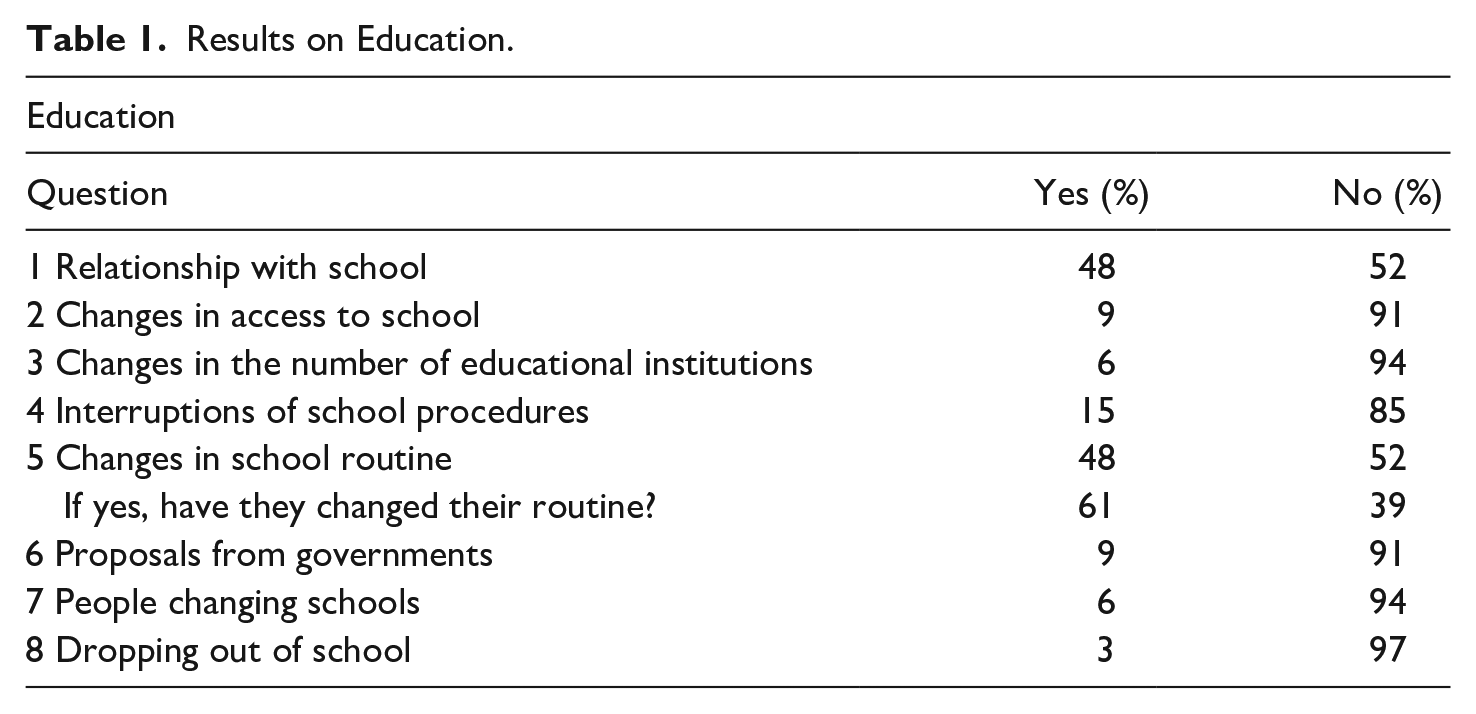
Question 1, “Have you or someone who lives in your house had or has a direct link with school during the period of the World Cup and its works?” aimed at identifying respondents with any association to the educational sector on the period of the event. How it is easily conceivable, not all homes visited during the realization of the survey counted with students, school teachers, or school staff among their residents. To prevent data waste and produce a set of more qualified data, it was decided to differentiate between respondents. This question exists to contribute to such a task. As can be seen, more than half of the houses (52%) have not any relation with the education sector or the school. In the following questions, some responses will be presented considering this differentiation where appropriate.
Question 2, “Were there any changes in access to school (enrolment, transportation, classrooms, number of schools, others . . . ) in the period of the works related to the World Cup?” aims at assessing the perceptions of the respondents in relation to elements around access to education. In response to this question, all respondents who said “yes, there were changes in access to school” were belonging to the 48% of houses with some kind of relationship with the school. Among them, of approximately 70 households, 10 commented that the situation had worsened. The works would have provoked problems relating to the transportation of students (buses could not access certain areas due to the works), teachers’ and school staff’s access to their workplace, and would have forced parents who could bring their children to school by car, making the commute longer, more expensive, and toilsome. For one of the interviewees, even if changes could be identified in relation to education, “. . . there was no progress at all. The schools remained the same, there was no evolution. On the contrary, the complaints continue” (Ariovaldo, January 20, 2018). 3
Question 3, “Have you noticed any changes in the number of educational institutions in the region during the works related to the World Cup?” evaluates the perceptions of the residents of the Tronco Avenue construction in relation to the educational offers in the region. In terms of primary and secondary schools, no changes were perceived in the period in which the area was affected by the 2014 World Cup works. However, a specific community reported that a kindergarten was closed due to the works, leaving several families forlorn. It was apparently an irregular kindergarten administrated by a lady who left the area due to pressures made by the Municipality authorities.
Three years had elapsed between the completion of the survey and the interviews with the respondents. Thus, some things had changed. One of them was reported by Isabel. She said in the interview that she knew of plans for the school in her community to be closed. She also expressed concern that the closing of the school would lead to many problems for the community and specific families. “They’re closing this school up here,” she announced. According to her, this “is a school that serves children from the periphery,” and as such, the school caters to “children who do not have the money to pay for a bus ticket.” For her, the typical family of a school child in the region is composed of a “father and a mother [who] work outside all day.” “The father is a mason; the mother is a cleaner.” The situation is worrying, according to Isabel, because “these mothers do not have the money to pay [bus fares] twice, three times for the children to go to and come back from school . . .” (Isabel, January 20, 2018). 4
Question 4, “Were there any interruptions of school procedures during the works related to the World Cup?” and Question 5, “Did the World Cup and/or its works caused any changes in school routine? if yes, how?” investigate the perceptions of the respondents regarding what is assumed as some of the most common interferences of sport mega events in the area of education: interruptions of school procedures and changes in school routine.
In terms of access/lack of access to educational facilities and other types of disruptions in school procedures, 15% of the respondents reported issues, all of them from houses with residents with links to the school. It is a relevant number, once it can be considered that apart from educational losses, such cases also have a cascade effect on families’ lives. The situation can also be aggravated if it is considered that these kinds of issues tend to be repeated in specific institutions due to their geographical location and to their socioeconomic features. In addition, in some of the cases, issues related to interruptions and difficulties in access can lead to school dropout. For example, in the Maria Imaculada School, it was reported that 10% of the students dropped school activities during the 2014 academic year due to the “confusion caused in school surroundings” (Nunes, 2014, p. 1).
Half (48) of the respondents to the survey that responded to this question reported changes in school routine. Extrapolating, it is possible to say then that half of the children of school age within the communities affected by the World Cup works had their study routine altered at some point. It is also relevant to point out that from the respondents who reported alterations in school routines, 61% felt that their own routine was in turn modified. The most dramatic cases can be described as double losses. First, the student is sent home for some reason (game day, no access to school) and thus he or she misses class(es). Second, one adult must then make room in their schedule to accommodate the unforeseen situation. Many times, it even has a third negative consequence, which is to decrease the family’s budget given that the adult taking care of the student will probably miss work or at least decrease production to some extent. In most cases, students were released from school earlier, which did not imply the loss of a school day, which would be contrary to Brazilian educational laws.
Question 6, “Were there any proposals from governments (Federal, State or local) to changes in education because of the World Cup? If so, what/which?” examines the existence and reach of governmental projects or programs linked to the realization of the 2014 World Cup. The results from this question are symbolic. They reveal that either the governments did not have any proposals that would involve the positive effect the World Cup could have had in the area of education or that they were not able to make the respondents aware of the proposals. Whichever is the case, promoters of the football tournament and governments were apparently missing an important opportunity, if the enthusiastic environment they described in the bidding process and other occasions is considered. It is also problematic that the comments of respondents noted that although the movements of the authorities in this field could be timid, when they occurred, they were permeated by unfulfilled “promises.” Isabel, during her interview, reported that nothing positive was done in relation to education during the period of the Tronco Avenue construction. “If we talk about improvement in education, what has been done? Nothing has been done,” she alleged. In addition, she reported that the number of classrooms in the region’s schools had fallen. Thus, the remaining classrooms had to accept a greater number of individuals, adding to the teacher’s workload, hence negatively affecting the level of learning. Isabel told me passionately that such action was aimed at exploiting the teachers: “to make the most of the teacher, they throw 50 students into a classroom!” (Isabel, January 20, 2018). 5
Question 7, “Did you or someone in your family have to change schools due to the works related to the World Cup?” and Question 8, “Did you or someone in your family drop out of school because of the works related to the Cup?” explore the consequences of the event in relation to continuity of students’ school lives and to permanence in school. While the necessity of changing schools was not frequent during the period researched in the area studied—only 6% of the respondents reported doing so—it is still apparently a significant number of people.
Abandoning school was another outcome of the 2014 World Cup–related works in the region of the construction of the Tronco avenue in the city of Porto Alegre. About 3% of the respondents reported dropouts. This issue certainly deserves more accurate studies, and the impact of sport mega events at the level of student retention at school in the Global South countries also needs to be addressed.
Discussion
The sector of education within the region affected by the World Cup–related works was, according to this research, affected by the 2014 World Cup. Although some of the results relate to specific areas of the region, it can be said that no positive impact in the Porto Alegre educational system could be found. Also, the negative aspects apparently had cascade effects that can be considered to have aggravated educational issues within an already vulnerable region and to have caused problems in other areas. For example, one of the most notable of these effects is how the parents of students felt in relation to the release of their children from school on game days. These absences from school allegedly had a negative ripple effect in families of workers, as the student who misses school often needs to be cared for by an adult. This means that the adult becomes unable to perform their usual labor activity in such period. Furthermore, the lack of planning and communication, for example, made it more difficult for teachers who did not live in the area to access the schools. Thus, they ended up being late and/or reporting absent from the school, again provoking a cascade of effects on students’ and families’ lives. Also, although the number of students that reportedly gave up the academic year or dropped out of school is not high, the consequences may affect such individuals for the rest of their lives.
An additional consequence that may potentially affect students for extended periods is the psychological imbalance that the uncertainties may bring. This may be considered a deeper issue in relation to specific populations. For instance, Marcio, who works in a school for children with special needs, reported that in the school where he works, they had three or four students who had to move to places farther away. The children had to request the transfer of school because those who accepted that value that the DEMHAB [Department of habitation] was giving to buy homes [then] could not [afford to] buy in Porto Alegre.
6
During the period prior to moving, this was a recurring concern expressed by the students, according to Marcio. Students would query teachers asking, “How and what will be my house, what house will I have, or will I be homeless?” 7 (Marcio, March 17, 2018).
Then, the issue of dropping out or transferring between schools appears again but with refinements that can be considered as worrying at least. By removing families that have school-aged members who are considered to have special needs among them, the City Hall and the World Cup development projects may have interrupted their school trajectory. Thus, the Tronco Avenue works may have contributed to the worsening of the conditions of learning of these people and have even placed their families in a precarious situation, as families may be penalized by justice in Brazil if they do not provide school-aged children with access to education. Further research could try and follow real cases, so the consequences of such actions can be better known. Marcio reported that real cases happened. He stated that so many families had to go to the countryside or to the beach. From my [his] school, there was a family that had to go to the beach. They had to start over, the whole family. My school, for example, is a special school.
8
So, it’s very complicated for the families to find a special school in the countryside or the beach, for example . . . (Marcio, March 17, 2018)
Conclusion
In this article, in line with preliminary studies, we note that there is an imperative need to look beyond the rhetoric of “legacy” of mega sports events to clearly identify the impacts—both positives and negatives—that these events cause in the communities where they are staged. Researchers have been presenting data that consistently show the extent of the negative impact that these events have been impinging over the cities and countries that host them: financial distress, relocation of vulnerable population, creation of costly sporting premises that regularly turn up to ‘white elephants,’ lack of further following up with educational enhancements for the population. The list goes on.
Our research looked at a local scenario to present data that contradict the legacy rhetoric in the educational field. Despite the early promises of reforms and improvements, we have shown that among all sectors impacted by the 2014 FIFA World Cup, the educational field has not seen any improvements from the World Cup works; furthermore, the school communities—students, families, and teachers—suffered from scheduling changes, lack of communication, transport issues, locomotion troubles that ended up making those communities’ right of accessible and quality education severely disrupted.
We have described how some students from this region have missed a term or even a year on their education trajectory; our evidence demonstrated how this process led to learners’ school disengagement and even abandonment of their formal instruction. The potential negative outcome of these disruptions is clear for these already socially disadvantaged young people: It might bring further hardship for their employment and life perspectives. Our results clearly indicate that the relationship between the 2014 World Cup and the right to access public education for the communities of the region affected by the works of Tronco Avenue in Porto Alegre can be considered detrimental to the population involved.
Despite the fact that Porto Alegre is the fourth-largest Brazilian capital city of the politically and economically influent Rio Grande do Sul state, we acknowledge that our data cannot be generalizable to other host cities in Brazil. Local contexts need to be analyzed in separate so researchers can have a broader view of the impact that mega sports events have been imposing over their hosts. Nevertheless, our research trajectory shows a clear path that urgently needs to be followed if the academic community wants to understand and also influence the future directions of mega sports events.
Currently, we see a trend around the world where citizens of potential host cities and countries have been rejecting the “honour” of hosting such events (Graeff, 2019); the important work of investigators to disclose the negative impact and the abuse of human rights over the communities affected by the events has clearly influenced this tendency. Our work adds to this body of knowledge and shows that the right of education of youth cannot be overlooked by momentous but transitory events. An agenda of sustainable events that take into account the rights of local people needs to be urgently developed. The right of education must be at the forefront of these discussions.
Footnotes
Declaration of Conflicting Interests
The author(s) declared no potential conflicts of interest with respect to the research, authorship, and/or publication of this article.
Funding
The author(s) disclosed receipt of the following financial support for the research, authorship and/or publication of this article: This work was supported by the Coordination for the Improvement of Higher Education Personnel (Capes) under Grant 99999.001822/2013-06.
