







Abstract
The purpose of this study was to examine violence against women (VAW) in the National Football League (NFL). Since Ray Rice assaulted his partner on video, VAW by NFL players has received more public attention. However, there is little empirical research that examines VAW in the NFL and player suspensions compared to other violations. Data come from a public list of 176 NFL players known to have violated NFL policies from 2010–2019. Four major types of violations were found: VAW included sexual assault, rape, and domestic violence; general violent behaviors included assault or battery; drug-related offenses included substance abuse, alcohol, driving under the influence (DUI's), illegal drugs, and performance-enhancing drugs (PEDs); and minor sports-related infractions included issues such as missing a team meeting. The average number of game suspensions was 4.08 for VAW offenses, 1.75 for general violent offenses, 4.05 for drug-related offenses and 1.88 for minor infractions. We found no differences in the number of game suspensions for drug-related offenses compared to VAW; general violent offenses had even fewer suspensions. These numbers are contradictory to the NFL's Personal Conduct Policy of a 6-game suspension without pay for VAW and general violence.
Keywords
Since Ray Rice assaulted his partner on video in 2014, violence against women (VAW) by National Football League (NFL) players has received public attention and concern (Martin, 2017). Most of this attention comes from sports journalists or legal experts, while little empirical research has investigated VAW in the NFL and whether the NFL holds players accountable as compared to other violations. NFL commissioners have been questioned many times due to their lack of player discipline in relation to VAW (Lee & McFarlin, 2016). For example, the current commissioner of the NFL, Roger Goodell, was highly scrutinized after the handling of the Ray Rice case. Rice received only a 2-game suspension, and later after public backlash, Rice was indefinitely suspended from the NFL. However, the conviction was overturned at the hands of a retired judge who heard Rice's appeal case (Lee & McFarlin, 2016). Additional questions emerged regarding how Roger Goodell handled other cases, which involved lighter punishments with more popular players (Lee & McFarlin, 2016).
Theoretical implications for VAW can be derived through the social ecological model (Bronfenbrenner, 1979), which uses the lens of multiple factors to explain perpetration, such as individual, interpersonal, community resources/environment, policies and society. In sum, VAW is a multilevel problem. First, starting at the societal level (i.e., macrosystem), VAW is a problem in the United States with rates of 1 in 4 women reporting victimization (Bureau of Justice Statistics, 2019). In comparison, research that assesses sexual and physical assault perpetration is less common, with wider definitions of assault, and ranges between 11 to 57% of men reporting some form of sexual or physical aggression (Abbey et al., 1998, 2001). Several studies have found that athletes have higher rates of violence against women compared to men in the general population (Johnson et al., 2008; Miller et al., 2006). However, research has been limited because VAW is one of the most underreported crimes due to the stigma given to rape victims and the victim blaming that occurs once a crime is reported (National Sexual Violence Resource Center, 2015). One study indicates that the NFL is known to be a violent sport and is often associated with perpetrators of violence against women (Dabbs, 1998). Currently, there are no publicly available data that provides rates of VAW by player or even league affiliation; especially since the MLB (Major League Baseball), NBA (National Basketball Association), and NHL (National Hockey League) only instituted VAW polices after the Ray Rice incident (Skrbina, 2018). Thus, the data on VAW in major league sports are limited.
Next, societal and cultural factors may influence male entitlement and masculinity, which has been found to be linked with aggression and dominance (Heise, 1998). At the policy and community levels (i.e., exosystems), any player convicted of a crime or pending prosecution are susceptible to discipline from the NFL. And lastly at the interpersonal and individual levels (i.e., microsystems) related to perpetration, nearly two thirds of VAW are perpetrated within romantic relationships (Allsworth et al., 2009). Marital and relationship conflict, use of alcohol, male control of wealth and dominance (Levinson, 1989), as well as familial relationships (i.e., witnessing parental violence; child abuse) have all been linked to VAW (see Heise, 1998; Hotaling & Sugarman, 1986).
Using the social ecological framework, the current study examined VAW in the NFL and whether players received fewer game suspensions compared to other violations. First, we review the League's Conduct Policies in regards to drug-related offenses, minor infractions, general violent behaviors, and finally VAW.
NFL Conduct Policies
The NFL has conduct policies for a variety of topics including minor team infractions, drug and substance abuse, violent behavior towards other individuals including those who are domestic partners, family members, children, and other vulnerable persons. These policies are listed in a variety of documents including the Collective Bargaining Agreement, the Uniform Player Contract, and the Personal Conduct Policy. The NFL uses these documents to give players guidelines of what they can and cannot do on and off the field. These documents also list out the steps to be taken by the National Football League if any policy is violated.
The National Football League Collective Bargaining Agreement (NFL-CBA) is an agreement between the league itself and the union of players. This agreement states the terms of the contracts for employment between the league and the player. This agreement specifically states the disciplinary actions that are to be taken by the league. The CBA is represented in the Uniform Player Contract. This also contains terms for employment by the NFL and details the benefits and salaries for signing a contract with the NFL. The League Constitution contains the role of the commissioner and also states by-laws to specify the commissioner's power.
According to the Policy on Performance-Enhancing Drugs from the NFL Players Association, for a first offense, the player will receive a 2-game suspension for diuretic or masking agent, 4-game suspension for stimulant and anabolic agents, and a 6-game suspension for a positive test result on a prohibited drug along with a masking agent that was used to cover up drug usage. The player's second offense will result in a 10-game suspension. The third offense leaves the player suspended for at least two seasons, subject to appeal. The NFL's drug policy is a very simple three chance policy. Each repeated suspension leads to a longer suspension period. Bennett (2013) discovered that some players were still paid during these suspensions even when they were not playing. Through this policy, players still receive large paychecks even though the paychecks are only a fraction of their regular pay. Bennett (2013) suggests that the NFL use a harm reduction alternative including group meetings or league-appointed therapy which may help lower the penalties given to players for misdemeanor drug use.
According to the Personal Conduct Policy from the NFL, any player convicted of a crime or pending prosecution are susceptible to discipline from the National Football League. Prohibited behaviors include:
“Actual or threatened physical violence against another person, including dating violence, domestic violence, child abuse, and other forms of family violence; Assault and/or battery, including sexual assault or other sex offenses; Violent or threatening behavior toward another employee or a third party in any workplace setting; Stalking, harassment, or similar forms of intimidation; Illegal possession of a gun or other weapon (such as explosives, toxic substances, and the like), or possession of a gun or other weapon in any workplace setting; Illegal possession, use, or distribution of alcohol or drugs; Possession, use, or distribution of steroids or other performance enhancing substances; Crimes involving cruelty to animals as defined by state or federal law; Crimes of dishonesty such as blackmail, extortion, fraud, money laundering, or racketeering; Theft-related crimes such as burglary, robbery, or larceny; Disorderly conduct; Crimes against law enforcement, such as obstruction, resisting arrest, or harming a police officer or other law enforcement officer; Conduct that poses a genuine danger to the safety and well-being of another person; and Conduct that undermines or puts at risk the integrity of the NFL, NFL clubs, or NFL personnel” (NFL, 2016, p. 2).
As a result of breaking one of these guidelines, the player is subject to leave with pay, an opened internal investigation, and discipline is given in the form of suspension. In the NFL's Personal Conduct policy, they clearly state that any violent act, including those towards domestic partners, family members, and children is punishable by a minimum of 6-game suspension with leeway for any factors that may have influenced the violent act (NFL, 2016). One of the factors that is taken into account is if the incident took place prior to the individual signing with the National Football League. It is also important to note that if the player receives another criminal charge or is facing another prosecution, they are suspended indefinitely, however, they can appeal after one year and there is no guarantee if the appeal will be accepted.
The NFL's policy for conduct ranges from missing a team practice all the way to assaulting an official on the field. These types of incidents are punished with either a fine or a suspension for a portion of the season (NFL Collective Bargaining Agreement, 2020). According to the official website for NFL Operations, physical contact with an official is punishable by a initial fine of $35,096 and if there is a second offense the fine is $70,194; this is identical to the policy for on-field fighting as well (NFL Football Operations, 2020). The second most expensive fine is for verbal aggression toward an official, which results in an initial fine of $28,075 and a fine of $56,156 for a second offense (NFL Football Operations, 2020). For violation of player safety rules or a personal foul, the fines range from $10,000 to $20,000 for the first offense and $15,000 to $40,000 for a second offense (NFL Football Operations, 2020). Fines can also be given for a player's uniform with a maximum fine of $10,000 for first offense and maximum of $20,000 for a second offense (NFL Football Operations, 2020). The only stipulation that has no concrete fine or suspension is gang signing during a game. This can result in both a suspension and/or fine depending on how severe the incident was (NFL Football Operations, 2020).
NFL and Violence Against Women
In recent years, the NFL has had an increasing number of cases involving disciplinary matters and off-field offenses (Staffo, 2013). Media attention and public have pressured the NFL to implement strategies that effectively control the problem of violence against women (Dabbs, 1998). In the 1990s, the NFL was the only professional sports league with a written formal policy for addressing players accused or convicted of domestic violence or sexual assault, but there were very few instances in which the League enforced this policy (Janusz, 2012). Updated in 2007, the NFL Personal Conduct Policy: “With regard to violations of the Personal Conduct Policy that involve: (i) criminal assault or battery (felony); (ii) domestic violence, dating violence, child abuse and other forms of family violence; or (iii) sexual assault involving physical force or committed against someone incapable of giving consent, a first offense will subject the offender to a baseline suspension without pay of six games, with consideration given to any aggravating or mitigating factors” (p 6–7). The NFL Personal Conduct Policy states that a player's first offense of domestic violence, assault, battery, or sexual assault is a 6-game suspension, subject to change due to mitigating factors. The second offense results in the player being banished permanently by the NFL. However, the stipulation that the suspension can be altered does not specify whether the commissioner can decrease the length of suspension (National Football League, 2016). Further, the policy does not require the NFL's commissioner to prove that a player committed misconduct under either the criminal standard of beyond a reasonable doubt, or even the lesser civil burden of preponderance of evidence (refer to Janusz, 2012). The discipline may be imposed whenever a player's misconduct is found to be detrimental to the integrity of the League, which is left to the commissioner's discretion.
In comparing VAW to other offenses, Martin (2017) found that the average suspension rate for a PED offense was similar to that of violence against women. In some cases, players received a more lenient suspension for violence against women than a first time PED offense. As noted earlier, the NFL requires a minimum of 6 games suspension in their policy for violent offences. However, some cases that involved violence against women only included a two to four game suspension. Thus, this minimal reaction has brought the NFL's handling of VAW cases into question (Martin, 2017). According to Martin, the conviction rate for the general population in relation to domestic violence is 77%, however for professional sports players, this rate is only a rate of 36% of players being convicted. Almost half of the violent offences that occurred at the hands of NFL players pertained to violence against women, compared to the general public of only 21%. Most alarming was the fact that 48% of NFL player arrests were on the basis of domestic violence (Martin, 2017).
Building off of Martin's study, our study focused on two research questions: (1) What is the prevalence of VAW among NFL players (inclusive of rape, domestic and dating violence, and stalking)? and (2) Are there differences in game suspensions for VAW as compared to other violations, including minor sports-infractions, general violent behaviors, and drug-related offenses?
Method
Data were derived from a public list of 176 National Football League (NFL) players known to have received game suspensions in the time period between 2010 and 2019. First, using Google internet to search NFL violations, a team of researchers (including the authors) created a database that housed player information, violation, number of games suspended, and other pertinent information that could be derived from the public websites. The lists of player and suspension information were collected from ESPN news, Denver Post, Pro Football Talk, NFL.com, USA Today and the New York Times. Institutional Review Board approval was deemed unnecessary as all data were archival. We categorized four major types of violations based on our findings: Acts of violence against women (included sexual assault, rape, and domestic violence); general violent behaviors (included assault or battery); drug-related behaviors (included alcohol, driving under the influence, illegal drugs, and performance-enhancing drugs); and minor sports-related infractions (included missing a team meeting). We analyzed the frequency of offenses that were committed by NFL players and also the average length of suspension time for the four offense categories
Results
First, we examined the data using descriptive statistics, including frequency of violations, and the average length of suspensions. Suspension lengths ranged from 0 to 16 games, with an average of 2.85 games (SD = 3.32). As shown in Figure 1, there were fewer player cases involving minor infractions (n = 24) and VAW (n = 25), with many more cases involving drug-related offenses (n = 57) and general violent behaviors (n = 70). Thus, VAW accounted for 14% of the NFL player violations over the past 10 years. To analyze our second research question, we used an ANOVA that examined the number of games suspended by the type of violation. The suspension game length differed significantly by the type of violation (F(3,171) = 7.61, p < .001), indicating that VAW offenses received 4.08 games (SD = 4.09) on average suspension compared to violent offenses (M = 1.75, SD = 2.37), drug offenses (M = 4.05, SD = 3.93), and minor infractions (M = 1.88, SD = 1.42); refer to Figure 2. There were no differences in game suspensions for drug-related offenses as compared to VAW offenses; general violent incidents had significantly fewer game suspensions as compared to both VAW and drug-related violations.
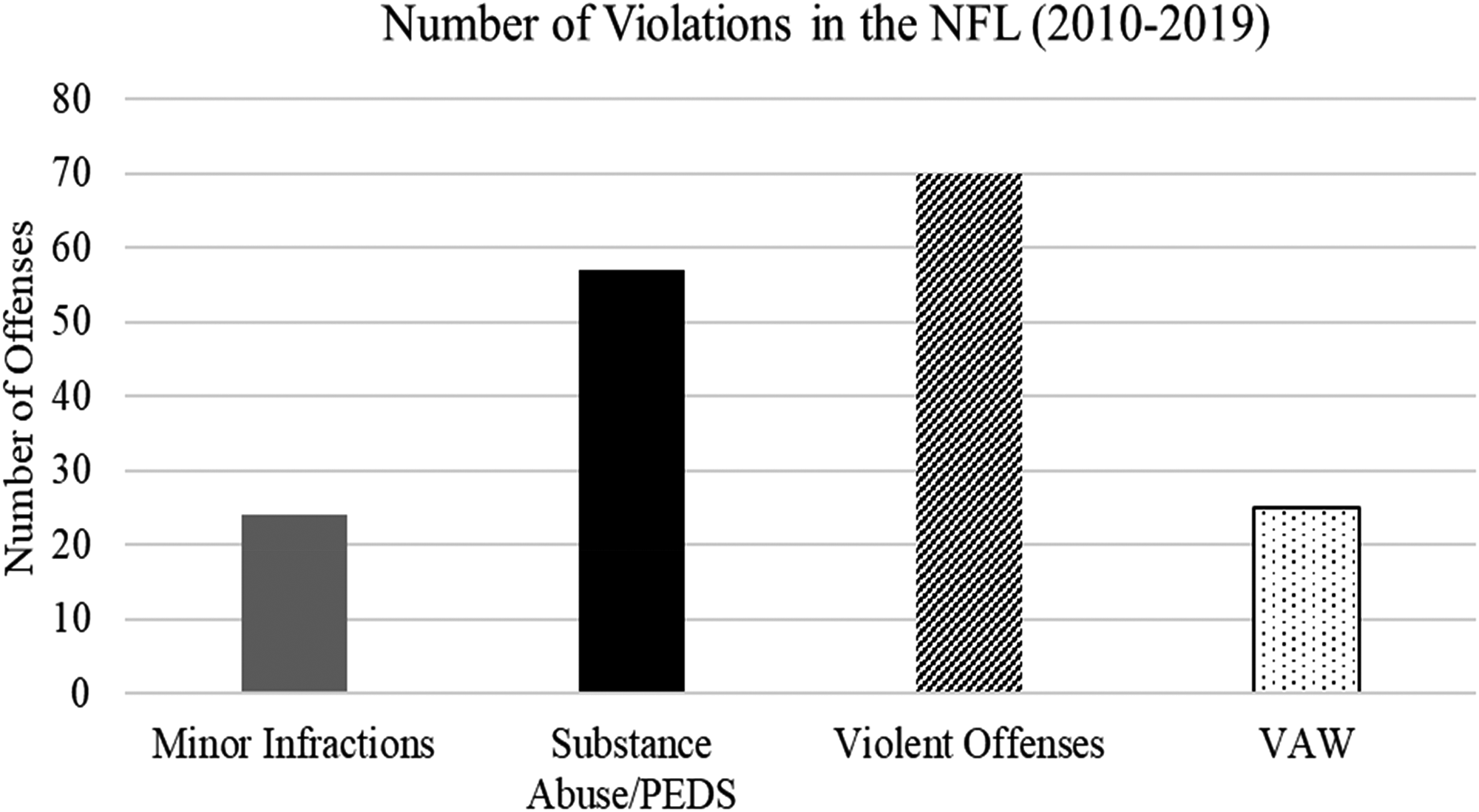
Number of Violations in the NFL (2010-2019).
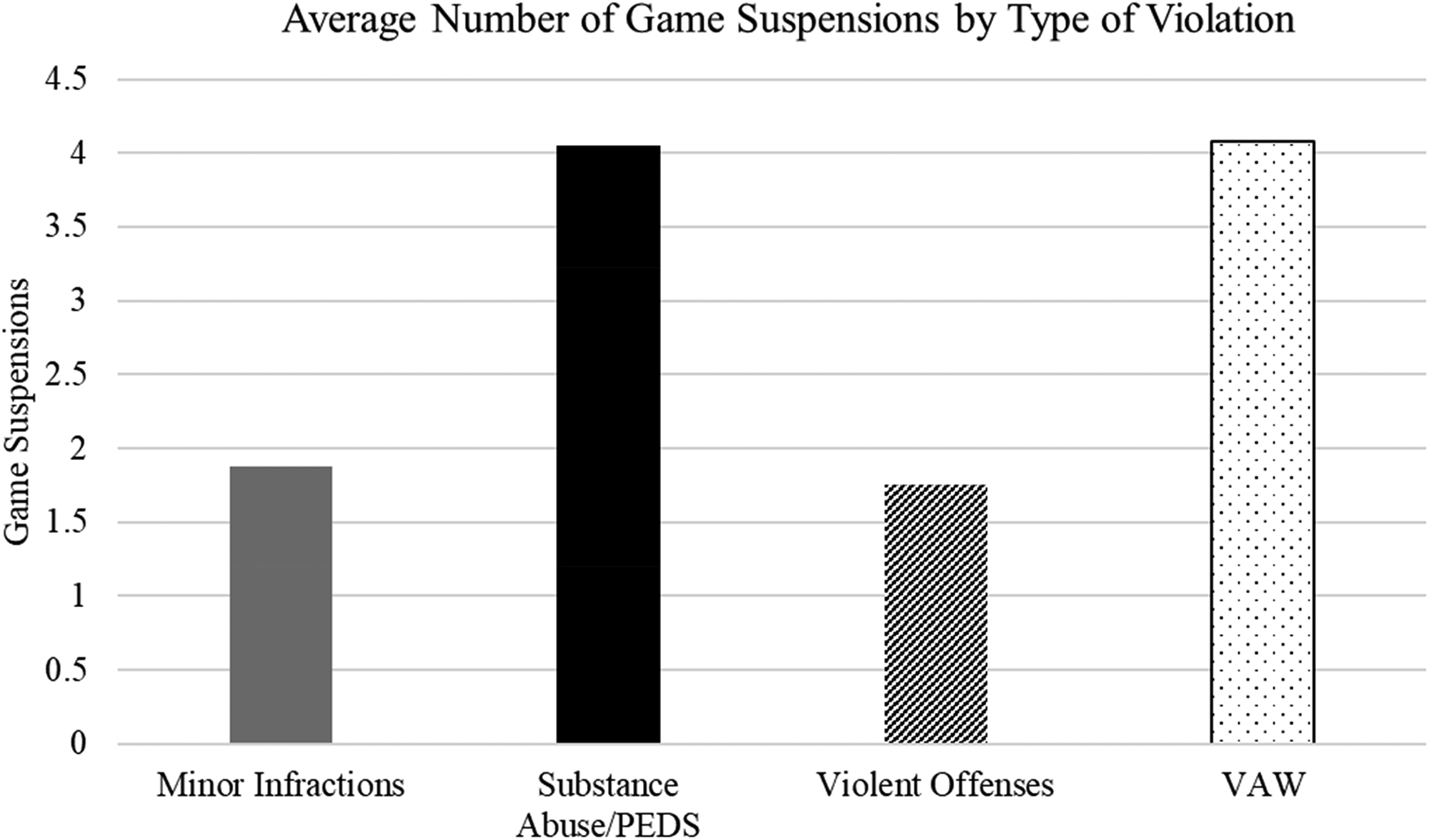
Average Number of Game Suspensions by Type of Violation.
Discussion
The current study examined VAW (sexual assault, rape, domestic violence), general violence (assault, battery), drug-related offenses (alcohol, DUI, illegal, PEDs), and minor sports-related infractions (missing team meetings) in the NFL. First, over half (54%) of the recorded NFL offenses in the past 10 years were violent in nature, either in general violence or VAW. However, only 14% of the total cases of NFL player violations included VAW. General violent behaviors, such as battery and assault (not specific to women), accounted for the highest number of cases (40%). These rates are similar to Morris (2014a) who compared NFL arrest rates with the national average (all men ages 25 to 29), indicating that NFL players had similar arrest rates in domestic and nondomestic violence: there were 83 arrests making it by far the NFL's worst category.
Game suspensions differed significantly by violation, indicating that players with VAW offenses were suspended 4 games on average compared to violent offenses (1.75) and minor infractions (1.88). And there were no differences in game suspensions for drug-related offenses (4 games) compared to VAW. Most surprising, was that violent offenses had significantly fewer game suspensions as compared to VAW or drug-related offenses. This is concerning given that the NFL's Personal Conduct Policy states a baseline suspension of 6 games without pay for VAW and general violent violations. Thus, it seems that the NFL may not have a problem with violence against women, but instead with general violent behaviors.
Additional empirical research is clearly warranted to build on this study by examining other factors in the social ecological framework, such as player position, previous histories of violence, alcohol or drug usage, race/ethnicity and other demographic factors, if a federal crime was actually prosecuted or led to a conviction, and financial information such as whether players were drafted (signing contract) and other salary information. In addition, these factors may need to be addressed with other types of methodologies, such as qualitative methods. Future research should also examine whether players commit multiple offenses, since the current study only compared certain types of offenses. What happens to players who commit VAW, violent offenses, and/or minor infractions? This played out recently with Antonio Brown: Despite allegations of sexual violence and personal misconduct towards the Oakland Raiders owner, Antonio Brown was still picked up by the New England Patriots in 2019. He then allegedly sent intimidating text messages to one of his accusers, and was later cut (Reiss, 2019). On July 31, 2020, Brown was suspended for the first eight games of the 2020 NFL season for multiple violations of the league's personal-conduct policy, regardless of if he is signed or not (Shook, 2020).
The problems that affect VAW prosecution in the legal system also complicate the NFL's ability to discipline its players (Janusz, 2012). One major issue is that most women who are abused do not report these crimes (National Sexual Violence Resource Center, 2015). And it may be exacerbated when the perpetrator is a NFL player because reporting the abuse may damage the relationship, the player's reputation, and potentially the player's NFL career. In addition, many legal cases are dismissed because of the lack of evidence to substantiate a victim's claims. This is true in the NFL which does not have the same power to conduct investigations as the criminal justice system, limiting the availability of evidence especially if a victim does not come forward (Janusz, 2012).
Lastly, is it the responsibility of the League to address and punish their players for VAW? Almost all societies tolerate VAW and let perpetrators (frequently husbands and lovers) go unpunished (Johnson & Gardner, 2000). And VAW often spills over into the workplace, in every society. Research indicates that a growing number of major corporations and businesses are recognizing that VAW can affect a person's job performance and a company's bottom line (Hudson, 1998), regardless if the employee is the perpetrator or victim. VAW can ultimately cost up to $500 billion annually in the US, according to a recent Fortune article (Zarya, 2016), as it affects productivity, attendance, and safety in the workplace (Fitzgerald et al., 1998). Furthermore, VAW creates negative publicity. Major corporations in the US have recognized the need to address VAW in the workplace, including Dupont, Polaroid, and many more (Johnson & Gardner, 2000); these businesses support employee education, sponsor fund raising for victims, engage in research that could lead to prevention, and counsel their employees. The NFL is no different from other major billion-dollar corporations, and should consider the financial repercussions among other reasons, for taking responsibility for their players’ violent behaviors.
Limitations
It should be noted that each of the 32 teams in the NFL carry 53-player rosters, totaling 1,700 players in the league (NCAA, 2020). Thus, our number of 176 (10%) may be problematic in that there are likely to be crimes that were not included in our list. Similar to Morris (2014b), our data collected may be even larger than the estimate based on roster limits; some players are frequently dropped and replaced, and our data might also be missing some players whose arrests flew under the radar (i.e., if not a popular player). Another concern in our data collection is that we were not able to account for harsher punishment such as the banning of certain players from the league due to misconduct, or other reasons. For example, if a player engaged in VAW, they may have ultimately been dropped or banned by a team of the NFL, and if the media did not account for that, that player would not be included in our list. Specifically, our data did not include Ray Rice, as he was banned, and not punished with game-suspensions. Thus, there seems to be major inconsistencies in the NFL policies about punishment (of which kind) that may have ultimately impacted our data collection. Our findings are preliminary and additional empirical research is clearly warranted.
Implications
These analyses provide important empirical insights into player violations in the NFL and the number of game suspensions. Given the negative publicity related to violence against women and general violent behaviors, the NFL may be reluctant to acknowledge and share information regarding athletes. In fact, there is some evidence that suggests college athletic departments and the NFL go to great lengths to protect violent athletes (Welch, 1997). There are countless reports every year of high school (e.g., Steubenville High School football players) and college players (e.g., Vanderbilt football players) being accused of violent behavioral misconduct followed by institutional cover up and mistreatment of victims, and yet are still allowed to play (Chief Elk-Young Bear, 2016). The video of the Ray Rice incident only came to light after a news outlet TMZ received the footage; at no point did the NFL ask for the footage from the casino where the incident occurred (Moskovitz, 2015). When there was outrage over the punishment of Rice, Goodell responded by saying he would increase the penalties for players accused of domestic violence. However, the current study found that there was not an increase, and remains as 4-game average, rather than the 6-game minimum suspension as stated in the Conduct Policy. In addition, this study indicates there is a need to address violence against women among all athletes, and not just within the NFL. It would be fruitful for future research to compare rates of VAW in other sports (MLB, NBA, NHL), as data is limited and not publicly available.
There are a number of ways the NFL can address VAW using the social ecological framework: One way to prevent players with a history of off-field violence entering the NFL is to focus on their behavior while in college (i.e., individual factors), because players who commit violent offenses typically have a history of violence (Staffo, 2013). In response to this, the NFL created a program to mentor new players. Through this program, senior players who have had issues with off-field violence mentor the new players on how to avoid the same situations (Staffo, 2013). Another initiative was presenting each team with a one-hour program on domestic violence (Moskovitz, 2015). These are examples of community resources and educational programming, which have been found to be helpful in preventing VAW (Terry, 2014)). At the very least, the NFL is creating policies and programming, which has not been done in other major leagues (i.e., NBA, MBA, NHL).
At the policy-level, the NFL introduced a policy to combat gender-based violence, which focused on the NFL Scouting Combine and Draft. The policy banned players with criminal convictions for domestic violence, sexual assault, or weapons charges from attending the Combine and Draft. And if players refused to submit to a background check, their invitations to both events were revoked. However, players were still allowed to attend private workouts, pro days, regional combines and to play in the league (Chief Elk-Young Bear, 2016). The NFL also donated airtime for an anti-domestic violence advertisement during a Super Bowl, partnering with No More, an unknown coalition to combat domestic violence and sexual assault, with a staff of only 4 and is for-profit. Additionally, the NFL did donate $1 million to help victims of domestic violence, however it came at very little cost to the league who brings in an estimated $10 billion each year (Moskovitz, 2015). These “messages seem to merely be public relation ploys designed to please the public…and more than obvious that the league cares more about its image than the women victimized by the league's players” (Chief Elk-Young Bear, 2016).
It should be noted that the majority of NFL players are not aggressive. However, Kimmel and Kimmel (2008) state that many men (and players) also do nothing to stop violence and thus perpetuate its existence. The silence by players and the League (i.e., Commissioner, owners) allow violence to continue, particularly in high risk all-male groups where group loyalty is engrained (Jozkowski & Wiersma-Mosley, 2017; Schwartz & DeKeseredy, 1997). Thus, the League should empower players to speak out as active bystanders and allies in the prevention of violence. The Mentors in Violence Prevention (MVP) program has been found to be effective and appealing to men, particularly athletes, as the approach views men as allies in preventing violence versus viewing men as perpetrators or potential perpetrators (Berkowitz, 1994; Katz, 1995).
In closing, our study empirically assessed VAW in the NFL. As Welch (1997) stated, there seems to be a connection between physical aggression, collision and combative sport with hypermasculinity, all of which are factors in the social ecological theory related to VAW. Welsh states further “how sports transform athletes into heroes and celebrities, thereby reinforcing prestige, narcissism, specialness, and a sense of entitlement; all of these products contribute to violence against women” (p. 4). This is seen in a statement from QB Don McPherson (as cited in Moskovitz, 2015): “I think the conversation that the NFL is having on the punitive side, all it does is further criminalize the players in the league. It doesn't address the core issue of men's violence against women, which is the culture of masculinity and men that leads to misogyny and sexism and the overall notion that women are less than, which is very much a message that comes out of a lot of language in sport. And until we address those core issues, the problem will continue, and all the NFL is going to be creating [is] a criminal state in their league.” In sum, until VAW is addressed at every level of the social ecological framework, VAW will continue to be an issue in our society and in the NFL.
Footnotes
Declaration of Conflicting Interests
The author(s) declared no potential conflicts of interest with respect to the research, authorship, and/or publication of this article.
Funding
The author(s) received no financial support for the research, authorship and/or publication of this article.
