







Abstract
The erasure of marginalized people, especially LGBTQ+ people, is commonplace in sport. As sport has become more commercialized, even at grassroots and youth levels), one group that has become even further marginalized and dehumanized are sports officials. Understanding the intersection of marginalized identities is important; as such, this study examined how homophobia and transphobia interplay with the sports officiating profession. Semistructured interviews with 16 self-identified LGBTQ+ referees revealed a series of organizational and social factors that led officials to either pass as non-LGBTQ+ or to come out as LGBTQ+, leading to the development of the LGBTQ+ Referee Identity Management Process Model. Implications for better supporting LGBTQ+ officials to promote higher levels of retention and career satisfaction are presented.
Since its inception, sport has been a structure in which certain groups of people, such as women and members of queer communities, are stigmatized, scrutinized, or erased, to maintain gendered power dynamics (Anderson, 2011; Birrell & Cole, 1990). As Messner (1992) wrote, “The extent to homophobia in the sport world is staggering. Boys (in sport) learn early that to be gay, to be suspected of being gay, or even to be unable to prove one's heterosexual status is not acceptable” (p. 34). Though more recent studies have interrogated the ways sport might be altered as an institution to counter such stigmatization (Breger et al., 2019; Cunningham, 2015; Piedra et al., 2017), people who identify as LGBTQ+ 1 continue to be marginalized, scrutinized, and erased within a vast majority of sport spaces (Allison & Knoester, 2021; Anderson et al., 2016; Cunningham & Hussain, 2020; Walker & Melton, 2015).
Stigmatization in Sport
Stigma, rooted in the works of Goffman (1963), was first theorized at the individual level as a “deeply discrediting” attribute that reduces someone “from a whole and usual person to a tainted, discounted one” (p. 3). In recent years, stigma has been theorized within a larger social context (see Yang et al., 2007). In 2001, Link and Phelan defined stigma as an umbrella term which includes social processes that take place in a larger sociocultural environment but whose effects impact the individual (see Yang et al., 2007). Recent research suggests stigma and social discrimination against the LGBTQ+ community, what Anderson (2011) termed cultural homophobia, has shifted from a state of homohysteria to structural discrimination in the form of heterosexism in recent decades (Bullingham et al., 2014; Bush et al., 2012; Cleland, 2019). Yet, nearly all sport cultures are still thought to be disproportionately heteronormative and heterosexist (Allison & Knoester, 2021; Cleland et al., 2021). Herek (2007) defined heterosexism as, “a cultural ideology embodied in institutional practices that work to the disadvantage of sexual minority groups even in the absence of individual prejudice or discrimination” (p. 907). Moreover, Potrac et al. (2022) indicated, “the current structural and cultural arrangements [of English football] support a reality where [homophobic, racist, and sexist] comments and behaviours” (p. 305), though technically inappropriate, are actually normalized elements for participants in grassroots football.
Perhaps the most present and persistent form of structural discrimination against the LGBTQ+ community, however, is in their absence. Or, as many scholars have noted, in the systemic erasure of LGBTQ+ voices and experiences in sport (Allison & Knoester, 2021; Cunningham & Hussain, 2020; MacCharles & Melton, 2021a; Melton and Cunningham, 2014).
The Erasure of LGBTQ+ Voices in Sport
The stigmatization and erasure of the LGBTQ+ community in sport have occurred not just for athletes, but for sport constituents (such as spectators). In their study of 9,500 sport fans, Denison and Kitchen (2015) found that over 41% of individuals identified spectator areas as the most likely sporting environment in which homophobia occurs (even more than locker rooms).
Further, a majority (78%) felt lesbian, gay, and bisexual spectators would not be safe in the stands. In their study of 2,663 football fans in the United Kingdom, Cleland et al. (2021) found that homophobic language is less prolific than in the past; still, more than 75% of study participants reported hearing homosexual-themed language that many defined as toxic or hostile. These findings are perhaps unsurprising, given the high profile of homophobic behaviors by spectators (Kian et al., 2011; Magrath, 2018; Velez & Piedra, 2020) and the negative experiences many LGBTQ+ athletes have at all levels of sport (Beemyn & Rankin, 2011; Cunningham, 2019; Krane, 2016).
With some notable exceptions (MacCharles & Melton, 2021a, 2021b; Sartore & Cunningham, 2010; Walker & Melton, 2015), few studies have examined the presence and perceptions of homophobia and transphobia amongst sport constituents beyond LGBTQ+ spectators and athletes. In an early study examining nonathletes, Sartore and Cunningham (2010) interviewed 14 kinesiology faculty, two of whom identified as lesbian, and found that assumptions about sexuality meant that, “women labeled as lesbians were identified as occupying minority status and suffering prejudice and discrimination at the individual and group levels” (p. 496). Further, Walker and Melton (2015) examined how the influence of multiple marginalized identities (i.e., sexual orientation, race, and gender) influenced organizational outcomes in college athletic departments. All 15 participants used concealing practices to mask their queer identities. Further, all of the “minority lesbians in this study have either left intercollegiate sports in the last year or are actively seeking other employment options” (p. 267). In their study of 12 gay men working in the sports industry, MacCharles and Melton (2021a) found the culture of respective sports and societal attitudes toward manhood impacted participants’ feelings that being gay was stigmatized. The participants also discussed their processes of searching their organizational contexts for signals of inclusion (e.g., visual signals and policies of inclusion) before deciding how open to be about their sexual orientation.
When considering the experiences of LGBTQ+ officials, scant research exploring and interpreting the lived experiences of LGBTQ+ officials, as a collective, exists. For instance, in 2019, Cleland examined professional football referee Ryan Atkin's coming out story. Despite the numerous LGBTQ+ officials who have come out in recent years, such as Atkin, Dale Scott, and Dave Pallone, the narratives of those referees are often coming out stories and nearly all of the stories that are featured in the media are about gay, White men (Brody, 2020; Cleland, 2019). One concern with focusing the gay men's experience around coming out is the narrative's necessary reliance on secrecy and disclosure (Brody, 2020). As Brody (2020) notes, this narrative casts homosexuality as a “problem” to be wrestled with and casts coming out as a voluntary declaration. But because “heterosexuals are never expected to make the same type of explicit announcement to live an ‘honest’ life,” coming out narratives ultimately isolate queer individuals as lone figures, rather than people within a culture and system that is based on intersectional oppressions. Often, such narratives disregard other members of the LGBTQ+ community (beyond gay and White men), ignoring other vulnerable populations in sport and stories that are not explicitly about coming out.
Recently, Webb (2022) highlighted the necessity of exploring vulnerable populations in sport, such as LGBTQ+ referees. Referees have a front-row seat to what occurs on and off the field in a sports competition, and theoretically based on their formal authority, have the capacity to mitigate homophobic, transphobic, or derogatory behaviors before, during, and after contests. Recognizing that officials with marginalized identities may be the most attuned to such experiences, both for themselves and other sport constituents, the aim of this research was to examine the experiences of LGBTQ+ officials.
The Erasure of Sport Officials
From a structural and performative perspective, referees are paramount to the success of sport as they directly impact the experience of all parties involved (Cuskelly & Hoye, 2013). Still, referees are often marginalized and seen as service providers rather than sport participants in their own right (Jacobs et al., 2020; Phillips & Fairley, 2014; Warner et al., 2013).
More pointedly, sports officials are othered in their treatment by some fan groups during sporting contests. Magrath (2018) placed homophobic songs and chants into three categories, the last of which was identified as the vilification of match officials and the opponents because they were against their team. Given the stigmatization of sports officials and the abuse they receive during competitions (Webb & Hill, 2020), after competitions (File, 2017; Pehkonen, 2021), in the mass media (Borel-Hänni, 2015; Webb, 2018), and in social media (Wells, 2019), it is perhaps no wonder that referees are leaving the profession at alarming rates. Recruitment of new referees has done little to turn this tide (Jacobs et al., 2020; Pappas, 2016); sport organizations are facing officiating shortages that impact the quality and quantity of games being offered.
A survey conducted by Officially Human indicated that 60% of the 19,000 respondents said verbal abuse from parents and fans would lead them to quit and 66% believe their area does not have enough officials to cover games (Officially Human, 2019). Pappas (2016), of the National Federation of State High School Associations (NFHS), noted the lack of officials has escalated into a crisis in many associations. Given the limited number of referees, sport organizations are being forced to cancel games, modify schedules, or allow underqualified and underprepared referees to officiate high-level contests (McCarthy, 2020; Ridinger et al., 2017).
Much of the early research on officiating identified psychological stressors as indicators of likely burnout and dropout (see Rainey, 1995). Recent research has suggested referee attrition is linked to numerous factors, including a lack of social identification with the refereeing community, a lack of training, a lack of a referee community, and problematic social interactions (Dell et al., 2016; Kellett & Warner, 2011; Potrac et al., 2022; Warner et al., 2013; Zvosec et al., 2021). In their recent study exploring attrition amongst grassroots English football referees, Potrac and colleagues found that inadequate advocacy and support left referees feeling betrayed, frustrated, and lonely. Additionally, referees indicated negative match-day interactions resulted in increases in fear, anger, guilt, and loneliness for study participants (Potrac et al., 2022).
Beyond their marginalization as referees, previous research has noted the intersection of referee identities with other marginalized identities may lead to even higher rates of dropout. Tingle et al. (2014) noted that women referees experienced gendered stressors beyond those of their men counterparts, while Schaeperkoetter (2017) found that perceptions of her officiating were influenced by her femaleness. A burgeoning line of research has explored the stigmatization of mental health concerns among women sports officials and its impact on retention (Tingle et al., 2022; Webb et al., 2021). Yet, match officials with intersecting marginalized identities remain one of the most understudied populations in sport scholarship.
Examining the experiences of the most marginalized people in sport may provide insight into whether and how one's identities have impacted their career trajectories and perceptions of officiating. In creating space for the voices of LGBTQ+ referees, the purpose of the study was to provide: (a) a more nuanced understanding of the officiating profession; (b) a clearer sense of LGBTQ+ people's experiences in sport; and (c) an understanding of how scholars and practitioners alike might better support and promote higher career satisfaction and retention of LGBTQ+ officials. Addressing such concerns, this study sought to answer the following:
In what ways, if at all, are officials’ careers impacted by their LGBTQ+ identity?
What are the experiences of LGBTQ+ officials within the larger sport community?
Do LGBTQ+ officials feel a sense of community amongst officials?
Analysis of these questions may bring more awareness to issues of marginalization in officiating and offer insights into how better support systems for LGBTQ+ referees may be developed.
Methods
A grounded theory framework was utilized as research on LGBTQ+ referees had not previously been conducted. Grounded theory provides a means for researchers to construct models and theories based on inductive analysis (Glaser & Strauss, 1967). Sotiriadou and Shilbury (2010) emphasize this further in saying, “As sport and its associated processes cut across a varied social demographic genre and from the professional sporting environment to the leisure, participatory and sport spectatorship setting, it lends itself to [Grounded Theory] to generate rich data to understand the processes involved and their supporting resources required” (p. 183). Thus, to effectively explore the experiences of LGBTQ+ officials, theories were generated throughout the research process and grounded by participant experiences (Strauss & Corbin, 1990). The use of semistructured interviews allowed participants to articulate issues that were important to their experiences as LGBTQ+ referees (Pickard, 2013).
Participants
Sixteen current and former officials who identify as members of the LGBTQ+ community participated in the study. These officials worked at six levels of competition (State High School, College Club, NCAA, Professional, International Federation, and/or another National Association) and in 12 sports (baseball, basketball, flag football, American football, ice hockey, roller derby, soccer, softball, tennis, track and field, volleyball, and wrestling). Conducting interviews with referees from various sports ensured the results of the study extended beyond the confines of a single sport. Participants were self-selected into the study and had been refereeing, on average, for 17.2 years. Of the respondents, 31.3% (n = 5) identified as lesbian, 43.7% (n = 7) identified as gay, and 25% (n = 4) identified as bisexual. Furthermore, 43.75% (n = 7) identified as women, 37.5% (n = 6) identified as men, 12.5% (n = 2) identified as transgender men or women, and 6.25% (n = 1) identified as nonbinary. Notably, 25% (n = 4) had officiated in more than one sport, 37.5% (n = 6) had officiated at more than one level, and 18.8% (n = 3) had officiated in many sports at multiple levels.
Procedure
After receiving Institution Review Board approval, the research team recruited LGBTQ+ referees from North America via social media posts on the Twitter, Facebook, and Instagram feeds of an international LGBTQ+ advocacy organization. All respondents received a solicitation email asking them to complete a demographic questionnaire and consent form. Researchers conducted Zoom interviews which were professionally transcribed verbatim. A growing line of research highlights the benefits of the Zoom platform for qualitative data collection, including interviewees feeling more comfortable in a setting of their own choice (Gray et al., 2020) and an enhanced capacity for rapport building, compared to nonvisual mediums (Archibald et al., 2019). Interviews were conducted until data saturation was reached and no new knowledge could be gained from further interviews.
Instrument
An interview guide was developed based on the previous officiating literature (Kellett & Warner, 2011; Rainey, 1995; Warner et al., 2013), the research questions and problem statement, and with consultation of an international LGBTQ+ advocacy organization. The guide was pilot-tested with one retired LGBTQ+ official, three current non-LGBTQ+ officials, and two LGBTQ+ sport scholars. A semistructured approach allowed the researchers to move from sociocultural level questions in the interview guide to more specific questions based on participant responses (Munhall, 2007). A sample of the questions include: “Can you tell me about your background as an official?” and “Are you open about your sexual identity in your officiating community? Why or why not?”
Researcher Positionality
Misener and Doherty (2009) detailed that researcher positionality can help “provide more thoughtful and critical representation of ourselves within our research” (p. 466). Researcher positionality is particularly relevant as thematic analysis was used to analyze the interview data. Guest et al. (2012) explain, “Thematic analysis, as in grounded theory and development of cultural models, requires more involvement and interpretation from the researcher” (p. 9).
Three of the authors have officiating experience. The first author does not have officiating experience but served as a collegiate coach for 11 years. Author two officiated basketball for 20 years, including 18 years of collegiate officiating, and 10 years at the NCAA Division-I level. Author three was a field hockey official for six years at the U-19 and U-16 club levels and the Referee Manager for a National Governing Body for four years. The fourth author officiated basketball for five years, including two years at the collegiate level. Additionally, two members of the research team identify as members of the LGBTQ+ community. Through those experiences, the authors gained practical insight into the role of officials within the sport ecosystem. Moreover, researcher positionality helped to develop a rapport during the interviews in that there was a “position of equality and mutual respect” (Doody & Noonan, 2013, p. 31). Researcher positionality also served a role throughout the study design and data analysis processes since, as delineated by Corbin and Strauss (2008): “when we share a common culture with our research participants … it makes sense, then, to draw upon those experiences to obtain insight into what our participants are describing” (p. 80). It should be noted that all of the authors are White and cisgender, which could have impacted the way interviewees responded.
Analysis
Interview transcripts were sent to participants to ensure their voices and intention had been appropriately captured. Member checking increases the trustworthiness of the research as it helps to confirm the representative nature of the data (Birt et al., 2016). Participants were given gender-neutral pseudonyms to protect their identity and mitigate bias. Researchers used a constant comparison to juxtapose emerging data with existing findings to continually ground coding to the experiences of the participants. The authors independently coded and developed preliminary themes. As codes and preliminary themes were refined, a thematic analysis, “a method for identifying, analyzing, and reporting patterns (themes) within the data” (Braun & Clarke, 2006, p. 79) was utilized. Further readings of the wider LGBTQ+ literature allowed the authors to categorize those emergent themes as related to the referee's decisions to come out or the referee's decision to reveal their LGBTQ+ identity. In this way, themes were generated throughout the research process and grounded the experiences of the participants (Strauss & Corbin, 1990). It was at this point that Clair et al.'s (2005) model was introduced as it was found to be a relevant lens through which to organize the data. As a result, emergent themes were grouped as antecedents and consequences within a generalized model of invisible stigma management (Clair et al., 2005). The model was adapted to orient the emergent themes, to adopt terminology from sport scholarship, and to simultaneously align with the extant literature on being LGBTQ+ in the workplace.
Results
During the initial analysis of the interviews, nine themes emerged. In subsequent analyses, the research team discussed why officials who participated in interviews were willing to come out and how those decisions influenced their everyday experiences, shifting the research focus toward the many cultural and social factors (e.g., antecedents) that informed each official's decisions.
Uncovering Invisible Stigma Management and the Disclosure Processes Model
As the research team began to uncover factors that impacted the official's decisions to come out as LGBTQ+ or not, literature on invisible stigma emerged. Invisible stigmas in the workplace, and invisible stigma management, became a topic of interest within various disciplines at the start of the century (see Beatty & Kirby, 2006; Ragins, 2004, 2008). According to Clair et al., “the literature on organizational diversity documents how women, racial minorities, older workers, and others bearing a stigmatized identity have suffered job loss, limited career advancement, difficulty finding a mentor, and isolation at work” (2005, p. 79). Invisible stigma management was an apt theoretical framing for the emergent data. Emerging from invisible stigma research are examples of how people manage stigmas at work (Clair et al., 2005). The Disclosure Processes Model suggests that disclosing one's identity as LGBTQ+ may lead to different outcomes depending on context (Chaudoir & Fisher, 2010). Within these frameworks, two strategic choices for those with invisible identities in the workplace exist: to pass (i.e., hide their invisible identity) or reveal (i.e., disclose their identity). However, each “person must make decisions about whether and how to reveal over and over again across many social interactions” when at work (Clair et al., 2005, p. 81). In the following sections, referees’ decisions to pass and reveal are outlined. Subsequent sections detail the antecedents which influence the choice to pass or reveal and the consequences of such decisions. The LGBTQ+ Referee Identity Management Process model is presented in Figure 1. It provides a visual representation of these themes and is organized to suggest how each theme may impact others for LGBTQ+ referees.
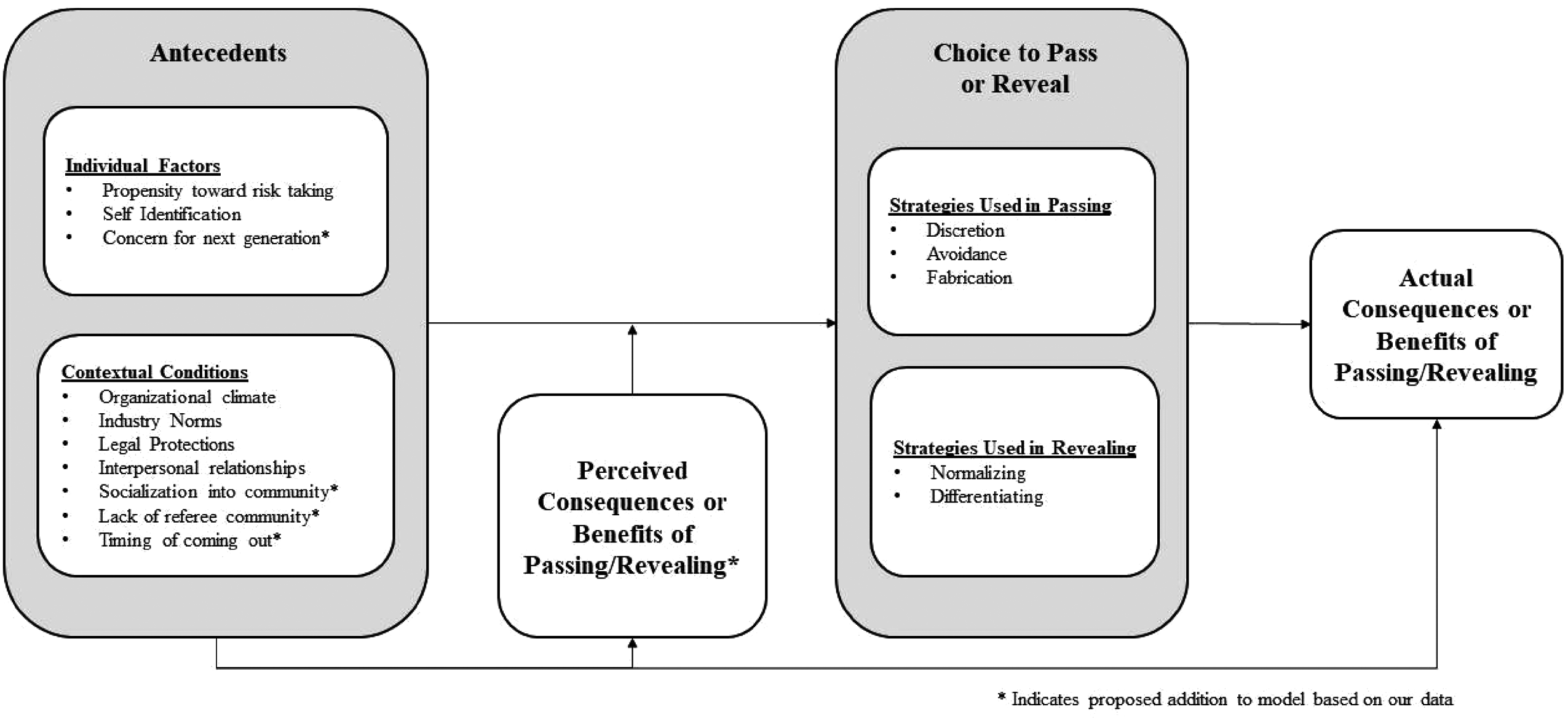
Conceptual model: LGBTQ+ referee identity management process.
Passing
Leary (1999) defined passing as a performance where “one member of a defined social group masquerades as another … to enjoy the privileges afforded to the dominant group” (p. 85). While this definition suggests passing is intentional and performative by nature, passing may occur unintentionally (Clair et al., 2005; Conyers & Kennedy, 1963). For Jamie, a fear of being found out led them to be conscious of how they were perceived: “I don’t project myself where I think some people in sports and athletics would see me to be … LGBTQ.” Peyton said, “Back in the early 1970s, I was as closeted as you could possibly be.” Three primary tactics used for passing have been identified: discretion, concealment (later referred to as avoidance by Clair et al., 2005), and fabrication (Herek, 1996). All three tactics were used by participants in this study to conceal their status as members of the LGBTQ+ community while at work as officials.
Discretion
Discretion is being elusive about or using ambiguous language to prevent the revelation of one's stigmatized identity. Avery noted, “Today I might call him my husband, tomorrow I might call him my partner … It kind of just depends.” Using the term partner anonymizes the spouse and prevents the revelation of one's LGBTQ+ identity. This use of ambiguous language highlights how individuals utilize discretion when they may not feel safe. Avery was not alone; many others suggested they, too, had utilized discretion during their careers. Stigmatized identities are often outwardly visible (eliminating the need to self-identify) or socially accepted (eliminating the need for discretion; Beatty & Kirby, 2006). When it comes to being LGBTQ+, however, these identities may be invisible—creating a new coming out process with every introduction. As Sawyer described, “I’ll be happy to engage them in a conversation, but I don’t go carrying a big sign around saying, ‘Hey, I’m the first trans high-level sport referee in North America.’” The ambiguity of language and discretion about one's identity highlighted here allude to myriad antecedents that influence whether an official passes or reveals.
Avoidance
Another passing strategy used by the officials in this study was avoidance. Avoidance is when someone circumvents revealing their sexuality in an attempt to escape “problematic social interactions” at work (Clair et al., 2005, p. 81). Several participants utilized avoidance, and for many, their hesitancy manifested from a fear of repercussions or a lack of trust. Logan described their avoidance as a fear of reprisal: Should someone not be accepting or welcoming of [one's LGBTQ+ identity], you would see games disappear for no reason. Half my games in the college season came from one assigner. So, there is a … question of, will it impact my assignments?
Fear of conflict and the potential consequences of living openly as an LGBTQ+ official were made clear by numerous participants. Furthering this notion, Skyler added, “that's how you met lesbians in the Army was through sports, because that was back before ‘don’t ask, don’t tell,’ when witch hunts were still the craze.” The participants in this study suggested that discretion and avoidance are common strategies that allow LGBTQ+ officials to pass as heterosexual, making it possible to hide their stigmatized identity to serve as referees. Similarly, officials noted that they sometimes used fabrication when determining how or if they would share their true identity.
Fabrication
Fabrication, according to Woods and Harbeck (1992), is the purposeful presentation of a false identity to avoid questions or gossip that might create work-related stress. Several participants discussed using fabrication to pass. In one extreme example, a gay male (Peyton) proposed marriage to a woman to hide, or repress, his queerness. Though he came out later in his life, Peyton described how fabricating felt necessary to stay in officiating. By fabricating, officials were able to operate unencumbered in the heterosexual officiating landscape. Others mentioned queer officials they worked with who also fabricated; one official mentioned working with lesbian referees who would regularly discuss their “boyfriends.” In this way, fabrication was utilized to prevent added stress and served as a defense mechanism to protect LGBTQ+ officials from workplace discrimination (Clair et al., 2005).
Passing by using discretion, avoidance, or fabrication was found to be commonplace amongst LGBTQ+ officials, especially early in their careers. Many noted that passing was necessitated by their heterosexist work environment, to avoid (either real or perceived) conflict and protect their careers. At times, passing was preferable as revealing one's true identity was seen to be a decision marred with uncertainty and fear of reprisal.
Revealing
Revealing, according to Clair et al. (2005), is when an individual discloses “an identity that would otherwise be invisible” (p. 83). People utilize different tactics to reveal their status as LGBTQ+ including two used by officials in this study: normalizing and differentiating.
Normalizing
Normalizing is when an individual reveals their invisible identity and strives to make that identity seem ordinary (Clair et al., 2005). Many officials described attempts to assimilate into their referee association by denying that being LGBTQ+ mattered to their work and by demonstrating they could perform as well, or better, at job-related tasks than others.
Parker offered this suggestion for how to normalize: “Instead of pretending you’re trying to be someone you’re not or someone else, no matter what happens, just be yourself and trust that you’re a good person.” Parker normalized by intentionally disaggregating their identity to job performance. Furthering this notion was Avery, who said in their officials’ association, “It's just such a non-issue … It's almost like a, ‘Yeah, we know gay people exist. And?’” Others justified their normalizing behaviors as being tired of being othered or feeling like they had to continually describe their family life. Jordan said, “I get tired … of having to explain that you’re gay, you know, my partner is a female.” Many of the officials utilized normalizing as a way to minimize stigma. Despite the repetitive nature of coming out and normalizing, as well as the emotional toll such behaviors took on these officials, the transition from passing to revealing, for many, was an important part of their personal and professional journeys.
Differentiating
Individuals engage in differentiating when they choose to reveal their stigmatized identity and find that revelation to be an important part of their expression (Clair et al., 2005). Differentiating allows the individual not only to reveal who they are but to find comfort and truth in being their authentic self. Several participants noted that being comfortable differentiating took time, but they were grateful to be at that point. As Quinn stated, where “I come from, it was something that I was worried about for a long time in my life, and now I’m finally at the point where I’m like, ‘Okay, I really don’t care anymore.’” As individuals differentiate, they are revealing and exclaiming their own value within officiating. While parts of the differentiating process are internal, external pressures also seem to impact how one values their invisible identity within the sporting sphere. As Quinn noted, officials often work in a team. Thus, the support and acceptance of officiating team members may play an integral role in one's decision not only to reveal their true identity, but also to find merit in the revelation.
The path to revealing one's stigmatized identity seemed to take two courses. In some instances, individuals became fed up with the bigotry and simply began living as their true selves; despite any external pressures. However, in most cases, participants noted that it was not until the external pressures dissipated that they were able to fully explore their stigmatized identity as an important part of their self-expression. Numerous antecedents dictated the path that one might take as they negotiate to reveal their stigmatized identity within the officiating sphere.
Antecedents
Invisible stigma research illustrates antecedents, factors that influence an individual's choice to reveal or pass, can be divided into two categories: (a) contextual conditions which include organizational climates, industry norms, legal protections, and interpersonal relationships; and (b) individual factors, such as one's propensity toward risk-taking and self-identification. According to Clair et al. (2005), these “factors are unlikely to operate independently. Consequently, a person is likely to experience conflicting pressures to reveal and to conceal stigmatizing information” at once (p. 84). In our interviews, each of these contextual conditions and individual factors was discussed, as were four newly identified antecedents: Socialization into the Community, Lack of Referee Community, Timing of Coming Out, and Concern for the Next Generations of LGBTQ+ Community. In the following sections, participants’ stories detail each of these antecedents. After, we describe the ways these antecedents influenced officials’ likelihood of coming out at work.
Organizational Climate
One antecedent that Wax et al. (2018) suggested may be the most significant to whether an employee comes out is organizational climate, which includes “shared perceptions of organization norms, policies, and practices” (p. 9). According to Tingle (2016), the climate, or culture, of an organization significantly impacts the decisions and behaviors of employees. The participants had wide-ranging refereeing experiences often varying from moderately positive to moderately negative. Jamie discussed responses to revealing he was gay as indifferent; after coming out to his peer officials, with some trepidation, the overarching response was “… who gives a crap?” Often though, referees discussed an unspoken climate of subtle homophobia. Seemingly, the organizational climate described by the referees was strategically neutral, but with an unspoken bias against the LGBTQ+ community.
One factor influencing organizational climate, according to the referees, was the way the heads of the sporting organization, or officials’ assignors, managed the culture of the organization. As Taylor noted, if the “boss makes sure that it is known that … hate speech, or any of that ignorance is not tolerated, it makes it a lot easier for everyone else to … also make sure that none of that is accepted.” In one pointed instance, Jamie discussed his coworkers’ response to hearing a trans athlete speak at a diversity summit: I rode with our athletic director at the time, an assistant athletic director, an athletic trainer … in the minivan [back from the summit], it was kind of awkward when they were like, ‘oh, I didn’t know he used to be a she. He still kind of looks like … you know, talks almost like a woman … and to me, they came across as they didn’t take anything else away except how [he] looked.
Others discussed ambivalence or a lack of awareness within their organizations. As Parker described, assignors would host social events but often, those events exacerbated social differences (like being LGBTQ+) rather than allowing officials to bond.
In a few cases, officials discussed the culture of the sport they officiated as being impactful to the LGBTQ+ community. Two officials discussed the openness of their sport for LGBTQ+ people: “[my current sport] is one of the most inclusive spaces for the queer community … without a doubt, I would not be officiating or a sportsperson if it was not for [my current sport]” (Casey). As Henley noted, she transitioned from playing soccer to officiating another sport and had very different experiences: I came into a sport that was specifically geared towards … queer individuals. When I played [soccer], I played on a male team, and I was specifically harassed every day. I don’t get that same feeling as a bisexual woman as an official in [my current] sport.
The culture of a sport, like a climate created by an organization's leaders, may impact the experiences and retention of LGBTQ+ officials.
Industry Norms
Previous research indicates that industry norms may have implications for the likelihood of an individual passing or revealing at work. Joyce and Slocum (1984) defined climate as the shared perceptions of organizational norms, policies, and practices. Diversity climate is the degree to which an organization prioritizes inclusivity (Cox, 2001; Stewart et al., 2011). A majority of interviewees described, in detail, the impact of industry norms on their experiences with co-officials and other stakeholders, and their decisions to pass or reveal.
Most often, referees discussed a collective silence around LGBTQ+ inclusion. Henley described how the rules of the sport are helpful: “Our sport has enabled us to have the power to throw people out, so they’ve already given us the tools where fans know that if they come and they’re abusive, we have the power to do that.” Logan, who officiates a different sport, described the importance of culture in terms of developing relationships: “There's a distinction and differentiation depending on what governing body you’re working for … in [my sport] to go pro, to advance, you’ll go so far on talent, but then it really is relationship based.” From these interviews, it was clear that climate has a significant impact on the lives of those who officiate, which can lead to greater retention and recruitment—or higher rates of attrition—of all officials, especially LGBTQ+ officials.
Legal Protections
In some instances, organizational norms become so ingrained that they move beyond culture and become formalized as policies, laws, or regulations protecting people with invisible identities. Several officials noted that legal protections served as an antecedent for revealing, though those protections varied greatly by sport and region. Some organizations have been proactive in providing LGBTQ+ protections. Camryn said, [my sport's National Governing Body], for instance, “… expanded protections for LGBTQ Black people in sports. We made it a policy.” According to Henly, some sports are “by mandate, accepting … the governing body itself, spends a lot of time branding and messaging the fact that this sport is … absolutely inclusive … Some people are queer, some … non-identifying, and that these individuals are also welcome.” Despite the inclusiveness in the policies and cultures of these two specific sporting organizations, such protections are not universal. Taylor shared, “I don’t think [my sport] would be open to having [inclusion] training unless it was required by the law.” As variability in protections for LGBTQ+ officials can hinder one's likelihood of coming out or, at the least, feeling safe doing so, many officials noted standardization of policies could be an important way for organizations to signal they support LGBTQ+ officials.
Interpersonal Relationships
The final antecedent for coming out was interpersonal relationships, which Clair et al. (2005) described as predicated on the person with whom the referee is interacting and the perceived level of trust between the two individuals. Nearly every official we interviewed discussed interpersonal relationships as paramount to whether or how they came out, and whether they remained in officiating. However, relationship types varied (e.g., some mentioned partners while others mentioned friends or spectators). The most commonly discussed relationships were those with peers and assignors.
Officials noted certain relationships were more supportive and accepting than others. Jamie described one situation where their assignors made a homophobic comment “… and I’m just like, okay, [I] really can’t say anything because these are my bosses.” Others had the opposite experience where their bosses were particularly supportive. As one trans official discussed: “They actually took their time out to make sure team captains and the teams that I reffed very often know about the situation and to not misgender me … After that, I got a lot closer to the staff” (Taylor). Most often, the referees noted the ambiguity of their relationships, commenting that they felt unsure as to whether to come out because their status as officials, and being assigned to high caliber—or any—games depended on their relationship with assignors.
At times, officials discussed interpersonal relationships as dependent upon their own choices and as a product of the environment in which they interacted with others. Jordan discussed being selectively out as LGBTQ+ based on the person they interacted with: “… as open as I am … there's [sic] certain people that, when I meet them … I’m a little guarded because I don’t want to be pre-judged before I even get a chance to know you.” Other officials described their peers as comrades who “have my back,” “a second family,” and “my really close friends.” Regularly, the officials described how they developed friendships with other officials over time, allowing for the building of trust and comfort in coming out. An environment that allowed the officials to build trust amongst themselves significantly improved the interpersonal relationships and experiences of the LGBTQ+ referees in this study.
The external antecedents discussed above, and seen in Figure 1, draw attention to the impact of a referee's environment on decisions to pass or reveal. In addition to external antecedents, the participants suggested that internal antecedents, including a propensity toward risk-taking and self-monitoring, played a significant role in their experiences.
Propensity Toward Risk-Taking
According to Clair et al. (2005), one's propensity toward risk-taking was related to the individual's willingness to trust and be vulnerable (Tingle, 2016). Several participants detailed how a strong propensity toward or from risk-taking impacted their decisions to reveal or pass (Clair et al., 2005). Camryn described a willingness to stand by his identity: “… what I believe in … is that I don’t back the fuck down from anybody.” Peyton provided a textbook definition of vulnerability when he described his willingness to take risks: “I had to take a leap of faith when they asked me that question.” Perhaps Parker described it best: when you own something … there's kind of not a lot of room to attack anymore … homophobes or bigots always attack as a defense mechanism.
Self-Monitoring
Self-monitoring includes the strategies one uses to manage the impression one displays, ensuring normative social expectations are met. Riley explained how self-monitoring influenced the ways he spoke and the topics he discussed: Even though it's a lot of effort to modify my behavior or my mannerisms, it was certainly much less effort than at least I perceived I would have had to deal with … with any potential fallout from being outed … It's weighing that effort scale.
Similarly, four officials noted they felt an expectation to maintain the social expectations of their officiating role. Hegemonic masculinity manifests through the marginalization of those who do not possess a dominant trait and impacts certain groups in sport including women (Birrell & Cole, 1990; Burton et al., 2011), Black, Indigenous, and people of color (Singer & Cunningham, 2018), and LGBTQ+ people (Beemyn & Rankin, 2011; Krane, 2016; Walker & Melton, 2015). The same seems to hold true for officials, necessitating self-monitoring and diligence about their identity expression.
Emergent Antecedents
While many of the antecedents that impacted LGBTQ+ officials’ decisions fit within the Disclosure Processes Model, the model did not capture all of the antecedents described by the participants. Four antecedents not identified in the literature emerged from the data (noted with asterisks in Figure 1). Most fell into two broad categories: Socialization into the Community and a Lack of Referee Community, though the Timing of Coming Out and Concern for the Next Generations of the LGBTQ+ Community was also salient. Previous research (Kellett & Warner, 2011; Tingle et al., 2014; Warner et al., 2013; Zvosec et al., 2021) highlights how a sense of community amongst officials is an important component of retention and conversely, how a lack of community leads to attrition. Many of the referees in this study discussed moments when they experienced a sense of community or exclusion by the sport community.
Socialization in the Community
Parker indicated that administrators and officials can better create community by simply, “Bring[ing] it up like, ‘Guys, I just want to let you know, everyone's welcome here. Diversity is something that we really value here, and we don’t care if you’re a girl or [LGBTQ+].’” Riley agreed: “I think that community can be a force for really helping officials, especially younger officials.” Peyton described the freeing effect of being accepted; “He made a personal decision to befriend me, which made the other two crew members … befriend me as well. We became really good, good friends … That helped a lot.”
He went on to describe how he was encouraged to come out during a conversation with a trusted umpire. The confidant said, “‘You need to tell him, and I’m sure he's going to be okay.’ I did, and he was, and that was the end of that.” Skyler detailed a situation in which nonreferee stakeholders helped create a sense of community where during a warm-up, one fan screamed
“You fucking dykes!” to one of the coaches on the field. Before the home team coach spoke to the spectator, “Ten of the mothers on that same side had literally picked him and his lawn chair, all of his stuff, and took him to the parking lot. And left him there.” Many participants described how they think changing times have led to a stronger community and made it easier for officials to reveal. As Taylor said, “I’m just very happy to see that it's more accepted nowadays. You see athletes that are coming out every day … and I just kind of hope it continues to get better to where it's not news anymore.”
Lack of Referee Community
Not all of the referees recounted a strong feeling of community. Many described situations that were exclusionary, much of which focused on language use. Quinn described the slurs that occurred in the locker room with other referees: … it never felt malicious in any way. But, it came from the words that they used. I don’t think their intent was to cause harm. But, if officials themselves are using that type of language, are you really empowered to draw a line around it when on the field?
Riley also detailed unchecked language used by other referees as “incredibly, incredibly offensive. I feel like there's just not a lot of push back there … It's sort of a land mine … at least I perceive that I’m the only one really pushing back.” Parker detailed how the league's handing of language led to his decision to stop officiating: there was an incident a few years ago in the minor pro league I was working where I got called a homophobic slur in the hallway by a coach. The league [just let it go] … I don’t think it was because they’re homophobic … I think it's just out of fear and the league didn’t have the tools to manage something like that.
For the participants in our study, both socialization into the community and a lack of a community were significant to their professional decisions.
Timing of Coming Out
A number of officials in this study noted the influence of generational differences and the timing of one's coming out on decisions to pass or reveal. Many perceived that LGBTQ+ people have become more prominent in mainstream media: “We are in a much different place in society. The awareness and the comfort level to be able to be open and authentic, for me, just feels different” (Logan). There was also a shared feeling that acceptance will continue to grow. As Alex described, people realize, “‘you’re not so different’ … I think that's a positive … if there's the one thing that is going to [impact perceptions], it's just you’re going to end up knowing someone … suddenly, it's not ‘those gay people’ [Alex].” The passage of time and societal acceptance of LGBTQ+ people may serve as an antecedent to future passing behaviors. Officials also discussed how the climate of refereeing was becoming more welcoming. As a few described, referee training over the last several decades has shifted away from yelling at new officials to a focus on encouraging and teaching. Broadly, some officials discussed how this shift was intended to retain more officials, and as a result, LGBTQ+ officials were more welcomed into refereeing.
Concern for Next Generation of LGBTQ+ Community
One unexpected antecedent was the referees’ concern for young LGBTQ+ people. Several mentioned either a moral or behavioral allyship with LGBTQ+ athletes for whom they wanted to be a role model. As a moral concern, each referee discussed fairness and equality as one of the reasons they remained officiating. As Alex noted: “I want to make sure … I have some control over the players’ experiences. I don’t want anyone to feel like they are left out … because of how they might identify.” Others described their own experiences as LGBTQ+ athletes, where sport was “totally unchartered waters” they had to navigate on their own (Sawyer). These experiences informed the officials' desire to act as an out role model. The most articulate example of this came from Avery: [a young fan at the event said], “I heard your conversation. And you mentioned your husband and I just wanted to say that that was really cool. And I appreciate seeing other people like me here.” Feelings of empathy with younger LGBTQ+ people were of importance to many officials in this study; nearly everyone mentioned their desire to create a more inclusive environment by establishing fairness on the field and by modeling what it means to be an LGBTQ+ adult.
Consequences and Benefits
Historically, stigma research has documented the ways revealing an identity has negatively impacted women, racial minorities, older workers, and those with disabilities through “job loss, limited career advancement, difficulty finding a mentor, and isolation at work (Cox, 1993)” (cited in Clair et al., 2005, p. 79). To avoid negative consequences, those with stigmatized invisible identities may struggle with whether or not as well as how to reveal their difference (Clair et al., 2005). Other research also suggests there are negative consequences associated with passing, such as stress, which may lead to burnout and potential dropout (Clair et al., 2005; DeJordy, 2008; Rainey, 1995). In the following sections, we outline the consequences and benefits identified by LGBTQ+ officials as a result of their choosing to reveal or pass.
Consequences of Revealing and Passing
Goffman (1963) concisely defined passing as “the management of undisclosed discrediting information” (p. 42). The most salient example of passing in organizational research is that of closeted LGBTQ+ people passing as straight or cisgender (Leary, 1999). Passing entails such practices as fabrication, avoidance, and discretion. However, recent literature has developed a theoretical model of passing which proposes passing “results in disengagement from the organizational context, decreased availability of cognitive … resources for work activities, and an altered perception of the organizational context, mediated by a lack of self-verification, ego depletion, and cognitive dissonance” (DeJordy, 2008, p. 506).
For many officials, the consequences of revealing or passing were made clear in both the officiating and broader sporting communities. In some instances, these were perceived consequences based on conversations with other officials. For some, the consequences were realized as they recounted being fired, forced out of organizations or leagues, losing assignments, and experiencing abuse or harassment. This fear of reprisal was realized in Peyton who was fired for being gay. LGBTQ+ officials also feared revealing their identity would have adverse and immediate effects, as assignors may be less likely to offer games to an “out official.”
In addition, participants noted harassment as a result of revealing. Jay expressed, “I had to wake up to swastikas drawn on the back of my car in college and shit like, you know, ‘faggot,’, and Nazi shit, and late-night phone calls of harassment.” This was not the only instance of disturbing harassment as Casey described: “There's a lot of people who … share horror stories, about ‘Hey, don’t work with that league because this happened to me.’” Peyton explained, “When I first came out … I was the highest-level amateur sport referee in Canada and the U.S. that was coming out as transgender. I didn’t know what would [happen if I stood up] for myself. I thought maybe I’d have to hang up the whistle or walk away.” The notion that revealing one's identity may necessitate a discontinuation in officiating was one that regularly emerged. It became clear that these referees felt officiating organizations and other officials were not prepared to accept the participation of LGBTQ+ officials. Logan added, … there's a significant amount of work that needs to be done that demonstrates … there is a place for [the LGBTQ+] community within sport, and that it actually is beneficial to sport when people can thrive openly and authentically … I think we’re losing good talent.
At the same time, some referees described the benefits of revealing and passing, those will be highlighted in the next section.
Benefits of Revealing and Passing
Building upon the work of Clair et al. (2005) and DeJordy (2008), it is necessary to recognize that passing and revealing are realities in the workplace. Some officials discussed passing as having positive effects, though the referees generally did so in vague or abstract ways. Primarily, the officials discussed feeling that passing was necessary for their career advancement. As Logan described, passing was not easy, but not as difficult as coming out may have been, telling himself, “This isn’t worth creating waves around. You’re getting to a good place and advancing, there's no need to rock the boat.” Peyton situated coming out as less important than his love of officiating and of his sport's community: “For me [my sport] was everything. [Officiating] was everything. There was no turning back, I had put too much into it … I knew it would give me a good future as far as a living.”
Several referees echoed similar sentiments about their decision to come out later in their careers. They viewed passing as more personally beneficial than they did earlier in their careers. As Jordan noted, revealing her identity was necessary because, “when you can’t be yourself, you can never give all of yourself, either … we can never give 100 percent or 110 percent. Even though you think you are, you can’t.” Like Jordan, Peyton noted: “But truly, I just felt so relieved. It was a kind of freedom, finally.” When describing the impact of revealing, Quinn said: “I’m finally at the point where I’m like, ‘Okay, I really don’t care anymore what you think about me as long as you think I’m a good referee and you don’t mind working with me.’” As they grew older, gained more experience, and the LGBTQ+ community was more socially accepted, many officials indicated the benefits of revealing far outweighed the consequences.
Discussion
Critical research on the experiences of the LGBTQ+ and the officiating communities in sport reflect deeply embedded narratives of who belongs and who does not. One manifestation of these narratives comes from those who work in and (knowingly or unknowingly) operationalize and maintain the current sporting structure. Specifically, existing research has found that sport organizations often fail to protect LGBTQ+ employees, establish heterosexist cultures, and may encourage the hiding of sexual identities in the workplace (Cunningham & Hussain, 2020; MacCharles & Melton, 2021a, 2021b; Melton & Cunningham, 2014; Walker & Melton, 2015). Yet, to our knowledge, no research has examined one of the most marginalized, and socially erased, populations in the sport workplace, LGBTQ+ referees. The aim of the study was to develop a more nuanced perspective on the officiating profession, a clearer picture of LGBTQ+ people's sporting experiences, and an in-depth understanding of how LGBTQ+ referees might be better supported in their careers.
Many officials interviewed for this study spoke of the inherently rote nature of officiating (e.g., protocols for uniforms and officiating mechanics) and their desire for neutrality in the profession. Most of the officials detailed attempts to assimilate into the officiating group or larger sports community and did so by passing as non-LGBTQ+. In doing so, through discretion and avoidance, officials felt they could operate unhindered in the landscape of officiating, which prevented stress, (perceived or real) workplace discrimination, and reprisal. This aligns with previous research which suggests that “LGBT identity disclosure in the workplace has been linked with increased instances of identity-based workplace bullying …” (Bryant-Lees & Kite, 2021, p. 886) and other scholars found that sport employees embraced the norms and values of their organization, even if in doing so their identity was stigmatized (MacCharles & Melton, 2021a; Melton & Cunningham, 2014).
However, officials also talked about the importance of eventually transitioning from passing to revealing in relation to their maturation both as people and sports officials. The adaptation of their behavior from passing to revealing their stigmatized identity typically occurred in one of two ways for the officials: by revealing despite persistent external pressures, or more commonly, waiting until external pressures dissipated, allowing the officials to see the exploration (and revelation) of their stigmatized identity as a valued part of self-expression. In these instances, the benefits of revealing outweighed the potential consequences, allowing LGBTQ+ officials to reframe their stigmatized identity as an asset. This finding aligns with MacCharles & Melton (2021a), who found that sport employees stopped seeing their stigmatized identity as a liability, but rather, as an asset. In light of many of the ways, LGBTQ+ officials engaged in specific strategies for passing, revealing was a particularly intentional decision.
Though the experiences of the LGBTQ+ officials varied (sometimes drastically), several underlying factors that dictated the officials’ experiences emerged. Often, the incongruity between experiences was based on who the officials were as individuals (e.g., the experiences of lesbian- and gay-identified referees were different than the experiences of trans or bisexual officials), what sport(s) they officiated (e.g., the experiences in hockey were different than roller derby), where they officiated, and when (e.g., the particular socio-historical moment in time in which) they officiated. One overarching trend did emerge—there were few instances of blatant homophobia or transphobia. This finding runs counter to research on LGBTQ+ athletes' experiences (Beemyn & Rankin, 2011; Cunningham, 2019; Krane, 2016) and other studies which suggest rampant homophobia and transphobia are a major part of the sport community (Denison & Kitchen, 2015; Kian et al., 2011; Magrath, 2018; Potrac et al., 2022; Velez & Piedra, 2020).
Rather, much like the microaggressions found in Tingle et al. (2014), there were many instances of subversive, subdued, ambivalent, or inadvertent homophobia and transphobia present in the lives of these referees. This was most apparent in the prevalence and types of passing and revealing strategies used by the officials. Few used blatant fabrication to pass or overt normalizing behaviors to reveal. Rather, when passing or revealing, the officials did so in an ambiguous and subtle way. Using the term “partner” to anonymize their spouses or hesitating to reveal for fear of reprisal are two examples of the discomfort many of the officials we interviewed still felt toward coming out in the broader sporting community.
The strategies they employed to manage their LGBTQ+ identity within officiating seemingly matched the environment in which they operated—as blatant homophobia was not present, neither were strategies such as overt fabrication. These behaviors, while not generalizable and needing to be examined further, suggest that homophobia and transphobia are alive and well in sport, though not in the same forms they took in earlier generations.
With broad strokes, these findings echo what Teal and Conover-Williams (2016) and Cleland et al. (2021) have named in public discourse; LGBTQ+ officials work in spaces of homophobia without homophobes. Similar to Ragins (2004), the referees in this study reported feeling othered and, at times, unwelcomed within the officiating and sporting communities. Previous studies have noted this phenomenon, emphasizing that the officiating role is often one where individuals are marginalized as outgroup members (Jacobs et al., 2020; Potrac et al., 2022). In this case, the intersection of officiating and LGBTQ+ identities coalesced to solidify the referees’ position as outgroup members—both within the officiating and sporting communities (Allison & Knoester, 2021). Moreover, these findings are consistent with the broader literature on homophobia in sport, which suggests that blatant homophobia and a state of homohysteria are less common in sport, the structure of sport (reflected in the experiences of its participants) remains wholly, though subtly, heterosexist and homophobic (Cleland et al., 2021).
Existing as outgroup members, the LGBTQ+ officials were acutely aware of their identity and the consequences associated with passing or revealing. In no instances did the officials describe an opportunity to access a subcommunity of LGBTQ+ officials where they might exist as part of the in-group. When supported by an in-group member; however, the door was opened for LGBTQ+ officials to reveal. This finding confirms previous findings that those who have support from organizational leadership, and who work in organizations with strong inclusion and antidiscrimination policies are less anxious and more committed to their jobs (Day & Schoenrade, 2000). The importance of allyship from in-group members for LGBTQ+ officials is underscored by their search for community. Further, the officials shed light on the importance of an LGBTQ+ officiating subcommunity where consequences and perceived fears are minimized and they can live authentically, as both LGBTQ+ and an official.
Conclusion
As the first study to examine LGBTQ+ officials’ experiences, this work extends the literature on both referee retention and the experiences of the LGBTQ+ community in sport. Borne out of a grounded theory approach, a conceptual model outlining officials’ experiences with the invisible stigma of being LGBTQ+ was created. The LGBTQ+ Referee Identify Management Process Model includes (a) the decisions and experiences of officials when passing; (b) the decisions and experiences of officials when revealing; (c) the antecedents to whether an official chose to pass or reveal their LGBTQ+ identity; and (d) the consequences and benefits of such decisions.
From these findings, several points of hope for LGBTQ+ officials emerged. First, many of the participants discussed their desire to improve the climate of sport for fellow LGBTQ+ identifying people (whether for fans while watching a competition, for athletes while they compete, or for future officials who may hold similar invisible stigmas). Several of the officials also offered minor policy changes that have had substantive effects in particular sports or might have such effects in less-welcoming sport cultures. Finally, as more officials and athletes are coming out earlier in their careers, the referees in this study underscored the (sometimes disregarded) notion that one's whole self, including their invisible identity, is always present, even in sport.
Within the North American sporting system, referee attrition runs both broad and deep. Recently, the NFHS indicated that 50,000 referees have stopped officiating since the 2018–2019 season, the last season unaffected by COVID (Niehoff, 2022). Recent research suggests these trends are linked to a lack of social identification, lack of training, a lack of referee community, and problematic social interactions for officials (Cunningham et al., 2018; Dell et al., 2016; Ridinger et al., 2017; Tingle et al., 2022; Zvosec et al., 2021). Tied to these interactions is an underlying current of referees being marginalized as outgroup service providers in sport, while players, coaches, and spectators are part of an in-group (Jacobs et al., 2020). Marginalized even beyond this second-class status in sport are referees who hold other marginalized identities, including women officials (Tingle et al., 2014), officials of color, and LGBTQ+ identifying officials.
Future Research
Both the process of recruiting LGBTQ+ officials and the number of participants are limitations of this study. There is potential for voluntary response bias as participants volunteered to take part in the research. As such, the participants may overrepresent those with strong opinions on the topics presented herein. Furthermore, while the number of participants limits the generalizability of the outcomes, this work provides an important first step in understanding the experiences of LGBTQ+ officials. In doing so, this study begins to address the dearth of literature focused on this community. Due to the exploratory nature of this research, the authors were unable to delve into topics related to sport-specific or geographic differences, LGBTQ+ subcommunities, intersectionality, mentorship, role modeling, or experiences related to specific subpopulations within the LGBTQ+ community. Each of these topics warrants exploration and has the potential to tremendously impact the officiating community. When considering community, it may be valuable to explore group dynamics and allyship through the lens of Social Identity Theory (Jacobs et al., 2020), the Sport Employee Identification framework (Zvosec et al., 2021), or Network Analysis (Katz et al., 2018). Further, which organizations offer protections for LGBTQ+ people varied considerably, warranting a comprehensive review to evaluate policies and intervention strategies.
Practical Implications
From our interviews, several suggestions of how to improve the climate for all LGBTQ+ people in sport emerged. Sport governing bodies and venues could collaborate to develop and implement zero-tolerance policies for abusive language. Officiating organizations should work to develop training for officials on how to address abusive language. Additionally, governing bodies might refine or develop policies for gender nonconforming athletes. Lastly, officiating organizations and sports leagues could formalize inclusive branding strategies as doing so could create a more welcoming environment and possibly lead to increased retention for referees.
Footnotes
Declaration of Conflicting Interests
The author(s) declared no potential conflicts of interest with respect to the research, authorship, and/or publication of this article.
Funding
The author(s) received no financial support for the research, authorship, and/or publication of this article.
