






Abstract
College athletics is experiencing rapid changes, prompting myriad proposed reform models, with one of the most prominent being the potential reclassification of college athletes from students to employees. Through the lens of amateur and commercial logics, we surveyed Power Four college athletes on their knowledge of and attitudes toward potential employee status. Results revealed that athletes held limited knowledge of employment, often depending on informal resources outside of their athletic departments, highlighting uneven access to information within a system in which athletes are central stakeholders yet remain peripheral to decision-making processes. Still, athletes’ attitudes toward employment leaned more positive, despite expressing conflicting attitudes on what employment would mean for sport offerings and potential loss of scholarship, reflecting tensions between labor-based understandings of participation and longstanding institutional narratives of education and amateurism. Similarly, athletes were uncertain or negative toward unionization and striking, suggesting ambivalence toward collective labor action within a context where athlete rights have long been constrained. Findings extend sport labor scholarship by showing how perceptions of “employee” are situated within broader structures of power and institutional control, with implications for how sport leaders and stakeholders engage athlete voice and rights in this evolving landscape.
The National Collegiate Athletic Association (NCAA), college sports’ leading governing body, has traditionally governed under the guise of amateurism, an ideological framework barring athlete compensation to preserve college sport participation as an academic-centered, noncommercial avocation distinct from professional sports (Otto & Otto, 2013; Smith, 2021). In doing so, amateurism has functioned not only as a regulatory principle but as a system that defined and limited athlete labor, positioning athletes outside of formal employment despite their economic contributions. Importantly, the NCAA's amateur framework has marginalized athletes’ voices from governance processes, positioning individuals such as administrators and coaches as the primary authorities over issues surrounding athletes’ rights (Southall et al., 2023). As a result, college sport leaders have historically maintained control over meanings and narratives of amateurism and athlete labor (Otto & Otto, 2013; Smith, 2021). However, the NCAA's hegemony wanes as the historic amateur model moves toward heightened commercialization (Harry, 2023).
The passage of California's Fair Pay to Play Act in 2019 marked a turning point in the debate over athletes’ rights, directly challenging the NCAA's control over athletes’ abilities to profit from their name, image, and likeness (NIL; Harry, 2023). Subsequent state legislation accelerated this shift, forcing the NCAA to adopt interim NIL policies on June 30, 2021 (Harry, 2023). Similarly, on June 6, 2025, the NCAA reached a landmark settlement, concluding its years-long legal battle in the House v. NCAA case. The settlement achieved retroactive compensation for athletes’ lost NIL opportunities to the tune of $2.8 billion and approved a forward-looking athlete compensation piece, known as revenue-sharing, in which athletic departments can provide up to $20.5 million to their current athletes (Murphy, 2025; Springer, 2025). Together, these developments sparked increased debates about compensation and athlete labor, and whether college athletes should continue to be classified solely as students rather than employees, particularly within the NCAA's most commercialized and resourced level, the Power Four (Southall et al., 2023). Consisting of the Atlantic Coast Conference (ACC), Big Ten, Big 12, and Southeastern Conference (SEC), Power Four programs tend to generate substantial media attention, revenue, and institutional and societal investment, particularly investment in “profit” sports such as football and men's basketball (Southall et al., 2023).
Thus, while the NCAA and its members have continued to embrace commercial logics within certain “profit” sports, many other sports (e.g., “loss” sports; Southall et al., 2023) tend to operate within more traditional amateur frameworks. These uneven conditions position Power Four athletes at the center of ongoing discussions surrounding employee status and tensions between amateurism and commercialization. However, despite the fact that Power Four athletes are likely to be those most impacted by an employment model, few athletes are included in these conversations about the future (Russo, 2023). For example, only a handful of college athletes testified to Congress at federal hearings to offer their opinions on college sports’ changes, such as compensation and employee status (Harry, 2025). When their opinions on employee status were requested by politicians, the responses were mixed, with some athletes seeking to preserve a more amateur model and others vying for continued commercialization (Harry, 2025; Testimony of Chase Griffin, 2024; Testimony of Keke Tholl, 2024). Thus, athletes’ own testimonies indicate a need for scholarship centering their perspectives on this potential reform.
Through the lens of amateur and commercial logics (Nite, 2017), this study addresses the following research questions (RQs): (1) how knowledgeable do Power Four athletes feel about potential employee status, and (2) what are Power Four athletes’ attitudes toward employee status? In addressing these questions, this study helps fill the historical absence of athlete perspectives in conversations surrounding sport governance and labor reform (Knoester & Ridpath, 2020; Southall et al., 2023). By focusing on athlete voices within this contested space, this study provides timely insights into how those most affected by the shifting college sport landscape interpret their roles and rights. In doing so, this study contributes to a broader discourse on sport labor and power.
Institutional Logics in College Sport
Institutional logics offer a foundational lens for understanding and exploring how actors make meaning within their organizational environments (Thornton et al., 2012). Institutional logics are broader belief systems that provide actors with organizing principles for interpreting policies, identities/roles, and appropriate behaviors within a field (Thornton et al., 2012). While logics intersect with discourses and ideologies to shape meaning-making and action, logics more specifically explain how broader belief systems operationalize through policies, governance structures, language practices, and interactions (Macaulay et al., 2025). So, logics influence what knowledge is prioritized, whose voices are amplified, and how individuals come to understand their position within organizations. Thus, institutional logics help explain how environments normalize certain priorities over others. Within college sport, two dominant logics—amateur and commercial—shape how the field defines its purpose and how athletes perceive and understand their own sport participation or labor (Macaulay et al., 2022; Nite, 2017).
The amateur logic posits sport participation as an educational and avocational pursuit, rooted in learning, development, and character building (Brand, 2006; Nite, 2017; Testimony of Mark Emmert, 2021). Under the amateur logic, athletics and sport participation are framed as an extension of the university's educational mission. The NCAA's contentious yet longstanding idealization of the “student-athlete” continues to protect higher education institutions and athletic departments from compensatory obligations their professional sport organization counterparts must account for (Harry, 2025; Southall et al., 2023). As an institutional logic, amateurism operates via policies, messaging, and legal arguments that frame athletes as students rather than workers. So, the amateur logic reproduces power asymmetries, embedding the NCAA's and sport leaders’ authority over athletes’ labor, compensation, and rights (Smith, 2021). Additionally, amateur logic can also foster institutional silence around athletes’ legal and labor rights, potentially creating an environment of miseducation and voids in athletes’ understanding of their status and classification (Harry, 2023; Shropshire & Williams, 2017), reinforcing knowledge hierarchies between institutions and athletes.
In contrast, the commercial logic centers on sport monetization and financial expansion through various revenue-generating activities such as media rights deals, sponsorships, conference realignment, and more (Southall et al., 2009). The commercial logic is further bolstered with NIL policies and revenue-sharing deals that institutionalize commercial values, potentially informing how athletes understand their work and value to their institutions. Through this lens, college sport and athletes are framed as marketable “goods” (Beamon, 2008). With college sport being a multibillion-dollar industry, critics posit that athletes’ contributions increasingly resemble those of professionals in an entertainment field (Macaulay et al., 2022; Southall et al., 2023).
Amateur and commercial logics exist in tension, creating a contested space in which the lines between education, athletics, and employment blur. This strain reflects broader struggles over labor, compensation, and control (Testimony of Chase Griffin, 2024). Significantly, competing logics shape the conditions athletes experience daily. Via policies, institutional messaging, media narratives, resource allocation, and interactions with coaches and staff, athletes often encounter conflicting definitions of their sport participation (Beamon, 2008; Macaulay et al., 2022). As such, logics and their tensions can produce disparate conditions by legitimizing some identities, values, and forms of knowledge while marginalizing others (Macaulay et al., 2025). For example, athletes may be encouraged to perceive themselves as students through education-centric messaging from academic advisors and faculty, while simultaneously being rewarded by compensation through commercial priorities for athletic performance.
The interaction of these logics sets the macrolevel scene for exploring athletes’ microlevel understandings of and attitudes toward their potential employee status. Indeed, as athletes engage with policies, interpersonal interactions, and pressures within sport, they may negotiate and make sense of employee status in different ways, even while maneuvering within the same organizational environment (Macaulay et al., 2025). In bridging macrolevel institutional structures (e.g., logics) and microlevel meaning-making (e.g., athletes’ knowledge and attitudes), this study offers the chance to explore the topic of college athlete-employees, an underexamined phenomenon in sport scholarship, particularly through athletes’ perspectives (Knoester & Ridpath, 2020; Staurowsky, 2018; Testimony of Charlie Baker, 2023).
Centering athletes’ perspectives is critical as they are directly implicated in, yet often excluded from, decisions regarding compensation and labor. This also provides theoretical and practical significance for the field. Rather than treating athletes solely as recipients of policy, this study positions them as meaning-makers navigating competing logics that shape how labor, rights, and participation are understood within college sport. By examining how athletes interpret potential employee status, this study situates their perceptions within broader discussions on labor recognition and inequality in contemporary sport. In doing so, it highlights how the definition of an “employee” in college athletics remains socially constructed and contested.
Athletes-as-Employees
The literature and popular media surrounding the athlete-employee debate are mixed (Southall et al., 2023; Wolohan, 2022). Prior and recent litigation and National Labor Relations Board (NLRB) actions give credit to the notion that athletes could be considered employees (McCann & Libit, 2024). However, in pushing for legislative protections against athletes’ employee status, current NCAA President Charlie Baker has testified to Congress that most college athletes do not want to be reclassified as employees of their athletic department, institution, conference, or the NCAA (Russo, 2023; Testimony of Charlie Baker, 2023). His position directly stems from amateur values, contending that athletes are students first and suggesting employment would undermine the educational mission of college sport (Testimony of Charlie Baker, 2023). Together, these positions demonstrate a broader conflict between the NCAA's historic model and control and the increasingly economic and market realities of college sport (Reedy, 2024; Wolohan, 2022).
Courts and administrative agencies are key places in which this tension is contested. Several cases have been brought under the Fair Labor Standards Act (FLSA), including Berger v. NCAA (2016), Livers v. NCAA (2018), and, more recently, Johnson v. NCAA (2024), to challenge the NCAA's amateur principles and the prohibition of employee rights/protections. Earlier rulings bolstered amateur logics by defining sport as educational and extracurricular, even in revenue-generating contexts (Livers v. NCAA, 2018). More recently, courts have questioned whether amateur status is sufficient to bar athletes from being considered under labor law
In Johnson v. NCAA (2024), plaintiffs argued Division I athletes should be considered employees under the FLSA and, therefore, entitled to compensation for their athletic-related time and labor. The Third Circuit Court of Appeals ruled that the district court had not erred in denying the NCAA's motion to dismiss the case. Importantly, the court held that the athletes’ amateur status did not automatically preclude them from bringing a claim under the FLSA, showing that amateur logic alone may not be sufficient to legally negate employment claims. As of this writing, the case has been remanded to the district court to apply an economic realities test to determine whether an employment relationship exists. Still, Johnson shows a potential willingness to see sport through a labor lens, rather than the NCAA's historic educational framing (Harry, 2023).
Similarly, the NLRB has challenged the NCAA's amateur-centric governance model (Abruzzo, 2021). In multiple regional rulings, the NLRB has found that college athletes may qualify as employees under the National Labor Relations Act when they perform services under institutional control in exchange for compensation (Northwestern v. CAPA, 2014; Trustees of Dartmouth College v. SEIU Local 560, 2024). Indeed, NLRB General Counsel Jennifer Abruzzo, appointed under Democratic President Joe Biden, advanced a labor-oriented interpretation of college athletes’ experiences and challenged the NCAA's framing of athletes as solely students (Abruzzo, 2021). However, following the election of Republican President Donald Trump, Abruzzo was removed from her position, signaling a shift away from more employee-centric perspectives of athlete labor. This political shift was especially notable following Trustees of Dartmouth College v. SEIU Local 560 (2024) , in which Dartmouth men's basketball players voted to unionize before the case was later withdrawn amid changes in the broader political environment opposing athlete employment (McCann & Libit, 2024). These waffling policies allow both amateur and commercial logics to coexist and compete in governing college athletes’ experiences, and as a result, athletes must navigate dynamic and contradictory values to determine their own understanding of their roles as students, athletes, workers, or something in between.
Importantly, the implications of athlete employment debates may not be experienced equally across all demographic populations. For example, critics have raised concerns that employment models and revenue-sharing systems could disproportionately benefit athletes in “profit sports,” namely football and men's basketball. Skeptics of an employment model have also noted concerns surrounding team elimination, particularly cutting “loss sports,” in order to meet new and increasingly financial obligations from an employment system and further support “profit sports” (Harry, 2025). This would not only limit participation opportunities for athletes outside of football and men's basketball but also potentially exacerbate gender inequities and tensions surrounding compliance with Title IX, the federal statute barring sex discrimination across educational institutions receiving federal funding (Ehrlich, 2023; Testimony of Keke Tholl, 2024).
Additionally, international athletes face vulnerabilities as employment classification could conflict with visa restrictions limiting work (e.g., athletic) opportunities (Sethi et al., 2025). Similarly, athletes of color are disproportionately represented in the highly commercialized profit sports (Comeaux, 2018), placing them at the heart of debates surrounding employee status (Testimony of Chase Griffin, 2024). Athletes from lower socioeconomic statuses (SESs) may view compensation and employment protections differently, as long-term economic security may hold more significance to them (Harry & Kloetzer, 2025). Conversely, athletes with greater familial/personal financial security may experience employment reforms differently. So, athletes’ understandings of employee status are likely informed by broader logics embedded within college sport.
Ultimately, the developments above indicate a transformation in how college sport is understood. These debates have profound implications for athletes, shaping whether they are positioned as students within an educational system or workers within a market industry. Because these classifications directly affect athletes’ rights and development, incorporating athletes’ perspectives into employment conversations and literature must be considered a necessity rather than a symbolic gesture. So, in this shifting period of college sport, exploring athletes’ perspectives is essential for creating systems that are both legally and developmentally sound, ensuring that those most impacted by potential changes are not excluded from decisions that redefine their rights and futures.
Methods
Data Collection
Surveys are particularly beneficial in systematically exploring knowledge and belief variation across demographic and organizational groups (Groves et al., 2011), and thus, this method aligned with the study's aim of exploring athletes’ knowledge of and attitudes toward potential employee status. Upon Institutional Review Board approval, data were collected across one Power Four conference that had five institutions with publicly available email directories. We collected athletes’ names from all sponsored sports’ rosters and entered them into the directories to obtain email addresses. This process led to the collection of 2,468 viable email addresses. Athletes were contacted via email to participate in this study during the spring 2025 semester. Of the 2,468 athletes contacted, 130 completed the survey in full, resulting in a 5% response rate.
While one of the first studies to examine athletes’ knowledge and attitudes related to employment status, we aimed for content validity (Groves et al., 2011), utilizing scholarship on athlete labor, exploitation, and rights to undergird the survey instrument (Ehrlich et al., 2023; Feldman, 2024; Johnson v. NCAA, 2021; McCann, 2023; Southall et al., 2023). The survey began with questions surrounding athlete demographics, including sport, racial and gender identity, year in school, scholarship status, and family SES background. Then, through Likert scale questions, the survey inquired about athletes’ knowledge of and attitudes toward potential employee status and willingness to join a union or strike. This was followed by questions surrounding their feelings of excitement and fears about a classification shift. The survey concluded with an open-ended question for participants to share additional thoughts about potential employee status.
Data Analysis
Completed survey data were collected through Qualtrics and imported into RStudio for statistical analysis. The research team recorded categorical variables, including demographics. For sport, we organized athletes into core Olympic and core non-Olympic (e.g., football, baseball, and softball) groups to ensure adequate cell sizes and meet the assumptions of tests and analyses described below. Other traditional categorizations of athletes (e.g., revenue-generating/nonrevenue-generating athletes and team/individual sport) did not meet analytical thresholds. We also collected ordinal variables such as the level of knowledge of employee status and attitudes toward potential reclassification. Descriptive, chi-square, and regression analyses were completed.
Descriptives summarized athlete demographic information and were particularly helpful in concluding athletes’ general knowledge levels and employment-related attitudes. Chi-square tests examined the associations between participant demographics and outcomes pertaining to their employee status, knowledge, and attitudes, with Cramer's V reported when appropriate. Chi-square tests were deemed significant at the p ≤ .05 level and were utilized because both predictors (e.g., gender, race, and scholarship type) and outcomes examined (e.g., knowledge categories and attitude categories) were categorical, which allowed for testing the differences in distribution across groups. When expected cell sizes were small, Fisher's exact tests and chi-square tests with Monte Carlo-simulated p-values were used to address potential violations of chi-square assumptions. Additionally, to account for small cell sizes, some responses were collapsed into categories. For example, race was analyzed as White versus non-White, while the athlete knowledge of employment was collapsed from broader categories into three (e.g., unknowledgeable, neutral, and knowledgeable). For multiresponse questions, each topic was coded as a binary indicator (1 = selected, 0 = not selected) and examined separately using chi-square tests to assess whether athletes identified that topic as relevant to their knowledge, excitement, or concern.
Ordinal regressions examined predictors of the strength of athletes’ attitudes toward potential employee reclassification. Independent variables in this model included gender, race, scholarship type, and knowledge level. These analyses allowed for modeling the independent contribution of each demographic variable while controlling for others, and because outcomes were either binary (knowledge) or ordinal (attitudes). Assumptions of proportional odds and fit were confirmed prior to the interpretation of the data. Results were expressed as odds ratios (ORs) with 95% confidence intervals, and significance was set at p ≤ .05.
Sixty-two athletes completed the open-ended question with insights ranging from brief phrasing to paragraph reflections. To analyze the responses, two qualitative team members used inductive coding to better understand participants’ perceptions of and attitudes toward potential employee status (Miles et al., 2020; Rossman & Rallis, 2017). This inductive process was informed by versus coding to identify dichotomous terms and conflicting understanding and/or attitudes related to athlete employment status (e.g., student-athlete vs. professional athlete and education vs. labor) that reflect broader tensions in the evolving college sport landscape (Saldaña, 2021).
In this analysis, the two researchers coded individually to identify how participants addressed the RQs. Each researcher memoed throughout the analytic process to reflect on the meaning athletes ascribed to employment (Rossman & Rallis, 2017). A third external researcher—familiar with the study topic but not an author of this manuscript—also coded the responses to support consistency in code application, reduce potential researcher bias, and enhance the credibility of the findings. Responses were categorized to determine if they addressed RQ1 (knowledge), RQ2 (attitudes), or both. For RQ1, codes pertained to awareness, miseducation/misunderstandings, and confusion about employment and related topics. For RQ2, codes centered support or lack of support for this new proposed model, advantages/disadvantages of employment, and/or resistance or promotion of certain values.
After the inductive coding process was completed and thematic patterns were established, we interpreted these patterns through amateur and commercial logics (Nite, 2017; Nite & Washington, 2025) to examine how athletes made sense of their sport participation and labor. At the conclusion of coding, the three researchers (two internal and one external) met to discuss their codes. Minimal differences emerged and were discussed until consensus was met (Miles et al., 2020). This process bolstered the credibility, transparency, and depth of our analysis and the results below.
Results
We present participants’ background characteristics. This is followed by subsections addressing each RQ and connecting these results to institutional logics. Quantitative findings are complemented by quotes from athletes’ open-ended responses.
Demographics
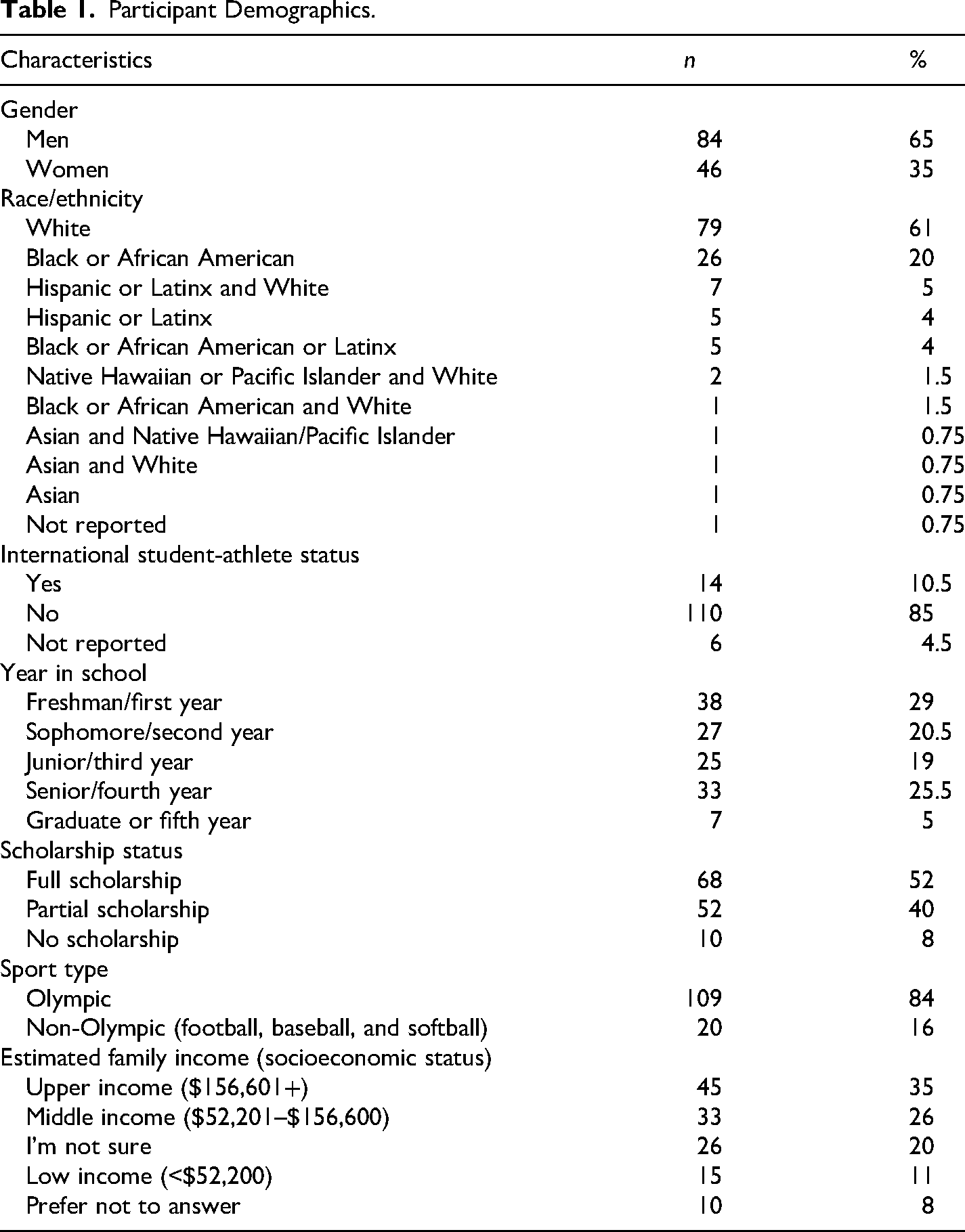
A total of 130 Power Four athletes from one conference completed the survey about their knowledge of and attitudes toward potential employee status. The majority of participants identified as women (n = 84, 65%) and white (n = 79, 61%). Additionally, 14 athletes, or just over 10%, identified as international athletes. Of the 16 sports represented, the largest subsamples came from women's swimming and diving (n = 21, 16%), women's track and field/cross country (n = 20, 15%), men's track and field/cross country (n = 13, 10%), and football (n = 12, 9%). Additionally, the majority of athletes (n = 68, 52%) reported receiving partial scholarships. The distribution of athletes’ academic years was fairly even, with the largest subsample coming from freshmen/first years (n = 38, 29%). See Table 1 for further demographic breakdown of the sample.
Participant Demographics.
RQ1: Athletes’ Knowledge of Employee Status
Knowledge Levels
When athletes were asked how knowledgeable they felt about potential employee status, the majority of athletes (n = 67, 52%) claimed to be “somewhat” or “very unknowledgeable.” Qualitative responses reinforced descriptives, with many athletes encountering the concept for the first time via the survey. Reflecting a common sentiment across open-ended responses, a women's track and field athlete noted, “I didn’t even know this was a thing!” while a football player stated, “I’ve never heard of this idea until this survey.” Conversely, just over one-third of the athletes (n = 36, 34%) felt “somewhat” or “very knowledgeable” on the topic, and 14% (n = 18) were “neutral.” A women's soccer player discussed her neutral responses as actually rooted in a lack of knowledge: “All my responses are neutral because I have like no idea about this topic. I’d like to learn more tho.” This soccer athlete's response suggests that even though some athletes noted neutrality, they may still perceive themselves as lacking foundational information to more critically understand employment debates.
Regarding demographics, chi-square tests showed no statistically significant associations between athletes’ self-reported knowledge of potential employee status and gender χ2(2, N = 129) = 5.56, p = .062; race χ2(2, N = 128) = 2.55, p = .28; scholarship status χ2(4, N = 129) = 7.01, p = .14; sport type χ2(2, N = 128) = 4.93, p = .09; or year in school χ2(8, N = 129) = 6.95, p = .54. However, estimated family income was significantly associated with athletes’ knowledge of potential employee status, χ2(8, N = 128) = 20.83, p = .008. Athletes from more affluent backgrounds had higher self-reported knowledge levels.
Knowledge Topics
Athletes were asked to select from a list (dictated by popular media and scholarly sources) which areas of employee status they felt most and least knowledgeable about (Ehrlich et al., 2023; McCann, 2023; Southall et al., 2023). These included the following: financial implications (e.g., taxes and salary structure); legal rights and protections (e.g., labor laws and unionization); impact on eligibility and scholarships; impact on sport offerings (number of teams); differences between employee and student status; and other topics, with an option for participants to write in topics. Descriptively, athletes expressed feeling most knowledgeable about employment's impact on sport offerings (n = 55, 45%), impact on eligibility (n = 45, 37%), and the difference between employee status and student status (n = 39, 32%). In contrast, athletes felt least knowledgeable about legal rights and protections (n = 92, 73%), personal financial implications (n = 78, 62%), and impact on eligibility (n = 58, 46%).
In their open-ended responses, athletes more frequently addressed topics they were less familiar with, particularly regarding finances. For example, in reflecting financial implication questions, a women's track and field athlete added, “I don’t think I’m eligible to be an employee on the track team. It's not like we’re football or men's basketball and make the school money.” A men's swim and dive athlete questioned, “would I lose what little scholarship I already have as an employee? How does this work with NCAA policies?” Collectively, these responses contextualize the quantitative results, showcasing that athletes’ topical understanding often involved confusion regarding which athletes or sports would realistically benefit from employee status.
Knowledge Attainment
To conclude the knowledge-based questions, we asked athletes to indicate where they obtained their employment information. Athletes could select as many sources/outlets as were relevant from the following options: athletic department programming; discussions with athletic administrators; discussions with coaches; discussions with teammates; discussions with family members; discussions with agent/legal representation; news articles/outlets; social media; and other. Athletes in this sample reported receiving their information predominantly from social media (n = 77, 64%), news articles/outlets (n = 55, 46%), and discussions with teammates (n = 44, 36%). Echoing feelings expressed by multiple participants, a women's basketball player stated, “I get some quick hit points on college sport off TikTok which is helpful and some random news articles I can find. But idk how much to trust whats on social media or really media in general.” This response also connects with the descriptive results showing athletes primarily obtained employment information via social media and news articles/outlets.
Athletes were least likely to gain employment information from coaches (n = 27, 22%), athletic department programming and discussion with athletic administrators (both n = 18, 15%), or agents/legal representatives (n = 6, 5%). Reflecting several participants’ responses about information surrounding employment, a women's cross country and track and field athlete stated: “I honestly have not been informed on anything regarding ‘employee status.’ I have been informed on NIL opportunities and the process regarding NIL. But nothing of the sort regarding employee positions as an athlete.” A baseball player also expressed: “It's really hard to imagine what this looks like when we don’t have the basic information provided to us and we don’t know where to go for it either.” Additionally, a football player's quote summarized the perspective of a handful of athletes who perceived organizational discomfort, even fear from those in current positions of power, around employment conversations: “I can’t imagine ADs or coach here wanting to talk to us hav[ing] more rights. I know fans and coaches already don’t really like some athlete[s] getting paid, maybe being an employee would make those feelings worse.”
To test for significance, each source (e.g., news articles/outlets and social media) was treated as a binary variable (selected or not selected) to examine whether certain participant demographics were more likely to select specific options. Race was significantly associated with receiving information through discussions with athletic administrators χ2(1, N = 129) = 8.16, p = .004 and athletic department programming χ2(1, N = 129) = 8.16, p = .020. For both instances, White athletes were more likely than non-White athletes to report receiving information through these channels. Additionally, gender was significantly associated with athletic department programming χ2(1, N = 130) = 4.22, p = .040, with women more likely than men to receive information through this avenue. Lastly, reliance on family members as a source of information differed significantly by year in school, χ2(4, N = 121) = 11.38, p = .023. Athletes earlier in their sports careers were more likely to rely on family members as a source of information compared to those later in their careers.
RQ2: Athletes’ Attitudes Toward Employee Status
When asked how they felt about the possibility of being reclassified as employees, 46% (n = 58) of athletes reported feeling “very” or “somewhat positive.” A football athlete noted, “If this happens, I’m in!” while a football peer echoed his attitudes: “With NIL money im not sure how many of us in FB really care about this change. But we are employees. I work for my coach and I work for my school.” A men's cross country and track and field athlete added, “I like the idea of giving athletes a chance to earn their salary as an employee. That is how all college athletics should be.”
Still, 27% (n = 34) of athletes expressed feeling “very” or “somewhat negative.” Countering his men's cross country and track and field peers above, another athlete believed employee status to be a “very bad decision” and that “amateurism needs to be restored in collegiate athletics.” In reflecting a common sentiment from Olympic sport athletes, a women's swim and dive athlete claimed, “this is bullsh*t because the money will be going to the big sports of football, basketball, baseball, not women sport like swim and dive or softball.” Similarly, a women's rower echoed: “All I can say is I think this is BULLSH*T. We are STUDENTS and all this stuff and House is going to ruin college sports. WHY ARE THEY DOING THIS?!” Twenty-seven percent (n = 35) selected “neutral.”
When examining whether demographic factors were associated with athletes’ views on potential reclassification, family SES showed a significant relationship with overall feelings toward reclassification χ2(10, N = 93) = 20.89, p = .022. Athletes who came from higher SES backgrounds reported more favorable attitudes toward reclassification. Additionally, chi-square analyses demonstrated significant gender differences with men more likely than women to support employee status χ2(3, N = 130) = 12.27, p = .007. Sport type also showed a significant association with athletes’ overall attitudes, as non-Olympic athletes showed more positive views toward reclassification compared to Olympic sport athletes, χ2(5, N = 126) = 14.68, p = .012.
Employment-Based Thrills and Concerns
Athletes were asked to select which topics, stemming from popular and scholarly sources (Ehrlich et al., 2023; McCann, 2023; Southall et al., 2023), excited and worried them. When asked about the components of employee status they were most excited about, athletes could select up to three options from a list of the following: loss of student status; loss of scholarship/athletic aid; potential tax implications; financial compensation in the form of salary and benefits; health insurance; legal protections (e.g., labor rights, union representation, and collective bargaining); potential for increased say in team and athletic department decisions; increased pressure and responsibility; potential decreased focus on academics; potential decreased equity between sports in the athletic department; risk of termination for performance reasons; risk of sports being cut/eliminated; other; and none of the above. From this list, athletes were most enthusiastic about employee-like compensation (n = 88, 68%), inclusion in decision-making (n = 63, 49%), and legal protections (n = 47, 37%). In a common stance by participants who supported employment status, a football player stated, “I feel like an employee and I want to be compensated as one,” while a women's basketball athlete agreed: “I feel like an employee most days. I work, play, train hard and feel the scholarship ain’t enough.” In illustrating how athletes connected employment to perceptions of labor, compensation, and contributions to their programs, these responses aligned with quantitative results.
While athletes did not elaborate on having more say in department decisions in their open-ended responses, this excitement option was statistically significant based on scholarship status, χ2(2, N = 130) = 10.69, p = .005. Full-scholarship athletes were more likely to have selected the aforementioned excitement area than partial-scholarship and nonscholarship athletes. Analyses also revealed differences in excitement depending on sport type. Non-Olympic sport athletes were significantly more likely to identify financial compensation as one of the changes that most excites them χ2(1, N = 129) = 6.65, p = .010.
In noting areas of concern, athletes were most worried about loss of scholarships (n = 87, 67%). A women's swim and dive athlete believed, “scholarships help athletes pay for books and housing—seeing there is no time to get even a part-time job—whereas a small salary per hour would not suffice.” The second most common fear was the risk of sport elimination (n = 67, 52%). Like many Olympic sport athletes and those early in their career, a women's tennis athlete provided: “I just got here, I don’t want my sport to get caught [cut] so just a handful of guys can make more money.” The third most prominent worry was the risk of termination for performance reasons (n = 61, 47%). Analyses about the risk of sports being cut or eliminated did not differ across gender, scholarship status, family SES, or year in school, indicating that fear of losing teams was widely shared across this sample of athletes.
However, concern about sport elimination differed significantly by race, χ2(3, N = 129) = 9.69, p = .021, with Hispanic/Latinx and White athletes reporting the highest levels of concern. Concern about sport elimination also differed by sport type, χ2(1, N = 129) = 8.32, p = .004, with Olympic sport athletes more likely than non-Olympic sport athletes to report concern about the possibility of teams being eliminated. Finally, there were differences in concern about termination for performance reasons. Concern for performance termination differed by year in school χ2(4, N = 130) = 17.60, p = .001, as first-year, second-year, and graduate athletes were more likely to select this as an area of concern.
Sport Elimination
Subsequently, we inquired about perceptions of sport elimination, asking: “If athletes are reclassified as employees, would you be willing to see teams eliminated at your institution if it meant better employment benefits and higher compensation for you?” Two-thirds of participants (n = 81, 64%) said they were “somewhat” or “very unwilling” to see teams cut. In alignment with worries commonly expressed across Olympic sport athletes, a men's tennis player noted his fears of sport elimination and his unwillingness to see eliminations unfold: “I think men's tennis would be pretty likely to be cut so I’m unwilling to see sports cut, mine and otherwise.” Expressing fear, a women's soccer player noted, “My fear is our sport getting cut and my friends’ sports being cut so that football and basketball can continue to get priority.” A gymnast added: This argument over status is complex. I noted I would be very unwilling to see teams cut with the fear that my sport, gymnastics, would be cut. However, we also don’t know about the ramifications regarding Title IX and understanding that would lead me to have a stronger opinion on the argument.
So, for some athletes, particularly Olympic sport athletes, their unwillingness to support team elimination was often connected to concerns surrounding sport survival, inequitable resource distribution, and uncertainty regarding the consequences of employee status.
Still, over a quarter of the athletes (n = 35, 28%) were “somewhat” or “very willing” to see teams eliminated. Eight percent (n = 10) selected “neutral.” Expressing his willingness to see other teams get eliminated at his school, a baseball player stated: My understanding is that employee status could be bad for some teams, especially women's teams. I think our baseball program does so much for the university/local area that us being called employees would be accurate. So I think that's accurate and some sports might get cut but also we wouldn’t be cut.
Statements like this athlete's show how some athletes participating in non-Olympic or higher-profile sports may understand employee status as symbiotic with their team's athletic department value.
Similarly, descriptive statistics showed 57% of Olympic sport athletes reported concern about the risk of being cut compared to 20% of non-Olympic sport athletes. Chi-square analyses further supported the notion that Olympic sport athletes were significantly more likely than their non-Olympic sport peers to be concerned about sports being cut or eliminated χ2(1, N = 130) = 9.41, p = .002. In diving deeper, ordinal logistic regression analyses revealed that athletes on partial scholarships demonstrated significantly lower odds of willingness to support the elimination of teams compared to full-scholarship athletes (β = −1.25, SE = 0.36, OR = 0.29, p < .001). Athletes without scholarships also exhibited lower odds of willingness to support team elimination compared to full-scholarship athletes, but this relationship was not statistically significant (β = −0.74, SE = 0.67, OR = 0.48, p = .27). Lastly, ordinal logistic regression analyses examining gender illustrated women were significantly less willing to support team elimination compared to men (β = −1.32, SE = 0.36, OR = 0.27, p < .001).
Unionization and Striking
To conclude the closed-ended portion of the survey, we asked athletes to share their perspectives on two key components of potential employee rights: unionization and striking. When asked how likely they would be to join a national or local union representing college athletes, participants were relatively hesitant. Thirty-eight percent (n = 48) said they were “unlikely” or “very unlikely” to join a union, while 29% (n = 37) were “neutral.” However, 32% (n = 41) said they were “likely” or “very likely” to join a union. Consistent with several athletes in the sample who connected unionization to professional sport models and specific sport representation, a baseball athlete noted: “If we had something like MLBPA I would join based on sport not a collective all sport/athlete union.”
Hesitancy increased when asked, “how willing would you be to strike (not play your sport for part of or even the whole season) to ensure schools provide better ‘working’ conditions for college athletes?” The majority of participants (n = 70, 56%) were “unwilling” or “very unwilling” to strike, and 18% (n = 23) were “neutral.” A football player expressed: “I’d like to know more about the implications of striking. I can’t see striking as an employee and also have the risk of being terminated because I am not an employee.” This athlete's quote described broader uncertainty expressed across responses regarding how employee protections would function in college sport spaces. Still, 26% (n = 33) were “somewhat willing” or “very willing” to strike for enhanced conditions, with a women's basketball player in favor of employment arguing, “if student athletes banded together we could make this change happen.”
When chi-square analyses were conducted using collapsed response categories, gender was not significantly associated with willingness to join a union, χ2(2, N = 67) = 2.85, p = .24, indicating that men and women expressed similar sentiments toward potential athlete unionization. However, gender was significantly associated with willingness to strike χ2(2, N = 94) = 7.28, p = .026, with men reporting greater willingness than women to withhold sport participation to potentially have improved working conditions. Sport type was significantly associated with both the likelihood of joining a union χ2(2, N = 67) = 14.36, p < .001 and willingness to strike χ2(2, N = 94) = 13.63, p = .001. Athletes in non-Olympic sports indicated higher support for unionization and greater willingness to strike compared to athletes in Olympic sports. Finally, a chi-square test of independence indicated athletes’ attitudes toward potential employee reclassification were significantly associated with their likelihood of joining a union, χ2(16, N = 125) = 31.25, p = .013. This association was moderate (Cramer's V = .25), indicating that athletes expressing more positive attitudes toward employee reclassification reported greater support for union membership.
Discussion
Through the lens of amateur and commercial logics, the findings above indicate that athletes have relatively mixed knowledge of and attitudes toward potential employee status. However, athletes did not interpret potential employment uniformly, as their knowledge/perceptions differed based on key demographics and the influence of logics. Although all athletes operated within similar Power Four structures, institutional logics are not experienced or interpreted neutrally (Macaulay et al., 2025), as athletes’ social positioning, sport context, and access to resources may shape how they understand and evaluate employment-related issues. So, in connecting back to the literature on logics and employment, this section discusses why some of our findings may have emerged.
First, athletes’ knowledge levels varied, but most athletes expressed a superficial understanding of a potential change in status. The only demographic factor that differentiated athletes’ knowledge of potential employee status was estimated family income, suggesting that athletes’ understanding of their legal and labor status is shaped by their broader socioeconomic positioning. Indeed, even as they operate within similar governance systems, athletes may engage with amateur and commercial logics and expectations differently depending on previous access to information or socioeconomic resources. This further reflects how access to labor knowledge and legal literacy is unevenly distributed across class lines.
Regarding their specific knowledge, the topics athletes contended they knew the most about often aligned with fear-based discourse surrounding employee status, as these discussions often center around team elimination and athletes’ loss of participation opportunities (Testimony of Charlie Baker, 2023; Testimony of Keke Tholl, 2024). Fear-based narratives about team elimination and reduced participation opportunities are rooted in historic amateurism rhetoric (Harry, 2023, 2025; Testimony of Mark Emmert, 2021), and as such, athletes’ perceived knowledge indicates how the amateur logic continues to shape athletes’, especially Olympic sport athletes’, understandings of employee status through narratives of participation opportunities.
Athletes also conveyed insufficient understanding of legal and financial topics. Such topics are complex and rarely discussed at length with college athletes (Comeaux, 2018; Shropshire & Williams, 2017). These knowledge gaps show how amateurism has prevented some athletes from reflecting on the legal and financial realities of their own labor. As a result, the permeation of amateur logics into their cognitive schemas (Thornton et al., 2012) may have limited their engagement with information about these important topics. Finally, “impact on eligibility” was selected by athletes as an area athletes were most and least knowledgeable about. This may indicate that this topic matters to athletes in the sample, but they lack clarity on how employment would change eligibility standards.
Athletes’ knowledge about potential employment is also constructed via information provided through communication channels to athletes, namely social media, news articles/outlets, and teammates. Institutional logics are reinforced via communication and interaction (Thornton et al., 2012), so these informational sources likely play a significant role in informing what athletes understand and how they feel about potential employment. Similarly, when it came to more structured information from athletic administrators and athletic department programming, significant differences emerged, with White athletes more likely to report receiving information via these channels. Such findings align with research noting the longstanding patterns of racialized trust (mistrust) and gatekeeping, allowing white athletes access to greater administrative channels and information (Shropshire & Williams, 2017). As such, White athletes in this sample may have been more incorporated into communicative/informative structures compared to others. Furthermore, their greater access to athletic administrators/programming may provide increased socialization into institutional messaging about employment, while non-White athletes may be more likely to rely on external or informal informational channels to interpret and establish opinions on potential employment. Unequal access to organizational communication/information structures shapes not just athletes’ knowledge attainment, but also how amateur and commercial logics are encountered and understood differently across racial groups within similar athletic environments (Macaulay et al., 2025).
Women athletes were also more likely than men to report receiving information from programming. Previous research suggests women athletes are more involved with issues related to equity, governance, and institutional reform, due to their heightened experiences with inequities (Cooky & Antunovic, 2020). As a result, women athletes may engage differently with competing amateur and commercial logics, often favoring amateur values that appear to promote more equity and access for women (Ehrlich, 2023; Harry, 2025). In addition, reliance on family members as an information source differed by year in school, with athletes earlier in their careers more likely to retrieve employment information from family compared to athletes further along in their collegiate careers. This indicates that athletes’ reliance on family members as an informational resource in this specific space may decrease as athletes progress through college. Such a pattern may demonstrate that athletes earlier in their college careers initially understand college sport through external support systems before becoming more immersed in NCAA messaging and logics over time.
Still, athletes relied heavily on a common set of external sources (social media and news), even as access to institutional channels varied by race and gender. Importantly, these outlets may offer insufficient, superficial, or even inaccurate information. Indeed, considering that many athletes in this sample expressed limited knowledge on the topic, it is likely that these outlets have not provided adequate educational backing for athletes to feel fully knowledgeable or comfortable with basic or intricate concepts pertaining to employee status. This partial awareness of employee status underscores how the amateur logic continues to shape the flow of knowledge and, potentially, athletes’ miseducation (Shropshire & Williams, 2017), as athletes remain largely excluded from institutional and financial conversations that determine their opportunities and experiences.
Exclusion from these conversations may be unintentional or strategic. First, athletic leaders who maintain the college sport commercial complex (Southall et al., 2023) may intentionally or inadvertently deprioritize athlete education on macrolevel legal or labor developments (Comeaux, 2018). This may help ensure athletes maintain their focus on performance, compliance, and public image while avoiding “distractions” that could prompt athlete concern or even resistance. Second, limited athlete education may arise from practical constraints, as administrators focus on immediate operational demands and neglect dissemination of knowledge (Springer, 2025). Still, this lack of athlete education functions as a form of control. In restricting understandings of labor, finances, and employment rights, sport leaders may protect their institutional power and the flow of revenue within athletic departments (Comeaux, 2018; Southall et al., 2023). Broad athlete literacy regarding employment has the ability to help destabilize longstanding hierarchies, such as the economic privileging of administrators and coaches, and disrupt the financial underpinnings of college sport. Such programming, however, may be misaligned with the interests of sport managers and institutional leaders who benefit from existing power structures. And so, this reveals a governance tension in college sport: while athlete education is framed as a developmental institutional responsibility under amateur principles (Testimony of Mark Emmert, 2021), expanding labor and compensation literacy can simultaneously challenge amateur values across the system and promote a more commercialized enterprise that is rooted in athlete knowledge and power.
Importantly, the knowledge, or lack thereof, athletes have about potential employee status is likely to inform their attitudes. Despite previous comments by NCAA President Charlie Baker (Testimony of Charlie Baker, 2023), almost half of the athletes in our sample expressed positive attitudes toward employee status. Such findings demonstrate a growing openness to a new, even further commercialized collegiate model for some athletes as they start to acknowledge their contributions to their athletic departments and institutions.
These positive sentiments of employment were more commonly indicated by men. Men's sports are traditionally associated with more commercialized environments and the commercial logic, so employment may be understood as another pathway to monetize their athletic skills and labor. Women athletes, whose sport access is often “protected” under an amateur logic (Ehrlich, 2023), may see more disadvantages with commercialized changes that come with employee status. Favorability toward employment was also higher for non-Olympic sport athletes. Although some Olympic sports are commercialized, non-Olympic sport athletes may be more likely to encounter commercial logics through mechanisms that create personal financial opportunities (e.g., NIL deals and collective involvement), making employment appear more financially fruitful to them (Southall et al., 2023). On the other hand, Olympic sport athletes’ more negative attitudes align with the fear discourse discussed in the knowledge section above and may reflect a stronger exposure to and acceptance of amateur logics, particularly surrounding participation opportunities.
Similarly, athletes from more affluent families were more positive toward employment. These athletes may see some of the financial and legal shifts from potential employee status as less risky compared to their less affluent peers. Thus, for those from higher SES backgrounds, the commercialization aspect of employment may align with what they are used to. Lower SES athletes may see the current—historically “amateur” system—as more stable (e.g., consistent scholarships over potentially fluctuating salaries) and therefore perceive employment as a threat to the protections they associate with amateur logics.
Still, athletes expressed areas of excitement regarding employee status. Athletes’ interests in employee-like compensation, voice, and legal protections show their increasing alignment with commercial logics that recognize and appreciate their athletic labor. Similarly, desires for more say in decisions about the future challenge the amateur logic grounded in control and power over their experiences (Southall et al., 2023). It also appears rational that non-Olympic sport athletes would show higher selection rates for financial compensation, as it aligns with their commercial logic exposure. Employee-like compensation may seem consistent with their current experiences. Interestingly, in reflecting amateur-commercial tensions (Macaulay et al., 2022; Nite, 2017), athletes were not all in on commercial values. Athletes did express concerns about scholarship loss, termination, and sport elimination. Such hesitancies demonstrate that athletes see a shift toward employment and further commercial entrenchment as dismantling some of the protections rooted in amateurism (Testimony of Mark Emmert, 2021).
Importantly, some athletes’ responses did note a willingness to trade institutional norms and standards, such as sport offerings, for perceived improvements from employee status for themselves or their teams. Indeed, such attitudes emerged in responses from non-Olympic sport athletes, who, already engaged in highly commercial/professional sport spaces, may view sport elimination as a necessary side effect of reforming college sport (McCann, 2023). Additionally, because their sports are more aligned with revenue and visibility, they are less likely to be cut; so, they may feel more insulated from any consequences stemming from an employment model.
Countering this, Olympic sport athletes have historically depended on the longstanding amateur model to preserve their participation (Harry, 2025), and thus, may oppose team cuts to preserve their own opportunities and the futures of their sports. This demonstrates how sport type influences how athletes experience and internalize logics in varied ways, potentially dependent upon how they perceive they are valued and/or vulnerable within structural changes.
Finally, the majority of athletes in the sample noted more negative attitudes toward unionization and striking, both of which are consistent with professional sport models. Athletes’ lack of support for these actions may reflect the maintenance of amateur logics, buttressed by limited education and discourse surrounding the topics. Ironically, many of the risks athletes noted, such as scholarship termination and team cuts, are the same issues that collective bargaining and unionization efforts could help regulate (Southall et al., 2023). But, under amateur logics, unions are framed—and understood—as destabilizing rather than as potential sources of protection, which may help explain athletes’ hesitancy to support them. Similarly, athletes may feel skeptical considering the outcomes of previous unionization attempts at Northwestern and Dartmouth (Bivens, 2017; McCann & Libit, 2024). Men and women showed similar attitudes toward joining a union, but gender differences emerged in striking, with men seeing it as more favorable. Men may have responded this way due to their potential leverage in the college sport system, while women may see striking as a threat to their historically precarious sport opportunities (Staurowsky, 2018). Non-Olympic sport athletes were also more likely to consider striking, potentially because their sports are more enmeshed in the commercial values of the current college sport structure.
However, athletes’ support for union membership was strongly associated with their attitudes toward employment, with individuals expressing more positive views of employee status also more likely to support joining a union. This pattern shows an emerging alignment with commercial logics and labor-based thinking, as college athletes who lean toward employee status are more likely to support representation and move away from historic amateur ideals. Ultimately, these findings further demonstrate that athletes within similar Power Four environments may engage with and interpret amateur and commercial logics differently depending on their background, sport context, and perceived value and/or vulnerability within the college sport system.
Implications
As one of the first studies to explicitly explore athletes’ knowledge and attitudes toward potential employee status, our results offer several important scholarly and practical implications.
Scholarly Implications
This study amplifies athletes’ knowledge of and attitudes toward an employment model, offering their perspectives on shifting governance reform during a time that has centered on NCAA-led narratives (Harry, 2025; Southall et al., 2023; Testimony of Charlie Baker, 2023). The findings above demonstrate athletes’ occupation within a broad and contested sport labor market where their status remains uncertain. By examining their perspectives surrounding employee status, this study extends sport labor and employment scholarship by showing how perceptions of “employee” are not static, especially in the new and shifting college sport environment.
By centering athletes’ sensemaking processes, this study extends institutional logics scholarship beyond its traditional focus on administrators, coaches, and governing bodies (Robertson et al., 2021), demonstrating that athletes are not just governed by institutional logics but are engaged individuals who selectively draw upon and blend these logics in response to changing structural conditions. Importantly, this highlights how individuals in positions with constrained power navigate and interpret institutional values surrounding labor, rights, and power. Rather than fully internalizing amateur or commercial logics, athletes in this sample selectively drew from both depending on the issue, expressing support for compensation, voice, and legal protections while simultaneously endorsing amateurism-based concerns about scholarships, sport elimination, and job security. These results underscore that institutional logics are not uniformly enacted across organizational actors but are cognitively mediated (Macaulay et al., 2025; Nite & Washington, 2025) and shaped by actors’ status within broader systems of power and access (Macaulay et al., 2022).
In fact, athletes’ alignment with amateur and/or commercial logics is informed by the knowledge and education they have access to, and through which avenues. In line with institutional theory, knowledge is a significant boundary for logic interaction and enactment (Thornton et al., 2012). Knowledge does not just determine which logic athletes draw from, but also shapes the depth to which they understand and are able to engage with said logics at all. As demonstrated by the results, athletes’ limited interaction with more commercial information may hinder their abilities to engage fully with commercial logics and understandings, thus limiting how they interpret their labor and rights. Still, athletes’ coexisting desires for enhanced compensation, voice, and legal protection with their fears of scholarship loss and sport elimination show a blending of logics (Macaulay et al., 2022). In this way, amateurism continues to structure how athletes assess risk and vulnerability, while commercial logics increasingly shape their aspirations for recognition and rewards (Testimony of Chase Griffin, 2024). These findings align with previous literature on hybrid and blending logics as athletes navigate competing and complex understandings of their sport experiences (Comeaux, 2018; Macaulay et al., 2022; Southall et al., 2023). Similarly, results bolster the influence of knowledge as a mechanism through which logics are filtered and enacted at the microlevel of college sport (Nite & Washington, 2025).
Ultimately, athletes’ knowledge of and attitudes toward potential employee status showcase how institutional logics are internalized and negotiated at the microlevel of college sport. As amateurism wanes and commercialization abounds, athletes’ engagement with these dueling logics will likely play an important role in shaping the future of college sport.
Practical Implications
The implications of this study center on how knowledge, power, and access shape athletes’ ability to engage with evolving labor conditions in college sport, with actionable considerations for athletes, administrators, and policymakers. More specifically, the findings point to a previously unarticulated tension: athletes in this sample were more open to employment, compensation, and voice, yet lacked sufficient knowledge to fully support or act on such ideas and reforms.
Athletes should be encouraged to actively seek and engage with information related to employment, labor rights, and compensation structures as these discussions continue to evolve. Given the limited and uneven knowledge demonstrated in this study, relying solely on informal sources such as social media or peer discussions may not provide sufficient understanding of how potential reforms could affect individual rights and opportunities. Additionally, athletes may benefit from engaging in conversations with knowledgeable stakeholders (e.g., legal experts, athlete advocates, or informed administrators) and seeking out credible resources that clarify topics such as unionization, collective bargaining, and employment protections. Athletes who want a stronger say in decision-making should learn how different forms of representation and collective action (e.g., unions or athlete groups) work, as this can help them more effectively participate in future discussions about policy and change.
Administrators and those working directly with athletes should prioritize the development and delivery of clear and consistent information regarding potential employment-related changes. The findings indicate that many athletes are being asked to interpret complex policy shifts without a shared baseline of understanding. Practically, this may involve implementing informational sessions, educational programming, or resource materials outlining how employee status could impact scholarships, eligibility, compensation, and their future responsibilities. These efforts should be informational rather than persuasive, allowing athletes to form their own perspectives based on comprehensive information. At the same time, increasing athlete understanding may change how athletes respond to and engage with existing structures, requiring administrators to be prepared for these shifts.
In addition to improving information access, athletics leaders should reconsider how athlete voice is incorporated into decision-making processes. Existing structures, such as student-athlete advisory committees, may not provide sufficient influence over key policy decisions. Creating opportunities for athlete input that are directly tied to decisions about compensation, working conditions, and sport offerings can support more meaningful participation. These efforts to enhance athlete participation should be paired with clear expectations about the scope and impact of that input to ensure both meaningful engagement and organizational clarity.
Policymakers should more directly incorporate athletes into the policy development process, rather than treating them as passive recipients of reform. Indeed, the findings above suggest that athletes’ uneven knowledge of employment raises concerns over whose perspectives are included and excluded from discussions shaping policies that directly impact athletes’ experiences and rights. To address this, policymakers at both the NCAA and federal levels should create formalized opportunities for athlete participation during the policy creation process. This may include expanding athlete representation on NCAA governance bodies, integrating athlete advisory panels into legislative discussions, and inviting a broader and more diverse group of athletes to testify at hearings beyond the small number traditionally included (Testimony of Keke Tholl, 2024). Ensuring representation across sport types, gender, and socioeconomic backgrounds is particularly important, as this study demonstrates that attitudes and knowledge vary across these groups. These efforts build upon informing athletes and position them as key contributors to sport governance processes. Without such inclusion, policy decisions risk reinforcing existing power imbalances by shaping athlete labor conditions without adequately incorporating athlete voice.
Together, these implications suggest that improving access to information, strengthening avenues for athlete voice, and ensuring clearer communication across stakeholders are critical steps in supporting more informed engagement with ongoing changes to athlete labor and employment in college sport.
Limitations and Future Research
Despite our important findings surrounding college athletes’ knowledge of and attitudes toward potential employment, there are a handful of limitations. The first limitation is the generalizability of the findings. This sample of participants came from one Power Four conference, and as such, findings may be limited to other Power Four conferences or schools/programs in other levels of NCAA competition. It would be beneficial for future research to examine other athletes’ employment knowledge and attitudes to compare across conferences, divisions, and institutional resource levels. Additionally, this sample was also limited by a lower response rate, which may also indicate self-section bias as athletes with stronger opinions on the topic may have been more likely to complete the survey. Furthermore, the sample size limited statistical power and needed several analytic decisions to meet test assumptions, such as placing athletes into core sport categories (e.g., Olympic and non-Olympic). While appropriate, these decisions may conceal some meaningful variation across individual sports. Future studies could add to these findings through larger samples.
Similarly, other methods could add more depth to athletes’ knowledge of and attitudes toward employee status through interviews or focus groups. Future studies could use longitudinal designs to track patterns in athletes’ sensemaking and opinions as labor discourse in college sport continues to evolve. Another key limitation is the reliance on athletes’ self-reported knowledge, which may not align with their actual legal or policy knowledge. As such, future studies could address this limitation by creating more objective knowledge measures, such as scenario-based questions, to more deeply examine gaps in actual and perceived understanding of the athlete employment conversation.
Conclusion
This is one of the first studies examining college athletes’ knowledge of and attitudes toward potential employment. In their responses, athletes conveyed limited and uneven knowledge of potential employee status as they relied on external and informal resources and demonstrated limited understanding of topics related to commercial logics, such as financial implications and legal protections and rights. Despite their limited knowledge on the topic, athletes leaned more in favor of employment, supporting a more commercialized model of college sport. Still, in alignment with historic amateur values, athletes demonstrated conflicted attitudes about fears of team elimination and loss of scholarships, and held uncertain or negative perceptions of unionization and striking. Ultimately, this study contributes to institutional logics literature as college athletes emerge as active sense-makers navigating contradictory logics with limited information and education. As college sport enters an era of unprecedented transformation, these findings suggest further supporting athletes must be requirement for an equitable and informed future for college athletes.
Footnotes
Funding
The authors received no financial support for the research, authorship, and/or publication of this article.
Declaration of conflicting interests
The authors declared no potential conflicts of interest with respect to the research, authorship, and/or publication of this article.
