






Abstract
The issue of football (soccer)-related fan violence encompasses a broad spectrum of aggressive behaviors associated with football games and the wider football culture. Although this problem has been studied for many decades, it has primarily been explored as a match-day-related issue. In reality, however, fan violence is not confined to the context of matches; it also permeates everyday life. Yet, the problem of everyday fan violence has remained largely untouched by academic research. This article aims to address this gap by (a) empirically identifying and conceptualizing everyday manifestations of football-related fan violence; (b) analyzing how these acts are justified by football fans, thereby explaining how fan violence is transferred, legitimized, and reproduced in everyday settings; and finally, (c) examining how this relates to existing theories on fan violence in football. To this end, this study utilizes data from 41 semi-structured individual interviews with ultras (22) and ordinary football fans (19) supporting Polish football clubs in derby cities/regions. Through abductive thematic analysis of their experiences, we identify nine forms of everyday fan violence, which we categorize into two broader themes relating to their main causes: turf wars and rivalry-driven spontaneous violence. We also identify the primary legitimization strategies employed by Polish football fans to justifying football-related fan violence in everyday settings, categorizing these into two themes: cultural violence and the quest for excitement. Finally, we apply theoretical triangulation by bridging existing theories on fan violence to explain why and how football-related violence is transferred and reproduced in everyday life.
Introduction
The issue of football-related fan violence encompasses a broad spectrum of aggressive behaviors associated with football games and the wider football culture. Although it has been studied for many decades, becoming one of the most researched topics in the social sciences of sport (Moorhouse, 2000), its examination has been limited to spontaneous and emotional acts of spectator violence (e.g., King, 1995; Pearson, 2012; Stott & Reicher, 1998) and organized, competitive violence, often framed as football hooliganism (e.g., Antonowicz & Grodecki, 2025; Armstrong, 1998; Dunning et al., 1988; King, 2001; Spaaij, 2006; van Ham et al., 2022). In other words, it has primarily been explored as a match-day-related issue, as even organized groups of hooligans have attracted researchers’ interest due to the problems they cause at football games. However, fan violence is not limited to these dimensions; it extends far beyond, penetrating everyday life.
Yet the problem of everyday fan violence has remained largely unexplored by academic research. One possible reason for the lack of interest in this issue is that acts of fan violence in everyday life are less visible in the public debate than high-profile disorders at football games. Additionally, they remain elusive in public statistics, which fail to distinguish football-related acts of violence in everyday life from ordinary crime. Despite their lower profile, manifestations of fan violence in everyday settings constitute a serious problem for social life. Some hooligan clashes occur in everyday urban settings, such as public houses, causing public disturbances and damage to property. Everyday violence also involves ultras and other typically nonviolent fans who can be both perpetrators and victims (Grodecki & Rookwood, 2025; e.g., Onet.pl, 2026). The presence of fan violence in everyday life translates into an overarching fear of football-related violence, affecting fans’ lives, as evidenced further in this article. Since fans are afraid to wear their favorite club colors or visit specific districts, streets, or bars considered to belong to supporters of rival football clubs, it impacts how they dress or commute through cities. By extending the research scope beyond game-day violence and hooligan groups to include everyday manifestations of fan violence, we can gain a fuller understanding of the issue of football-related violence, including its easily overlooked consequences for daily life and its social costs.
This article aims to address the existing gap in academic knowledge by (a) empirically identifying and conceptualizing everyday manifestations of football-related fan violence; (b) analyzing how these acts are justified by football fans, thereby explaining how fan violence is transferred, legitimized, and reproduced in everyday life; and finally, (c) examining how this relates to existing theories on fan violence in football. We understand violence according to the standard WHO definition, which states that violence is the intentional use of physical force or power, threatened or actual, against oneself, another person, or against a group or community, that either results in or has a high likelihood of resulting in injury, death, psychological harm, maldevelopment, or deprivation (WHO, 2002, p. 5). To be considered football-related fan violence, it must be motivated or rationalized by football rivalries (Grodecki & Rookwood, 2025), which means that supporting a rival or another football club is used as a justification for violence against another person or people. The everyday dimension implies that fan violence occurs outside the context of football matches, namely in settings other than the football matches themselves, before and after the matches or during transportation to or from away matches. However, our analysis excludes pre-arranged hooligan fights (see van Ham et al., 2022) such as self-ruled setup fights (Antonowicz & Grodecki, 2025). Although technically these fit into the definition of everyday fan violence, as they often occur outside the match context, they concern only a small minority of hooligans who participate voluntarily and, most importantly, they are already well described in the existing literature. Finally, we focus solely on manifestations of everyday violence in real life. While we do not neglect the consequences that online football-related hatred can cause, we consider it as a phenomenon guided by a different logic than real-life manifestations of everyday violence (e.g., Manoli et al., 2025).
This study utilizes data from 41 semi-structured individual interviews with ultras (22) and ordinary football fans (19) supporting Polish football clubs. Using abductive thematic analysis (ATA) as our analytical method (Timmermans & Tavory, 2012; Thompson, 2022), we identify and conceptualize forms of everyday football-related fan violence and fans’ justifications in the form of legitimization strategies. Finally, we apply theoretical triangulation by bridging existing theories on fan violence to explain why and how football-related violence is transferred and reproduced in everyday life.
The article begins with an overview of research and theories on fan violence in football. It then moves to the methods section, where the research context, methods of data gathering, sampling, participants, and analytical framework are described. Next, the results of the analysis are presented, divided into two parts: the first introduces identified forms of everyday fan violence, while the second focuses on legitimization strategies. Following this, in the discussion section, we build on existing theories on fan violence to explain the potential genesis of everyday fan violence and the mechanisms behind its reproduction. Finally, we discuss the limitations of our study, directions for future research, and implications for practice.
Fan Violence in Football in Academic Research
A considerable body of research exists on fan and hooligan violence in football, exploring different dimensions of this problem. Early studies considered hooliganism as a voice of frustration from economically excluded communities (e.g., Clarke et al., 1976; Taylor, 1971). They also focused on the role of the media, showing how moral panics created an “amplification spiral” that strengthened the development of the football hooliganism subculture (Hall, 1978). These theories, however, focused primarily on explaining the genesis of the football hooligan subculture. Other works employed interactionist theories to conceptualize the actors and dynamics contributing to the outburst of game-day violence (Brechbühl et al., 2017; King, 1995; Stott & Reicher, 1998). However, because of their strong contextual focus on the match-day violence, this line of research lacks the capacity to understand its everyday manifestations. More recent studies have examined the role of identity fusion behind the violent attitudes of football fans (Newson et al., 2018) or employed General String Theory to understand their violent tendencies (Shadmanfaat et al., 2022). These theories are useful in explaining driving forces behind individuals’ engagement in violence, but they cannot fully account for how and when this violence is legitimized by (sub)cultural norms. In this review, we would like to focus only on those conceptions and findings that may help explain the dislocation of fan violence and the processes through which it becomes legitimized.
Many previous works have highlighted that fan violence and hooligan rivalry generate excitement (Collins, 2008; Elias & Dunning, 2008). In this regard, football games are also considered to provide a social context in which carnivalesque practices emerge, involving the temporary suspension or inversion of certain social norms. Associated with the football “carnival,” fan violence allows for a transgression from everyday life, enabling individuals to step outside their routine and experience intense emotions (Giulianotti, 1999; Pearson, 2012). Another major factor highlighted by existing works is the connection between hooligan/fan violence and territory (Armstrong, 1998; Armstrong & Giulianotti, 2002; Clarke et al., 1976; Dunning et al., 1988; Spaaij, 2006). Researchers from the so-called Leicester School (Dunning et al., 1988) traced the origins of football hooliganism to patterns of aggressive masculinity associated with the rough working class, a class that did not catch up with the modernization of the rest of English society after World War I. One cultural characteristic among young males from this class was a strong territorial attachment, where defending territory was a way of demonstrating manhood. These patterns were transferred to football grounds, which became considered their turf, making the acquisition of opponents’ terraces central to hooligan rivalry (Dunning et al., 1988). The rules governing these “turf wars” were described by another early research, which showed that hooligan rivalry follows symbolic (ritualistic) violence known as aggro. As it is focused more on demonstrating readiness for violence than on physicality (Marsh et al., 1978), hooligan rivalry revolves around driving opponents from turfs considered to be their territory, thereby demonstrating symbolic dominance. However, since symbolic violence rarely produces a clear winner, the outcomes of such confrontations are typically subject to collective negotiation (King, 2001).
Initially limited to football matches and stadium ends, usually occupied by young males from lower-class backgrounds (Armstrong & Giulianotti, 2002), hooligan turf wars have spread to broader match-day settings, including means of transport and travel to away games (Dunning et al., 1988), and further to more secluded locations and urban spaces (Spaaij, 2006). The dislocation of hooligan competitive violence was a consequence of counter-hooliganism policies identified across different countries, including the expansion of police powers and increased surveillance at football stadiums (e.g., Divišová, 2024; Tsoukala et al., 2016; Lee Ludvigsen, 2025). These policies targeted mainly the aftereffects rather than the causes of hooligan violence, effectively reducing violent acts at stadiums but being inefficient in combating football hooliganism and football-related violence as a practice in general (Antonowicz & Grodecki, 2018). By focusing solely on manifestations of violence, these policies did not eliminate hooligan groups and fan violence. Instead, hooligan groups adapted to new policing and surveillance measures (Dunning et al., 1988), becoming better organized and moving their competitive violence outside football grounds, where it has been institutionalized and is harder to control. Ultimately, such policies contributed to the emergence of modern hooliganism, characterized by direct physical confrontations in secluded locations (e.g., forests; Antonowicz & Grodecki, 2025). Most importantly, however, they also contributed to the redefinition of urban spaces that hooligans identify as their symbolic territory. Public houses, such as bars and nightclubs (Armstrong & Giulianotti, 2002), as well as certain streets (Spaaij, 2006), have become defined as hooligan turfs, which may also be contested in everyday contexts.
The works described provide insights into how football-related violence is linked with space, demonstrating why and how hooligan groups identify and (re)define their symbolic turfs over which their competitive violence revolves. However, as previously mentioned, everyday fan violence extends beyond hooligan rivalries, as ultras and nonviolent fans can also be perpetrators and victims of fan violence. Existing research shows that some hooligan rivalries can be romanticized and acknowledged by nonviolent fans as yet another dimension of football rivalry, in which hooligans act as representatives of their club, fighting with rivals for its greater reputation (Rookwood & Pearson, 2012). This indicates that hooligan rivalry is normalized by other fans and, to some extent, passively accepted or even supported. Since hooligan rivalry can be justified by nonviolent supporters, this may also suggest that they acknowledge hooligan turfs as belonging to their supporters’ community and may legitimize instances of violence to protect them from rival supporters.
Finally, the theory of football rivalries ideology (Grodecki & Rookwood, 2025) directly conceptualizes everyday manifestations of fan violence. It considers football rivalries as a form of cultural violence (see Galtung, 1990) that legitimizes and institutionalizes fan violence. The specific way in which culture legitimizes violence is through ideology, which creates and justifies social divisions (Galtung, 1990). In this regard, football rivalries ideology creates conflicting football identities that generate or intensify social divisions, providing justifications for these divisions. This way of thinking has achieved hegemony in the sporting world, reproducing rivalry-related divisions as something taken for granted. Importantly, however, football rivalries have been linked with fan violence through contingent historical processes and are being used as a justification for fan violence. As a result, football rivalries ideology provides legitimization for fan violence, reproducing the association between violence and football (Grodecki & Rookwood, 2025). Crucially, football rivalries ideology does not operate solely in the context of football games but also in everyday life. The main mechanism behind everyday violence is that rival colors evoke the logic of football rivalries ideology in daily life, justifying the use of violence against other fans, especially against “trespassers.” There are two main processes triggering this. Firstly, everyday violence can be a side effect of hooligan turf wars. In this regard, other fans can be assaulted by hooligans for wearing rival club memorabilia, especially on their turfs. The second mechanism explains why violence in everyday settings can be enacted by nonhooligan fans or even nonfans with strong local identities. This is because football rivalries ideology has been adapted into the wider norms of aggressive masculinity. The logic of hooligan turf wars has defined certain local territories (specific neighborhoods, bars, streets, cities, etc.) as belonging to fans supporting a given football club, thereby linking local identities with football identities. This means that local team colors also symbolize being from “here.” Conversely, other team symbols mark outsiders. Since defending territory is one way of proving one's masculinity, individuals identified as rival fans approaching such territories are considered strangers who need to be driven away to prove one's manhood (Grodecki & Rookwood, 2025). This is significant, as it demonstrates that the logic behind football-related fan violence can also be adopted in everyday settings by nonfans, affecting urban culture and public safety.
Methodology
Research Context
Fan violence in football is evidenced as a global phenomenon that adapts to local cultures (Young, 2019) and the same has been argued for its everyday manifestations (Grodecki & Rookwood, 2025). Poland has followed a trajectory of fan violence development similar to that of other (Western) European countries (Spaaij, 2006); however, due to the legacy of the communist regime, fan disorder at football games reached its peak only in the 1990s, driven by the rapid development of organized hooligan groups during the early years of systemic transition. Since then, physical clashes between fans/hooligans have been almost entirely eliminated from football games through the implementation of numerous safety measures, making Polish stadiums among the safest in Europe in this regard (PZPN, 2025). At the same time, however, fan violence thrives outside the context of football matches. Everyday manifestations of intraclub fan/hooligan violence have been present for several years now, developing into an institutionalized field of fan competitive violence, as suggested by unsystematic media reports (e.g., Onet.pl, 2026). Crucially, the vast majority of domestic football rivalries in Poland do not reflect wider political, class, ethnic, or religious tensions, which are the main historical factors in some other sociocultural settings (Dmowski, 2013). In other words, rivalries between Polish football clubs inflame existing local animosities or constitute separate lines of division rather than mirroring existing ones. This stems from the history of the communist regime, which adopted existing sports clubs to represent specific branches of the public sector, surpassing class-, religious-, or ethnic-based football rivalries that developed in Polish society before World War II. This is important to consider, as research in the Polish context allows for a focus on “pure forms” of fan violence motivated by football/fan rivalries, separating it from cases where fan violence intersects with wider social divisions.
Method and Participants
This study utilizes data from 41 semi-structured individual interviews with male ultras (22) and male ordinary football fans (19) supporting Polish football clubs. Both ultras and ordinary fans have a strong emotional bond with their football club, building their identities around it and demonstrating loyalty (Giulianotti, 2002). Ultras participate in home and away support regardless of their team's sporting results, as well as engage in a range of daily fan activities (such as painting graffiti), with the risk of facing violence from rival ultras/fans. Some of them voluntarily engage in fan violence on occasions. However, in the Polish context, hooligans—defined by their self-identification with a hooligan subculture—have emerged as a recognized, separate groups responsible for competitive violence between football fans. On the other hand, ordinary fans’ engagement is primarily limited to home matches, where they are more inclined to take neutral seats and watch matches in peace. Nonetheless, similar to ultras, they maintain a strong emotional connection with their clubs, often manifesting their identity outside of game days. We included these two types of football fans because of their potentially different experiences with violence and varying levels of violence legitimization. We do not focus on hooligans since they are, by definition, involved in competitive violence, and our study aims to examine the extent to which and in what roles everyday violence engages other football fans. We concentrate on male supporters due to the strong relationship between fan violence and aggressive hypermasculinity, in which only men are considered justified targets/opponents (or are at least claimed to be; see Dunning et al., 1988).
Interviews were conducted with fans supporting 10 Polish clubs (Arka Gdynia, Lechia Gdańsk, Legia Warsaw, Polonia Warsaw, ŁKS [Łódź], Widzew Łódź, Cracovia [Cracow], Wisła Cracow, Górnik Zabrze, and Zagłębie Sosnowiec), with the assumption of including two ultras and two ordinary fans from each club. The list of clubs was predefined, as all these teams have strong derby/local rivals, which is important since such rivalries are considered the most intense in terms of provoking fan violence (Marsh et al., 1978).
We employed purposive sampling, assigning participants to analytically distinct groups based on the following operationalization: (a) regular participation in away support and (b) experiencing home football matches from chanting stands for ultras; and regular home matches attendance for ordinary fans. Participant recruitment was carried out in collaboration with a professional recruitment agency. This process consisted of two stages: the agency conducted initial recruitment using online forums to advertise the research and filtered potential participants based on predefined criteria, followed by telephone verification carried out by a member of the research team using a short questionnaire with filter questions. Participants were incentivized for completing the interview.
The number of interviews was predefined as 20 for each category, as this number allows for achieving “meaning saturation,” meaning that additional interviews do not result in new conceptual categories (Hennink et al., 2017). After reaching 22 interviews for ultras and 19 interviews for ordinary fans, we analyzed our data and established that it did not produce any new conceptual codes, thus achieving our goal of “meaning saturation.”
The interviews were conducted between March 2025 and July 2025 by all authors. They lasted between 30 and 75 min and were held in local cafes or, where possible, in focus group rooms of academic institutions.
Questions
We first asked the fans whether they had ever experienced or witnessed any form of fan violence outside of game fixtures. We were concerned with all dimensions of direct experiences of everyday violence, including being an offender, victim, or direct witness. We followed up by asking what form of violence it was, where it occurred, how fans behaved, who the offender was, who the victim was, and other context-relevant information. These initial questions were intended to explore the experiences of both groups with everyday fan violence.
The justifications behind the use of football-related violence in everyday settings were studied by applying two interviewing techniques. First, we asked questions about supporters’ judgments based on their experiences of fan violence revealed in the first stage. However, considering that direct questions about violence could be perceived as sensitive and could lead some participants to underreport their true views, we employed a third-person projective technique. In this technique, participants were exposed to three press-style narratives portraying incidents of fan violence in everyday contexts. The narratives were developed by the research team, drawing on real-world events. They are set in a neighborhood identified as belonging to supporters of one of the derby clubs and illustrate three situations in which rival supporters visibly display their club colors and because of that they are: (a) verbally assaulted, (b) threatened and their colors robbed, and (c) physically assaulted by a group of local fans. Participants were asked how they understood the behavior of both sides of the conflict.
Analytical Method
To identify and map forms of everyday violence, we explored the experiences of football fans. It is argued here that the experiences of participants and direct witnesses of the events will provide a more accurate picture of the phenomenon than content analysis or secondary data analysis based on sketchy official statistics, as forms of everyday football-related violence can be elusive for media and state institutions and captured only in football fans’ life stories. We also explored the justifications behind the use of football-related violence in everyday settings, as we see them as essential for understanding how violence is transferred from the game-day context and how it becomes reproduced in everyday life as “legitimised violence,” namely “required, authorised, or approved under the rule or norms of the social group of the actor” (Spaaij, 2014, p. 149).
To identify and conceptualize forms of everyday fan violence and fans’ justifications, we applied ATA (Timmermans & Tavory, 2012; Thompson, 2022). ATA is an iterative analytical method in which empirical and theoretical coding are used interdependently, informing each other. In other words, it is not simply theory-driven or data-driven, as both dimensions are engaged in making sense of empirical data. As such, it allows for the revelation of theoretical gaps (Thompson, 2022). This is important, as we assume that, to some extent, everyday violence in football can be explained by some existing works on fan violence, but we also leave space for dimensions that may be new to science, and ATA allows for such discoveries.
Our analysis comprised six steps (Thompson, 2022): (a) transcription of interviews; (b) empirical coding; (c) creating a codebook; (d) developing themes; (e) using existing theories of fan violence to inform the process. Since everyday fan violence remains an underexplored issue, the forms it takes were developed inductively. Next, we employed deductive analysis to see how they fit existing findings and how existing theories can explain the mechanisms behind identified forms of violence. On this basis, we created themes that theoretically sorted identified forms of violence by their main mechanisms. Similarly, we coded and analyzed fans’ justifications. Inductively created empirical codes were analyzed and categorized into broader theoretical themes explaining how fan violence is legitimized and reproduced. Since we explored our issue within two different categories of football fans, we also decided to (f) compare our datasets to examine differences between ultras and ordinary fans regarding their experiences with everyday fan violence and its justifications.
Ethical Approval
The research was approved by The Maria Grzegorzewska University Ethics Committee (Opinion No. 2–2024/2025, issued on 4 December 2024). The identities of the supporters have been anonymized. We use the names of the clubs they support, as agreed by our participants.
Results
Forms of Everyday Fan Violence
Based on our analysis, we identify nine forms of everyday fan violence, which we categorize into two broader theoretical themes representing different mechanisms behind the use of football-related violence in everyday settings: turf wars and rivalry-driven spontaneous violence. Table 1 is provided to illustrate the interconnections between forms and themes, as well as to demonstrate the results of comparative analysis presenting differences in experiences with everyday fan violence between ultras and ordinary fans.
Forms of Everyday Fan Violence.
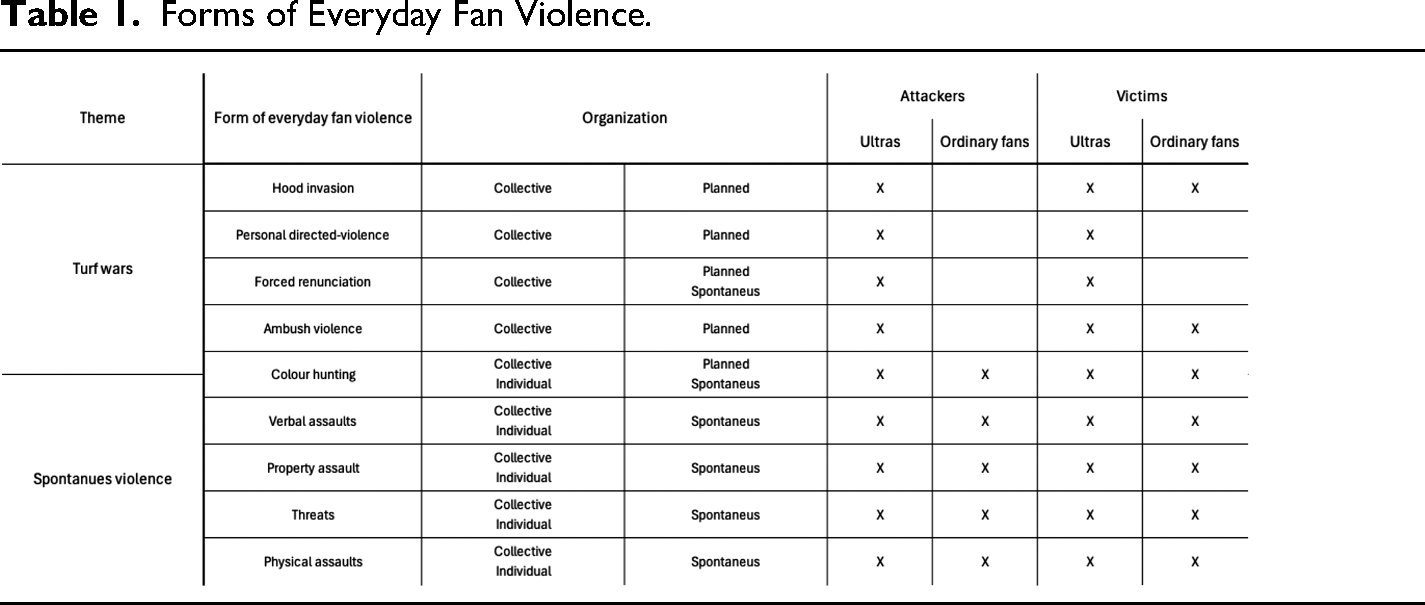
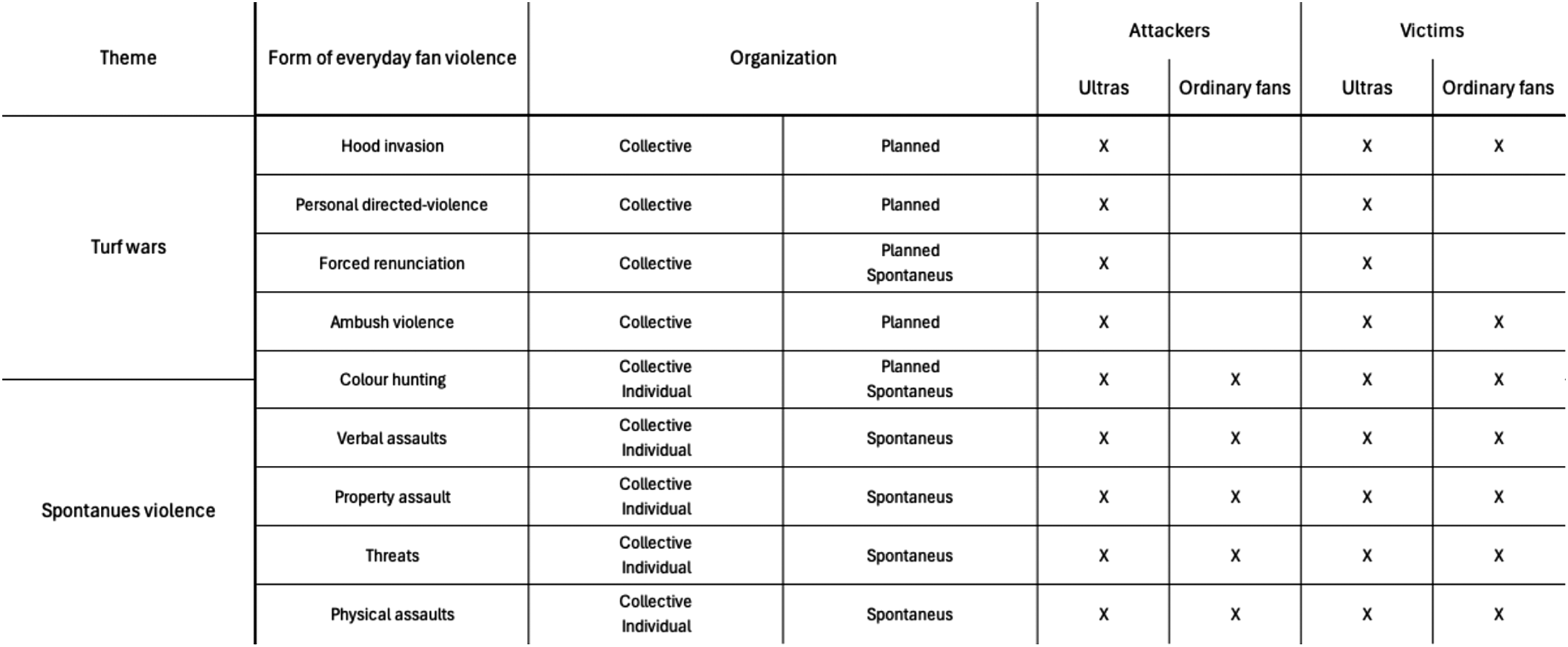
Turf Wars
Instances of everyday fan violence included in this category represent the logic of turf wars, in which a given urban territory is identified as belonging to supporters of a specific fan community/hooligan firm (Armstrong & Giulianotti, 2002; Clarke et al., 1976; Dunning et al., 1988; Spaaij, 2006). Temporary capturing or defending of turf constitutes the basis for competitive violence in everyday settings. In this regard, everyday turf wars have two main aims: (a) to demonstrate symbolic dominance in the city or region by proving that rival supporters cannot defend their turf (street, neighborhood, city, or bar), and, in rarer cases, (b) to physically acquire disputed territory by casting out individual fans of the opposing team living there. We distinguish five forms of everyday violence connected to turf wars.
The first is hood invasion, where supporters of one team (usually hooligans, but this also involves ultras) organize themselves to collectively invade rivals’ streets or neighborhoods. This takes different forms, ranging from surprise physical assaults on individuals passing through the area identified with rival fans, to verbal assaults directed at the opposing club to demonstrate rivals’ powerlessness, and to the destruction of graffiti and murals created by rival ultras on their turfs, including covering them up with their own symbols. The intensity of such assaults and the range of violence they incorporate is illustrated by a Wisła Kraków ultra: There was a period when guys from rival hoods started feeling way too confident and began ‘visiting’ our hood more often, patrolling. They’d show up and destroy graffiti. They got way too confident, and that's what brought them down. It worked for them a few times, but eventually they walked straight into an ambush. They ran off so fast they even left their cars behind, and those cars were completely wrecked afterwards. After that, things stayed quiet for a while because it was clear the neighbourhood was strong. (Wisła Kraków, ultras 1)
Our participants also reported that hood invasions intensify before derby matches (Zagłębie Sosnowiec, ultras 1), as establishing symbolic domination over opponents’ turf provides another reason to boast during games.
The second form is ambush violence (see also Perasović & Mustapić, 2018), which refers to planned and direct assaults on rival supporters. While hood invasions sometimes involve accidental victims, as they focus on invading and capturing territory, ambush violence targets individual fans and specific gatherings of rivals. For instance, dating sites such as Tinder are used to create false female profiles designed to lure individual fans to a meeting where a group of violent fans is already waiting. Such situations usually end with physical assault: It's the twenty-first century, right—you’ve got Tinder, all that internet stuff, and that's how you meet women now too. I know more than one guy who went on his ‘date’ in Gdańsk—and the moment he opened the door, there was a crew waiting for him already. Because they knew straight away, you know, they knew it was him. And then shit went down, you know? (Arka Gdynia, ultras 1)
When it comes to ambushes on gatherings of rival fans, one typical strategy is to destroy club or firm graffiti on their turf. To regain symbolic rule over a given territory, destroyed graffiti needs to be repainted, creating a good opportunity to set up an ambush: For instance, if we go to Gdańsk and destroy their graffiti, they need to repaint it later. And that's when it's easiest to catch someone. (Arka Gdynia, ultras 1)
Since this has become a popular practice in derby cities, ultras organize themselves to patrol the area of destroyed graffiti before it is repainted.
Ambush violence also includes using intelligence to organize assaults on gatherings of rival fans, such as fans’ football tournaments (Polonia Warsaw, ultras 1), events celebrating the club's anniversary (Polonia Warsaw, ultras 2), martial arts training sessions, or even birthday parties taking place in public houses (ŁKS, ultras 1). These assaults are also aimed at stealing tifos, especially those being prepared for upcoming derby games: They showed up, smashed the gate to the school gym where all that stuff was being painted. They chased some people off, beat up others, and took all the painted tifos, the banners, all of it. (Arka Gdynia, ultras 1)
The third form is forced renunciation, which refers to situations in which individuals identified as supporters of rival clubs are caught and then forced (usually through physical violence) to renounce their club or loyalty to a given club or hooligan/ultras firm. Recently, such statements have been recorded and published online to document them publicly. Usually, these practices are used against recognized members of ultras or hooligan firms. Fans who renounce their teams/firms are often ostracized from the ultras community, even when renunciation has been physically forced upon outnumbered fans. When they catch someone who's active, they usually record a video showing how he renounces, for instance, insulting some important person from the Górnik firm, you know, making him basically finished in the ultras world. They record it and then upload it to the internet. (Górnik Zabrze, ultras 2)
The fourth form of violence is personally directed violence. Ultras gather intelligence on their rivals, which involves creating lists consisting of their names, pictures, and sometimes places of residence. Game footage published on official sporting sites or in papers, as well as social media accounts, are used as sources of information. Such lists are constantly exchanged for updates (Wisła Kraków, ultras 2). This allows for the recognition of rival fans in everyday contexts. Such information is further used for retaliatory violence to identify attackers (ŁKS Łódź, ultras 2) or to identify rival ultras in urban areas and assault them on occasion: I’ve been beaten up very badly. I literally had stitches in my head because they beat me that hard. (…) They recognised us because that was the time when they were posting our photos online. It was like they’d memorised our faces or something. (Polonia Warsaw, ultras 1)
Recognized fans can also be personally abused with the aim of forcing them to move out of neighborhoods identified as fully belonging to a given ultras or hooligan firm. As illustrated by the story of a Lechia Gdańsk ultra who lived in Gdynia and was sticker-slapping Lechia's turf with Arka's colors and destroying some of Lechia's graffiti there: Arka hooligans showed up in five cars right outside my house. (…) They told me I had two months to move out, or we are doing this the hard way. (…) I was under observation. Every time I stepped out of the house, there was at least one car there, always with the same familiar face inside. (Lechia Gdańsk, ultras 2)
Similar to forced renunciation, this form of violence is aimed mainly at active and recognized members of opposing ultras or hooligan groups, as ordinary fans are usually not considered participants in the turf-wars game.
Finally, color hunting involves patrolling urban and leisure areas on a nonmatch days with the intention of robbing opposing fans of their club colors. Football memorabilia such as scarves, jerseys, or key lanyards are valuable trophies, as looting rival colors increases internal status among ultras communities. Robbed colors are often burned at games against the respective rival. Color hunting serves both as a practice aimed at defending turf (Zagłębie Sosnowiec, ultras 1) and as a way of proving symbolic dominance over a given territory: We used to gather in small groups, a few guys at a time, and basically run a competition to see who could collect the most rivals’ colours. It was very easy because most of the time they didn’t expect it at all. Sometimes someone would try to defend it, but these were rare cases. (Polonia Warsaw, ultras 2)
Color robbing may also occur accidentally, mostly in “neutral” urban areas, as well as in other cities and even countries (for instance, between immigrants), when fans wearing their club memorabilia happen to encounter violent fans or violent young males for whom robbing other club colors is a way of proving their manhood (Dunning et al., 1988; Grodecki & Rookwood, 2025). In such cases, color hunting is driven by the logic of rivalry-driven spontaneous violence, which constitutes our second theme (see Table 1).
Rivalries-Driven Spontaneous Violence
Forms of everyday fan violence included in this theme occur when encountering a person identified as a supporter of a rival team. Such situations are not planned or organized, as in most cases of forms connected to turf wars, and usually take place when encountering individuals wearing opposing club colors. In this regard, violent behavior can be explained by football rivalries ideology theory (Grodecki & Rookwood, 2025). This theory indicates that in everyday contexts, opposing team colors evoke the logic of football rivalries, which provides greater permission (or even expectation) for violence against rivals, justifying it by reference to football rivalries. This is especially true when colors are presented—even unintentionally—on turfs considered to belong to rivals. However, spontaneous violence can also occur in “neutral territories,” such as city centers (Widzew Łódź, ultras 2), leisure areas including holiday resorts (Zagłębie Sosnowiec, ultras 1), as well as abroad, when accidentally encountering a rival fan, for instance during immigration periods (Lechia Gdańsk, ultras 2). It also penetrates schools, manifesting as football-rivalry-driven peer violence (ŁKS, ultras 2).
Rivalries-driven spontaneous violence includes five forms of aggressive behavior by fans. Color hunting—which we addressed earlier—is the first of these. It can also manifest in verbal assaults, usually directed at fans personally and at the clubs they support (Widzew Łódź, ultras 2), or threats involving the use of violence if a given person does not leave the space (usually rival turf) or hide their colors. One extreme case of threats involved the use of a knife to stop another fan from chanting his club's name in the city center (Cracovia, ultras 2).
Our participants also reported cases of property assault. For instance, one of them accidentally left a football-club-jersey-shaped air freshener in his car and had his windows vandalized: In everyday life, it's basically standard that you don’t wear or display any emblems when you’re going to Gdynia, right? (…) I was studying in Gdynia. One day I forgot to take a jersey-shaped air freshener down from my rear-view mirror, and my car windows ended up being sprayed all over. (Lechia Gdańsk, ordinary fan 2)
This theme also includes spontaneous physical assaults, where wearing club colors is considered a justified reason for beating another person: I was harassed by ŁKS supporters. For example, in broad daylight, when I was getting off a tram. One guy didn’t like that I had the Widzew crest on my jacket. (…) Two years ago, I was beaten up and ended up in the hospital. I had to undergo surgery. (Widzew Łódź, ultras 2)
Physical assaults often coincide with color robbing. In rare cases, they also involve the use of knives and other melee weapons (Legia Warsaw, ultras 1); however, this is likely geographically dependent, as in some regions carrying melee weapons is more culturally rooted than in others (Armstrong & Giulianotti, 2002).
Justifications of Everyday Fan Violence
We also identify five justification strategies by our participants to legitimize fan violence in everyday life. These are classified into two theoretical themes: cultural violence and the quest for excitement. Table 2 illustrates the interconnections and results of comparative analysis of ultras and ordinary fans.
Justifications Behind Everyday Fan Violence.
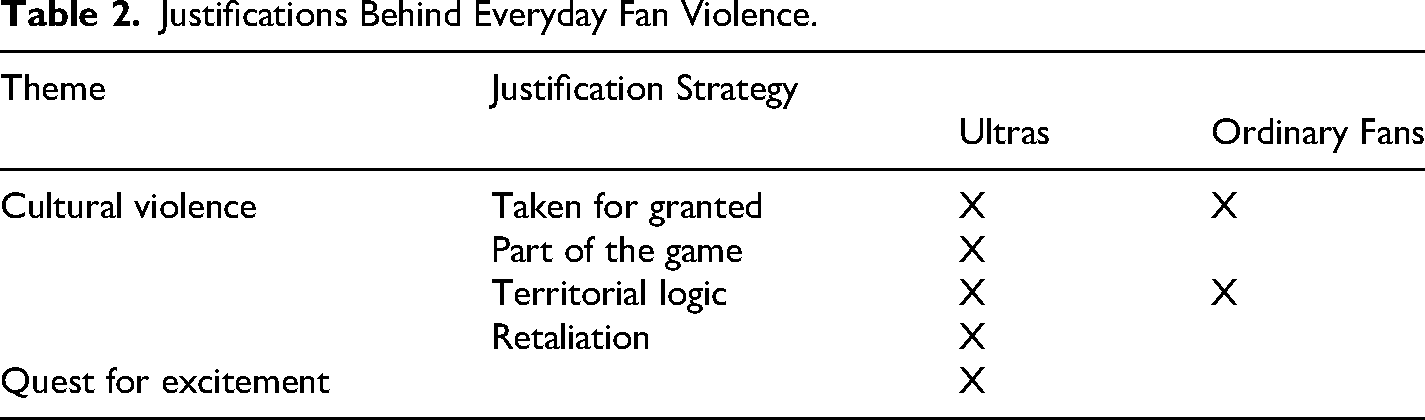
Cultural Violence
As a reminder, the concept of cultural violence underscores the role of culture in legitimizing violence (Galtung, 1990). Cultural violence makes direct violence, which is inherently event-based, instutionalized and ritualistic (Galtung, 1990, p. 302). Fan violence is considered a form of cultural violence by football rivalries ideology theory, which legitimizes and banalizes direct violence against rival fans (Grodecki & Rookwood, 2025). Justification strategies included in this theme demonstrate that everyday fan violence can be regarded as cultural violence, as it is transmitted through socialization as a desirable behavior and is legitimized by reference to existing norms in football fandom culture.
The first strategy, in which fan violence is justified as something taken for granted, reflects both dimensions. It is transmitted through socialization—usually via older fans—as a norm of behavior, justified by football/fan rivalries. We also identify that in this form it is not subjected to reflection. It is rather uncritically internalized as “natural behavior” and merely a perception of reality. As illustrated by an Arka ultra: I didn’t have any personal animosities toward them; I just didn’t. It was something imposed top-down. That's just how it stuck. As a young child, I didn’t really think about it or ask myself why we were supposed to hate them and beat them up. It simply had to be that way. I accepted this. (Arka Gdynia, ultras 1)
In this way of thinking, everyday forms of violence are viewed as just another dimension of the ongoing rivalry for symbolic domination over opposing fans.
Another justification strategy relates directly to the normative dimension of the ultras subculture, which treats violence as an inherent part of the game. This primarily concerns ultras, as ordinary fans are not considered legitimate participants (and thus targets) of competitive violence. In contrast to the previous strategy, where ultras blindly follow what they have been told, this way of thinking is more reflexive. It acknowledges that ultras norms create a separate, extreme social (sub)world in which they participate voluntarily and consciously, being aware of and accepting the risks of their decisions: I know that … that's just normal in that world. And when you step into it, you either accept it or you walk away. There's really no live in-between. (Arka Gdynia, ultras 2)
This perspective considers violence justified as long as it adheres to ultras norms regarding forms, contexts and targets, even though these norms are not consistent and are under constant (re)negotiation. One example is the acknowledgement that wearing club colors brings the risk of confrontation with rivals; therefore, wearing club colors carries the responsibility of defending them (Legia Warsaw, ultras 1).
Cultural violence also includes two other justification strategies. Although, in general terms, they articulate the normative logic of football fandom culture and can be considered part of the game, we separate them as more distinctive ways of thinking because they highlight more specific dimensions of violence. The first is a territorial logic that acknowledges turf divisions and the rights of fans to defend them. Within this strategy, manifestations of identification with a rival team (such as chanting, wearing colors or tattoos in visible places) on territories considered to belong to another group of fans are viewed as provocation, which justifies the use of violence. Importantly, this strategy places the responsibility for recognizing turfs on all football fans, who should be aware of the potential consequences of trespassing them. This applies even to people who may be unaware of turf divisions in a given urban setting. This is illustrated by a Wisła Kraków ultra, who justified a physical assault in response to one of our projective questions: It was definitely stupid behaviour that they (Widzew Łódź fans – authors) hung out on Retkinia. Retkinia is a really strong ŁKS hood. Especially if they had their colours on them—that was just really dumb and irresponsible. (…) As grown men, adults, they should know that this is a no-go zone for them. Even going to a store. (…) They (ŁKS fans - authors) were on their own turf, so those are the rules. That's just how the game works. (Wisła Kraków, ultras 1)
This way of thinking leads directly to blaming victims and, as such, normalizes territorial fan violence.
The other strategy is retaliation. Fans following this mode of legitimization refer to personal or collective experiences of violence from rival fans, which, in their view, necessitate a response. Violence does not have to be experienced directly by a given person or group; it is sufficient that it has affected fans of one's team or been directed at one's symbols, such as destroying graffiti: It was always justified like, ‘Come on, they did this and that to us back then, so we’ve got to get them back.’ It was that kind of talk, you know, hyping each other up in that direction. (Arka Gdynia, ultras 1)
What makes this justification distinctive is that it builds on emotions stemming from experiences of violence, apart from referring to the norms of the ultras subculture, which require revenge to regain status among peers after experiencing violence from rivals. Justifications based on retaliation may also indicate identity fusion, particularly as this legitimization strategy appears only among ultras, who prior research identifies as highly bonded and willing to fight for peers (Newson et al., 2018).
Quest for Excitement
This theme builds on a strong body of literature showing that engagement in fan violence provides excitement to its participants, serving as a transgression from the usually boring and routinized everyday life (Collins, 2008; Dunning et al., 1988; Elias & Dunning, 2008; Pearson, 2012; Spaaij, 2006; van Ham et al., 2022). Our study shows that everyday forms of violence are also used as a source of excitement, as they elicit similar emotions. This adrenaline rush is used by some ultras as a justification for engaging in violence: Personally, I think it's the adrenaline that drives me the most at those matches, you know. (…) All those acts of aggression just ramp it up even more. (…) I like it when that aggression is directed at people who want it, when it's two sides who both chose to be there and do it. (Górnik Zabrze, ultras 1)
What is crucial here is that excitement is strongly related to fear. For hooligans and some ultras, the anticipation of (potential) violence and overcoming the fear of violence are the main sources of excitement (Spaaij, 2006). However, for other fans, football-related violence in everyday settings constitutes a real threat, producing only fear that influences their daily lives.
Discussion and Conclusions
This study focuses on the understudied issue of fan violence in everyday settings by exploring its forms and legitimization through the experiences and justifications of Polish ultras and ordinary football fans. In general, it shows that everyday fan violence has gained a permanent foothold in daily life, where it has developed in urban settings to take distinctive forms and become entrenched in Polish fandom culture. Connecting our findings with the existing literature, in this discussion section, we address potential causes of everyday fan violence and explain how it achieves the status of legitimate violence within the football fan community. We also cover potential implications of our findings for practice and future research agenda.
We identified nine forms of football-related everyday fan violence, which we classify into two theoretically driven themes explaining their main mechanisms: turf wars and rivalry-driven spontaneous violence. Based on past research, we can assume that everyday violence results from the transfer of fan violence from football games, influenced by counter-hooliganism policies (Antonowicz & Grodecki, 2018; Armstrong & Giulianotti, 2002; Dunning et al., 1988; Lee Ludvigsen, 2025; Tsoukala et al., 2016) and the banalization of football-rivalry-driven violence in everyday settings (Grodecki & Rookwood, 2025). Since the former was aimed mainly at eliminating manifestations of violence rather than its causes, it contributed to the relocation of hooligan turf wars. Being displaced from successive spaces, hooligan firms kept redefining new territories as their turfs (Armstrong & Giulianotti, 2002), eventually symbolically claiming urban spaces and some leisure areas outside football grounds. Additionally, as a result of the coproduction process (Dunning et al., 1988), they became better organized, developing new forms of violence that suited urban areas and were harder to detect for both police forces and rivals. On the other hand, rivalry-driven spontaneous violence demonstrates that fan violence has indeed turned into cultural violence, being banalized and thus legitimized in everyday settings by the (ideology of) football rivalries (Grodecki & Rookwood, 2025). In everyday life, this cultural logic is evoked by visible identification with a rival team (such as scarves, jerseys, tattoos, chanting, etc.), allowing for and justifying violence against rival fans.
The claim that fan violence in everyday settings has become cultural violence is further supported by the justification strategies identified in our study. They show that fan violence is socialized as something taken for granted by both Polish ultras and ordinary fans. Additionally, it is justified by ultras through reference to the normative logic of football fandom culture, which is evident in the part of the game justification strategy. Our study suggests, however, that territorial logic is the most deeply rooted cultural legitimization of fan violence, as it was commonly identified by both ultras and ordinary fans. This is problematic, as it means that urban spaces are widely recognized as divided by ultra/hooligan firms. The broad legitimization of turf divisions provides them with a moral right to drive off outsiders, including through direct physical violence. Since turf logic has become part of Polish football fandom culture, it is unsurprising that our projective question revealed that any manifestation of identification with a rival club on opposing turf is considered provocation, leading to the conclusion that victims are blamed for violence in such cases.
In general, our study shows that existing theories of fan violence can account for its everyday dimensions, as these forms follow the basic mechanisms behind competitive violence established by hooligan subculture. What is new, however, is that (a) they have taken distinctive forms because they have developed to fit urban settings, and (b) they have spread to other fans (see Table 1), who are both victims and perpetrators. The latter observation supports findings showing that violence (or facing violence from rival fans) is the primary means of gaining status and legitimacy in ultras communities (Pearson, 2012). Its everyday forms provide alternative, and perhaps more accessible (than direct hooligan confrontations, such as setup fights, which require physical toughness and martial-arts proficiency), ways of gaining status among peers. Our study also contributes to the existing literature by empirically supporting theoretical assumptions of football rivalries ideology theory (Grodecki & Rookwood, 2025), demonstrating that fan violence has been banalized in everyday settings, thus becoming cultural violence.
Regarding the practical implications of our research, we find that the persistent presence of football-related violence in everyday urban settings results in pervasive fear. For those more engaged in competitive violence, this fear is used as a quest for excitement (e.g., Elias & Dunning, 2008; Spaaij, 2006), constituting one of the reasons behind engaging in everyday fan violence. However, for others—both ultras and ordinary fans—everyday violence is considered a serious threat that influences their sense of security in private life, impacting their behavior as a consequence: I don’t want to end up paying for it with my health or something like that because I’ve got my whole life ahead of me and people to live for (…) I just avoid going to some places on purpose, certain neighbourhoods. If I’ve got something to deal with there, I try to send someone else instead because I just don’t want to go there. (Cracovia, ultras 2)
This fear also concerns fans who have not experienced football-related violence in everyday life but have heard or read about such instances from secondary sources (Arka Gdynia, ordinary fan 2). However, even in the absence of direct or vicarious experiences, it affects their lives, as they avoid wearing their club colors in public spaces or visiting specific districts. This shows that, at least in the Polish context, the fear of everyday violence is deeply rooted in the football fan community, constituting a serious social problem.
One question that remains is how to combat fan violence that has already spilled over into everyday life. Although addressing this issue is beyond the scope of this study, we believe our research provides some groundwork for future policies, as it shows how, where, why and by whom fan violence is manifested in everyday settings, and who, under what circumstances, may fall victim to it. It also demonstrates that the banalization of football violence in everyday settings has contributed to its transformation into cultural violence. This is problematic as cultural violence is a “‘permanence’ remaining essentially the same for long periods, given the slow transformations of basic culture” (Galtung, 1990, p. 294), and as such is very hard to tackle, requiring time, a variety of tools and reaching a wide population. It would also require working on forgiveness to break the chain of violence, considering that retaliation is used as both an emotional and normative justification strategy.
Despite the fact that our study is limited to the Polish research context, we believe it provides findings that should encourage us to reconceptualize how football-related fan violence is approached in contemporary societies, especially in countries where its physical forms appear to have declined. If we were to analyze available statistics alone, it would seem that physical forms of fan violence in Poland are no longer a significant social issue, as serious incidents of disorder at football stadiums are very rare (PZPN, 2025). The problem would then be reduced to a small minority of football hooligans who are nowadays better trained and organized but, paradoxically, no longer treated as seriously as they once were, since they typically fight each other away from the public eye. Our study proves that football violence has not disappeared—it has become less visible, embedded in everyday practices. We argue that our work lays the empirical groundwork for a new research agenda on fan violence. It moves beyond viewing football-related violence as solely a game-day interactions or a matter of hooligan rivalries. Instead, it encourages us to study it as a deeply rooted and socially sanctioned practice that manifests beyond football itself. By examining where and how everyday fan violence is manifested—and, crucially, how it is socialized as part of fan and masculine identities, banalized, legitimized, reproduced, and also contested—this approach aims to develop an agenda that not only identifies its cross-cultural variations but, more importantly, explains why fan violence—and perhaps violence more broadly—does not disappear but instead reemerges in different social settings. We believe that our study, which is the first systematic and empirical research on the issue, offers a useful conceptual framework in this regard and thus provides a solid starting point for future studies and policymakers.
Footnotes
Ethical Approval
The research project was approved by The Maria Grzegorzewska Ethics Committee (Opinion No. 2–2024/2025 issued at 4th December 2024).
Funding
This work was supported by the National Science Centre, Poland (Grant No. 2023/51/D/HS6/02542).
Declaration of Conflicting Interest
The authors declare no potential conflict of interest.
Data Availability Statement
The data are available from the corresponding author, upon request.
