







Abstract
Background:
The Parenting Stress Index Short Form (PSI-SF) is a widely used instrument in scientific literature to evaluate the levels of stress a parent feels when facing parenting-related tasks. Despite the potential usefulness of the PSI-SF with at-risk families, no validation studies have been carried out on this population in Spain.
Objectives:
The main objective of this study is to report evidences of the reliability and validity of PSI-SF with a sample of at-risk mothers. Specifically, (1) to examine the discriminative capacity of PSI-SF to differentiate between a community sample and another sample composed of families with various levels of risk and (2) to analyze the relationships with general health indicators and parental sense of competence.
Results:
Analyses reported in this article show satisfactory results regarding appropriate internal consistency coefficients for the scale. With respect to the evidences of validity, results reported here suggest that the total PSI-SF score, but not the two subscales, could be useful to differentiate between different groups of mothers with different levels of risk. The Childrearing stress subscale was associated with a poorer perception as a mother as well as with an external locus of control, and the Personal distress subscale was related to all the general health indicators, explaining a high percentage of variance.
Conclusion:
The results reported show that the total score or the subscales should be used in a differentiated way according to the professional’s objectives. Hence, PSI-SF may be a useful instrument for researchers and practitioners who work with at-risk families.
Parental stress is a complex process in which adults feel overwhelmed by the tasks and responsibilities associated with their role as parents (Deater-Deckard, 1998). The stress associated with this developmental task has proven to be a relevant dimension in studies that examine the dynamics taking place within family context. According to Abidin (1992), stress may work as a motivational arousal and moderate levels are desirable, but negative consequences are related to high parenting stress. Thus, clinical stress levels have been associated with lower indicators for parent–child relationship values (Crnic & Low, 2002) with a higher frequency of dysfunctional parenting practices (Bonds, Gondoli, Sturge-Apple, & Salem, 2002) and abuse (Stith et al., 2009) as well as with child adjustment (Costa, Weems, Pellerin, & Dalton, 2006; Haapsamoa et al., 2013; Östberg & Hagekull, 2013). With regard to the parents, parenting stress have been associated with the quality of life of mothers (Cho & Hong, 2013) and negative symptoms in the general health of the parents, particularly those linked to anxiety and depression (Gerdes et al., 2007; Lyon, 2000; Ponnet & Wouters, 2014; Ponnet et al., 2013). Therefore, it is important to appropriately detect parenting stress levels to prevent their negative effects.
Social stressors have been studied through three perspectives (Sandín, 2003): life events, daily hassles, and role-related stress. The third one has been discussed by Abidin (1992) in his theory regarding the determinants of parenting. According to the Transactional Model of Stress proposed by Lazarus and Folkman (1984), Abidin points out that the cognitive appraisals associated with the parenting role influence the degree of stress experienced. Thus, the sense of competence and the perception of control as parent have been commonly examined in studies about stress (Roddenberry & Renk, 2010; Sevigny & Loutzenhiser, 2009).
Based on this theoretical model, Abidin designed the Parenting Stress Index (PSI, 1983, 1997), a scale that assesses the negative feelings and stress related to child-rearing. The extended version of this instrument includes 120 items and, using two subscales, provides information about the stress associated with parenthood (parent domain) and the stress derived from the child (child domain). Based on the results obtained with a sample of 530 mothers (Caucasian, married, and with problem-free children around 4 years of age), Abidin (1995) developed an abbreviated version of this scale, the Parenting Stress Index–Short Form (PSI-SF). It includes 36 items, but the results of the factorial analyses reported by this author did not replicate the originals, and PSI-SF yields three subscales: Parental distress, Parent–child dysfunctional interaction, and Difficult child. Psychometric properties of this instrument have been analyzed with several populations obtaining satisfactory reliability coefficients. However, different factorial solutions have been reported, ranging from two to five subscales with acceptable to excellent reliability (Deater-Deckard & Scarr, 1996; Haskett, Ahern, Ward, & Allaire, 2006; McKelvey et al., 2009; Reitman, Currier, & Stickle, 2002; Whiteside-Mansell et al., 2007; Zaidman-Zait et al., 2010). A number of studies have also examined evidences of validity for this tool. Thus, Haskett, Ahern, Ward, and Allaire (2006) showed that PSI-SF allows differentiating between parents with a documented history of abuse and those without a known history of maltreatment and that the scores are related to general health dimensions. According to Costa, Weems, Pellerin, and Dalton (2006), Parental distress subscale shows high sensibility to depressive and anxiety symptoms without collinearity problems. Thus, parenting stress is a robust predictor of general health (Ponnet et al., 2013). Additionally, PSI-SF has proved to be a useful assessment tool to determine the effectiveness of psychoeducational programs (Bloomfield & Kendall, 2012; Marcynyszyn, Maher, & Corwin, 2011; Reitman et al., 2002).
To our knowledge, there is just one version of the PSI-SF in Spanish, and it is developed by Díaz-Herrero, Brito, López-Pina, Pérez-López, and Martínez-Fuentes (2010) in Spain with 129 mothers. Similar to Abidin’s initial proposal (1983), Díaz-Herrero and colleagues (2010) report two factors related to the stress as a parent (Personal distress) and with respect to the child (Childrearing stress), with good levels of internal consistency (α = .90 and .87, respectively).
Parents from families at psychosocial risk are a specific population that usually experience high levels of parental stress (Anderson, 2008; Raikes & Thompson, 2005). Several studies focusing in this topic indicate that many parents of at-risk families tend to experience clinical levels of parenting stress (Bloomfield & Kendall, 2012; Hurley et al., 2012; Lanier, Kohl, Benz, Swinger, & Drake, 2014). For a broad range of reasons, the parents have difficulties to adequately provide for their children and therefore hinder their well-being but not severely enough to require the children’s placement in foster care (Rodrigo, Byrne, & Álvarez, 2012; Sanders & Cann, 2002). According to transnational recommendations (i.e., Committee of Ministers of the Council of Europe, 2006), at-risk families should be attended with preventive and supporting interventions designed to preserve the family unit. In Spain, to date, these interventions are delivered in state agencies by interdisciplinary professional teams (psychologists, social workers, and educators), and throughout a wide range of diversified services. At-risk families cover approximately 80% of the cases attended by Child and Family Protection Services (CFPS). Therefore, correctly identifying and evaluating parental stress is a key topic to better understand the process that characterizes the families and also to design and implement effective preservation and support interventions. Hence, reliable and cost- and time-efficient instruments to assess parental stress should be available to researchers and practitioners who work with at-risk families (Harnett & Dawe, 2008; Hutchings & Webster-Stratton, 2004; Rodríguez, Camacho, Rodrigo, Martín, & Máiquez, 2006). Despite the potential usefulness of the PSI-SF, there are no validation studies for this tool available with Spanish families at psychosocial risk. In this regard, the recommendations of the American Educational Research Association, the American Psychological Association, and the National Council on Measurement in Education (AERA, APA, & NCME, 2002) concerning the need to collect empiric evidences using assessment instruments with noncommunity populations should be highlighted. According to Ramayah, Yeap, and Ignatius (2014), the reliability and validity of standardized scales must be studied through repeated application of an instrument in diverse contexts and among different population groups (e. g., Conrad, Riley, Conrad, Chan, & Dennis, 2010).
The main objective is to evaluate and report evidences about the reliability and validity of the PSI-SF in a sample of at-risk mothers. Specifically, a series of psychometric analysis will be computed:
to analyze the properties of the items and the reliability coefficient of the PSI-SF and to report evidences of validity. Specifically:
2.1. To explore the utility of PSI-SF to predict community, moderate-risk, or high-risk status. 2.2. To analyze the relationships between PSI-SF scores and data about other individual indicators: general health and parental sense of competence.
Method
Participants
The target population were at-risk mothers receiving supporting and strengthening interventions at the CFPS. The sample framework included 9 of the 11 social work areas in the province of Huelva (Spain), which covers 62.34% of the population. The at-risk sample was composed of 109 mothers, which represents 16.03% of the recipients of CFPS. Inclusion criteria were the following: (1) to be formally supported by the aforementioned agencies for family preservation and (2) to have at least one child below 12 years. At the time of data collection, the families had been receiving some support intervention over a period of approximately 3 years (M = 2.85, SD = 3.55). The mean age of the women were around 35 years (M = 35.35, SD = 7.25). Only 36.1% were employed, and their educational level was quite low: 42.6% were illiterate, 21.8% completed primary school, and only 31.7% and 4% had initiated or finished high school or university studies, respectively. The families had two or three children (M = 2.41, SD = 1.12) with an average age of 8 (M = 8.07, SD = 3.33). The weighted of monthly family incomes per consumption unit and their contrast with population and official data in Spain (Observatorio de la Infancia en Andalucía, 2013) showed that most (56%) of the families lived below the poverty threshold.
A sample of community families was contacted in 10 schools from the same areas where the at-risk families resided. Mothers from the community sample were not supported by agencies for family preservation. This sample was composed of 40 mothers with an average age of 40.15 (SD = 6.52), with most of them being employed (75.70%) at the time of the study. The families had two or three children (M = 2.44, SD = 1.10), with an average age of 11 (M = 11.60, SD = 1.16).
Instruments
PSI-SF
This instrument assesses the feelings of stress a person experiences regarding his or her role as a parent (Abidin, 1995). It is composed of 36 items with a Likert-type answer format of five options. According to the original author, total stress scores of 90 or above may indicate a clinical level of stress. The Spanish adaptation of this scale (Díaz-Herrero, Brito, López-Pina, Pérez-López, & Martínez-Fuentes, 2010) revealed a bifactorial structure: stress generally associated with parenthood (Personal distress, 12 items; e.g., I feel that I cannot handle things) and specifically to child-rearing (Childrearing stress, 24 items; e.g., My child doesn’t giggle or laugh much when playing). The levels of internal consistency in this study were α = .79 for Personal distress and α = .85 for Childrearing stress.
Parental sense of competence (PSOC)
This instrument explores the perception the parent has of his or her abilities regarding parental role (Johnston & Mash, 1989). It is a self-report tool with 16 items rated on a 6-point Likert-type scale. Two scores are computed: Effectiveness as a parent (α = .73, 7 items; e.g., I honestly believe I have all the skills necessary to be a good mother to my child) and Satisfaction with the parental role (α = .50, 9 items; e.g., Being a parent makes me tense and anxious).
Parental Locus of Control
Parental locus of control (PLOC) is a 47-item (α = .71) scale to assess whether a parent views his or her child’s behavior as a direct consequence of their parenting efforts (internal locus of control) or as outside the reach of his or her parenting efforts (external locus of control; e.g., When something goes wrong between me and my child, there is little I can do to correct it; Campis, Lyman, & Prentice-Dunn, 1986). Each item is rated on a 5-point Likert-type scale. The highest scores indicate a more external PLOC.
General Health Questionnaire
This tool is a self-report instrument designed to assess general state of health by the presence of different symptomatology (Goldberg & Williams, 1996). General Health Questionnaire 28 (GHQ-28) is composed of 28 items rated on a 5-point scale scoring four subscales: Somatic symptoms (α = .94, 7 items; e.g., Have you recently been feeling perfectly well and in good health?), Anxiety and insomnia (α = .92, 7 items; e.g., Have you recently lost much sleep over worry?), Social dysfunction (α = .73, 7 items; e.g., Have you recently been able to enjoy your normal day-to-day activities?), and Depression (α = .91, 7 items; e.g., Have you recently felt that life isn’t worth living?). The highest scores indicate a high frequency of symptoms and, hence, a worst level of general health.
Family risk and case history indicators
Practitioners completed a semistructured protocol designed ad hoc to collect data about the trajectory and the current services received from CFPS (number of years and number of different concrete services received per family), and the level of family risk characterizing the global situation (by means of a single score ranging from 0 to 10, the higher the score, the higher the level of risk).
Procedure
A series of meetings were conducted with the psychologists of CFPS to describe the objectives of the research, the target sample of the study, and the cooperation required from each professional. These practitioners were requested to (a) select from the group of parents with whom they were working a sample of mothers from declared at-risk families (the children are at risk for being removed for their homes), (b) arrange an appointment of a trained researcher with each mother to complete the aforementioned tools, and (c) complete the semistructured protocol described earlier. The mothers signed an informed consent form, and confidentiality was guaranteed.
Directors of the 10 schools were requested to send an evaluation protocol to the students’ parents. It included an informative document (describing the objectives of the project and the confidentiality rules) and the PSI-SF. All this information was collected anonymously and in a sealed envelope. The questionnaires were collected by school administration and delivered to the research team. At each school, families were asked to participate in the study voluntarily, although only families having a child aged 12 years or below and who did not have an active CFPS file were considered as part of the community sample for this study.
Data Analyses
The skewness and kurtosis of Personal distress and Childrearing stress scores were calculated. Item-total correlations were computed, and test reliability was established by Cronbach’s α for internal consistency. To provide evidence of validity, the at-risk sample was subdivided into two groups with respect to the level of family risk reported by practitioners. These two groups (moderate and high risk) were established considering ±1 standard deviation of the mean of family risk as limiting criteria. Analysis of variance and post hoc contrasts (minimum significant difference test [DMS]) were computed to analyze the differences between the groups, taking into account the estimated effect size (Cohen, 1988). A multinomial logistic regression analysis was performed with each PSI-SF subscale to explore the differences between groups (Tabachnick & Fidell, 2007).
The explanatory capacity of the PSI-SF subscales with regard to the general health and the PSOC was explored using multiple regression analysis. For each of the aforementioned analysis, the parametric test assumptions were validated. Analyses were conducted by using SPSS 18 software.
Results
Estimating Test Reliability
The item-total correlations for each of 36 items were calculated (see Table 1). The analysis showed that most of these items had adequate item-total correlations (>.20), except Items 11 (Personal distress), 14, 22, and 32 (Childrearing stress), which decreased the overall α coefficient. PSI-SF was highly internally consistent (α = .89), and each subscale had an internal consistency of α = .79 for Personal distress and α = .85 for Childrearing stress.
Item-Total Correlations and Test Reliability.
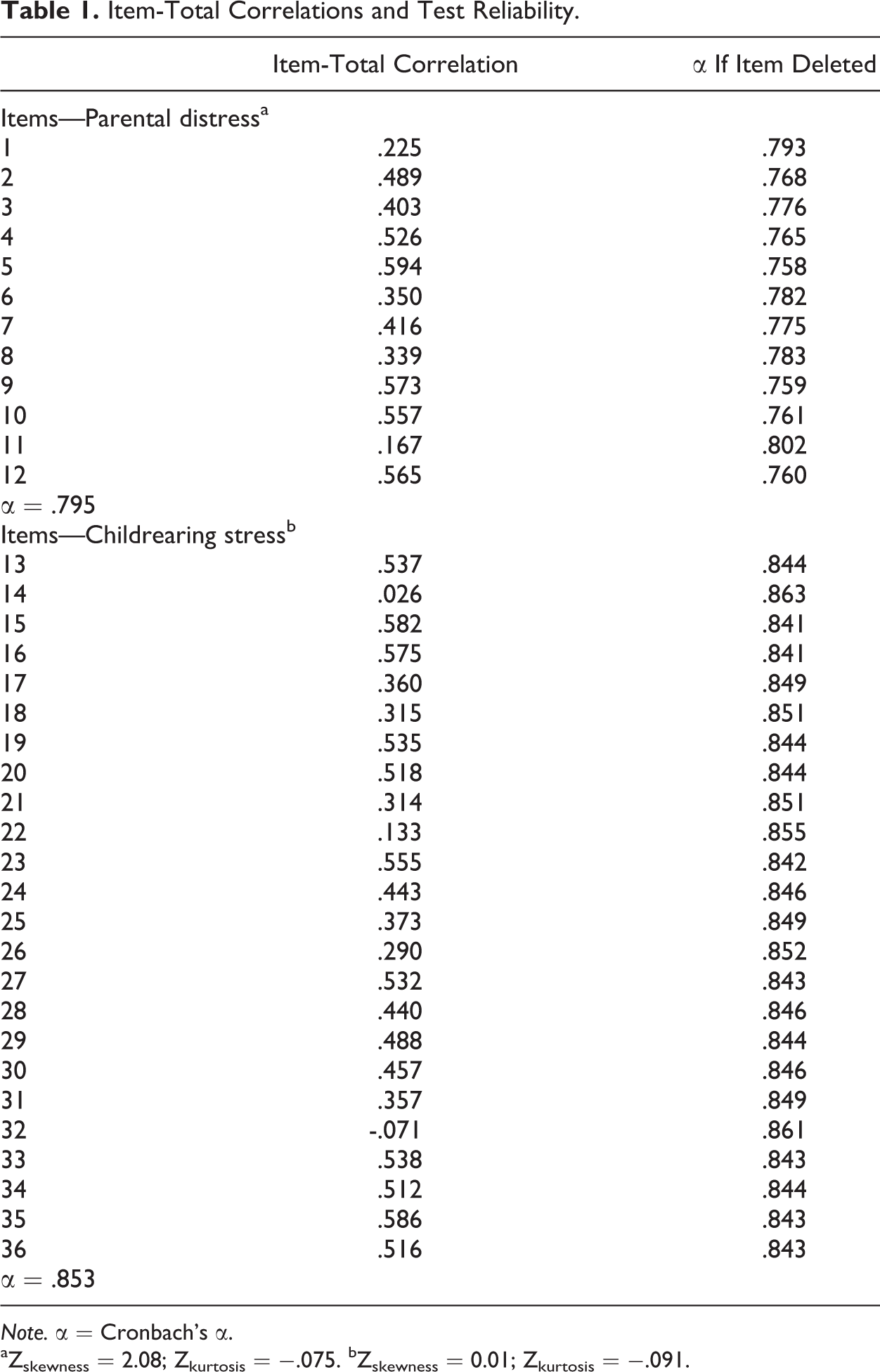
Note. α = Cronbach’s α.
aZskewness = 2.08; Zkurtosis = −.075. bZskewness = 0.01; Zkurtosis = −.091.
Evidence of Validity
PSI-SF scores according to the level of family risk
According to the practitioners’ point of view, at-risk families were characterized by a global level of risk of around 5 in a 0–10 scale (M = 5.31, SD = 2.08, Zskewness = −0.17, Zkurtosis = −1.05). The at-risk sample was divided into two groups considering ±1 standard deviation of the mean: moderate risk (M = 3.66, SD = 1.16) and high risk (M = 7.13, SD = 0.82).
Total stress scores were significantly different among the three groups of families (community, moderate risk, and high risk; see Table 2). The community sample obtained the lowest mean and the high-risk group the higher total score. Moderate- and high-risk groups showed clinical levels of parenting stress. Post hoc analysis indicated that the PSI-SF total stress score was statistically different for each of the three groups. The mothers from the moderate-risk group differed from those in the community sample as well as those from the high-risk group (medium size). However, both subscales only differentiated the high-risk group from the other two.
Variability in the Level of Parenting Stress Between Community, Moderate-, and High-Risk Groups.
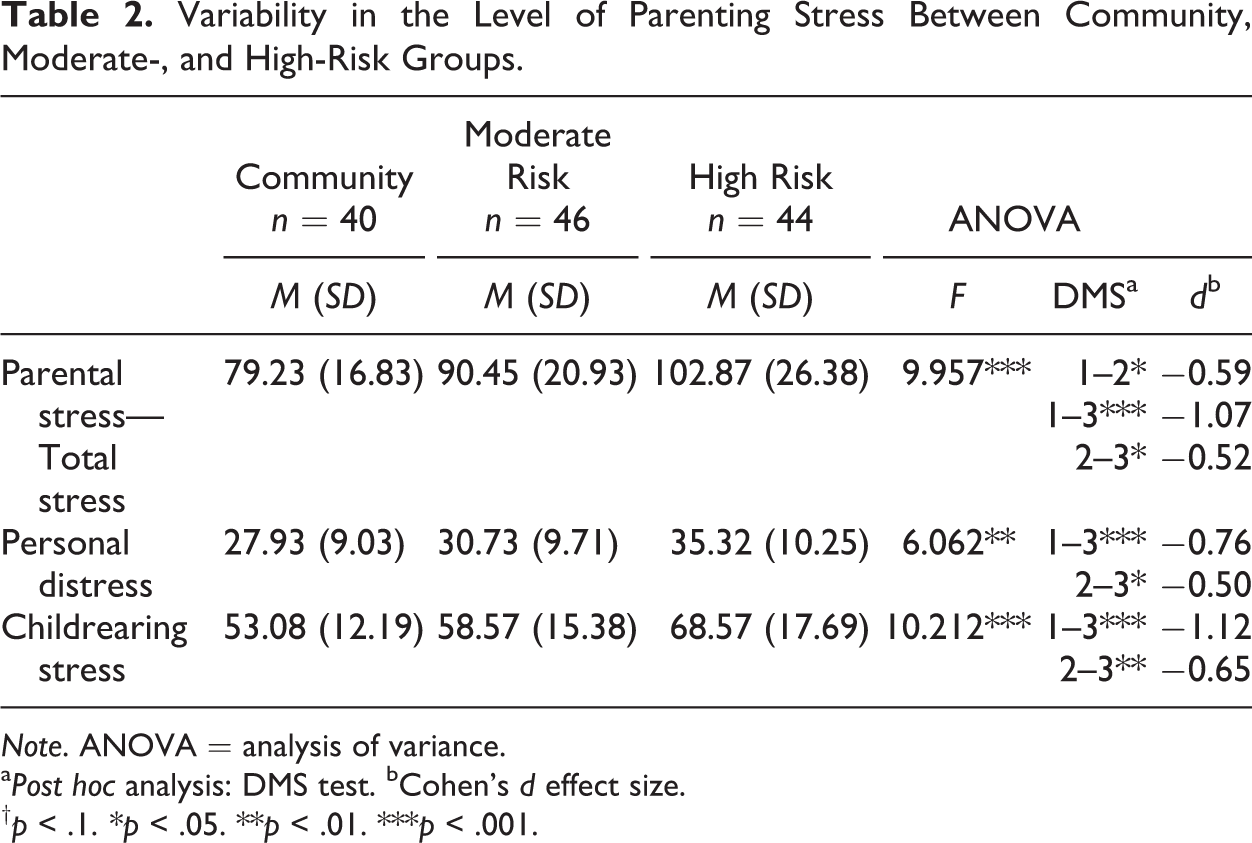
Note. ANOVA = analysis of variance.
a Post hoc analysis: DMS test. bCohen’s d effect size.
† p < .1. *p < .05. **p < .01. ***p < .001.
The three groups were included in a series of multinomial logistic regressions to explore the relation of PSI-SF subscales to each group. Table 3 displays the results obtained using the community sample as a reference. As indicated, the Personal distress subscale did not differ between the three groups of mothers. Nevertheless, the Childrearing stress revealed differences between the community sample group and the high-risk group: One-unit change in Childrearing stress was associated with a 2.31 times higher odds of being in the high-risk group compared to being in the community group. Contrary to the subscales, the highest scores in total parental stress correlated with a greater probability that a mother from the community sample group would become part of the moderate-risk group (one-unit change in parenting stress was associated with a 94% increase in odds of being in the moderate-risk group compared to the community group) or a member of the high-risk group (one-unit change in parenting stress was associated with a 239% increase in odds of being in the moderate-risk group compared to the community group). Both models explained 17% and 18% of the variance in the group factor, respectively.
Multinomial Logistic Regression Model Parameters Using the Community Sample as a Reference.
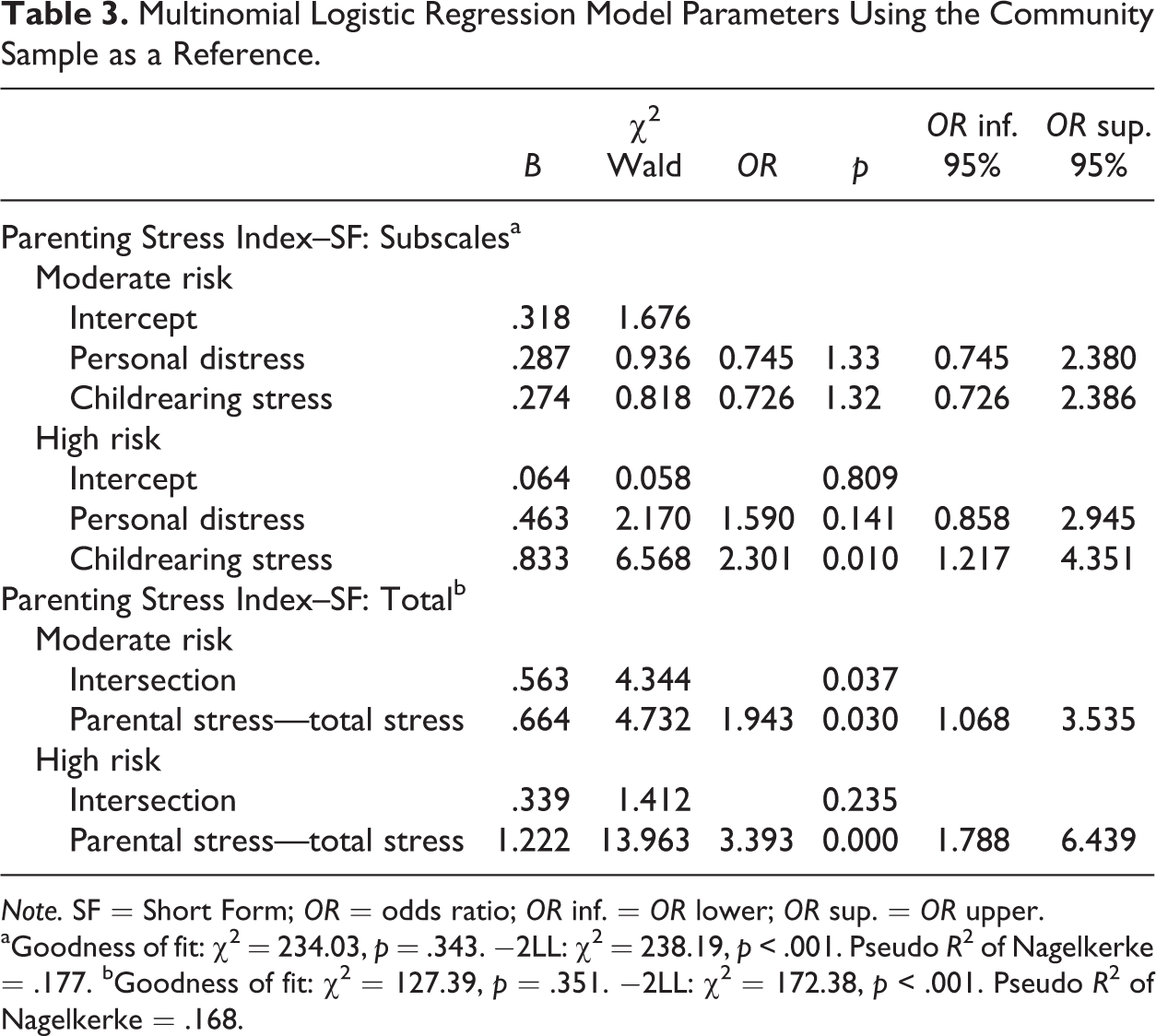
Note. SF = Short Form; OR = odds ratio; OR inf. = OR lower; OR sup. = OR upper.
aGoodness of fit: χ2 = 234.03, p = .343. −2LL: χ2 = 238.19, p < .001. Pseudo R 2 of Nagelkerke = .177. bGoodness of fit: χ2 = 127.39, p = .351. −2LL: χ2 = 172.38, p < .001. Pseudo R 2 of Nagelkerke = .168.
Relationships between the PSI-SF scores and scores on criterion measures
The results obtained indicated that the total PSI-SF score was related to all measures, except for the effectiveness as a parent. As shown in Table 4, greater levels of parental stress were associated with an external locus of control, poorer satisfaction as a mother, and higher indices of depressive symptoms, anxiety, social dysfunction, and somatic symptoms. With regard to the subscales, Personal distress followed the same pattern as the total score, while greater Childrearing stress was negatively related to the satisfaction and effectiveness as a parent and with a more external PLOC, but this subscale failed to correlate with any general health indicator.
Pearson Correlations Coefficient Between Parental Stress and the Locus of Control, Parental Efficacy and Parental Satisfaction, and General Health.
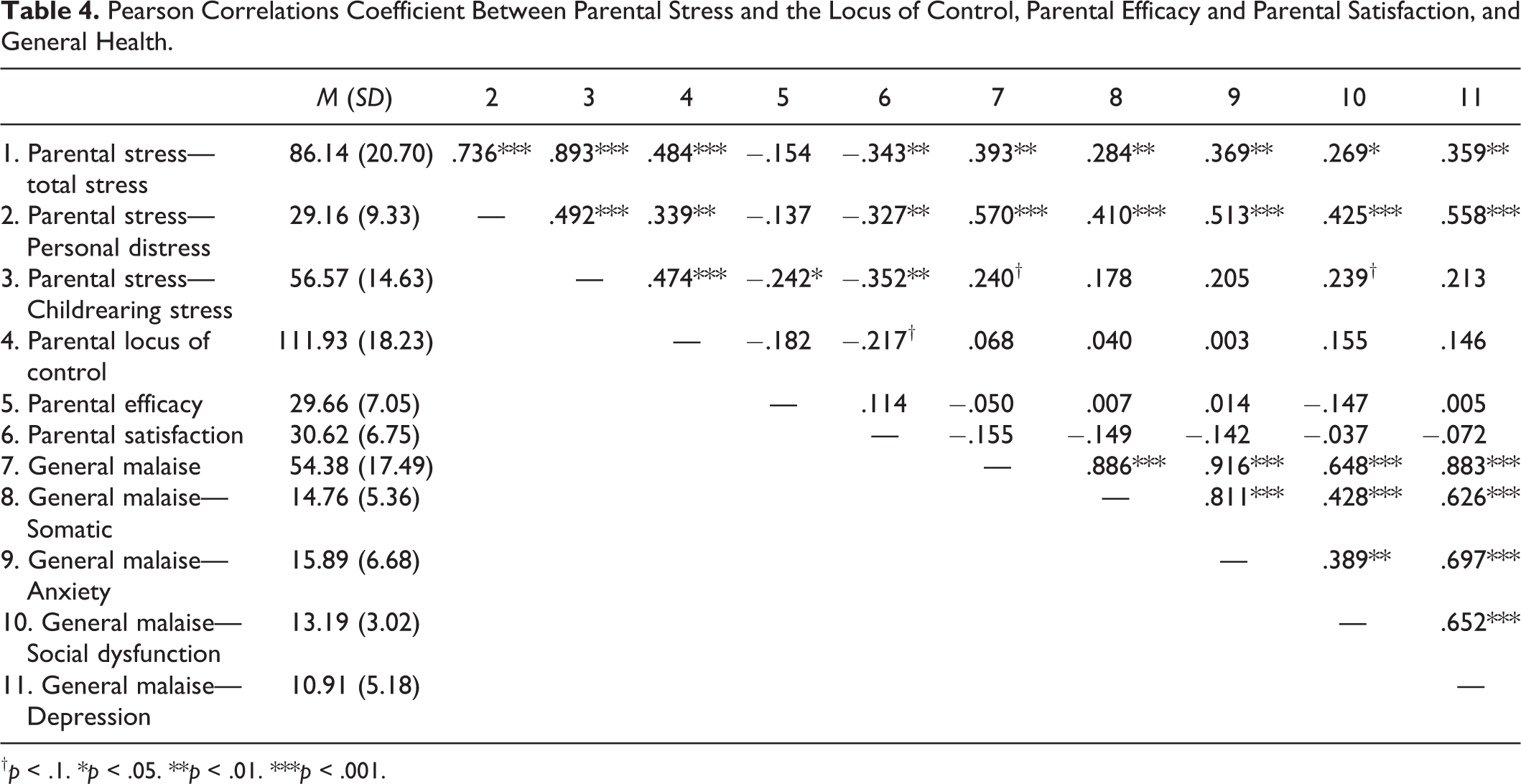
† p < .1. *p < .05. **p < .01. ***p < .001.
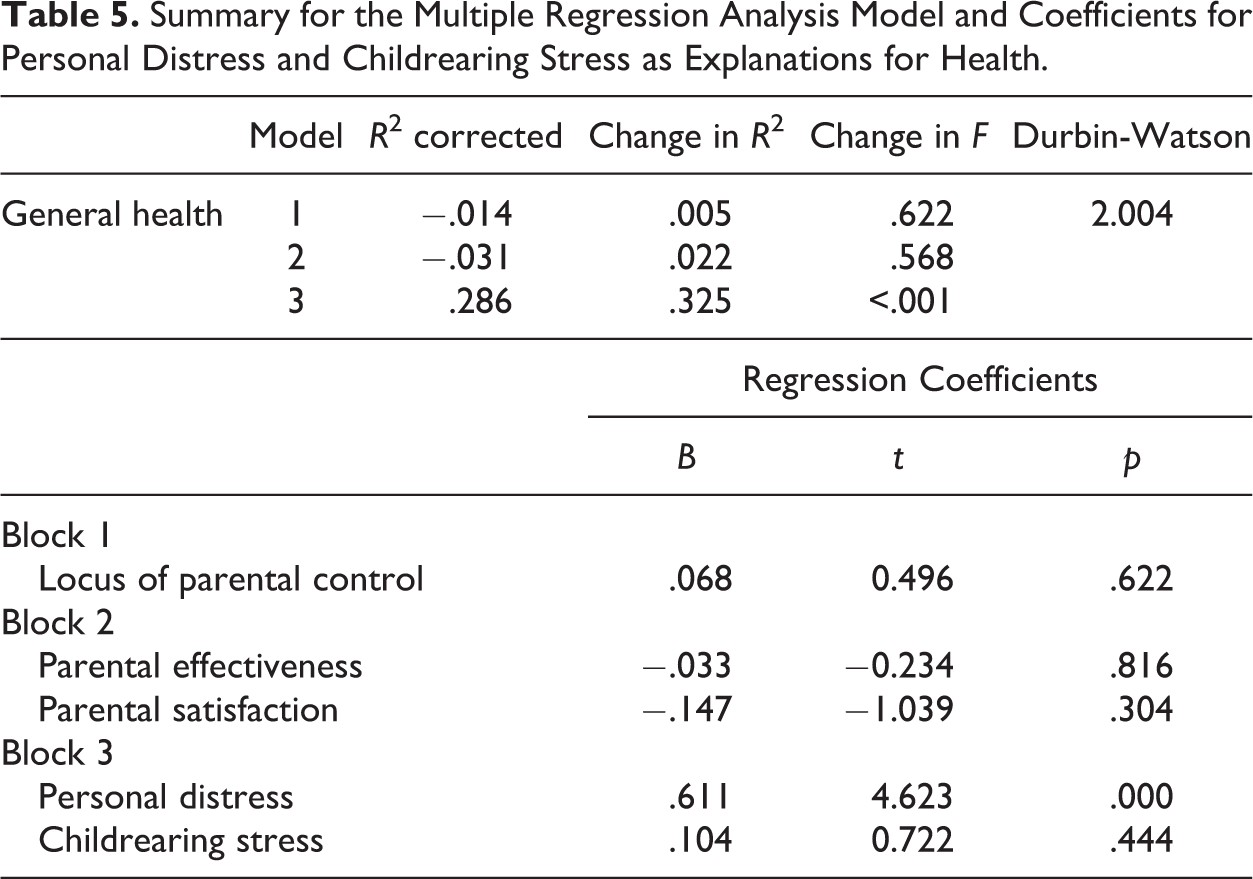
Finally, a multiple regression analysis was computed to calculate the proportion of total variance of the general health indicators explained by the subscales. To control any possible influences of the PSOC and the PLOC, a hierarchical regression was used. PLOC was introduced in the first block (since this shows the highest correlation coefficient with the stress scores), the second block was completed with the subscales related to parental sense of competence, and in the third block, Personal distress and Childrearing stress were entered simultaneously.
The model explained approximately 29% of the variance in general health (see Table 5). Both the first and the second block obtained no significant change in F, on the contrary, block three showed a significant change increasing the model explanation by 32%. Attending to the regression coefficients, the scores for PLOC, parental satisfaction, and parental effectiveness did not obtain any significant β. Therefore, they did not contribute to the explanation of the mothers’ general health. In the third block, the main effects for the subscales were observed but only the Personal distress subscale showed a significant β.
Summary for the Multiple Regression Analysis Model and Coefficients for Personal Distress and Childrearing Stress as Explanations for Health.
Discussion
The objective of this study was to estimate the reliability and report evidences of validity of the PSI-SF in a sample of at-risk mothers attended by CFPS. Since sample size did not allow computing a confirmatory factor analysis, the internal structure of PSI-SF was examined using other statistical procedures. Analyses performed and reported in this article show satisfactory results regarding appropriate internal consistency coefficients for the scale as a whole and for the two subscales that Díaz-Herrero et al. (2010) recommend for the Spanish female population. Hence, even the higher α if item deleted indicates that the scales might be shortened without loss of information, this approach was not considered as appropriate according to the reliability results and because it would affect the validity of the scores (it implicitly includes changing the operational definition of the construct).
With respect to the evidences of validity, results reported here suggest that the total PSI-SF score (but not the two subscales) could be useful to differentiate between different groups of mothers with different levels of risk. These results are similar to the ones founded by Haskett and colleagues (2006) using the PSI-SF with a sample of parents with or without a documented history of abuse, but in this work, the scores for the two subscales also differentiated between the parents. Probably, the subscales of this tool allow a more precise differentiation when there are greater differences between the considered levels of risk. If the differences are less acute or intense (as in the case of at-risk families), only the global score of PSI-SF discriminate between groups. The obtained results also reveal that a large percentage of the at-risk sample presents clinical levels of stress as has also been reported in other studies (Anderson, 2008; Raikes & Thompson, 2005). Summing up, these results suggest that PSI-SF may be a useful assessment tool for at-risk mothers.
The scores obtained with PSI-SF were related to the mother’s perception of control, results that have also been reported in other studies (Roddenberry & Renk, 2010; Sevigny & Loutzenhiser, 2009). Specifically, the Childrearing stress subscale was associated with a poorer perception as a mother as well as with an external locus of control, in line with the theoretical framework (Abidin, 1992, 1995; Lazarus & Folkman, 1984). Contrary to the previous one, the Personal distress subscale was related to all the general health indicators, explaining a high percentage of variance (Lyon, 2000). These results are similar to those reported by McKelvey et al. (2009), who founded a greater relationship of the Personal distress scores with depressive symptoms, compared with Childrearing stress subscale. Therefore, both subscales are related to diverse aspects of parental role in this sample, obtaining different results depending on the domain they are focusing on (Abidin, 1995; Haskett et al., 2006). These results not only provide evidences about the validity of this instrument but also suggest that the total score or the subscales should be used in a differentiated way according to the professional’s objectives. The Personal distress subscale is sensitive to the mother’s general health, and therefore, it may be useful in therapeutic and clinical interventions. The Childrearing stress subscale is related to the self-perceptions about the parental role. Thus, it could provide professionals working with mothers in a more preventive and strengthening way with useful information. Similar conclusions have been observed in previous studies (McKelvey et al., 2009; Whiteside-Mansell et al., 2007), which examine the usefulness of decomposing the first two PSI-SF scales into more narrowly defined and shorter subscales. Although the two dimensions proposed in the present study is supported by both the Abidin’s parenting stress theory (1983, 1995) and the Spanish adaptation of this scale (Díaz-Herrero et al., 2010), further studies to capture specific sources of parenting stress in at-risk families are planned.
Finally, some limitations of this study must be underlined, mainly the fact that the sample includes only women, reflecting the reality in CFPS. Furthermore, the level of internal consistency of satisfaction with the parental role scale was weak. Nevertheless, the results reported in this article show that short version for PSI may be a useful instrument for researchers and practitioners who work with at-risk families. Moreover, the two-dimensional structure is appropriate for at-risk mothers, consistently with the theoretical framework of Abidin (1983, 1992).
Footnotes
Declaration of Conflicting Interests
The authors declared no potential conflicts of interest with respect to the research, authorship, and/or publication of this article.
Funding
The authors received no financial support for the research, authorship, and/or publication of this article.