






Abstract
Although scholars have discussed in depth about the evaluation content and the construction of evaluation index system of emergency management and crisis management, a unified and standardized interpretation of system construction concepts and empirical research on the performance evaluation of urban emergency management is still lacking. In view of this, this paper is based on the theory of the crisis life cycle, with the four phases of urban emergency management and the content of the task as a clue, constructed a performance evaluation index system containing 12 primary indicators and 44 secondary indicators, and centered on the emergency management work situation of S city. The study reveals that emergency management underperforms in S city, with a score of 5.948, qualifying as the “defined level”. The “prevention and preparedness stage” receives poor evaluation, indicating a significant bias for crisis response instead of prevention. The report suggests the improvement of emergency material stockpile planning, the formation of grassroots emergency response teams, the emergency management publicity, and special emergency drill plans, etc., with a view to providing reference for city managers to comprehensively review and evaluate the emergency management system, and to promote the construction of a more systematic, complete and scientific urban emergency management system.
Keywords
Introduction
Cities, as the main habitat for human beings, are an important engine for modernization and economic and social development, and a fundamental space for the development and occurrence of risks. In China, with rapid urbanization since the start of reform and opening up, a large number of people have been moving from rural areas to various cities, resulting in the increasing size of the urban population and the continuous expansion of the geographical area of cities. Uncertainty is an overarching aspect of life (Zhao, X & Meo, MS et al., 2022). According to reports from regional governments, extreme weather, epidemic outbreaks, and other serious threats to public safety, health, and well-being have led to a dramatic increase in the frequency and scale of global emergencies (Haddow et al., 2017; IPCC, 2021). For example, in 2019, a sudden plague, caused by a new coronavirus, swept the world, posing an enormous threat to the lives, health, and safety of citizens, especially urban residents, who are the most affected by the epidemic due to crowded living spaces and dense populations. This epidemic brought tremendous pressure and challenges to city managers (local governments) (Zhou & Lu, 2022). Therefore, in the face of increasingly frequent public security incidents, city managers are required to continuously strengthen emergency management capacity building and improve the level of crisis response and handling.
However, at present, for most developing countries, the government is still in the primary stage of urban crisis management and emergency management. Many regions adopt the traditional government-led rigid management model in the phases of emergency preparedness, emergency response, or aftermath recovery, emphasizing authoritarian means of control (Qi Bian & Danning et al., 2023). For example, in the process of epidemic prevention and control, a strong top-down authorization and unified governance structure enabled the use of coercive responses, such as the isolation of personnel and area closures, in an attempt to minimize the spread of the epidemic. In fact, these policies did not achieve expected results (Yang K, 2020). Therefore, in the face of increasing numbers of public crises and emergencies in highly complex urban environments, governments around the globe are intensifying their search for efficient and effective ways to build resilient communities and robust societies with adequate emergency response capabilities (Boin & Lodge, 2016). Rigid response models that rely on established rules, standards, and procedures are unsustainable, and the promotion of an adaptive, flexible, and agile urban emergency management system (Boin & 't Hart, 2010; Moynihan, 2009) has become the focus of the authorities and a critical topic that urgently needs to be addressed.
Just as there are reviews for management in an organization, a good management model in a governance system also requires assessment and evaluation, with a view to achieving “assessment for building.” The results of all management activities must be able to be properly assessed; if they cannot be measured, they cannot be improved (Zheng & Liu, 2020). Therefore, to modernize the urban emergency management system and capacity and to transform traditional rigid response models to flexible governance, it is objectively necessary to carry out a rigorous and reasonable performance evaluation of the local government’s emergency response capacity and to give full play to the functions of the “baton” and “wind vane” in the assessment. The government should take the initiative to examine the problems in traditional emergency management, such as a single participant in emergency rescue, imperfect monitoring and early warning mechanisms (Park et al., 2022), and insufficient preparation for emergencies (Li, L & Li, YB et al., 2013; Chen, ZY & Kong, F et al., 2022; Krogh & Lo, 2022). A transformation of the governance mode and citizen education on emergency response will make it more reasonable and efficient to cope with all kinds of public crisis events and reduce the negative impacts on society and the public. To date, many scholars have discussed in depth the assessment of emergency management capacity, such as assessing the Chinese government’s environmental emergency management capacity before and after developing processes for preparedness, early warning, response, and recovery. These approaches include the 4Rs theory of crisis management, the PPRR theory of emergency management and ISO 22320. Scholars further analyze the differences between different regions (Leilei T. & Bonai F. et al., 2022). Crisis management in urban large-scale public buildings has been assessed from three dimensions: basic security strategy, emergency risk strategy, and recovery strategy. These strategies are part of the lifecycle of crisis management, including assessments of vulnerability, providing a more complete and effective decision-making basis for crisis management in large public buildings (Qian Wu & Shuhua Gao et al., 2011). Other scholars used the fuzzy evaluation method to construct an evaluation index for campus emergency management from the aspects of early warning, emergency readiness, emergency response, and emergency recovery, etc. (Minghua Wu & Jing Zhao et al., 2015).
It can be seen that the literature mainly focuses on evaluating the emergency management capacity of a certain field or a certain direction but does not examine and test the emergency management capacity of cities and municipalities from a macro level. Academic and practical departments have not yet formed a unified and standardized performance evaluation system around the city’s emergency management capacity. Along with the continuous advancement of urbanization, the agglomeration risks faced by cities have become increasingly prominent, and the effective evaluation and improvement of crisis response and emergency management is related to the guarantee of urban security and economic development. Therefore, this paper is dedicated to answering the following questions: what are the conceptual connotations of urban emergency management performance? How can urban emergency management performance be measured?
Drawing from the literature, this study uses the crisis life cycle theory with four distinct phases in the emergency management cycle as the entry point and then applies dynamic evaluation capability standards to establish a complete evaluation system that includes the whole cycle of public security crisis events. It further carries out an empirical evaluation of City S in the eastern coastal region of China to rigorously and reasonably evaluate the implementation of emergency management systems in the first quarter of 2022 and explore existing problems and suggestions for improvement. This will help to further expand the research on the assessment of emergency and crisis management and provide valuable references for city managers to continuously improve and enhance their emergency management capability.
Conceptual Framework
Urban Emergency Management Performance
Urban emergencies usually refer to natural disasters, safety and production accidents, public riots, and other crises that deviate from normal plans or expectations, negatively affect the safety of personal property and lives, and may cause serious damage, loss, or destruction (Jensen, S.F. & Jensen, S.J. et al., 2019). Urban emergency management is regarded as an important tool to track the causes and consequences of crises to prevent or avoid their recurrence; it includes a dynamic process in prevention and emergency preparedness, monitoring and early warning, emergency response and rescue, and recovery and reconstruction (Abdalla, M; Alarabi, L and Hendawi, A, 2021). A proven and effective urban emergency management system avoids emergencies and plans how to respond to crises when they occur to mitigate catastrophic consequences and obtain a high level of emergency management performance (Linlejohn, R, 1983; Kitano, H. & Tadokoro, S, 2001).
According to the crisis life cycle theory (Fink S, 1986), which is now generally recognized and respected in the academic world, the formation and development of a crisis can be roughly divided into four phases: the latent period, the outbreak period, the diffusion period, and the resolution period. In the latent period, the social system or organization accumulates points of friction over time, so that the crisis is in a state of quantitative change. This is the easiest period in which to solve the crisis, but crises are not easy to detect because there is no obvious sign of an event occurring. In the outbreak, critical crisis events suddenly erupt and evolve rapidly. This period has the shortest duration among the four phases but the greatest social impact and harm; it immediately attracts widespread social attention. During diffusion, the outbreak is initially controlled but not completely resolved, and the impact of the crisis continues. In the resolution, the crisis event is completely resolved, and the impact is eliminated. Correspondingly, according to the crisis life cycle theory, the city emergency management system follows the different stages of the crisis from latent existence to recovery and is divided into four parts: first, signal detection—new warning signals are identified for the occurrence of the crisis and preventive measures taken; second, detection and prevention—the organization searches for known crisis risk factors and tries to reduce the potential damage; third, damage control—the organization tries to keep the crisis from affecting other operations either internally or externally in the environment; and fourth, the recovery stage—the organization restores maximal functionality as quickly as possible.
Accordingly, we can construct an analytical framework based on the dynamic crisis process to analyze and explain urban emergency management performance. The concept of performance originated from business management and was gradually extended to the public sector after the 1930s, when Western scholars began to use the concept of “government performance,” which refers to the achievements and public benefits achieved by the government in a specific period of time (Coggburn J D & Schneider S K, 2010). Like other management and service activities, urban emergency management is also an organized and targeted initiative. For the full range and process of an urban emergency management system, we also need to pay attention to its performance in different stages and assess the overall performance level (Kettebekov, N.K.E.S.S. & Sharma, R, 2002), that is, to form a new conceptual category—urban emergency management performance. Therefore, as a derivative of the composite concept, urban emergency management performance is defined in this study as the value, performance, and effectiveness of each management subject’s participation in the process of the city’s “pre-emergency, emergency, and post-emergency phases.” The evaluation of urban emergency management performance is a comprehensive examination of the dynamic operations and overall effectiveness of emergency management from prevention and preparation to recovery and reconstruction, targeting the subjects responsible for urban emergency management. Specifically, with reference to the crisis life cycle and evolution of crisis containment, urban emergency management performance can be decomposed into four basic dimensions: (1) prevention and preparedness, (2)) monitoring and early warning, (3) disposal and rescue, and (4) recovery and reconstruction. Each of these dimensions can be further subdivided into different performance elements, such as the provision of specific services or resources, the development of solutions, and the provision of software facilities and products for urban emergency management.
Prevention and Preparedness
An important element and key prerequisite for urban emergency management is the prevention of and preparation for emergencies and crisis events (Akhshik, S.S. & Beglou, R.R, 2021). To help avoid urban emergencies and curtail possible crises while still building, reducing response time and negative impacts, the emergency management system should first improve its preventive mechanisms and preparedness capacity (Fuller, RP & La Sala, A, 2019), including the establishment of a sound and complete emergency management organization, the formulation of flexible and effective contingency plans, the provision of adequate emergency response equipment and facilities, and the deployment of experienced professional staff. Specifically, “prevention and preparedness” in urban emergency management has two connotations: one is the early prevention of accidents or public security incidents through the use of a series of security management or technical measures, etc., to achieve the purpose of security (Perry et al., 2002). The second connotation is that if public security incidents cannot be avoided, then emergency services will take the initiative to secure control as far as possible, so that public safety, including people’s lives and property, as well as socioeconomic stability, receives minimal impact from any damage.
Monitoring and Early Warning
Monitoring and early warning essentially belong to the management mode of the “pre-emergency stage,” when information is collected, monitoring and analysis are conducted, and early warnings are mobilized before a public security crisis occurs; these actions enable effective emergency responses (Paraskevas, A, 2006). Due to the emergence and continuous accumulation of various types of risks and uncertainties in the city and the increasingly complex governance environment, professional early warning and monitoring systems based on informatization and digitization are crucial for urban emergency management. For example, when there is “no emergency at hand,” the prediction system would be activated to estimate the probability of a disaster occurring in the next moment and notify the emergency preparedness agency to propose measures to cope with the impending disaster in advance (Lemos, M.C. & Agrawal, A, 2006). Therefore, “monitoring and early warning” in the performance of urban emergency management has two main aspects: first, the system must generate a rigorous and effective information system by improving the precision and refinement of information collection and risk identification to make reasonable and objective analyses and predictions of possible future crisis events (Pohl, D & Bouchachia, A et al., 2015; Paraskevas, A & Altinay, L., 2013). Second, based on the data and assessments provided by the emergency information system, the system must make early warnings, mobilize and protect the responsible subjects and the groups that may be affected, and ensure that there is sufficient understanding of potential crisis events.
Disposal and Rescue
Disposal and rescue is an emergency response, which refers to a series of behaviors and activities after the outbreak of a public security incident (North Carolina Division of Emergency Management, 2022). Disposal and rescue is the core process of urban emergency management. The ultimate test of emergency management is in how it effectively responds to and copes with emergency situations, and the results of its performance largely determine the level of emergency management performance (Shen, WF & Jiang, LB et al., 2015; Liu, XH & Liu, Z et al., 2021). For example, the local government should take targeted emergency response measures according to the severity and development of the emergency and organize relevant departments and personnel to carry out on-site resettlement, relocation, medical treatment, the release of public information, and the maintenance of stability and security (Williams G & Batho S et al., 2000; Kong, F. & Sun, S, 2021). In short, “monitoring and early warning” in the performance of urban emergency management means protecting the lives and properties of the people who are under threat or about to be threatened and responding to the needs of the public, while at the same time, controlling the impact of the public security incident, mitigating the loss of the lives and property or other socioeconomic interests, and ensuring the stability and security of the social order.
Recovery and Reconstruction
Recovery and reconstruction is the last link in urban emergency management and the key to restoring the social environment to normal order as soon as possible after an emergency or crisis event. Specifically, it includes the establishment of a working group for recovery and reconstruction planning, the provision of necessary public goods and services to the affected people, the remediation of threats and damages brought about by the crisis, and the conduct of investigation and assessment of accidents (Cho A, 2014; Lu & Xu, 2014). Overall, the key to “recovery and reconstruction” in the performance of urban emergency management is to make the damage in the place where the public safety incident occurs and in the affected area not to expand, and to gradually reach a relatively stable plateau, and then to gradually return to the normal level before the occurrence of the public safety incident (Li et al., 2022; Maynard et al., 2017).
Methods and Data
Indicator System Construction
The construction of an urban emergency management performance assessment is a reasoned and rigorous process; generally, the indicator structure can be divided into the target layer → domain layer (first-level indicators) → connotation layer (second-level indicators) → specific indicators (specific element indicators). Based on the above analysis of the four different stages of urban emergency management performance, this study systematically analyzes the main implications and key requirements for each stage of prevention and preparedness, monitoring and early warning, disposal and rescue, and recovery and reconstruction. This study refers to FEMA’s Capability Assessment for Readiness (CAR) in the United States and the Emergency Response Law of the People’s Republic of China. The first-level indicators of the evaluation system will be the following: (1) emergency response organization, (2) emergency response plan, (3) emergency response team, (4) material equipment and funding, (5) public training, (6) monitoring and early warning, (7) emergency duty, (8) predisposal, (9) on-site command, (10) professional handling of accidents, (11) information dissemination and response to public opinion, (12) rehabilitation and recovery, and 12 other key competencies. The prevention and preparedness stage is mainly evaluated from the operational rigor in emergency organizations and institutions, the degree of perfection in emergency plan management, the construction of emergency teams, the applicability and appropriateness of emergency materials and funds management, and the implementation of relevant publicity, education, and training. The monitoring and early warning stage can be measured in terms of the completeness, rigorousness, timeliness, and effectiveness of the early warning of public security incidents. The disposal and rescue stage can be evaluated from the timeliness and effectiveness of various emergency management and disposal measures, the professionalism and comprehensiveness of the professional disposal of accidents, and the timeliness and accuracy of the release of information as well as the response to public opinion. The first-level indicators of recovery and reconstruction capacity include the effectiveness of the management and prevention of secondary disasters, the stability of the social and public order after the disaster, the quality and speed of the resumption of production and work, and the comprehensiveness of lessons learned after the disaster.
Urban Emergency Management Performance Evaluation Indicators.
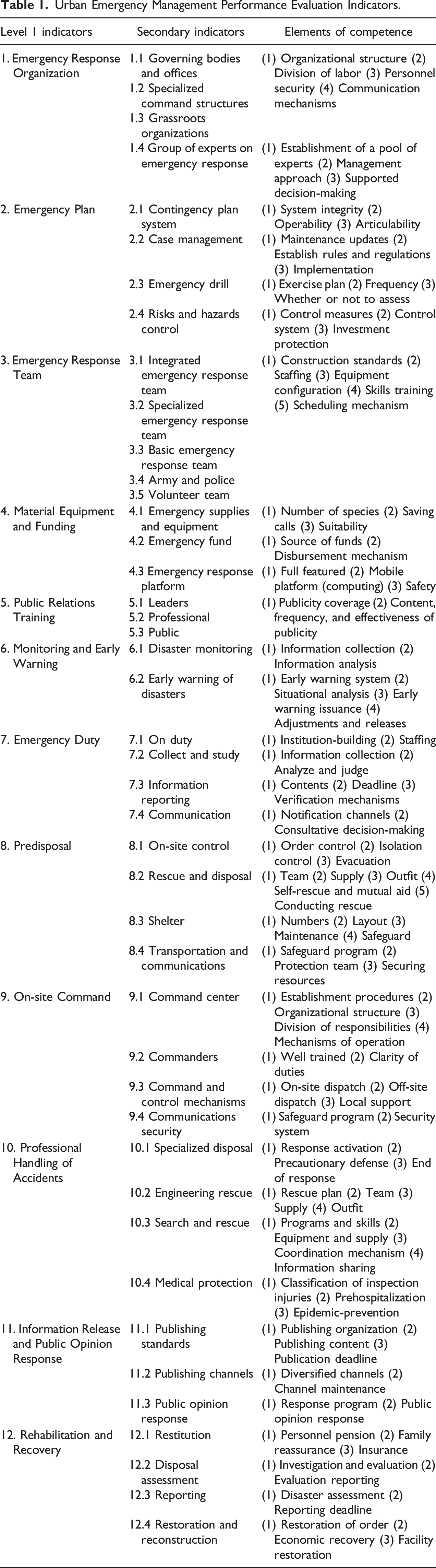
Calculation of Indicator Weights
Analysis of the Influencing Factors of First-Level Indicators
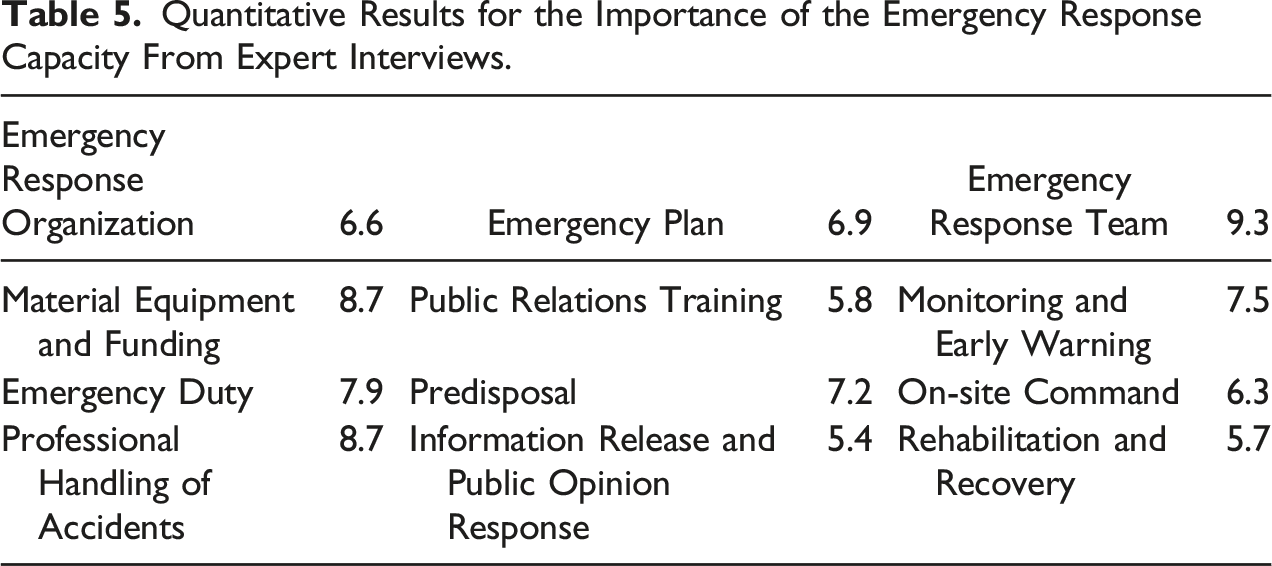
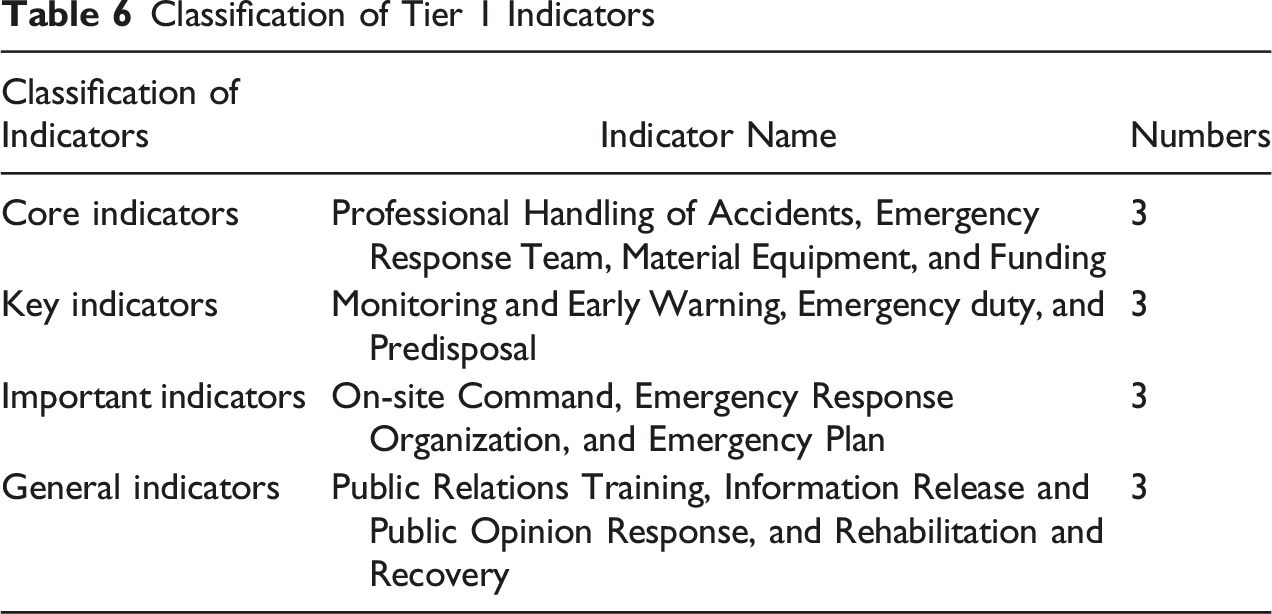
The calculation of the weights of the first-level indicators is proposed using the analytic hierarchy process (AHP). Hierarchical analysis determines the relative importance of each factor through pairwise comparisons and then compares the relative importance coefficients on this basis (SAATY T L, 2013). In the above assessment system, there are twelve first-level indicators that are not suitable for direct use according to the research paradigm for AHP, so this paper divides the first-level indicators into four categories according to their importance: core ability assessment indicators, key ability assessment indicators, important ability assessment indicators, and general ability assessment indicators. These are translated into a hierarchical analysis of the indicator classes targeting the four categories of the assessment.
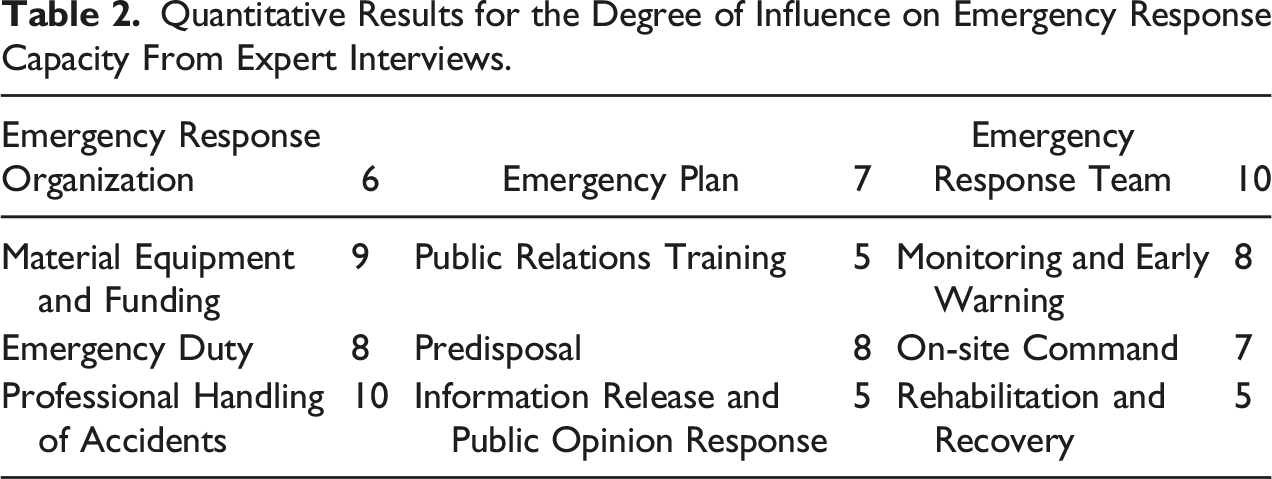
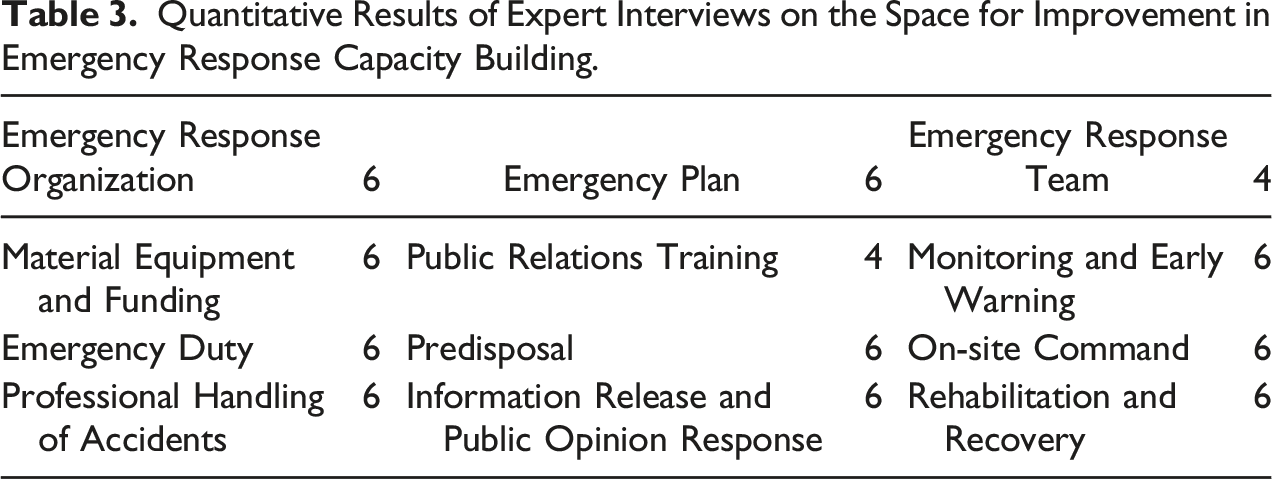
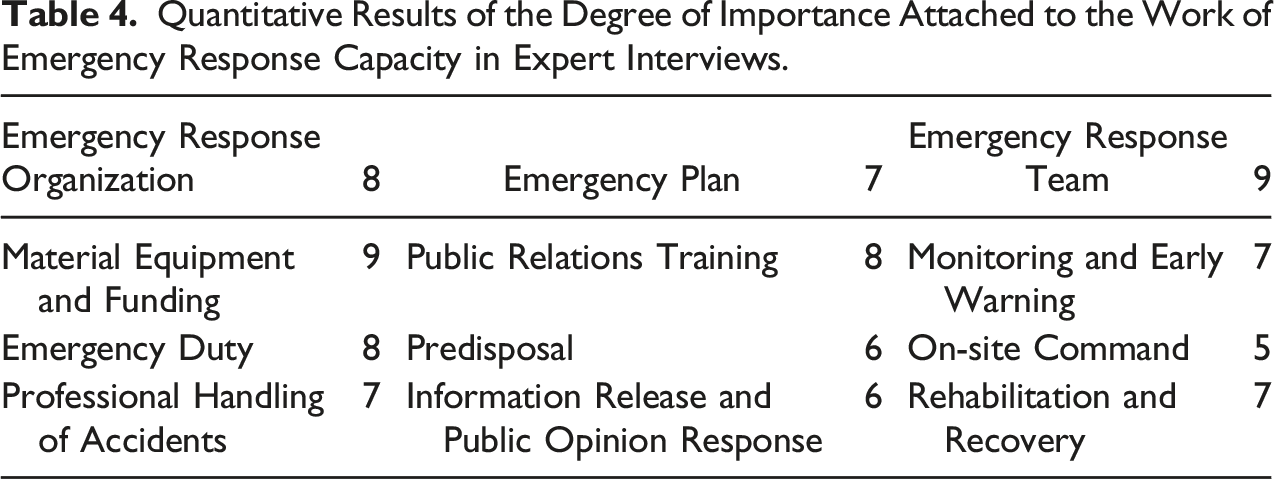
At the same time, expert interviews are conducted with staff of City S’s emergency management department and experts who have frequently been involved in emergency responses to natural disasters. During the interview, each participant is asked to rank the importance of each indicator in the city’s emergency management system, and the importance of each indicator is quantitatively valued; second, the importance of the first-level indicators is sorted from high to low and reasonably sorted into four grades. The questions for quantitative valuation of indicators include “the degree of influence on the effective handling of public security incidents (X),” “the size of the space for improvement of emergency response capacity building corresponding to this emergency response capacity assessment indicator (Y),” and “the degree of importance attached to the content of the emergency response capacity assessment indicator in the actual work process (Z).” Experts were then asked to assign points to the importance of the first-level indicators in the above three dimensions, with the range of the assigned values being from 0 to 10. If the difference between the scores of the three experts was less than 3, the indicator was considered to have been unanimously recognized, and the scores were retained. After calculating the scores with a weighted average, these averages were used as the basis for sorting the scores. After several rounds of expert consultation, the indicators and weights were finalized as follows:
Quantitative Results for the Degree of Influence on Emergency Response Capacity From Expert Interviews.
Quantitative Results of Expert Interviews on the Space for Improvement in Emergency Response Capacity Building.
Quantitative Results of the Degree of Importance Attached to the Work of Emergency Response Capacity in Expert Interviews.
Quantitative Results for the Importance of the Emergency Response Capacity From Expert Interviews.
Classification of Tier 1 Indicators
Calculation of the Weights of First-Level Indicators
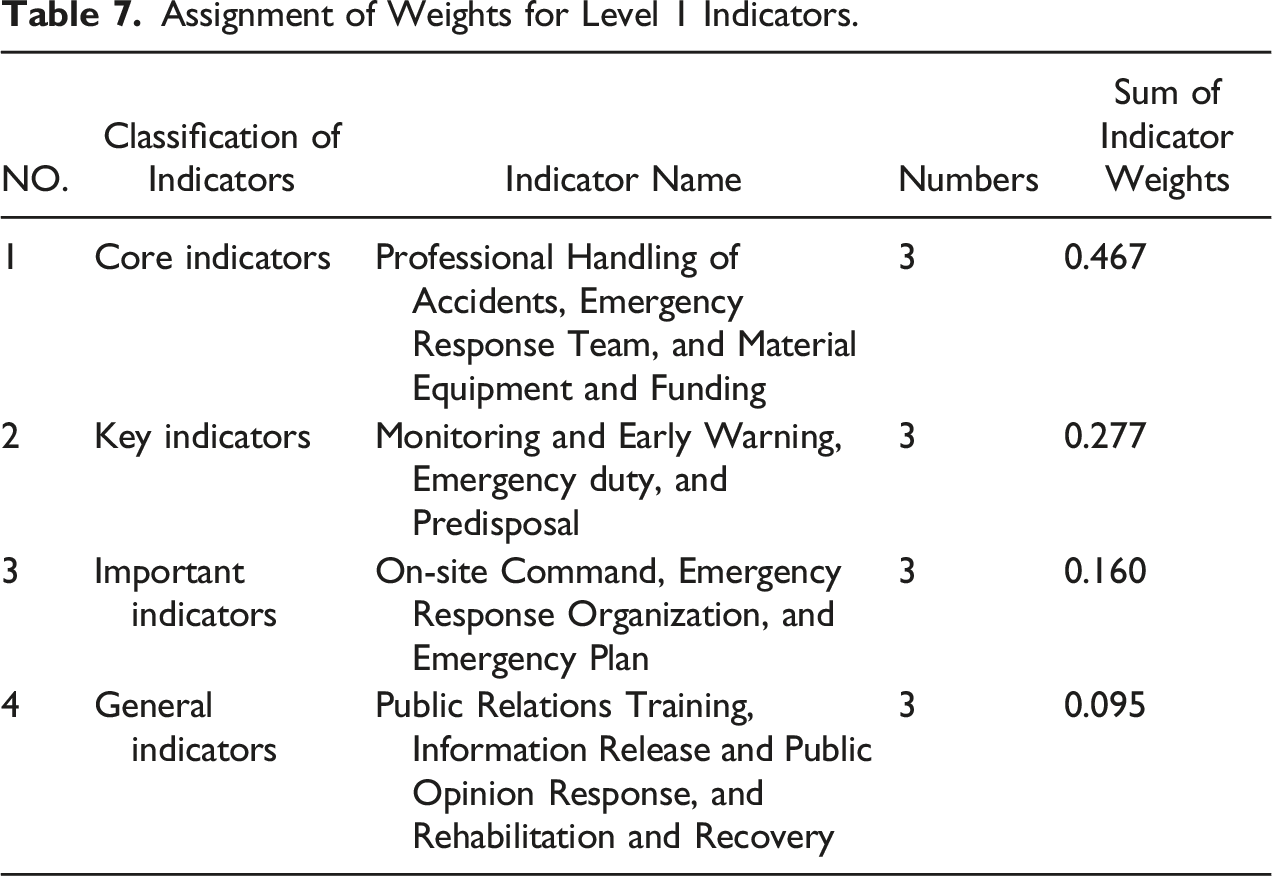
After classifying the first-level indicators, we can start to analyze the relationship between the factors structurally, determine the relative importance of each factor through pairwise comparison, and compare the coefficients of relative importance on this basis. In the assessment indicator system, the 12 first-level indicators are sorted and categorized according to the magnitude of their influence into 4 indicator classes, and then pairwise comparisons of these 4 indicator classes can be made to obtain the judgment matrix:
From the judgment matrix, w is obtained after calculating row sums as well as normalization:
Therefore:
Assignment of Weights for Level 1 Indicators.
Indicator Assessment Methodology
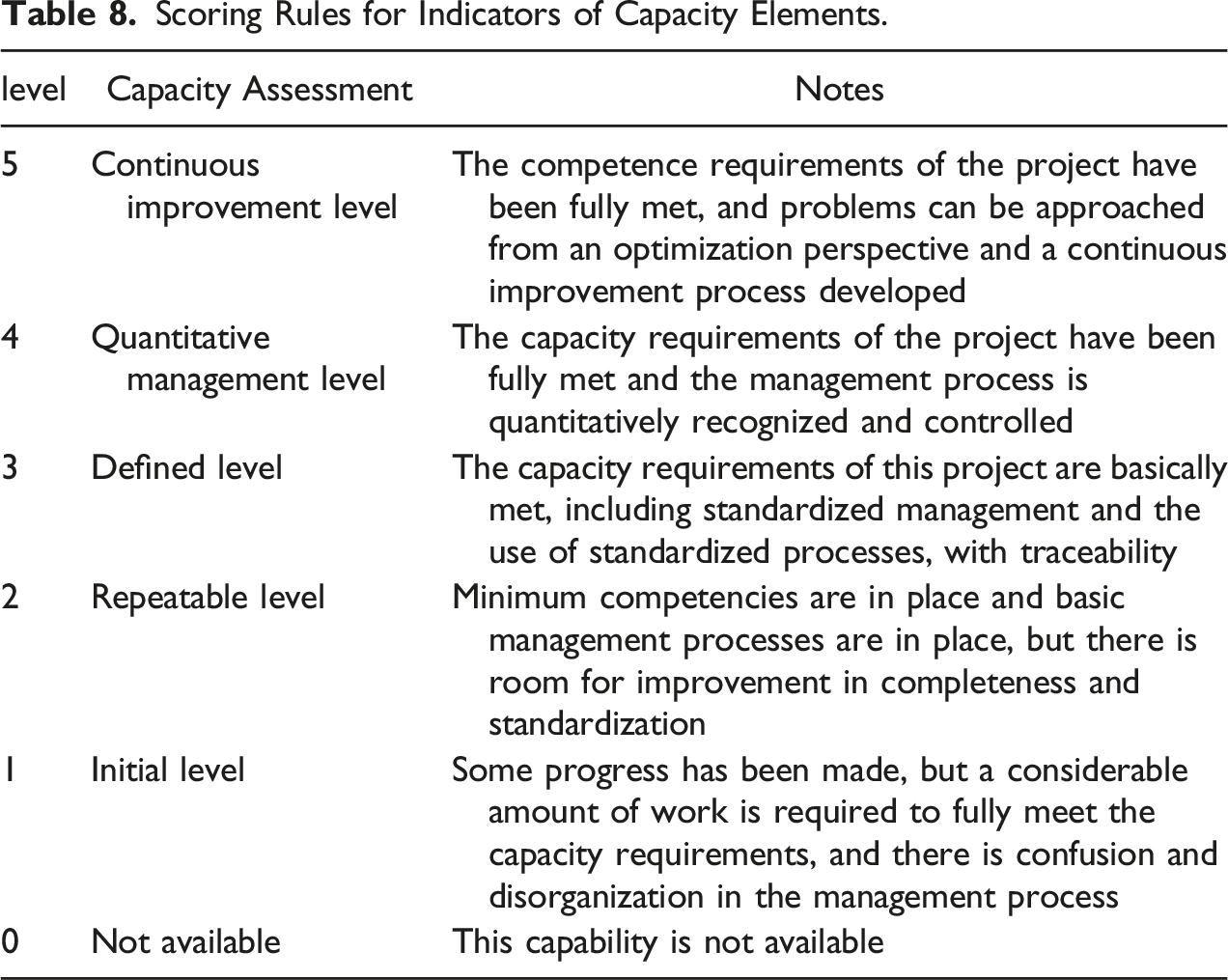
Capability Element Assessment Methods
Scoring Rules for Indicators of Capacity Elements.
Assessment Method of Secondary Indicators
The score of the secondary indicators of the urban emergency management performance evaluation is determined by the degree of achievement of the corresponding target capacity elements, and its final score is measured according to a ten-point system (1∼10). The specific evaluation methods and standards are as follows: (1) If there is no element at the “defined level” or below in the evaluation results and the proportion of points allocated to the “continuous improvement level” is ≥50% of the total, then the maximum score of the secondary indicator is 10 points; if all are at the “continuous improvement level,” then 10 points (full) are recorded. Otherwise 9 points shall be given to the remaining elements. (2) When the percentage of the elements at the “quantitative management level” is ≥50%, if there an element at the “defined level” or below, it will be credited with 7 points; other elements will be credited with 8 points. (3) If every element in the assessment is at the “quantitative management level,” “defined level,” or “repeatable level,” the score will be 6, 5, and 4 points, respectively, according to the situation in which the three indicators account for the highest total. (4) If there is no element at the “continuous improvement level,” “quantitative management level,” or “repeatable level,” each will be scored 7 points; other elements will be 8 points. If all elements are scored at the “repeatable level,” they will be scored 3 points, other elements will be scored 2 points. (5) If all elements are “initial grade” or when the proportion of elements in the “initial level” is ≥50%, they will be credited with 0 points. When the proportion of elements at the “repeatable level” is ≥50% they will be credited with 1 point.
Tier-1 Indicators and Overall Scoring Methods
First, there are n secondary indicators under the ith first-level indicator, and the score of each ith secondary indicator is noted as
Based on the calculated urban emergency management performance assessment scores, the performance level is divided into five bands, and the emergency management performance is judged according to the following principles: if the score is higher than 8 (not included), the emergency management level is at the level of continuous improvement; if the score is between 6 (not included) and 8, it is at the level of quantitative management; if the score is between 4 (not included) and 6, it is at the level of defined; if the score is between 2 (not included) and 4, it is at the level of repeatable; and if the score is between 0 and 2, it is at the level of initial.
Data Sources
The data samples and evaluation materials used in this paper mainly come from research on the construction of an urban emergency management system in the context of governance modernization carried out by the author’s research team, the Center for Government Performance Evaluation of South China University of Technology, in S City, Province G, China, from October 2022 to December 2022. The research targets include the heads and staff of the emergency management department of S City, the staff of the S City Emergency Management Association, and technical experts in related fields. The research content mainly focuses on the construction and weighting of the urban emergency management index, assessment of the basic situation of emergency management work in S City, and identification of the problems and difficulties of the work at this stage. In the process, the research team also included a number of other experts in the field of emergency management. The team consciously collected from the interviewed units and relevant personnel the original materials, such as policies and regulations, institutional mechanisms, meeting records, ledgers, and statistics, regarding the emergency management work of S City in the region. At the same time, they searched for and summarized the news reports, third-party reports, statistical yearbooks, and other public materials related to the emergency management work of S City through official websites for the subsequent development of the performance evaluation.
S city is a coastal city in South China, and its economic volume, foreign trade, population size, and degree of openness are among the highest in the country. However, due to its geographical environment, it often suffers from typhoon disasters from the western Pacific Ocean and the South China Sea, which affects the safety of the life and property of the city residents and the social and economic stability to varying degrees every year. This causes considerable difficulties for the city’s emergency management work, requiring continuous adjustment. Therefore, typhoon disasters, as the main crisis events and potential risks suffered by S City, are characterized by dynamics, complexity, and frequency, and it is of high practical significance and representative significance to assess the performance of S City’s emergency management of typhoon natural disasters. Therefore, based on the established urban emergency management performance assessment index, the performance of the S city government in responding to typhoon disasters in the first quarter of 2022 is analyzed on the basis of a case study, field research, data analysis, and expert interviews.
Empirical Analysis Results
The validation of the indicator system lies in its application. As one scholar writes, “Only factual evidence can show whether it is right or wrong, whether it can be temporarily accepted as valid or should be rejected” (Zheng & Liu, 2020). Regardless of the type of indicator system, the index must eventually be tested and continuously improved in empirical practice. However, the empirical evaluation depends on the environmental conditions and effective resources. From necessity and feasibility, we take S city in G Province of China as the research object and evaluate their performance with their real emergency management work in 2022.
Descriptive Analysis
Results of Emergency Management Performance Evaluation in City S
Overall Evaluation Results.
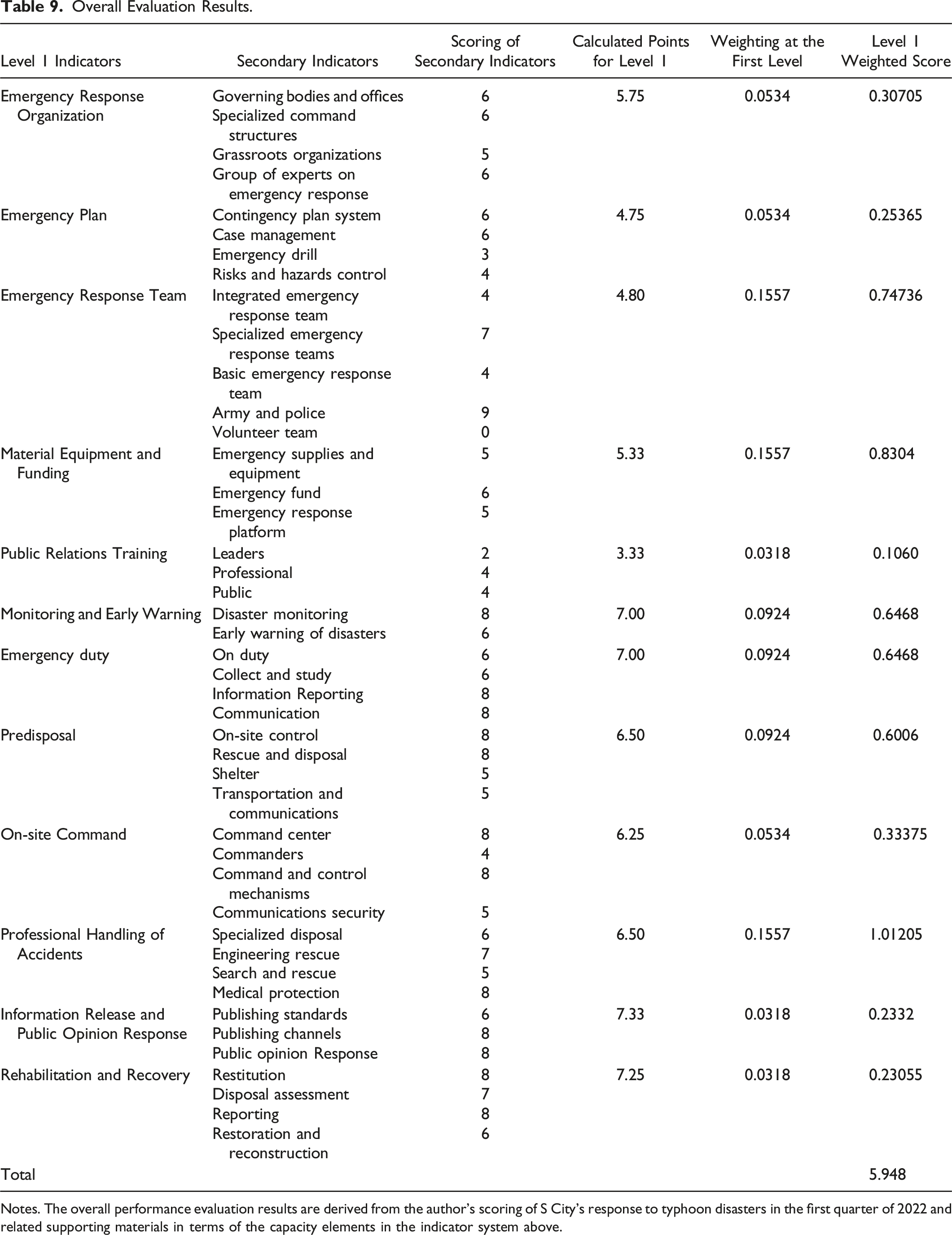
Notes. The overall performance evaluation results are derived from the author's scoring of S City's response to typhoon disasters in the first quarter of 2022 and related supporting materials in terms of the capacity elements in the indicator system above.
Analysis of Assessment Results
In the “prevention and preparedness stage,” the scores of “education and training,” “emergency plan,” “emergency response team,” “materials, equipment, and funds,” and other pre-event stages are generally low. Other scores are mostly concentrated in the “disposal and rescue stage” and “recovery and reconstruction stage.” (Figure 1 Ranking of tier 1 indicator score levels.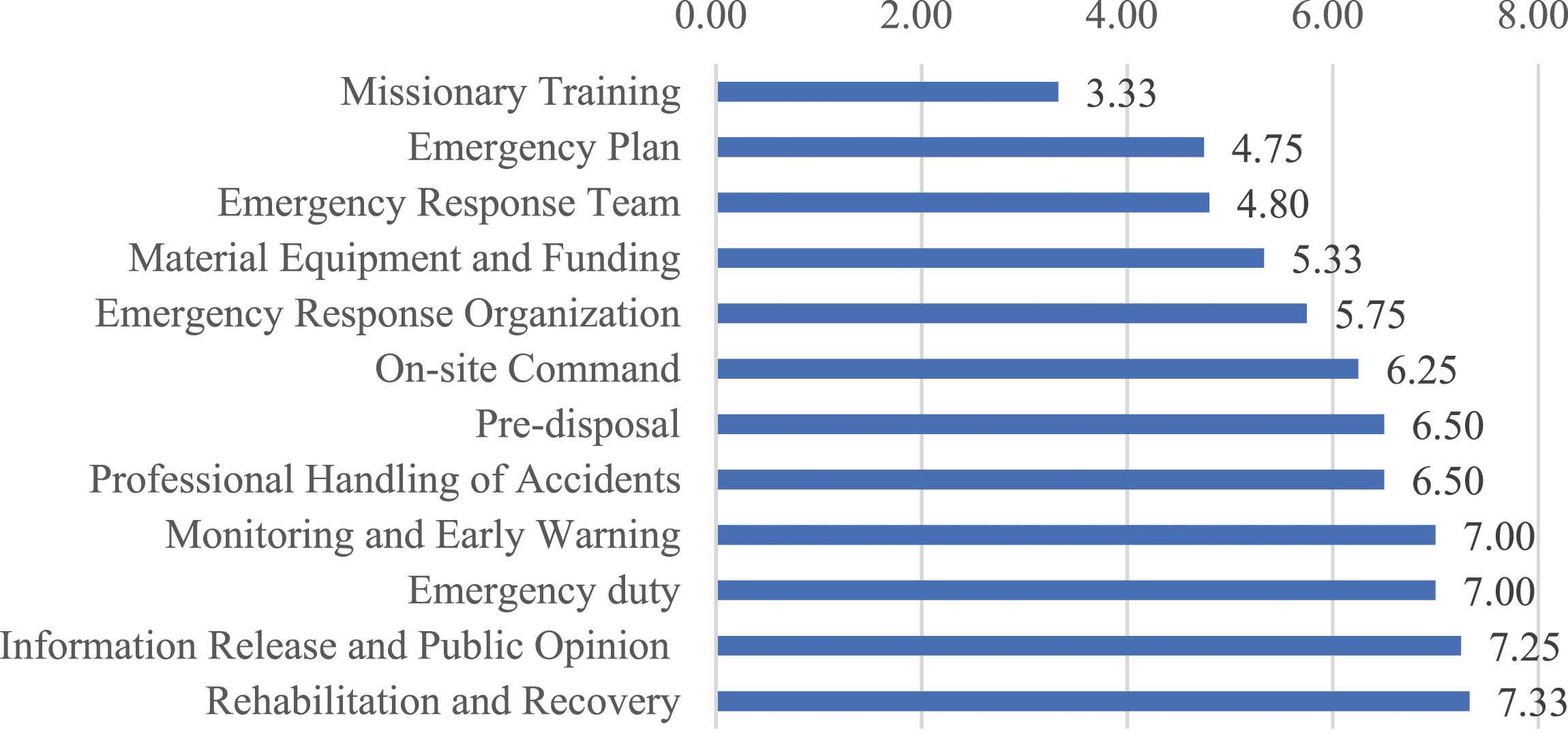
First, the planning and standards for emergency supply reserves need to be strengthened. At present, China has initially formed a four-level chain for the distribution of disaster relief supplies (“central—provincial—municipal—county”) in reserve for natural disasters. However, in the context of increasingly complex and severe public security situations, advance planning and standards for emergency reserves need to be further improved. There are still some deficiencies in the construction of the system, such as insufficient inventory in the warehouse, a single method of stockpiling materials, relatively underdeveloped and outdated management tools, insufficient stockpiling capacity at the grassroots level, and other shortcomings. S city has not yet formulated a unified material stockpiling plan, and all districts in S city carry out emergency material preparations in accordance with their own actual conditions. The level of emergency equipment and facilities varies, leading to a large gap in the emergency response capacity of different regions.
Second, there is still much room for improvement in team-building standards. In the construction of emergency response teams, excessive reliance on the military, armed police, fire brigades, and other institutional emergency departments is necessary. Although such teams are the backbone of emergency response, their targeting and professionalism are often inadequate in the face of special public security incidents. At the same time, S City’s comprehensive emergency rescue team, professional emergency rescue team, and other social organizations and social groups participating in public security incident disposal opportunities are relatively small and lack certain combat experience. There are teams of personnel who have skills and equipment that are not up to standards, and professional technology and knowledge have not been fully applied. As a result, the quality of grassroots emergency response teams still needs to be improved, and the power of the market and society, including grassroots people and volunteers, has yet to be fully mobilized.
Third, the publicity, education, and training mechanism needs to be further improved. The government’s publicity work on public safety is relatively frequent and common, but the depth of publicity and education for disaster self-rescue and mutual aid is insufficient. Similarly, the number of accessible and publicized professional trainings is relatively few. At the same time, emergency management for typhoon disaster emergency management involves more laws, regulations, rules, standards, and a variety of documents, but there is a lack of learning and training materials for teaching these materials in emergency management. There is still much room for improvement.
Fourth, an emergency plan management mechanism is still lacking. At this stage, all relevant departments in the city formulated targeted emergency plans for typhoon prevention and other crisis events, but the contents of the plans are still lacking in terms of standardizing and refining the forms of participation in the various emergency themes, the forms of management, the contents of training, compensation for materials, and other specific matters, which can easily lead to a biased understanding.
Conclusions and Policy Recommendations
Conclusions
Based on the theory of the crisis life cycle, this paper takes the four special phases of the emergency management cycle—“prevention and preparation, monitoring and early warning, disposal and rescue, and recovery and reconstruction”—as the entry point, constructs a performance evaluation index for urban emergency management (12 first-level indicators and 44 second-level indicators), and then applies dynamic evaluation capacity standards to evaluate the performance of the emergency management system in S City in the first quarter of 2022. The study found that the performance evaluation score of S City’s emergency management is 5.948 points, resulting in placement at a “defined level,” that is, “there is a quantitative understanding and control of the public safety management process, but it fails to adopt standardized process management, and the management process does not yet have traceability.” The overall performance is relatively good, but the level of emergency management in S City is still in the process of transforming from disaster prevention and mitigation to a comprehensive emergency management system, and the evaluation scores reveal an erroneous tendency among the emergency response workers of “focusing on response but skimping on prevention” in the management of urban public safety. At the same time, according to the evaluation results and the information obtained from the field visit and research, we analyze the factors affecting the improvement of the performance of emergency management in S City at this stage. We identified places for improvement that include the planning and standardization of emergency material stockpiling, the standard of team construction, the publicity, education, and training mechanisms, and the management of emergency plans, which is still missing. These provide a basis for the subsequent policy recommendations for improving the construction of the urban emergency management system. This analysis also provides a reference for other regions to optimize the evaluation of public security emergency response capacity.
Policy Recommendations
Based on the results of the above assessment and analysis of the emergency management performance of S City, the relevant policy insights and optimization measures are specified as follows.
First, emergency material stockpile planning and standards should be improved. It is recommended that city administrators establish a digital platform for inventory management on the basis of the mapping and reported quantities of emergency material reserves. Standards and management rules need to be formulated for various types of material reserves. In this way, stockpiling can be administered according to the urgency and material needs of different crisis events and the dynamic data of materials can be updated in real time.
Second, the construction of grassroots emergency response teams should be upgraded. Among grassroots emergency response teams, an integrity system and a credit information management platform should be established to promote the healthy and orderly development of social emergency response forces through incentives for trustworthiness and penalties for a breach of trust. At the same time, standards should be further standardized for the construction of grassroots emergency response teams, such as the main person in charge, basic duties, operational mechanisms, and equipment.
Third, emergency management publicity should be strengthened. To enhance the public’s knowledge and professional skills in emergency management, publicity and education on laws and regulations, special plans for crisis events, on-site disposal plans, and emergency rescue cases should be widely carried out according to the real needs of different industries and positions. For example, the public is advised to learn about emergency rescue laws and regulations, the use of emergency equipment and facilities, emergency self-rescue in the process of crisis event disposal, mutual rescue knowledge, and successful emergency rescue cases.
Fourth, special emergency drill plans and systems need to be further optimized. Local governments, enterprises of all kinds, and social organizations promote plans for emergency response drills. They can organize and carry out comprehensive or special emergency response drills on a regular basis in accordance with the law and form a long-term mechanism for running emergency response drills to ensure that the emergency response plans are reasonable and effective.
Based on the idea of a “results-oriented and factually based” system, this paper provides a useful exploration of the construction of an urban emergency management performance evaluation model and empirical analysis of cases, and its main contributions are as follows. First, by sorting out the list of main tasks in the four stages of prevention and preparation, monitoring and early warning, disposal and rescue, and recovery and reconstruction, a systematic performance evaluation system for urban emergency management is constructed, which provides a technical method for carrying out similar evaluation work elsewhere. Second, the performance evaluation and analysis of the emergency management work in the first quarter of S City is carried out, which provides a research template for the subsequent evaluation of urban emergency management through empirical application. Third, we discuss the case study of emergency management in S City, which provides policy suggestions and improvement ideas for decision-makers to continuously improve the city’s emergency management system and capacity to respond to public crises more effectively.
However, there is still some room for improvement. First, due to the relative scarcity of regional statistics on public safety and the difficulty of obtaining them, subjective qualitative research is mostly used to assess the performance indicators of urban emergency management. The quantitative assessment and analysis of the indicators should be further strengthened in the subsequent assessment. Second, the empirical sample selected for this study includes emergency management work in the first quarter of the year 2022 in S City. Due to the limitations of research time and cost, the whole year of emergency management performance in S City could not be scrutinized and examined. There is a need to continue to expand the sample of surveyed cities and emergencies in the future to improve the rigor and comprehensiveness of the evaluation results.
Footnotes
Declaration of Conflicting Interests
The author(s) declared no potential conflicts of interest with respect to the research, authorship, and/or publication of this article.
Funding
The author(s) disclosed receipt of the following financial support for the research, authorship, and/or publication of this article: This work was supported by the Philosophy and Social Science planning project of Guizhou Province, “Research on Risk perception, Behavior rules and Emotional Guidance of Guizhou Public from the Perspective of Major Public Health Emergencies” (22GZYB52).
