






Abstract
The purpose of this review is to synthesize the research evidence for the role of the work environment—workplace physical activity policies and resources and job strain factors—in explaining physical activity in white-collar workers. White-collar workers are at risk for developing a sedentary lifestyle, which contributes to all-cause mortality. Understanding how work environment can influence worker physical activity is important for the development of effective interventions. We reviewed 15 research articles that describe the relationship between work environment factors and physical activity in predominantly white-collar workers. Relatively consistent evidence was found for the effects of supportive workplace policies and resources. Weak evidence was found for the effects of job strain. Both work environment factors have the potential to influence physical activity but require further exploration to fully understand their contribution to physical activity in white-collar workers. Limitations and implications are discussed.
Regular physical activity is protective against numerous chronic diseases and health problems, such as cardiovascular disease, hypertension, diabetes, various cancers, obesity, osteoporosis, and mental illness (U.S. Department of Health and Human Services, 2008; World Health Organization, 2002). However, today’s living and working environments contribute to inadequate physical activity and prolonged sitting, both of which contribute to all-cause mortality (Andersen, Schnohr, Schroll, & Hein, 2000; Hamilton, Hamilton, & Zderic, 2007; Patel et al., 2010). White-collar workers are at greater risk for developing sedentary lifestyles, mainly because of their extended sitting at work (Jans, Proper, & Hildebrandt, 2007; Miller & Brown, 2004). There is also evidence that workers do not compensate for prolonged sitting at work by spending less time in sedentary leisure activities (Jans et al., 2007). Given that employees spend most of their waking hours at work, a better understanding of the possible relationships between work environment factors and physical activity of white-collar workers is needed to inform the development of interventions.
There is an increasing interest in changing the work environment by creating supportive workplace physical activity policies and providing resources that reduce barriers and promote physical activity, such as placing motivational signs to encourage stair use and increasing access to places for physical activity (Gates, Brehm, Hutton, Singler, & Poeppelman, 2006; Pronk, 2009; Pronk & Kottke, 2009; Sallis, Bauman, & Pratt, 1998). Moreover, it is thought that health promotion programs should go beyond educational initiatives to support behavior change in the target population (Engbers, van Poppel, Chin, Paw, & van Mechelen, 2005). Policies and resources that support individual level efforts are more likely than educational initiatives to produce successful physical activity outcomes (Pronk & Kottke, 2009). However, this is an understudied area and it is not clear whether workplace physical activity policies/resources are associated with employee physical activity because most of the research examines workplace programs that target multiple health-related behaviors, making it difficult to determine the isolated effects of workplace policies/resources on physical activity.
In addition, the psychosocial work environment, specifically job strain, as a determinant of physical activity, has received attention in recent years. The leading theoretical model that tries to explain this mechanism is Karasek’s (1979) demand/control model (also termed the job strain model; Figure 1). Job strain, a form of psychological stress, refers to jobs characterized by high psychological work demands combined with low decision latitude. Job demands are the psychological demands of work, including workload, work pace, organizational constraints on completing work, and conflicting demands. Job decision latitude is the primary measure of job control and is referred to as the combination of making autonomous decisions on the job and using a variety of skills on the job. According to the model, low control combined with high demands represents a “high strain job,” which may lead to adverse health outcomes, whereas high control combined with low demands represents a “low strain job.” High control combined with high demands represents an “active job,” which may lead to active behavior, while low control combined with low demands represents a “passive job,” which may lead to a passive lifestyle. Such work characteristics are hypothesized to influence individual behavior and health. In addition, work characteristics are modifiable and may thus provide an opportunity to influence individual behavior, such as physical activity (Karasek, 1979; Karasek et al., 1998). Therefore, a comprehensive review of the existing literature on the relationship between job strain factors and employee physical activity is warranted.
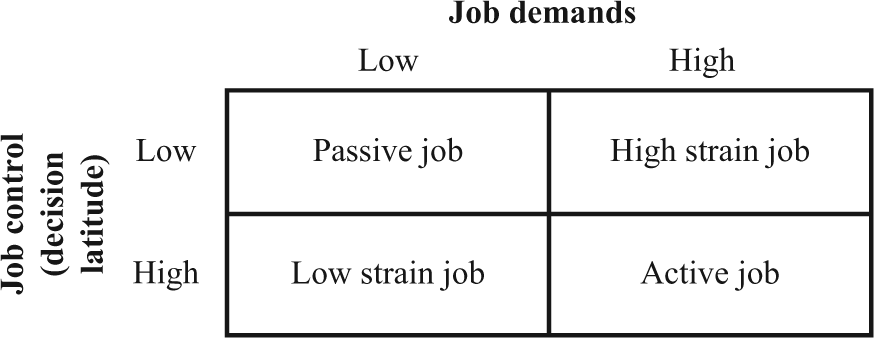
Karasek job strain model.
This work is grounded in the ecological model for health promotion (McLeroy, Bibeau, Steckler, & Glanz, 1988), suggesting that important factors include individual and organizational. For purposes of this article, we have limited our review to organizational factors. There are a wide variety of organizational factors that could influence physical activity of employees. So far, the only ones that have been studied include work environment factors for policies and resources and job strain factors. Work environment factors refer to (a) psychosocial work environment, specifically job strain variables including the workload, pace of work, employee involvement in decision making, and management styles and (b) workplace physical activity policies and resources including incentives, supervisor and management support, corporate culture, changes in policies, and environmental modifications to support employee physical activity (McLeroy et al., 1988). Although it seems likely that a combination of job strain variables and workplace policies/resources may contribute to a better understanding of the relationship between work environment factors and physical activity, it remains underexplored.
Previous reviews suggest that the effectiveness of workplace physical activity interventions is not consistent (Conn, Hafdahl, Cooper, Brown, & Lusk, 2009; Dishman, Oldenburg, O’Neal, & Shephard, 1998; Proper et al., 2003). Most of the previous research used multicomponent interventions at the individual level (e.g., information, education, and counseling sessions). While Dishman et al. (1998) and Proper et al. (2003) reported limited or inconclusive evidence due to a small amount of high-quality research, Conn et al. (2009) conducted a comprehensive meta-analysis of the literature and found that workplace physical activity interventions have significant positive effects on physical activity (0.21) and health and work-related outcomes (0.08-0.57). Two reviews were conducted to determine the effectiveness of workplace policy and/or environmental interventions on physical activity and dietary intake (Engbers et al., 2005; Matson-Koffman, Brownstein, Neiner, & Greaney, 2005). Matson-Koffman et al. (2005) concluded that policy and environmental interventions may promote physical activity, whereas Engbers et al. (2005) found inconclusive evidence regarding environmental changes to promote physical activity because of the small number of studies available and methodological quality concerns.
A review of work environment factors associated with physical activity targeting white-collar workers is lacking. Therefore, the purpose of this review is to synthesize the research evidence for the role of the work environment—workplace physical activity policies and resources and job strain factors—in explaining physical activity in white-collar workers. Because most reported job strain factors vary between men and women, our data analysis and presentation were stratified by gender.
Method
Design
An integrative review was conducted to synthesize the empirical literature to more fully understand how work environment factors influence physical activity among white-collar workers. The integrative review method allows the simultaneous inclusion of diverse methodologies (experimental and nonexperimental study) and the incorporation of many purposes, such as defining concepts, reviewing theories and/or evidence, and analyzing methodological issues of a phenomenon of interest (Whittemore & Knafl, 2005). We followed the process of the integrative review outlined by Whittemore and Knafl (2005), including problem identification, literature search, data evaluation, data analysis, and presentation.
Search Methods
The following sources were searched to identify potential research articles: online databases (CINAHL, MEDLINE, PsycINFO, and PubMed), reference lists of included papers, and hand search of journals. Articles were retrieved using a combination of the search terms physical activity or exercise, and workers or employees, and work environment or workplace environment or job strain. Papers were included if they were published in English from January 1990 to November 2011 and described the relationship between work environment factors, specifically workplace physical activity policies and resources and job strain factors as independent variables and physical activity or exercise behavior as the dependent variable in predominantly white-collar workers. As stated earlier, workplace physical activity policies and resources refer to any workplace activities that support or promote employee physical activity. Job strain factors include job/work demands, job control/decision latitude, high-strain jobs, low-strain jobs, active jobs, and passive jobs. White-collar workers in this review refer to those who work in clerical, administrative, and professional nonmanual occupations. Intervention studies were not included in this review because there are very few studies of work environment interventions that solely target physical activity among white-collar workers. We limited our review to studies published in 1990 or later to capture the literature that focused on current white-collar workers, such as information technology workers.
Search Outcome
The initial computerized search yielded 624 citations (including 100 duplicates). After removing duplicates and screening titles and abstracts, 16 potentially relevant studies were identified for evaluation. Four additional articles were identified through other sources. After full-text readings of these 20 articles, 5 were excluded. The reasons for exclusion were not focusing on the relationship between workplace physical activity policies and resources and physical activity (n = 2), assessing physical activity as the independent variable (n = 1), the outcome measure combining diet and exercise scores (n = 1), and unable to distinguish between blue-collar and white-collar workers (n = 1). The final sample included 15 articles.
Data Evaluation
For each study, the level of evidence was assessed using a 7-level scale (Melnyk & Fineout-Overholt, 2011), ranging from Level 1 (the strongest evidence: systematic review or meta-analysis of all relevant randomized controlled trials [RCTs], or evidence-based clinical practice guidelines based on systematic reviews of RCTs) to Level 7 (the weakest evidence: opinion of authorities and/or reports of expert committees). The level of evidence rating for each of the included studies was generally low. Fourteen studies were graded Level 6 (weaker evidence from a single descriptive study), and one study (Gimeno et al., 2009) was graded Level 4 (moderate evidence from a well-designed cohort study). All 15 studies were included in this review because of the limited research in this area.
Data Analysis
The constant comparison method described by Whittemore and Knafl (2005), consisting of data reduction, data display, data comparison, conclusion drawing, and verification, was used for data analysis. We extracted data from the included studies, including the authors, year of publication, sample characteristics (number of all participants, gender, age, work setting, and location of study), study designs, the work environment measures, the physical activity outcome measures, and main findings.
To demonstrate the level of empirical support for the work environment factors associated with physical activity, we used the following rules (Campbell & Matthews, 2010): (a) relatively consistent support: Numerous studies examining the factor found a significant relationship with physical activity; (b) weak or no support: Numerous studies examining the factor found a nonsignificant relationship with physical activity; and (c) equivocal: The relationship between a factor and physical activity was about evenly split between studies with significant and nonsignificant findings. For each job strain factor, we counted the number of studies that found a significant relationship with physical activity and the number of studies that found no significant relationship. There were a small number of studies in the area of workplace physical activity policies and resources, so we assessed the relationship between overall supportive policies/resources or cumulative policies/resources and physical activity, instead of assessing workplace physical activity policies and resources separately, for each study.
Results
Study Characteristics
Fifteen articles were identified as meeting the criteria. Five studies were categorized under the workplace policies and resources (Table 1), and 10 were categorized under the job strain factors (Table 2). Fourteen studies were cross-sectional and 1 (Gimeno et al., 2009) was a prospective longitudinal study. All but 1 study (Landsbergis et al., 1998) involved male and female participants, and sample size ranged from 202 (Landsbergis et al., 1998) to 46,573 (Kouvonen et al., 2005) participants.
Characteristics and Main Findings of Studies That Examine the Relationships Between Workplace Physical Activity Policies/Resources and Physical Activity Among White-collar Workers.

Note: yr = year; M = mean; MVPA = moderate-to-vigorous physical activity; PA = physical activity; IPAQ = International Physical Activity Questionnaire; β = parameter estimate; BRFSS = Behavioral Risk Factor Surveillance System; ORadj = adjusted odds ratio; ns = not statistically significant; LTPA = leisure-time physical activity; WPA = work-break/workplace physical activity; R2adj = adjusted R2.
Rated according to Melnyk and Fineout-Overholt (2011).
p < .05. **p < .01.
Characteristics and Main Findings of Studies That Examine the Relationships Between Job Strain Factors and Physical Activity Among White-Collar Workers.

Note: yr = year; wk = week; mo = month; PA = physical activity; Adj = adjusted; OR = odds ratio; F/M = females/males; LTPA = leisure-time physical activity; CI = confidence interval;
Ref = reference; SOR = standardized odds ratio; M = mean; β = standardized coefficient.
Rated according to Melnyk and Fineout-Overholt (2011).
The odds ratio was statistically significant.
Borderline statistical significance.
The prevalence ratio was statistically significant.
p < .05. **p < .01. ***p < .001.
All studies reviewed relied on self-report measures of all variables, with the exception of one study (Crespo, Sallis, Conway, Saelens, & Frank, 2011) that included an objective measure of physical activity (accelerometer). Seven studies examined associations of work environment factors with leisure-time physical activity. Workplace policies and resources relevant to physical activity were usually assessed using measures of workplace policies (n = 5) and physical environments (n = 5), followed by social environments (n = 2). Job strain factors were most commonly assessed with the job demands and job control scales derived from Karasek’s (1979) Job Content Questionnaire (JCQ; n = 5) or questions similar to JCQ (n = 5). Tables 1 and 2 summarize the level of evidence, samples, type of physical activity outcome, work environment factors measured and their association with physical activity, and major findings. Table 3 presents the level of empirical support, as well as significant and nonsignificant associations between job strain factors and physical activity, stratified by gender.
Association of Job Strain Factors With Physical Activity Among White-Collar Workers, Research Yields Inconsistent Results.
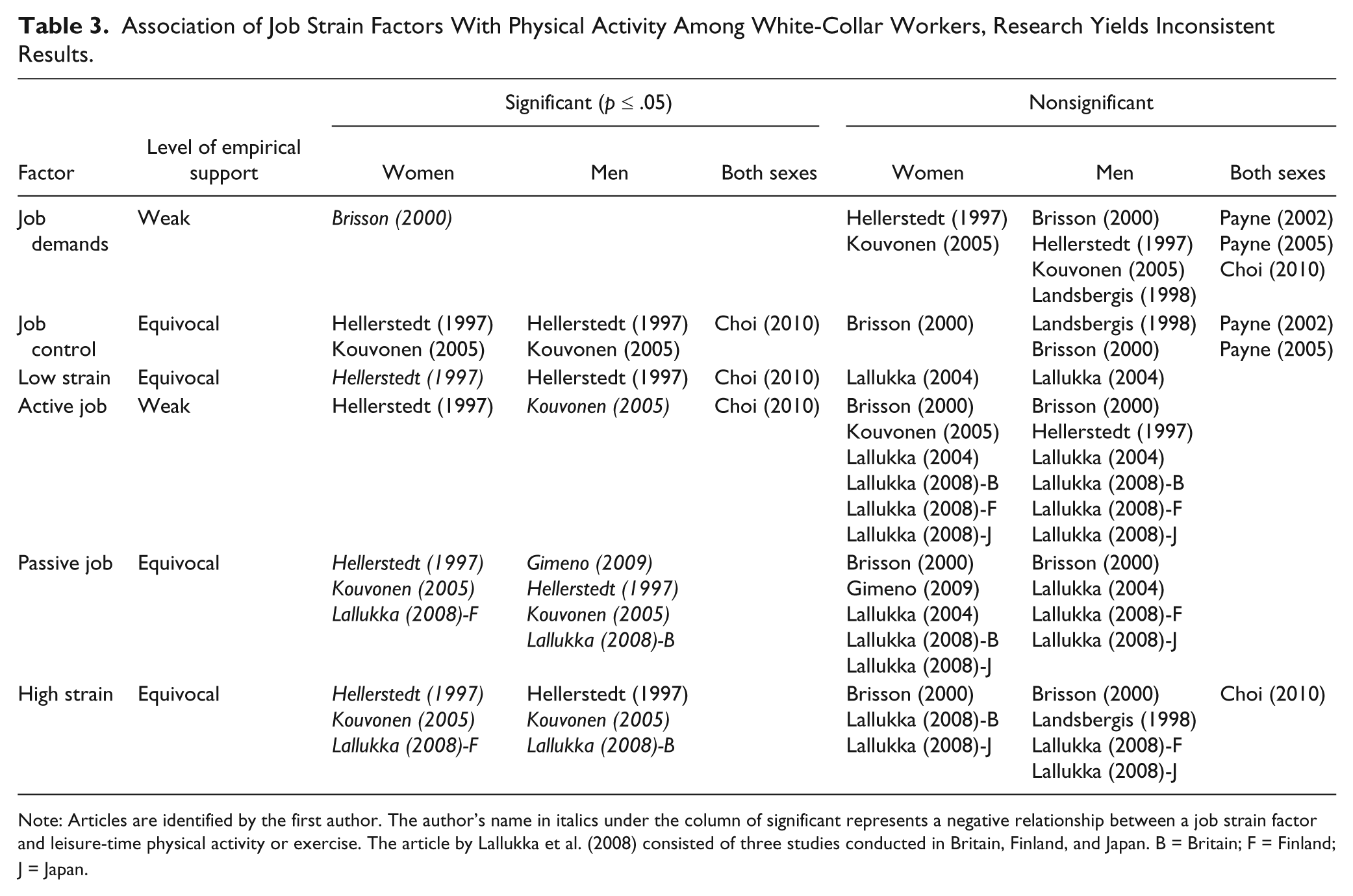
Note: Articles are identified by the first author. The author’s name in italics under the column of significant represents a negative relationship between a job strain factor and leisure-time physical activity or exercise. The article by Lallukka et al. (2008) consisted of three studies conducted in Britain, Finland, and Japan. B = Britain; F = Finland; J = Japan.
Workplace Physical Activity Policies/Resources and Physical Activity
Four studies examined supportive workplace policies/resources for physical activity, and results generally suggest a weak positive relationship with level of physical activity. Supportive workplace policies/resources for physical activity were positively related to moderate-to-vigorous physical activity (Crespo et al., 2011; Dodson, Lovegreen, Elliott, Haire-Joshu, & Brownson, 2008), leisure-time physical activity (Crespo et al., 2011; Lucove, Huston, & Evenson, 2007; Prodaniuk, Plotnikoff, Spence, & Wilson, 2004), and work-break/workplace physical activity (Lucove et al., 2007; Prodaniuk et al., 2004). For workplace policies supporting physical activity, subsidies for health club use were positively related to leisure-time physical activity and work-break physical activity, and paid time for non-work-related physical activity was positively related to work-break physical activity. For workplace resources supporting physical activity, having access to onsite exercise facility was positively related to leisure-time physical activity, and a safe place to walk outside work was positively related to work-break physical activity (Lucove et al., 2007). Workers with accessible exercise facilities and equipment, stairways, and personal services (e.g., fitness testing and counseling) at worksites were more likely to meet physical activity recommendations than those without these resources. For the cumulative effects, the number of supportive elements in the environment was associated with an increased likelihood of meeting physical activity recommendations (Dodson et al., 2008). In addition, there is evidence that the relationship between supportive workplace policies/resources and workplace physical activity was partially mediated by self-efficacy. However, outcome expectations did not mediate the effects of supportive policies/resources on physical activity (Prodaniuk et al., 2004).
A few results from this body of research were inconsistent with the proposed relationship between supportive workplace policies/resources and physical activity. For example, Lucove et al. (2007) did not find a relationship between supportive policies/resources and recommended levels of physical activity. Crespo et al. (2011) found that supportive workplace policies/resources were related positively to higher total sedentary behavior and negatively to job-related physical activity.
One study (Kaczynski, Bopp, & Wittman, 2010) examined the association between workplace physical and cultural supports for active commuting and employee active commuting behavior. Factors associated with walking or bicycling to work included having coworkers who actively commute to work and bicycle parking and storage policies in the workplace. In the cumulative effects, workers reporting more supports were more likely to actively commute at least once a week, especially women (Table 1).
In summary, our findings provide empirical support for the importance of supportive workplace physical activity policies and resources in promoting employee physical activity. Five studies found a significant positive relationship between overall supportive policies/resources (Crespo et al., 2011; Prodaniuk et al., 2004) or cumulative policies/resources (Dodson et al., 2008; Kaczynski et al., 2010; Lucove et al., 2007) and physical activity (including leisure-time, moderate-to-vigorous, work-break/workplace, and recommended physical activity or active commuting). In reality, however, workplace physical activity policies and resources are not yet generally available. Dodson et al. (2008) found that 69% of 977 U.S. workers reported no policies or resources that support physical activity in their workplace. The most commonly reported policies or resources were accessible stairways (57%) and a safe place to walk outside work (56%), whereas paid time for non-work-related physical activity (15%), facilities (15%), and equipment (11%) were the least commonly reported (Dodson et al., 2008; Lucove et al., 2007).
Job Strain Factors and Physical Activity
The relationships between job strain factors and physical activity were inconsistent and varied across gender and countries (Tables 2 and 3). The level of support for these relationships is presented in Table 3. For example, U.S. women with active jobs were more likely to be physically active (Hellerstedt & Jeffery, 1997), while Finnish men and older workers with active jobs were less likely to be active (Kouvonen et al., 2005). In the United States, however, highly educated men with active jobs were more likely to be physically active during leisure time (Choi et al., 2010). Men (in higher education) with low-strain jobs were more likely to be active (Choi et al., 2010; Hellerstedt & Jeffery, 1997), while women with low-strain jobs were less likely to be active (Hellerstedt & Jeffery, 1997). However, less educated women with low-strain jobs were more likely to be physically active during leisure time (Choi et al., 2010). White-collar workers from Britain, Finland, and Japan demonstrated inconsistent and weak associations between job strain factors and physical inactivity across gender and all three countries (Lallukka et al., 2008).
Nevertheless, in some studies, high job control had a relatively consistent positive relationship with leisure-time physical activity or exercise (Choi et al., 2010; Hellerstedt & Jeffery, 1997; Kouvonen et al., 2005), whereas passive jobs and high-strain jobs had a relatively consistent negative relationship with leisure-time physical activity or exercise, controlling for covariates (Gimeno et al., 2009; Hellerstedt & Jeffery, 1997; Kouvonen et al., 2005; Lallukka et al., 2008). In other studies, job demands and job control were not associated with exercise (Landsbergis et al., 1998; Payne, Jones, & Harris, 2002, 2005). However, Payne et al. (2002) indicated that people who intended to exercise but did not exercise reported higher job demands than intenders who did exercise, and Payne et al. (2005) further suggested that job demands affected exercise indirectly by reducing perceptions of control over exercise. In brief, the level of empirical support for job strain factors suggests only equivocal (e.g., job control, passive job, high strain, and low strain) or weak (e.g., job demands and active job) support.
Discussion
In this review, organizational factors include work environment factors, specifically workplace physical activity policies/resources and job strain factors. To our knowledge, this is the first review to synthesize and evaluate the extant literature examining the relationship between work environment factors and physical activity in predominantly white-collar workers. Overall, positive, albeit weak, associations between supportive workplace policies/resources and different types of physical activity were identified, providing relatively consistent empirical support. Job strain factors had some independent, but relatively small, effects on leisure-time physical activity or exercise, with job control, passive jobs, and high-strain jobs demonstrating stronger, though equivocal evidence. Other job strain factors were observed to have insufficient evidence for predicting physical activity, such as low-strain jobs, active jobs, and job demands. These merit further study. Moreover, we examine job strain as one of the psychosocial work environment factors, there might be other psychosocial work environment factors (e.g., low social support and low reward) that require further exploration. Finally, this is what we know about the organizational factors; future research may consider individual factors to better understand the whole picture.
Much of the research on worker physical activity to date has focused on job strain factors, but researchers are beginning to explore the potential influence of workplace physical activity policies and resources on worker physical activity. The paucity of research examining the effects of supportive workplace policies/resources on physical activity is likely influenced by the challenge of operationalizing key constructs and the lack of theoretically based and psychometrically sound measures of workplace physical activity policies/resources. Only one study (Prodaniuk et al., 2004) used a theoretical framework (social cognitive theory and ecological workplace physical activity model) to guide their research endeavors and used a reliable and valid measure of perceived workplace environment. In contrast, the theory and measurement of job strain constructs are well-developed, such as Karasek’s (1979) demand/control model and JCQ. More effort is needed to establish a shared understanding of the conceptual and operational definitions and theoretical frameworks to advance empirical examination of the concept of workplace physical activity policies and resources.
None of the reviewed studies examined the combined effects of workplace physical activity policies/resources and job strain factors on worker physical activity. Examining both the perspectives simultaneously will contribute to our understanding. Furthermore, only one study (Prodaniuk et al., 2004) used mediator analyses, which allowed the researchers to disentangle the causal direction and meaning of the relationship between the predictor variable and the outcome variable. Although limited literature prevents a definitive conclusion, the self-efficacy construct may have use as a mediator of physical activity. There have been recent calls to examine the potential mediation effects of psychosocial factors on the relationship of environmental factors and physical activity, in an attempt to guide development of interventions (Baranowski, Cullen, Nicklas, Thompson, & Baranowski, 2003; Brug, Oenema, & Ferreira, 2005; Kremers et al., 2006).
The research exhibits diversity in the population groups and research settings across studies that warrant careful consideration. The vast majority of studies reviewed were conducted in North America (52.9%) and Europe (41.2%); only one study was conducted in Asia (Japan). Although the target population in this review is predominantly white-collar workers (mostly well-educated, office-based, and sedentary workers), variations in job characteristics and workplace environments are expected within and across studies. These variations can affect workers’ levels of physical activity. For example, nurses’ job tasks are very different from that of other workers studied (Kouvonen et al., 2005). Nurses are likely more physically active than office workers during the workday, whereas on a nonwork day, office workers are likely more active than nurses. These differences may account for some inconsistent findings in some of the studies reviewed here.
Methodological and conceptual issues related to sample size, potential confounding factors, and the demand/control model may have contributed to the mixed results for job strain factors. In two studies, an inadequate subgroup sample size may have contributed to nonsignificant results (Lallukka et al., 2004, 2008; Landsbergis et al., 1998). In another study, results may have been confounded by the fact that subjects who participated in the study were more physically active than those who did not participate, thereby affecting the observed relationship between job strain factors and physical activity (Gimeno et al., 2009). Hellerstedt and Jeffery (1997) noted that the demand/control model weights demands and control equally and assumes linear relationships between demands and control and health behaviors, which may have produced misclassification errors in the job strain group, leading to an underestimation of the true association.
Methodological issues must be considered when synthesizing diverse sources of evidence. There was consistency in the way similar variables were defined in individual studies. Yet, there was less consistency in the specific measures used to assess the variables. The variables of physical activity and workplace physical activity policies/resources were measured differently across studies. The studies assessed job strain factors using Karasek’s (1979) job demands and job control scales or similar ones, but there were individual variations in the number of items, response options, item content, and reliability. These differences in measures make synthesis and generalizations across studies difficult and highlight the need for standardized and validated measures to be used across studies to determine the theoretically consistent patterns of findings.
It was interesting to note that supportive workplace policies/resources had a positive effect on leisure-time physical activity and sedentary behavior but a negative effect on job-related physical activity (Crespo et al., 2011). As suggested by the authors, it may be that supportive policies/resources were most likely to influence workers’ leisure-time physical activity (at work and away from work), and employers were more likely to provide supportive policies/resources for physical activity for their sedentary workers.
There are several limitations to this review. First, the review was limited to published articles. This may be subject to a publication bias in which studies with larger effects are more likely to be reported than those with smaller effects. Given the relatively small effects in the findings of this review, the bias may be small. Second, the review was limited to journal articles in English. Thus, not all relevant research papers were included. Third, the review was limited to the search terms, databases, and other search sources described in the methods section. Fourth, all but one of the studies reviewed were descriptive or exploratory (relatively low level of evidence). The use of a cross-sectional design can help identify the most salient constructs for further study, but questions of causality cannot be demonstrated. Finally, this review focused on white-collar workers, and the subjects in each study were “mostly” white-collar workers but not exclusively white-collar workers. Thus, one must be cautious about generalizing the findings to other groups of white-collar workers.
The results of this study offer implications for clinical practitioners. First, practitioners should consider creating supportive policies/resources for physical activity for inclusion in workplace physical activity interventions. Second, supportive policies/resources related to employee physical activity should be considered for inclusion in workplace policies, guidelines, and/or regulations. Third, redesigning jobs to reduce adverse psychosocial work environment (job strain) factors, such as high psychological work demands and low decision latitude, may influence work culture and reduce barriers to physical activity or exercise. The information provided in this review may provide some guidance to occupational health nurses in terms of a limited number of potentially effective work environment factors that could be addressed to help increase physical activity of white-collar workers. The results may also be used to identify features of supportive policies/resources for physical activity and to develop strategies that integrate physical activity promotion into the workplace culture.
In conclusion, workplace physical activity policies and resources appear to have a more consistent association with different types of physical activity than job strain factors. This finding supports the rising trend of creating supportive policies/resources as a sustainable approach to promoting employee health or physical activity in the workplace, aiming to maintain a healthy and productive workforce and workplace. Nevertheless, given the evidence we reviewed, more research is needed to confirm the effect of work environment factors on physical activity. Specifically, to clarify the direction of causality with regard to these relationships, we recommend a longitudinal design with a large population of white-collar workers that would reduce the confounding between predictor and outcome variables. Furthermore, future research should use reliable and valid measures to more accurately evaluate predictor and outcome variables. Additional research needs to clearly define and improve measurements of workplace physical activity policies and resources to facilitate an empirical examination of how these policies and resources affect workers’ physical activity.
Footnotes
Declaration of Conflicting Interests
The author(s) declared no potential conflicts of interest with respect to the research, authorship, and/or publication of this article.
Funding
The author(s) received no financial support for the research, authorship, and/or publication of this article.