







Abstract
As a means of promoting scholarship, faculty are increasingly including undergraduate nursing students as team members in faculty-led research projects. Research involvement is a high-impact educational practice that enhances student engagement and retention rates and enables the reflection and integration of learning. The purpose of this article is to describe the benefits and innovative ways of directly involving undergraduate nursing students in faculty-guided research projects. Case examples from four non-research-intensive nursing programs are presented to illustrate the benefits of undergraduate student research involvement to students, faculty, their communities, as well as the nursing profession. Student assistance in all phases of the research process, ranging from research question generation, literature reviews, methods development, and data collection and analysis, to presentations and manuscript publication, motivates and helps faculty progress with their research programs. Benefits also include the creation of effective learning experiences that build nursing knowledge and potentially contribute to community health.
Keywords
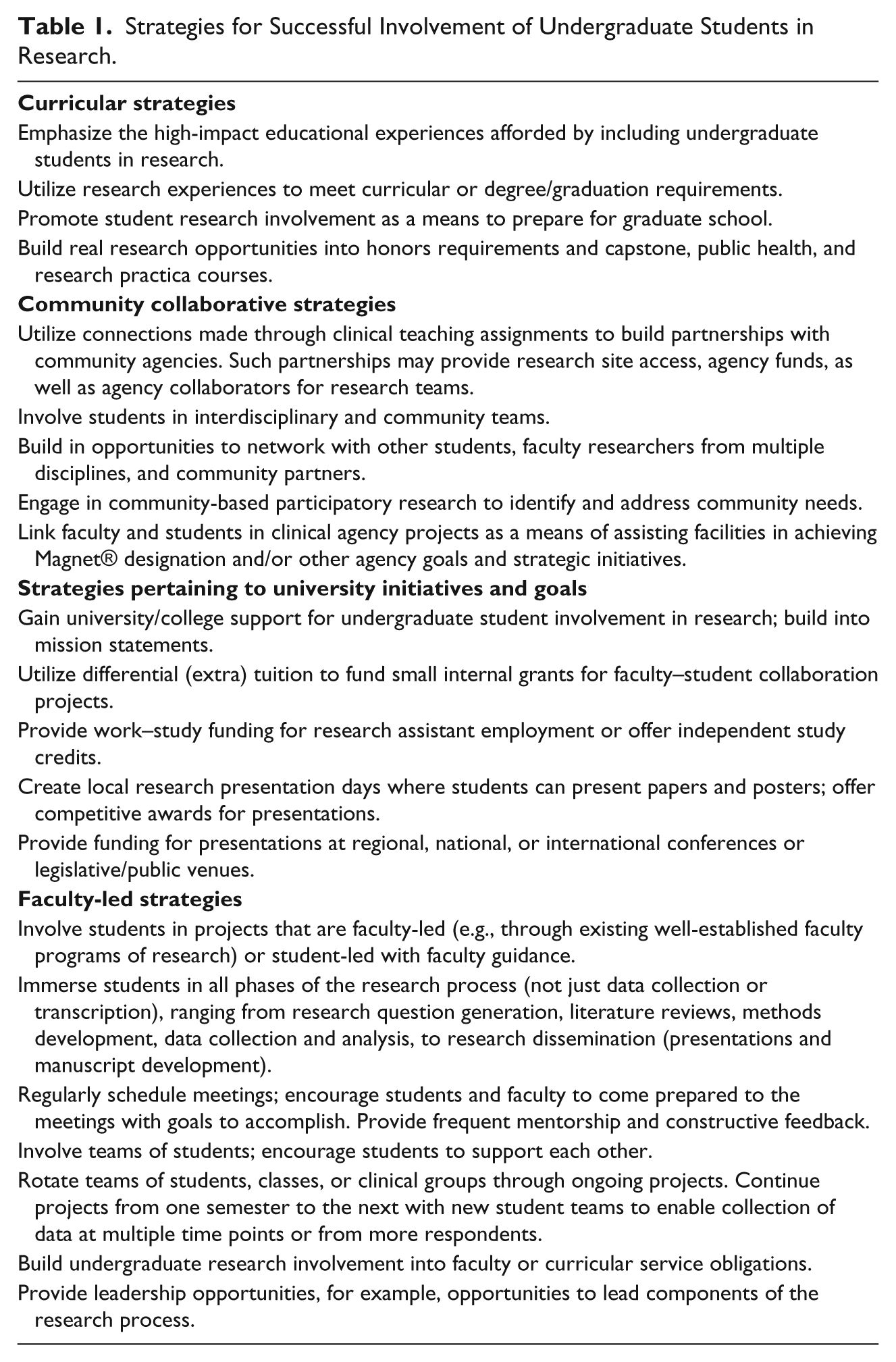
Although including graduate students in a faculty member’s research projects has been an expectation in research-intensive universities for decades, less attention has been paid to embracing undergraduates in such activities. At non-research-intensive colleges and universities, faculty teaching workloads tend to hamper faculty scholarship. Thus, faculty must be creative in finding feasible means of fostering their programs of research and scholarship in teaching-predominant settings. As a means of promoting scholarship, a number of both comprehensive and research-intensive campuses have increased engagement of undergraduate nursing students in faculty-led research projects. Traditionally, undergraduate students may have assisted faculty with research projects as a means of earning work–study money or of obtaining independent study credits. Immersing undergraduate students in all aspects of the research process, however, reaps additional value for the students, as well as for the faculty and the greater community. This article describes the benefits and innovative ways of directly involving undergraduate nursing students in faculty-guided research projects. Key strategies for successful involvement in research are summarized in Table 1.
Strategies for Successful Involvement of Undergraduate Students in Research.
Benefits of Undergraduate Student Engagement in Research
For students, the benefits of engaging in research are of such significance that the Association of American Colleges and Universities (AAC&U; Brownell & Swaner, 2010) promotes undergraduate research as a high-impact educational practice. High-impact practices are educational experiences that enhance student engagement and retention rates, and enable the reflection and integration of learning. The students gain richer learning opportunities and become excited to contribute to the knowledge base of their chosen profession, while working to meet degree requirements. To that end, AAC&U encourages faculty to re-think their role responsibilities and build student research and scholarship activities into existing curricular and service obligations (Kuh, 2010).
As a number of studies have shown, involving undergraduate students in research is associated with enhanced communication skills, scholarly writing abilities, time management and organizational skills, critical thinking capacities, and satisfaction with their educational experience (Greenwald, 2010; Hu, Scheuch, Schwartz, Gayles, & Li, 2008; Schaefer, 2013; Seymour, Hunter, Laursen, & Deantoni, 2004). Furthermore, participating in research teams gives students lessons and experiences in professionalism, persistence and resourcefulness, networking within professional organizations, presenting at conferences, and leading and working within groups. Students also gain opportunities to be mentored, build relationships with faculty, and grow in their confidence (Schaefer, 2013; Seymour et al., 2004). In addition, the exposure can entice them to pursue careers in academia and research. Introducing undergraduate students to research opportunities early on in their education contributes to their records of scholarship, which is helpful as these students are more likely and better prepared to subsequently apply for graduate school (Hu et al., 2008).
While benefits to engaging undergraduate students in research are well documented, less attention is paid to the potential value for faculty (Greenwald, 2010). The majority of baccalaureate programs in the United States are housed within colleges and universities that are not research intensive. Coupled with heavy teaching loads, many faculty find consistent engagement in scholarship difficult. Yet, faculty are encouraged and expected to develop and sustain scholarly productivity. When students are formally contracted to work with faculty, whether it be through independent study credit, work study funding, or research practica, faculty are obliged to keep research moving forward as they regularly mentor students (i.e., having students showing up at one’s door expecting to help is a good motivator). Furthermore, rotation of students through faculty projects can keep research active from semester to semester leading to enhanced productivity. Small internal grant programs also can help sustain these projects. Ultimately, by creating teaching environments that promote scholarship, faculty retention and career satisfaction may be enhanced (Elgren & Hensel, 2006).
In non-research-intensive settings, tenured and tenure-track faculty often are expected to teach in clinical settings. The presence of faculty in undergraduate clinical teaching environments builds trust and links the faculty and students to potential research sites (Cepanec, Clarke, Plohman, & Gerard, 2013; Taber, Taber, Galante, & Sigsby, 2011). Nurturing relationships in such community settings can lead to greater potential for research funding, securement of research sites, and identification of potential donors. Moreover, at the university level, strategic planning efforts almost always emphasize community connection and collaboration to meet common goals. Engagement of faculty and students in community efforts to solve clinical problems can help meet these important initiatives, thereby benefiting both the community and the university.
In many health care settings, achievement and maintenance of Magnet® designation status is an important goal. Magnet® agencies are seeking opportunities to involve nurses in scholarship and evidence-based practice (EBP). Linking faculty and students in clinical agency projects can be mutually attractive and align with both university and agency aspirations.
To illustrate the potential benefits of undergraduate student involvement in faculty-led research, the following section includes case examples from four non-research-intensive college or university nursing programs. These examples include and expand beyond the more traditional methods of introducing students to research, such as senior capstone or class projects. The case examples show novel ways of immersing and involving students in all phases of the research process, ranging from research question generation, literature reviews, methods development, and data collection and analysis, to research dissemination.
Case Examples
University of Wisconsin (UW)–Eau Claire: Faculty–Student Collaborative Research
To sustain a program of research, whether that be at a research-intensive or non-research-intensive university, institutional support is crucial. The UW–Eau Claire is a small regional comprehensive university in the west central part of Wisconsin, with an enrollment of about 10,500 undergraduate students and 500 graduate students. Although research with graduate students is less of an emphasis at UW–Eau Claire, the university climate is very supportive of undergraduate research.
UW–Eau Claire has had a Center of Excellence for Faculty and Undergraduate Student Research Collaboration since 1988 that supports the engagement of students in faculty–student research projects. The students vote yearly to pay differential (additional) tuition to specifically fund high-impact educational experiences, such as faculty–student collaborative research projects. The majority of the research grant funds are used to pay student stipends. These projects may involve students assisting in faculty-led research or participating in faculty-guided student research. All undergraduate research, at a minimum, culminates in presentations at an annual university-wide research day. In reality, students further disseminate at many local, state, national, and international professional forums. And with the recent adoption of new university-wide liberal education core requirements, undergraduate students at UW–Eau Claire can use involvement in faculty–student research to meet an integrative learning requirement.
Through the strong tradition of students working directly with faculty mentors on faculty-directed studies, students assist with projects originating from faculty programs of research. For example, besides the usual student-paid activities such as interview transcription, students engage in actual data analysis and manuscript development. In research examining the meaning of variety to community-dwelling elders, two students participated in systematic content analysis to identify themes (Jansen, Druga, & Sauve, 2011). In a study assessing comfort levels among nursing students certified as nursing assistants (Stombaugh & Judd, 2013), an undergraduate student helped the faculty mentor with a literature review, data collection, data analysis with the SPSS statistical package, and the writing of the manuscript. The student met regularly with the faculty member, and came prepared with goals, thereby assisting with keeping the project and writing progressing forward.
Other examples include having students collaborate on literature reviews for research proposals and articles for publication. In one case, a grant funded literature review was conducted in anticipation of a clinical research project (Sanchez, Hankins, Crow, Comdohr, & Moch, 2013). In another, Branson collaborated with professors to complete a literature review on undergraduate nursing EBP education for publication (Moch, Cronje, & Branson, 2010). For a concept analysis paper on longing (Pehler, Sjostrom, & Markwardt, 2014), an undergraduate student conducted a literature search to provide the list of articles from which the sample of articles for the analysis was drawn. The faculty mentor then split the articles between the student and another student; both students reviewed and described each article (while the faculty member reviewed all the articles). Together, the students and faculty member analyzed the article information to identify themes. The faculty mentor and students each drafted sections of the subsequent manuscript and worked together on the final edits.
In addition to the faculty-directed research projects, faculty members also collaborate with students on student-directed work through honors projects, independent studies, and undergraduate student capstone course projects. An example includes an independent study project through which a student summarized the literature on dementia assessment tools for use with individuals with Down Syndrome (Philipps, Sievert, Sanchez, & Moch, 2013).
A benefit to the student is the ability to be part of a research team; moreover, these teams can be broadened to include both students and faculty from other disciplines. Some teams include two faculty mentors, either from the same or different disciplines; student team composition can be interdisciplinary as well. For example, nursing students worked with a social work professor and a nursing professor along with two health professionals to publish a review article on oxygen use at end of life (Quinn-Lee et al., 2012). The student, faculty, and health care team continued the research through developing a survey, summarizing results, and presenting at local, regional, and national conferences, and at a state legislative venue. Besides the experience of being part of an interdisciplinary team, students also gained leadership skills by mentoring new students to the research role as they were added to the team.
Community partnerships involving undergraduate students also have been beneficial to students, faculty, and the community. Through a research program on EBP, nursing faculty members partnered with the community to mentor student leadership while providing a service to clinical agencies (Moch & Lonsdorf, 2014; Moch, Quinn-Lee, Gallegos, & Sortedahl, 2015). The agencies identified clinical topics for which the nurses and administrators wished to know the best practices for managing the conditions. Given topics, a student leader and teams of student researchers searched the literature for EBP and presented those to agency staff. In some of these cases, students were funded through the agencies and collaborated with agency staff to present or publish outcomes. For instance, students were supported to collaborate with clinical teams to reduce heart failure readmissions (Rozar et al., 2014).
In summary, faculty–student collaborative research projects afford students and faculty productive opportunities to add to the knowledge base of nursing through publications and presentations, fulfill student educational requirements, further connect faculty with practice, and make meaningful contributions to local communities, such as professional staff development on best practices. These high-impact educational practices engage students in leadership opportunities, foster interdisciplinary team work, and help the university achieve strategic initiatives. A challenge in engaging undergraduate students in research is the time required to mentor and supervise students. This challenge, however, is not unique to research teams involving undergraduate students as even graduate students and other employed assistants need oversight. Moreover, the need for oversight can be beneficial as the faculty principal investigator (PI) is forced to make time for regularly scheduled meetings, thereby advancing the project through to completion.
Calvin College: Public Health Practica
The Calvin College Department of Nursing is a baccalaureate nursing program in a non-research-intensive, private, religiously affiliated, liberal arts college located in Grand Rapids, MI. The ideological perspective of community-based participatory research (CBPR) coupled with long-term partnerships with four urban, ethnically diverse, impoverished communities offers opportunities to promote and protect the health of these communities, engage in research meaningful to the residents, and design robust student learning experiences. Research programs addressing two resident identified needs—women’s anxiety/depression and unintended pregnancy—in the predominately Black, Hispanic, White, and homeless partner neighborhoods afford undergraduate students significant exposure to the research process in their final semester public health practicum course and via the research assistant (RA) role.
Women supporting women (WSW)
WSW is a pilot intervention study that offers supportive/educative groups to women at four neighborhood sites. The goal of the study is to decrease participant symptoms and increase self-care agency relative to anxiety/depression. The intervention consists of six 90-min sessions of a supportive/educative group including connecting/reconnecting, education, and support. The educational component covers the symptoms, causes, and treatment options for anxiety/depression as well as cognitive/behavioral strategies to prevent or cope with these health issues. The supportive component occurs around refreshments and a craft where the women have the opportunity to form relationships.
This pilot intervention is embedded into the senior-level public health practicum where students return, after a junior year introduction, to their assigned neighborhood. Two students from each practicum group volunteer for WSW for the first half of the semester and two for the second half—thus involving 16 of the 64 or 25% of the senior students in this study. With the support of a faculty member and a lay community health worker, students assist with the administration of the pre-/post-test measures, deliver the educational component of each session using the established curriculum, and plan culturally sensitive crafts and refreshments. Students have robust learning experiences relative to multiple steps of the research process. In addition, students synthesize collaboration, teaching/learning, group process, and mental health nursing principles to enact a culturally sensitive research intervention for a group of clients. In the Hispanic neighborhood, the students deliver the entire intervention in Spanish thus allowing for use of their double major or minor. Each learning opportunity fosters achievement of the course objectives. Simultaneously, the use of 16 students provides essential study research personnel.
The WSW research project has consistently employed undergraduate nursing RAs. Ideally, the RA works side-by-side with the primary investigator. She or he compiles consents and pre-/post-tests, does reminder telephone calls prior to sessions, transports women to the sessions, conducts sessions, inputs data, follows up on missing data, collects the 6-month post-test data, and engages in literature searches, data analyses, paper presentations (e.g., Doornbos, Zandee, DeGroot, & Bossenbroek, 2013), and manuscript preparation (e.g., Doornbos, Zandee, DeGroot, & Warpinski, 2013). These experiences prepare students for doctoral programs.
Women’s Health Promotion Project (WOHPP)
All senior nursing students participate in the WOHPP as part of their public health practicum. Some nursing students also work/volunteer as RAs from their sophomore year until graduation. WOHPP is an ongoing preconception reproductive knowledge promotion program funded by the Robert Wood Johnson Foundation Nurse Faculty Scholar Program as well as internal funding from Calvin College. It entails a 24-month randomized controlled trial, designed from previous CBPR results, to address residents’ identified needs related to unintended pregnancy. WOHPP is delivered through 10 home visits to groups of ethnically diverse women living in medically underserved neighborhoods. Students participate at all stages of the research as well as perform nursing roles within the context of public health nursing. Accompanied by either the community partnership coordinator and/or the PI, RAs go door-to-door to recruit participants in the partner neighborhoods. Nursing student/community health worker (CHW) teams receive training in intervention implementation and survey research, after which they go to the homes of participating women to provide reproductive education to the experimental group and healthy lifestyle education to the control group. Students also conduct follow-up visits every month for 6 months, then at 12, 18, and 24 months, and collect survey data during these home visits. RAs work with the PI to complete data entry, data cleaning, and receive in-depth one-on-one coaching on literature review, analysis, and synthesis.
WOHPP led to an increase in scholarship for nursing students and faculty, including manuscript writing (e.g., Ayoola, Zandee, Johnson, & Pennings, 2014) and dissemination of research findings through oral/poster presentations at local, regional, and international nursing conferences. Four of the faculty member project coordinators and three students held a symposium on practical lessons learned from integrating WOHPP into an undergraduate nursing curriculum at a regional nursing research conference (Ayoola, Zandee, Sneller, Bosch, & VanderWall, 2014; Ayoola, Zandee, Sneller, Bossenbroek, et al., 2014; Ayoola, Zandee, Sneller, DeGroot, & Datema, 2014; Ayoola, Zandee, Sneller, Pennings, & Schipper, 2014). WOHPP also led to an increased zest for nursing research among the students as well as enhanced interest in the pursuit of graduate education.
During an evaluation of WOHPP, students reported an increase in their understanding of public health nursing, communication skills, and knowledge of reproductive changes. Students acquired skills on the conduct of home visits and teaching sensitive reproductive content to clients. Students’ worldviews relative to caring for women from racially diverse and socio-economically disadvantaged backgrounds were challenged and positively impacted.
The most significant challenge in incorporating undergraduate students in the WSW and WOHPP studies revolved around intervention fidelity. Although the intervention curricula are developed in explicit detail and students have a consistent level of exposure to the relevant health condition, nursing research, and teaching/learning content, there are potential differences in their ability to implement the interventions. For the WSW study, the research team addressed this via a thorough orientation at the course outset and ongoing support from the course faculty prior to each group session. For the WOHPP study, the project team designed detailed protocols for each home visit and trained students and CHWs to use and adhere to all project protocols. After the initial training, the project team also reviewed protocols periodically, every 6 to 8 weeks, with RAs as well as emphasized the importance of adhering to the protocols to ensure implementation fidelity. Another challenge pertained to the need to switch students at the end of each practicum as students progressed in the nursing program. In both cases, the community health workers, who are residents in the neighborhoods, provided continuity by taking part in the WOHPP home visits throughout the study and attending all WSW support group sessions.
Purdue University: Undergraduate Nursing Capstone Course
Purdue University Calumet is a comprehensive regional university located in Hammond, IN, in the northwestern part of the state. It has an enrollment of more than 9,000 students. The Institute of Medicine (IOM; 2011) landmark report on the Future of Nursing encouraged schools of nursing to develop innovative ways to rethink curriculum and embed EBP and research utilization into practical experiences for students. With this charge came many opportunities for faculty to design research utilization learning experiences.
At Purdue University Calumet College of Nursing, Capstone is the final baccalaureate course taken prior to graduation. The course requires students to work through actual evidence-based, quality improvement (QI) projects submitted by community, regional, and statewide partners. The course coordinators request potential projects from area health care agencies that may assist them in their QI efforts. They then prioritize the projects based on course objectives and suitability to baccalaureate student learning. Students choose from the list of projects and work in teams to develop PICO (patient problem or population, intervention, comparison, and outcome) questions with faculty guidance. Some projects can be completed in one semester and others require more time. Projects that require more than one semester to complete are handed over to a second team of students the next term. After PICO question formation, all student teams search and evaluate the literature, develop and implement a solution, and assess project results. These collaborative research activities, including dissemination opportunities for publication and professional presentations (e.g., Christian, James, Hurtado, Sanders, & Wegner, 2014; Cobb, Douglas, NacJebzie, Rebecca, & Moore, 2014), reinforce the importance of active learning with a research utilization focus.
Since the capstone course began, course co-coordinators have received a U.S. Department of Education Title III grant to further develop the course, research release time to report EBP findings, and a national competitive Academic Partnership grant to evaluate an online version of the course. Internal undergraduate research grants (URGs) also are available; faculty work with students in submitting for this support. To date, 27 URGs have been awarded, and 10 student teams have received first, second, and third place Research Day awards.
This example provides a description of how an EBP Capstone project related to Quality and Safety Education for Nurses (QSEN) competencies was developed over two semesters by two different student teams. During the first semester of the EBP QSEN project, an EBP question was developed: “For health professionals, what is the effectiveness of developing an electronic resource matrix with links to educational tools specific to QSEN competencies for the practicing nurse to improve patient outcomes?” The focus for this initial project was to search for the best available evidence for one competency—QI. With the assistance of a faculty mentor who facilitated learning, the student team applied for and received an URG. The second semester of the project involved completing the electronic resource matrix with the remaining five QSEN competencies. Students developed a user’s guide for nurses in clinical practice. Eventually, the electronic matrix and user’s guide will be accessible to practicing nurses to aid in bridging the gap between knowledge of QSEN in academia and utilizing QSEN competencies in nursing practice.
The Purdue University Calumet case example illustrates several key points: The need for creativity in developing student-faculty-community collaborative partnerships; the impact of mentoring on sustaining student engagement in research/EBP activities; the value of embedding research utilization and EBP application into curricula to address IOM directives; the opportunities for faculty to participate with students in research utilization; the importance of designing EBP projects in real-world, experiential learning settings; the benefits of research utilization to students, faculty, and patients for improved outcomes; and most importantly, the opportunity to build a culture for appreciating and valuing research utilization activities and lifelong learning.
Capstone is an experiential learning course; therefore, collaborating with area hospitals and statewide partners presented barriers, most notably, time constraints and meeting project deadlines. Since meetings are often held off-site or via teleconference, the importance of team flexibility, adhering to principles of project management, and examining organizational culture is essential. Barriers were viewed by the QSEN team as “teachable moments” and opportunities to enhance student learning through mentoring.
Hope College: The Nursing Research Practicum
Hope College, as a private, 4-year, and religiously affiliated liberal arts college in Holland, MI, is nationally recognized for undergraduate research. To be in optimal alignment with the college mission and vision, the Hope College Nursing Department adopted a new mission and philosophy in 2001 with an emphasis on collaborative faculty–student research. This led to the integration of a research theme throughout the undergraduate nursing curriculum, including required coursework in statistics and research methodology. Most distinctive about the nursing program is a required semester-long senior-level nursing research practicum course. The practicum provides hands-on participation with an ongoing research project. Students choose from a variety of projects, working alongside a nursing faculty researcher or an advanced practice nurse in a clinical setting. In addition to a research mentor, students have an assigned faculty person to assist them in meeting the course objectives. The practicum provides several benefits. Students overwhelmingly describe it as an excellent learning experience, particularly in relation to critical thinking and scholarly writing skills. The majority of students note a new passion and respect for nursing research and report the research practicum as a determining factor in their pursuit of graduate education.
Collaborative research with undergraduate students is likewise highly beneficial to the faculty and clinical nurse researchers working alongside the students. Most of the research projects are ongoing in nature, but are able to continue with the availability of new students from semester to semester. Students have the option to pursue research practicum credits over multiple semesters, and internal funds provided by donors and small external grants additionally provide the option for paid summer research assistance positions. In addition to the increased productivity as students assist in all phases of the research process, faculty and clinical researchers report a sense of fulfillment in their role as research mentors.
The nursing research practicum course is beneficial to the local community as well. Hope College nursing faculty and clinical nurse researchers from West Michigan hospitals and other health care agencies have developed strong collaborative relationships over time. Magnet® designated agencies value the involvement of their nurses in research and other QI initiatives in collaboration with PhD-prepared faculty from the college. Collaborative research projects have sparked other joint efforts between the college and health care agencies, including research seminar and guest speaker opportunities and invitations to serve on committees, advisory councils, or boards in both college and agency settings. The nursing research practicum is additionally beneficial to the community at large, as most projects are focused on improved quality care in the local community.
As part of the research practicum course, students are required to present their research posters at both a college-wide symposium and at their affiliated clinical agency, disseminating nursing knowledge to fellow students and practicing nurses alike. Undergraduate nursing students are also encouraged to submit abstracts for presentation at the National Conference on Undergraduate Research or the Midwest Nursing Research Society conference and are financially supported by the college to attend. Over 40 undergraduate students from Hope College have presented their work at these regional and national conferences since the inception of the research practicum course, with several receiving awards for their work. Other students have been active participants in co-authoring published peer-reviewed articles.
Despite the many benefits of the nursing research practicum for students, college faculty, clinical agencies, and the community at large, there are challenges in maintaining a high-quality research practicum experience. The college has not yet been faced with an inadequate number of research projects for students; however, this is recognized as a potential barrier as more colleges imbed research experiences within their nursing curriculum. If necessary, nursing faculty teaching the research practicum course can reach out to additional clinical agencies for research practicum collaborations. Another challenge is the large amount of planning and organization needed by the nursing faculty teaching the course, as research practicum projects must be identified and matched to students several months ahead of each given semester. Support by college administration in allocating fair workload hours in organizing and teaching the research practicum course has been crucial to its success.
There have been a variety of collaborative research projects since the establishment of the research practicum course. Two examples will be described here, one within a clinical agency and the other based within the Hope College Nursing Department. The first was a research project request from a local community hospital focused on eliciting staff nurses’ thoughts and beliefs about the foundations of their practice. The Plan, Do, Study, Act (PDSA) cycle approach was used for this project by a team consisting of advanced practice nurses at the hospital, an undergraduate nursing student, and a nursing faculty member. Focus groups were used to explore staff nurses’ thoughts and beliefs, leading to a professional model of care unique to the health care organization. The student and faculty member were involved in all aspects of the research process over a two-semester time frame, including a literature review, design of research questions, implementation of 22 focus groups, categorization of common themes, and dissemination of findings to hospital nurse leaders. This project was later disseminated in a published article, with the student serving as a co-author (Dunn, Shattuck, Baird, Mau, & Bakker, 2011). No funding was needed for this research work, as the advanced practice nurses and faculty member completed the project as part of their salaried positions and the student completed two semesters of the research practicum course for college credit.
A second example of collaborative research practicum work is focused on a faculty member’s program of research related to the development and testing of a hopelessness scale, with a more recent focus on the relationship between hopelessness and exercise. The ongoing nature of this program of research has provided research practicum experience and college credit to 20 undergraduate nursing students. Internal donor and small external grant funds have additionally supported summer research work by 11 students and the faculty member. The program of research is cross-disciplinary in nature, exposing students to a research team composed of faculty from the Departments of Nursing, Psychology, Kinesiology, and Statistics. This research additionally exposes students to collaborative partnerships with local hospitals and their staff. The majority of the undergraduate students who participated in this research presented their individual work at regional or national conferences and several served as co-authors of a published manuscript (Dunn et al., 2014). Most of these students also went on to pursue graduate education, with three in research-intensive PhD nursing programs.
The examples described above represent an intentional creative approach to collaborative learning and research at Hope College through the use of a research-focused undergraduate curriculum. The research practicum course in particular provides undergraduate students with direct hands-on experience with nursing research, increasing their knowledge of the research process, preparing them for translating research into practice, and readying them for potential graduate education. Through this collaborative experiential learning opportunity, students, faculty, and clinical agency researchers report an increased passion for nursing research, an increase in scholarly productivity, and a desire for lifelong learning. The nursing research practicum projects have additionally contributed to advancing nursing knowledge and improving the quality of care in the local community.
Discussion
Case examples of undergraduate student involvement in faculty-led research at four non-research-intensive university nursing programs were presented. The examples illustrate the potential scholarship opportunities available at institutions where the primary focus is undergraduate teaching. Collaborating with undergraduate students in conducting a faculty member’s research benefits both the students and the faculty, enabling a program of research to continue while providing exceptional student learning opportunities.
The case examples show that student-faculty scholarship is particularly exciting and productive when it is designed to extend beyond using students to simply help collect data. With faculty guidance, undergraduate students can excel at all levels of the research process including identifying research questions, examining the literature, discussing and interpreting findings, and disseminating results (Kuh, 2013). One of the key elements of a high-impact practice, such as engaging students in research, is that there be “frequent, timely, and constructive feedback” (p. 8). The case examples involved researchers and students working side by side in all phases of the research process. These opportunities immerse students in research experiences in dynamic ways more powerful than are possible in traditional classroom learning environments. Students engage in activities that advance beyond classroom assignments, such as public presentations at university research days or professional conferences and participation in manuscript preparation; these activities involve skills that are extraordinarily beneficial for building academic records that undergraduates can take forward toward graduate study and beyond.
Finding ways to embed research in undergraduate learning opportunities has the potential to promote faculty scholarly productivity in teaching-intensive environments. Some of the case examples pertain to research projects that are ongoing over the course of several semesters, allowing students to see the process of scholarship unfold over time and enabling multiple students to participate in these opportunities. With student teams passing the research projects on from one semester to the next, a potentially very small-scale study is able to grow in size with multiple data points or increased participant numbers.
The case studies also reveal that involving undergraduates in faculty-led research can help meet the needs of clinical agencies, including achieving Magnet® status. Relationships that may initially have started between faculty and community partners through clinical practica were strengthened vis-à-vis research or EBP collaborations. In some cases, nursing faculty, clinical agency nurses, and students worked together as teams on projects identified by the health care organizations. In other case examples, CBPR was incorporated into public health practica and capstone courses to meet community needs. Kuh (2013) stresses investing in practices that engage undergraduate students in educationally purposeful behaviors that are immersive and ongoing, and involve institutions of higher educations within their surrounding communities. To that end, students who participated in these collaborative projects were prepared to become leaders and advocates in service to their communities.
In conclusion, colleges and universities have increasingly committed to the importance of high-impact practices such as undergraduate student engagement in research, and many have adopted these practices into their strategic planning processes. Nursing is particularly poised to lead in these university level efforts through evidence-based initiatives. Nursing faculty are already well-connected to community and clinical agencies through clinical education. Nurse educators can be at the forefront in embedding research into undergraduate curricular and co-curricular work to reap benefits for students and the communities for which they will ultimately serve, the nursing faculty person, and the nursing profession as a whole.
Footnotes
Declaration of Conflicting Interests
The author(s) declared no potential conflicts of interest with respect to the research, authorship, and/or publication of this article.
Funding
The author(s) received no financial support for the research, authorship, and/or publication of this article.