







Abstract
The purpose of this integrative review was to analyze the current state of the science related to the novice nurse practitioner (NP) transition into primary care. A systematic review of the literature was conducted using the databases Pubmed, MEDLINE, Ovid, and Cumulative Index to Nursing and Allied Health Literature (CINAHL) with the terms nurse practitioner, role, and transition to search articles published after 1997. Three major themes emerged from the literature related to the novice NP transition into primary care. These themes were categorized as “experiencing role ambiguity,” “quality of professional and interpersonal relationships,” and “facing intrinsic and extrinsic obstacles.” Strategies to reduce role ambiguity, improve the quality of professional relationships, and mitigate extrinsic obstacles faced by novice NPs may improve their transition into the primary care workforce. Educational institutions, employers, and novice NPs all have a stake in the successful transition from student to primary care practitioner and should be engaged in developing effective NP transition-to-practice programs.
The 2010 Patient Protection and Affordable Care Act calls for an increase in patients served by Federally Qualified Health Centers from 20 to 40 million. Nurse practitioners (NPs) are increasingly meeting the demand for quality primary care providers, delivering high-quality, cost-effective health care with high patient satisfaction (Cassidy, 2013; Fairman, Rowe, Hassmiller, & Shalala, 2011; Horrocks, Anderson, & Salisbury, 2002; Newhouse et al., 2011). Furthermore, they command lower salaries, can be trained more quickly and at a lower cost than physicians, and perform similarly on several process and outcome measures of care quality (Fairman et al., 2011). According to the Institute of Medicine (IOM, 2010) Future of Nursing Report, a significant barrier to providing quality patient care in a transformed health care system is high turnover rates, which “continue to destabilize the nurse workforce in the United States” (p. 5). The IOM task force emphasizes that turnover rates among new graduates are particularly high, and recommends greater focus on the transitional period to the work environment following degree completion. Indeed, recent findings indicate that as many as one third of NPs change employment in the initial year of practice (Sullivan-Bentz et al., 2010). This has significant implications for patient outcomes, as NPs are increasingly being called on to fill primary care roles to address health inequities (Cassidy, 2013; Fairman et al., 2011). However, there has been remarkably little study of the NP transition into the workforce to date.
NP Primary Care Role Transition
The first year of employment following graduation from an NP program has been described as a period of transition that may be stressful and turbulent for the novice NP, regardless of practice setting (Brown & Olshansky, 1997; Chang, Mu, & Tsay, 2006; Heitz, Steiner, & Burman, 2004; Kelly & Mathews, 2001; Maguire, Carr, & Beal, 1995; Schumacher & Meleis, 1994). Meleis (1986) defines transitions as “periods in which change takes place in an individual or environment” (p. 6). Development, flow or movement over time from one state to another is a hallmark of any transition (Chick & Meleis, 1986). Situational transitions are those specifically related to professional or educational roles, and are defined as a change in role function and scope of practice (Schumacher & Meleis, 1994). Indicators of successful transitions are subjective well-being, role mastery, and well-being of relationships (Schumacher & Meleis, 1994). Many NPs progress through common stages as they transition into their first role that mirrors the descriptions outlined in Benner’s (1984) model From Novice to Expert. In this framework of passage through the stages of professional development, skill and skilled practice are the implementation of nursing interventions and clinical judgment in real clinical situations. According to the theory, expertise develops as clinicians apply general principles to the real-world setting.
Although extensive research has been conducted on the successful transition into the registered nurse role (Alex & MacFarlane, 1992; Clark & Holmes, 2006; Duchscher, 2008; Etheridge, 2007; Farnell & Dawson, 2005; Newton & McKenna, 2007; Thomas, Bertram, & Allen, 2012), there is little research regarding the initial role transition that occurs during the first year of primary care NP practice. Research analyzing the NP role transition mainly focuses on specific specialties or hospital settings (Bahouth & Esposito-Herr, 2009; Chang et al., 2006; Cleary, Matheson, & Happell, 2009; Cusson & Strange, 2008; Cusson & Viggiano, 2002; Rosenzweig et al., 2012; Shea & Selfridge-Thomas, 1997; Yeager, 2010). A literature review conducted regarding successful entry into NP practice concluded that there is a need for further research in this area (Rich, Jorden, & Taylor, 2001).
The seminal article in this area is a grounded theory qualitative study conducted by Brown and Olshansky (1997) titled “From Limbo to Legitimacy: A Theoretical Model of the Transition to the Primary Care Nurse Practitioner Role.” After interviewing 35 NPs at three time points throughout the first year of primary care practice, the authors developed a theoretical model of transition to the first primary care NP role. The model is representative of forward movement over time, with four distinct phases of the transitional year (Brown & Olshansky, 1997). Although the initial year of practice was riddled with identity confusion, obstacles, and difficulties, the participants also reported significant progress in the development of their professional expertise (Brown & Olshansky, 1997).
Over the past two decades, little research has followed to test this theory, and no new theoretical model has been proposed to describe the NP transition into the initial primary care role. Because of the small sample size and qualitative method, as well as the narrow geographic location, the generalizability of the “From Limbo to Legitimacy” framework is limited. However, it continues to be the framework cited by nearly all of the researchers studying the NP primary care initial role transition. In addition, our health care system continues to evolve and there has been new research on the NP transition to practice since this seminal framework. Of the few articles that have been published analyzing the NP role transition, the majority use a qualitative method with small sample sizes, with the studies conducted in one geographic location.
Purpose
The purpose of this article is to analyze previous research used to study this area. The primary aims of this review are (a) to understand the primary care NPs’ perception of their preparation for their initial NP role following graduation from a NP program, and (b) to explore the barriers and facilitators of the NP role transition. Ultimately, the goal of this literature review is to provide a clearer understanding of the novice NP transition into the primary care workforce.
Method
An integrative review was chosen because it allowed inclusion of studies with diverse methodologies (i.e., qualitative and quantitative research) in the same review (Whittemore & Knafl, 2005). Integrative reviews have the potential to generate a comprehensive understanding of health care issues based on separate research findings (Whittemore & Knafl, 2005). The integrative review was divided into the following phases: problem identification, literature search, data analysis, and presentation of the results (Whittemore & Knafl, 2005).
Search Method
Several different databases were searched to identify relevant published material. Systematic searches of the Pubmed, MEDLINE, Ovid, and the Cumulative Index to Nursing and Allied Health Literature (CINAHL) databases were undertaken using the terms nurse practitioner, role, and transition. The searches were limited to the period 1998 to 2015, because the seminal article describing the phenomenon in this area of research was published in 1997 by Brown and Olshansky.
Search Result
After duplicates were excluded, the researcher read the titles and abstracts of the remaining 28 studies. Studies were included in the review if they met the following criteria: the language had to be English; articles had to be published in peer-reviewed journals and address the NP role transition into primary care as there are distinct issues related to the workforce transition in this setting. The main exclusion criteria were as follows: the published works were literature reviews, conceptual analyses, or if the studies were conducted in hospital settings or on specialty NPs. The included studies were tabulated in chronological order under the following headings: citation, methodology, sample size, and main findings. Nine articles were identified as meeting the criteria. Six of the articles were qualitative research design, two were cross-sectional descriptive studies, and one was descriptive correlational (Table 1). None of the articles included NPs without prior nursing experience, and the studies were conducted in the United States and Canada. The sample size in the qualitative studies ranged from four to 44, with a total of six specialties represented. The cross-sectional descriptive studies analyzed from 352 to 562 questionnaires.
Summary of Articles Included in the Literature Review.
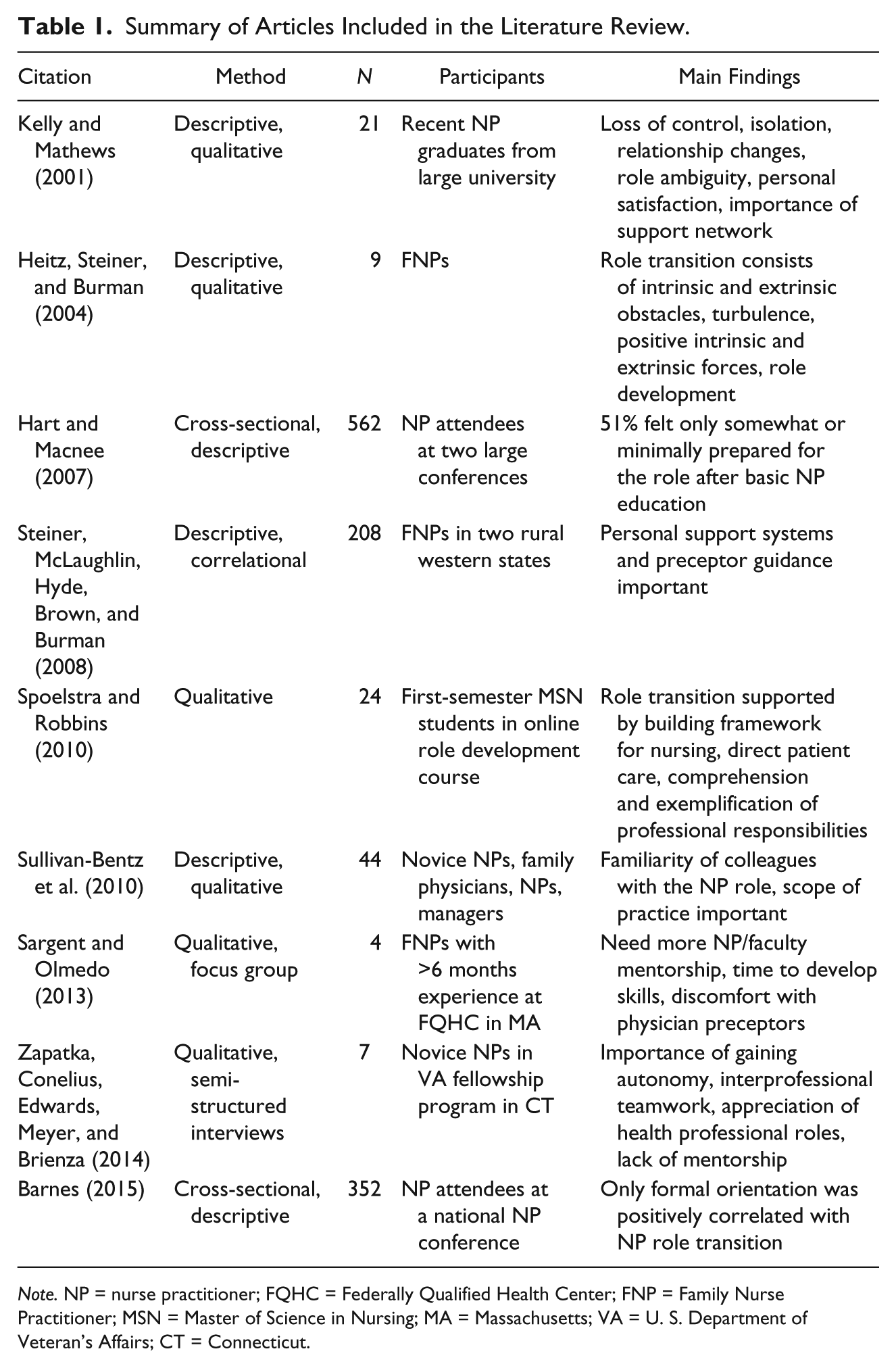
Note. NP = nurse practitioner; FQHC = Federally Qualified Health Center; FNP = Family Nurse Practitioner; MSN = Master of Science in Nursing; MA = Massachusetts; VA = U. S. Department of Veteran’s Affairs; CT = Connecticut.
Data Extraction and Analysis
Based on the framework for data analysis for integrative reviews by Whittemore and Knafl (2005), data reduction, representation, and comparison were conducted to analyze the data for this review. The first step was to classify the data into subgroups by type of evidence and begin by analyzing all qualitative studies and then the cross-sectional quantitative studies. For each primary source, relevant data were extracted and compiled into a table creating a one-page summary. Utilizing this approach allowed for systematic comparison of specific issues or variables among the primary sources (Whittemore & Knafl, 2005). The data were then compiled into a table that grouped the data from multiple sources around subgroups, allowing for the iterative process of comparison to identify patterns, themes, and categories.
Results
After reviewing the state of the science, several themes related to the initial NP role transition into the primary care setting emerged in the literature. These themes can be categorized as “experiencing role ambiguity,” “quality of professional and interpersonal relationships,” and “facing intrinsic and extrinsic obstacles” (Table 2). Each of these categories and their themes will be discussed.
Novice Nurse Practitioner Primary Care Workforce Transition Themes.
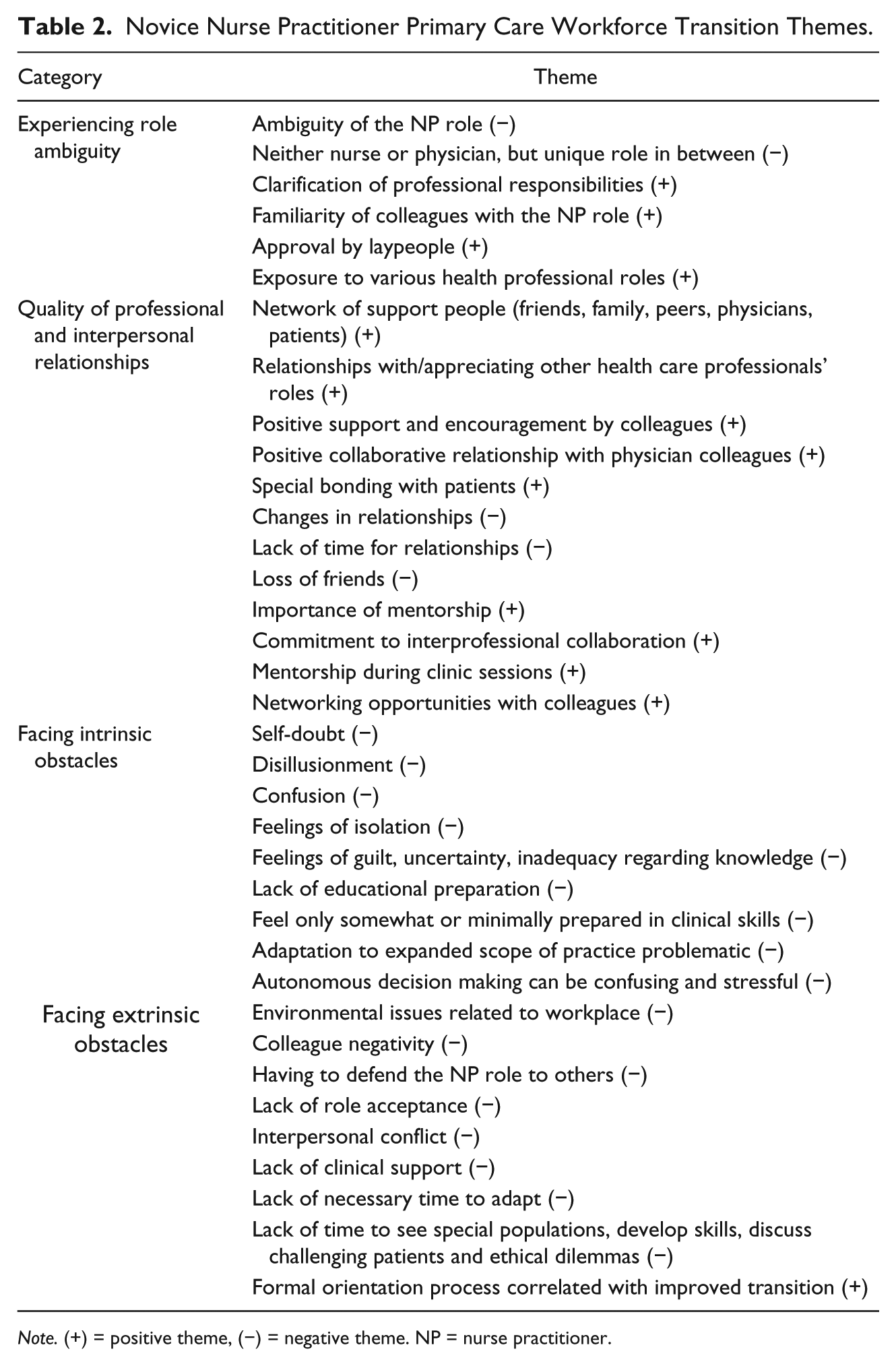
Note. (+) = positive theme, (−) = negative theme. NP = nurse practitioner.
Experiencing Role Ambiguity
The most emphasized issue by novice NPs was related to the ambiguity of the NP role (Heitz et al., 2004; Kelly & Mathews, 2001; Sullivan-Bentz et al., 2010). Some novice NPs felt isolated from other health care providers, as they did not perceive themselves as either a nurse or a physician, but in a unique role in between (Kelly & Mathews, 2001). However, the clarification of professional responsibilities (Spoelstra & Robbins, 2010), familiarity of colleagues with the NP role (Sullivan-Bentz et al., 2010), and approval by laypeople (Heitz et al., 2004) facilitated the role transition by providing structure and positive reinforcement. Being exposed to the various health professional roles in their fellowship program made novice NPs appreciate others’ roles in relation to their own (Zapatka, Conelius, Edwards, Meyer, & Brienza, 2014).
Quality of Professional and Interpersonal Relationships
Relationships with other health care personnel were vital to the NP role transition. Positive support and encouragement by colleagues, a positive collaborative relationship with physician colleagues, networking with colleagues outside of the work setting (Heitz et al., 2004), and NP-supported preceptors during clinic sessions (Sargent & Olmedo, 2013) were cited as important by newly graduated NPs in their first positions. In one focus group, novice NPs reported being uncomfortable with physician preceptors who were viewed as being unapproachable or too busy (Sargent & Olmedo, 2013). However, mentorship by NPs and MDs during a postgraduate fellowship program made novice NPs feel supported and gave them confidence in developing their clinical skills (Zapatka et al., 2014). In fact, during their fellowship program, novice NPs realized the importance of working collaboratively as part of an interprofessional team and were able to cite the benefits of such teamwork in providing quality patient care (Zapatka et al., 2014). In addition, a support network, which included peers, physicians, family, and patients, was integral to coping during the initial role transition (Kelly & Mathews, 2001). Special bonding with patients contributed to gains of personal satisfaction, but a lack of time for relationships and loss of friends contributed to feelings of isolation outside the workplace (Kelly & Mathews, 2001).
Facing Intrinsic/Extrinsic Obstacles
Intrinsic obstacles novice NPs experienced included self-doubt and disillusionment (Heitz et al., 2004). Self-doubt in relation to independent role responsibilities and stress regarding an expanded scope of practice were a constant source of emotional turmoil for novice NPs (Heitz et al., 2004; Kelly & Mathews, 2001). Confusion and feelings of isolation were evident across many of the studies, and stemmed from a variety of causes from role ambiguity to colleague interactions (Heitz et al., 2004; Kelly & Mathews, 2001; Sullivan-Bentz et al., 2010).
Adequacy of educational preparation was lacking according to Hart and Macnee (2007), who surveyed 562 NPs at various stages in their career. Only 10% of the sample felt they were very well prepared for practice after their basic NP education, and 51% reported being only somewhat or minimally prepared (Hart & Macnee, 2007). In another survey of new graduate NPs, 70% perceived themselves as being “somewhat uncomfortable” and 55% “somewhat prepared” in the NP role (Sargent & Olmedo, 2013). Kelly and Mathews (2001) asked novice NPs about their educational adequacy, and uncovered feelings of guilt, uncertainty, and inadequacy resulting from the apprehension between knowledge and a lack of knowledge. Novice NPs desire more time to see special population groups and develop skills, as well as support to discuss challenging patients and ethical dilemmas (Sargent & Olmedo, 2013). Mentorship by a colleague (Sullivan-Bentz et al., 2010), and a formal orientation program (Barnes, 2015) have been associated with improved NP role transition.
Extrinsic obstacles included environmental issues related to the workplace, colleague negativity, having to defend the NP role to others (Heitz et al., 2004; Steiner, McLaughlin, Hyde, Brown, & Burman, 2008), and lack of clinical support (Sargent & Olmedo, 2013). In fact, one third of NP graduates from the Ontario Primary Health Care Nurse Practitioner program reported interpersonal conflict or lack of role acceptance in their practice environments as reasons for changing employment (Sullivan-Bentz et al., 2010). Specifically, jealousy and nonacceptance by RNs were cited in addition to concerns about patient acceptance (Kelly & Mathews, 2001; Steiner et al., 2008), and novice NPs found themselves having to defend their role to patients and colleagues alike (Heitz et al., 2004).
Discussion
Analyzing the current state of the science revealed three main categories of the NP transition to the first primary care role: “experiencing role ambiguity,” “quality of professional and interpersonal relationships,” and “facing intrinsic and extrinsic obstacles.” The results of this review not only validate prior findings in this area, but also bring to light new issues that should be considered in improving the workforce transition of novice NPs in primary care.
The concept of role ambiguity is in line with the “impostor phenomenon” that many novice NPs face as highlighted by Brown and Olshansky (1997) in the “From Limbo to Legitimacy” theoretical framework of NP role transition. In this model, novice NPs were described as “being in limbo” and faced many obstacles in establishing their identity in their new role during the first year of practice. In addition, according to Kelly and Mathews (2001) and Chang et al. (2006), inconsistent role expectations and a lack of understanding of the NP role by others resulted in NP frustration and insecurity. If a physician was not familiar with the NPs’ scope of practice, their autonomy was reduced and they were dissatisfied. Furthermore, lack of role acceptance led to novice NP turnover (Sullivan-Bentz et al., 2010) whereas clarification of professional responsibilities facilitated the NP role transition (Spoelstra & Robbins, 2010). Some novice NPs used encouraging self-talk as a coping strategy to get through this difficult phase of self-doubt and role ambiguity (Heitz et al., 2004).
Social support was integral during the transition from an NP student to a practitioner (Heitz et al., 2004; Kelly & Mathews, 2001; Steiner et al., 2008). In addition, positive support and encouragement by colleagues including a positive collaborative relationship with physicians (Heitz et al., 2004; Kelly & Mathews, 2001; Steiner et al., 2008) and networking with NP peers (Heitz et al., 2004) were important to novice NPs in their first positions. Mentorship during clinic sessions was also vital to success for novice NPs (Sargent & Olmedo, 2013; Zapatka et al., 2014).
The most common intrinsic obstacles faced by novice NPs had the common theme of perceived competence and self-confidence, which according to Brown and Olshansky (1997) was found to influence the novice NPs’ transition into their initial roles as primary care providers. Self-doubt and lack of preparation after their basic NP education were cited across most of the studies (Hart & Macnee, 2007; Kelly & Mathews, 2001). The most frequently cited extrinsic obstacles reported by novice NPs were colleague negatively or lack of understanding of the NP role (Heitz et al., 2004; Sullivan-Bentz et al., 2010), as well as lack of adequate time to complete their work (Kelly & Mathews, 2001; Sargent & Olmedo, 2013).
This literature review of the novice NP role transition into primary care has education, practice, and policy implications. NP residency programs may be effective in decreasing role ambiguity, in particular through use of reflective journaling. For example, resident NPs may be required to submit reflective journals weekly that provide insights into challenges they are facing throughout the transition process, and discuss the progress they are making in becoming competent primary care practitioners (Flinter, 2012). These journals may be used as tools for communication among the NP residents to explore feelings of self-doubt or role ambiguity that may arise throughout the first year of practice, thereby minimizing role ambiguity in novice NPs.
Results could potentially aid employers in developing recruitment, transition, and retention strategies specific to novice NPs in the primary care setting. Health care organizations should consider providing some level of formal orientation and support. For example, the model of the Community Health Center, Inc. NP Residency Training Program provides NP residents the opportunity to practice independently with access to an identified primary care practitioner for consultation (Flinter, 2012). This review found that increasing interprofessional collaboration and decreasing role ambiguity are critical to facilitating the successful transition of novice NPs in primary care settings. The common denominator to accomplishing both of these goals is improving collaborative relationships in the practice setting. There are multiple campaigns underway to improve interprofessional collaborative practice, including recent recommendations by the IOM, Robert Wood Johnson Foundation, and the Interprofessional Education Collaborative, which includes the American Association of Colleges of Nursing, American Association of Colleges of Osteopathic Medicine, American Association of Colleges of Pharmacy, American Dental Education Association, Association of American Medical Colleges, and Association of Schools of Public Health, among others).
Scope of practice of NPs is a hotly debated topic in many states, and may influence organizational policies in relation to the NP role. In addition, the collaborative relationship among NPs and other health care professionals (HCPs) in the practice setting needs to be better defined and improved. Greater clarity and increased awareness of other HCPs in the practice setting of the NP role is needed in many organizations. Employers may benefit from educating their staff, particularly other HCPs, about the role and scope of practice of NPs. Many are proponents of collaborative and interprofessional education to increase awareness and understanding among various HCPs at an earlier stage so that they may more effectively communicate in the workplace. The IOM (2010) recommended that nurses should be educated with doctors and other health professionals as students and beyond. It has been suggested in the literature that NP socialization needs to begin much earlier than post-graduation, and therefore curriculum changes should be considered (Heitz et al., 2004; Spoelstra & Robbins, 2010). Furthermore, it has been argued that curriculum changes are necessary to provide a learning environment that promotes the development of professional nurse autonomy by providing a theoretical framework of nursing with a learner-centered design as well as opportunities for interdisciplinary education (Heitz et al., 2004; Steiner et al., 2008). Student selection of mentor-preceptors is important (Kelly & Mathews, 2001; Steiner et al., 2008), and can result in increased self-efficacy (Hayes, 1998).
Educational institutions may benefit from understanding what deficits novice NPs feel they have when entering the workforce to provide resources or training to better prepare them. In additional to clinical skills, professional socialization is an important component of the curriculum for preparing novice NPs to successfully enter the workforce. More specifically, greater emphasis should be placed on role development and professional skills such as understanding NP scope of practice, negotiation, and setting up an independent practice (Kacel, Miller, & Norris, 2005). The first step in developing intervention programs is to understand the needs of the population, and that was the aim of this literature review of the novice NP transition into the primary care setting.
It is evident that there are numerous and practical potential applications of understanding the NP transition into the initial primary care role. This information is relevant to educators as they train NPs, to the NPs themselves, as well as to employers who wish to retain these much-desired providers. Policy implications include the evolution of NP residency programs as a result of the new knowledge generated. In addition, employers may choose to adopt policies or programs aimed at improving the transition and retention of novice NPs. There may even be educational impacts with curriculum changes aimed at better preparing the student NP to enter the workforce. Interprofessional education would promote understanding of the NP role by other HCPs by providing earlier socialization. More research is needed to evaluate the successful transition of novice NPs into the workforce to determine their needs and how best to support them during the transitional period. What is known to date is that novice NPs entering the primary care workforce face many difficulties (Brown & Olshansky, 1997; Cusson & Strange, 2008; Heitz et al., 2004; Kelly & Mathews, 2001), which can lead to feelings of discontentment and lower job satisfaction which in turn has been associated with increased intent to leave and high turnover (DeMilt, Fitzpatrick, & McNulty, 2011; Sargent & Olmedo, 2013). By improving transitions between the educational and work arena, it is possible to improve novice NP role development, thereby increasing retention of vitally needed primary care providers. This may improve continuity of care, leading to improved patient outcomes.
Footnotes
Declaration of Conflicting Interests
The author(s) declared no potential conflicts of interest with respect to the research, authorship, and/or publication of this article.
Funding
The author(s) disclosed receipt of the following financial support for the research, authorship, and/or publication of this article: This work was supported by the National Institute of Nursing Research, National Institutes of Health (T32-NR-008346-10).