






Abstract
Background:
Nursing interns are the next generation of nurses, and their employment status affects nursing team stability. Interns often face career development difficulties and attrition. Cognitive flexibility may help students adapt to the workplace and clarify their work self-definition, and future work self-salience may relate to career adaptability. However, these relationships are unclear in the Chinese context.
Objective:
We aimed to explore the mediating effect of future work self-salience between cognitive flexibility and career adaptability among nursing students during their internship.
Methods:
Using a cross-sectional study design with convenience sampling, nursing interns from a tertiary general hospital in Nanjing, China, were selected between November and December 2024. Data were collected using a general information questionnaire, the Cognitive Flexibility Inventory (CFI), the Future Work Self-Salience Scale (FWSS), and the Career Adapt-Abilities Scale (CAAS). Of 201 questionnaires distributed, 195 were valid (97.0%). Descriptive statistics, Spearman’s correlation, and structural equation modeling were used to test the mediating effect.
Results:
The CFI, FWSS, and CAAS scores were 68.74 ± 10.22, 13.45 ± 2.91, and 91.97 ± 16.58, respectively. Cognitive flexibility positively predicted career adaptability, and future work self-salience played a partial mediating role (mediation effect: 20.92%).
Conclusion:
Cognitive flexibility is directly associated with nursing interns’ career adaptability and also is indirectly associated through future work self-salience. Nursing educators may enhance interns’ career adaptability by fostering both cognitive flexibility and future work self-salience.
Keywords
Introduction
The shortage of human resources for nursing is a global problem. 1 Nursing interns, defined as students who have completed theoretical nursing education and entered healthcare institutions for clinical practice, represent the next generation of the nursing workforce. 2 Their employment status significantly affects the stability of the nursing workforce. However, there is a general lack of career development and a high turnover of current nursing interns. After graduating into clinical nursing, dilemmas such as heavy workloads, poor interpersonal relationships, inadequate knowledge and skills, and role ambiguity lead nursing interns to experience barriers to work adjustment and increased willingness to leave their jobs. 3 The intention to leave within 1 year was as high as 39.9% to 43.5% for newly graduated nurses,3-5 and the tendency to leave was generally higher than for senior nurses. 6 This trend not only further exacerbates the nursing shortage but also negatively impacts hospital staffing costs, quality of care, patient outcomes, and nursing interns’ professional development. Therefore, it has become a matter of concern and urgency for current nursing educators to help nursing interns plan and prepare for their careers, avoid career dilemmas, and promote beneficial career choices.
To address the challenges of adapting to a career, most existing research mainly looks at how outside factors—like transition shock, work stress, social support, or organizational climate—affect how individuals adjust to their roles.7-10 While valuable, these studies often position interns in a relatively passive “responder” role, failing to fully reveal how individuals actively utilize internal psychological resources to process, integrate, and construct career-related information to achieve positive adaptation. Savickas’ career construction theory offers a more agentic theoretical framework for this purpose. 11 The theory suggests that career development is not just about fitting into set roles but is an active process where people shape their own career identities and adjust to the job market as they face expected challenges, changes in their careers, and work-related difficulties. 12 The core product and hallmark of this “construction-adaptation” process is career adaptability. 13 For nursing interns, the clinical internship period is precisely a critical stage for constructing their vocational selves. 14 They need to translate abstract professional ideals (eg, “helping others”) into complex professional role cognitions and navigate the conflicts between idealized roles and realistic demands (eg, high-intensity workloads, complex interpersonal relationships). Thus, from the perspective of career construction theory, the core task during the internship is to accomplish a successful construction of the vocational self. The level of their career adaptability directly determines the stability of their professional identity and the effectiveness of their professional behaviors.
In complex, dynamic, and uncertain clinical environments, successful career construction highly depends on an individual’s cognitive processing capacity. 15 Cognitive flexibility is a core component of executive functioning and refers to an individual’s ability to flexibly adapt working memory, attention, and response choices to the changing demands of a task. 16 This cognitive regulatory ability is an important psychological trait that helps people incorporate new experiences and change how they see themselves as they build their careers. In nursing practice, cognitive flexibility refers to the ability to quickly switch focus from one patient to managing the entire ward, adjust care plans swiftly when a patient’s condition or medical orders change, and learn from negative experiences after facing challenges or conflicts, using those lessons to improve future strategies. Nursing interns who lack cognitive flexibility tend to fall into cognitive rigidity, solidifying temporary difficulties into an overall negative perception of the nursing profession, thereby hindering the positive construction of their vocational selves. Cognitive flexibility is an important skill that helps people keep their thinking and self-control up-to-date in changing clinical situations.
Additionally, building a positive career requires not just the ability to adapt to current situations but also having a clear and inspiring vision for the future. The future work self is defined as the future image of an individual’s hopes and aspirations for work and is the individual’s description of his or her desired future work self. 17 It functions as both a construction blueprint and a motivational engine. A clear and specific future work self, such as vividly imagining oneself as a skilled emergency nurse or a specialized nurse, acts like a career compass. It offers direction, meaning, and sustained intrinsic motivation for interns navigating real-world confusion and conflicts. It represents a phased construct of “who I aspire to become,” shaped through individual cognitive and emotional processing. 18 This clear future image motivates individuals to set goals, proactively seek learning opportunities, and persist in overcoming current challenges, thereby directly fostering the development of career adaptability.
While the individual importance of cognitive flexibility and future work self-salience has been partially explored, existing research15,19 has not yet thoroughly examined the synergistic mechanism between these 2 factors within the integrated framework of career construction theory, particularly in relation to nursing interns’ career adaptability. A paucity of empirical studies exists that investigate whether cognitive flexibility, as a constructive process capability, exerts an influence on career adaptability, as a final constructive outcome, by facilitating future work self-salience, as a formation of constructive content. Elucidation of this intrinsic mechanism is imperative to transitioning the focus of intervention from merely optimizing the external environment to concurrently empowering the internal constructive capabilities of nursing interns. Based on this, our study adopts the “individual proactive construction” perspective of career construction theory and proposes that cognitive flexibility and future work self-salience are 2 crucial individual internal constructive resources. It aims to explore the relationship between cognitive flexibility and career adaptability among nursing interns and examine the mediating role of future work self-salience in this relationship, in order to provide a deeper explanation of the underlying mechanisms during the clinical internship stage. In accordance with the aforementioned reasoning, the following hypotheses are proposed (Figure 1):
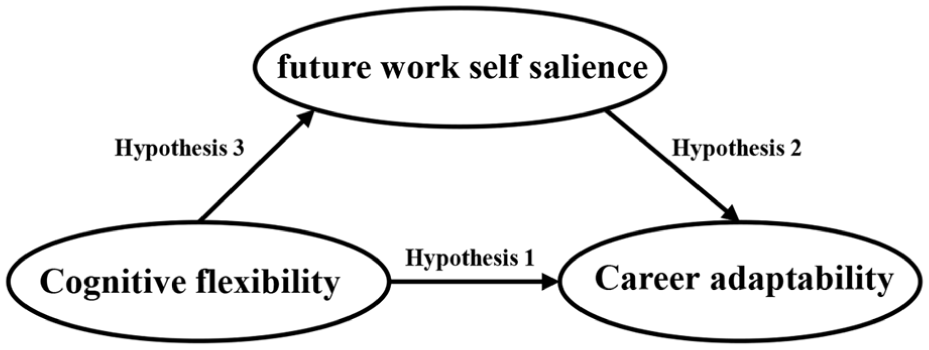
Hypothesized model.
Methods
Design
A cross-sectional study design was employed to investigate the relationship between nursing interns’ future work self-salience (independent variable), cognitive flexibility (independent variable), and career adaptability (dependent variable). The STROBE checklist was followed in accordance with the guidelines for reporting observational studies.
Participants
The study population comprised all nursing students who were undergoing clinical placement at tertiary grade-A hospitals in Nanjing, Jiangsu Province, China. The nursing interns were recruited from the second hospital of Nanjing through convenience sampling from November to December 2024. The second hospital of Nanjing is a large-scale hospital affiliated with several university teaching programs that receives a substantial number of nursing interns annually and has representative and extensive experience in intern training and management. Inclusion criteria were as follows: (1) age ≥18 years, (2) Chinese nationality, and (3) voluntary participation. Sample size was calculated using G*Power 3.1 software (Heinrich-Heine-Universität Düsseldorf, Germany). With an alpha error probability of .05, a statistical power (1 − β error probability) of .80, a medium effect size of f2 = 0.15, and 10 predictor variables (including demographic information, cognitive flexibility, and future work self-salience), the minimum required sample size was determined to be 118. This study ultimately collected 195 valid samples. A post-hoc power analysis was subsequently conducted. The results indicated a statistical power of 0.992, confirming that the current sample size was sufficient for testing the study hypotheses.
Data Collection
We conducted this survey through the Questionnaire Star platform (https://www.wjx.cn), a popular professional online questionnaire survey website in China. Prior to distribution, formal approval was obtained from the hospital’s nursing department and education section. A researcher who was not involved in the interns’ clinical teaching or evaluation administered the questionnaires during the interns’ regular meetings. It was emphasized that participation was voluntary and unrelated to academic or clinical assessments. Before the formal survey, a pilot test was conducted with 2 to 3 nursing interns, which indicated that completing the questionnaire required approximately 5 to 10 minutes. To guarantee the accuracy of the data, we restrict each account to a single fill-out, necessitating the completion of all options, and only allow submission when fully completed. We performed data export if no new data emerged within a week. We screened the questionnaires to further ensure the study’s high quality, excluding the following: (1) those with rapid response times (<180 seconds) and (2) those with regular or repeated responses. A total of 201 questionnaires were distributed. Ultimately, 195 valid responses were collected (4 individuals declined participation, and 2 responses exhibited patterned answers).
Ethical Considerations
This study was approved by the Ethics Committee of the second hospital of Nanjing (No. 2024-LS-ky-084). Before distributing the questionnaires, the researchers explained to the participants that the study was anonymous, outlined its purpose, and confirmed that the scales used had been licensed. Only after signing the informed consent form were participants permitted to complete the questionnaires. All data collected during the study were stored on a password-protected computer dedicated to this research, accessible only to the principal researcher.
Instruments
Sociodemographic Characteristics
The sociodemographic characteristics included gender, age, education, grade, place of origin, being an only child, being a student leader, and reasons for choosing the nursing profession.
Cognitive Flexibility Inventory
The Cognitive Flexibility Inventory (CFI) was initially developed by Dennis et al. 20 The Chinese version of the CFI (C-CFI) consisted of 20 items in 2 dimensions: selectivity (13 items) and control (7 items). The C-CFI was rated on a 5-point Likert scale, which ranged from 1 (not at all) to 5 (all). Higher CFI scores indicate that individuals are more likely to use adaptive coping styles and have higher levels of cognitive flexibility. The Cronbach’s α coefficient in this study was 0.916.
Future Work Self-Salience Scale
The Chinese version of the Future Work Self-Salience Scale (C-FWSS) was adopted from Guan et al, 21 which was revised from the initial scale developed by Strauss et al, 22 with 4 items. The C-FWSS was rated on a 5-point Likert scale, ranging from 1 (not at all) to 5 (all). Higher total scores indicate higher levels of future work self-salience. The Cronbach’s α coefficient in this study was 0.889.
Career Adapt-Abilities Scale
The Career Adapt-Abilities Scale (CAAS) was developed by Hou et al 23 to assess students’ career adaptability. The CAAS consists of 24 items in 4 dimensions: career concern (6 items), career control (6 items), career curiosity (6 items), and career confidence (6 items). The CAAS was rated on a 5-point Likert scale, ranging from 1 (not strong) to 5 (strongest). The total score ranges from 24 to 120 points, with higher scores indicating greater career adaptability. The Cronbach’s α coefficient in this study was 0.982.
Statistical Analysis
We performed all statistical analyses using SPSS version 25.0 (IBM Corp., Armonk, NY, USA). Descriptive statistics were used to summarize socio-demographic characteristics, and Spearman’s correlation analyses were used to explore correlations between cognitive flexibility, future work self-salience, and career adaptability in nursing interns. Mediation effects were analyzed using AMOS 26.0 software. A P-value of less than .05 indicated that the difference was statistically significant.
Results
Participant Characteristics
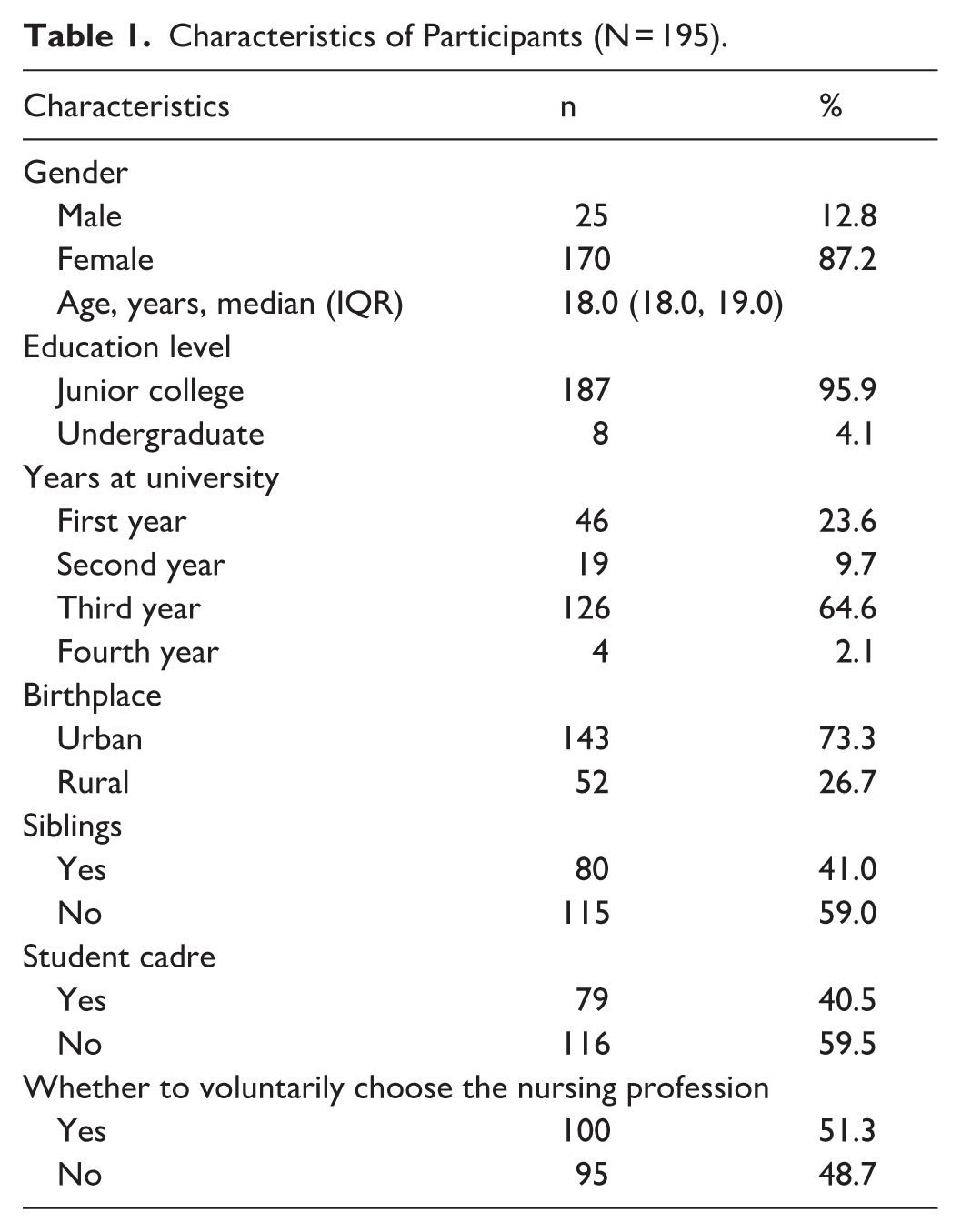
We distributed and collected a total of 201 questionnaires. After screening and checking, we collected 195 valid questionnaires, resulting in a validated questionnaire recovery rate of 97.0%. Of the 195 nursing interns, the majority were female (87.2%), and their median age was 18.0 (IQR: 18.0, 19.0). The characteristics of the participants are presented in Table 1.
Characteristics of Participants (N = 195).
Descriptive and Correlation Analysis of the 3 Scales
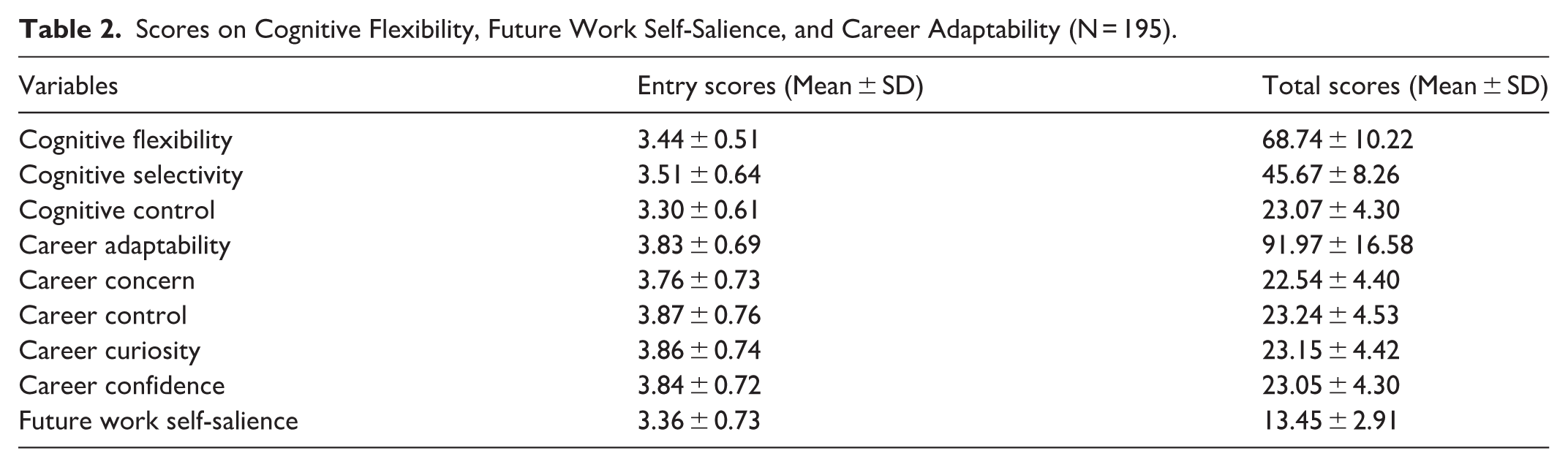
The CFI scores of 195 nursing interns ranged from 44 to 100 (68.7 ± 10.2), which is a moderate level, including 13 to 65 (45.7 ± 8.3) for the selectivity dimension and 11 to 35 (23.1 ± 4.3) for the control dimension. The FWSS scores of 195 nursing interns ranged from 4 to 20 (13.5 ± 2.9), and the CAAS scores ranged from 24 to 120 (92.0 ± 16.6). In CAAS, the career concern dimension ranged from 6 to 30 (22.5 ± 4.4), the career control dimension from 6 to 30 (23.2 ± 4.5), the career curiosity dimension from 6 to 30 (23.2 ± 4.4), and the career confidence dimension from 6 to 30 (23.1 ± 4.3). The scores of each questionnaire dimension are detailed in Table 2. The results of Spearman’s correlation analyses showed that the CFI was positively correlated with CAAS (r = 0.62, P < .01) and FWSS (r = 0.42, P < .01). The CAAS were positively correlated with FWSS (r = 0.64, P < .01), as shown in Table 3.
Scores on Cognitive Flexibility, Future Work Self-Salience, and Career Adaptability (N = 195).
Correlations Among Cognitive Flexibility, Future Work Self-Salience, and Career Adaptability (N = 195).
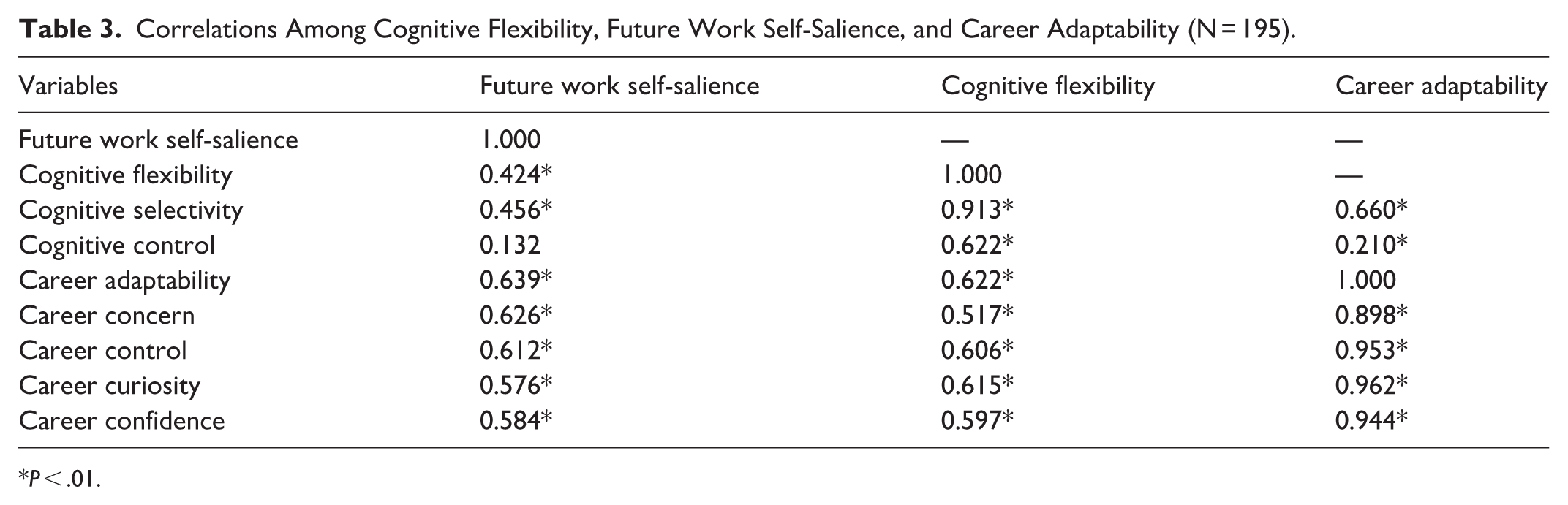
P < .01.
Mediation Analysis
We conducted structural equation modeling using AMOS 26.0 software (IBM Corp., Armonk, NY, USA). The dependent and independent variables were identified as cognitive flexibility and career adaptability, and the mediator variable was identified as future work self-salience for model construction. The hypothetical model was corrected according to the correction indexes and specific situation, and the model was finally constructed, as shown in Figure 2. The model fit measurements showed that the chi-squared to degree of freedom ratio (χ2/df) was 1.795, which is less than 3.000; the root mean square error of approximation (RMSEA) was 0.064, which is less than 0.080; the goodness-of-fit index (GFI) was 0.978, which is greater than 0.900; the comparative fit index (CFI) was 0.986, which is greater than 0.900; and the Tucker-Lewis index (TLI) was 0.978, which is also greater than 0.900, all showing that the model fit well.
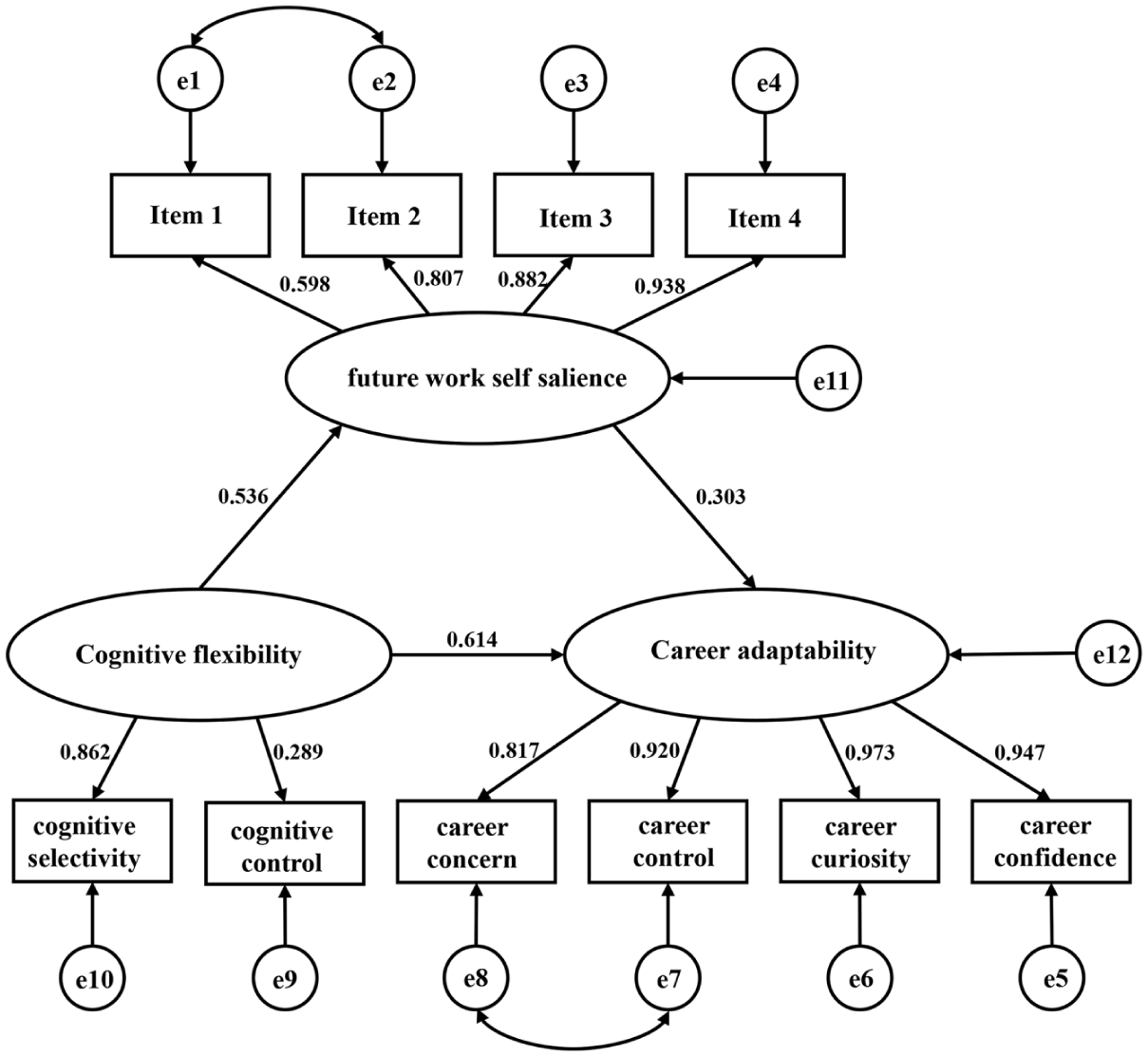
Model test.
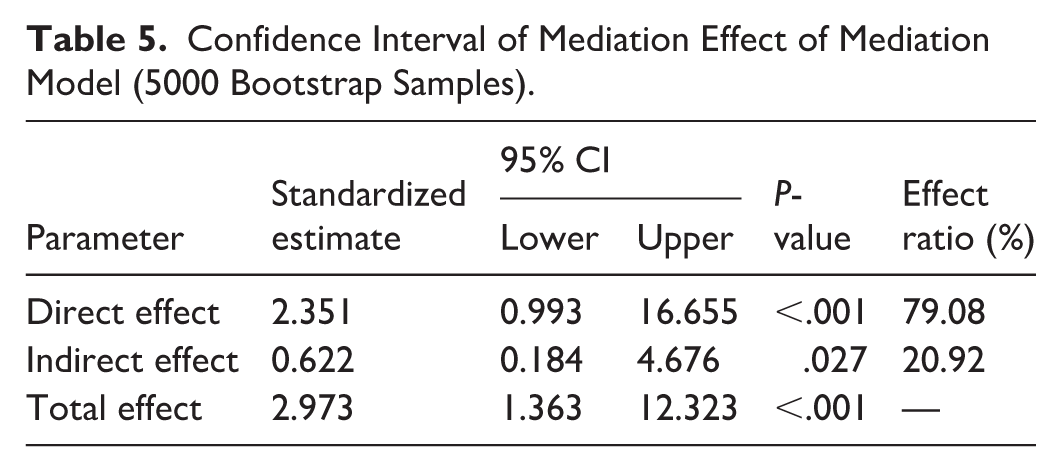
The results of AMOS analysis indicated that nursing interns’ cognitive flexibility and future work self-salience directly and positively affected career adaptability (Table 4). To better check how important the mediating effect was, the bootstrap method repeated the sampling of the original data 5000 times, and the mediating effect was tested by looking at the 95% confidence interval (CI) that did not include 0. The results indicated that nursing interns’ future work self-salience played a partial mediating role in the effect of cognitive flexibility on career adaptability, with a total effect of 2.973 (P < .001; 95% CI 1.363-12.323), a direct effect of 2.351 (P < .001; 95% CI 0.993-16.655), and a mediating effect of 0.622 (P < .05; 95% CI 0.184-4.676), accounting for 20.92% of the total effect, as shown in Table 5.
Effect of Cognitive Flexibility and Future Work Self-Salience on Career Adaptability (N = 195).

Confidence Interval of Mediation Effect of Mediation Model (5000 Bootstrap Samples).
Discussion
This study was founded on Savickas’ career construction theory, framing the clinical internship period as a critical stage for nursing students to actively construct their career selves. In this theoretical framework, career adaptability is conceptualized as the core outcome of the “construction-adaptation” process. Cognitive flexibility is posited to be the critical cognitive regulatory capacity that facilitates this process. Future work self-salience is identified as the content blueprint guiding the construction direction.
Status of Nursing Interns’ Cognitive Flexibility, Career Adaptability, and Future Work Self-Salience
Our study showed that the career adaptability of nursing interns was at a moderate level and similar to the results of Xu et al. 24 This may be because nursing students have gained some understanding of clinical nursing work through their career education courses and already possess a certain level of career adaptability when facing unpredictable career development challenges. Notably, this study also found that nursing interns scored relatively high on the control dimension of career adaptability, whereas their scores on the concern dimension were somewhat lower. According to career construction theory, individuals actively mobilize psychological resources for adaptation when confronted with clear developmental tasks, such as the transition from student to nurse. 11 The strong sense of career control displayed by the nursing interns reflects their initial establishment of professional autonomy. The relative deficiency in career concern indicates that the breadth and depth of their career exploration remain limited. This phenomenon may be attributed to their apparent paucity of systematic, long-term planning for future career trajectories, such that it is a characteristic phase commonly observed during the early stages of career construction.
Our study showed that the cognitive flexibility of nursing interns was slightly lower than the results of Mehralian et al 25 and Polat et al. 26 This may be related to the study population, which consisted of registered nurses who were older. Serving as a core cognitive regulator in the career construction process, cognitive flexibility could enable individuals to adjust their attention and cognitive strategies in response to environmental information, 27 which is crucial for integrating new and old experiences and updating self-perception. 28 Compared to experienced registered nurses who can skillfully handle complex clinical situations, nursing interns are exposed to more limited and often routine scenarios. It objectively restricts their opportunities to flexibly shift cognitive sets and generate diverse strategies, potentially limiting the developmental ceiling of this ability. However, Entezari et al 29 found that cognitive flexibility declined with age, and Holmberg et al 30 observed no significant correlation. Consequently, additional research is required to elucidate the relationship between age and cognitive flexibility. Despite the inconsistent findings on the relationship between age and cognitive flexibility across studies, career development theory suggests that accumulated clinical experience may provide individuals with more cognitive strategies for dealing with complex situations, thereby promoting the development of cognitive flexibility. Individuals with high cognitive flexibility tend to remain calm when faced with the unexpected, viewing events as manageable and being adept at seeking multiple solutions.31,32 This enables them to better adapt to changes and maintain a positive psychological state in challenging clinical environments. 33
Our study also showed that the future work self-salience of nursing interns was at a moderately low level. This may be because the majority of our study population came from junior college. Compared with undergraduate nursing students, they may be poor in independent learning, self-control, self-career planning, and so on. Thus, they may lack concreteness and planning for their future as nurses and in nursing-related work. This relatively incomplete self-direction may hinder them from imagining their future work selves, resulting in low levels of clarity about their future work selves. According to career construction theory, a clear future work self is an important intrinsic motivator for individuals’ career exploration and adaptation. 18 Therefore, nursing educators should implement measures to help nursing students refine their idea of what they want to do in the future. Nursing educators could emphasize the noble image of nurses and actively promote this profession as one that prioritizes life, love, and dedication to healing. This approach can help nursing interns gradually refine their future work selves in their subconscious minds, slowly recognize their self-image, and enhance their work self-salience.
Correlation of Cognitive Flexibility, Career Adaptability, and Future Work Self-Salience Among Nursing Interns
Our study showed a significant positive correlation between career adaptability and cognitive flexibility, meaning that nursing interns with better cognitive flexibility tend to be more adaptable in their careers, which matches the results of Demirtaş and Kara 34 and Yıldız-Akyol and Boyacı. 35 From the perspective of career construction theory, adaptive behavior itself is a personal quality that requires cognitive flexibility and an open attitude. 36 When nursing interns have high cognitive flexibility, they are better able to use flexible ways of adapting to new situations and reduce problem-solving time when faced with changing and heavy clinical work. Notably, this study also found that the “selectivity” dimension of cognitive flexibility (referring to the ability to recognize multiple causes for behavior and adopt diverse coping methods) had the strongest association with career adaptability. This finding profoundly reveals the proactive nature of career construction. Rather than being a passive response to environmental pressures, adaptation is an active process in which individuals proactively mobilize cognitive resources to interpret and reconstruct career information in creative and strategic ways. Therefore, nurse educators can improve career adaptability by taking steps to improve the cognitive selectivity of nursing interns, such as developing cognitive skills, improving concentration, and so on.
Our study showed a significant positive correlation between career adaptability and future work self-salience, meaning that nursing interns who are more aware of their future work are also better at adapting in their careers, which matches what Ling et al 37 and Lu and Jia 38 found. A vivid, positive self-image of a future nurse can give nursing interns a clear sense of meaning, direction, and sustained intrinsic motivation, as it results from cognitive and emotional processing. According to career construction theory, a clear focus on and planning for the future—that is, “attention” and “control”—is a core component of career adaptability, leading directly to positive career construction behaviors.18,39,40 When nursing interns have a clear vision of their future work, they will make a series of appropriate preparations to achieve their work goals and their ideal future selves, which will lead to a quicker adjustment to their careers. Therefore, nursing educators should offer courses that help nursing students develop their career goals and consider individual differences, enabling them to set clear and personalized career objectives that enhance their future work self-salience and improve their career adaptability.
The Role of Future Work Self-Salience in Partially Mediating the Relationship Between Cognitive Flexibility and Career Adaptability Among Nursing Interns
Our study showed that cognitive flexibility was a significant predictor variable of career adaptability and that future work self-salience partially mediated the effect between cognitive flexibility and career adaptability, with the mediating effect contributing to the total effect at 20.92%. This finding integrates perspectives from cognitive psychology and career development. Cognitive flexibility serves as a fundamental cognitive ability that enables individuals to process information effectively and adapt to change, while future work self-salience builds upon this to provide a motivational and directional vision of the future. So these 2 factors influence an individual’s career adaptation process together. Yıldız-Akyol and Boyacı 35 found through a survey of 401 university students in Turkey that students with higher cognitive flexibility plan their career future better. It confirmed that students with higher cognitive flexibility are better able to adapt to their careers, similar to the findings of our study. The future work self-salience helps people to have a clear orientation and judgment about their future career. 17 When people have a clear sense of their future, they are better able to cope with the uncertainties and difficulties of their careers. 41 Thus, future work self-salience may increase their confidence and control in coping with environmental change, thereby increasing their career adaptability. 42 Therefore, nursing educators should focus on the interrelationships between cognitive flexibility, future work self-salience, and career adaptability among nursing interns. They should also establish a correct and positive view of employment for these interns and consider intervening in their career adaptability from the perspective of future work self-salience. In addition, our study showed that future work self-salience partially mediated the relationship between cognitive flexibility and career adaptability among nursing interns. Our results indicated that there may be other variables that mediate the relationship between cognitive flexibility and career adaptability, and the mechanism of action needs to be further explored.
Limitations
Although this study minimized information bias by conducting anonymous surveys through independent researchers, establishing uniform platform rules, and implementing clear criteria for excluding invalid questionnaires (eg, abnormally short response times or repetitive answer patterns) as part of data quality control, it still has certain limitations. Firstly, our study population was nursing interns from a tertiary hospital in Jiangsu Province, China, so the data source is relatively simple, and there may be some limitations in extrapolating the findings to other regions or countries. Secondly, our study was a cross-sectional study without further follow-up. Furthermore, the study lacked a hierarchical categorization of career adaptability, potentially overlooking some intrinsic influencing mechanisms. In the future, longitudinal follow-up and qualitative interviews could be considered to extend the scope of the investigation and to compare the differences in career adaptability between different types of future work self-salience and cognitive flexibility and to verify the intrinsic links and mechanisms between cognitive flexibility, future work self-salience, and career adaptability.
Conclusion
Based on the framework of career construction theory, this study revealed that cognitive flexibility not only directly promotes the career adaptability of nursing interns but also indirectly enhances it by improving their future work self-salience. This indicates that nursing education ought to adopt a comprehensive intervention strategy that integrates capability empowerment and vision shaping to improve students’ career adaptability. On one hand, nursing curricula could incorporate cognitive flexibility training modules and introduce career construction workshops. These would guide students in proactively building clear and positive professional self-images using techniques such as narrative exercises, interviews with professional role models, and future self-visualization. Conversely, it is prudent to prompt nursing interns to contemplate intricate cases or interpersonal disputes they have managed during clinical practice. They should be affirmed for their efforts in flexible problem-solving and guided to connect these experiences with their long-term career development goals, thereby strengthening their future work self-salience. This could help nursing interns develop a positive and adaptable attitude toward employment. It also could strengthen their ability to handle uncertainties in job seeking and future work, ease their transition from student to professional nurse, and lay a solid foundation for their long-term career development.
Footnotes
Acknowledgements
The authors greatly thank all nursing interns for their participation and contribution to this study. During the preparation of this work, the authors used QuillBot in order to improve language. After using this tool, the authors reviewed and edited the content as needed and take full responsibility for the final content of the article.

Ethical Considerations
This study was approved by the Ethics Committee of the second hospital of Nanjing (No. 2024-LS-ky-084).
Consent to Participate
All participants provided written informed consent or submitted it electronically after reading the document.
Author Contributions
Le Ma: conceptualization, methodology, software, and writing–original draft preparation. Mingyue Pan: conceptualization, methodology, supervision, validation, and writing—reviewing and editing. Xiaoyan Wang, Yina Xu, Rui Huang, Yunjie Shi, Aihua Shi, Mei Fan: investigation, data curation, conceptualization and methodology.
Funding
The authors received no financial support for the research, authorship, and/or publication of this article.
Declaration of Conflicting Interests
The authors declared no potential conflicts of interest with respect to the research, authorship, and/or publication of this article.
Data Availability Statement
The data of this study can be obtained from the corresponding author according to reasonable requirements.