







Abstract
Objective
The aim of this study is to evaluate the ototoxicity of topical oxiconazole and boric acid in alcohol solutions.
Study Design
Prospective controlled animal study.
Setting
Research laboratory.
Method
Fifty adult Wistar albino rats were divided into 5 groups consisting of 10 animals each. The right tympanic membranes were perforated, and baseline and posttreatment distortion product otoacoustic emission (DPOAE) measurements were performed.
Results
The solutions were applied through the external ear canal to the middle ear twice a day for 14 days. The rats in group I and group II received 0.1 mL of oxiconazole-containing solution drops and 4% boric acid in alcohol solution drops, respectively. Group III received gentamicin solution (40 mg/mL) (ototoxic control), group IV received saline solution, and group V was followed without any medication. The baseline DPOAE results of the right ears of all animals tested were normal. Animals in groups I, II, IV, and V showed no statistically significant change in the DPOAE amplitudes. The rats in the gentamicin group showed a significant decrease.
Conclusion
This study demonstrates that topically used oxiconazole and boric acid in alcohol solutions to the middle ear appear to be safe on the inner ear of rats. The safety of these drugs has not yet been confirmed in humans. Caution should be taken when prescribing these drugs, especially to patients who had tympanic membrane perforation. Ear drops should be chosen more carefully in an external ear infection for patients with tympanic membrane perforation to avoid ototoxicity.
Otitis externa is most commonly caused usually by bacterial and occasionally by fungal infections. Sometimes it is associated with some dermatologic diseases. High environmental temperature, excessive moisture and trauma, and usage of external ear canal hearing aids can be the underlying factors of this disease. 1 Fungal external ear canal infections are commonly known as otomycosis. Main fungal pathogens causing this condition are Candida species and Aspergillus species.2,3 Most patients diagnosed with otomycosis can be treated with only topical treatment, except for some complicated cases. Topical treatment involves debridement of the external ear combined with topical antifungal drugs.4-6 The main advantages of these topical drugs include a high concentration at the affected site and decreased systemic side effects. Status of the tympanic membrane is very important in the selection of local treatment.
Antifungal formulations, including ointments, gels, and creams, should not be used because of the risk of granulation tissue development if the tympanic membrane is perforated. Although antifungal solutions are recommended for this group of patients, these drugs could pass through the round window and reach the cochlea, which may cause ototoxic effects. 2 At a consensus panel on the role of potentially ototoxic antibiotics for topical middle ear use from the American Academy of Otolaryngology—Head and Neck Surgery, Roland et al 7 indicated that the use of potentially ototoxic preparations presents no risk of ototoxic injury if the tympanic membrane, middle ear, and mastoid are normal.
Potential ototoxicity of some antifungal solutions has been investigated in many studies.8-14 In these studies, gentian violet, m-cresyl acetate, acetic acid, and boric acid in alcohol have shown significant evidence of ototoxicity, whereas ciclopirox, miconazole, tolnaftate, clotrimazole, nystatin, boric acid in distilled water, and Castellani solution demonstrated no evidence of ototoxicity. In a recent study, oxiconazole cream showed an ototoxic effect in rats. 15 Oxiconazole, an imidazole derivate, and boric acid in alcohol solutions are frequently used agents in the treatment of otomycosis. To the best of our knowledge, the possible ototoxic effects of the solution forms of oxiconazole and boric acid in alcohol solutions together have not been previously reported in the English literature. In the current study, we aimed to evaluate the possible effects of topical oxiconazole and boric acid in alcohol solutions on the cochlear outer cell functions of rats by measuring distortion product otoacoustic emission (DPOAE) amplitudes.
Materials and Methods
Study Design
Fifty adult male Wistar albino rats (weighing 230-260 g) were kept in cages at 20 ± 2°C constant temperature and humidity (55.5%) in 12-hour light/dark cycles and fed with regular rat commercial food and tap water from drinking bottles. The experimental protocol was designed according to the Guide for the Care and Use of Laboratory Animals, published by the National Academies Press. 16 The study was performed after approval from the Committee on Animal Research of Cukurova University, Adana, Turkey, and was done at the experimental animal studies laboratory of the same university. The animals were anesthetized by 5 mg/kg xylazine (Rompun; Bayer Ltd, Leverkusen, Germany) and 80 mg/kg ketamine (Ketalar; Eczacibasi, İstanbul, Turkey) administered via intraperitoneal injection before the surgical procedure and measurements of otoacoustic emissions.
Animals were divided into 5 groups consisting of 10 animals each. The ear canals and the tympanic membranes of the animals were examined and right tympanic membranes were partially perforated (less than half of the tympanic membrane) with the help of a pick and a very small piece of gel foam inserted into the middle ear directly to the round window under an operating microscope and general anesthesia. When we perforated more than half of the tympanic membrane or inserted a big piece of gel foam into the middle ear, we saw that we could not measure otoacoustic emissions because of conductive hearing loss. All surgical procedures were performed by the same 2 surgeons (S.Ö. and Ü.T.) in sterile conditions. After this surgical procedure, the baseline DPOAE measurements of the right ears were done. Fifteen days later, 1 day after the last application, these measurements were repeated to compare hearing results. Otoacoustic emission measurements were performed by using an Echoport ILO288 USB-II (Otodynamics Ltd, London, UK) in a quiet room. Primary tones were given to the sealed external ear canals through an earphone. The acoustic stimulus that created DPOAEs consisted of 2 simultaneous continuous pure tones at different frequencies: f1 and f2 (f2/f1: 1.22). Intensities were L1 (dB sound pressure level [SPL]) and L2 [dB SPL]). In this study, we used the stimulus parameters of L1/L2 of 80 dB SPL/70 dB SPL with the f2/f1 ratio of 1.22, and then the amplitude of the DPOAE signal was analyzed.
Over 14 days, the rats in group I received 0.1 mL of oxiconazole-containing solution drops (Oceral; Saba İlaç, İstanbul, Turkey), group II received 4% boric acid solution in alcohol drops, and groups III and IV received gentamicin (40 mg/mL) and saline solutions, respectively. Group V received no medication. Each solution used was given twice a day.
Statistical Analysis
The Kruskal-Wallis test was used to compare the independent continuous variables, and the Friedman test was used to compare the dependent continuous variables between groups. A P value less than .05 was considered significant for univariate comparisons. For multiple comparisons, post hoc analysis was performed using a Mann-Whitney U test or Wilcoxon rank sum test, respectively. Bonferroni’s correction was applied to the P value (P < .05/n, where n = number of comparisons) when multiple comparisons were made, and a P value less than .005 was considered significant for post hoc analysis. Results are presented as mean ± SD and median. Statistical analyses were performed using the statistical package SPSS version 18.0 (SPSS, Inc, an IBM Company, Chicago, Illinois).
Results
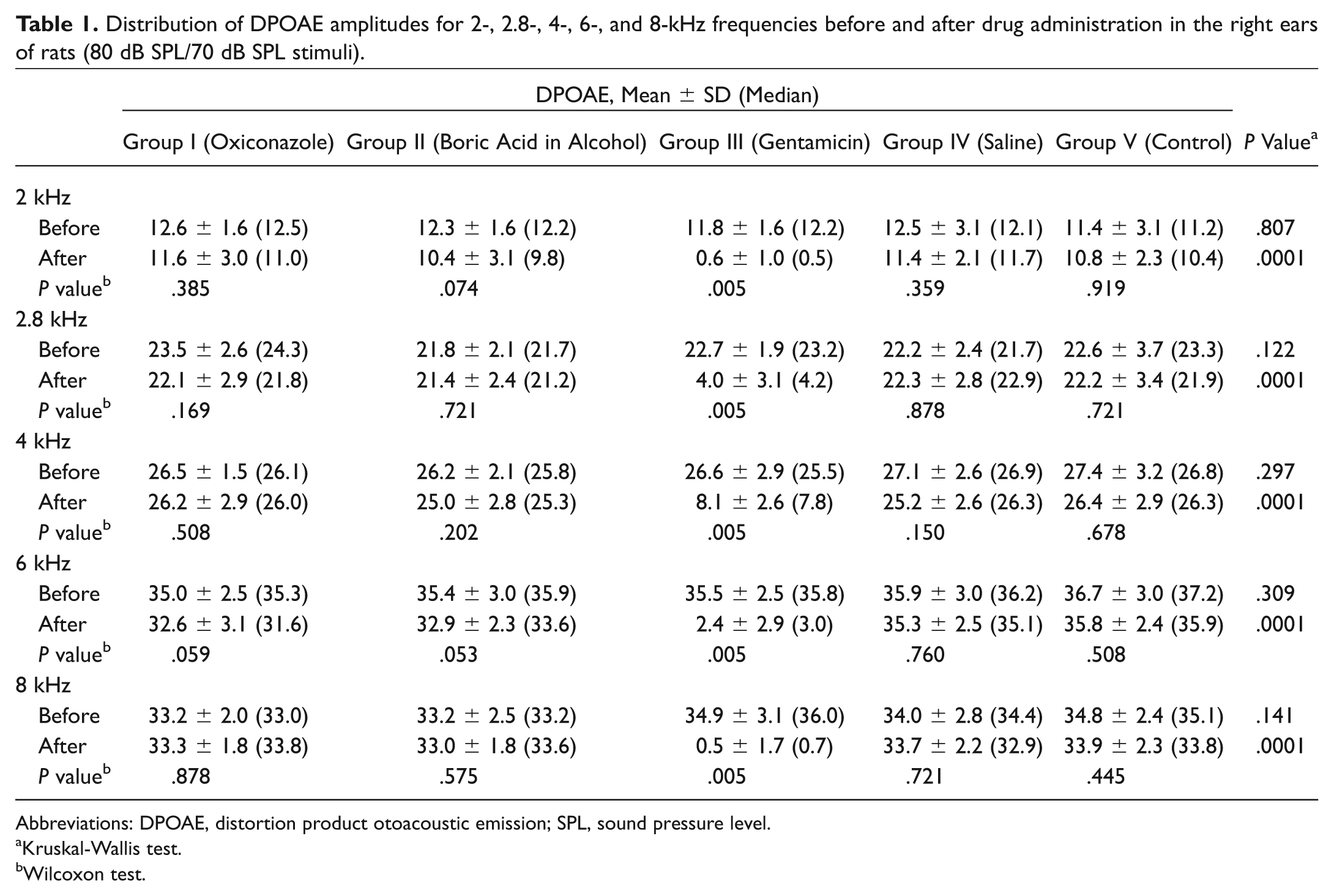
All rats completed the study. None of them showed signs of infection. In the examination of the tympanic membranes, it was observed that the perforations became wider in some rats during the posttreatment period. Also, we observed a temporary vestibular imbalance between days 6 and 10 in the animals in the gentamicin group (group III). The effects of solutions on the animals were measured by DPOAE amplitudes at 2000, 2800, 4000, 6000, and 8000 Hz. Pretreatment and posttreatment measurements were performed with an interval of 15 days. Table 1 demonstrates the distribution of DPOAE amplitudes before and after treatment for all groups at 2000, 2800, 4000, 6000, and 8000 Hz. Although there was no significant difference among all groups in all frequencies for pretreatment DPOAE amplitudes, there were significant differences among all groups in all frequencies for posttreatment DPOAE amplitudes by the Kruskal-Wallis test. The comparison of before-and-after treatment DPOAE amplitudes yielded a significant decrease in all frequencies only in group III (Wilcoxon test).
Distribution of DPOAE amplitudes for 2-, 2.8-, 4-, 6-, and 8-kHz frequencies before and after drug administration in the right ears of rats (80 dB SPL/70 dB SPL stimuli).
Abbreviations: DPOAE, distortion product otoacoustic emission; SPL, sound pressure level.
Kruskal-Wallis test.
Wilcoxon test.
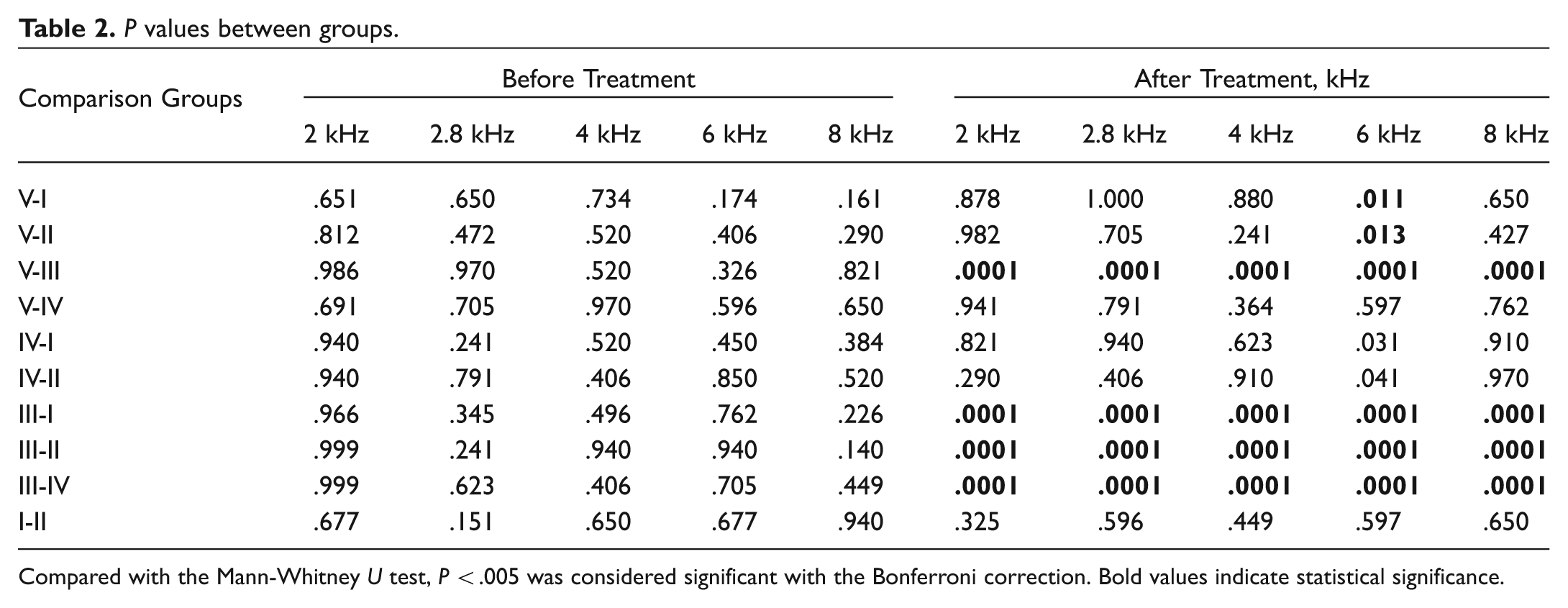
To detect the difference among groups, the Mann-Whitney U test with Bonferroni correction was used, and the results are given in Table 2 . The pretreatment DPOAE amplitudes were not significantly different between groups for all frequencies. Posttreatment DPOAE amplitudes of group III were significantly different from all other groups for all frequencies. There was no significant difference between oxiconazole and control and saline groups. The same results were found between the boric acid in alcohol group and control and saline groups.
P values between groups.
Compared with the Mann-Whitney U test, P < .005 was considered significant with the Bonferroni correction. Bold values indicate statistical significance.
In light of these results, oxiconazole and boric acid in alcohol solutions appear to be safe in rat ears.
Discussion
Topical use of drugs is more effective than systemic use in external ear infections. They can reach a higher concentration at the sites of infection, but the potential adverse effects can be seen in ears with tympanic membrane perforation or open mastoid cavity.4,7 The US Food and Drug Administration has not approved any topically used preparation for otomycosis to date. 17 If the topical drug has an ototoxic effect, the stria vascularis, hair cells, and supporting cells of the organ of Corti may temporarily or permanently be damaged. 8 In this study, we preferred DPOAE, which is a noninvasive tool to determine the outer cell functions of the cochlea and therefore hearing impairment.
Oxiconazole and boric acid in alcohol solutions have been widely used in the treatment of otomycosis by otolaryngologists. Oxiconazole is a broad-spectrum imidazole derivate antifungal drug against dermatophytes, yeast-like fungi, molds, and mixed infections due to fungi and gram-positive bacteria. 18 Imidazole derivates inhibit ergostorol biosynthesis, which is critical for the cellular membrane integrity of fungi. 8 Boric acid solutions can be prepared with alcohol or distilled water. These solutions have antiseptic and also acidic affects both in external and middle ear infections. 14
Many animal studies have investigated the ototoxic potential of antifungal agents. In his study in guinea pigs, Tom 8 reported that topical use of cloritmazole, miconazole, nystatin, and tolnaftate was safe but gentian violet had ototoxic effects. Baylançiçek et al 10 showed that a topical ciclopirox solution and Serin et al 19 showed that a Burrow solution had no effect on the inner ear of guinea pigs. In a different study, Gültekin et al 11 reported that Castellani solution was safe in rat middle ears by using DPOAE to measure hearing.
We could find only 1 study about oxiconazole’s ototoxicity in the English literature. In this recent study, Aydın et al 15 found that cream forms of oxiconazol and terbinafine had an ototoxic effect on rat inner ear. This result about oxiconazole is opposite to ours. In our study, we found that oxiconazole solution had no ototoxic effect. The formulation of the drug may be affected by this situation because antifungal formulations, including ointments, gels, and creams, should not be used due to the risk of granulation tissue development if the tympanic membrane is perforated. 2
In another study, Oztürkcan et al 14 studied the effects of 4% boric acid in distilled water and 4% boric acid in alcohol solutions in guinea pigs. They found that boric acid in alcohol solution caused significant changes in the auditory brainstem response thresholds. This finding about boric acid in alcohol solution is also opposite to our results in the current study. We detected a minimal decrease in the DPOAE amplitudes in the posttreatment frequencies, but this decrease was not statistically significant. Alcohol in this solution can be ototoxic. In our clinical practice, we saw that some referred patients with tympanic membrane perforation to our clinic used this solution. Main complaints of these patients were sore throat (because of alcohol drained from the eustachian tube) and otalgia but not total hearing loss. This result can result from a low-concentration dosage of alcohol in the solution and the usage time. In our opinion, to avoid any risk, especially in the patients with perforated tympanic membrane or open mastoid cavity, boric acid in distilled water solution is a more reliable preparation than boric acid in alcohol.
Another possible explanation for the opposite results between our study and the other 2 studies may also be due to the limited reaches of solutions to the middle ear due to the mobility of animals. This is a low probability because we observed a temporary vestibular imbalance in animals and detected statistically significant decreases of the amplitudes in our negative control group (gentamicin).
To investigate the ototoxicity of these drugs, more animal studies that evaluate otoacoustic emissions, auditory brainstem responses, and electron microscopic changes of cochlea together are needed.
Conclusion
This study demonstrates that topically used oxiconazole and boric acid in alcohol solutions to the middle ear appear to be safe on the inner ear of rats. However, the safety of these drugs has not yet been confirmed in humans. Therefore, caution should be taken when prescribing these drugs, especially to patients who had tympanic membrane perforation, to avoid a possible ototoxicity.
Author Contributions
Disclosures
Footnotes
Acknowledgements
We thank Gülşah Seydaoğlu, MD, for her help on statistical analysis.
Sponsorships or competing interests that may be relevant to content are disclosed at the end of this article.
This article was presented as a poster at the 2012 AAO-HNSF Annual Meeting & OTO EXPO; September 9-12, 2012; Washington, DC.