







Abstract
This study explores the origins and evolution of the specialty name for what is now primarily known in the English-speaking world as otolaryngology–head and neck surgery. This appellation is the longest and least pronounceable of all medical specialties. While it is reasonably well understood among medical professionals, surveys show that only a small fraction of health consumers understand its meaning. The ideal medical specialty name should have a meaning recognizable to a large segment of the public, be easily pronounceable, be reasonably short, and serve to communicate the type of illnesses treated. The cumbersomeness of the specialty name has led to nearly universal use of informal substitutes, which do not covey the scope of contemporary practice (eg, ear, nose, and throat) and to abbreviations (eg, ENT, ORL, OHNS). Based on the commercial experience, it is clear that shorter is better. The authors advocate that dialog be opened, guided by the experience from instances of successful corporate rebranding, to consider possible alternatives.
The ideal medical specialty name should have a meaning recognizable to a large segment of the public, be easily pronounceable, be reasonably short, and serve to communicate the type of illnesses treated. In commonly used English vernacular, the saying “It’s all Greek to me” means that something is utterly not understandable. This idiom, derived from Shakespeare’s play Julius Caesar, aptly describes the public’s perception of otolaryngology as a medical specialty name.
Otolaryngology and otorhinolaryngology are directly derived from modern Greek: oto (ear), rhino (nose), and laryngo (larynx). 1 Otorhinolaryngology in the Greek alphabet is Ωτoρινoλαρυγγoλoγία. The comparable Latin terms are auris (ear), nasus (nose), larynx (larynx). Suffixes are applied to anatomical region(s) to indicate that the word refers to a field of study. Hence, the names appear in variants according to language: -logy in English, -logia in Latin and Spanish, -logie in French, and -iatria in Italian. Use of the term otolaryngology predominates in English-speaking countries, while otorhinolaryngology is more popular in Europe. A handful of American departments, such as the Mayo Clinic and the University of Pennsylvania, use otorhinolaryngology.
A study by Laskin et al 2 showed that among the general public, only 53.5% of adults were able to match “otolaryngologist” with “ear, nose, and throat” when given a list containing descriptions of 15 medical fields. This represents the lowest name recognition of any medical specialty, lower than even nephrologist or hepatologist. 2 If their survey did not have a closed list of suggested selections, and the benefit of elimination of well-recognized names, then the name recognition would undoubtedly have been considerably lower. A 1982 survey in the United States found that only 27% of the public would know to consult an otolaryngologist for a fractured nose. 3 Among medical specialty names, otolaryngology is most likely the hardest for unfamiliar speakers to pronounce but probably not the hardest to spell. That distinction most likely lies with ophthalmology, with its silent first “h.”
The primary goal of this study is to examine the origins of the contemporary appellations used for the regional specialty of the head and neck and also their evolution over time. A second goal is to trace the efforts undertaken by reformers to adopt a more consumer-friendly name as well as to align it better with the specialty’s expanding scope of practice.
Methods
Multiple reference sources were used in this study. Primary sources were sought from the authors’ extensive personal libraries of historical texts as well as from online resources including Google Books and Google Scholar. Search terms included English, French, Italian, German, Latin, and Spanish variants of names used in the field. Historical and contemporary dictionaries in various languages were used. These included medical dictionaries (eg, Dorland’s Medical Dictionary, Dechambre Medical Dictionary), comprehensive reference dictionaries (eg, the Oxford English Dictionary), and etymological dictionaries (eg, Chambers Dictionary of Etymology). Priority was placed on identifying primary historical sources. PubMed searching was used to locate 20th-century articles that describe debates over the name of the specialty.
Evolution of the Specialty Name
Naming According to Organ
Prior to the late 19th century, before otolaryngology was recognized as a distinct specialty, individual clinical disciplines were named by the organ they focused on. The term otology appears to have come into use in the mid-17th century, with the Latin term otologia. The earliest reference the authors could identify appeared in 1661. 4 The earliest reference to rhinology found so far is in 1736 in Timothy Bridgeabout’s book Rinology: Or, a Description of the Nose. 5 A report concerning this book in the same year used the contemporary spelling of rhinology. 6 The first source identified using the term laryngology was a French medical dictionary (laryngologie) in 1764. 7 It should be stressed that the sources cited in the present article are not likely to be the actual first appearance of terms but are more close to actual than the usual literature on the history the field has indicated. Many usually authoritative sources inaccurately use considerably later dates for the first appearance of these terms than those indicated in this article. 8 Single organ names were used as titles for the earliest societies, journals, and medical departments of the nascent specialty. A handful of institutions retain organ-specific nomenclature in their titles. For example, the program at Harvard University retains the historical 19th-century title: the Department of Otology and Laryngology.
Combined Multiple Names of Organs
Otolaryngology is a combined form of otology and laryngology. It is one of only a handful of medical specialties to contain multiple organs in its name (eg, cardiothoracic surgery, maxillofacial surgery). Adoption of the combined form heralded the consolidation of single-organ practices into a regional specialty. The term otolaryngology first appeared in the later part of the 19th century. The earliest use the authors could find was an 1891 article about the importance of “oto-laryngologie” for the general practitioner. 9 In 1897, a report in an English journal used the term oto-laryngology. 10 The organization, now known as the American Academy of Otolaryngology—Head and Neck Surgery, in its first year of 1896, was called the Western Association of Ophthal-mologists, Otologists, and Laryngologists. They adopted the term oto-laryngologic in 1898, which was changed to otolaryngology in 1903. The earliest use of otorhinolaryngology the authors could find was a Spanish national congress of Otorrinolaringologia in 1896 and a Spanish book titled Casuistica Oto-rino-laringologica in 1897.11,12 Since that time, otolaryngology or otorhinolaryngology are included in the name of the vast majority of academic departments, national societies, and textbooks. It is interesting to note that the word rhino-laryngological has sometimes been used to describe reports concerning rhinology and laryngology. 13
Augmentation of Traditional Nomenclature with Non-Greek Phrases
During the 1950s, many observers expressed the belief that the specialty of otolaryngology was in decline because of the introduction of effective antimicrobial therapy. 14 Over the next 2 decades, the field underwent a resurgence, which included both a broadening of the scope of practice to include many areas formerly managed by other specialties (eg, head and neck cancer surgery, facial plastic surgery) and an introduction of new procedures (eg, skull base surgery, endoscopic sinus surgery). By the late 1960s, due to dissatisfaction with the perceived narrow scope of the traditional ear-nose-throat description, a desire arose to encompass this expanded role within the name of the specialty.
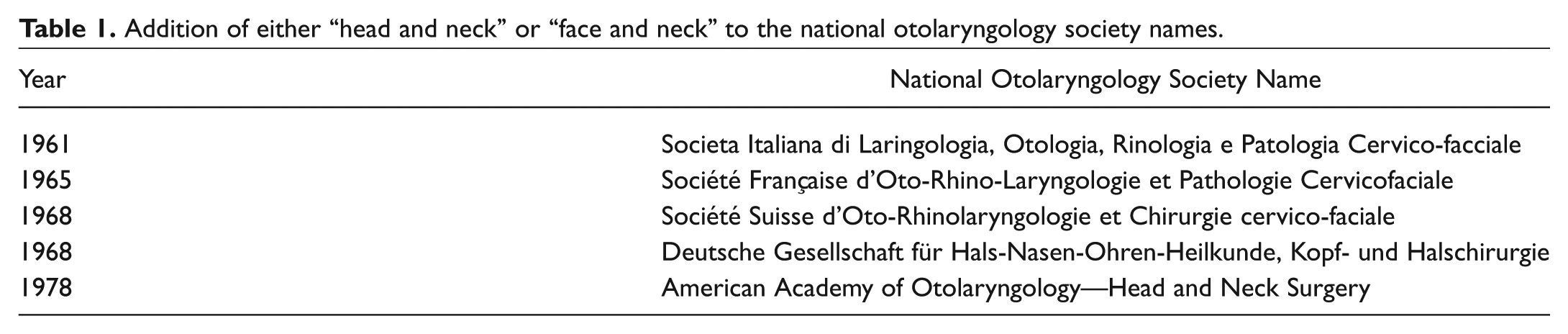
The equivalent of “face and neck” was added by the national societies of Italy (1961), France (1965), and Switzerland (1968; Table 1 ). Inclusion of the equivalent of “head and neck” appeared in the German society name in 1968. The American Academy was a relative latecomer to this transition, deciding to add “head and neck surgery” in 1978. 15 Addition of this explanatory phrase to the traditional Greek name was not without controversy.16-18 In 1980, Paul Ward of the University of California, Los Angeles, recommended simplifying the specialty name to “head and neck surgery.” He also opined that many in the field perceived “a certain stigma in being called ear, nose, and throat men.” 19 This trend of added language to the specialty name resulted in lengthy, complicated names that read more like sentences than titles. On the positive side, it communicated the change from a narrow organ-specific field to a broader regional specialty. It is noteworthy that the American Board retains the otolaryngology name, as the addition of head and neck surgery was resisted by other surgical disciplines.
Addition of either “head and neck” or “face and neck” to the national otolaryngology society names.
Some have questioned the appropriateness of incorporating the terms head and neck, arguing that head includes the brain and eyes and neck connotes spine to many patients. Nevertheless, inclusion of the terms head and neck have become well established over the past 35 to 40 years and are generally well understood in this context. Many Europeans include the word face in the specialty description. Depending on various definitions, face may or may not include the ears and may be thought to include only surface features rather than the deeper recesses, which are the primary focus of the field. The term may also lead to confusion with the dental specialty of maxillofacial surgery. Nevertheless, the French phrase chirurgie cervico-faciale sounds decidedly elegant, especially when uttered by a native speaker.
Informal Names for the Specialty
Given the opaqueness of the formal name otolaryngology, it should not be surprising that a host of informal names have entered common use. A large fraction of outpatient clinics, especially private practices, refer to themselves with the consumer-friendly term “ear, nose, and throat.” In university systems, the academic hospital services often use this common name, whereas the academic departments typically employ the more formal Greek term. Similar, informal appellations such as the French “Nez, gorge, oreilles,” German “Hals-Nasen-Ohren,” Italian “Orecchio naso gola,” and Spanish “Oído, nariz y garganta” are in common use. It is intriguing to note that the order varies, with ear first in English, Spanish, and Italian, while nose is first in French and throat is first in German. The authors will leave it to the imagination of readers to speculate on the reasons behind this variability.
Shortened forms in regional use consisting of contractions of the Greek name include the Portuguese “Otorrino,” Italian “Otorino,” and French “Otorhino.” Use of abbreviations to represent the field is widespread, and abbreviations are perhaps the most commonly used of all names for the specialty. Examples include the English (ENT), French (ORL), German (HNO), and Dutch (KNO). The phrase ENT surgeon is prevalent in the United Kingdom. Within the profession, Americans often refer to the specialty as OHNS.
Discussion
It is widely recognized that otolaryngology–head and neck surgery is difficult to pronounce, obscure in meaning, and excessively long. To be fair, the name is perfectly understandable if you are Greek. Otolaryngology–head and neck surgery possesses no fewer than 33 characters and some variants even more. Among American medical specialties, it is approached in length only by physical medicine and rehabilitation (32 characters), a specialty name with the distinct advantage of being entirely composed of commonly used English words. Medical specialties have chosen their names in various ways. Some are named by the treatments they offer (eg, medicine, radiotherapy). Others are named by the techniques they perform (eg, surgery, neurosurgery, anesthesiology). A couple are age-related terms (eg, pediatrics, geriatrics). Many are named for the single-organ system they care for (eg, neurology, cardiology, dermatology, orthopedics, urology). The specialty otolaryngology/otorhinolaryngology is named by a combination of organs, which, taken together, comprise only a fraction of the modern scope of the field. The form is undeniably cumbersome. If urology followed this rule, it might be named nephro-uretero-vesiculo-urethro-penology. It has been proposed that a suitable name might convey that the field primarily concerns the upper respiratory tract. One suspects that the term mucosology would not be popular, and otologists and salivary gland surgeons might seek extensions, leading to incomprehensible conglomerations such as salivomucocerumenology.
It is important to consider who makes use of specialty names. Within the medical community, the term otolaryngology is quite familiar among physicians, somewhat so among nurses, and characteristically garbled badly by administrators. Of all medical fields, otolaryngology is perhaps the name most exclusively focused on the profession. Outside of it, particularly among patients, the name is largely both unrecognizable and unpronounceable. Even professional announcers on television and radio typically stumble when trying to enunciate it.
Such factors explain the predominance of informal names (eg, ear, nose, and throat) and abbreviated forms (ENT, ORL, HNO, etc). Ear, nose, and throat is so prevalent that it has been discussed in the mid-1990s to change the name of the American Academy to “Ear, Nose, and Throat Specialists.” In 1996, Drs Johns and Niparko of Johns Hopkins opposed this proposal, stating that “the ENT era of our specialty is over, and to return to that appellation is to potentially make a U-turn in our evolution.” 20 While ENT has the advantage of being in simple English, it has the disadvantage of connoting a scope of practice much more limited than is actually the case today.
In recent years, an ever-increasing fraction of surgeons trained in otolaryngology no longer use the mother specialty name when describing their profession. Faced with confused looks when they introduce themselves as otolaryngologists, they have instead opted to call themselves facial plastic surgeons, head and neck surgeons, laryngologists, otologists, or sinus surgeons. The ascension of this single-organ nomenclature heralds a tendency to return to the naming conventions of the 19th century. It must be acknowledged that this drift toward use of subspecialty nomenclature may primarily reflect the trend toward higher degrees of specialization rather than a desire to abandon the awkward parent specialty name. Our sense is that subspecialized practitioners of other surgical specialties (eg, neurosurgery, urology, orthopedics, cardiac surgery) have not disassociated themselves from their mother specialty name to the same degree that otolaryngologists have.
The desirability of a name more understandable to lay people and better representative of contemporary specialty practice has long been recognized. All agree that it should be considerably shorter, explicitly convey the regional nature of our specialty, be easier to pronounce, and (ideally) be stated in commonly understood language. Among corporations, the tendency is to shorten and simplify the name, often by contraction and abbreviation. Examples of this type include Federal Express becoming FedEx and Lucky Goldstar adopting LG. A second form is creating a neologism, such as the transformation of Standard Oil into Exxon. The clear trend among commercial entities, who benefit from sophisticated market research, demonstrates that shorter is better.
It needs to be acknowledged that the specialty of otolaryngology–head and neck surgery is thriving despite its cumbersome brand name. Revising the name of a specialty has substantial implications. When a company rebrands itself, it typically engages in a major marketing campaign to make the new name familiar to a broad audience. Medical organizations, which would necessarily lead this process, lack the marketing resources available to large corporations. Nevertheless, accomplishing this change may be more readily achievable when the field is strong and vigorous rather than under, threat as it was in the 1940s and 1950s.
If it were easy to find a more suitable name for otolaryngology–head and neck surgery, this would already have been done long ago. Just because it is difficult does not mean that it ought not be attempted. Specialty leaders could convene an inclusive process to consider a name change. Clearly, discussions about such a change would be contentious, and unanimity of opinion would not be an achievable goal. However, arriving at a consensus for a more suitable name by a plurality of specialists is entirely realistic.
In one of many possible solutions, making use of principles established by industry, the specialty name in English could be shortened to simply “OHNS.” This would need explanation with a descriptive subtitle, used in more formal settings (such as letterheads), such as “regional specialty of the head and neck.” The specialty’s name would reduce from 33 to 4 characters while maintaining a connection with its traditional Greek name. The explanatory subtitle conveys in clear and simple language the scope and scale of contemporary practice. One could speculate that at some future time, as the concept of the regional specialty becomes deeply ingrained, that use of the legacy terms OHNS, ORL, or HNO could be discontinued.
Another proposal, which many would consider the logical next step stemming from earlier modifications, would be to interpret the era of hyphenation as a prelude to the ultimate removal of the Greek term. The 3-decade period with a hyphenated name has acclimated many to the phrase, which could now come to the forefront as the specialty’s primary title. This could take the form of “head and neck surgery” or, as an acknowledgment of the duality of medicine and surgery in the field, as “head and neck specialty.” Either option would give the field an easy-to-pronounce and more readily understandable appellation. It would also have the potential of achieving something that the present cumbersome name has not: routine use both within the medical system and among health care consumers.
As it has been well over 3 decades since the name of the specialty was last modified, it is reasonable to consider whether the presently used specialty name is optimally suited to represent the field in the future.
Author Contributions
Disclosures
Footnotes
No sponsorships or competing interests have been disclosed for this article.