






Abstract
Objectives
(1) Review and report our experience performing medialization thyroplasty (MT) in previously irradiated patients and (2) compare complications and voice outcomes in 2 cohorts (irradiated vs nonradiated) to evaluate safety and efficacy.
Study Design
Case series with chart review.
Setting
Academic medical center.
Subjects
All patients (44 total) who underwent MT from 2011 to 2015.
Methods
Demographic data, complications, and acoustic and subjective voice outcome parameters were collected. The complication rates and voice outcome results were compared between 2 cohorts: patients with a history of radiation to the neck versus those with no radiation history.
Results
There were 7 previously irradiated patients and 37 nonradiated patients, with median follow-up of 314 and 538 days, respectively. One complication was noted in each group, and this complication rate was not significantly different (P = .26). Both cohorts demonstrated significant postoperative improvement in subjective voice assessment (P = .04, P < .0001) as well as maximum phonation time (P = .02, .001) when compared with preoperative data.
Conclusions
Our study suggests that MT can be safely and effectively performed in irradiated patients. We found no statistically significant difference in the safety of performing MT in irradiated versus nonradiated patients, and there was significant improvement in subjective voice parameters and maximum phonation time in both groups. A larger prospective study is required to statistically determine whether the significant improvements in objective parameters seen in the nonradiated group are present in irradiated patients as well.
Keywords
Numerous treatment approaches exist for the management of unilateral vocal fold paralysis, including behavioral, endoscopic, and external surgical procedures. 1 While office-based injection medialization has become increasingly popular, surgical management continues to be the primary treatment modality, resulting in reliable long-term improvements in glottal function and voice production. External approaches can be dynamic, as in the case of reinnervation procedures, as well as static, as in laryngeal framework surgery.
One of the most broadly utilized and best-studied techniques is the type I medialization thyroplasty (MT), as first described by Isshiki et al in 1974. 2 In this procedure, typically done under local anesthesia and mild sedation, a window is created in the ipsilateral thyroid alar cartilage, enabling access to the paraglottic space for placement of a permanent medializing implant. Advantages of this procedure include immediate improvement in voice, real-time voice feedback that permits individualization of the implant, low complication rates, and reversibility of the procedure. Disadvantages include typical surgical complications, such as bleeding and infection, as well as the potential long-term risks associated with foreign body placement—for example, implant infection, migration, or extrusion into the airway, a potentially life-threatening scenario.
The long-term safety and efficacy of MT have been well established with a variety of implant materials, including Silastic, Gore-Tex, silicone, and titanium.3-6 Appropriate patient selection is important to maximize safety and voice outcomes. Given that malignancy is a common etiology of unilateral vocal fold paralysis, it is not unusual for a patient to be considered for MT who has received neck radiation. 1 There is evidence that patients who undergo neck surgery in a radiated field have a higher risk of complications.7,8 However, the relative risk of complications has not been established for performing MT on a patient who has received neck radiation versus one with no history of radiation. For example, some studies have advocated against performing thyroplasty in patients who have undergone neck radiation, as this is seen as a contraindication. 9 External beam radiation is known to alter tissue vascularity, promote fibrosis, and increase the risk of implant extrusion, as is the case with mandible reconstruction plates and breast implants.10,11 It has been suggested that radiation exposure may be a relative contraindication in MT, with the proffered rationale that the implant material could be applying sufficient pressure on thinned, poorly vascularized paraglottic tissue that could become ischemic. However, there is no existing literature suggesting that it has been objectively studied in the case of MT. To our knowledge, the only existing prior work was presented by Casiano et al to the Triological Society in 1995, although it was not subsequently published.
The purpose of this report is to review our experience in performing MT in both irradiated and nonradiated patients to evaluate the long-term safety and efficacy of the procedure.
Methods
Approval was obtained from the University of Miami Institutional Review Board. A retrospective chart review was conducted of all patients who underwent MT from 2011 to 2015 at University of Miami Hospital, a tertiary academic medical center. All patients were implanted with Gore-Tex (WL Gore and Associates, Newark, Delaware) under monitored anesthesia care via a standard transcervical approach with creation of a thyroid cartilage window, and all were performed by a single surgeon (D.E.R.). Adduction arytenopexy was additionally performed in 10 patients with posterior glottic insufficiency (1 in the irradiated group, 9 in the nonradiated group), through the technique described by Zeitels et al. 12 The complication rates of patients undergoing MT were compared between those with a history of radiation to the neck and those with no history of radiation, by means of Fisher’s exact test. Subjective voice outcomes were compared by means of Voice Handicap Index (VHI) and VHI-10 questionnaires. Our institution transitioned to VHI-10 questionnaires in 2013; therefore, all VHI results were normalized to the 40-point VHI-10 scale. Statistical comparison of VHI-10 pre- and post-MT was performed through the 2-tailed Student’s t test with a significance threshold of P = .05. Objective data collection was performed pre- and post-MT via the CSL 4500 Multi-dimensional Voice Program Advanced (KayPENTAX, Inc, Montvale, New Jersey). The acoustic data were collected in a standardized fashion during prolongation of the vowel sound /a/ at a comfortable pitch and loudness level. Parameters measured included maximum phonation time, fundamental frequency, jitter, shimmer, and noise-to-harmonic ratio, and these parameters were also compared with the 2-tailed Student’s t test. A microphone (Shure, Inc, Niles, Illinois) was utilized with an approximate mouth-to-microphone distance of 15 cm.
Results
Forty-four patient charts were reviewed, including those of 7 previously irradiated patients and 37 nonradiated patients. There were 17 male patients and 27 female patients, with an average age of 57.4 years. Five cases were revisions: 2 from other surgeons at our own institution and 3 from elsewhere. The mean and median follow-up for the irradiated group were 391 and 314 days, respectively, while the nonradiated group had a mean follow-up of 600 days and a median of 538 days (P = .09 by Mann-Whitney U test).
Patients were found to have undergone external beam radiation for treatment of the following pathologies: thyroid carcinoma (2 patients), oropharyngeal carcinoma, hypopharyngeal carcinoma, squamous cell carcinoma of the aortic arch, pulmonary neuroendocrine tumor, and non-Hodgkin’s lymphoma. The last 3 patients received primary radiation to the chest with additional treatment to the neck, but treatment plans and total dosage were not available from outside institutions. Radiation was completed as far back as 25 years prior to surgery and as recently as 1 year prior to thyroplasty.
Safety Data
Two complications were noted during chart review, 1 for each group (1 of 7 for the radiated group, 1 of 37 for the nonradiated group; P = .26 by Fisher’s exact test). One nonradiated patient experienced immediate implant extrusion intraoperatively due to injury to the paraglottic mucosa. This was managed with conservative observation, and the patient experienced no further sequelae >3 years later. A radiated patient experienced postoperative edema with dysphagia requiring an emergency room visit and overnight hospitalization for observation and intravenous corticosteroids. The symptoms resolved within 3 days, and there was no edema on laryngoscopy 1 week later. The patient ultimately had no further complaints or long-term sequelae >5 months later and maintains improved voice.
Voice Outcomes
The pooled data for all study patients demonstrated significant improvement in both subjective and objective voice parameters ( Table 1 ). VHI-10 data revealed an average preoperative score of 27.4 (out of 40) and an average postoperative score of 15.5 (P < .0001). All objective parameters demonstrated significant improvement postoperatively except for fundamental frequency, which showed no significant change. Significant improvement was seen in subjective VHI-10 data for radiated patients ( Table 2 ) and nonradiated patients ( Table 3 ), as well as in the maximum phonation time. Other objective parameters were significantly improved in the nonradiated group, again with the exception of fundamental frequency, which showed no significant change. The other objective acoustic parameters were not significantly different in the radiated group.
Objective and Subjective Voice Data for All Patients. a
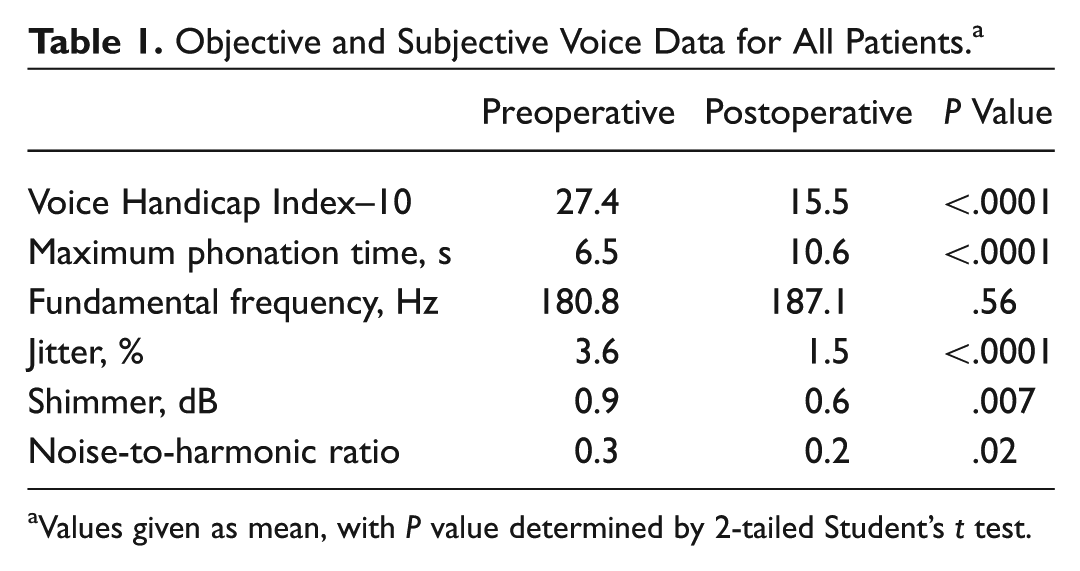
Values given as mean, with P value determined by 2-tailed Student’s t test.
Objective and Subjective Voice Data for Irradiated Patients. a
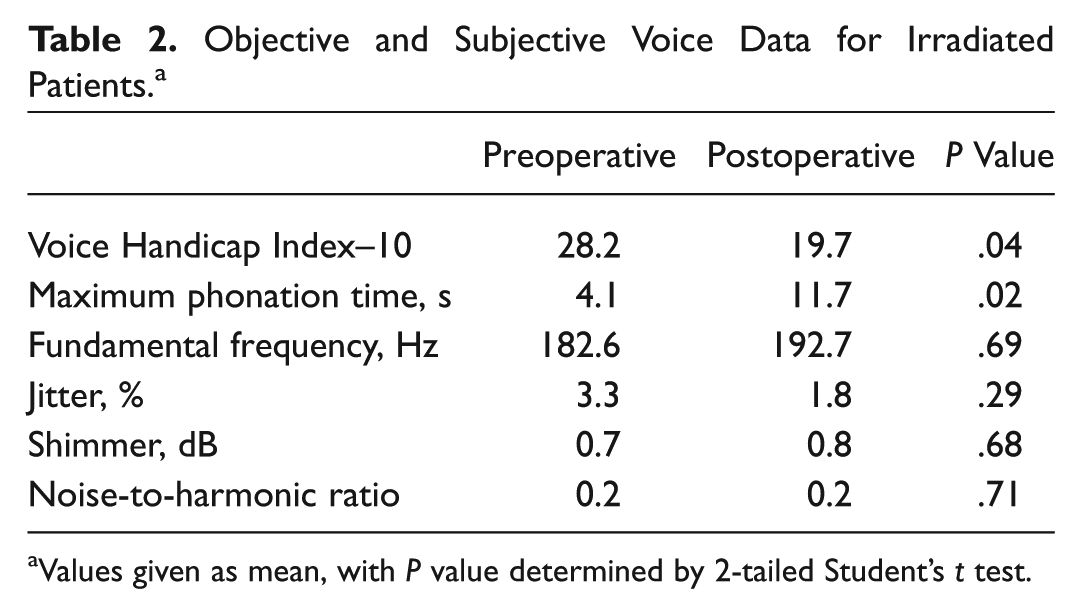
Values given as mean, with P value determined by 2-tailed Student’s t test.
Objective and Subjective Voice Data for Nonradiated Patients. a
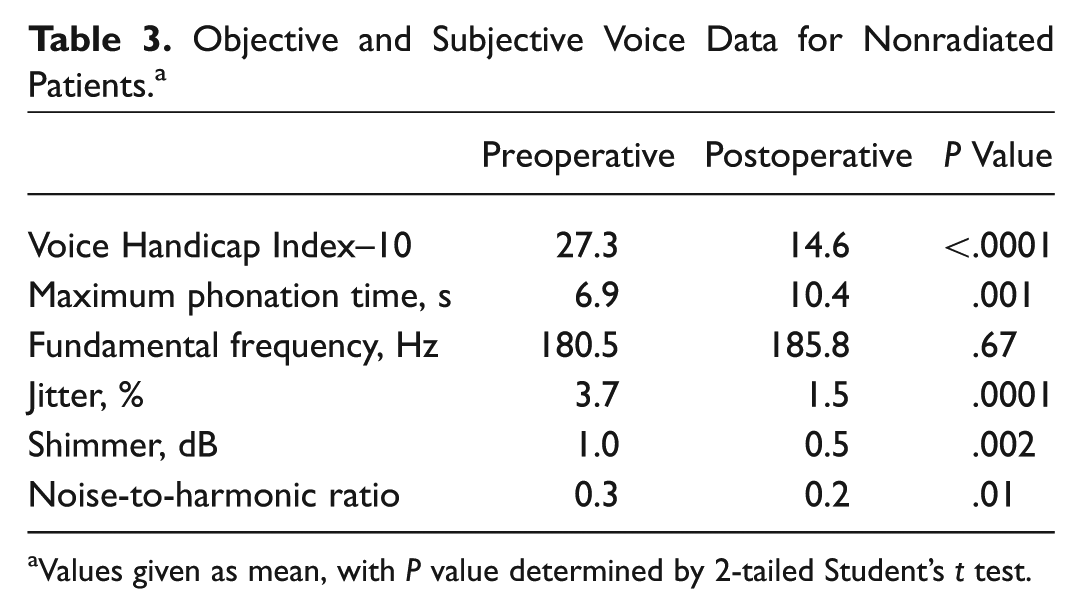
Values given as mean, with P value determined by 2-tailed Student’s t test.
Discussion
There has been considerable attention in the otolaryngology literature to the hazards of operating in a radiated field. It is well established that side effects of radiation treatment include neurovascular compromise, soft tissue desmoplasia and scarring, as well as radiation-induced bone and cartilage necrosis.13,14 Despite the advent of intensity-modulated radiotherapy and other technologies designed to minimize collateral injury to nearby structures, the larynx will often receive a significant dose of radiation during management of other head and neck malignancies, including those of the thyroid, oropharynx, esophagus, and cervical lymph nodes. 13 Unfortunately, the malignancy and its management can result in unilateral vocal fold paralysis requiring treatment. MT remains one of the most common rehabilitative options for these patients to achieve long-term vocal function improvement. 15
Chang et al recently published their experience with injection medialization procedures in a small group of irradiated patients and found no statistically significant difference in voice quality improvement as compared with nonirradiated patients. 9 In their discussion, the authors stated that “history of radiation to the neck has been a contraindication to more definitive open laryngeal framework surgery.” However, they offered no clear evidence to support this conclusion. Injection medialization is an enormously important tool in management of vocal fold paralysis, but the decision regarding injection versus surgical medialization can be a complex one for the patient and the physician for several reasons.
First, the advent of long-term injectable materials such as calcium hydroxylapatite has enabled many patients to realize improved glottal closure and enhanced voice for over a year and, in some cases, for several years. 16 However, patients may not wish to undergo multiple procedures, instead preferring a single permanent treatment. Furthermore, there may be anatomic variables precluding effective injection medialization in an office or operative setting, such as poorly appreciated external laryngeal landmarks or minimal cervical spine extension. MT may also be preferred for its permanent nature, reversibility, and revisability, as well as for the opportunity it affords the surgeon to perform arytenoid repositioning concurrently for patients with significant posterior glottic insufficiency. A history of external beam radiation is another potential issue to consider when treating patients with either injection augmentation or MT to provide the best possible voice outcome with maximum patient safety. However, a large prospective study would be needed to establish the risks associated with radiation given the low complication rate of the procedure and the results of our study.
This retrospective review suggests that MT can be safely performed in irradiated patients, with similar efficacy and no major complications or voice outcome sequelae. The complication rates of 3% in the nonradiated group and 14% in the radiated group are statistically similar and are in line with a reported complication rate of 15%. 15 Patients in the irradiated group had >1 year of mean follow-up, which seems a reasonable length of time to expect any implant extrusion or migration to occur, although it is certainly possible that these could occur many years later. Anecdotally, 3 irradiated patients were noted intraoperatively to have very thin paraglottic tissue, and flexible laryngoscopy during dissection of the paraglottic space in these patients demonstrated initial implant placement as being more superficial than what would be ideal. With careful dissection and tissue handling, the implant could be positioned more posteriorly and laterally while avoiding impingement on Reinke’s space and reducing the potential for implant extrusion. We therefore wish to emphasize the importance of handling the paraglottic tissue delicately and considering laryngoscopic confirmation of implant positioning in an irradiated patient.
Voice outcomes were significantly improved in the aggregate group on the basis of objective acoustic data and the VHI-10—a subjective, validated quality-of-life questionnaire. In both the irradiated and nonradiated groups, patients realized significant improvements in VHI-10 and maximum phonation time, as well as in most of the acoustic parameters for the nonradiated group, but in both groups, the fundamental frequency remained unchanged. There is, however, a body of literature suggesting that this measurement can be reduced or elevated in the setting of unilateral vocal fold paralysis, so thyroplasty may not necessarily change this value in one predictable direction.17,18
Strengths of this study include the period of patient follow-up, as well as the use of subjective and objective voice data to confirm the efficacy of MT on vocal function. While the period of follow-up between the 2 groups appears to be different, it is not a statistically significant difference. The main weaknesses are the relatively small number of patients and the study’s retrospective nature, which does introduce selection bias, as patients could theoretically have complications or voice complaints that are managed elsewhere. It is also reasonable to assume that there was a small number of irradiated patients with scarred, distorted anatomy who were not offered MT, given the unlikelihood that framework surgery would improve their vocal function. This decision process, however, is equally applicable in a nonradiated patient when MT is considered for management of glottic insufficiency.
Conclusion
Type I MT is the most common laryngeal framework procedure and an important surgical tool in the management of unilateral vocal fold paralysis. Our study suggests that this procedure can be safely and effectively performed in patients with a history of neck radiation, although surgeons must exercise extra care when handling the paraglottic tissues and use sound clinical judgment in selecting appropriate treatment options.
Author Contributions
Disclosures
Footnotes
No sponsorships or competing interests have been disclosed for this article.
This article was accepted for presentation at the 2015 AAO-HNSF Annual Meeting & OTO EXPO; September 27-30, 2015; Dallas, Texas.