







Abstract

In 1996 the New England Journal of Medicine published a series of 6 weekly commentaries on quality in health care, focusing attention to a topic that had been discussed previously but was taking on additional visibility as the millennium approached. By the end of the decade, the Institute of Medicine issued its landmark report To Err Is Human: Building a Safer Health System, in which the unsettling rate of medical errors was brought into the broad view of the public. 1 In the first paper in the New England Journal series, Blumenthal noted that among issues confronting medicine, “none seems more perplexing than the debate about the quality of care.”2(p891) Looking back to the work of Donabedian in 1980 3 and drawing on earlier work from the Institute of Medicine, Blumenthal defined quality of care by the appropriateness and skill with which care was provided, as well as through the outcome of that care on individuals and populations. He also recognized that the perception of physicians was key in quality assessment and improvement—a voice that he felt had not been considered sufficiently to that point.
From an editorial standpoint, the medical literature has exploded with papers that focus on patient quality and safety. As seen in Figure 1 , there has been a steady annual rise in the proportion of published papers that discuss quality, from a handful of papers in the 1960s to >6000 publications per 100,000, or 6% of published papers, in 2013. 4 Medical journals and their editors have received a rapidly increasing number of articles that review topics in patient safety and quality, ranging from small quality improvement projects in hospitals and ambulatory practices to large database analyses using such indices as the American College of Surgeons’ National Surgical Quality Improvement Program and the Agency for Healthcare Research and Quality’s Kids’ Inpatient Database. This focus is appropriate and helps to ensure not only that patients are receiving the best possible care in the most timely manner but that improved efficiencies in health care delivery create value for all stakeholders in the health care system.
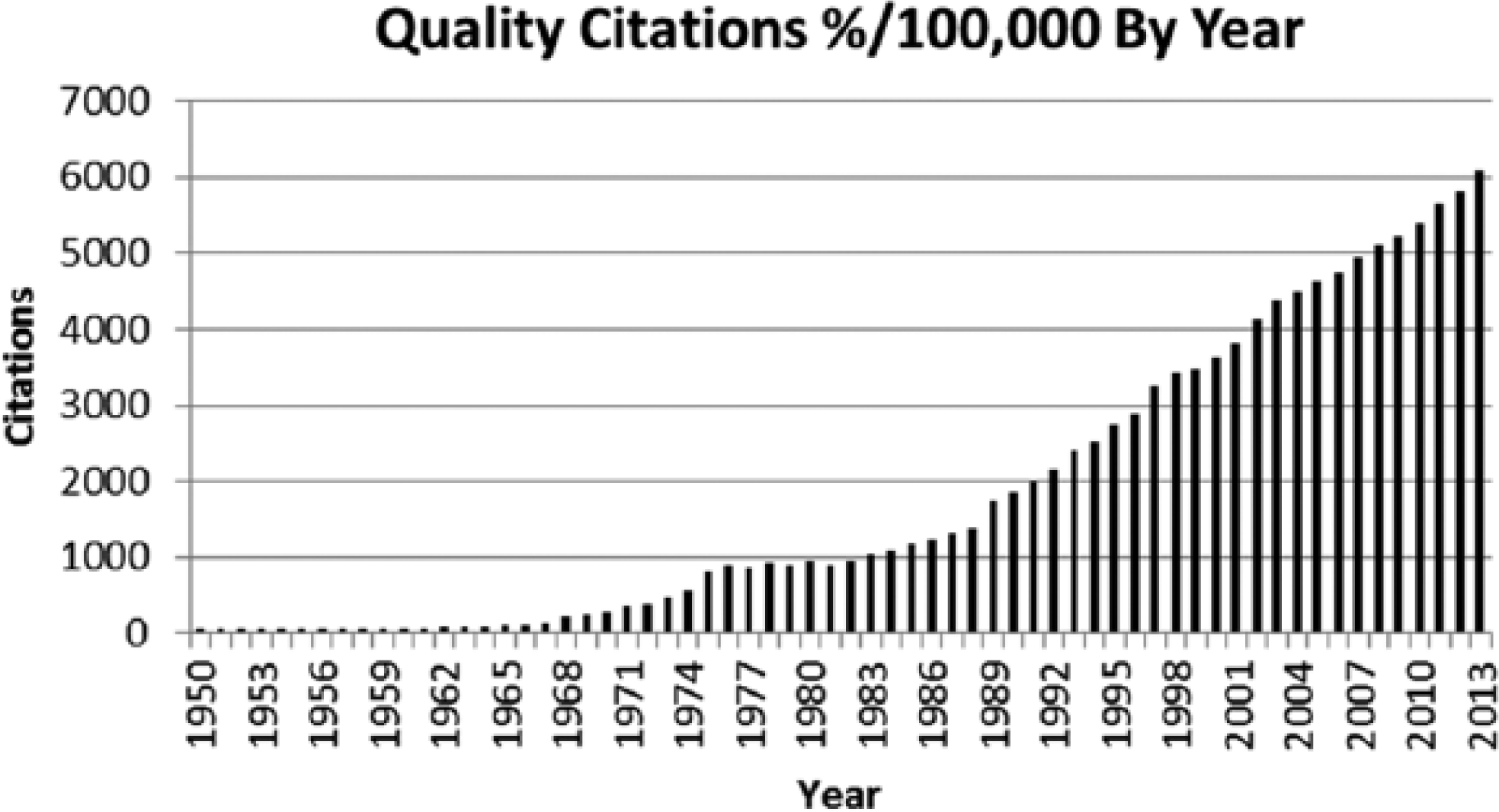
Proportion of published papers (citations per year) in the MEDLINE-indexed medical literature referencing “quality” from 1950 through 2013.
In May, Otolaryngology–Head and Neck Surgery published its first issue in a semiannual series that contained a focused group of papers exploring the role of quality in medicine broadly and in otolaryngology specifically. As Deputy Editor Cecelia Schmalbach discussed in her editorial, we at the journal will continue the discussion around quality “by providing the necessary, dedicated forum for quality PS/QI [patient safety/quality improvement] peer-reviewed research and associated editorials.”5(p773) This month, we again present several papers that look at the role of quality and patient safety in our delivery of care. We welcome future submissions directed toward these semiannual issues, including commentaries and research studies that expand our consideration of patient safety and quality.
Toward this end, we embrace the thoughts of Brook and colleagues in their contribution to the New England Journal’s 1996 series on quality: “Our goal should be to ensure that all patients receive care considered to be high in quality on the basis of scientific data and expert judgment.”6(p969) The editorial staff and I take this charge seriously and look forward to providing an ongoing forum for research, opinion, and review that contribute to increasing safe and quality-focused care to our patients and our communities.