






Abstract
Objective
Complementary and alternative medicine, or integrative medicine, has become increasingly popular among patients with head and neck cancer. Despite its increasing prevalence, many patients feel uncomfortable discussing such therapies with their physicians, and many physicians are unaware and underequipped to evaluate or discuss their use with patients. The aim of this article is to use recent data to outline the decision making inherent to integrative medicine utilization among patients with head and neck cancer, to discuss the ethical implications inherent to balancing integrative and conventional approaches to treatment, and to highlight available resources to enhance head and neck cancer providers’ understanding of integrative medicine.
Data Sources
Randomized controlled trials involving integrative medicine or complementary and alternative medicine treatment for cancer patients.
Review Methods
Trials were drawn from a systematic PubMed database search categorized into cancer prevention, treatment, and symptom management.
Conclusions
Integrative medicine is gaining popularity for the management of cancer and is most commonly used for symptom management. A number of randomized controlled trials provide data to support integrative therapies, yet physicians who treat head and neck cancer may be faced with ethical dilemmas and practical barriers surrounding incorporation of integrative medicine.
Implications for Practice
In the management of head and neck cancer, there is an increasing demand for awareness of, dialogue about, and research evaluating integrative medicine therapies. It is important for otolaryngologists to become aware of integrative therapy options, their risks and benefits, and resources for further information to effectively counsel their patients.
Complementary and alternative medicine encompasses “a group of diverse medical and health care interventions, practices, products, or disciplines that are not generally considered part of conventional medicine.” 1 These modalities are used by 38% of adult patients in the United States, and prevalence continues to increase. 2 In recent years, “integrative medicine” has replaced “complementary and alternative medicine” as the preferred terminology. Integrative medicine focuses on a collaborative approach to patient care that involves “bringing conventional and complementary approaches together in a coordinated way” 3 and suggests a more cohesive and patient-centered treatment.
As the use of integrative therapies is becoming increasingly common among patients with cancer, physicians must become adept at helping patients navigate these therapies. However, despite its increasing popularity among patients, integrative medicine has been slow to gain acceptance in the mainstream health care system, in part due to a lack of awareness among clinicians of research and clinical trials demonstrating the efficacy of integrative therapies, 4 the barriers to paying for integrative therapies, and a paucity of resources to guide clinicians in finding integrative medicine resources and providers.
Despite its overall growing presence in Western medicine, a role for integrative medicine has not been fully established among head and neck cancer providers. For patients and providers alike, key considerations in using integrative therapies include assessing the potential risks and benefits of the therapy, available evidence for specific therapies, and whether patients intend to use such therapy as an alternative treatment or in a complementary/integrative manner.5-7 Given this complex and challenging landscape, clinicians may benefit from an increased awareness of how integrative medicine can enhance the patient-doctor interaction and potentially improve patient experiences. Herein we present index patients with head and neck cancer who used integrative medicine, to guide a discussion of how clinicians might better understand the types of and rationale for integrative medicine as they navigate the inherent practical and ethical challenges. We also offer resources that clinicians can use to help them determine the evidence for integrative therapies, as well as their potential harms, interactions, and contraindications.
Methods
Articles were identified via a formal PubMed database search specifying all randomized controlled trials published within the past 10 years investigating integrative medicine or complementary and alternative medicine for cancer patients and/or head and neck cancer patients. We assessed the trials and sorted them into categories of cancer prevention, cancer treatment, or symptom management.
Illustrative de-identified case examples were chosen to exemplify the inherent issues. The University of Michigan Institutional Review Board has determined that publication of de-identified case studies does not require formal review or approval.
Discussion
Integrative Medicine Use in Head and Neck Cancer
Patients commonly use several types of integrative therapies, including natural products, mind-body practices, naturopathy, and ayurveda. 3 Biologically based therapies, such as herbal medicines, medicinal teas, and vitamins/minerals, are the most common integrative therapies used by patients with head and neck cancer, followed by mind-body interventions, such as visualization.6,8 Patients tend to use integrative medicine in regard to cancer in 1 of 3 paradigms: prevention of cancer, intended treatment of cancer, and mitigation of side effects associated with cancer and conventional treatments.8,9 While scientific evidence is generally limited with regard to the efficacy of integrative therapies for cancer prevention and treatment, there is a wealth of data supporting integrative therapies for symptom management. In fact, >200 randomized controlled trials are focused on integrative therapies for symptom management of breast cancer alone. 10
While prevalence of integrative medicine usage varies greatly across studies, systematic reviews suggest that approximately one-third to one-half of cancer patients are using some form of integrative therapy.11,12 Specifically in head and neck cancer, rates of use are more varied, ranging from 6% to 90%.6,9,13 This variation may be a function of data collection methodology as well as timing; notably, integrative medicine use in head and neck cancer patients may increase dramatically after diagnosis and initiation of treatment. 8
It may be difficult for patients and physicians to know where to find reliable information regarding the efficacy of these therapies, especially because the preponderance of Internet-based information is of questionable veracity and accuracy. 13 There is an increasing demand for rigorous integrative medicine data and clinical trials in cancer for physicians to provide better recommendations to their patients. 14
Cancer Prevention
A 45-year-old woman is referred to the head and neck oncology clinic for worsening white lesions in the oral buccal mucosa. She has no previous tobacco or alcohol use. Her medical history is otherwise unremarkable, but she does have an uncle who was a heavy smoker and developed larynx cancer. On examination, she appears to have benign oral leukoplakia. She is relieved but asks about any data for dietary supplements that may help in preventing oral cancer.
Integrative therapies for cancer prevention have generated interest from patients and researchers alike. A number of natural compounds commonly used for cancer prevention have demonstrable anticancer effects in both in vitro and in vivo translational studies, while others are backed by testimonials or individual case studies. Curcumin, an active compound in turmeric, has been shown to have anticancer properties in both in vitro and in vivo studies.15-17 A number of antioxidants have been shown to display cancer-preventive properties as well as reduce oxidative free radical production in cells.18,19 Common antioxidants utilized include green tea (active agent: epigallocatechin gallate), grape seed extract (resveratrol), and pomegranates (polyphenols), which have been shown to have anticancer properties. 20
Other dietary factors may play a role in cancer prevention. Prospective epidemiologic studies have identified that pretreatment low fruit intake predicts worse survival in head and neck cancer patients, 21 while diets rich in whole foods, such as fruits, vegetables, whole grains, fish, and poultry, are associated with better prognosis. 22 Diets rich in soy may also aid in head and neck cancer prevention: soy isoflavones, particularly genistein, have been shown to inhibit proliferation of head and neck cancer cells in vitro and may act as a chemopreventive agent in various human carcinomas.23,24 Additionally, an epidemiologic study suggested a possible decreased thyroid cancer risk associated with consumption of soy-based foods. 25
There have been some early-phase clinical trials that have demonstrated modest efficacy of agents in premalignant oral cavity lesions, including retinoic acid and green/black tea ( Table 1 ). 26 However, despite encouraging preclinical data, demonstrating a clinically significant and durable preventative intervention in patients has been difficult. The challenges of such studies in regard to head and neck cancer prevention are the relatively low overall incidence of head and neck cancer (necessitating an extremely large cohort) and the high potential of confounding patient dietary and lifestyle factors. Specific patient populations at significantly elevated risk for head and neck cancers (eg, patients with Fanconi anemia or BRCA2 mutations) may prove to be ideal populations in which to validate chemoprevention agents. However, such studies have not been performed to date. As such, currently, there are no clear evidence-based recommendations for head and neck cancer chemoprevention (dietary or otherwise).
Selected Randomized Controlled Trials for Integrative Medicine for Head and Neck Cancer Prevention.

Cancer Treatment
A 53-year-old male smoker with advanced-stage laryngeal squamous cell carcinoma is treated with concurrent chemoradiotherapy with curative intent. He presents for follow-up shortly after completion of treatment with persistent/recurrent cancer. The patient is counseled that a salvage laryngectomy represents his only option with curative intent. He is hesitant to lose his voice box and wants to explore other options, including a trip to Central America for alternative therapy with a traditional healer. He is counseled about the risks of disease progression and mortality associated with delay of standard treatment but is not ready to consider surgery until he has explored his alternatives.
Integrative medicine has long been considered for curative treatment of cancer, both as a monotherapy and as an adjuvant therapy. It is important to note that patients who seek out alternative therapy and forego conventional treatment constitute a minority (<5%) of patients using integrative medicine. This small cohort is often motivated to use alternative medicine due to distrust of and/or dissatisfaction with the conventional health care system, as well as a strong desire for control. 27 For physicians, awareness of this underlying distrust for conventional medicine may allow for a useful starting point for discussions with such patients.
More commonly, patients seek out integrative therapy as a supplement to standard medical care. Indeed, current National Institutes of Health–funded clinical studies are investigating integrative medical therapies in a variety of cancer treatment paradigms to supplement current standard of care. 28
Interestingly, many chemotherapeutic agents currently being used in Western medicine for cancer treatment are derived from natural compounds. 29 For example, (–)-gossypol—a therapeutic derived from cottonseeds and previously used as an herbal Chinese compound—has been shown to enhance radiation sensitivity in vitro 30 as well as inhibit tumor growth in in vivo models of head and neck cancer. 31 Mistletoe extract has historically been used as an adjuvant cancer therapeutic in many European countries, with in vitro studies demonstrating cytotoxic effects on cancer cells and with anecdotal evidence indicating a clinical effect in laryngeal cancer.32,33 Other commonly used natural compounds have been demonstrated to have potential as anticancer agents in in vitro studies, including curcumin (turmeric) and genistein (soy).24,34,35
Clinical trials studying integrative products as treatment for head and neck cancer have been limited ( Table 2 ). The most robust study to date involved mistletoe extract as an adjuvant therapy after surgery/radiotherapy, which did not demonstrate an effect on survival. 36 Notably, our institution is currently conducting a clinical trial examining the potential benefit of adding (–)-gossypol (AT101) to chemoradiation for advanced larynx cancer. 37 Further clinical trials advancing promising agents from in vitro/in vivo studies may uncover novel adjuvant therapeutic agents in the near future.
Selected Randomized Controlled Trials for Integrative Medicine for Head and Neck Cancer Treatment.

Symptom Management
A 62-year-old woman with tonsil cancer is treated with transoral robotic resection and neck dissection. Postoperative adjuvant radiation therapy is recommended. She develops local treatment toxicity, including neck pain, stiffness, and xerostomia. She is committed to finishing her course of radiation but asks if any additional options exist for helping her with her troublesome symptoms.
Patients most often use integrative medicine to counteract side effects of cancer and/or conventional treatment. Frequent thematic responses from a survey of head and neck cancer patients pursuing integrative medicine therapies at MD Anderson included “[to] improve emotional well-being, hope, and optimism” and “[to do] everything to fight the disease.” 38 Head and neck cancer therapies are often associated with significant local and systemic morbidity; thus, patients may be drawn to integrative therapies that may ameliorate or temporize bothersome side effects. 14
A variety of studies support the efficacy of numerous integrative therapies for symptom management during chemotherapy and radiation for head and neck cancer, including honey for mucositis and calendula cream for skin toxicity after radiotherapy for head and neck cancer.39,40 While encouraging, many of these studies are limited by small sample sizes.
Acupuncture has repeatedly been shown to effectively manage numerous cancer- and radiation-related symptoms, including xerostomia, pain, nausea/vomiting, and pain after neck dissection for head and neck cancer, as well as provide pain relief from cancer symptoms ( Table 3 ).41-45 These promising results show that acupuncture may provide significant symptom relief for patients with head and neck cancer and can be considered a therapeutic option. Additionally, an ongoing phase III clinical trial is studying the effect of acupuncture on radiation-induced xerostomia, although the results are not yet available. 46
Selected Randomized Controlled Trials for Integrative Medicine for Symptom Management in Head and Neck Cancer.

Additional integrative interventions, including visualization, meditation, and prayer, may increase quality of life for patients with head and neck cancer by reducing their psychological distress. 47 In addition, yoga and meditation are routinely recommended for anxiety and mood disorders related to cancer. 10 These mind-body practices are unlikely to interfere with conventional treatments and have the potential to provide comfort. In sum, there is robust evidence validated from reliable clinical trials supporting acupuncture and other integrative modalities in alleviating symptoms from cancer pain and treatment-associated toxicities.
Shared Decision Making
As awareness and use of integrative medicine continue to increase, head and neck cancer providers may struggle to balance their ethical obligations while safely advising their patients about their options. Despite being used for centuries, integrative therapies remain poorly understood and underutilized in the modern Western health care system. This lack of awareness of integrative medicine research, combined with a historical deficiency of educational material in most medical school curricula, creates a population of physicians with little knowledge about or confidence in such therapies, despite a globally increasing interest in them. 48 This sets a difficult stage for patient-physician interaction with regard to discussions about integrative medicine. For example, many patients feel that their physicians are unequipped or unwilling to discuss integrative medicine and therefore avoid disclosing their plans or behaviors to medical professionals. 48 Not only does such nondisclosure create potential for harm through unintended therapeutic interactions, adverse side effects, and lack of regulated production or dosing, but it can also create an atmosphere of distrust in the patient-physician relationship.
An overriding theme in all venues of cancer care involves a strong patient-physician relationship with an emphasis on conversation and shared decision making. As such, when patients with head and neck cancer show interest in integrative medicine, it is crucial that physicians take time to discuss these options. Physicians should consider screening for and opening dialogue in regard to integrative medicine use, as this can build trust between patient and physician as well as create an atmosphere of open-mindedness to integrative therapies.
Patients may have a variety of philosophical motivations for pursuing integrative medicine. For example, many patients use integrative medicine, not because of a dissatisfaction with conventional medicine, but rather because the ideas behind integrative medicine are more aligned with their philosophical beliefs about health. 27 By discussing goals of care with patients, physicians can create more individualized treatment regimens.
Physicians must also be careful to avoid acting in a paternalistic manner when discussing integrative medicine with patients. Since knowledge about these therapies is generally limited among conventional health care providers and patients, education and evidence-based research or appropriate referral to an integrative medicine provider is vital before beginning an integrative medicine regimen. Disclosing any physician bias regarding alternative therapies to patients is important 6 ; however, physicians should refrain from passing judgment on patients for using these therapies and instead focus on having a clear discussion that leaves room for both patient and physician education.
The ultimate obligation of any physician is to avoid and mitigate patient harm. However, this ethical obligation becomes complicated when physicians and patients disagree about what constitutes the proper course of treatment. Since there is limited awareness about integrative therapies for head and neck cancer, a patient’s desire to use integrative medicine can provide a unique opportunity for physicians and patients to collaboratively explore these therapies and develop a treatment plan that is safe, effective, and patient centered. To safeguard the health of patients, physicians are obliged to ensure that their patients’ use of integrative medicine is safe and monitored.
Despite the potential benefits of integrative therapies, it is imperative that physicians consider the potential unintended effects that these therapies may have on standard treatment/cancer prognoses and that they advise their patients appropriately. A common patient misconception about herbal medicine is that natural compounds are always safe. If physicians believe that an integrative therapy has the potential to negatively affect patient health, they are obliged to discuss this with patients and possibly recommend a safer or more effective therapy. Rather than attempt to discredit or steer patients away from integrative therapies altogether, physicians might recommend treatments that are known to be safe and effective, as well as advise patients about harmful therapies that they should avoid. 49 For example, cytochrome P450 inhibitors/activators such as St John’s wort have significant effects on drug metabolism and thus on response to chemotherapy. 50 Additionally, some agents generally considered to be safe in most circumstances may be deleterious in specific instances. As a case in point, high-dose antioxidants have been shown to reduce tumor control during radiation and decrease survival. 18
Eisenberg 51 proposes a step-by-step strategy for physicians to advise patients who are interested in integrative medicine; it emphasizes communication and teamwork between doctor and patient, as well as patient safety. His strategy also involves questioning patients about current symptoms and closely monitoring these symptoms throughout the course of treatment. Next, physicians should discuss patients’ expectations and motivations for using integrative medicine and work together with patients to research the safety and efficacy of each therapy. If patients still show interest, physicians should work with them to identify a licensed integrative medicine provider and brainstorm questions to ask during the initial visit. Many tertiary care centers are establishing departments of integrative medicine in general and for cancer patients specifically. Finally, Eisenberg recommends carefully documenting patient visits and scheduling follow-ups to monitor the patient’s well-being throughout the course of integrative medicine treatments.
To integrate such therapeutic modalities into head and neck cancer management, physician and patient education must increase synergistically ( Figure 1 ). Furthermore, the incorporation of research-based integrative medicine programs into oncology departments can optimize patient access to safe and effective integrative medicine. 52 Open discussion between physician and patient is key in the joint effort to treat cancer in a more interdisciplinary, holistic manner.
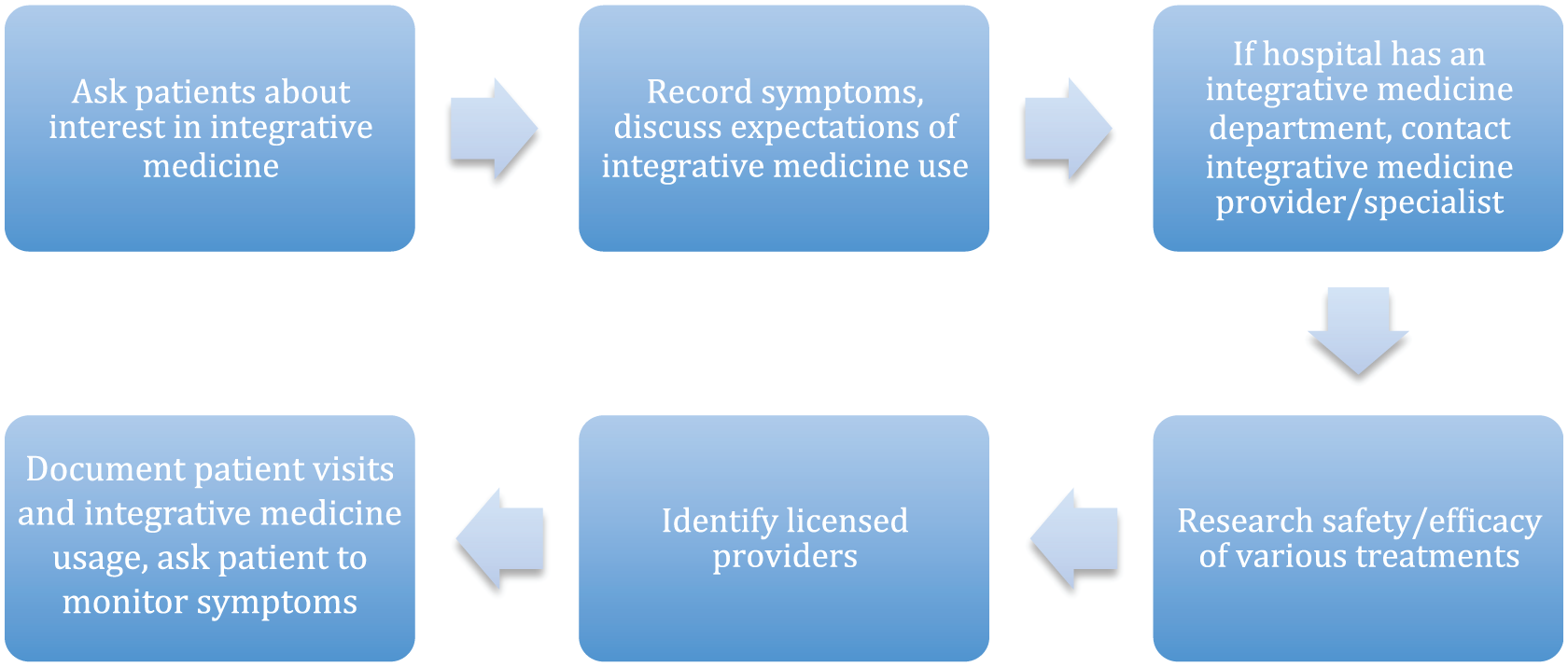
Approach to discussion of integrative medicine with head and neck cancer patients.
National Positions on Integrative Medicine
Integrative medicine is undeniably beginning to play a more important role in Western medicine. As such, the Institute of Medicine stated that integrating complementary and alternative medicine “into traditional systems should be a high priority for research.” 53 In 1998, the National Cancer Institute founded the Office of Cancer Complementary and Alternative Medicine to fund robust basic and clinical research into the potential for integrative medicine therapies for cancer. Additionally, the National Institutes of Health established the National Center for Complementary and Integrative Health (formerly known as the National Center for Complementary and Alternative Medicine). 54 Both these organizations conduct and fund a multitude of integrative medicine research but also represent the necessity of increased clinically sound research about such therapies.
Integrative medicine programs have been or are being established in hospitals throughout the country and are frequently incorporated into cancer centers. Indeed, there has been a movement toward involving integrative medicine counselors as part of comprehensive cancer treatment planning and delivery. 52 Additionally, there has been an expansion of interest in integrative medicine by private institutions as well as national organizations, which will aid in its assimilation into the mainstream. 54
Integrative Medicine Resources
The array of potential integrative therapy options can be daunting for both physicians and patients. Fortunately, publically available resources provide lists of commonly used integrative medicines, peer-reviewed research investigating their therapeutic effects, and potential drug side effects and interactions. Among those providing such resources are the National Institutes of Health (National Center for Complementary and Integrative Health division), Memorial Sloan Kettering Cancer Center, and the Natural Medicines ( Table 4 ).
Integrative Medicine Resources.

Abbreviation: CAM, complementary and alternative medicine.
Implications for Practice
The use of integrative medicine is prevalent among patients with head and neck cancer and is employed in 3 main paradigms: cancer prevention, cancer treatment, and management of side effects associated with cancer treatment. Patients most frequently seek out integrative medicine for hope, a sense of control in the treatment of their cancer, and symptom management. Using integrative medicine for cancer prevention and symptom management generally does not impose a significant risk to patient health, but awareness of potential interactions and risks is necessary for the provider and the patient. Barriers to care include patient discomfort in disclosing integrative medicine use, physician discomfort in discussing and providing recommendations on integrative therapies, and the relative lack of randomized clinical trials regarding the efficacy of integrative therapies in head and neck squamous cell carcinoma. Although only a small cohort of patients choose to forego recommended clinical cancer-directed therapies in favor of alternative cancer treatments, such cases engender ethical dilemmas that are difficult for patients and clinicians alike. There is a need for greater awareness of, dialogue about, and research evaluating integrative medicine therapies for head and neck cancer management.
Author Contributions
Disclosures
Footnotes
Sponsorships or competing interests that may be relevant to content are disclosed at the end of this article.
References
Supplementary Material
Please find the following supplemental material available below.
For Open Access articles published under a Creative Commons License, all supplemental material carries the same license as the article it is associated with.
For non-Open Access articles published, all supplemental material carries a non-exclusive license, and permission requests for re-use of supplemental material or any part of supplemental material shall be sent directly to the copyright owner as specified in the copyright notice associated with the article.
