







Abstract
Palliative care is an underutilized and often misunderstood discipline in the treatment of patients with head and neck cancer. The key components of palliative care include symptoms management, psychosocial support, and enhanced communications. Abundant evidence has demonstrated the beneficial effect for the early incorporation of palliative care in the treatment paradigm for patients with chronic diseases and malignancies, with findings supporting its positive effect on patients’ quality of life as well their survival. Particularly for otolaryngologists, the unique morbidities of head and neck cancer make our patients especially vulnerable and even more in need of the support and benefits that can come from palliative care. While increased consultation with palliative care providers for patients with head and neck cancer is a good first step, training otolaryngologists to develop their own “primary palliative care competencies” is key for improving our patients’ outcomes.
We have made significant prognostic advances in the treatment of head and neck cancer (HNC). These advances can be attributed to multidisciplinary factors, such as translational research in the field of immunotherapy, advanced robotic minimally invasive techniques, intensity-modulated radiotherapy, and many more clinical innovations. 1 Still, a large proportion of patients will succumb to disease, and our field has largely neglected to incorporate and utilize an entire discipline in our treatment paradigm that has immense potential for our patients to live better and potentially longer—palliative care.
Guidelines from the National Comprehensive Cancer Network recommend early involvement of palliative care for all patients with advanced malignancy. 2 Yet, the World Health Organization identified 40 million people in need of palliative care worldwide but found that only about 14% actually receive it, leading to the first World Health Assembly resolution on the topic in 2014. 3
This discrepancy between recommendation and utilization of palliative care may stem from misconceptions among patients and providers. Many erroneously believe that palliative care is equivalent to hospice, that it cannot be initiated concurrently with curative therapy, or that it is limited to end of life and terminal illness. 2 On the contrary, palliative care is an interdisciplinary care that alleviates physical, emotional, and psychological suffering for patients with any serious illness at all stages of disease. 2 The core components of palliative care can be simplified as follows: symptom management (which for HNC includes pain, xerostomia, dysphagia, mucositis, etc), psychosocial support (recognizing the distress of the disease experience and providing prompt referral/treatment by mental health specialists), and enhanced communication (oriented around dynamic disease understanding and goals of care). 2 The discipline was borne out of the European hospice movement but has since evolved into a medical subspecialty per the Accreditation Council for Graduate Medical Education.
Even though palliative care is a relatively new discipline, a number of robust trials have demonstrated that involving palliative care in the treatment of patients with advanced cancer leads to improved quality of life (QOL).4-6 Improved QOL is particularly important for patients with HNC, as studies have consistently demonstrated unique morbidities of HNC, given its impact on high-visibility anatomic sites that govern essential human interactions. 7
Despite established patient-perceived benefits, some still question, “Does palliative care actually improve survival?” ( Figure 1 ). Mounting evidence suggests that the answer is “yes.” Indirectly, the impact of QOL on survival has been well studied among patients with life-limiting illness, including HNC.4,8 Evidence also supports a direct benefit of palliative care on survival. A well-designed randomized controlled trial of the effect of concurrent palliative care among patients with lung cancer showed that they lived 3 months longer, had improved QOL and less psychosocial distress, and pursued less aggressive treatment. 4 Indeed, palliative care helps reduce unnecessary aggressive treatments and can lead to significant cost savings. 9 Palliative care is thus a key component of evidence-based medicine and moves our care closer toward the triple aim of improving health care quality, costs, and patient experience.
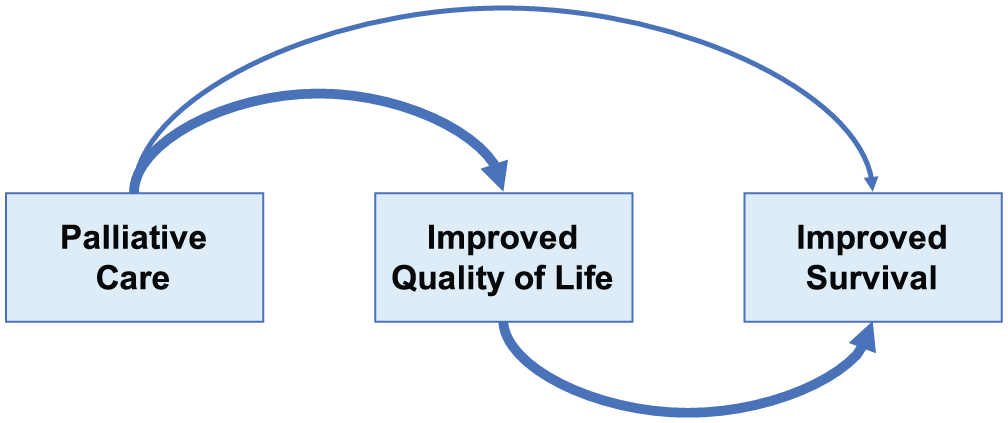
Direct and indirect benefits of palliative care for patients with head and neck cancer.
What Can Head and Neck Surgeons Do?
Many have advocated for HNC surgical oncologists’ early consultation of palliative care specialists. While that is a critical initial step and one that is clearly underutilized, it is in and of itself inadequate. 7 These specialists are experts in palliative care, but they are not experts in the unique morbidities and QOL issues of patients with HNC. Moreover, given the shortage of palliative care providers and the lack of ambulatory palliative care services, responsibility often falls by default to the primary provider—for most patients with HNC, the surgical oncologist. 1 Indeed, especially for advanced or recurrent HNC, it is precisely the HNC surgeon who should manage patients’ symptoms, address issues of disease understanding, and discuss goals of care. HNC surgeons are the providers performing the life-altering operation and are the ones with the most understanding of its complications, recovery, and QOL changes. They are truly the “primary care provider.”
Yet, HNC surgeons are not traditionally trained in complex oncologic pain management, recognition and initial management of psychosocial disorders, and the communication skills necessary for discussing goals of care and shared decision making. Combined with the busy nature of surgical practice, this care is simply not being delivered—leaving a population of patients with HNC without a form of care that has the potential to improve QOL, reduce cost, and improve survival.
To address this, Schenker et al 1 argued for developing “primary palliative care competencies” within all of us. As an example of this approach, the US Department of Veterans Affairs is currently implementing the Life-Sustaining Treatment Decisions Initiative, which aims to train all primary care providers, as well as specialists, to provide basic palliative care. 10 National entities, such as the Accreditation Council for Graduate Medical Education, the American Academy of Otolaryngology—Head and Neck Surgery, and the American Board of Otolaryngology, can extend these efforts by enabling greater training and certification (eg, through training modules, home study courses, or other continuing medical education materials).
We can no longer ignore the underutilized disciple of palliative care in the treatment of our patients with HNC. Merely implementing early consultations—or waiting for the palliative care provider workforce to grow—is not a realistic solution to the current shortage and gap in our care delivery. If, as a field, we elevate our skills in delivering palliative care, we could improve not only the quality of our patients’ final days but the quantity of these days as well. Expanding our skill set is key: governing bodies, academic departments, and training programs must all step up their efforts to address this critical need.
Author Contributions
Disclosures
Footnotes
Acknowledgements
I thank Dr Rodney Taylor from the University of Maryland School of Medicine for review and feedback on this work.
No sponsorships or competing interests have been disclosed for this article.