







Abstract

Keywords
An 86-year-old woman with bilateral profound sensorineural hearing loss and a cochlear implant placed 16 years prior presented to her local emergency department with pain near the implant for 1 week, although it functioned normally. A computed tomography scan was obtained, and implant displacement was suspected per the resulting image ( Figure 1A ). She was referred for neurotology evaluation. Upon examination, the external transmitter was removed, revealing a loose button battery underneath ( Figure 1A , arrow), which had eroded through the scalp toward the internal receiver/stimulator magnet. The patient reported changing her battery several weeks prior and recalled possibly losing one. The ulceration ( Figure 1B ) healed completely with local wound care. This project was determined to be exempt by the Johns Hopkins Medicine Institutional Review Board.
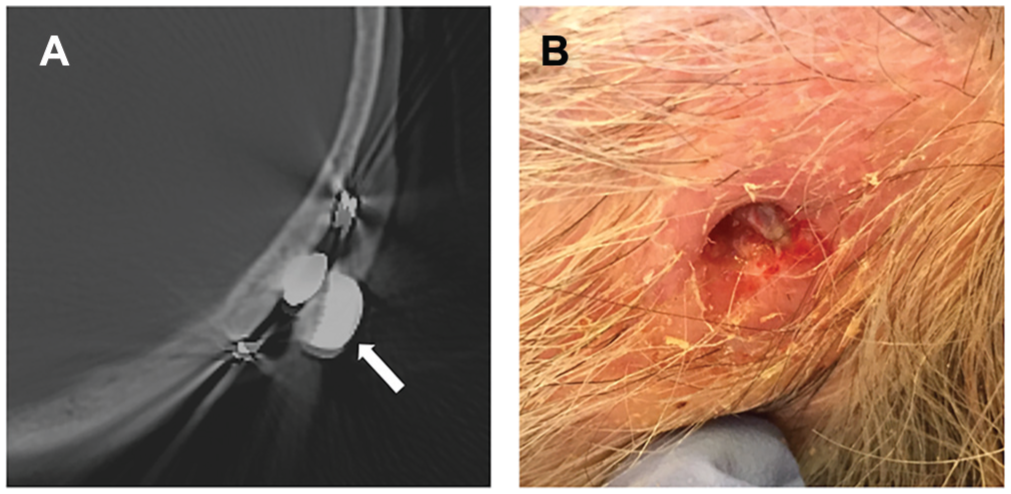
(A) Computed tomography scan of a button battery (white arrow) in close contact with an underlying cochlear implant internal receiver/stimulator. (B) Full-thickness cutaneous ulceration of scalp tissue overlying the internal receiver/stimulator after removal of the button battery.
Discussion
The unusual full-thickness cutaneous ulceration from the button battery in this scenario was attributed to the battery’s galvanic current in the context of continuous pressure from magnetic attraction to the internal receiver/stimulator magnet. Although button batteries are well known for causing mucosal injuries, 1 cutaneous ulcerations have rarely been reported and only in the context of plaster casts, with lost batteries trapped underneath.2,3 This case underscores the importance of physical examination for patients with cochlear implants who have unexplained symptoms or unusual imaging, and it reinforces the perils of lost button batteries.
Author Contributions
Disclosures
Footnotes
No sponsorships or competing interests have been disclosed for this article.