







Abstract
In our previous installment, we introduced shared decision making (SDM) as a collaborative process in which patients, families, and clinicians develop a mutually optimized treatment plan when more than 1 reasonable treatment option exists. In this subsequent installment of our Evidence-Based Medicine in Otolaryngology Series, we expand on the topic of SDM, including the related current state of clinical decision making, the impact of SDM on health care utilization and patient satisfaction, the potential role of system and society changes, the experience with SDM as it relates to race and ethnicity, existing financial incentives, and the validated instruments that assess the extent to which SDM occurs.
Keywords
Shared decision making (SDM) is a process in which clinicians and patients work together to determine treatment plans based on current evidence and individual patient values and preferences.1,2 This cooperative approach is a key piece of quality care 3 because it may foster superior health outcomes and prevention of disease.4,5 SDM can also facilitate evidence-based practice, as it relies on vetted up-to-date data, clinical expertise, and an understanding of individual patient values and preferences.2,6 SDM is best invoked in clinical scenarios where more than 1 feasible treatment option exists, 7 and since such scenarios occur with regularity, SDM has drawn attention in national and international communities.3,8,9 In otolaryngology, we offer a range of procedures in situations where surgical and nonsurgical options are legitimate choices (eg, otosclerosis, obstructive sleep apnea, laryngeal carcinoma).10-13 The frequency of such scenarios provides further impetus to consider the impact, incentives, and instruments related to SDM.
In the most recent installment of this Evidence-Based Medicine in Otolaryngology Series (Part 7), we introduced the concept of SDM and described its definition and components, its potential to decrease decisional conflict and decisional regret, the best circumstances for applying SDM, its potential benefits, barriers to its implementation, and its role in the management of otolaryngologic disease. 14 In this subsequent installment, we provide a more advanced exposition of related topics to place SDM in the context of current medical practice. Specifically, we discuss the present state of clinical decision making, the impact of SDM on health care utilization and patient satisfaction, the potential role of system and society changes, the experience with SDM as it relates to race, existing financial incentives, and the validated instruments that assess the extent to which SDM occurs.
What Is the Current State of Clinical Decision Making?
Although the concept of SDM has been discussed for over 2 decades, the related research in otolaryngology is in its infancy. To date, only 1 systematically developed decision aid to support SDM is available in our specialty. 15 This decision aid pertains to children with sleep-disordered breathing, and the main options discussed are surgery (adenotonsillectomy) and watchful waiting. Nonetheless, there remain many clinical scenarios in which SDM could be beneficial, as previously mentioned.
Research in SDM ideally begins with a decision needs analysis—that is, elucidating the current state of decision making and perceived deficiencies in current decision making. Initial analyses demonstrate that there are unfulfilled opportunities in otolaryngology for SDM. Decisional conflict occurs frequently. For example, among patients considering diagnostic thyroidectomy with indeterminate fine-needle aspirate cytopathology, 34% had significant decisional conflict. 16 In addition, 43% of parents considering bone-anchored hearing devices for children with unilateral aural atresia reported significant decisional conflict. 17 Also, a study assessing parental needs for elective pediatric otolaryngology procedures showed that 93% wanted more information about surgery and the risks and benefits of treatment options. 18 Thus, developing means to support these decision-making processes in otolaryngology could have immediate applicability.
Extending beyond our field, a survey evaluating patient experiences in hospitals across 5 countries (Germany, Sweden, Switzerland, the United Kingdom, and the United States) demonstrated that 1 of the most commonly reported concerns was failure to involve patients in treatment decisions. 19 Within the United States, 37% of patients surveyed in 272 hospitals reported this issue, as did 46% in Germany, 54% in Sweden, 36% in Switzerland, and 59% in the United Kingdom. 19 In U.S. hospitals, 17% to 57% of patients described not having enough involvement in decisions regarding their care, and 7% to 73% of those seen in the emergency room reported insufficient information. 19 Prospective data demonstrate that the majority of patients desire an active role in SDM regarding treatment and complication of their disease. 20 Patients also frequently reported inadequate emotional support in discussing their anxieties and cited uncertainty in the provider’s care. 19 Published data suggest that the main factors that influence perceived decision-making participation are the relationship between the patient/family and the health care professional, the perceived competence of the health care professional, and the level of patient participation. 21
Does SDM Affect Health Care Utilization?
SDM may reduce the disproportionate use of medical interventions and minimize unwarranted variations in care. 1 The implementation of SDM thus has the potential for significant health care savings. Up to 20% of patients who participated in SDM choose less invasive surgical options and more conservative treatment than patients not using associated decision aids, which are tools to support SDM. 22 In 2012, a SDM process utilizing decision aids was implemented for patients who were eligible for hip and knee replacements; the program led to a substantial reduction in surgery rates and costs (up to 38% fewer surgical procedures and savings of 12% to 21% over 6 months). 23 This evidence suggests that the adoption of SDM could result in less spending, but it is unknown whether it could promote cost-effective health care for otolaryngology conditions over time.
What Systems and Society Changes Could Support SDM?
Medical societies, organizations, schools, and governance could influence clinicians’ capacity for SDM. During training, we are taught to have “the answer” during clinical encounters so that discussing treatment options without direction to a specific choice may feel foreign. In addition, SDM is usually not an integral part of the medical school curriculum, even though most medical schools have other communications training (eg, delivering bad news). In residency, where communication skills are learned through apprenticeship, good role models for SDM are rare. Therefore, changes in the medical education system may be required for SDM to become widely disseminated. The American Medical Association adopted a policy amendment proposed by its Medical Student Section to support SDM in 2014:
D-373.999 Informed Patient Choice and Shared Decision-Making: (1) Our AMA will work with state and specialty societies, medical schools, and others as appropriate to educate and communicate to medical students and to physicians about the importance of shared decision-making guidance through publications and other educational methods and assist the medical community in moving towards patient-centered care; and (2) collaborate with the appropriate medical education organizations to develop undergraduate medical education recommendations that ensure proficiency in shared decision-making and effective use of shared decision-making tools, such as patient decision aids.
24
In light of these developments, there is impetus to teach students that uncertainty in some clinical decision making is acceptable and that it is important to understand patient preferences and values. Such fundamental early education may allow SDM to become more widely practiced.
There is also an opportunity for medical societies and organizations to make their members aware of SDM and provide training when appropriate. The American Academy of Communication in Healthcare provides SDM training, 25 although its impact is, as yet, unknown. In addition, larger systems-based changes may be needed at the administrative, managerial, and policy maker levels. Regulatory pressures, decision support tools (eg, decision aids), and changes in reimbursement, with an emphasis on quality improvement, could foster SDM implementation. Some researchers posit that a systems-level perspective with fundamental structural changes in health care delivery (eg, less focused on volume and cost) is required to allow SDM to become an integral part of a routine practice. 26 Other factors that could help SDM to be used more commonly include the overall movement away from traditional paternalism in medicine and toward informed patients and societal expectations for transparent bidirectional communication and accountability.
Are There Financial Incentives for SDM?
In 2010, the Patient Protection and Affordable Care Act called for the use of SDM and the development of resources for patients and providers to support collaborative decision making. SDM was considered part of Medicare’s Shared Savings Program and the Accountable Care Organization program. 8 SDM visit codes have been created by the Centers for Medicare and Medicaid Services (CMS) for asymptomatic adult smokers or previous smokers prior to undergoing low-dose computed tomography scanning to evaluate for possible lung cancer. 27 In 2017, the CMS also proposed a model for 6 “preference-sensitive” conditions: stable ischemic heart disease, hip osteoarthritis, knee osteoarthritis, herniated disk and spinal stenosis, clinically localized prostate cancer (confined to the prostate gland), and benign prostate hyperplasia. 27 The CMS is trialing SDM in 50 accountable care organizations and requiring that a 4-step process be documented ( Figure 1 ) to qualify for a financial incentive. To date, no otolaryngology conditions are tied to SDM for CMS compensation. Moreover, commercial payer support has historically been lacking. 28 Several nonprofit organizations and academic institutions are evaluating ways to develop mechanisms to implement SDM, and advocacy is growing among professional organizations. 8 Several states have also passed or proposed legislation to promote SDM. 28
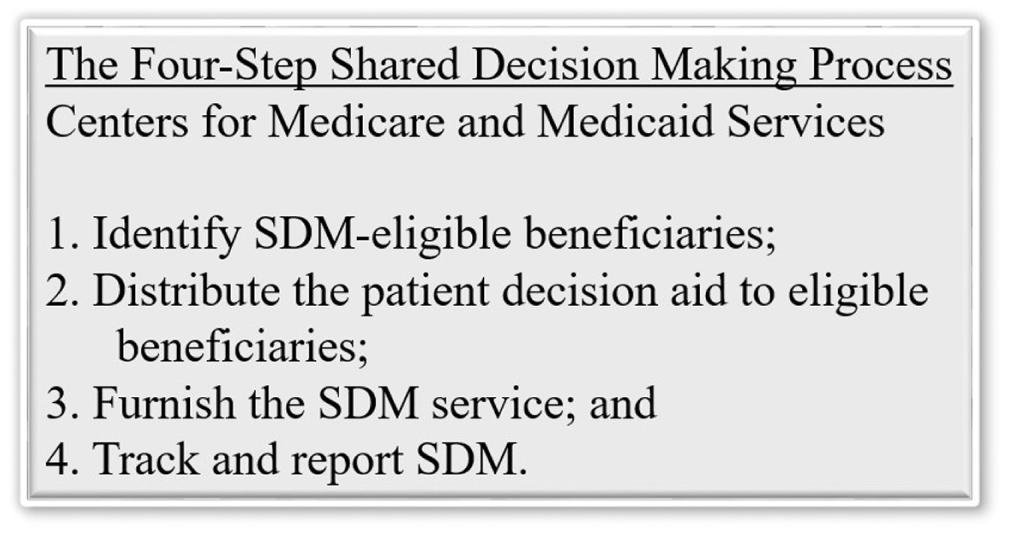
The 4-step shared decision-making (SDM) process required for payment of SDM incentives by the Centers for Medicare and Medicaid Services.
The Agency for Healthcare Research and Quality and the National Institutes of Health have also provided funding for research into SDM. 28 Other funding opportunities for SDM-related research have been available through nonprofit and private granting organizations, such as the Robert Wood Johnson Foundation, the Foundation of Informed Medical Decision Making, the Commonwealth Fund, George Bennett Fellowships, and Robert Derzon Grants. This includes funding for the development of patient decision aids and decision support interventions for patients.
Do Components of SDM Influence Patient Satisfaction?
SDM invariably involves conveying information to patients and families about the potential options for management, and this knowledge acquisition can promote patient satisfaction. Active consideration of patient values and preferences in decision making also may enhance satisfaction. 29 A systematic review of 35 studies of patient satisfaction in pediatric surgery demonstrated that satisfaction was positively correlated with child and parental knowledge and understanding of the operative procedure. 30 Patients’ and parents’ education was provided through role-play, preadmission hospital visits, and familiarization with hospital equipment and staff roles. 30 Further supporting the relationship between patient/parent knowledge and satisfaction were data demonstrating that the most common complaint from dissatisfied patients or parents was a feeling of not having enough information. 30 Such knowledge and understanding deficits have also been associated with decisional conflict, 31 which is a state of uncertainty about a selected choice; this conflict can result in delayed health care decisions and worsened emotional stress. 32 The investigators noted that verbal counseling or written handouts did not themselves appear to change satisfaction, 30 so there is a need to better understand the mechanisms that inform patients about options, benefits, risks, and side effects and that help clarify personal values of treatment outcomes. 33 Such research will be critical to advancing our understanding of what actions clinicians can take to optimize patients’ decision-making experience.
Does SDM Vary among Patient Populations?
Studies indicate that there may be cultural and/or ethnic differences in medical decision-making processes. For example, some have suggested that levels of engagement, perceptions of patient-provider power imbalance, and likelihood of asking clarifying questions vary among African American and Caucasian patients in the United States.34,35 Research also suggests that populations of lower socioeconomic status are less activated (ie, they may have described less ability and inclination to manage their own health care) and that interventions to increase engagement may be particularly useful for these vulnerable populations. 36 Clinicians and medical organizations can address these potential differences by promoting patient education, health literacy, and sociocultural issues, as well as through the use of verbal and nonverbal cues reflecting that the patient’s concerns and opinions are valued. 37
Are There Tools That Assess the Caliber of SDM?
Several validated instruments have been proposed for studying the effectiveness of SDM. Most are based on self-reporting by the patient. SDM scales were compared in a recent systematic review 38 that evaluated proposed tools against 9 essential elements of SDM:
Defining and explaining the problem
Presenting the options
Discussing the pros and cons (benefits/risks/cost)
Discussing the patient’s values and preferences
Discussing the patient’s ability/self-efficacy
Considering the physician’s knowledge and recommendations
Checking/clarifying understanding
Making a decision or explicitly postponing it
Organizing the follow-up 39
Overall, multiple instruments have shown good internal reliability, but their validity is less clearly proven.40-42 There is ongoing debate about the best type of instrument to use (eg, observer-based outcome measures vs patient-reported outcome measures) and inconsistent agreement regarding which outcome instruments are optimal. 1
Related tools include the Decisional Conflict Scale,43,44 which is a 16-item survey that encompasses 3 subscales that contribute to decisional conflict: uncertainty, factors contributing to uncertainty, and perceived effective decision making. The first subscale measures the degree of perceived uncertainty in decision making. The second subscale focuses on influential factors, such as unclear values and emotional distress. The third subscale captures how effective the patient perceives her or his decision is, based on available information and alignment with personal values. The Decisional Conflict Scale has been translated into different languages, and a low-literacy version is available. 38 Other examples include the 9-Item Shared Decision-Making Questionnaire 45 and the Decisional Regret Scale. 46 There are also more concise tools, such as the SURE and CollaboRATE scales, which may be more practical for nonresearch-oriented practitioners.47-50 Another area of research is the dyadic approach—assessing the adoption and utilization of SDM by the health care provider and the patient. 1 The OPTION instrument (“observing patient involvement in decision making”) is a validated assessment of the degree to which physicians involve patients in decision making.51,52 It is composed of a 12-item scale that is scored by independent raters of patient-physician encounters.51,52 Although the OPTION assessment demonstrates reliability, only moderate interitem variability has been reported. 51 Additionally, the OPTION instrument is used to measure normative SDM behavior; however, it is unclear whether such a measure should be equally applied to all medical and surgical settings, as a descriptive measure to code observations may be more appropriate in some situations.
Conclusions
SDM is a collaborative process in which patients, families, and clinicians work together to agree on a treatment plan when more than 1 reasonable option exists. Patients and families report that they want more involvement in health care decisions, and SDM has the capacity to mitigate unwarranted variations in resource utilization. Systems and society changes could further SDM through educational curricula and professional organizational efforts. Financial incentives for engaging in SDM exist, and components of SDM can influence patient satisfaction. Multiple validated instruments have been described to assess the extent to which SDM occurs.
Author Contributions
Disclosures
Footnotes
Acknowledgements
J.J.S. thanks Thomas Lin for support during the preparation of this manuscript. We also thank Giri Venkatraman for input on initial outlines, as well as Andrea Fetrow for assistance with manuscript formatting.
Sponsorships or competing interests that may be relevant to content are disclosed at the end of this article.