







Abstract
Objective
To provide preclinical medical students early access to otolaryngologists to learn about the specialty, facilitate acquisition of clinical skills, and provide one-on-one mentorship.
Methods
Students are matched with a single otolaryngology faculty mentor from The Ohio State University/Nationwide Children’s Hospital and attend 8 hours per month in the clinic or operating room, monthly lectures, and rounds, and they give a final presentation. Mentors complete performance evaluations, and surveys are administered longitudinally until Match Day.
Results
Thirty-five students and 17 faculty members have participated in the program since 2015. All mentors and students found the program to be a valuable experience. When compared to nonparticipating students, participants had significantly higher confidence scores for clinical performance, knowledge of anatomy, and familiarity with the department of interest. All students felt the program prepared them well for third and fourth years, and all 8 of the initial program participants successfully matched into residency with 4 entering otolaryngology.
Discussion
Medical students face a competitive residency application process in otolaryngology with limited exposure, which creates an opportunity for guidance in the pursuit of matching into this field. This novel preclinical mentorship program prepares students for their clinical years and residency by facilitating acquisition of various competencies. Students gain hands-on clinical exposure in a field of interest and support for navigating the application process.
Implications for Practice
The structure of this program can be applied to other medical schools or specialties if the individual departments contain adequate resources of teaching faculty willing to participate.
In general, medical students lack early exposure to surgical specialties. Often, students do not choose their specialty until rotating on a clinical service during their third year of medical school. This is especially the case for otolaryngology, as evidenced by a recent study that surveyed medical schools within the United States and revealed that only 59% of respondents required a mandatory preclinical otolaryngology module. Most of these modules were noted to be simple head and neck physical exam sessions and otolaryngology lectures without true clinical exposure. 1 The disadvantages of choosing a specialty later in medical school are lack of access to research faculty with little time to complete a meaningful project, short amount of time to make a decision on specialty, lack of longitudinal relationships with faculty in chosen specialty, and shorter time frame to prepare an application and gain experiences important for specialty choice.
In addition, the residency application process has become increasingly competitive, complex, and expensive for medical students in recent years. This is especially the case for applicants to otolaryngology–head and neck surgery, which has seen a nearly 250% increase in mean number of applications per applicant over the past 2 decades with programs placing a heavy emphasis on high United States Medical Licensing Exam (USMLE) Step 1 scores, research productivity, and grade distinctions.2,3 Furthermore, the 2019 otolaryngology residency match rate was only 71% (328 successful matches into otolaryngology from 462 total applications), decreased from 95% in 2018, which highlights the increasingly competitive nature of the match process. 4
The combination of limited medical student exposure to otolaryngology with a rigorous residency selection process creates a need for early formalized mentorship and guidance in the pursuit of matching into this competitive field. While mentorship programs for otolaryngology residents have been reported, 5 there have been no reports of programs targeted toward preclinical medical students interested in otolaryngology. The goals of this program are to provide the following early in medical school: exposure to the profession of otolaryngology, introduction of surgical mentorship, feedback-oriented longitudinal clinical experience, education on the residency application process, career advising, networking and research opportunities, and focus on professionalism. The rationale for implementation of a formalized program was based on the theory that early mentorship and exposure provide preclinical students with positive outcomes, including preparation and confidence for their clinical years and throughout the residency match application process.
Methods
Overview
In 2015, the Department of Otolaryngology–Head and Neck Surgery at The Ohio State University Wexner Medical Center (OSU), Department of Pediatric Otolaryngology at Nationwide Children’s Hospital (NCH), and The Ohio State University College of Medicine (OSUCOM) collaborated to implement a formalized, longitudinal preclinical early elective known as the ENT Mentorship Program (ENTMP). The objectives are to provide medical students early access to otolaryngologists to learn about the specialty, facilitate the acquisition of clinical skills, and provide valuable one-on-one mentorship.
Student Recruitment/Application Process
All first-year medical students are introduced to the program via email with an attached program description and application link. Students are asked to describe any previous experience with otolaryngology and goals for the program. Applicants also preference subspecialties, which are taken into consideration during the match process.
Faculty Recruitment/Match Process
An email with the program description and request for participation is sent to all otolaryngologists at OSU and NCH. Applications are reviewed by the program directors and faculty advisers, and students are matched with a single faculty mentor based on subspecialty preferences and availability.
Curriculum Design and Educational Strategies
This program offers 4 months of feedback-oriented clinical experience, research opportunities, networking, career advising, and opportunities to develop professionalism, responsibility, and focus. Students are enrolled during the summer between their first and second years of medical school and have the following requirements:
Clinical attendance
Prior to their first session, the program directors and faculty advisers host an orientation to discuss program logistics and expectations and a “How to Scrub and Suture” fundamentals session. Students are required to spend a minimum of 8 clinical hours per month with their assigned mentor but are not limited to the required hours. Student experiences vary due to the diversity of mentor subspecialties and practice schedules, but all have the opportunity to spend time in both clinic and operation room (OR) settings. Due to this variability, individual schedules are at the discretion of the mentor and student. Students also attend rounds arranged by residents on service.
Lectures and reading assignments
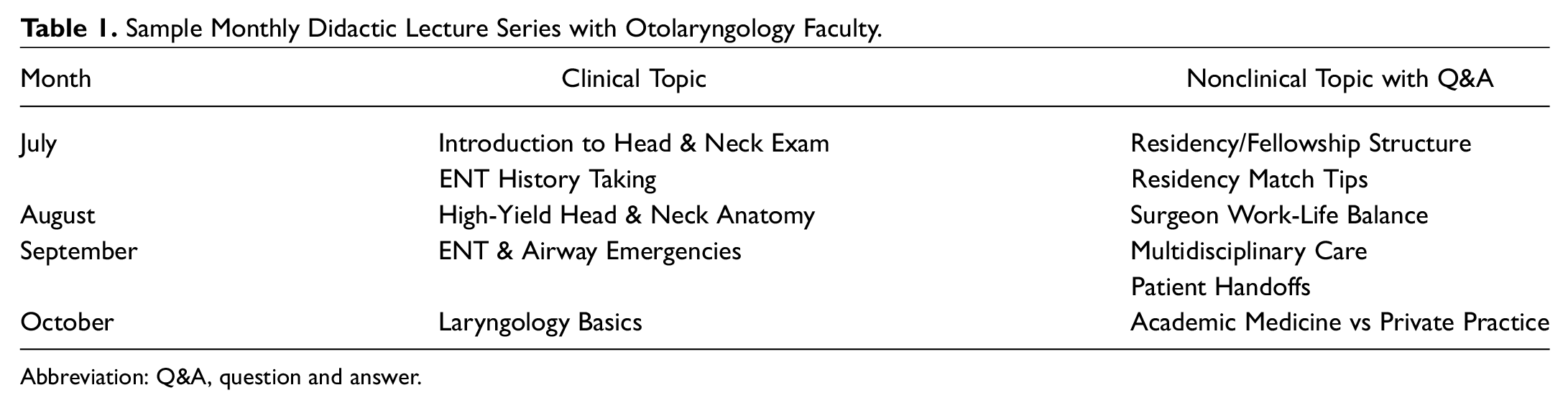
Students are required to attend 1 lecture per month given by faculty members from the Department of Otolaryngology. These lectures are focused on clinical topics and professionalism topics relevant to all surgical specialties and are followed by an informal question-and-answer session ( Table 1 ). Students are assigned readings that are used to prepare for upcoming lectures and allow mentors to assess medical knowledge during each session.
Sample Monthly Didactic Lecture Series with Otolaryngology Faculty.
Abbreviation: Q&A, question and answer.
Final presentation
During the last week of the program, all students are required to give a 10-minute presentation in a Grand Rounds format to participating mentors and departmental leadership. As each student’s experience is unique, students are instructed to choose any topic relevant to the field of otolaryngology in consultation with their mentor. Students are evaluated by peers and faculty in attendance.
Student Performance Evaluation and Grading System
Student evaluations are distributed to mentors monthly and assess clinical performance, professionalism, and teamwork. The final grade is based on the oral presentation (50%) and mentor evaluations (50%). A minimum score of 70% must be achieved on both assessments to receive a passing grade. A narrative paragraph discussing this program, including feedback from the respective mentor, is added to the student’s Dean’s Letter upon completion of this program, and students are eligible for preclinical elective credit through OSUCOM.
Longitudinal Feedback Surveys
Institutional review board approval (OSU IRB 2015E0551) was obtained to monitor student progress through surveys. Postprogram evaluation surveys using a modified Likert scale are administered to participants to analyze the effect of the program on their clinical performance and to adapt program goals for future classes ( Figure 1 ). The same survey is distributed to an equal number of nonparticipating classmates to serve as a study control. Responses are tabulated and converted to numeric scores. A comparison is performed between participating and nonparticipating students using a Student t test to determine statistical significance. Participants are followed longitudinally until completion of medical school. Ultimately, the number of participating students who match into otolaryngology is also analyzed.
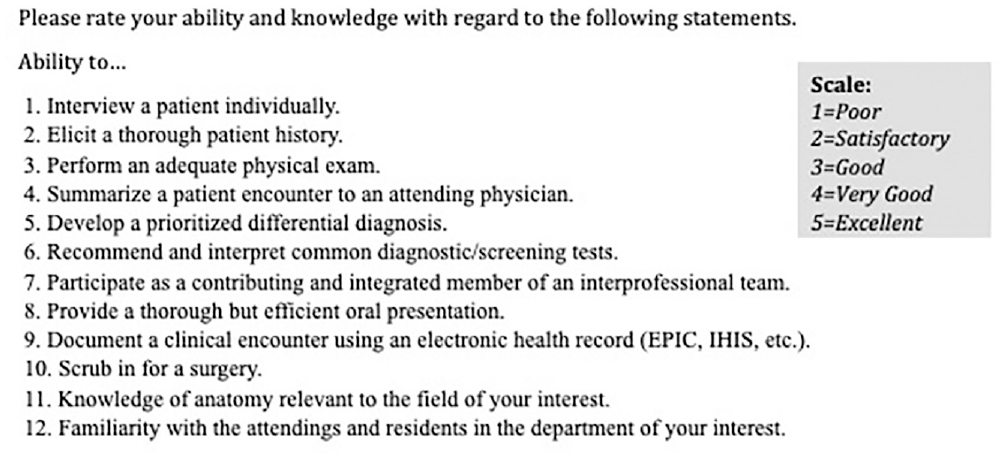
Postprogram survey. The survey was administered to ENT Mentorship Program participants and nonparticipating students of the same year. The students were asked to use the modified Likert scale as shown.
Preresidency Curriculum
A preresidency transition curriculum is delivered to all fourth-year students who successfully match into otolaryngology residency. Topics include how to approach intern year, residency, fellowships, professionalism, wellness, burnout, and a question-and-answer session with faculty and residents who have been through the transition process.
Methodology
We provide initial qualitative analysis based on current survey data available. The qualitative survey data measures were chosen to study the processes and outcomes of the implementation of the ENTMP. This data are reviewed and presented to ensure that the program is successfully meeting the goals of increasing early otolaryngology exposure to preclinical medical students and preparing them for clinical years and the residency match process. In consulting with an expert in medical education who serves as a leader within the medical school, we determined that survey analysis in addition to analyzing match data will allow for the most optimal evaluation of the outcomes of the ENTMP. The surveys were designed based on existing surveys administered through the medical school for curriculum evaluation.
We plan to collect 5 years of survey data from all student participants and mentors. Data analysis will include postprogram surveys, third-year follow-up surveys, fourth-year follow-up surveys, and control surveys administered to nonparticipating students at the time of the participant postprogram survey administration. We plan to retrospectively analyze the survey results and present the data in a qualitative analysis. By reporting the methodology behind implementation of the ENTMP and reporting outcomes to measure its success, we provide the framework for generalizability to other programs.
Results
Since its creation in 2015, 35 students have participated in the ENTMP over 4 sessions (8, 8, 11, and 8 students per session). Two students applied but chose not to participate, and 1 student was unable to complete the program due to scheduling conflicts. There was a 100% passing rate among the remaining students who completed the program.
To date, 17 faculty members have participated in this program with many different subspecialties represented, creating a diversity of experiences for participating students (
Figure 2
). Of the mentors who completed postprogram surveys, 100% stated that they “strongly agree” or “agree” with the statement “As a mentor, I found this program to be a valuable experience” (n = 24). One mentor provided the following feedback: My particular mentee went out of her way to spend time with me in the OR and clinic, and by the end of the program, most of my office staff and nurses knew her well. This aspect, along with all she was learning in a formal way through the program’s lectures, really led to a strong relationship as well as a longitudinal experience where she steadily built on knowledge gained in the early weeks, such that she is actually quite skilled at some of the techniques of my subspecialty that our residents don’t necessarily learn until later years.
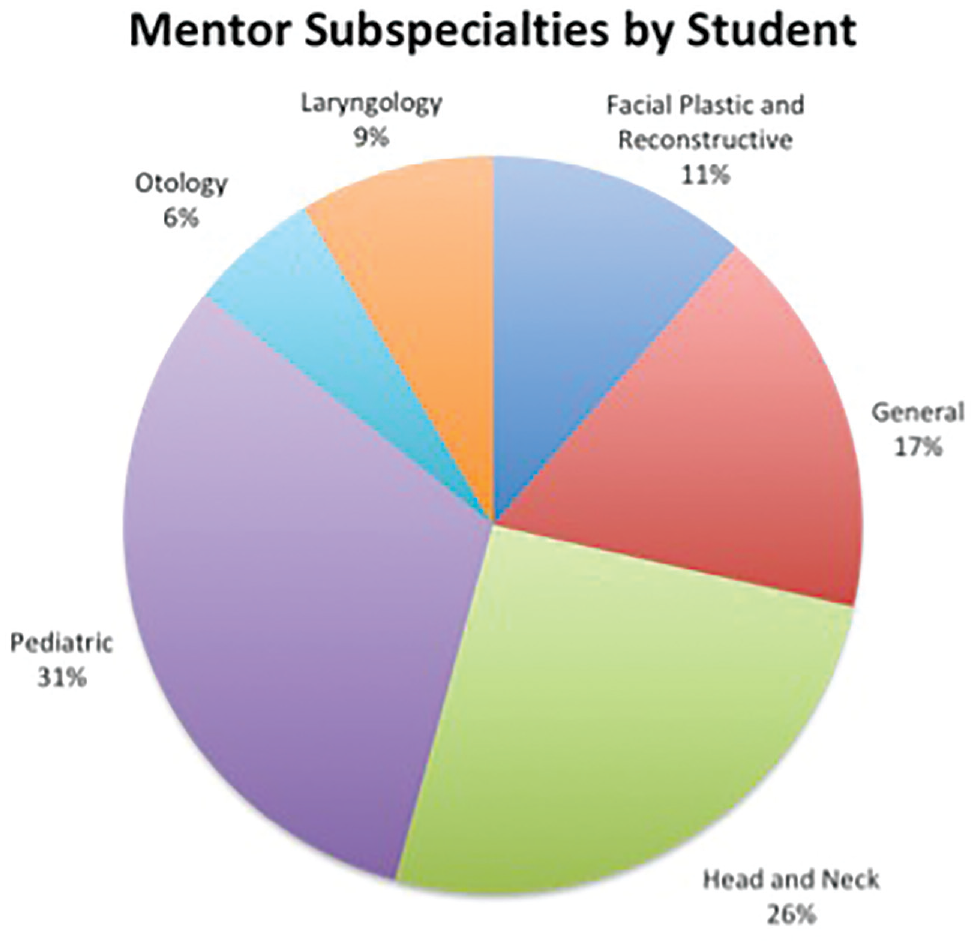
Mentor subspecialties by student. Seventeen total mentors participated over 4 program sessions. Six subspecialties were represented, and 13 mentors participated in multiple sessions.
In reviewing student responses, there was significant variability in previous exposure to otolaryngology among the 37 applicants. Twenty students (54%) did not have any previous experience in the field of otolaryngology. Of the 17 students with previous exposure, 13 (77%) had only shadowed once in the outpatient setting. Student goals for participation included learning more about the field and skills needed to be a successful surgeon, confirming interest in the field, and guidance for the otolaryngology residency application.
Postprogram responses are seen in Figure 3 . The mean score was calculated using the aggregate of scores over 3 sessions with question numbers correlating to the survey seen in Figure 1 . Compared to nonparticipating students, participants scored higher in all survey questions, including ability to perform clinically, knowledge of anatomy within field of interest, and familiarity with members of the department of interest.
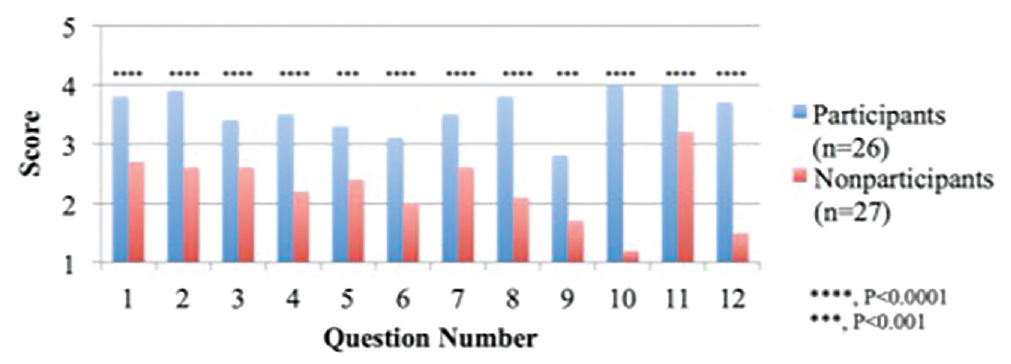
Student postprogram evaluation responses. Mean aggregate scores for participants and nonparticipants are reported. All questions yielded higher mean scores in the Participants group and all comparisons were statistically significant (P < .05).
All students found the program to be a valuable experience, and 62% of the students stated they had become involved in otolaryngology research as a result of their mentorship relationship (n = 26). Participant comments on program strengths included the following: I know what is expected of a medical student and future resident in the OR. I feel comfortable with sterile technique and I’m becoming more comfortable with holding and using surgical tools. I have also solidified that otolaryngology is the field for me through this program!
A majority of students responded with either “strongly agree” or “agree” in response to the statement, “Overall, I feel the ENT Mentorship Program prepared me well for third year (compared to my peers who were not involved in this program)” (n = 14).
In response to the fourth-year survey question, “Do you feel that you benefited from this program? If yes, how so?” participant comments included the following: Surgical skills and examination skills as well as history taking. I also gained a great lifetime mentor. Even though I did not apply to ENT, I still had my mentor write a letter of recommendation since we worked many hours together. She was able to talk about my character and skills on a personal level. I really enjoyed this mentorship and I wish more specialties had this program.
All students marked “strongly agree” or “agree” in response to questions regarding confidence for fourth-year scheduling, residency interviews, reaching out to mentor for advice about residency, understanding benefits and consequences of away rotations, and understanding the process of applying to residencies (n = 4).
When examining the Residency Match, the number of applications to otolaryngology from OSUCOM increased from 1 in 2017 to 12 in 2018. This increase corresponds with the implementation of the ENTMP into the medical school curriculum. Of the 12 students who applied to otolaryngology residency from OSUCOM in 2018, all 12 successfully matched into otolaryngology residency ( Figure 4 ). To our knowledge, this is the highest in the history of OSUCOM. Notably, 6 of the 12 students matched into otolaryngology hospitals ranked in the top 12 according to U.S. News & World Report. 6
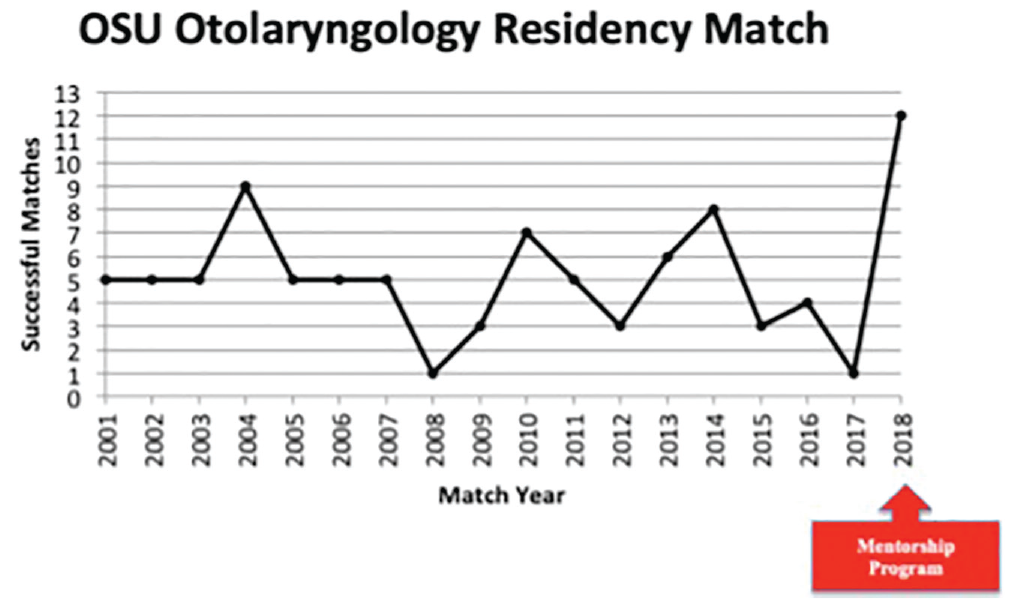
Number of otolaryngology residency matches per year from The Ohio State University College of Medicine. The class of 2018 matched 12 of 12 students and includes the initial ENT Mentorship Program class.
Of the 8 students from the initial class of the ENTMP, all 8 successfully matched into a residency position in 2018. Four of the 8 students, as well as the 2 student directors, successfully matched into otolaryngology residency. The other 4 students from the initial class successfully matched into other specialties, including General Surgery, Dermatology, Family Medicine, and Obstetrics and Gynecology. According to anonymous faculty physician sources involved in the deliberation process for 1 otolaryngology residency program, participation in the ENTMP favorably affected student match list ranking.
Discussion
We report outcomes of a novel preclinical mentorship program for otolaryngology with positive outcomes. According to student and mentor feedback, the program appears to prepare students for their clinical years and residency by facilitating acquisition of various competencies beyond the traditional medical school curriculum. In addition, we speculate that the implementation of the ENTMP contributed to the sharp increase in successful otolaryngology residency matches for OSUCOM students from the class of 2018. As 6 of the 12 students who successfully matched into otolaryngology residency in 2018 were not associated with the ENTMP, it is reasonable to assume that the formality and apparent advantage of the ENTMP did not dissuade but rather encouraged these nonparticipating students to consider otolaryngology, likely due to the disseminated perception of accessible mentorship available within the department. The program continues to elicit interest as there were 12 student applications submitted by the class of 2022.
In previous years, trends have revealed a decrease in otolaryngology applicant numbers.7,8 By creating a pathway for preclinical medical students to connect to faculty and gain reassurance that applying into their field is a feasible and worthwhile endeavor, this program offers a sustainable response to increase interest in otolaryngology. Despite this trend, however, the 2019 match cycle proved to be an extremely competitive year, with a 71% match rate for otolaryngology. 3 If this increase in applications is sustained, the ENTMP offers students an avenue to receive essential early guidance to navigating the increasingly competitive residency application process from medical schools and otolaryngology departments interested in continued successful residency match cycles.
Limitations
This program was designed at an academic institution with access to a large group of faculty. The program can be transferred to other departments if they contain adequate resources of teaching faculty willing to participate. The survey data collected are informative, but there is potential for observer bias as participating students are also prospective applicants to the field. Future surveys will minimize this bias by blinding the feedback evaluation process. Finally, the control group of nonparticipating students was selected randomly but could be matched for potential confounders such as previous experience, interest in surgery vs medicine, and academic performance.
Implications for Practice
Several studies have examined the attrition rate in surgical residencies. For otolaryngology, reports have ranged from 2% to 6%.9,10 One study reported an 11% combined attrition rate from 5-year surgical specialties, including urology, otolaryngology, plastic surgery, neurosurgery, and orthopedics. 11 Although the experience is geared toward students with an interest in otolaryngology, the core values developed in this program have broad applicability to other surgical and medical specialties. Early clinical exposure allows students to make well-informed career decisions. A student with years of early exposure to a specialty rather than a few short months during their third year (sometimes not until fourth year) of medical school will develop a better, more thorough understanding of the advantages and disadvantages of the given specialty and will therefore be able to determine if that specialty fits well with the student’s career goals. This type of program might be especially useful for ophthalmology and urology, which participate in the early match, emphasizing the need for early exposure and mentorship. In addition, early exposure to surgical specialties may be advantageous to students to participate in research, which is emphasized by many surgical specialties as a prerequisite to be a competitive candidate.
By describing the framework of our program, we hope to provide a foundation for medical schools and other surgical departments to adopt similar preclinical elective courses. We encourage department leadership to increase financial and professional support dedicated to formal mentorship programs for preclinical medical students. Currently, this is the only individualized preclinical mentorship program of its kind that exists at OSUCOM and nationally. However, the leadership of the ENTMP is working to expand to other surgical specialties at OSUCOM and to other otolaryngology programs across the country.
Footnotes
Acknowledgements
We thank the Department of Otolaryngology–Head and Neck Surgery at The Ohio State University Wexner Medical Center, the Department of Pediatric Otolaryngology at Nationwide Children’s Hospital, and The Ohio State University College of Medicine for their support.
Sponsorships or competing interests that may be relevant to content are disclosed at the end of this article.
This article was presented at the Triological Society 122nd Annual Meeting at Combined Otolaryngology Spring Meetings; May 3-4, 2019; Austin, Texas.