







Abstract
Otolaryngology is a small and highly sought-after surgical subspecialty with sparse residency positions, making it competitive to match into. Allopathic (MD) students without home otolaryngology residency programs, osteopathic (DO) medical students, and underrepresented minorities have historically faced additional challenges in matching into otolaryngology. These specific populations generally experience limited opportunities in establishing mentors, engaging in scholarly activity, and gaining early exposure to clinical settings. Even though the American Osteopathic Association and the Accreditation Council for Graduate Medical Education merger was in part established to create equity among applicants, there remains a substantial disparity among the match rates of medical students of various educational and cultural backgrounds. The National Otolaryngology Interest Group is a student-led interest group created to provide all medical students, especially those facing barriers, with the resources needed to best prepare for matching into an otolaryngology residency program and ultimately a career in otolaryngology.
Otolaryngology is consistently ranked among the most competitive specialties, 1 with a total of 129 residency programs and 350 newly matched incoming residents in 2021. 2 In 2020, osteopathic and allopathic residency programs merged under a single accrediting body, the Accreditation Council for Graduate Medical Education, with an aim to standardize training and increase graduate medical education positions. 3 In theory, the merger should encourage equity among applicants; however, there remains a sizable discrepancy in match rates among allopathic (MD) and osteopathic (DO) medical students. 4 Disparity is also seen in match rates between MD students having a home otolaryngology program and those without an affiliated program. 5 Last, otolaryngology continues to struggle in recruiting students who are traditionally underrepresented in medicine. 6 The disparity in recruitment and match rates could be explained, at least in part, by the lack of early exposure to otolaryngology and limited access to specialty mentorship, research opportunities, and other resources that significantly aid in preparation for a successful residency match and future career. Multiple historically competitive surgical subspecialties, including neurosurgery 7 and orthopedics, 8 to name a few, have already recognized that certain medical student populations face similar barriers and have resultantly established nationally recognized medical student organizations to support these specific populations.
National Otolaryngology Interest Group
The National Otolaryngology Interest Group (NOIG) is a grassroots initiative developed by a cohort of otolaryngology resident physicians and medical students pursuing a career in otolaryngology and supported by attending otolaryngology physicians to (1) mitigate barriers faced by specific medical student populations with limited access to key resources, (2) increase awareness of otolaryngology across the spectrum of education, and (3) prepare student members for residency, regardless of background. NOIG strives to create opportunities for students who lack the resources that are generally required to sufficiently prepare for a successful match into the specialty and future career in otolaryngology. Additionally, leadership within NOIG will be dedicated to advocating for diversity and inclusion in otolaryngology to attract talented, diverse, historically underrepresented students to the field.
Structure
NOIG is structured as a national student-led interest group working in collaboration with Headmirror, 9 a centralized open-access online resource for otolaryngology education. NOIG is modeled after the well-established and successful Organization of Student Representatives of the Association of American Medical Colleges, which is dedicated to improving the nation’s health through the advancement of academic medicine. 10 NOIG operates as a nationwide networking platform in which NOIG-registered medical school otolaryngology interest groups and/or individual medical student members will connect with otolaryngology faculty and resident mentors through regional resident advisors and regional chairs within each of 4 geographic regions of the United States (Western, Midwestern, Southern, Northeastern; Figure 1 ). These associated faculty will help provide students with the valuable resources that they need (eg, mentorship, research, and clinical exposure) to become well-rounded aspiring otolaryngology residents. An executive board of physicians, residents, and medical students, alongside Headmirror leadership, will govern the national organization and be responsible for the recruitment of otolaryngology faculty, the creation of novel research opportunities for students, and the coordination of symposiums, as well as the initiation of educational seminars, grand rounds, and community service projects. The national student leadership is composed of the following:
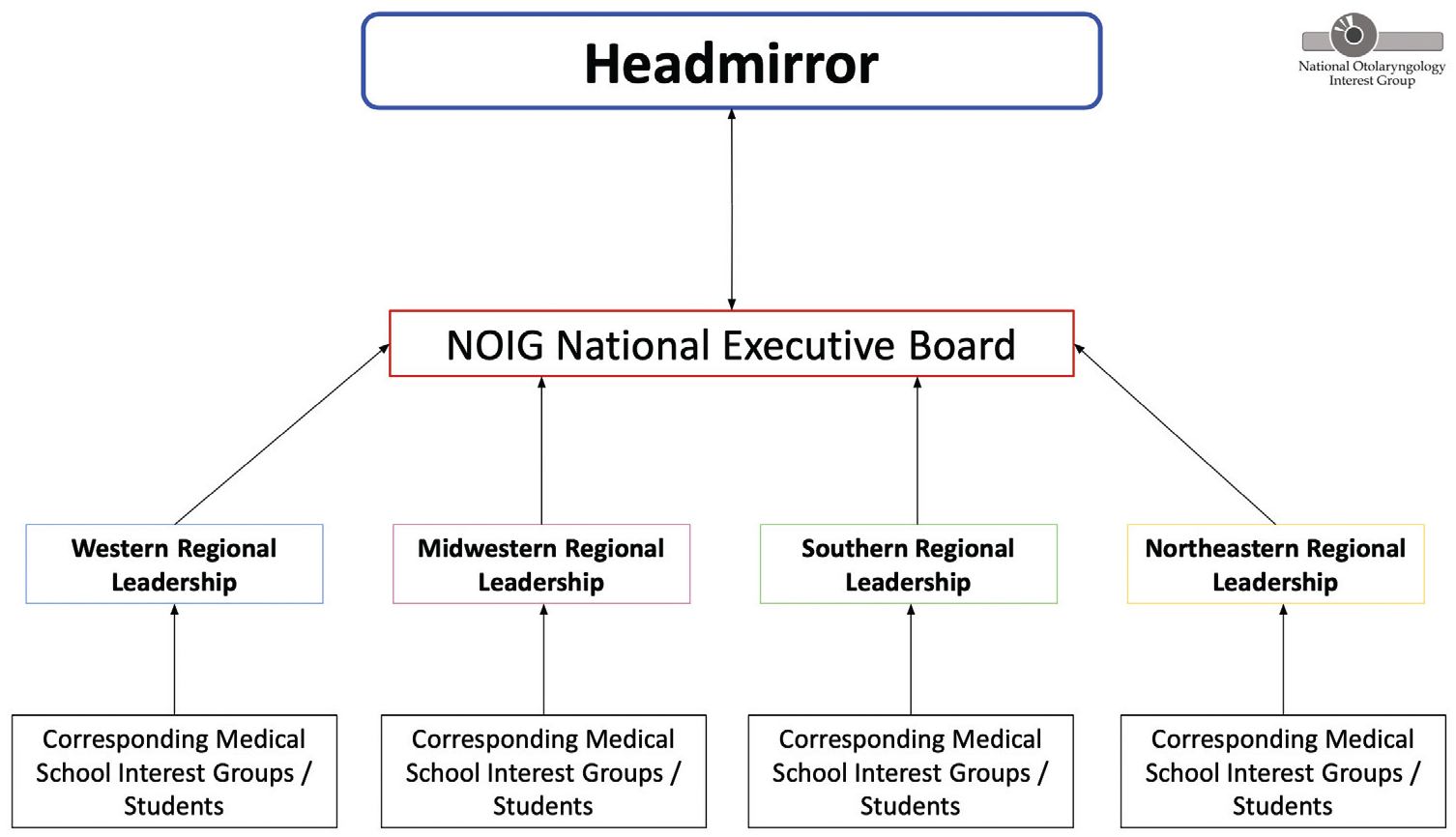
Schematic of the organizational structure of National Otolaryngology Interest Group (NOIG), modeled after the Organization of Student Representatives of the Association of American Medical Colleges.
Chair of mentorship recruits faculty and resident mentors and coordinates efforts with other established mentorship initiatives.
Chair of education develops educational content in the form of webinars, workshops, and so on.
Chair of research generates a database of active research projects seeking medical student contributors, organizes new scholarly activity opportunities with our roster of faculty, and organizes the annual research symposium.
Chair of media and outreach presides over social media efforts and engages new potential student members.
Chair of communications is responsible for all internal communications of NOIG, including relaying updates from regional leadership to the executive board.
Chair of diversity and inclusion promotes diversity within all facets of NOIG.
Student president and vice president oversee the duties of these chairs, maintain contact with Headmirror leadership, and organize elections, among other national executive responsibilities.
Future Initiatives
NOIG leadership will institute long-term initiatives that are aligned with the organization’s mission. An initial objective includes curation of webinar content focused on guidance for medical students who are preparing for subinternship opportunities and Electronic Residency Application Service submission. Additionally, NOIG is developing an annual virtual NOIG Academic Conference. This conference will provide opportunities to present research, elect officers, and network with students, residents, and faculty of NOIG. Other plans include projects focused on mentorship and research database development, public health campaigning, and community outreach. These actions will encourage early interest and exposure to the field of otolaryngology and foster collaboration among student members, otolaryngology residents, and attending physicians across the country.
Conclusion
Otolaryngology is a highly competitive surgical subspeciality exemplified by the limited residency positions available across the nation. It is critical for aspiring otolaryngology residents to have access to clinical exposure, mentorship, research, and networking opportunities to improve their chances of a successful match into otolaryngology. The mission of NOIG is to provide students from across the country with resources that help mitigate barriers and promote a more diverse otolaryngology resident pool. While there is precedent for similar initiatives in other medical and surgical specialties, currently no such organization exists within the field of otolaryngology in the United States. We believe that NOIG, through its mission of providing resources to all students and especially historically underserved students, will over time create a more diverse applicant pool to otolaryngology residency programs.