







Abstract
Objective
To elucidate financial and intellectual conflicts of interest (COIs) among clinical practice guideline (CPG) authors of allergic rhinitis in Japan and to evaluate the extent of transparency and accuracy in COIs by CPG authors of allergic rhinitis.
Study Design
A cross-sectional analysis of the payment data from all 79 pharmaceutical companies in Japan between 2016 and 2017.
Setting
Japan.
Methods
We considered all 27 CPG authors from 2 different versions of the most prominent CPGs for allergic rhinitis in Japan. Using payment data disclosed by 79 major pharmaceutical companies between 2016 and 2017, we assessed the magnitude and characteristics of financial COIs of CPG authors. We also evaluated the intellectual COIs of the CPG authors by counting self-citations of research articles related to CPG statements and recommendations.
Results
Of 27 CPG authors, 26 authors (96.3%) received at least 1 payment from a combined total of $1,333,552 between 2016 and 2017. The 2-year combined average and median monetary values per author were $49,391 (SD, $67,438) and $18,400 (interquartile range: $6,216-$72,494), respectively. Pharmaceutical companies with novel drugs predominantly made these payments. The percentage of citations with at least 1 CPG author relative to total citations was 47.6% in 2016 and 27.9% in 2020. There were no formal COI disclosure statements in either version.
Conclusion
This study found that allergic rhinitis CPG authors had significant financial relationships with pharmaceutical companies, particularly those marketing novel drugs. In addition, CPG authors had relatively high self-citation rates, a potential marker of intellectual COIs. More rigorous and comprehensive COI management strategies are needed.
Keywords
Patient-centered care is a fundamental concept in current health care practice, and clinical practice guidelines (CPGs) help achieve this by guiding health care professionals toward standardized treatment. 1 Contrastingly, a wide range of CPGs are subject to conflicts of interest (COIs) of a financial or intellectual nature.2-10 Given the increasing role of CPGs among patients and health care professionals,11,12 CPGs have a significant influence both directly and indirectly on patient-centered care implementation. Appropriate and rigorous COI management, including full COI disclosure, greater efforts to reduce COIs among both CPG authors and CPG developing organizations, and balanced recommendations by multiple experts, is essential in achieving reliable, reproducible CPGs and patient-centered care.13-15
Among several specialties, otolaryngology is an important field in terms of COI assessment. While pharmaceutical company payments to otolaryngologists were generally lower than those made to other specialists in the United States,16,17 some American otolaryngology CPG authors, specifically those contributing to allergic rhinitis guidelines, drew larger payments than authors of other types of CPGs. 6 This trend could be explained by a large patient population and the fierce competition in drug development and marketing.
This phenomenon may also be true in Japan, where nearly half the population had allergic rhinitis in 2019. 18 The market for the treatment of allergic rhinitis reached roughly 30 billion Japanese yen ($272 million) in 2019. 19 Recently, several novel drugs for allergic rhinitis have been developed, and given the vital role of CPGs in Japan, CPG authors can significantly affect treatment selection for conditions like allergic rhinitis and novel new drugs’ prescription rates. This study aimed to assess the financial relationships between pharmaceutical companies and otolaryngology CPG authors using publicly disclosed payment data in Japan and the characterization of intellectual COIs from author self-citation rates in CPGs.
Methods
Study Setting and Participants
This cross-sectional analysis examined the COIs among Japanese otolaryngology CPG authors. We reviewed 2 different versions of the Practical Guideline for the Management of Allergic Rhinitis in Japan (PG-MARJ), representing the sole and most influential CPG for perennial and seasonal allergic rhinitis. They were composed of the 2016 version, published by an independent group of authors, 20 and the 2020 updated version published by members of a professional society of otolaryngologists. 21 Summary articles of the 2016 20 and 2020 PG-MARJ 21 were published in Allergology International in 2017 22 and 2020, 23 respectively. Please note that these summary articles for the PG-MARJ were not used in our analyses. For further details on the study setting and participants, refer to Supplemental Material 1 (in the online version of the article).
Data Collection and Payment Source
The 2016 and 2020 PG-MARJ, as well as associated official institutional webpages, provided data on author names, sex, affiliations, and positions. Furthermore, individual author COI statements, cited publications, and recommendations of particular drugs were extracted from these guidelines and accessible online supplementary materials. For each of the brand-named drugs listed in the PG-MARJ, we collected the approval date and the manufacturer name from the official pharmaceutical interview forms and package inserts (see Supplemental Material 2 in the online version of the article).
Authorship of original and review articles cited in CPG recommendations represents a potential source of intellectual COI. 24 This is particularly so where authors often perform self-citation to enhance their academic stature and credibility for stated positions, potentially jeopardizing the quality of CPG. 1 To evaluate the extent of intellectual COIs arising from self-citation in PG-MARJ, all citations were reviewed, the CPG author names extracted, and categorized types of cited publications (see Supplemental Material 3 in the online version of the article). To assess the authors’ academic performance, we collected their h-index using the Scopus database (https://www.scopus.com/freelookup/form/author.uri), as previously described. 25
In 2011, the Japan Pharmaceutical Manufacturers Association, the largest pharmaceutical trade organization in Japan, published transparency guidelines as in other developed countries.26,27 Beginning in 2013, this association required all member companies to disclose payments to health care entities on company webpages. 28
As described previously,29,30 we evaluated financial COIs among PG-MARJ authors based on data relating to speaking, writing, and consulting payments made and publicly disclosed by a combined 79 all Japan Pharmaceutical Manufacturers Association member and other related companies in 2016 and 2017. Extracted data included the payment amount, the payment category, and the pharmaceutical company name (see Supplemental Material 4 in the online version of the article).
In addition, a review of the COI policy for CPG authors posted on the Oto-Rhino-Laryngological Society of Japan’s official webpage (http://www.jibika.or.jp/members/iinkaikara/about_coi.html) helped evaluate integrity between official policy and published PG-MARJ COI statements.
As needed, we contacted the Society’s development committee and professional offices responsible for publishing these guidelines for further information on the development process and COI statements and policy details.
Analysis
We performed a descriptive analysis on the demographic, self-citation, and payment data. To evaluate intellectual COI, we counted citations with at least 1 CPG author listed and calculated median and interquartile range (IQR) of self-citation to total citations and total citations for each chapter assigned to authors (see Supplemental Material 3 in the online version of the article). We assessed financial COI inequalities between individual CPG authors using the Gini index. 31 To avoid the effect of currency differences, we based calculations on payments in Japanese yen (¥) converted into US dollars using 2016 and 2017 average monthly exchange rates of ¥108.8 and ¥112.1 per $1, respectively.
Treatment recommendations in CPGs and accompanying online information were initially presented on a 5-point Likert scale. To simplify, we recategorized the recommendations for particular treatments as “recommendation for,”“conditional recommendation,” and “recommendation against” based on the groupings presented within the CPG and online databases (see Supplemental Material 5 in the online version of the article).
Ethical Clearance
The Ethics Committee of the Medical Governance Research Institute approved this study.
Results
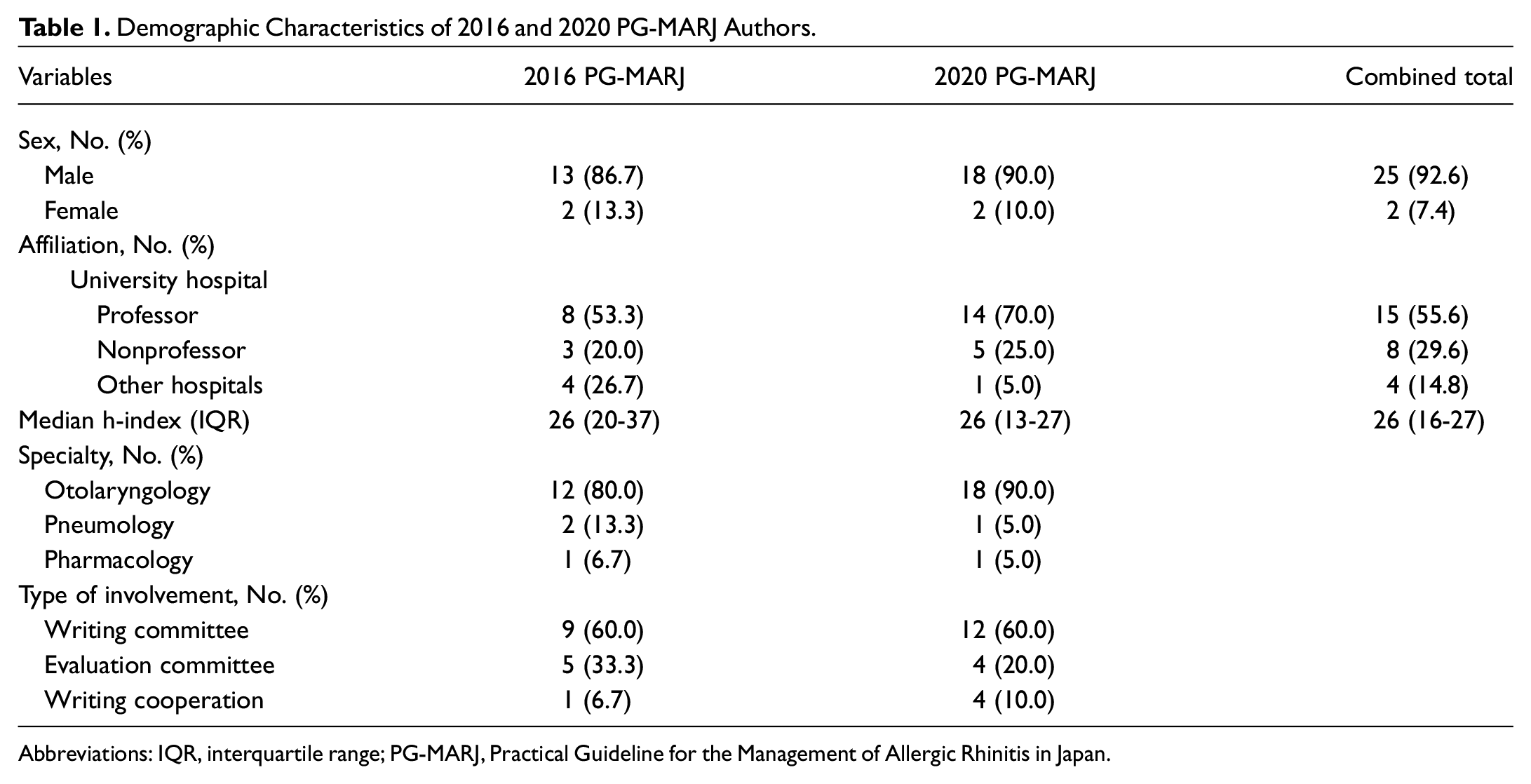
We identified 27 CPG authors, 15 of whom contributed to the 2016 PG-MARJ and 20 to the updated 2020 version. Among them, 8 (29.6%) contributed to both. Table 1 summarizes the demographic characteristics of these authors. They were predominately male (92.6%) and university professors (55.6%), with a high median h-index of 26 (IQR, 16-27).
Demographic Characteristics of 2016 and 2020 PG-MARJ Authors.
Abbreviations: IQR, interquartile range; PG-MARJ, Practical Guideline for the Management of Allergic Rhinitis in Japan.
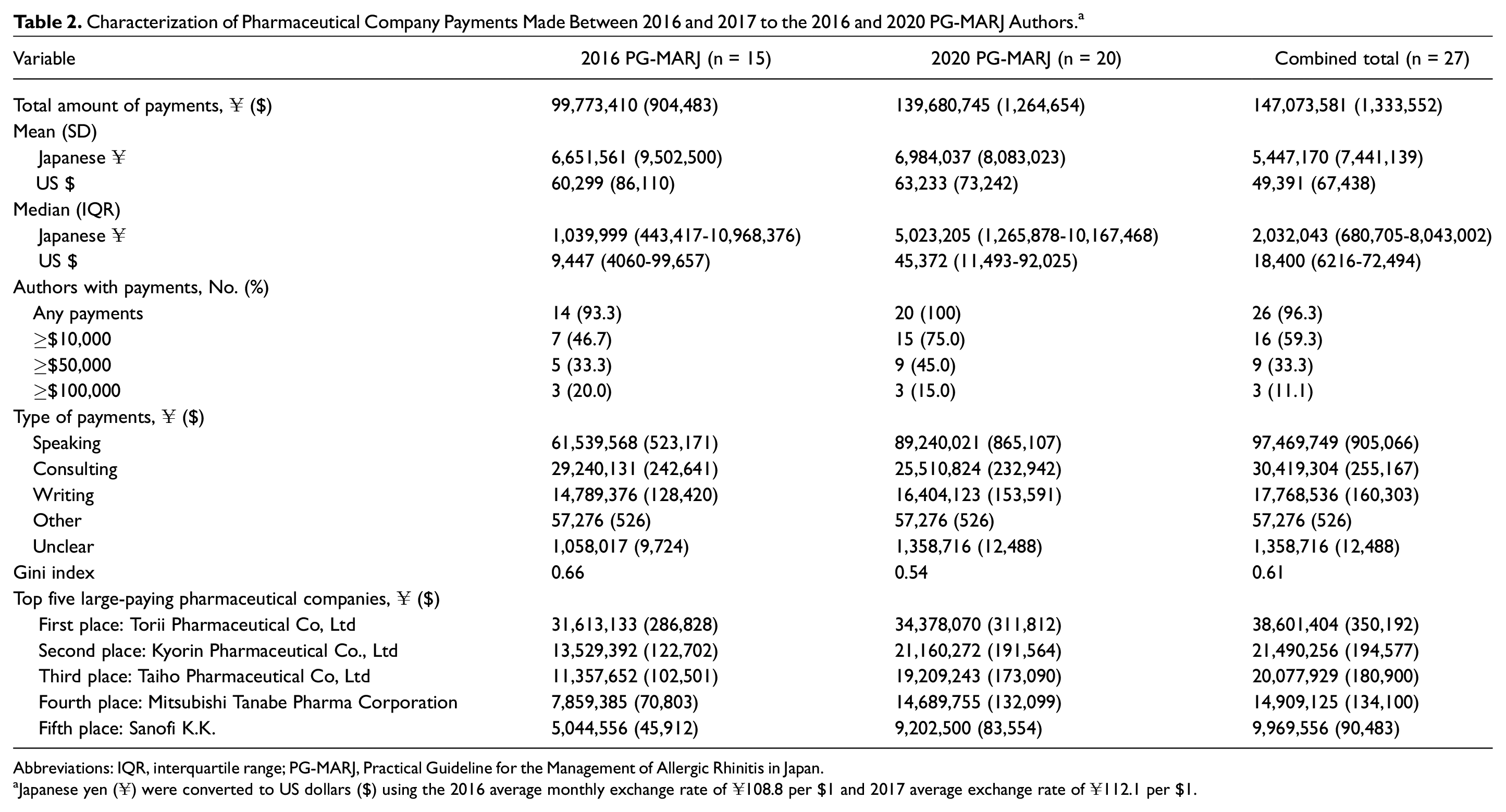
Table 2 breaks down the pharmaceutical company payments made to PG-MARJ authors between 2016 and 2017. Among the 27 authors, 26 (96.3%) received a total of 1217 payments, representing a combined total of $1,333,552 (¥147,073,581) for 2016 and 2017, from 39 pharmaceutical companies (49.4%). The 2-year combined average and median monetary values per author were $49,391 (SD, $67,438) and $18,400 (IQR, $6,216-$72,494), respectively. Of the 39 pharmaceutical companies making at least 1 author payment, the top 5 largest paying pharmaceutical companies accounted for 71.3% of the total payment values at $950,252 (¥105,048,270). The chairperson for the 2016 PG-MARJ received the highest payment at $312,564 and was subsequently the co-chair for the updated 2020 version.
Characterization of Pharmaceutical Company Payments Made Between 2016 and 2017 to the 2016 and 2020 PG-MARJ Authors. a
Abbreviations: IQR, interquartile range; PG-MARJ, Practical Guideline for the Management of Allergic Rhinitis in Japan.
Japanese yen (¥) were converted to US dollars ($) using the 2016 average monthly exchange rate of ¥108.8 per $1 and 2017 average exchange rate of ¥112.1 per $1.
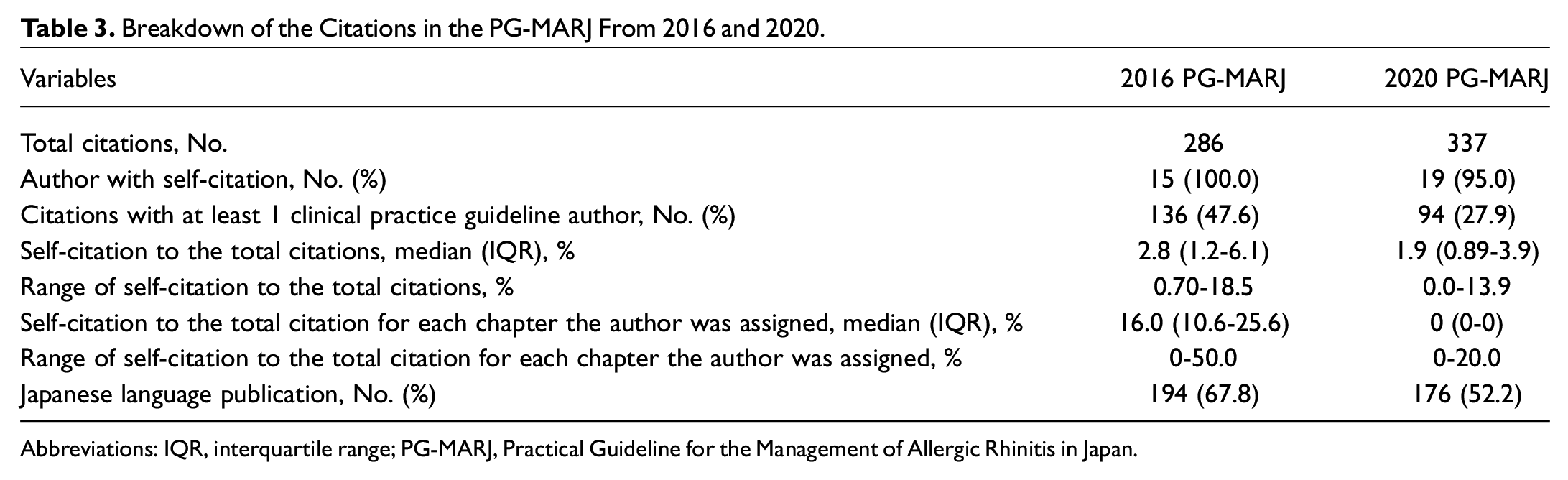
We considered 286 and 337 references cited in the 2016 and 2020 PG-MARJ, respectively. The percentage of citations with at least 1 CPG author relative to total citations was 47.6% in 2016 and 27.9% in 2020. The median self-citation percentages in the chapters assigned to the CPG authors were 16.0% (IQR, 10.6%-25.6%) in 2016 and 0% (IQR, 0%-0%) in 2020 ( Table 3 ). In total, 40.4% and 22.3% of self-cited publications were review articles, books, or other articles including editorials, commentary, and perspectives in the 2016 and 2020 PG-MARJ, respectively (see Supplemental Material 6 in the online version of the article).
Breakdown of the Citations in the PG-MARJ From 2016 and 2020.
Abbreviations: IQR, interquartile range; PG-MARJ, Practical Guideline for the Management of Allergic Rhinitis in Japan.
There were no formal COI sections in either the 2016 or 2020 PG-MARJ. Upon further inquiry, the Japan Society of Immunology Allergology and Infection in Otolaryngology’s office, the member society of the Oto-Rhino-Laryngological Society of Japan, confirmed neither guideline disclosed the authors’ COIs. In addition, both the 2016 and 2020 PG-MARJ lacked formal criteria for the development process. The Society’s office acknowledged the absence of COI management strategies and the failure to adhere to established COI policies.
In 2016, the chairperson acknowledged receiving no funding from pharmaceutical companies for his role in developing PG-MARJ. Also, the Society office responded to our inquiry about CPG development funding, indicating that authors never received funding from pharmaceutical companies for their contributions and that development funding comes from sales of prior CPGs. The Society’s webpages noted the previous solicitation of public comment for the 2020 PG-MARJ. However, there was no discussion on the utilization of such statements. Supplemental Material 7 (in the online version of the article) lists the Society’s COI policy guidelines not followed in the 2020 PG-MARJ.
Furthermore, in both the 2016 and 2020 PG-MARJ versions, all drugs were labeled with their respective brand or nonproprietary names, and some with pharmaceutical company names, a style that has persisted since the 1999 third edition PG-MARJ (see Supplemental Material 8 in the online version of the article). From this, we identified 40 pharmaceutical companies manufacturing or marketing 81 of the 87 total products listed. Among these companies, MSD K.K. had the largest number of products at 7, followed by Novartis Pharma K.K. and Pfizer Japan with 5 each, as well as Kyorin Pharmaceutical Co Ltd, Mitsubishi Tanabe Pharma Corporation, and GlaxoSmithKline K.K., all with 4 each.
We identified 9 and 28 recommendations in the 2020 guidelines and online databases for specific treatment recommendations, respectively. Each online database for 2016 and 2020 had exactly the same 14 recommendations. Among the 9 treatment recommendations in the 2020 PG-MARJ, all were classified as “recommendation for” (see Supplemental Material 9 in the online version of the article). Also, among 14 particular treatments in the supplementary online database, 13 (92.9%) were classified as “recommendation for,” and 1 (7.1%) received “conditional recommendation” (see Supplemental Material 10 in the online version of the article). Both the 2016 and 2020 guidelines recommended that broad-spectrum combination chemotherapy of more than 2 drugs.
Discussion
This study elucidated that nearly all PG-MARJ authors received substantial personal payments from pharmaceutical companies. They also tended to highly self-cite their publications. Furthermore, we found no COI statements or adherence to established transparency policies in the current PG-MARJ.
Although the prevalence of financial COI among PG-MARJ authors was similar to previous studies in Japan and elsewhere,5,6,29,32,33 the average monetary value of $49,391 (SD, $67,438) was among the highest relative to other previously analyzed CPGs in Japan. For example, average payments to CPG authors in fields like dermatology ($26,600 over 2 years), 29 oncology ($10,565 for 1 year), 34 urology ($31,965 over 2 years), 32 hematology ($25,471-$49,693 over 2 years), 35 neurology ($14,427 for 1 year), 36 and infectious diseases ($18,316 for 1 year) 37 were typically much lower. Moreover, the average payments received by PG-MARJ authors were higher than payments received by otolaryngology CPG authors in the United States ($11,910 over 3 years). 6 However, it is impossible to directly compare financial COIs in light of differences in patient populations, approved drugs for allergic rhinitis, and the payment categorization between Japan and the United States. Nonetheless, this finding indicates that Japanese pharmaceutical companies may be targeting PG-MARJ authors with these higher payments.
We found that the top 5 companies with the highest payments had marketed novel drugs for allergic rhinitis between 2012 and 2017. Still, several high-ranking pharmaceutical companies with the most PG-MARJ drugs were not among the top 5 companies with the highest payments. Given the differences, we assumed that the total amount paid by each pharmaceutical company would depend on the availability of newly approved drugs rather than on the number of brand-name drugs listed. For example, Torii Pharmaceutical Co Ltd, the largest payer, had 3 novel subcutaneous and sublingual immunotherapy products, all introduced after 2014. Kyorin Pharmaceutical Co Ltd and MSD K.K., the second and sixth largest payers, respectively, manufactured and marketed desloratadine (Desalex) approved in 2016. Among the remaining top 5 payers, Taiho Pharmaceutical Co Ltd markets bilastine (Bilanoa), approved in 2016, and Sanofi K.K. fexofenadine hydrochloride/pseudoephedrine hydrochloride (Dellegra), approved in 2012. Last, Mitsubishi Tanabe Pharma Corp made 2.66 times higher payments in 2017 (¥10,836,343, $96,667) when it launched rupatadine fumarate (Rupafin) compared to 2016 (¥4,072,782, $37,434).
Regarding intellectual COIs among PG-MARJ authors, no previous studies focused on self-citations in CPGs, to our best knowledge. Based on otolaryngology primary literature, Tolisano et al 38 reported a self-citation rate averaging 9.5%, with review articles (1.8%) less often self-cited than original articles (10.8%). Of the screened PG-MARJ recommendations, up to 50.0% were self-authored citations, many of which were less rigorously reviewed works consisting of review articles, books, editorials, commentaries, and perspectives. Between 27.9% and 47.6% of these citations represented the work of at least 1 CPG author. DuBroff 39 described the citing of self-authored works as confirmation bias, pointing out that CPG authors with COIs would inappropriately cite their own articles or ignore unfavorable evidence that fails to support their statements. This suggests the presence of confirmation bias among PG-MARJ authors, particularly those authors disproportionately citing their own work.
Inconsistent with other CPGs,40-42 the treatment recommendations for allergic rhinitis in PG-MARJ were 89.2% (33/37) positive. For example, the CPG published by the American Academy of Otolaryngology–Head and Neck Surgery (AAO-HNS) contained 9 treatment recommendations. Among the 9 recommendations, only 3 (30.0%) garnered “recommendation for” (strong recommendation or recommendation), while 4 (44.4%) appeared neutral and 2 (22.2%) were not recommended (no recommendation or “recommendation against”). 40 Similarly, the recommendations made by the Allergic Rhinitis and its Impact on Asthma guidelines lean conservative. 42 Using leukotriene receptor antagonists as an example, both previously mentioned entities did not actively recommend their use as they exhibit lower efficacy vs antihistamines or intranasal steroids and the potential increased health care costs.40,42 In contrast, the PG-MARJ recommended their use for primary treatment and the treatment of severe seasonal allergic rhinitis with nasal blockage.22,23 Both 2016 and 2020 PG-MARJ recommended leukotriene receptor antagonists, based on a multifacility double-blind comparative study demonstrating that pranlukast improved nasal blockage more than epinastine in Japanese patients with moderate to severe allergic rhinitis investigated by the original founder and the former PG-MARJ chairperson. However, given that most clinical trials have not shown an overwhelming benefit of leukotriene receptor antagonists for allergic rhinitis, 40 this recommendation might have caused bias on the CPG authors’ fair judgment on the recommendation. 43 The authors of future PG-MARJ may need to reduce drug recommendations, considering the cost of treatment compared to other drugs.
In the present PG-MARJ, the drugs listed only included brand and nonproprietary names. The primary aim of a CPG is to guide health care professionals in providing the best available treatment to patients in terms of both effectiveness and cost. The failure to include generic brands, coupled with clinicians’ time constraints in day-to-day practice, only ensures increased patient costs and not necessarily improved care. CPGs should refer to drugs by compound names rather than brand names or list the drugs with generic drugs’ availability to reduce health care costs. Even the allergic rhinitis CPG from the AAO-HNS failed to include references to generic drugs such as levocetirizine and desloratadine. 40
In researching the CPG development process, we found no COI disclosures or formal strategies following established policy on the matter. This is against a COI policy of the professional societies responsible for publishing these guidelines. Furthermore, the Society office stated that new CPG authors are selected based on nominations by previous authors. This may also contribute to CPG recommendations being at risk of potential bias. Addressing some of these concerns, Lenzer et al 13 proposed publishing a list of comments from CPG authors and the general public with objections based on scientific evidence. Further suggestions include incorporating input from patients with the disease, clinicians with extensive clinical experience, and experts from different disciplines, including methodology and statistics, full COI disclosure, and external peer review.4,13,44,45 In this respect, the CPG development system of PG-MARJ is exceptionally vulnerable to both financial and intellectual COIs.24,29,35 These suggestions should be pursued for all CPGs as they would help patients and physicians judge the relevance of offered recommendations.
Last, while the development of PG-MARJ was not funded directly by pharmaceutical companies, the Society office indicated that support for the development of these guidelines came from selling the previous version. This means that the purchase of these guidelines by pharmaceutical companies seeking to promote their products listed in PG-MARJ may indirectly fund CPG development efforts. It has been reported that 86.2% of physicians in Japan receive free CPGs, paid for by pharmaceutical companies. Consequently, concerns about indirect funding from pharmaceutical companies cannot be ruled out. Even specialty medical societies, which develop many CPGs, often receive some financial support from pharmaceutical companies. 2 Thus, one of the most critical unresolved questions remains as to what type of funding would reduce the undue bias in CPGs.2,46,47 One study suggests financing from governments and national political parties might be better than pharmaceutical companies’ funding. Still, it is not the best solution for independence. Case in point, the US dietary guidelines are affected by political calculations, and the National Guideline Clearinghouse was discontinued from government funding.44,48 Given these findings, the development of CPGs by independent groups of authors could represent an option to avoid undue influence from both industry and politics. However, there remains a need to establish strict standalone standards for managing COIs or incorporating existing policies established by other organizations. Given the present situation and this study’s findings, further research is needed to deepen our understanding of CPG development and recommendations’ independence.
Limitations
There were several limitations in this study. First, as described in previous studies, the process of developing a payment database involves manual steps, and despite careful and repeated cross-checking, the payment data might still contain errors.29,30 Second, the payment data used in this study did not overlap accurately with the time frame of development or publication of the PG-MARJ. Nevertheless, our study aimed to provide insight into the magnitude of the financial relationships between pharmaceutical companies and the CPG authors. Third, being limited to payment data between 2016 and 2017, we could not assess the financial relationships between the CPG authors and pharmaceutical companies with newly approved therapies listed in 2020 PG-MARJ, such as omalizumab (Xolair; Novartis Pharma K.K.) approved in 2019. Fifth, the Japanese payments database differs from the US Open Payments Database. Unlike their American counterparts, Japanese pharmaceutical companies do not disclose payments to individual health care professionals concerning gifts, stock shares, meals, travel and accommodation, or education. Therefore, the PG-MARJ authors may receive more personal payments from pharmaceutical companies. Despite these limitations, to the best of our knowledge, this was the first study outside the United States to elucidate financial COIs between otolaryngology CPG authors and pharmaceutical companies. It may also quite possibly be the first such study to assess intellectual COIs among this same group of authors.
Conclusions
This study determined that allergic rhinitis CPG authors had significant financial relationships with pharmaceutical companies predominantly marketing novel drugs. There were no formal COI statements or policies in these CPGs. More rigorous COI management must be warranted, including incorporating input from patients with the disease, clinicians with extensive clinical experience, experts from different disciplines, full COI disclosure regardless of monetary values, and external peer review. Furthermore, more attention should be paid to intellectual COIs among CPG authors, and self-citations by CPG authors might be one indicator of intellectual COIs.
Supplemental Material
sj-docx-1-oto-10.1177_01945998211034724 – Supplemental material for Financial and Intellectual Conflicts of Interest Among Japanese Clinical Practice Guidelines Authors for Allergic Rhinitis
Supplemental material, sj-docx-1-oto-10.1177_01945998211034724 for Financial and Intellectual Conflicts of Interest Among Japanese Clinical Practice Guidelines Authors for Allergic Rhinitis by Anju Murayama, Futa Kida, Akihiko Ozaki, Hiroaki Saito, Toyoaki Sawano and Tetsuya Tanimoto in Otolaryngology–Head and Neck Surgery
Supplemental Material
sj-docx-2-oto-10.1177_01945998211034724 – Supplemental material for Financial and Intellectual Conflicts of Interest Among Japanese Clinical Practice Guidelines Authors for Allergic Rhinitis
Supplemental material, sj-docx-2-oto-10.1177_01945998211034724 for Financial and Intellectual Conflicts of Interest Among Japanese Clinical Practice Guidelines Authors for Allergic Rhinitis by Anju Murayama, Futa Kida, Akihiko Ozaki, Hiroaki Saito, Toyoaki Sawano and Tetsuya Tanimoto in Otolaryngology–Head and Neck Surgery
Supplemental Material
sj-docx-3-oto-10.1177_01945998211034724 – Supplemental material for Financial and Intellectual Conflicts of Interest Among Japanese Clinical Practice Guidelines Authors for Allergic Rhinitis
Supplemental material, sj-docx-3-oto-10.1177_01945998211034724 for Financial and Intellectual Conflicts of Interest Among Japanese Clinical Practice Guidelines Authors for Allergic Rhinitis by Anju Murayama, Futa Kida, Akihiko Ozaki, Hiroaki Saito, Toyoaki Sawano and Tetsuya Tanimoto in Otolaryngology–Head and Neck Surgery
Supplemental Material
sj-docx-4-oto-10.1177_01945998211034724 – Supplemental material for Financial and Intellectual Conflicts of Interest Among Japanese Clinical Practice Guidelines Authors for Allergic Rhinitis
Supplemental material, sj-docx-4-oto-10.1177_01945998211034724 for Financial and Intellectual Conflicts of Interest Among Japanese Clinical Practice Guidelines Authors for Allergic Rhinitis by Anju Murayama, Futa Kida, Akihiko Ozaki, Hiroaki Saito, Toyoaki Sawano and Tetsuya Tanimoto in Otolaryngology–Head and Neck Surgery
Supplemental Material
sj-docx-5-oto-10.1177_01945998211034724 – Supplemental material for Financial and Intellectual Conflicts of Interest Among Japanese Clinical Practice Guidelines Authors for Allergic Rhinitis
Supplemental material, sj-docx-5-oto-10.1177_01945998211034724 for Financial and Intellectual Conflicts of Interest Among Japanese Clinical Practice Guidelines Authors for Allergic Rhinitis by Anju Murayama, Futa Kida, Akihiko Ozaki, Hiroaki Saito, Toyoaki Sawano and Tetsuya Tanimoto in Otolaryngology–Head and Neck Surgery
Supplemental Material
sj-docx-6-oto-10.1177_01945998211034724 – Supplemental material for Financial and Intellectual Conflicts of Interest Among Japanese Clinical Practice Guidelines Authors for Allergic Rhinitis
Supplemental material, sj-docx-6-oto-10.1177_01945998211034724 for Financial and Intellectual Conflicts of Interest Among Japanese Clinical Practice Guidelines Authors for Allergic Rhinitis by Anju Murayama, Futa Kida, Akihiko Ozaki, Hiroaki Saito, Toyoaki Sawano and Tetsuya Tanimoto in Otolaryngology–Head and Neck Surgery
Supplemental Material
sj-xlsx-1-oto-10.1177_01945998211034724 – Supplemental material for Financial and Intellectual Conflicts of Interest Among Japanese Clinical Practice Guidelines Authors for Allergic Rhinitis
Supplemental material, sj-xlsx-1-oto-10.1177_01945998211034724 for Financial and Intellectual Conflicts of Interest Among Japanese Clinical Practice Guidelines Authors for Allergic Rhinitis by Anju Murayama, Futa Kida, Akihiko Ozaki, Hiroaki Saito, Toyoaki Sawano and Tetsuya Tanimoto in Otolaryngology–Head and Neck Surgery
Footnotes
Acknowledgements
The authors thank the Tansa (formerly known as Waseda Chronicle) for providing payment data, Ms Erika Yamashita for organizing this data, and Dr Derek Hagman for professional language editing. We also appreciate Ms Hanano Mamada for her constructive comments on self-citations, for collecting and categorizing the self-cited publications, for calculating the self-citations of PG-MARJ authors, and for structuring the  .
.
Author Contributions
Disclosures
Supplemental Material
Additional supporting information is available in the online version of the article.
References
Supplementary Material
Please find the following supplemental material available below.
For Open Access articles published under a Creative Commons License, all supplemental material carries the same license as the article it is associated with.
For non-Open Access articles published, all supplemental material carries a non-exclusive license, and permission requests for re-use of supplemental material or any part of supplemental material shall be sent directly to the copyright owner as specified in the copyright notice associated with the article.
