






Abstract
Chronic rhinosinusitis is a common disease associated with reductions in quality of life across a range of measures, including sexual health. We conducted a case-control study assessing chronic rhinosinusitis prevalence among men with and without clinically significant erectile dysfunction. We found that chronic rhinosinusitis was significantly associated with erectile dysfunction (odds ratio = 2.0, 95% CI = 1.8-2.4, P < .001) and that this association remained significant even when the interval between chronic rhinosinusitis diagnosis and erectile dysfunction treatment was restricted. This study adds to a growing body of literature demonstrating an association between chronic rhinosinusitis and sexual dysfunction.
Chronic rhinosinusitis (CRS) is a common medical condition in the United States with significant healthcare and societal cost burdens. 1 CRS is known to have detrimental effects on a number of quality-of-life measures, such as fatigue, sleep, work productivity, and psychological well-being.2-5 Several studies have suggested a potential relationship between CRS and sexual dysfunction, with patients showing subjective improvements in sexual health after surgery.5-7 A population-based study in Taiwan demonstrated that patients with CRS were at increased risk of developing erectile dysfunction (ED). 8 We hypothesized that, as an extension of the negative quality of life impact of CRS on sexual health, male patients with ED would exhibit a higher prevalence of CRS compared to a matched cohort of control patients without ED.
Methods
We conducted a case-control study for adult patients in our healthcare system. This study was approved by the Mass General Brigham committee on clinical investigations. The case cohort of patients with ED was assembled from a medical records extraction of male patients aged 35 to 75 years who received a prescription medication for ED (sildenafil, tadalafil, or vardenafil) in 2018 to 2019. The control cohort consisted of a group of patients aged 35 to 75 years who were matched 1:1 to the case cohort by age (within 10 years), sex, race, and comparative health but who did not receive any medications for ED in the same interval. Patients with any diagnosis of peripheral vascular disease (ICD-10 diagnosis code I7*.*) were excluded from both groups.
Standard demographic information for each patient was extracted. For patients in the case group, the medical record was searched for a diagnosis of CRS (ICD-10 code J32.*) within the study period. The diagnosis of CRS could precede or follow the ED diagnosis. The number of days between the CRS diagnosis and the ED prescription was tabulated. Similarly, in the control group, the record was searched for a diagnosis of CRS within the study period. We then compared the proportion of patients with ED and an associated diagnosis of CRS with the proportion of patients in the control group with a diagnosis of CRS, using chi-square with significance set at P = .05. Odds ratios and 95% CIs were computed for the association between CRS diagnosis and ED.
To test the strength of the association, sensitivity analyses were conducted. The first analysis restricted the case group to those cases in which the CRS diagnosis occurred within 365 days of the ED medication prescription, and the second analysis restricted the case group to those cases in which the CRS diagnosis occurred within 180 days of the ED medication prescription.
Results
In 2018 to 2019, we identified 17,891 men who received a prescription for ED with a mean age of 60.6 years (95% CI = 60.5-60.8, SD = 8.7). The most common ED medications prescribed in the case group were sildenafil (61.2%), followed by tadalafil (38.8%). The matched control group without ED consisted of men with a mean age of 60.9 years (95% CI = 60.75-61.0, SD = 9.7).
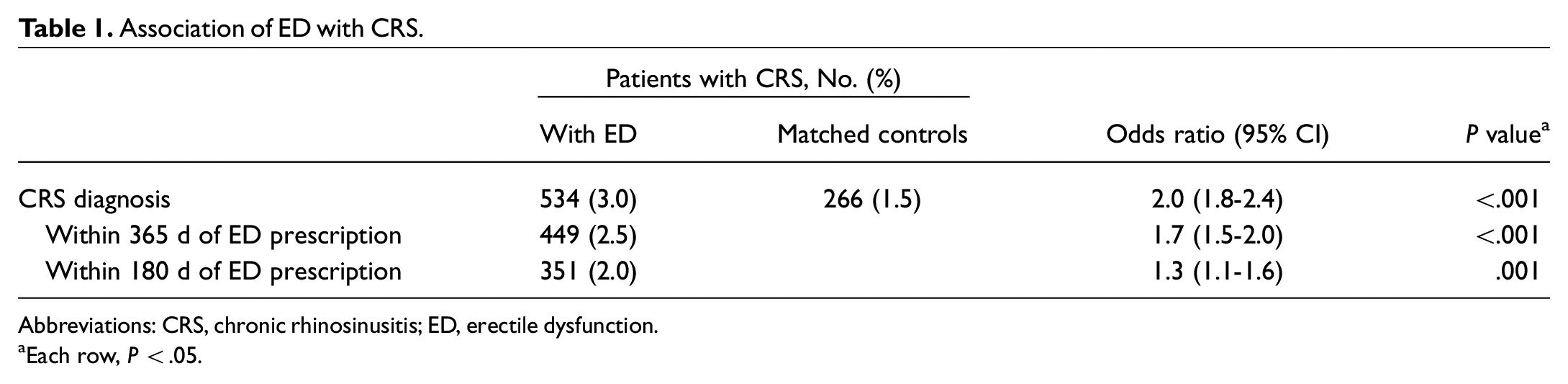
Table 1 examines the association of a CRS diagnosis with ED. In the matched groups analysis for the study period, there were 534 patients with a diagnosis of CRS (3.0%) in the ED group versus 266 (1.5%) in the control group. A diagnosis of CRS was significantly associated with ED, with an odds ratio of 2.0 (95% CI = 1.8-2.4, P < .001).
Association of ED with CRS.
Abbreviations: CRS, chronic rhinosinusitis; ED, erectile dysfunction.
Each row, P < .05.
For the sensitivity analysis, where the interval between CRS diagnosis and ED prescription was required to be ≤365 days in the case group, there was a 2.5% rate (449 patients) of an associated diagnosis of CRS. When the interval was restricted to ≤180 days between CRS diagnosis and ED prescription, there were 351 CRS diagnoses (2.0%) in the case group. In both instances, the association between CRS and ED remained statistically significant (P < .001 and P = .001, respectively).
Discussion
CRS is associated with reduced quality of life, including poorer sexual health.2-4,6-8 We sought to investigate whether there was an increased prevalence of CRS in men with ED. We compared the prevalence of CRS in male patients with a prescription for the treatment of ED versus the prevalence of CRS in similar aged males without ED, controlling for other potentially confounding variables through a matched cohort design. ED was associated with CRS with an odds ratio of 2.0 (95% CI = 1.8-2.4, P < .001), and the odds of having CRS remained significantly higher when examined within 1 year and 180 days of ED prescription.
Several possible physiologic mechanisms may explain this association, such as chronic inflammation leading to atherosclerosis, as well as hypoxia and hypercarbia resulting in reduced nitric oxide production.9,10 Decreased quality of life and impaired sleep, as seen in CRS, may also contribute to sexual dysfunction.11,12 One limitation of this study is a potential confounding relationship between CRS treatment modalities and ED, although even if this were the case, CRS would remain a marker for ED risk. Additional limitations include errors in diagnostic coding, including potential nonadherence to diagnostic criteria, and missing data.
Conclusion
CRS is associated with decreased quality of life in a number of areas, including sexual health. We show that CRS is associated with a significant risk of ED. Further research is required to elucidate relationships between CRS and sexual health beyond ED.