







Abstract
Although simple, audiograms are a dynamic tool that, much like fine art, can be used by experts to decipher the history, present, and probable future of its subject. Through close comparison with El Greco’s Burial of the Count Orgaz, a very well-known painting for its temporal complexity, a sample audiogram is examined through an artistic lens. That intimate relationship with time that El Greco’s piece and audiograms share offers not only a layered interpretive narrative but also a humanities-based perspective on how to approach diagnostic testing.
The arts and the sciences are often juxtaposed: one is interpretive and profound, the other objective and deeply intellectual. However, they share a temporal quality that grants a trained eye in either discipline the ability to discern the past, the present, and even the future with only a glance. This characteristic is demonstrated in the audiogram, a deceptively simple but useful diagnostic tool that effectively illustrates the hearing ability of a patient at a particular point in time. Yet, a closer examination to the trained eye will recognize subtle insights to the history of how the patient arrived at the current state and to potential future understandings of the prognosis of the condition. In this article, we attempt to better explicate this concept by drawing parallels between an audiogram of a patient with otosclerosis and El Greco’s Burial of the Count Orgaz, a renowned 16th-century painting known for its artistic complexity. This painting integrates elements of eras that predate its rendering and serves as a foundation for future artworks. Additionally, we aim to demonstrate how experts in these fields can often skillfully detect these underlying temporal relationships.
Analysis of the Present
Otosclerosis is a disorder of the stapes footplate that causes ossicular fixation and conductive hearing loss. It has a very specific characterization that, once recognized on an audiogram, can prompt a high level of diagnostic certainty with this single test. Conductive hearing loss in the setting of normal compliance of the tympanic membrane and evidence of Carhart’s notch at 2 kHz are signs that quickly indicate this condition to the examiner ( Figure 1 ). 1 This analysis reveals the status of that patient at the time when the measurement was taken and therefore functions precisely as a snapshot of a single instant amid an often-progressive affliction.
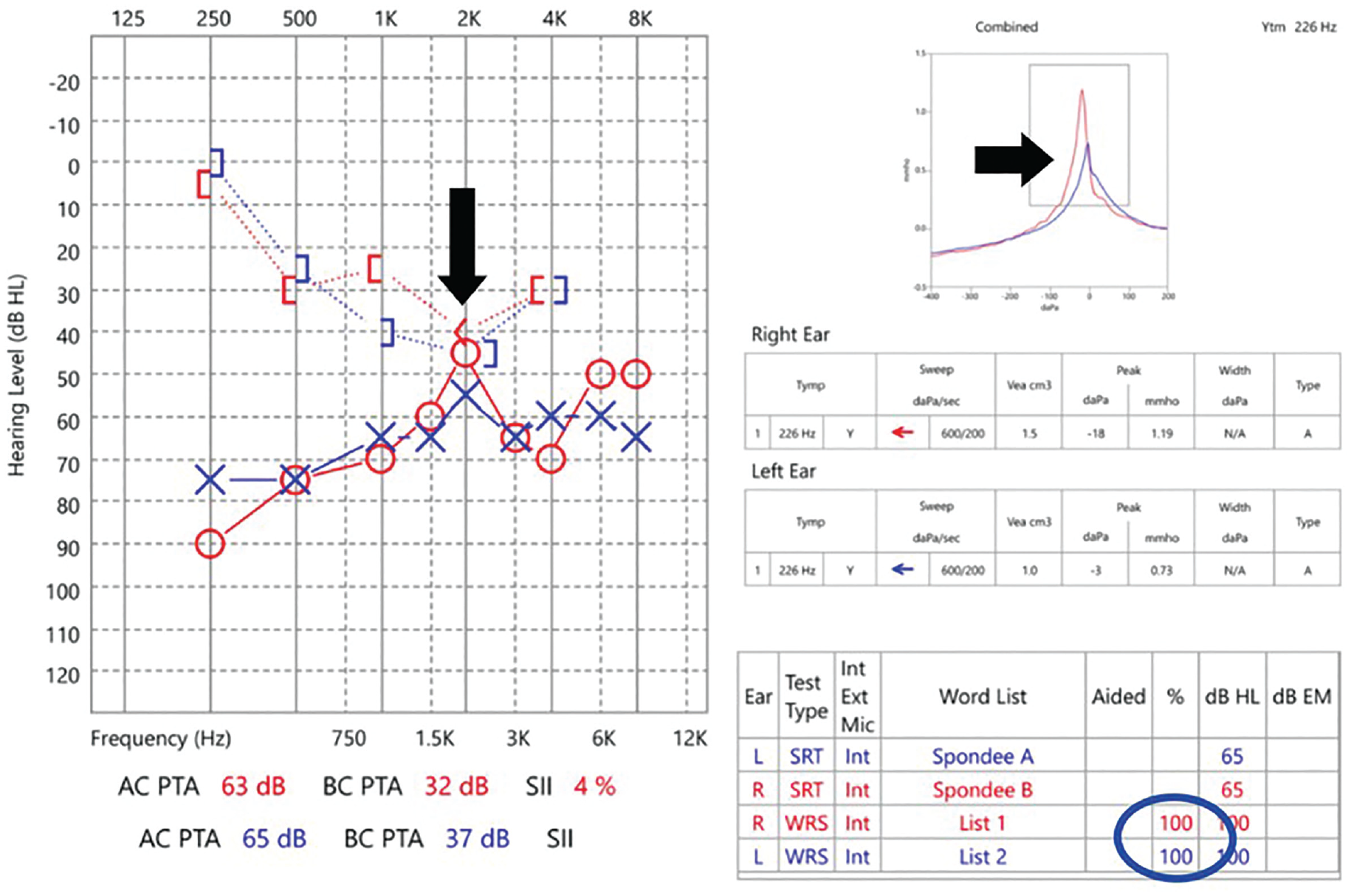
Otosclerosis: audiometric signs such as Carhart’s notch (big arrow) and normal tympanograms (small arrow) with normal speech discrimination (circle) are subtle clues that suggest a diagnosis to a skilled observer.
Similarly, the scene depicted in Burial of the Count Orgaz (1586-1588, El Greco) is the artist’s account of the moment when the body of Don Gonzalo Ruíz, the illustrious lord of Orgaz, was fabled to have been lowered into its tomb by the likes of Saint Augustine and Saint Stephen in the early 1300s ( Figure 2 ). Although this painting depicts an event approximately 200 years earlier, it hints at the era in which it was created through the inclusion of numerous prominent figures of the time. However, the true giveaway of the period when this piece was created lies in details that are apparent only to experienced eyes. Multiple individuals are illustrated wearing 16th-century clothing, and even Ruíz himself wore golden armor reminiscent of that worn by 16th-century Spanish kings. Additionally, details of the ceremony, such as the processional cross and 6 mortuary candles, closely resembled traditions followed during the 1500s—2 centuries after the scene allegedly took place. 2 These details, much like the audiometric signs of otosclerosis, signal to the observer the present conditions under which this portrayal was created. While this painting and the audiogram appear to be more different than they are similar, each image imbeds the subject matter with the time when it was produced.
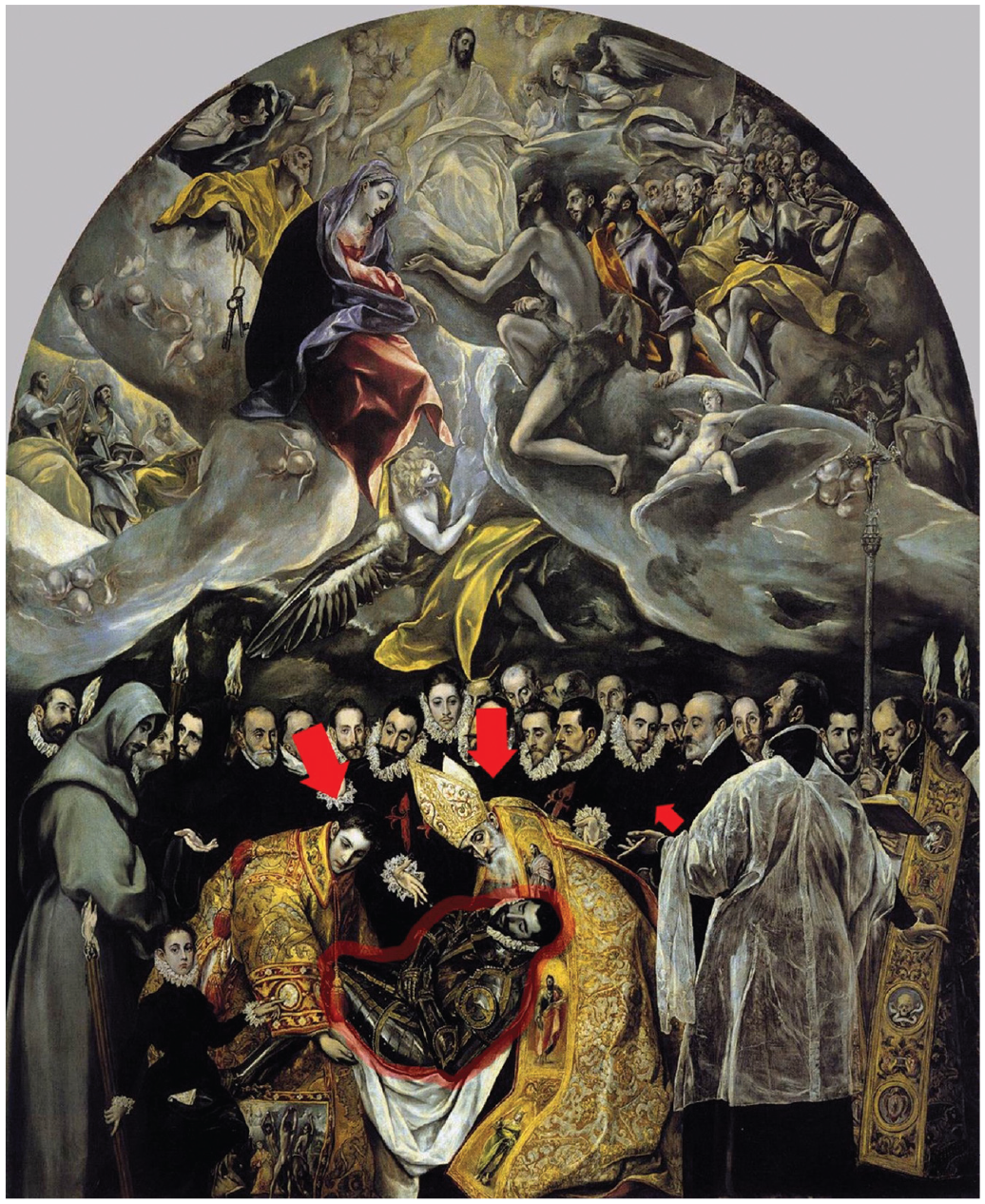
Burial of the Count Orgaz: Saint Stephen and Augustine (large arrows) bury Ruiz—an event occurring in 1323. White ruffled garbs (small arrow) and armor worn by Ruiz (highlighted) represent 16th-century attire. Copyright, public domain.
Eliciting History
As a historical piece, Burial of the Count Orgaz cannot be discussed without addressing its intimate relationship with the past. Just as the audiogram can reveal a patient’s likely history and suggest how one progressed to the present state, the presentation of this artwork is reminiscent of El Greco’s artistic predecessors. Perhaps due to the miraculous nature of Don Gonzalo Ruíz’s funeral, it bears an uncanny resemblance to earlier depictions of the burial of Jesus Christ, such as Titian’s The Entombment of Christ (circa 1520). 3 Such religious imagery had been a distinguishing feature of Renaissance art for over a century by the time El Greco had fleshed out this composition, and that influence is heavily apparent in the spiritual iconography present in this scene. As art styles evolve over time, artists such as El Greco often build on existing themes and techniques to develop new ones, which in turn allows an experienced viewer to trace a particular painting into the past indefinitely through a chain of references.
In the case of the audiogram, history is inferred from a number of findings. The tympanogram displays a peak at approximately 0 daPa ( Figure 1A ), which indicates a healthy, intact eardrum. Additionally, the patient’s normal speech discrimination demonstrates that the relevant inner ear and neurological pathways are functioning properly. These findings paired with the aforementioned conductive hearing loss suggest that there was unlikely a history of damage to the eardrum, as might occur with a history of chronic otitis media, and that the deficits that this patient is experiencing are due to a problem with the ossicular chain. Much like Burial of the Count Orgaz, the presence (or, in this case, absence) of certain themes in this representation reveals key information about the past that eventually led to its creation.
Glimpses of the Future
Just as the past continually interacts with the present, the content of these representations inherently influences the trajectory of the future. In the case of Burial of the Count Orgaz, El Greco embedded the spiritual representation of the scene into his artwork, allowing viewers to visualize the heavenly dimension alongside the worldly domain. 5 A deeply spiritual man during the Counter-Reformation, El Greco was a gifted expressionist who could harness naturalism and realism in a way that was spiritually profound, and amid widespread political division, his work offers insights into the future of art. From a stylistic standpoint, his work served as an inspiration for expressionist artists in the early 20th century who had begun to depart from impressionism and looked back to their predecessors. 4 Artists, once again, started to gaze inward and strove to draw on the marriage of matter and spirit. El Greco’s mastery of this style was widely recognized, and he became an icon for a new generation of artists. 5
The interpretation of this audiogram offers similar potential. Having already deduced the present condition and the pertinent history from this audiogram, the skillful examiner can determine the appropriate prognosis and a comprehensive understanding of which treatment options are available. This patient’s future may involve worsening hearing loss as the otosclerosis progresses. Yet, the future often portends a good prognosis if stapedectomy is performed to restore hearing. Just as art evolves over time, updates to the patient’s treatment and condition build on this foundation, and together they form a cohesive narrative that continues into the future.
Conclusion
Despite the simplicity of this collection of measurements, an astounding amount of information can be elicited from an audiogram, comparable to complex works of art. Medicine often lends the greater part of its attention to understanding precise relationships and evidence, without enough consideration for the artistic interpretation required to understand such evidence. History, put simply, is a record of the continuous flow of time and is limited only by human ignorance of the past. Art and diagnostic tools such as audiograms are media through which trained individuals can explore and interpret history. In medicine, as in art, it is important to train our eyes to understand the complex omnitemporality of a simple test and appreciate its artistic capacity to tell a story.