






Abstract
Objective
The utilization of image-guided navigation during endoscopic sinus surgery (ESS) has increased significantly since its introduction. However, the most common associated complications are still unknown. This study describes and analyzes adverse events related to image-guided ESS.
Study Design
Cross-sectional analysis.
Setting
The Food and Drug Administration’s 2018-2022 MAUDE database (Manufacturer and User Facility Device Experience).
Methods
The MAUDE database was searched for all reports on adverse events involving sinus navigation systems used in ESS from 2018 to 2022. Reported events were reviewed and categorized.
Results
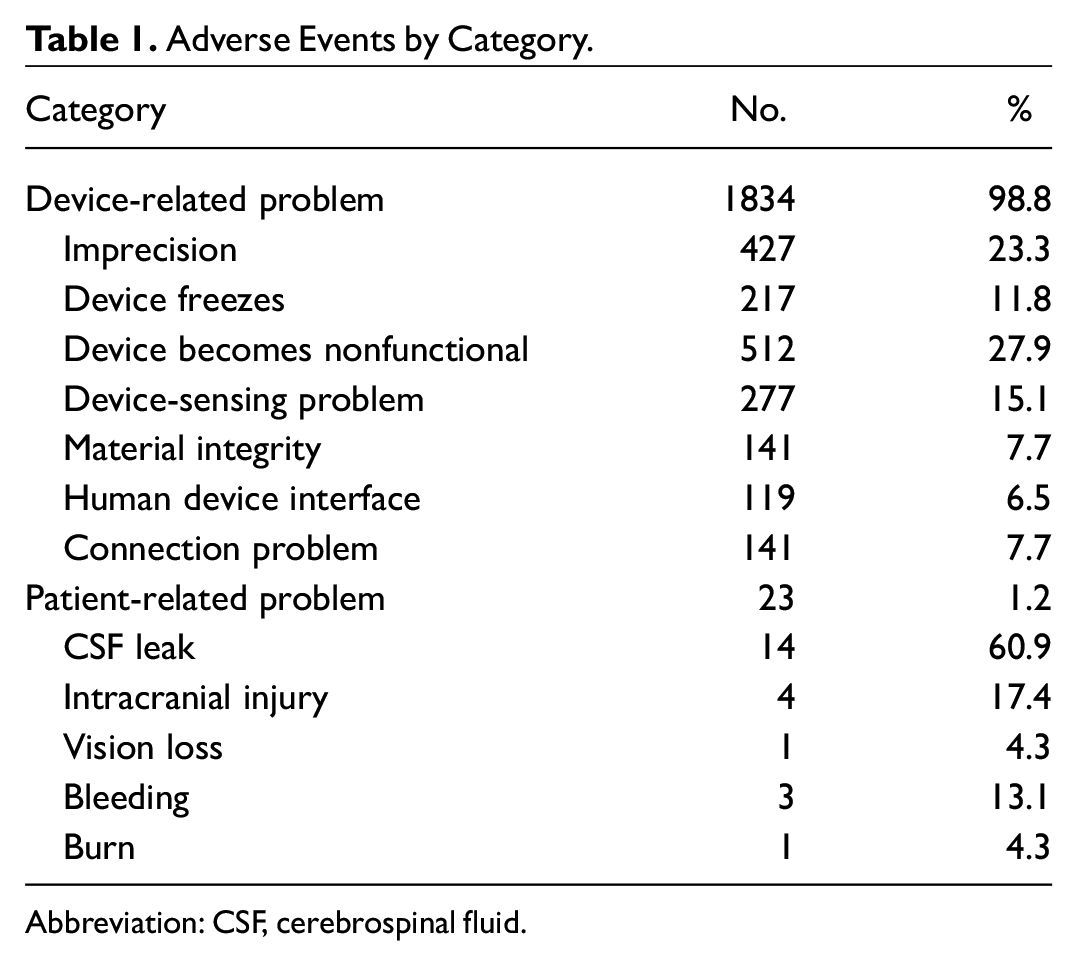
During the study period, there were 1857 adverse events from 1565 reports, which were divided into device-related (n = 1834, 98.8%) and patient-related (n = 23, 1.2%) complications. The most common device-related complications were nonfunctionality of the system (n = 512, 27.9%), device imprecision (n = 427, 23.3%), and device sensing problems (n = 277, 15.1%). The most common patient-related complications were cerebrospinal fluid (CSF) leak (n = 14, 60.9%), intracranial injury (n = 4, 17.4%), and bleeding/hemorrhage (n = 3, 13.1%). Imprecision was associated with increased risk of navigation abortion by the surgeon (odds ratio, 1.50 [95% CI, 1.38-1.65]; P < .001) and increased risk of CSF leak (odds ratio, 16.5 [95% CI, 3.66-74.0]; P < .001) as compared with other device-related complications.
Conclusions
The most commonly reported device- and patient-related adverse events associated with image-guided sinus navigation systems were device nonfunction, imprecision, device sensing difficulties, and CSF leak. When imprecise navigation occurred, there was an increased likelihood of CSF leak and navigation abortion by the surgeon. Health care providers should be mindful of these possible complications when electing to use image-guided sinus navigation during ESS.
Endoscopic sinus surgery (ESS) is generally accepted as the standard of care for patients with chronic rhinosinusitis whose adequate medical treatment has failed. 1 Previously, sinus surgery was achieved through external approaches, which were considered last-resort options due to their invasiveness and facial scarring. 2 Due to technological advancements, ESS today is minimally invasive and has high success rates and low complication rates.2-4
Multiplanar computed tomography imaging is key to successful ESS, as it visualizes the paranasal sinuses and identifies anatomic variants while providing insight into disease severity and chronicity.5,6 While sinus imaging has traditionally been used for chronic rhinosinusitis diagnosis and preoperative planning, intraoperative computer-aided imaging has become increasingly popular due to its ability to guide intraoperative decision making and assist in more complete sinus exploration and dissection.6-8 Image-guided surgery (IGS) has been demonstrated to be a cost-effective option 9 that decreases major and total complication rates 10 and improves patient nasal symptomatology. 11 As a result, the American Academy of Otolaryngology–Head and Neck Surgery has endorsed the use of IGS in select cases. 12
Whereas many IGS systems exist, they all consist of the same general components. 13 Target registration error, the distance between an instrument’s position in the real world and its tracked and measured position, is assessed following registration and throughout the case to ensure intraoperative system accuracy and to prevent operative complications. A target registration error ≤2 mm must be sustained to maintain the utility of intraoperative sinus navigation. 14
An IGS system is a tool designed to aid surgeons performing ESS; however, it is not intended as a substitute for surgical judgment, operative experience, and sinonasal anatomy knowledge. Intraoperative error or malfunction is possible with any surgical technology, and IGS is no exception. Although hardware issues such as slippage of the patient tracking sensor and tracking imprecision have been mentioned in the literature,13,15 there has been no investigation into adverse events related to image-guided sinus navigation systems used in ESS in a national database. We aim to utilize data from the MAUDE database (Manufacturer and User Facility Device Experience) to describe the device-related problems of image-guided sinus navigation systems experienced nationwide and their impact on operative delay and patient outcomes.
Methods
The MAUDE database was accessed on March 1, 2022, at https://www.accessdata.fda.gov/scripts/cdrh/cfdocs/cfmaude/TextSearch.cfm. The MAUDE database was developed by the Food and Drug Administration (FDA) as a way of systematically collecting data on adverse outcomes related to medical devices. 16 Device manufacturers and health care providers are required to submit reports to MAUDE in cases where an adverse event has occurred. This includes instances of device- and patient-related complications. This database has been used to examine a range of devices, such as sinus balloons, cochlear implants, bone-anchored hearing aids, and robot-assisted surgical systems.17-20 The search term “sinus navigation” was used to identify medical device reports made between January 1, 2018, and January 1, 2022, for FDA-approved navigation systems used for ESS. Two reviewers independently collected the following data from each report: report year, device type, device-related complications (device freezing, device becoming nonfunctional, imprecision, device sensing difficulties, material integrity, human-device interface, and connection problems), patient-related complications (vision loss, bleeding/hemorrhage, burn, cerebrospinal fluid [CSF] leak, or intracranial injury), instances of navigation abortion (premature termination of intraoperative navigation by the surgeon), procedure delays, event description, and manufacturer narrative. Procedure delays were extracted from the manufacturer narratives and defined as <60 or >60 minutes. Device freezing was identified by instances where the image-guided sinus navigation stalled intermittently during the procedure. Device nonfunction was identified by instances where the full navigation system was malfunctioning or became inoperative. Device imprecision was self-reported by surgeons at the time of the procedure. Device sensing difficulties were defined by instances where the navigation system did not appear to be adequately tracking the surgical instruments. Material integrity was characterized by instances where the quality of the device components were damaged. Human-device interface problems were characterized by instances where the device could not be properly set up without the help of a manufacturer representative. Nervous system injuries were characterized by instances of intracranial injury.
All reports were included that explicitly described the use of navigation for “functional endoscopic sinus surgery” in the manufacturer narrative. Degree of imprecision was gathered from the event description. Reports were excluded if they were in reference to specific instruments related to the navigation system, rather than the navigation system itself, or if they were duplicate or unrelated to ESS. Due to the publicly available and deidentified nature of the MAUDE database, this study was exempt from review by the University of Southern California Institutional Review Board.
All analyses were conducted with Stata software (version 17.0; StataCorp). Descriptive statistics were used to examine relationships between device-related problems and patient outcomes. Statistical significance was defined as P < .05.
Results
From January 2018 to January 2022, there were 1857 adverse events from 1565 reports sent to the FDA. Figure 1 demonstrates the number of adverse events by year. The years 2018 (n = 520) and 2019 (n = 509) had the highest number of adverse events as compared with all other years. When stratified by category, 98.8% of adverse events were device-related complications, and 1.2% were patient-related complications ( Table 1 ). The most common device-related complications were nonfunctionality of the sinus navigation (n = 512, 27.9%), device imprecision (n = 427, 23.3%), and device sensing problems (n = 277, 15.1%). The most common patient-related complications were CSF leak (n = 14, 60.9%), intracranial injury (n = 4, 17.4%), and bleeding/hemorrhage (n = 3, 13.1%).

Number of adverse events by year.
Adverse Events by Category.
Abbreviation: CSF, cerebrospinal fluid.
Workflow-related complications are described in Table 2 . Between the years 2018 and 2022, there were 995 (63.6%) procedure delays, with an average delay <1 hour. Navigation was aborted in 32.3% of adverse event reports.
Number of Workflow-Related Adverse Events by Year.

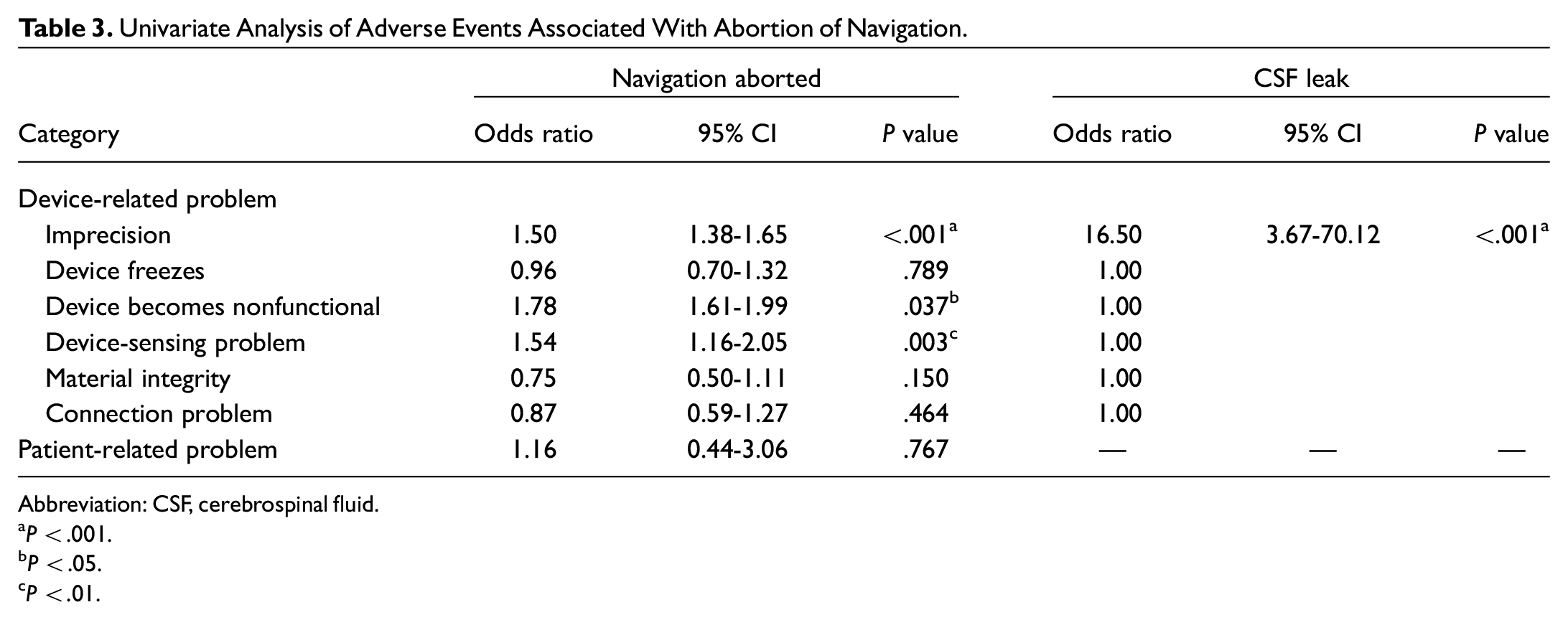
There was a significant association between device-related problems and instances of navigation abortion in a univariate model ( Table 3 ). Imprecision was associated with increased risk of navigation abortion (odds ratio [OR], 1.50 [95% CI, 1.38-1.65]; P < .001). The device becoming nonfunctional and device sensing problems were also associated with increased risk of navigation abortion (OR, 1.78 [P = .037]; OR, 1.54 [P = .003], respectively). There was no significant association between navigation abortion and device freezing, material integrity, or patient-related adverse events. The mean degree of imprecision was 6 mm (SD, 4 mm).
Univariate Analysis of Adverse Events Associated With Abortion of Navigation.
Abbreviation: CSF, cerebrospinal fluid.
P < .001.
P < .05.
P < .01.
There was a significant association between device-related problems and instances of patient-related complications. Imprecision was associated with an increased risk of CSF leak (OR, 16.5 [95% CI, 3.66-74.0]; P < .001) as compared with other adverse events ( Table 3 ). There was no significant association between patient-related complications and other device-related complications, such as device freezing, device becoming nonfunctional, and device sensing difficulties.
When stratified by year, adverse events describing the navigation device becoming nonfunctional were highest in 2019. Imprecision was also highest in 2019, with 137 adverse events. Patient complications peaked in 2018, with 8 events, and slightly declined to 5 in 2021. There were no patient deaths in any of the adverse event reports from 2018 to 2022.
Discussion
ESS is generally accepted as the standard of care for patients with sinonasal disease whose adequate medical treatment has failed. Despite the safety and efficacy of ESS, patient complications are reported in 0.5% to 1.0% of ESS cases. 21 To improve the efficacy and safety of ESS, surgeons have implemented computed tomography navigation systems that track the position of tools inside the patient. Despite the increasing number of ESS cases that use navigation, little is known about the device- and patient-related complications associated with use of image-guided sinus navigation. Previous studies noted that use of these navigation systems decreases intraoperative time, improves surgical outcomes, and reduces overall workload.11,22 However, these studies were completed in small samples. To the best of our knowledge, this is the first study to describe adverse events associated with image-guided sinus navigation systems with a nationwide database.
More than 98% of adverse events described were device-related complications, specifically complications with system operations such as the device freezing or becoming nonfunctional. Device sensing was the third-most common problem, which described instances where the surgeon was not able to track the location of instruments. In such instances, the surgeon was oftentimes left with the decision of waiting for the device to become fully functional or aborting the use of navigation. We found device-related complications to result in surgical delays <1 hour in 63.6% of cases, and sinus navigation was ultimately aborted in 32.3% of cases. While previous findings suggest that use of image-guided sinus navigation systems decrease intraoperative time,11,22 such time may increase during instances of device-related complications.
It should be noted that although navigation-guided ESS is associated with fewer complications, there are still associated risks. Although very rare, the most common patient-related complication was CSF leak. Assessment of variable skull base anatomy is key to preventing skull base compromise and intracranial complications. 23 CSF leaks were noted in 0.8% of the adverse events. In comparison, CSF leaks range from 0.13% to 0.39% in ESS with image-guided sinus navigation24-26 and between 0.17% and 0.30% in ESS without image-guided sinus navigation.27,28 The discrepancy is most likely due to the fact that our study did not account for all navigation-guided ESS cases; it merely cited the prevalence of patient-related complications among adverse event reports.
Of device-related adverse events, imprecision had the highest association with a subsequent CSF leak. Among cases where imprecision was noted, a CSF leak was 16 times more likely to occur as compared with other device-related adverse events. We found an average imprecision of 6 mm for image-guided sinus navigation systems where imprecision was reported as an adverse event. This is much higher than the acceptable 2 mm of accuracy needed to maintain the utility of intraoperative sinus navigation.14,29,30 Greater imprecision has been associated with higher incidences of patient-related complications. 21 While imprecision likely is a mediating factor for CSF leaks, given our study design we cannot definitively determine the causal relationship between imprecision of navigation and CSF leaks. While IGS is not intended to supplant knowledge of surgical anatomy, these results suggest that surgeons may be overrelying on IGS during surgery. Future studies should examine surgeons’ perceptions of IGS and their confidence when using the system.
When we analyzed the number of adverse events reported each year, there was a peak in 2018 that has since declined. ESS is considered elective surgery, and this observation may be largely due to the COVID-19 pandemic, which saw a 48% decrease in total surgical volume. 31 Further research analyzing this trend is needed.
There are several limitations to this study. First, the MAUDE database relies on mandatory and voluntary reporters to submit adverse events; therefore, there may be underreported events in cases where a reporter is not available to document and report the adverse event. Second, the MAUDE database does not report the number of total national ESS procedures completed with image-guided sinus navigation. Thus, we cannot calculate complete complication rates. Third, there is no patient information available through the MAUDE database to give context to the adverse event (eg, race, sex, age, comorbidities, variations in sinonasal anatomy, record of previous ESS, operative reports). Fourth, the degree of imprecision was estimated by surgeons and included in the narrative report. These values may not be the most accurate representation of degree of imprecision.
Conclusion
The most commonly reported patient- or device-related adverse events associated with image-guided sinus navigation systems were device nonfunction, imprecision, device sensing difficulties, and CSF leak. Image-guided navigation devices with imprecision adverse events were associated with a greater risk of CSF leak. Health care providers should be mindful of these possible complications when electing to use sinus navigation in ESS.
